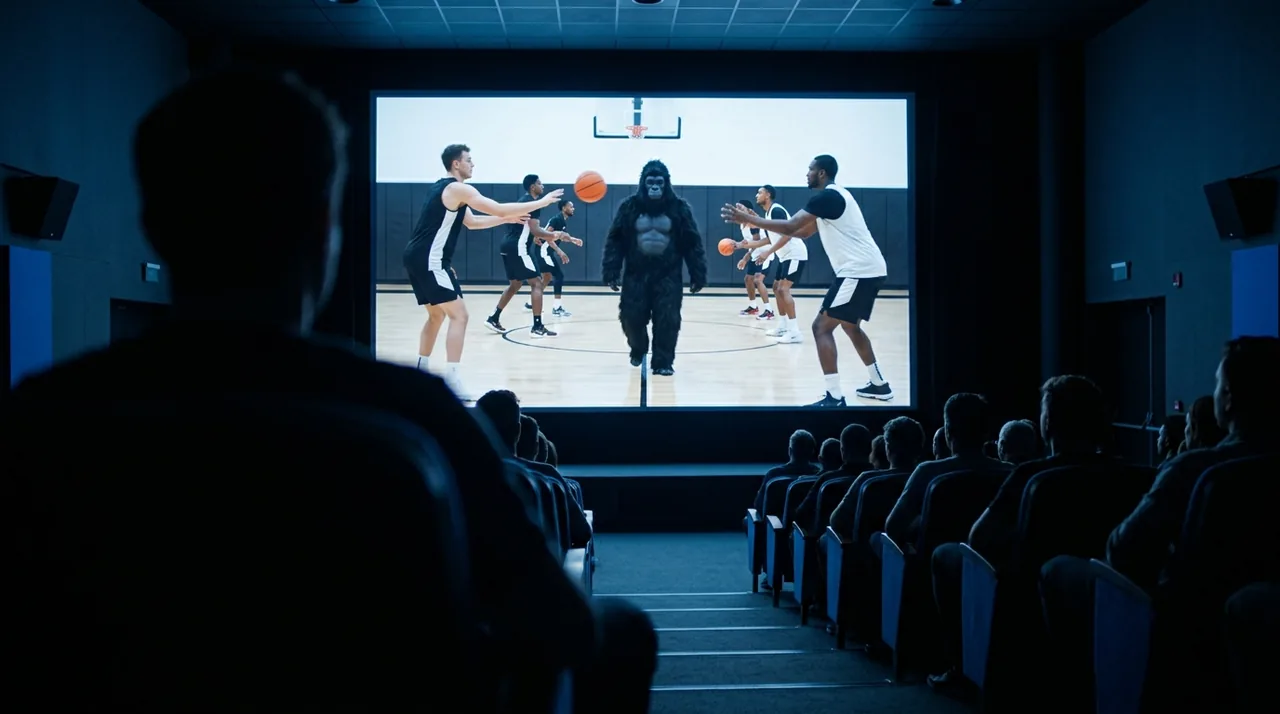
In a 1999 psychology experiment at Harvard, half the participants watching a basketball video failed to notice a woman in a gorilla suit walk into the middle of the game, beat her chest, and walk off. They were looking right at her.
The video is forty seconds long. Six students, three in white shirts and three in black, weave around each other passing two basketballs. The instruction is simple: count how many times the team in white passes the ball. Most viewers settle on the right answer, fifteen, and feel pleased with themselves.
Halfway through the clip, a woman in a full gorilla suit walks into the middle of the players from the right of the frame. She stops in the centre, faces the camera, beats her chest with both fists, and strolls off to the left. She is on screen for nine seconds. About half the people who watch the video the first time, focused on the passes, do not see her at all. When told what they missed, they often refuse to believe it and demand to watch again.
The invisible gorillaasmodejs · PDM 1.0
The experiment was run in 1999 by Daniel SimonsPersonDaniel SimonsAmerican cognitive psychologist, now at the University of Illinois at Urbana-Champaign, best known for the 1999 selective-attention experiment with Christopher Chabris that produced the gorilla video. His broader research programme concerns the limits of human attention, memory, and the gap between what people believe their minds do and what they actually do. He has spent two decades replicating, refining, and arguing against simple readings of his own headline result.美国认知心理学家,现任职于伊利诺伊大学厄巴纳-香槟分校,以1999年与克里斯托弗·查布里斯共同开展的选择性注意实验(即"大猩猩视频"实验)而广为人知。其研究纲领涵盖人类注意力与记忆的局限,以及人们对自身心理运作的主观认知与客观实际之间的差距。二十余年来,他持续从事这一标志性研究成果的重复验证与深化阐释,并致力于反驳对该结果的简单化解读。Psicólogo cognitivo estadounidense, actualmente en la Universidad de Illinois en Urbana-Champaign, conocido sobre todo por el experimento de atención selectiva de 1999 realizado junto a Christopher Chabris que dio origen al vídeo del gorila. Su programa de investigación más amplio versa sobre los límites de la atención y la memoria humanas, y la brecha entre lo que las personas creen que hace su mente y lo que esta hace en realidad. Lleva dos décadas replicando, refinando y cuestionando las lecturas simplistas de su propio resultado más celebrado.عالم نفس إدراكي أمريكي، يعمل حالياً في جامعة إلينوي في أوربانا-شامبين، اشتُهر بتجربة الانتباه الانتقائي التي أجراها عام 1999 مع كريستوفر شابري، والتي أسفرت عن مقطع الغوريلا الشهير. يتمحور برنامجه البحثي الأشمل حول حدود الانتباه والذاكرة البشريَّين، والهوَّة بين ما يعتقد الناس أن عقولهم تفعله وما تفعله فعلياً. وقد أمضى عقدين من الزمن في إعادة اختبار نتيجته البحثية الأبرز وتنقيحها، والجدال ضد القراءات المبسَّطة لها.Psicólogo cognitivo norte-americano, atualmente na Universidade de Illinois em Urbana-Champaign, mais conhecido pelo experimento de atenção seletiva de 1999 realizado com Christopher Chabris que deu origem ao vídeo do gorila. O seu programa de investigação mais abrangente versa sobre os limites da atenção humana, da memória e a discrepância entre aquilo que as pessoas acreditam que as suas mentes fazem e aquilo que elas realmente fazem. Dedicou duas décadas a replicar, refinar e contestar leituras simplistas do seu próprio resultado de maior projeção.अमेरिकी संज्ञानात्मक मनोवैज्ञानिक, वर्तमान में इलिनॉय विश्वविद्यालय, अर्बाना-शैंपेन में कार्यरत; 1999 में क्रिस्टोफ़र शैब्रिस के साथ किए गए चयनात्मक-अवधान प्रयोग के लिए सर्वाधिक प्रसिद्ध, जिसके परिणामस्वरूप गोरिल्ला वीडियो अस्तित्व में आया। उनका व्यापक शोध कार्यक्रम मानव अवधान एवं स्मृति की सीमाओं तथा उस अंतराल पर केंद्रित है जो लोगों की इस धारणा और वास्तविकता के बीच विद्यमान है कि उनका मन क्या करता है और वह वास्तव में क्या करता है। वे दो दशकों से अपने इसी चर्चित परिणाम की पुनरावृत्ति, परिष्करण और उसकी सरलीकृत व्याख्याओं के खंडन में संलग्न हैं।Psikolog kognitif Amerika, kini bertugas di University of Illinois at Urbana-Champaign, paling dikenal berkat eksperimen atensi selektif tahun 1999 bersama Christopher Chabris yang menghasilkan video gorila. Program penelitiannya yang lebih luas berkaitan dengan batas-batas atensi dan memori manusia, serta kesenjangan antara apa yang diyakini orang mengenai kemampuan pikiran mereka dan apa yang sesungguhnya terjadi. Selama dua dekade ia telah mereplikasi, menyempurnakan, dan menentang penafsiran sederhana atas temuan utamanya sendiri.Psychologue cognitiviste américain, aujourd'hui rattaché à l'université de l'Illinois à Urbana-Champaign, principalement connu pour l'expérience d'attention sélective de 1999 conduite avec Christopher Chabris, dont est issue la vidéo du gorille. Son programme de recherche porte plus largement sur les limites de l'attention et de la mémoire humaines, ainsi que sur l'écart entre les représentations que les individus se font du fonctionnement de leur esprit et ce que celui-ci accomplit réellement. Depuis deux décennies, il s'emploie à répliquer, affiner et contester les lectures simplistes de son propre résultat phare.アメリカの認知心理学者。現在はイリノイ大学アーバナ・シャンペーン校に所属。クリストファー・チャブリスとともに1999年に実施した選択的注意実験(通称「ゴリラ動画」)により広く知られる。研究の主軸は、人間の注意および記憶の限界と、人々が自らの心の働きについて抱く信念と実際の働きとの乖離の解明にある。自身の看板的研究成果に対する安易な解釈に異議を唱えながら、その再現と精緻化に20年以上を費やしてきた。Американский когнитивный психолог, ныне работающий в Иллинойсском университете в Урбана-Шампейне; наиболее известен экспериментом 1999 года по избирательному вниманию, проведённым совместно с Кристофером Шабри и породившим видеозапись с гориллой. Более широкая исследовательская программа учёного посвящена ограничениям человеческого внимания и памяти, а также разрыву между представлениями людей о работе собственного разума и тем, как он функционирует в действительности. На протяжении двух десятилетий он занимается воспроизведением, уточнением и оспариванием упрощённых интерпретаций собственного резонансного результата.Amerikanischer Kognitionspsychologe, gegenwärtig an der University of Illinois at Urbana-Champaign tätig, vor allem bekannt durch das 1999 gemeinsam mit Christopher Chabris durchgeführte Experiment zur selektiven Aufmerksamkeit, aus dem das Gorilla-Video hervorging. Sein weiterreichendes Forschungsprogramm gilt den Grenzen menschlicher Aufmerksamkeit und des Gedächtnisses sowie der Kluft zwischen dem, was Menschen ihrem Geist zuschreiben, und dem, was dieser tatsächlich leistet. Zwei Jahrzehnte lang widmete er sich der Replikation, Verfeinerung und Zurückweisung vereinfachender Deutungen seines eigenen aufsehenerregenden Befunds.미국의 인지심리학자로, 현재 일리노이 대학교 어배너-섐페인 캠퍼스에 재직 중이다. 크리스토퍼 체이브리스와 공동으로 수행한 1999년의 선택적 주의 실험, 이른바 '고릴라 영상'으로 가장 널리 알려져 있다. 보다 광범위한 연구 프로그램은 인간 주의력과 기억의 한계, 그리고 사람들이 자신의 마음이 실제로 어떻게 작동하는지에 대해 믿는 것과 실제 작동 방식 사이의 간극을 탐구한다. 20여 년에 걸쳐 자신의 대표적 연구 결과를 반복 검증하고 정교화하는 한편, 이에 대한 단순한 해석에 반론을 제기하는 작업을 지속해왔다. and Christopher ChabrisPersonChristopher ChabrisAmerican cognitive psychologist and co-author, with Daniel Simons, of the 1999 invisible-gorilla study and the 2010 trade book that followed it. Trained at Harvard, he now researches collective intelligence and individual differences in cognition at Geisinger. His work tends to dismantle popular intuitions about the mind — that memory is reliable, that confidence tracks competence, that we notice what is in front of us.美国认知心理学家,与丹尼尔·西蒙斯合著1999年"隐形大猩猩"研究及随后出版的2010年同名大众读物。曾受训于哈佛大学,现于盖辛格从事集体智能与认知个体差异研究。其研究长于颠覆大众对心智的惯常直觉——记忆是可靠的、自信与能力相称、以及我们能察觉眼前所见。Psicólogo cognitivo estadounidense y coautor, junto a Daniel Simons, del estudio del gorila invisible de 1999 y del libro de divulgación de 2010 que lo siguió. Formado en Harvard, investiga actualmente la inteligencia colectiva y las diferencias individuales en cognición en Geisinger. Su obra tiende a desmantelar intuiciones populares sobre la mente: que la memoria es fiable, que la confianza refleja la competencia y que percibimos lo que tenemos delante.عالم نفس إدراكي أمريكي، اشترك مع دانيال سيمونز في تأليف دراسة الغوريلا الخفية عام 1999 والكتاب الموجَّه للجمهور العام الذي صدر عنها عام 2010. تلقّى تدريبه في هارفارد، ويُجري حالياً أبحاثه في الذكاء الجمعي والفروق الفردية في الإدراك بمؤسسة غيزينغر. تتّجه أعماله نحو تفنيد الحدوس الشائعة حول العقل البشري — من أن الذاكرة موثوقة، وأن الثقة بالنفس تعكس الكفاءة، وأننا نُدرك ما يقع أمامنا.Psicólogo cognitivo norte-americano e coautor, com Daniel Simons, do estudo do gorila invisível de 1999 e do livro de divulgação que se seguiu, em 2010. Formado em Harvard, pesquisa atualmente inteligência coletiva e diferenças individuais na cognição no Geisinger. Sua obra tende a desmontar intuições populares sobre a mente — de que a memória é confiável, de que a confiança acompanha a competência, de que percebemos o que está diante de nós.अमेरिकी संज्ञानात्मक मनोवैज्ञानिक तथा डेनियल साइमन्स के साथ 1999 के अदृश्य-गोरिल्ला अध्ययन एवं उससे अनुसृत 2010 की व्यावसायिक पुस्तक के सह-लेखक। हार्वर्ड में प्रशिक्षित, वे अब गाइज़िंगर में सामूहिक बुद्धिमत्ता तथा अनुभूति में व्यैक्तिक भिन्नताओं पर शोध करते हैं। उनका कार्य मन के विषय में प्रचलित सहज धारणाओं को खंडित करता है — कि स्मृति विश्वसनीय होती है, कि आत्मविश्वास दक्षता का अनुगमन करता है, और कि हम अपने समक्ष जो उपस्थित है उस पर ध्यान देते हैं।Psikolog kognitif Amerika dan rekan penulis, bersama Daniel Simons, dari studi gorila tak terlihat tahun 1999 serta buku populer yang menyusulnya pada 2010. Lulusan Harvard, ia kini meneliti kecerdasan kolektif dan perbedaan individual dalam kognisi di Geisinger. Karyanya cenderung meruntuhkan intuisi populer tentang pikiran — bahwa ingatan bersifat andal, bahwa rasa percaya diri mencerminkan kompetensi, dan bahwa kita memperhatikan apa yang ada di hadapan kita.Psychologue cognitif américain et co-auteur, avec Daniel Simons, de l'étude sur le gorille invisible (1999) et de l'essai grand public qui s'ensuivit (2010). Formé à Harvard, il mène désormais des recherches sur l'intelligence collective et les différences interindividuelles en cognition à Geisinger. Ses travaux tendent à battre en brèche des intuitions populaires sur l'esprit — que la mémoire est fiable, que la confiance est à la mesure de la compétence, que nous percevons ce qui se trouve devant nous.アメリカの認知心理学者。ダニエル・サイモンズとともに1999年の「見えないゴリラ」実験を共同実施し、その成果をまとめた2010年刊の一般向け書籍の共著者でもある。ハーバード大学で研鑽を積み、現在はガイジンガーにおいて集合知および認知の個人差を研究している。記憶は信頼に足る、自信は能力の高さを示す、目の前にあるものは必ず知覚されるといった、心に関する通俗的な直感を体系的に覆す業績で知られる。Американский когнитивный психолог, соавтор — совместно с Дэниелом Саймонсом — исследования 1999 года с «невидимой гориллой» и вышедшей в 2010 году научно-популярной книги по его мотивам. Окончил Гарвард; в настоящее время изучает коллективный интеллект и индивидуальные различия в когнитивных способностях в организации Гайзингер. Его работы последовательно опровергают расхожие интуитивные представления о разуме: что память надёжна, что уверенность соответствует компетентности, что мы замечаем то, что находится прямо перед нами.Amerikanischer Kognitionspsychologe und Ko-Autor – gemeinsam mit Daniel Simons – der Unsichtbarer-Gorilla-Studie von 1999 sowie des 2010 erschienenen populärwissenschaftlichen Buches darüber. An der Harvard University ausgebildet, forscht er heute bei Geisinger zu kollektiver Intelligenz und individuellen Unterschieden in der Kognition. Sein Werk widerlegt wiederholt gängige Intuitionen über den Geist – dass das Gedächtnis verlässlich sei, dass Selbstsicherheit mit Kompetenz korreliere und dass wir wahrnehmen, was sich unmittelbar vor uns befindet.미국의 인지심리학자. 다니엘 사이먼스와 공동으로 1999년의 '보이지 않는 고릴라' 연구를 수행하고, 이를 바탕으로 한 2010년 대중 서적을 공저했다. 하버드에서 수학하였으며, 현재 가이싱어에서 집단 지성 및 인지의 개인차를 연구하고 있다. 그의 연구는 기억이 신뢰할 만하다거나, 자신감이 능력과 비례한다거나, 눈앞에 놓인 것을 알아챈다는 등 마음에 관한 대중적 직관을 해체하는 방향으로 수렴한다., then both at Harvard. It was not the first demonstration of the effect — the psychologist Ulric NeisserPersonUlric NeisserAmerican psychologist, often called the father of cognitive psychology after his 1967 textbook by that name. In the 1970s he ran an early version of the selective-looking paradigm in which observers asked to count basketball passes overlooked a woman walking through the scene carrying an umbrella. His later work on flashbulb memory showed how confidently people misremember major public events, a theme Simons and Chabris would later extend.美国心理学家,因其1967年出版的同名教科书常被称为认知心理学之父。20世纪70年代,他开展了选择性注视范式的早期版本实验,要求观察者计数篮球传球次数,结果受试者未能察觉一名手持雨伞穿越场景的女性。其后期关于闪光灯记忆的研究揭示了人们在回忆重大公共事件时往往充满自信却严重失实,这一主题后由西蒙斯与查布里斯加以深化。Psicólogo estadounidense, frecuentemente denominado el padre de la psicología cognitiva a raíz de su libro de texto homónimo de 1967. En la década de 1970 llevó a cabo una versión temprana del paradigma de la observación selectiva, en el que observadores a quienes se encomendaba contar los pases de baloncesto no percibían a una mujer que cruzaba la escena portando un paraguas. Su trabajo posterior sobre la memoria de destello demostró con qué seguridad las personas recuerdan erróneamente grandes acontecimientos públicos, tema que Simons y Chabris ampliarían posteriormente.عالم نفس أمريكي كثيرًا ما يُلقَّب بأبي علم النفس المعرفي، نسبةً إلى كتابه المدرسي الصادر عام 1967 والحامل لهذا الاسم. في سبعينيات القرن العشرين، أجرى نسخةً مبكرةً من نموذج النظر الانتقائي، إذ أغفل المراقبون المكلَّفون بعدّ تمريرات كرة السلة وجودَ امرأة تعبر المشهد حاملةً مظلة. وتمحور عمله اللاحق حول الذاكرة الومضية، وكشف عن مدى ثقة الناس بذكريات مغلوطة عن أحداث عامة كبرى؛ وهو الموضوع ذاته الذي وسَّعه سيمونز وشابري في مرحلة لاحقة.Psicólogo norte-americano, frequentemente designado pai da psicologia cognitiva após o seu manual homónimo de 1967. Na década de 1970, conduziu uma versão inicial do paradigma da observação seletiva, no qual observadores incumbidos de contar passes de basquetebol não notavam uma mulher que atravessava a cena com um guarda-chuva. Os seus trabalhos posteriores sobre memória de lampejo demonstraram com que convicção as pessoas se recordam erroneamente de grandes acontecimentos públicos, tema que Simons e Chabris viriam mais tarde a desenvolver.अमेरिकी मनोवैज्ञानिक, जिन्हें प्रायः संज्ञानात्मक मनोविज्ञान का जनक कहा जाता है — यह उपाधि उनकी 1967 की उसी नाम की पाठ्यपुस्तक के कारण प्रचलित हुई। 1970 के दशक में उन्होंने चयनात्मक-दर्शन प्रतिमान का एक प्रारंभिक संस्करण संचालित किया, जिसमें बास्केटबॉल पास गिनने के लिए कहे गए प्रेक्षकों ने दृश्य में से छाता लेकर गुज़रती एक महिला को नज़रअंदाज़ कर दिया। फ्लैशबल्ब स्मृति पर उनके परवर्ती कार्य ने यह प्रदर्शित किया कि लोग प्रमुख सार्वजनिक घटनाओं को किस दृढ़ विश्वास के साथ ग़लत ढंग से याद करते हैं — एक विषय जिसे साइमन्स और चाब्रिस ने बाद में और विस्तारित किया।Psikolog Amerika yang kerap dijuluki bapak psikologi kognitif, merujuk pada buku teksnya tahun 1967 yang berjudul demikian. Pada dekade 1970-an, ia menjalankan versi awal paradigma pengamatan selektif, di mana para pengamat yang diminta menghitung operan bola basket tidak menyadari seorang perempuan yang berjalan melintas dalam adegan tersebut sambil membawa payung. Karya-karyanya kemudian tentang memori kilat menunjukkan betapa yakinnya orang salah mengingat peristiwa-peristiwa publik besar — sebuah tema yang kelak dikembangkan oleh Simons dan Chabris.Psychologue américain, souvent désigné comme le père de la psychologie cognitive en référence à son manuel de 1967 portant ce titre. Dans les années 1970, il mena une version précoce du paradigme du regard sélectif, dans lequel des observateurs invités à compter des passes de basket-ball ne remarquaient pas une femme traversant la scène munie d'un parapluie. Ses travaux ultérieurs sur les souvenirs-éclair révélèrent avec quelle assurance les individus se remémorent de façon erronée les grands événements publics, thème que Simons et Chabris devaient par la suite prolonger.アメリカの心理学者。1967年に出版した同名の教科書により、しばしば認知心理学の父と称される。1970年代には選択的注視パラダイムの初期版を実施し、バスケットボールのパス回数を数えるよう指示された観察者が、傘を持って場面を横切る女性を見落とすことを示した。フラッシュバルブ記憶に関するその後の研究では、人々が重大な公的出来事をいかに自信を持って誤記憶するかを明らかにし、この主題は後にサイモンズとチャブリスによってさらに発展させられた。Американский психолог, нередко именуемый отцом когнитивной психологии — по названию его учебника 1967 года. В 1970-х годах провёл ранний вариант парадигмы избирательного наблюдения, в ходе которого испытуемые, считавшие передачи баскетбольного мяча, не замечали женщину, проходящую через сцену с зонтиком. Последующие работы о памяти-вспышке показали, насколько уверенно люди неверно воспроизводят воспоминания о значимых общественных событиях, — тему, которую впоследствии развили Саймонс и Шабри.Amerikanischer Psychologe, oft als Vater der Kognitiven Psychologie bezeichnet – nach seinem gleichnamigen Lehrbuch von 1967. In den 1970er Jahren führte er eine frühe Version des Paradigmas des selektiven Schauens durch, bei dem Beobachter, die Basketballpässe zählen sollten, eine Frau übersahen, die mit einem Regenschirm durch die Szene ging. Seine späteren Arbeiten zum Flashbulb-Memory zeigten, wie sicher Menschen bedeutende öffentliche Ereignisse falsch erinnern – ein Thema, das Simons und Chabris später aufgriffen und erweiterten.미국의 심리학자로, 1967년 출간한 동명의 교과서를 계기로 흔히 인지심리학의 아버지로 불린다. 1970년대에 선택적 주시 패러다임의 초기 형태를 시행하였으며, 해당 실험에서 관찰자들은 농구 패스 횟수를 세도록 지시받은 상태에서 우산을 든 여성이 장면을 가로질러 걷는 모습을 간과하였다. 섬광 기억에 관한 후기 연구는 사람들이 주요 공적 사건을 얼마나 확신에 차서 잘못 기억하는지를 보여 주었으며, 이 주제는 훗날 사이먼스와 차브리스에 의해 확장되었다. had done a thinner version in the 1970s, with a woman carrying an umbrella through a similar overlay of passing players — but the gorilla version was vivid enough to escape the lab. It is now probably the most-cited single video in cognitive science.
What the eyes do versus what the brain sees
The effect has a name: **inattentional blindness**. The interesting part is what it is not. It is not a failure of vision. Eye-tracking studies done with the Simons-Chabris stimulus show that observers who miss the gorilla nonetheless fixate on it for an average of about a second as it crosses the screen. Their retinas resolve it. Their visual cortices process it. And then it gets thrown out before reaching anything you would call awareness.
A person in a bulky dark gorilla suit walks calmly between basketball playersIllustration · AI-generated (FLUX.1-dev)
This is, in one sense, the whole point of attention. The optic nerve carries something on the order of a megabyte per second into the brain. Conscious perception runs at a tiny fraction of that. Somewhere between the eye and the felt experience of seeing, an aggressive editorial process is throwing out almost everything you look at, retaining only the parts that match what you are currently asking the world for. When the question is *how many passes by the team in white*, a gorilla is, technically speaking, off-topic.
00E-WeProtestCover copyTish Lampert · BY-SA 4.0
A decade later Simons ran a follow-up he called *The Monkey Business Illusion*. Viewers who knew the original trick watched a new version, smug, counting passes and waiting for the gorilla. They saw her. They also missed the curtain in the background changing colour from red to gold, and one of the black-shirted players quietly walking off the court. Knowing about the effect does not protect you from the next instance of it. The filter just moves.
An eye-tracking lab replaying the basketball taskIllustration · AI-generated (FLUX.1-dev)
The cost outside the lab
In 2013, the radiologist Trafton DrewPersonTrafton DrewAmerican cognitive scientist at the University of Utah whose 2013 study superimposed a small gorilla on a CT lung scan and showed that most experienced radiologists, hunting cancer nodules, looked directly at it without registering it. His research uses radiology, baggage screening, and other real-world search tasks to probe how expert attention works and where it predictably breaks.美国认知科学家,任职于犹他大学。其2013年的研究将一只小猩猩图像叠加于肺部CT扫描图像之上,结果表明,大多数经验丰富的放射科医生在搜寻癌性结节时,目光虽直接扫过该图像,却浑然未觉。其研究以放射诊断、行李安检及其他现实场景中的搜索任务为媒介,探究专家注意力的运作机制及其可预期的失效规律。Científico cognitivo estadounidense en la Universidad de Utah cuyo estudio de 2013 superpuso un pequeño gorila en una tomografía computarizada de pulmón y demostró que la mayoría de los radiólogos experimentados, mientras buscaban nódulos cancerosos, lo miraron directamente sin registrarlo. Su investigación emplea radiología, inspección de equipaje y otras tareas de búsqueda en entornos reales para examinar el funcionamiento de la atención experta e identificar los puntos donde falla de manera predecible.عالم معرفي أمريكي في جامعة يوتا؛ كشفت دراسته عام 2013، التي دمج فيها صورة غوريلا صغيرة على صورة مقطعية محوسبة للرئة، أن معظم أطباء الأشعة المتمرسين الذين كانوا يبحثون عن عقيدات سرطانية قد حدّقوا فيها مباشرةً دون أن يلحظوا وجودها. تستكشف أبحاثه، عبر الأشعة وفحص الأمتعة وسائر مهام البحث الميداني، كيفية عمل الانتباه لدى الخبراء ومواطن إخفاقه المتوقعة.Cientista cognitivo americano na Universidade de Utah cujo estudo de 2013 sobrepôs um pequeno gorila a uma tomografia computadorizada de tórax e demonstrou que a maioria dos radiologistas experientes, à procura de nódulos cancerosos, olhou diretamente para ele sem o registrar. Sua pesquisa emprega radiologia, inspeção de bagagens e outras tarefas de busca em situações reais para investigar como a atenção especializada funciona e onde falha de modo previsível.अमेरिकी संज्ञानात्मक वैज्ञानिक, यूनिवर्सिटी ऑफ यूटा में स्थित, जिनके 2013 के अध्ययन में सीटी लंग स्कैन पर एक छोटे गोरिल्ला की छवि अध्यारोपित की गई तथा यह प्रदर्शित किया गया कि कैंसर नोड्यूल की खोज में संलग्न अधिकांश अनुभवी रेडियोलॉजिस्टों की दृष्टि उस पर सीधे पड़ने के बावजूद वे उसे पहचान नहीं सके। उनका शोध रेडियोलॉजी, सामान जाँच एवं अन्य वास्तविक-जगत के खोज कार्यों का उपयोग करते हुए यह अन्वेषण करता है कि विशेषज्ञ ध्यान किस प्रकार कार्य करता है और यह कहाँ अनुमानतः विफल होता है।Ilmuwan kognitif Amerika di Universitas Utah yang pada studi tahun 2013 menumpangkan gorila kecil pada pemindaian CT paru-paru dan menunjukkan bahwa sebagian besar ahli radiologi berpengalaman yang sedang mencari nodul kanker memandang langsung ke objek tersebut tanpa menyadarinya. Penelitiannya menggunakan radiologi, pemeriksaan bagasi, dan tugas pencarian dunia nyata lainnya untuk menyelidiki cara kerja atensi pakar dan di mana atensi tersebut secara terduga gagal berfungsi.Cognitiviste américain à l'université de l'Utah, dont l'étude de 2013 — consistant à superposer un petit gorille sur un scanner pulmonaire — a montré que la plupart des radiologues expérimentés, en quête de nodules cancéreux, posaient les yeux dessus sans le percevoir. Ses recherches recourent à la radiologie, au contrôle des bagages et à d'autres tâches de détection en situation réelle pour sonder les mécanismes de l'attention experte et les conditions dans lesquelles elle fait défaut de façon prévisible.ユタ大学に所属するアメリカの認知科学者。2013年の研究では、肺のCTスキャンに小さなゴリラの画像を重ね合わせ、癌結節を探す熟練放射線科医の大半がそれを直視しながらも認識しないことを示した。放射線診断、手荷物検査、その他の実世界における探索課題を用いて、専門家の注意のメカニズムとその予測可能な破綻点を研究している。Американский когнитивный учёный из Университета Юты, в исследовании 2013 года наложивший небольшое изображение гориллы на КТ-снимок лёгких и показавший, что большинство опытных рентгенологов, искавших раковые узлы, смотрели непосредственно на него, не замечая его. В своих работах он использует задачи из области рентгенологии, досмотра багажа и других прикладных поисковых ситуаций, чтобы исследовать механизмы экспертного внимания и предсказуемые точки его отказа.Amerikanischer Kognitionswissenschaftler an der University of Utah, dessen Studie von 2013 einen kleinen Gorilla auf einer CT-Lungenaufnahme einblendete und nachwies, dass die meisten erfahrenen Radiologen, die nach Krebsknoten suchten, direkt auf ihn blickten, ohne ihn wahrzunehmen. Seine Forschung nutzt Radiologie, Gepäckkontrolle und andere praxisnahe Suchaufgaben, um zu untersuchen, wie die Aufmerksamkeit von Experten funktioniert und wo sie vorhersehbar versagt.유타 대학교 소속 미국 인지과학자. 2013년 연구에서 CT 폐 스캔 영상에 소형 고릴라 이미지를 합성하고, 암 결절을 탐색하는 숙련된 방사선과 전문의 대다수가 해당 이미지를 직접 응시하면서도 인식하지 못함을 입증하였다. 방사선학·수하물 검색 등 현실 세계의 탐색 과업을 활용하여 전문가 주의의 작동 원리와 예측 가능한 실패 지점을 규명하는 연구를 수행한다. superimposed a small image of a gorilla, about the size of a matchbox, onto a CT scan of a lung and asked twenty-four experienced radiologists to look for cancer nodules. Eye-tracking confirmed that most of them looked directly at the gorilla. Twenty of the twenty-four did not report seeing it. They were busy hunting nodules of a different shape and size, and the brain obligingly deleted the rest.
Christopher Chabris speaking at PopTech 2012, Northport, Maine, USA.Agaton Strom for PopTech · CC BY-SA 2.5
The motorcycle community has a name for the same effect: *Sorry Mate, I Didn't See You*, often shortened to SMIDSY. A car pulls out of a junction into the path of a motorcyclist the driver was looking straight at. The driver, by their own honest account, did not see the bike. They were scanning for cars. In aviation, several runway incursions have been traced to flight crews who fixated on landing checks and missed aircraft on the strip in front of them; cockpit voice recorders catch the controller's warning, then silence.
The uncomfortable inversion is this. Your attention does not feel like a filter. It feels like a window. You assume you are seeing the room. You are seeing whatever survived the cull.
A radiology reading room with a lung scan on a lightbox and a tiny unexpected gorilla-shapIllustration · AI-generated (FLUX.1-dev)
What we still don't know
We do not know why the rate sits so reliably near fifty per cent. Simons has spent two decades varying the load, the colour of the gorilla, the speed of the players, the age of the observers; the number drifts but the effect does not dissolve. There is no clean account of who, exactly, is in the half that sees and the half that does not.
Figure 1 of 2005 article by Dehaene & Changeux published under Creative Commons. Legend: "Shown are the constituents of the simulation (uppeStanislas Dehaene & Jean-Pierre Changeux · CC BY 2.5
We do not know how much overlap inattentional blindness has with change blindnessConceptChange blindnessThe failure to notice large changes between two views of a scene separated by a brief interruption — a blink, a saccade, a flicker, a cut in a film. In classic demonstrations, an experimenter stops a passer-by to ask directions, is briefly hidden by people carrying a door, and is swapped for a different person; many passers-by carry on the conversation without registering the switch. A cousin of inattentional blindness.在两次场景观察之间,因短暂的中断——一次眨眼、一次扫视、一次闪烁、一次电影剪辑——而未能察觉到画面中发生的重大变化。在经典演示中,实验者拦住路人问路,中途被抬门而过的人短暂遮挡,随即被另一个人替换;许多路人会继续对话,而完全未察觉对方已被掉包。它是无意视盲的近亲。El fracaso en detectar cambios de gran magnitud entre dos vistas de una escena separadas por una breve interrupción —un parpadeo, una sacada, un destello, un corte cinematográfico—. En las demostraciones clásicas, un experimentador detiene a un transeúnte para pedirle indicaciones, queda momentáneamente oculto por personas que transportan una puerta y es sustituido por otra persona diferente; muchos transeúntes continúan la conversación sin registrar el cambio. Variante próxima de la ceguera por falta de atención.الإخفاق في ملاحظة التغييرات الكبيرة بين مشهدَين متتاليَين يفصل بينهما انقطاعٌ وجيز — كالرمشة، أو السكادة، أو الوميض، أو القطع في الفيلم. وفي التجارب الكلاسيكية، يُوقف الباحثُ أحدَ المارة ليستفسر منه عن الاتجاهات، ثم يُحجب لوهلة خلف أشخاص يحملون باباً، فيحلَّ محله شخصٌ مختلف؛ ويواصل كثيرٌ من المارة الحديثَ دون أن يُدركوا الاستبدال. وهو ظاهرةٌ قريبة الصلة بالعمى الانتباهي.Falha em perceber grandes mudanças entre duas visões de uma cena separadas por uma breve interrupção — um piscar de olhos, uma sacada, uma cintilação, um corte cinematográfico. Em demonstrações clássicas, um experimentador aborda um transeunte para pedir informações, é brevemente ocultado por pessoas carregando uma porta e substituído por outra pessoa; muitos transeuntes prosseguem a conversa sem registrar a troca. Fenômeno afim à cegueira por desatenção.दृश्य में संक्षिप्त व्यवधान — पलक झपकना, सैकेड, प्रकाश का टिमटिमाना, या फ़िल्म में कट — के दो क्षणों के बीच हुए बड़े परिवर्तनों को न पहचान पाने की विफलता। परिवर्तन अंधता (change blindness) के क्लासिक प्रदर्शनों में एक प्रयोगकर्ता किसी राहगीर को रुककर रास्ता पूछता है; बीच में दरवाज़ा उठाए जा रहे लोगों की आड़ में वह प्रयोगकर्ता किसी दूसरे व्यक्ति से बदल दिया जाता है, और बहुत-से राहगीर इस बदलाव को भाँपे बिना बातचीत जारी रखते हैं। यह अनवधानजन्य अंधता (inattentional blindness) का एक सहोदर परिघटना है।Kegagalan untuk memperhatikan perubahan besar antara dua tampilan suatu adegan yang dipisahkan oleh selingan singkat — kedipan mata, sakade, kilatan, atau potongan dalam film. Dalam demonstrasi klasik, seorang peneliti menghentikan pejalan kaki untuk menanyakan arah, sesaat tersembunyi oleh orang-orang yang membawa pintu, lalu digantikan oleh orang yang berbeda; banyak pejalan kaki tetap melanjutkan percakapan tanpa menyadari pergantian tersebut. Merupakan kerabat dari kebutaan inatensi.L'incapacité à percevoir des modifications importantes entre deux visions d'une scène séparées par une brève interruption — un clignement des yeux, une saccade, un scintillement, une coupe au montage. Dans les démonstrations classiques, un expérimentateur arrête un passant pour lui demander son chemin, est momentanément dissimulé par des individus portant une porte, puis est remplacé par une autre personne ; de nombreux passants poursuivent la conversation sans remarquer la substitution. Phénomène apparenté à la cécité par inattention.瞬目・サッカード・画面の明滅・映画のカットといった短い中断を挟んだ二つの場面の間で生じた大きな変化を見落とす現象。古典的な実証例では、実験者が通行人に道を尋ねている最中にドアを運ぶ人物らによって一時的に遮られ、その間に別人とすり替わるが、多くの通行人はすり替わりに気づかないまま会話を続ける。不注意盲と近縁の概念である。Неспособность замечать существенные изменения между двумя наблюдениями сцены, разделёнными кратким прерыванием — морганием, саккадой, помеховой вспышкой или монтажной склейкой. В классических демонстрациях экспериментатор останавливает прохожего, чтобы спросить дорогу; пока его на несколько секунд заслоняют люди, несущие дверь, его подменяют другим человеком — многие прохожие продолжают разговор, не замечая подмены. Явление, родственное слепоте невнимания.Das Unvermögen, große Veränderungen zwischen zwei Ansichten einer Szene wahrzunehmen, die durch eine kurze Unterbrechung getrennt sind — einen Lidschlag, eine Sakkade, ein Flackern, einen Filmschnitt. In klassischen Versuchsanordnungen hält ein Versuchsleiter einen Passanten an, um nach dem Weg zu fragen, wird kurz durch Personen verdeckt, die eine Tür tragen, und durch eine andere Person ersetzt; viele Passanten führen das Gespräch fort, ohne den Wechsel zu bemerken. Ein Verwandter der Unaufmerksamkeitsblindheit.짧은 중단—눈 깜빡임, 단속성 안구운동, 깜박임, 영화의 컷—을 사이에 두고 관찰한 동일 장면의 두 시점 사이에서 일어나는 큰 변화를 알아채지 못하는 현상. 고전적인 시연에서, 실험자가 행인을 불러 세워 길을 묻는 도중 문을 들고 지나가는 사람들에 의해 잠시 가려졌다가 다른 사람으로 교체되는데, 많은 행인들이 이 교체를 인지하지 못한 채 대화를 이어간다. 무주의 맹시의 유사 현상이다., the related phenomenon in which observers fail to notice large differences between two images shown a moment apart. The two are usually treated as cousins, but whether they share an underlying mechanism — a sparse internal model of the scene, refreshed only where attention lands — is still disputed.
A driver at dusk staring toward a busy intersection while a motorcycle approaches from theIllustration · AI-generated (FLUX.1-dev)
And we do not know how to train it away. Two decades of work on radiologist attention, driver attention, and pilot attention have produced procedural fixes — checklists, second readers, mandated scan patterns — but no reliable way to make a human brain actually notice the thing it was not looking for. The current best practice is to assume the gorilla is always there, somewhere, and to design around the fact that you will miss it.
Right now, reading this, you are not seeing most of the room you are sitting in. You will, if you look up, decide that you were.
这项实验由时任哈佛大学研究员的 Daniel SimonsPersonDaniel SimonsAmerican cognitive psychologist, now at the University of Illinois at Urbana-Champaign, best known for the 1999 selective-attention experiment with Christopher Chabris that produced the gorilla video. His broader research programme concerns the limits of human attention, memory, and the gap between what people believe their minds do and what they actually do. He has spent two decades replicating, refining, and arguing against simple readings of his own headline result.美国认知心理学家,现任职于伊利诺伊大学厄巴纳-香槟分校,以1999年与克里斯托弗·查布里斯共同开展的选择性注意实验(即"大猩猩视频"实验)而广为人知。其研究纲领涵盖人类注意力与记忆的局限,以及人们对自身心理运作的主观认知与客观实际之间的差距。二十余年来,他持续从事这一标志性研究成果的重复验证与深化阐释,并致力于反驳对该结果的简单化解读。Psicólogo cognitivo estadounidense, actualmente en la Universidad de Illinois en Urbana-Champaign, conocido sobre todo por el experimento de atención selectiva de 1999 realizado junto a Christopher Chabris que dio origen al vídeo del gorila. Su programa de investigación más amplio versa sobre los límites de la atención y la memoria humanas, y la brecha entre lo que las personas creen que hace su mente y lo que esta hace en realidad. Lleva dos décadas replicando, refinando y cuestionando las lecturas simplistas de su propio resultado más celebrado.عالم نفس إدراكي أمريكي، يعمل حالياً في جامعة إلينوي في أوربانا-شامبين، اشتُهر بتجربة الانتباه الانتقائي التي أجراها عام 1999 مع كريستوفر شابري، والتي أسفرت عن مقطع الغوريلا الشهير. يتمحور برنامجه البحثي الأشمل حول حدود الانتباه والذاكرة البشريَّين، والهوَّة بين ما يعتقد الناس أن عقولهم تفعله وما تفعله فعلياً. وقد أمضى عقدين من الزمن في إعادة اختبار نتيجته البحثية الأبرز وتنقيحها، والجدال ضد القراءات المبسَّطة لها.Psicólogo cognitivo norte-americano, atualmente na Universidade de Illinois em Urbana-Champaign, mais conhecido pelo experimento de atenção seletiva de 1999 realizado com Christopher Chabris que deu origem ao vídeo do gorila. O seu programa de investigação mais abrangente versa sobre os limites da atenção humana, da memória e a discrepância entre aquilo que as pessoas acreditam que as suas mentes fazem e aquilo que elas realmente fazem. Dedicou duas décadas a replicar, refinar e contestar leituras simplistas do seu próprio resultado de maior projeção.अमेरिकी संज्ञानात्मक मनोवैज्ञानिक, वर्तमान में इलिनॉय विश्वविद्यालय, अर्बाना-शैंपेन में कार्यरत; 1999 में क्रिस्टोफ़र शैब्रिस के साथ किए गए चयनात्मक-अवधान प्रयोग के लिए सर्वाधिक प्रसिद्ध, जिसके परिणामस्वरूप गोरिल्ला वीडियो अस्तित्व में आया। उनका व्यापक शोध कार्यक्रम मानव अवधान एवं स्मृति की सीमाओं तथा उस अंतराल पर केंद्रित है जो लोगों की इस धारणा और वास्तविकता के बीच विद्यमान है कि उनका मन क्या करता है और वह वास्तव में क्या करता है। वे दो दशकों से अपने इसी चर्चित परिणाम की पुनरावृत्ति, परिष्करण और उसकी सरलीकृत व्याख्याओं के खंडन में संलग्न हैं।Psikolog kognitif Amerika, kini bertugas di University of Illinois at Urbana-Champaign, paling dikenal berkat eksperimen atensi selektif tahun 1999 bersama Christopher Chabris yang menghasilkan video gorila. Program penelitiannya yang lebih luas berkaitan dengan batas-batas atensi dan memori manusia, serta kesenjangan antara apa yang diyakini orang mengenai kemampuan pikiran mereka dan apa yang sesungguhnya terjadi. Selama dua dekade ia telah mereplikasi, menyempurnakan, dan menentang penafsiran sederhana atas temuan utamanya sendiri.Psychologue cognitiviste américain, aujourd'hui rattaché à l'université de l'Illinois à Urbana-Champaign, principalement connu pour l'expérience d'attention sélective de 1999 conduite avec Christopher Chabris, dont est issue la vidéo du gorille. Son programme de recherche porte plus largement sur les limites de l'attention et de la mémoire humaines, ainsi que sur l'écart entre les représentations que les individus se font du fonctionnement de leur esprit et ce que celui-ci accomplit réellement. Depuis deux décennies, il s'emploie à répliquer, affiner et contester les lectures simplistes de son propre résultat phare.アメリカの認知心理学者。現在はイリノイ大学アーバナ・シャンペーン校に所属。クリストファー・チャブリスとともに1999年に実施した選択的注意実験(通称「ゴリラ動画」)により広く知られる。研究の主軸は、人間の注意および記憶の限界と、人々が自らの心の働きについて抱く信念と実際の働きとの乖離の解明にある。自身の看板的研究成果に対する安易な解釈に異議を唱えながら、その再現と精緻化に20年以上を費やしてきた。Американский когнитивный психолог, ныне работающий в Иллинойсском университете в Урбана-Шампейне; наиболее известен экспериментом 1999 года по избирательному вниманию, проведённым совместно с Кристофером Шабри и породившим видеозапись с гориллой. Более широкая исследовательская программа учёного посвящена ограничениям человеческого внимания и памяти, а также разрыву между представлениями людей о работе собственного разума и тем, как он функционирует в действительности. На протяжении двух десятилетий он занимается воспроизведением, уточнением и оспариванием упрощённых интерпретаций собственного резонансного результата.Amerikanischer Kognitionspsychologe, gegenwärtig an der University of Illinois at Urbana-Champaign tätig, vor allem bekannt durch das 1999 gemeinsam mit Christopher Chabris durchgeführte Experiment zur selektiven Aufmerksamkeit, aus dem das Gorilla-Video hervorging. Sein weiterreichendes Forschungsprogramm gilt den Grenzen menschlicher Aufmerksamkeit und des Gedächtnisses sowie der Kluft zwischen dem, was Menschen ihrem Geist zuschreiben, und dem, was dieser tatsächlich leistet. Zwei Jahrzehnte lang widmete er sich der Replikation, Verfeinerung und Zurückweisung vereinfachender Deutungen seines eigenen aufsehenerregenden Befunds.미국의 인지심리학자로, 현재 일리노이 대학교 어배너-섐페인 캠퍼스에 재직 중이다. 크리스토퍼 체이브리스와 공동으로 수행한 1999년의 선택적 주의 실험, 이른바 '고릴라 영상'으로 가장 널리 알려져 있다. 보다 광범위한 연구 프로그램은 인간 주의력과 기억의 한계, 그리고 사람들이 자신의 마음이 실제로 어떻게 작동하는지에 대해 믿는 것과 실제 작동 방식 사이의 간극을 탐구한다. 20여 년에 걸쳐 자신의 대표적 연구 결과를 반복 검증하고 정교화하는 한편, 이에 대한 단순한 해석에 반론을 제기하는 작업을 지속해왔다. 和 Christopher ChabrisPersonChristopher ChabrisAmerican cognitive psychologist and co-author, with Daniel Simons, of the 1999 invisible-gorilla study and the 2010 trade book that followed it. Trained at Harvard, he now researches collective intelligence and individual differences in cognition at Geisinger. His work tends to dismantle popular intuitions about the mind — that memory is reliable, that confidence tracks competence, that we notice what is in front of us.美国认知心理学家,与丹尼尔·西蒙斯合著1999年"隐形大猩猩"研究及随后出版的2010年同名大众读物。曾受训于哈佛大学,现于盖辛格从事集体智能与认知个体差异研究。其研究长于颠覆大众对心智的惯常直觉——记忆是可靠的、自信与能力相称、以及我们能察觉眼前所见。Psicólogo cognitivo estadounidense y coautor, junto a Daniel Simons, del estudio del gorila invisible de 1999 y del libro de divulgación de 2010 que lo siguió. Formado en Harvard, investiga actualmente la inteligencia colectiva y las diferencias individuales en cognición en Geisinger. Su obra tiende a desmantelar intuiciones populares sobre la mente: que la memoria es fiable, que la confianza refleja la competencia y que percibimos lo que tenemos delante.عالم نفس إدراكي أمريكي، اشترك مع دانيال سيمونز في تأليف دراسة الغوريلا الخفية عام 1999 والكتاب الموجَّه للجمهور العام الذي صدر عنها عام 2010. تلقّى تدريبه في هارفارد، ويُجري حالياً أبحاثه في الذكاء الجمعي والفروق الفردية في الإدراك بمؤسسة غيزينغر. تتّجه أعماله نحو تفنيد الحدوس الشائعة حول العقل البشري — من أن الذاكرة موثوقة، وأن الثقة بالنفس تعكس الكفاءة، وأننا نُدرك ما يقع أمامنا.Psicólogo cognitivo norte-americano e coautor, com Daniel Simons, do estudo do gorila invisível de 1999 e do livro de divulgação que se seguiu, em 2010. Formado em Harvard, pesquisa atualmente inteligência coletiva e diferenças individuais na cognição no Geisinger. Sua obra tende a desmontar intuições populares sobre a mente — de que a memória é confiável, de que a confiança acompanha a competência, de que percebemos o que está diante de nós.अमेरिकी संज्ञानात्मक मनोवैज्ञानिक तथा डेनियल साइमन्स के साथ 1999 के अदृश्य-गोरिल्ला अध्ययन एवं उससे अनुसृत 2010 की व्यावसायिक पुस्तक के सह-लेखक। हार्वर्ड में प्रशिक्षित, वे अब गाइज़िंगर में सामूहिक बुद्धिमत्ता तथा अनुभूति में व्यैक्तिक भिन्नताओं पर शोध करते हैं। उनका कार्य मन के विषय में प्रचलित सहज धारणाओं को खंडित करता है — कि स्मृति विश्वसनीय होती है, कि आत्मविश्वास दक्षता का अनुगमन करता है, और कि हम अपने समक्ष जो उपस्थित है उस पर ध्यान देते हैं।Psikolog kognitif Amerika dan rekan penulis, bersama Daniel Simons, dari studi gorila tak terlihat tahun 1999 serta buku populer yang menyusulnya pada 2010. Lulusan Harvard, ia kini meneliti kecerdasan kolektif dan perbedaan individual dalam kognisi di Geisinger. Karyanya cenderung meruntuhkan intuisi populer tentang pikiran — bahwa ingatan bersifat andal, bahwa rasa percaya diri mencerminkan kompetensi, dan bahwa kita memperhatikan apa yang ada di hadapan kita.Psychologue cognitif américain et co-auteur, avec Daniel Simons, de l'étude sur le gorille invisible (1999) et de l'essai grand public qui s'ensuivit (2010). Formé à Harvard, il mène désormais des recherches sur l'intelligence collective et les différences interindividuelles en cognition à Geisinger. Ses travaux tendent à battre en brèche des intuitions populaires sur l'esprit — que la mémoire est fiable, que la confiance est à la mesure de la compétence, que nous percevons ce qui se trouve devant nous.アメリカの認知心理学者。ダニエル・サイモンズとともに1999年の「見えないゴリラ」実験を共同実施し、その成果をまとめた2010年刊の一般向け書籍の共著者でもある。ハーバード大学で研鑽を積み、現在はガイジンガーにおいて集合知および認知の個人差を研究している。記憶は信頼に足る、自信は能力の高さを示す、目の前にあるものは必ず知覚されるといった、心に関する通俗的な直感を体系的に覆す業績で知られる。Американский когнитивный психолог, соавтор — совместно с Дэниелом Саймонсом — исследования 1999 года с «невидимой гориллой» и вышедшей в 2010 году научно-популярной книги по его мотивам. Окончил Гарвард; в настоящее время изучает коллективный интеллект и индивидуальные различия в когнитивных способностях в организации Гайзингер. Его работы последовательно опровергают расхожие интуитивные представления о разуме: что память надёжна, что уверенность соответствует компетентности, что мы замечаем то, что находится прямо перед нами.Amerikanischer Kognitionspsychologe und Ko-Autor – gemeinsam mit Daniel Simons – der Unsichtbarer-Gorilla-Studie von 1999 sowie des 2010 erschienenen populärwissenschaftlichen Buches darüber. An der Harvard University ausgebildet, forscht er heute bei Geisinger zu kollektiver Intelligenz und individuellen Unterschieden in der Kognition. Sein Werk widerlegt wiederholt gängige Intuitionen über den Geist – dass das Gedächtnis verlässlich sei, dass Selbstsicherheit mit Kompetenz korreliere und dass wir wahrnehmen, was sich unmittelbar vor uns befindet.미국의 인지심리학자. 다니엘 사이먼스와 공동으로 1999년의 '보이지 않는 고릴라' 연구를 수행하고, 이를 바탕으로 한 2010년 대중 서적을 공저했다. 하버드에서 수학하였으며, 현재 가이싱어에서 집단 지성 및 인지의 개인차를 연구하고 있다. 그의 연구는 기억이 신뢰할 만하다거나, 자신감이 능력과 비례한다거나, 눈앞에 놓인 것을 알아챈다는 등 마음에 관한 대중적 직관을 해체하는 방향으로 수렴한다. 于1999年主持。这并非此类效应的首次演示——心理学家 Ulric NeisserPersonUlric NeisserAmerican psychologist, often called the father of cognitive psychology after his 1967 textbook by that name. In the 1970s he ran an early version of the selective-looking paradigm in which observers asked to count basketball passes overlooked a woman walking through the scene carrying an umbrella. His later work on flashbulb memory showed how confidently people misremember major public events, a theme Simons and Chabris would later extend.美国心理学家,因其1967年出版的同名教科书常被称为认知心理学之父。20世纪70年代,他开展了选择性注视范式的早期版本实验,要求观察者计数篮球传球次数,结果受试者未能察觉一名手持雨伞穿越场景的女性。其后期关于闪光灯记忆的研究揭示了人们在回忆重大公共事件时往往充满自信却严重失实,这一主题后由西蒙斯与查布里斯加以深化。Psicólogo estadounidense, frecuentemente denominado el padre de la psicología cognitiva a raíz de su libro de texto homónimo de 1967. En la década de 1970 llevó a cabo una versión temprana del paradigma de la observación selectiva, en el que observadores a quienes se encomendaba contar los pases de baloncesto no percibían a una mujer que cruzaba la escena portando un paraguas. Su trabajo posterior sobre la memoria de destello demostró con qué seguridad las personas recuerdan erróneamente grandes acontecimientos públicos, tema que Simons y Chabris ampliarían posteriormente.عالم نفس أمريكي كثيرًا ما يُلقَّب بأبي علم النفس المعرفي، نسبةً إلى كتابه المدرسي الصادر عام 1967 والحامل لهذا الاسم. في سبعينيات القرن العشرين، أجرى نسخةً مبكرةً من نموذج النظر الانتقائي، إذ أغفل المراقبون المكلَّفون بعدّ تمريرات كرة السلة وجودَ امرأة تعبر المشهد حاملةً مظلة. وتمحور عمله اللاحق حول الذاكرة الومضية، وكشف عن مدى ثقة الناس بذكريات مغلوطة عن أحداث عامة كبرى؛ وهو الموضوع ذاته الذي وسَّعه سيمونز وشابري في مرحلة لاحقة.Psicólogo norte-americano, frequentemente designado pai da psicologia cognitiva após o seu manual homónimo de 1967. Na década de 1970, conduziu uma versão inicial do paradigma da observação seletiva, no qual observadores incumbidos de contar passes de basquetebol não notavam uma mulher que atravessava a cena com um guarda-chuva. Os seus trabalhos posteriores sobre memória de lampejo demonstraram com que convicção as pessoas se recordam erroneamente de grandes acontecimentos públicos, tema que Simons e Chabris viriam mais tarde a desenvolver.अमेरिकी मनोवैज्ञानिक, जिन्हें प्रायः संज्ञानात्मक मनोविज्ञान का जनक कहा जाता है — यह उपाधि उनकी 1967 की उसी नाम की पाठ्यपुस्तक के कारण प्रचलित हुई। 1970 के दशक में उन्होंने चयनात्मक-दर्शन प्रतिमान का एक प्रारंभिक संस्करण संचालित किया, जिसमें बास्केटबॉल पास गिनने के लिए कहे गए प्रेक्षकों ने दृश्य में से छाता लेकर गुज़रती एक महिला को नज़रअंदाज़ कर दिया। फ्लैशबल्ब स्मृति पर उनके परवर्ती कार्य ने यह प्रदर्शित किया कि लोग प्रमुख सार्वजनिक घटनाओं को किस दृढ़ विश्वास के साथ ग़लत ढंग से याद करते हैं — एक विषय जिसे साइमन्स और चाब्रिस ने बाद में और विस्तारित किया।Psikolog Amerika yang kerap dijuluki bapak psikologi kognitif, merujuk pada buku teksnya tahun 1967 yang berjudul demikian. Pada dekade 1970-an, ia menjalankan versi awal paradigma pengamatan selektif, di mana para pengamat yang diminta menghitung operan bola basket tidak menyadari seorang perempuan yang berjalan melintas dalam adegan tersebut sambil membawa payung. Karya-karyanya kemudian tentang memori kilat menunjukkan betapa yakinnya orang salah mengingat peristiwa-peristiwa publik besar — sebuah tema yang kelak dikembangkan oleh Simons dan Chabris.Psychologue américain, souvent désigné comme le père de la psychologie cognitive en référence à son manuel de 1967 portant ce titre. Dans les années 1970, il mena une version précoce du paradigme du regard sélectif, dans lequel des observateurs invités à compter des passes de basket-ball ne remarquaient pas une femme traversant la scène munie d'un parapluie. Ses travaux ultérieurs sur les souvenirs-éclair révélèrent avec quelle assurance les individus se remémorent de façon erronée les grands événements publics, thème que Simons et Chabris devaient par la suite prolonger.アメリカの心理学者。1967年に出版した同名の教科書により、しばしば認知心理学の父と称される。1970年代には選択的注視パラダイムの初期版を実施し、バスケットボールのパス回数を数えるよう指示された観察者が、傘を持って場面を横切る女性を見落とすことを示した。フラッシュバルブ記憶に関するその後の研究では、人々が重大な公的出来事をいかに自信を持って誤記憶するかを明らかにし、この主題は後にサイモンズとチャブリスによってさらに発展させられた。Американский психолог, нередко именуемый отцом когнитивной психологии — по названию его учебника 1967 года. В 1970-х годах провёл ранний вариант парадигмы избирательного наблюдения, в ходе которого испытуемые, считавшие передачи баскетбольного мяча, не замечали женщину, проходящую через сцену с зонтиком. Последующие работы о памяти-вспышке показали, насколько уверенно люди неверно воспроизводят воспоминания о значимых общественных событиях, — тему, которую впоследствии развили Саймонс и Шабри.Amerikanischer Psychologe, oft als Vater der Kognitiven Psychologie bezeichnet – nach seinem gleichnamigen Lehrbuch von 1967. In den 1970er Jahren führte er eine frühe Version des Paradigmas des selektiven Schauens durch, bei dem Beobachter, die Basketballpässe zählen sollten, eine Frau übersahen, die mit einem Regenschirm durch die Szene ging. Seine späteren Arbeiten zum Flashbulb-Memory zeigten, wie sicher Menschen bedeutende öffentliche Ereignisse falsch erinnern – ein Thema, das Simons und Chabris später aufgriffen und erweiterten.미국의 심리학자로, 1967년 출간한 동명의 교과서를 계기로 흔히 인지심리학의 아버지로 불린다. 1970년대에 선택적 주시 패러다임의 초기 형태를 시행하였으며, 해당 실험에서 관찰자들은 농구 패스 횟수를 세도록 지시받은 상태에서 우산을 든 여성이 장면을 가로질러 걷는 모습을 간과하였다. 섬광 기억에 관한 후기 연구는 사람들이 주요 공적 사건을 얼마나 확신에 차서 잘못 기억하는지를 보여 주었으며, 이 주제는 훗날 사이먼스와 차브리스에 의해 확장되었다. 曾在20世纪70年代做过一个简版实验,内容是一名撑伞女子穿过类似的传球球员叠加画面——但大猩猩版本足够生动,从而走出了实验室。它现在很可能是认知科学领域被引用次数最多的单条视频。
十年后,Simons 进行了后续研究,他称之为《猴子生意幻觉》(The Monkey Business Illusion)。看过原始诡计的观众观看了新版本,他们自鸣得意,数着传球,等着大猩猩出现。他们确实看到了它。但他们也错过了背景中从红色变为金色的幕布,以及其中一名黑衫球员悄悄走下球场。了解这种效应并不能让你免于下一次中招。过滤器只是转移了目标。
An eye-tracking lab replaying the basketball taskIllustration · AI-generated (FLUX.1-dev)
实验室之外的代价
2013年,放射科医生 Trafton DrewPersonTrafton DrewAmerican cognitive scientist at the University of Utah whose 2013 study superimposed a small gorilla on a CT lung scan and showed that most experienced radiologists, hunting cancer nodules, looked directly at it without registering it. His research uses radiology, baggage screening, and other real-world search tasks to probe how expert attention works and where it predictably breaks.美国认知科学家,任职于犹他大学。其2013年的研究将一只小猩猩图像叠加于肺部CT扫描图像之上,结果表明,大多数经验丰富的放射科医生在搜寻癌性结节时,目光虽直接扫过该图像,却浑然未觉。其研究以放射诊断、行李安检及其他现实场景中的搜索任务为媒介,探究专家注意力的运作机制及其可预期的失效规律。Científico cognitivo estadounidense en la Universidad de Utah cuyo estudio de 2013 superpuso un pequeño gorila en una tomografía computarizada de pulmón y demostró que la mayoría de los radiólogos experimentados, mientras buscaban nódulos cancerosos, lo miraron directamente sin registrarlo. Su investigación emplea radiología, inspección de equipaje y otras tareas de búsqueda en entornos reales para examinar el funcionamiento de la atención experta e identificar los puntos donde falla de manera predecible.عالم معرفي أمريكي في جامعة يوتا؛ كشفت دراسته عام 2013، التي دمج فيها صورة غوريلا صغيرة على صورة مقطعية محوسبة للرئة، أن معظم أطباء الأشعة المتمرسين الذين كانوا يبحثون عن عقيدات سرطانية قد حدّقوا فيها مباشرةً دون أن يلحظوا وجودها. تستكشف أبحاثه، عبر الأشعة وفحص الأمتعة وسائر مهام البحث الميداني، كيفية عمل الانتباه لدى الخبراء ومواطن إخفاقه المتوقعة.Cientista cognitivo americano na Universidade de Utah cujo estudo de 2013 sobrepôs um pequeno gorila a uma tomografia computadorizada de tórax e demonstrou que a maioria dos radiologistas experientes, à procura de nódulos cancerosos, olhou diretamente para ele sem o registrar. Sua pesquisa emprega radiologia, inspeção de bagagens e outras tarefas de busca em situações reais para investigar como a atenção especializada funciona e onde falha de modo previsível.अमेरिकी संज्ञानात्मक वैज्ञानिक, यूनिवर्सिटी ऑफ यूटा में स्थित, जिनके 2013 के अध्ययन में सीटी लंग स्कैन पर एक छोटे गोरिल्ला की छवि अध्यारोपित की गई तथा यह प्रदर्शित किया गया कि कैंसर नोड्यूल की खोज में संलग्न अधिकांश अनुभवी रेडियोलॉजिस्टों की दृष्टि उस पर सीधे पड़ने के बावजूद वे उसे पहचान नहीं सके। उनका शोध रेडियोलॉजी, सामान जाँच एवं अन्य वास्तविक-जगत के खोज कार्यों का उपयोग करते हुए यह अन्वेषण करता है कि विशेषज्ञ ध्यान किस प्रकार कार्य करता है और यह कहाँ अनुमानतः विफल होता है।Ilmuwan kognitif Amerika di Universitas Utah yang pada studi tahun 2013 menumpangkan gorila kecil pada pemindaian CT paru-paru dan menunjukkan bahwa sebagian besar ahli radiologi berpengalaman yang sedang mencari nodul kanker memandang langsung ke objek tersebut tanpa menyadarinya. Penelitiannya menggunakan radiologi, pemeriksaan bagasi, dan tugas pencarian dunia nyata lainnya untuk menyelidiki cara kerja atensi pakar dan di mana atensi tersebut secara terduga gagal berfungsi.Cognitiviste américain à l'université de l'Utah, dont l'étude de 2013 — consistant à superposer un petit gorille sur un scanner pulmonaire — a montré que la plupart des radiologues expérimentés, en quête de nodules cancéreux, posaient les yeux dessus sans le percevoir. Ses recherches recourent à la radiologie, au contrôle des bagages et à d'autres tâches de détection en situation réelle pour sonder les mécanismes de l'attention experte et les conditions dans lesquelles elle fait défaut de façon prévisible.ユタ大学に所属するアメリカの認知科学者。2013年の研究では、肺のCTスキャンに小さなゴリラの画像を重ね合わせ、癌結節を探す熟練放射線科医の大半がそれを直視しながらも認識しないことを示した。放射線診断、手荷物検査、その他の実世界における探索課題を用いて、専門家の注意のメカニズムとその予測可能な破綻点を研究している。Американский когнитивный учёный из Университета Юты, в исследовании 2013 года наложивший небольшое изображение гориллы на КТ-снимок лёгких и показавший, что большинство опытных рентгенологов, искавших раковые узлы, смотрели непосредственно на него, не замечая его. В своих работах он использует задачи из области рентгенологии, досмотра багажа и других прикладных поисковых ситуаций, чтобы исследовать механизмы экспертного внимания и предсказуемые точки его отказа.Amerikanischer Kognitionswissenschaftler an der University of Utah, dessen Studie von 2013 einen kleinen Gorilla auf einer CT-Lungenaufnahme einblendete und nachwies, dass die meisten erfahrenen Radiologen, die nach Krebsknoten suchten, direkt auf ihn blickten, ohne ihn wahrzunehmen. Seine Forschung nutzt Radiologie, Gepäckkontrolle und andere praxisnahe Suchaufgaben, um zu untersuchen, wie die Aufmerksamkeit von Experten funktioniert und wo sie vorhersehbar versagt.유타 대학교 소속 미국 인지과학자. 2013년 연구에서 CT 폐 스캔 영상에 소형 고릴라 이미지를 합성하고, 암 결절을 탐색하는 숙련된 방사선과 전문의 대다수가 해당 이미지를 직접 응시하면서도 인식하지 못함을 입증하였다. 방사선학·수하물 검색 등 현실 세계의 탐색 과업을 활용하여 전문가 주의의 작동 원리와 예측 가능한 실패 지점을 규명하는 연구를 수행한다. 将一张约火柴盒大小的小猩猩图像叠加到肺部 CT 扫描图上,并请二十四名经验丰富的放射科医生寻找癌症结节。眼动追踪证实,他们中大多数人直接看向了那只大猩猩。二十四人中有二十人报告没有看到它。他们忙于搜寻其他形状和大小的结节,大脑便顺从地删除了其余信息。
Christopher Chabris speaking at PopTech 2012, Northport, Maine, USA.Agaton Strom for PopTech · CC BY-SA 2.5
摩托车界对同样的效应有一个称呼:*对不起伙计,我没看见你 (Sorry Mate, I Didn't See You)*,通常简称为 SMIDSY。一辆汽车从路口驶出,挡在了一名骑手的去路上,而驾驶员当时正直视着前方。驾驶员诚实地表示,他们确实没看见那辆摩托车。因为他们扫描寻找的是汽车。在航空领域,几起跑道侵入事件被追溯到飞行机组人员身上,他们因专注于着陆检查而错过了身前跑道上的飞机;座舱语音记录器捕捉到了管制员的警告,随后便是寂静。
Figure 1 of 2005 article by Dehaene & Changeux published under Creative Commons. Legend: "Shown are the constituents of the simulation (uppeStanislas Dehaene & Jean-Pierre Changeux · CC BY 2.5
我们不知道非注意盲视与 change blindnessConceptChange blindnessThe failure to notice large changes between two views of a scene separated by a brief interruption — a blink, a saccade, a flicker, a cut in a film. In classic demonstrations, an experimenter stops a passer-by to ask directions, is briefly hidden by people carrying a door, and is swapped for a different person; many passers-by carry on the conversation without registering the switch. A cousin of inattentional blindness.在两次场景观察之间,因短暂的中断——一次眨眼、一次扫视、一次闪烁、一次电影剪辑——而未能察觉到画面中发生的重大变化。在经典演示中,实验者拦住路人问路,中途被抬门而过的人短暂遮挡,随即被另一个人替换;许多路人会继续对话,而完全未察觉对方已被掉包。它是无意视盲的近亲。El fracaso en detectar cambios de gran magnitud entre dos vistas de una escena separadas por una breve interrupción —un parpadeo, una sacada, un destello, un corte cinematográfico—. En las demostraciones clásicas, un experimentador detiene a un transeúnte para pedirle indicaciones, queda momentáneamente oculto por personas que transportan una puerta y es sustituido por otra persona diferente; muchos transeúntes continúan la conversación sin registrar el cambio. Variante próxima de la ceguera por falta de atención.الإخفاق في ملاحظة التغييرات الكبيرة بين مشهدَين متتاليَين يفصل بينهما انقطاعٌ وجيز — كالرمشة، أو السكادة، أو الوميض، أو القطع في الفيلم. وفي التجارب الكلاسيكية، يُوقف الباحثُ أحدَ المارة ليستفسر منه عن الاتجاهات، ثم يُحجب لوهلة خلف أشخاص يحملون باباً، فيحلَّ محله شخصٌ مختلف؛ ويواصل كثيرٌ من المارة الحديثَ دون أن يُدركوا الاستبدال. وهو ظاهرةٌ قريبة الصلة بالعمى الانتباهي.Falha em perceber grandes mudanças entre duas visões de uma cena separadas por uma breve interrupção — um piscar de olhos, uma sacada, uma cintilação, um corte cinematográfico. Em demonstrações clássicas, um experimentador aborda um transeunte para pedir informações, é brevemente ocultado por pessoas carregando uma porta e substituído por outra pessoa; muitos transeuntes prosseguem a conversa sem registrar a troca. Fenômeno afim à cegueira por desatenção.दृश्य में संक्षिप्त व्यवधान — पलक झपकना, सैकेड, प्रकाश का टिमटिमाना, या फ़िल्म में कट — के दो क्षणों के बीच हुए बड़े परिवर्तनों को न पहचान पाने की विफलता। परिवर्तन अंधता (change blindness) के क्लासिक प्रदर्शनों में एक प्रयोगकर्ता किसी राहगीर को रुककर रास्ता पूछता है; बीच में दरवाज़ा उठाए जा रहे लोगों की आड़ में वह प्रयोगकर्ता किसी दूसरे व्यक्ति से बदल दिया जाता है, और बहुत-से राहगीर इस बदलाव को भाँपे बिना बातचीत जारी रखते हैं। यह अनवधानजन्य अंधता (inattentional blindness) का एक सहोदर परिघटना है।Kegagalan untuk memperhatikan perubahan besar antara dua tampilan suatu adegan yang dipisahkan oleh selingan singkat — kedipan mata, sakade, kilatan, atau potongan dalam film. Dalam demonstrasi klasik, seorang peneliti menghentikan pejalan kaki untuk menanyakan arah, sesaat tersembunyi oleh orang-orang yang membawa pintu, lalu digantikan oleh orang yang berbeda; banyak pejalan kaki tetap melanjutkan percakapan tanpa menyadari pergantian tersebut. Merupakan kerabat dari kebutaan inatensi.L'incapacité à percevoir des modifications importantes entre deux visions d'une scène séparées par une brève interruption — un clignement des yeux, une saccade, un scintillement, une coupe au montage. Dans les démonstrations classiques, un expérimentateur arrête un passant pour lui demander son chemin, est momentanément dissimulé par des individus portant une porte, puis est remplacé par une autre personne ; de nombreux passants poursuivent la conversation sans remarquer la substitution. Phénomène apparenté à la cécité par inattention.瞬目・サッカード・画面の明滅・映画のカットといった短い中断を挟んだ二つの場面の間で生じた大きな変化を見落とす現象。古典的な実証例では、実験者が通行人に道を尋ねている最中にドアを運ぶ人物らによって一時的に遮られ、その間に別人とすり替わるが、多くの通行人はすり替わりに気づかないまま会話を続ける。不注意盲と近縁の概念である。Неспособность замечать существенные изменения между двумя наблюдениями сцены, разделёнными кратким прерыванием — морганием, саккадой, помеховой вспышкой или монтажной склейкой. В классических демонстрациях экспериментатор останавливает прохожего, чтобы спросить дорогу; пока его на несколько секунд заслоняют люди, несущие дверь, его подменяют другим человеком — многие прохожие продолжают разговор, не замечая подмены. Явление, родственное слепоте невнимания.Das Unvermögen, große Veränderungen zwischen zwei Ansichten einer Szene wahrzunehmen, die durch eine kurze Unterbrechung getrennt sind — einen Lidschlag, eine Sakkade, ein Flackern, einen Filmschnitt. In klassischen Versuchsanordnungen hält ein Versuchsleiter einen Passanten an, um nach dem Weg zu fragen, wird kurz durch Personen verdeckt, die eine Tür tragen, und durch eine andere Person ersetzt; viele Passanten führen das Gespräch fort, ohne den Wechsel zu bemerken. Ein Verwandter der Unaufmerksamkeitsblindheit.짧은 중단—눈 깜빡임, 단속성 안구운동, 깜박임, 영화의 컷—을 사이에 두고 관찰한 동일 장면의 두 시점 사이에서 일어나는 큰 변화를 알아채지 못하는 현상. 고전적인 시연에서, 실험자가 행인을 불러 세워 길을 묻는 도중 문을 들고 지나가는 사람들에 의해 잠시 가려졌다가 다른 사람으로 교체되는데, 많은 행인들이 이 교체를 인지하지 못한 채 대화를 이어간다. 무주의 맹시의 유사 현상이다. 之间有多大重叠。后者是另一种相关现象,指观察者无法注意到两张相隔片刻呈现的图像之间存在的巨大差异。这两者通常被视为“表亲”,但它们是否共享某种潜在机制——即一种仅在注意力降落处刷新的稀疏内部场景模型——仍存在争议。
A driver at dusk staring toward a busy intersection while a motorcycle approaches from theIllustration · AI-generated (FLUX.1-dev)
في تجربة لعلم النفس أجريت في جامعة هارفارد عام 1999، فشل نصف المشاركين الذين شاهدوا مقطع فيديو لمباراة كرة سلة في ملاحظة امرأة ترتدي زي غوريلا وهي تمشي إلى منتصف الملعب، وتضرب صدرها، ثم تغادر. لقد كانوا ينظرون إليها مباشرة.
يستغرق مقطع الفيديو أربعين ثانية. ستة طلاب، ثلاثة يرتدون قمصانًا بيضاء وثلاثة يرتدون قمصانًا سوداء، يتحركون متداخلين فيما بينهم ممررين كرتي سلة. التعليمات بسيطة: أحصِ عدد المرات التي يمرر فيها الفريق الذي يرتدي الأبيض الكرة. يستقر معظم المشاهدين على الإجابة الصحيحة، وهي خمسة عشر، ويشعرون بالرضا عن أنفسهم.
في منتصف المقطع، تدخل امرأة ترتدي زي غوريلا كامل إلى وسط اللاعبين من يمين الإطار. تتوقف في المركز، وتواجه الكاميرا، وتضرب صدرها بقبضتيها، ثم تغادر متمهلة إلى اليسار. تظهر على الشاشة لمدة تسع ثوانٍ. ما يقرب من نصف الأشخاص الذين يشاهدون الفيديو في المرة الأولى، مركزين على التمريرات، لا يرونها على الإطلاق. وعندما يُخبرون بما فاتهم، غالبًا ما يرفضون تصديق ذلك ويطالبون بالمشاهدة مرة أخرى.
The invisible gorillaasmodejs · PDM 1.0
أُجريت التجربة عام 1999 من قبل Daniel SimonsPersonDaniel SimonsAmerican cognitive psychologist, now at the University of Illinois at Urbana-Champaign, best known for the 1999 selective-attention experiment with Christopher Chabris that produced the gorilla video. His broader research programme concerns the limits of human attention, memory, and the gap between what people believe their minds do and what they actually do. He has spent two decades replicating, refining, and arguing against simple readings of his own headline result.美国认知心理学家,现任职于伊利诺伊大学厄巴纳-香槟分校,以1999年与克里斯托弗·查布里斯共同开展的选择性注意实验(即"大猩猩视频"实验)而广为人知。其研究纲领涵盖人类注意力与记忆的局限,以及人们对自身心理运作的主观认知与客观实际之间的差距。二十余年来,他持续从事这一标志性研究成果的重复验证与深化阐释,并致力于反驳对该结果的简单化解读。Psicólogo cognitivo estadounidense, actualmente en la Universidad de Illinois en Urbana-Champaign, conocido sobre todo por el experimento de atención selectiva de 1999 realizado junto a Christopher Chabris que dio origen al vídeo del gorila. Su programa de investigación más amplio versa sobre los límites de la atención y la memoria humanas, y la brecha entre lo que las personas creen que hace su mente y lo que esta hace en realidad. Lleva dos décadas replicando, refinando y cuestionando las lecturas simplistas de su propio resultado más celebrado.عالم نفس إدراكي أمريكي، يعمل حالياً في جامعة إلينوي في أوربانا-شامبين، اشتُهر بتجربة الانتباه الانتقائي التي أجراها عام 1999 مع كريستوفر شابري، والتي أسفرت عن مقطع الغوريلا الشهير. يتمحور برنامجه البحثي الأشمل حول حدود الانتباه والذاكرة البشريَّين، والهوَّة بين ما يعتقد الناس أن عقولهم تفعله وما تفعله فعلياً. وقد أمضى عقدين من الزمن في إعادة اختبار نتيجته البحثية الأبرز وتنقيحها، والجدال ضد القراءات المبسَّطة لها.Psicólogo cognitivo norte-americano, atualmente na Universidade de Illinois em Urbana-Champaign, mais conhecido pelo experimento de atenção seletiva de 1999 realizado com Christopher Chabris que deu origem ao vídeo do gorila. O seu programa de investigação mais abrangente versa sobre os limites da atenção humana, da memória e a discrepância entre aquilo que as pessoas acreditam que as suas mentes fazem e aquilo que elas realmente fazem. Dedicou duas décadas a replicar, refinar e contestar leituras simplistas do seu próprio resultado de maior projeção.अमेरिकी संज्ञानात्मक मनोवैज्ञानिक, वर्तमान में इलिनॉय विश्वविद्यालय, अर्बाना-शैंपेन में कार्यरत; 1999 में क्रिस्टोफ़र शैब्रिस के साथ किए गए चयनात्मक-अवधान प्रयोग के लिए सर्वाधिक प्रसिद्ध, जिसके परिणामस्वरूप गोरिल्ला वीडियो अस्तित्व में आया। उनका व्यापक शोध कार्यक्रम मानव अवधान एवं स्मृति की सीमाओं तथा उस अंतराल पर केंद्रित है जो लोगों की इस धारणा और वास्तविकता के बीच विद्यमान है कि उनका मन क्या करता है और वह वास्तव में क्या करता है। वे दो दशकों से अपने इसी चर्चित परिणाम की पुनरावृत्ति, परिष्करण और उसकी सरलीकृत व्याख्याओं के खंडन में संलग्न हैं।Psikolog kognitif Amerika, kini bertugas di University of Illinois at Urbana-Champaign, paling dikenal berkat eksperimen atensi selektif tahun 1999 bersama Christopher Chabris yang menghasilkan video gorila. Program penelitiannya yang lebih luas berkaitan dengan batas-batas atensi dan memori manusia, serta kesenjangan antara apa yang diyakini orang mengenai kemampuan pikiran mereka dan apa yang sesungguhnya terjadi. Selama dua dekade ia telah mereplikasi, menyempurnakan, dan menentang penafsiran sederhana atas temuan utamanya sendiri.Psychologue cognitiviste américain, aujourd'hui rattaché à l'université de l'Illinois à Urbana-Champaign, principalement connu pour l'expérience d'attention sélective de 1999 conduite avec Christopher Chabris, dont est issue la vidéo du gorille. Son programme de recherche porte plus largement sur les limites de l'attention et de la mémoire humaines, ainsi que sur l'écart entre les représentations que les individus se font du fonctionnement de leur esprit et ce que celui-ci accomplit réellement. Depuis deux décennies, il s'emploie à répliquer, affiner et contester les lectures simplistes de son propre résultat phare.アメリカの認知心理学者。現在はイリノイ大学アーバナ・シャンペーン校に所属。クリストファー・チャブリスとともに1999年に実施した選択的注意実験(通称「ゴリラ動画」)により広く知られる。研究の主軸は、人間の注意および記憶の限界と、人々が自らの心の働きについて抱く信念と実際の働きとの乖離の解明にある。自身の看板的研究成果に対する安易な解釈に異議を唱えながら、その再現と精緻化に20年以上を費やしてきた。Американский когнитивный психолог, ныне работающий в Иллинойсском университете в Урбана-Шампейне; наиболее известен экспериментом 1999 года по избирательному вниманию, проведённым совместно с Кристофером Шабри и породившим видеозапись с гориллой. Более широкая исследовательская программа учёного посвящена ограничениям человеческого внимания и памяти, а также разрыву между представлениями людей о работе собственного разума и тем, как он функционирует в действительности. На протяжении двух десятилетий он занимается воспроизведением, уточнением и оспариванием упрощённых интерпретаций собственного резонансного результата.Amerikanischer Kognitionspsychologe, gegenwärtig an der University of Illinois at Urbana-Champaign tätig, vor allem bekannt durch das 1999 gemeinsam mit Christopher Chabris durchgeführte Experiment zur selektiven Aufmerksamkeit, aus dem das Gorilla-Video hervorging. Sein weiterreichendes Forschungsprogramm gilt den Grenzen menschlicher Aufmerksamkeit und des Gedächtnisses sowie der Kluft zwischen dem, was Menschen ihrem Geist zuschreiben, und dem, was dieser tatsächlich leistet. Zwei Jahrzehnte lang widmete er sich der Replikation, Verfeinerung und Zurückweisung vereinfachender Deutungen seines eigenen aufsehenerregenden Befunds.미국의 인지심리학자로, 현재 일리노이 대학교 어배너-섐페인 캠퍼스에 재직 중이다. 크리스토퍼 체이브리스와 공동으로 수행한 1999년의 선택적 주의 실험, 이른바 '고릴라 영상'으로 가장 널리 알려져 있다. 보다 광범위한 연구 프로그램은 인간 주의력과 기억의 한계, 그리고 사람들이 자신의 마음이 실제로 어떻게 작동하는지에 대해 믿는 것과 실제 작동 방식 사이의 간극을 탐구한다. 20여 년에 걸쳐 자신의 대표적 연구 결과를 반복 검증하고 정교화하는 한편, 이에 대한 단순한 해석에 반론을 제기하는 작업을 지속해왔다. و Christopher ChabrisPersonChristopher ChabrisAmerican cognitive psychologist and co-author, with Daniel Simons, of the 1999 invisible-gorilla study and the 2010 trade book that followed it. Trained at Harvard, he now researches collective intelligence and individual differences in cognition at Geisinger. His work tends to dismantle popular intuitions about the mind — that memory is reliable, that confidence tracks competence, that we notice what is in front of us.美国认知心理学家,与丹尼尔·西蒙斯合著1999年"隐形大猩猩"研究及随后出版的2010年同名大众读物。曾受训于哈佛大学,现于盖辛格从事集体智能与认知个体差异研究。其研究长于颠覆大众对心智的惯常直觉——记忆是可靠的、自信与能力相称、以及我们能察觉眼前所见。Psicólogo cognitivo estadounidense y coautor, junto a Daniel Simons, del estudio del gorila invisible de 1999 y del libro de divulgación de 2010 que lo siguió. Formado en Harvard, investiga actualmente la inteligencia colectiva y las diferencias individuales en cognición en Geisinger. Su obra tiende a desmantelar intuiciones populares sobre la mente: que la memoria es fiable, que la confianza refleja la competencia y que percibimos lo que tenemos delante.عالم نفس إدراكي أمريكي، اشترك مع دانيال سيمونز في تأليف دراسة الغوريلا الخفية عام 1999 والكتاب الموجَّه للجمهور العام الذي صدر عنها عام 2010. تلقّى تدريبه في هارفارد، ويُجري حالياً أبحاثه في الذكاء الجمعي والفروق الفردية في الإدراك بمؤسسة غيزينغر. تتّجه أعماله نحو تفنيد الحدوس الشائعة حول العقل البشري — من أن الذاكرة موثوقة، وأن الثقة بالنفس تعكس الكفاءة، وأننا نُدرك ما يقع أمامنا.Psicólogo cognitivo norte-americano e coautor, com Daniel Simons, do estudo do gorila invisível de 1999 e do livro de divulgação que se seguiu, em 2010. Formado em Harvard, pesquisa atualmente inteligência coletiva e diferenças individuais na cognição no Geisinger. Sua obra tende a desmontar intuições populares sobre a mente — de que a memória é confiável, de que a confiança acompanha a competência, de que percebemos o que está diante de nós.अमेरिकी संज्ञानात्मक मनोवैज्ञानिक तथा डेनियल साइमन्स के साथ 1999 के अदृश्य-गोरिल्ला अध्ययन एवं उससे अनुसृत 2010 की व्यावसायिक पुस्तक के सह-लेखक। हार्वर्ड में प्रशिक्षित, वे अब गाइज़िंगर में सामूहिक बुद्धिमत्ता तथा अनुभूति में व्यैक्तिक भिन्नताओं पर शोध करते हैं। उनका कार्य मन के विषय में प्रचलित सहज धारणाओं को खंडित करता है — कि स्मृति विश्वसनीय होती है, कि आत्मविश्वास दक्षता का अनुगमन करता है, और कि हम अपने समक्ष जो उपस्थित है उस पर ध्यान देते हैं।Psikolog kognitif Amerika dan rekan penulis, bersama Daniel Simons, dari studi gorila tak terlihat tahun 1999 serta buku populer yang menyusulnya pada 2010. Lulusan Harvard, ia kini meneliti kecerdasan kolektif dan perbedaan individual dalam kognisi di Geisinger. Karyanya cenderung meruntuhkan intuisi populer tentang pikiran — bahwa ingatan bersifat andal, bahwa rasa percaya diri mencerminkan kompetensi, dan bahwa kita memperhatikan apa yang ada di hadapan kita.Psychologue cognitif américain et co-auteur, avec Daniel Simons, de l'étude sur le gorille invisible (1999) et de l'essai grand public qui s'ensuivit (2010). Formé à Harvard, il mène désormais des recherches sur l'intelligence collective et les différences interindividuelles en cognition à Geisinger. Ses travaux tendent à battre en brèche des intuitions populaires sur l'esprit — que la mémoire est fiable, que la confiance est à la mesure de la compétence, que nous percevons ce qui se trouve devant nous.アメリカの認知心理学者。ダニエル・サイモンズとともに1999年の「見えないゴリラ」実験を共同実施し、その成果をまとめた2010年刊の一般向け書籍の共著者でもある。ハーバード大学で研鑽を積み、現在はガイジンガーにおいて集合知および認知の個人差を研究している。記憶は信頼に足る、自信は能力の高さを示す、目の前にあるものは必ず知覚されるといった、心に関する通俗的な直感を体系的に覆す業績で知られる。Американский когнитивный психолог, соавтор — совместно с Дэниелом Саймонсом — исследования 1999 года с «невидимой гориллой» и вышедшей в 2010 году научно-популярной книги по его мотивам. Окончил Гарвард; в настоящее время изучает коллективный интеллект и индивидуальные различия в когнитивных способностях в организации Гайзингер. Его работы последовательно опровергают расхожие интуитивные представления о разуме: что память надёжна, что уверенность соответствует компетентности, что мы замечаем то, что находится прямо перед нами.Amerikanischer Kognitionspsychologe und Ko-Autor – gemeinsam mit Daniel Simons – der Unsichtbarer-Gorilla-Studie von 1999 sowie des 2010 erschienenen populärwissenschaftlichen Buches darüber. An der Harvard University ausgebildet, forscht er heute bei Geisinger zu kollektiver Intelligenz und individuellen Unterschieden in der Kognition. Sein Werk widerlegt wiederholt gängige Intuitionen über den Geist – dass das Gedächtnis verlässlich sei, dass Selbstsicherheit mit Kompetenz korreliere und dass wir wahrnehmen, was sich unmittelbar vor uns befindet.미국의 인지심리학자. 다니엘 사이먼스와 공동으로 1999년의 '보이지 않는 고릴라' 연구를 수행하고, 이를 바탕으로 한 2010년 대중 서적을 공저했다. 하버드에서 수학하였으며, 현재 가이싱어에서 집단 지성 및 인지의 개인차를 연구하고 있다. 그의 연구는 기억이 신뢰할 만하다거나, 자신감이 능력과 비례한다거나, 눈앞에 놓인 것을 알아챈다는 등 마음에 관한 대중적 직관을 해체하는 방향으로 수렴한다.، وكانا حينها في جامعة هارفارد. لم يكن ذلك أول عرض لهذه الظاهرة - فقد أجرى عالم النفس Ulric NeisserPersonUlric NeisserAmerican psychologist, often called the father of cognitive psychology after his 1967 textbook by that name. In the 1970s he ran an early version of the selective-looking paradigm in which observers asked to count basketball passes overlooked a woman walking through the scene carrying an umbrella. His later work on flashbulb memory showed how confidently people misremember major public events, a theme Simons and Chabris would later extend.美国心理学家,因其1967年出版的同名教科书常被称为认知心理学之父。20世纪70年代,他开展了选择性注视范式的早期版本实验,要求观察者计数篮球传球次数,结果受试者未能察觉一名手持雨伞穿越场景的女性。其后期关于闪光灯记忆的研究揭示了人们在回忆重大公共事件时往往充满自信却严重失实,这一主题后由西蒙斯与查布里斯加以深化。Psicólogo estadounidense, frecuentemente denominado el padre de la psicología cognitiva a raíz de su libro de texto homónimo de 1967. En la década de 1970 llevó a cabo una versión temprana del paradigma de la observación selectiva, en el que observadores a quienes se encomendaba contar los pases de baloncesto no percibían a una mujer que cruzaba la escena portando un paraguas. Su trabajo posterior sobre la memoria de destello demostró con qué seguridad las personas recuerdan erróneamente grandes acontecimientos públicos, tema que Simons y Chabris ampliarían posteriormente.عالم نفس أمريكي كثيرًا ما يُلقَّب بأبي علم النفس المعرفي، نسبةً إلى كتابه المدرسي الصادر عام 1967 والحامل لهذا الاسم. في سبعينيات القرن العشرين، أجرى نسخةً مبكرةً من نموذج النظر الانتقائي، إذ أغفل المراقبون المكلَّفون بعدّ تمريرات كرة السلة وجودَ امرأة تعبر المشهد حاملةً مظلة. وتمحور عمله اللاحق حول الذاكرة الومضية، وكشف عن مدى ثقة الناس بذكريات مغلوطة عن أحداث عامة كبرى؛ وهو الموضوع ذاته الذي وسَّعه سيمونز وشابري في مرحلة لاحقة.Psicólogo norte-americano, frequentemente designado pai da psicologia cognitiva após o seu manual homónimo de 1967. Na década de 1970, conduziu uma versão inicial do paradigma da observação seletiva, no qual observadores incumbidos de contar passes de basquetebol não notavam uma mulher que atravessava a cena com um guarda-chuva. Os seus trabalhos posteriores sobre memória de lampejo demonstraram com que convicção as pessoas se recordam erroneamente de grandes acontecimentos públicos, tema que Simons e Chabris viriam mais tarde a desenvolver.अमेरिकी मनोवैज्ञानिक, जिन्हें प्रायः संज्ञानात्मक मनोविज्ञान का जनक कहा जाता है — यह उपाधि उनकी 1967 की उसी नाम की पाठ्यपुस्तक के कारण प्रचलित हुई। 1970 के दशक में उन्होंने चयनात्मक-दर्शन प्रतिमान का एक प्रारंभिक संस्करण संचालित किया, जिसमें बास्केटबॉल पास गिनने के लिए कहे गए प्रेक्षकों ने दृश्य में से छाता लेकर गुज़रती एक महिला को नज़रअंदाज़ कर दिया। फ्लैशबल्ब स्मृति पर उनके परवर्ती कार्य ने यह प्रदर्शित किया कि लोग प्रमुख सार्वजनिक घटनाओं को किस दृढ़ विश्वास के साथ ग़लत ढंग से याद करते हैं — एक विषय जिसे साइमन्स और चाब्रिस ने बाद में और विस्तारित किया।Psikolog Amerika yang kerap dijuluki bapak psikologi kognitif, merujuk pada buku teksnya tahun 1967 yang berjudul demikian. Pada dekade 1970-an, ia menjalankan versi awal paradigma pengamatan selektif, di mana para pengamat yang diminta menghitung operan bola basket tidak menyadari seorang perempuan yang berjalan melintas dalam adegan tersebut sambil membawa payung. Karya-karyanya kemudian tentang memori kilat menunjukkan betapa yakinnya orang salah mengingat peristiwa-peristiwa publik besar — sebuah tema yang kelak dikembangkan oleh Simons dan Chabris.Psychologue américain, souvent désigné comme le père de la psychologie cognitive en référence à son manuel de 1967 portant ce titre. Dans les années 1970, il mena une version précoce du paradigme du regard sélectif, dans lequel des observateurs invités à compter des passes de basket-ball ne remarquaient pas une femme traversant la scène munie d'un parapluie. Ses travaux ultérieurs sur les souvenirs-éclair révélèrent avec quelle assurance les individus se remémorent de façon erronée les grands événements publics, thème que Simons et Chabris devaient par la suite prolonger.アメリカの心理学者。1967年に出版した同名の教科書により、しばしば認知心理学の父と称される。1970年代には選択的注視パラダイムの初期版を実施し、バスケットボールのパス回数を数えるよう指示された観察者が、傘を持って場面を横切る女性を見落とすことを示した。フラッシュバルブ記憶に関するその後の研究では、人々が重大な公的出来事をいかに自信を持って誤記憶するかを明らかにし、この主題は後にサイモンズとチャブリスによってさらに発展させられた。Американский психолог, нередко именуемый отцом когнитивной психологии — по названию его учебника 1967 года. В 1970-х годах провёл ранний вариант парадигмы избирательного наблюдения, в ходе которого испытуемые, считавшие передачи баскетбольного мяча, не замечали женщину, проходящую через сцену с зонтиком. Последующие работы о памяти-вспышке показали, насколько уверенно люди неверно воспроизводят воспоминания о значимых общественных событиях, — тему, которую впоследствии развили Саймонс и Шабри.Amerikanischer Psychologe, oft als Vater der Kognitiven Psychologie bezeichnet – nach seinem gleichnamigen Lehrbuch von 1967. In den 1970er Jahren führte er eine frühe Version des Paradigmas des selektiven Schauens durch, bei dem Beobachter, die Basketballpässe zählen sollten, eine Frau übersahen, die mit einem Regenschirm durch die Szene ging. Seine späteren Arbeiten zum Flashbulb-Memory zeigten, wie sicher Menschen bedeutende öffentliche Ereignisse falsch erinnern – ein Thema, das Simons und Chabris später aufgriffen und erweiterten.미국의 심리학자로, 1967년 출간한 동명의 교과서를 계기로 흔히 인지심리학의 아버지로 불린다. 1970년대에 선택적 주시 패러다임의 초기 형태를 시행하였으며, 해당 실험에서 관찰자들은 농구 패스 횟수를 세도록 지시받은 상태에서 우산을 든 여성이 장면을 가로질러 걷는 모습을 간과하였다. 섬광 기억에 관한 후기 연구는 사람들이 주요 공적 사건을 얼마나 확신에 차서 잘못 기억하는지를 보여 주었으며, 이 주제는 훗날 사이먼스와 차브리스에 의해 확장되었다. نسخة أقل حدة في السبعينيات، مع امرأة تحمل مظلة وسط تراكب مشابه للاعبين ممررين للكرة - لكن نسخة الغوريلا كانت حية بما يكفي لتخرج من حدود المختبر. وتعد الآن على الأرجح الفيديو الأكثر استشهادًا به في العلوم الإدراكية.
ما تفعله العين مقابل ما يراه الدماغ
لهذا التأثير اسم: **العمى غير الانتباهي**. والجزء المثير للاهتمام هو ما ليس هو عليه؛ فهو ليس فشلًا في الرؤية. تُظهر دراسات تتبع حركة العين التي أُجريت باستخدام محفزات سيمونز وتشابريس أن المراقبين الذين فاتتهم الغوريلا قد ثبّتوا أبصارهم عليها في الواقع لثانية واحدة في المتوسط أثناء عبورها الشاشة. شبكيات أعينهم رصدتها، وقشورهم البصرية عالجتها، ثم تم التخلص منها قبل أن تصل إلى أي شيء يمكن تسميته بالوعي.
A person in a bulky dark gorilla suit walks calmly between basketball playersIllustration · AI-generated (FLUX.1-dev)
هذا، من ناحية، هو جوهر الانتباه. يحمل العصب البصري ما يقرب من ميغابايت في الثانية إلى الدماغ. أما الإدراك الواعي فيعمل بجزء ضئيل من ذلك. وفي مكان ما بين العين وتجربة الرؤية المحسوسة، تقوم عملية تحريرية عدوانية بطرح كل شيء تنظر إليه تقريبًا، مع الاحتفاظ فقط بالأجزاء التي تتطابق مع ما تطلبه من العالم في تلك اللحظة. فعندما يكون السؤال هو *كم تمريرة قام بها الفريق الذي يرتدي الأبيض*، تكون الغوريلا، من الناحية الفنية، خارج الموضوع.
00E-WeProtestCover copyTish Lampert · BY-SA 4.0
بعد عقد من الزمان، أجرى سيمونز متابعة أطلق عليها اسم *وهم تجارة القردة*. شاهد المشاهدون الذين عرفوا الحيلة الأصلية نسخة جديدة، واثقين بأنفسهم، يعدون التمريرات وينتظرون الغوريلا. لقد رأوها. لكنهم فاتهم أيضًا الستار في الخلفية الذي تغير لونه من الأحمر إلى الذهبي، وأحد اللاعبين ذوي القمصان السوداء وهو يغادر الملعب بهدوء. إن معرفتك بهذا التأثير لا تحميك من وقوعه في المرة القادمة. فالفلتر يتحرك ببساطة.
An eye-tracking lab replaying the basketball taskIllustration · AI-generated (FLUX.1-dev)
التكلفة خارج المختبر
في عام 2013، وضع اختصاصي الأشعة Trafton DrewPersonTrafton DrewAmerican cognitive scientist at the University of Utah whose 2013 study superimposed a small gorilla on a CT lung scan and showed that most experienced radiologists, hunting cancer nodules, looked directly at it without registering it. His research uses radiology, baggage screening, and other real-world search tasks to probe how expert attention works and where it predictably breaks.美国认知科学家,任职于犹他大学。其2013年的研究将一只小猩猩图像叠加于肺部CT扫描图像之上,结果表明,大多数经验丰富的放射科医生在搜寻癌性结节时,目光虽直接扫过该图像,却浑然未觉。其研究以放射诊断、行李安检及其他现实场景中的搜索任务为媒介,探究专家注意力的运作机制及其可预期的失效规律。Científico cognitivo estadounidense en la Universidad de Utah cuyo estudio de 2013 superpuso un pequeño gorila en una tomografía computarizada de pulmón y demostró que la mayoría de los radiólogos experimentados, mientras buscaban nódulos cancerosos, lo miraron directamente sin registrarlo. Su investigación emplea radiología, inspección de equipaje y otras tareas de búsqueda en entornos reales para examinar el funcionamiento de la atención experta e identificar los puntos donde falla de manera predecible.عالم معرفي أمريكي في جامعة يوتا؛ كشفت دراسته عام 2013، التي دمج فيها صورة غوريلا صغيرة على صورة مقطعية محوسبة للرئة، أن معظم أطباء الأشعة المتمرسين الذين كانوا يبحثون عن عقيدات سرطانية قد حدّقوا فيها مباشرةً دون أن يلحظوا وجودها. تستكشف أبحاثه، عبر الأشعة وفحص الأمتعة وسائر مهام البحث الميداني، كيفية عمل الانتباه لدى الخبراء ومواطن إخفاقه المتوقعة.Cientista cognitivo americano na Universidade de Utah cujo estudo de 2013 sobrepôs um pequeno gorila a uma tomografia computadorizada de tórax e demonstrou que a maioria dos radiologistas experientes, à procura de nódulos cancerosos, olhou diretamente para ele sem o registrar. Sua pesquisa emprega radiologia, inspeção de bagagens e outras tarefas de busca em situações reais para investigar como a atenção especializada funciona e onde falha de modo previsível.अमेरिकी संज्ञानात्मक वैज्ञानिक, यूनिवर्सिटी ऑफ यूटा में स्थित, जिनके 2013 के अध्ययन में सीटी लंग स्कैन पर एक छोटे गोरिल्ला की छवि अध्यारोपित की गई तथा यह प्रदर्शित किया गया कि कैंसर नोड्यूल की खोज में संलग्न अधिकांश अनुभवी रेडियोलॉजिस्टों की दृष्टि उस पर सीधे पड़ने के बावजूद वे उसे पहचान नहीं सके। उनका शोध रेडियोलॉजी, सामान जाँच एवं अन्य वास्तविक-जगत के खोज कार्यों का उपयोग करते हुए यह अन्वेषण करता है कि विशेषज्ञ ध्यान किस प्रकार कार्य करता है और यह कहाँ अनुमानतः विफल होता है।Ilmuwan kognitif Amerika di Universitas Utah yang pada studi tahun 2013 menumpangkan gorila kecil pada pemindaian CT paru-paru dan menunjukkan bahwa sebagian besar ahli radiologi berpengalaman yang sedang mencari nodul kanker memandang langsung ke objek tersebut tanpa menyadarinya. Penelitiannya menggunakan radiologi, pemeriksaan bagasi, dan tugas pencarian dunia nyata lainnya untuk menyelidiki cara kerja atensi pakar dan di mana atensi tersebut secara terduga gagal berfungsi.Cognitiviste américain à l'université de l'Utah, dont l'étude de 2013 — consistant à superposer un petit gorille sur un scanner pulmonaire — a montré que la plupart des radiologues expérimentés, en quête de nodules cancéreux, posaient les yeux dessus sans le percevoir. Ses recherches recourent à la radiologie, au contrôle des bagages et à d'autres tâches de détection en situation réelle pour sonder les mécanismes de l'attention experte et les conditions dans lesquelles elle fait défaut de façon prévisible.ユタ大学に所属するアメリカの認知科学者。2013年の研究では、肺のCTスキャンに小さなゴリラの画像を重ね合わせ、癌結節を探す熟練放射線科医の大半がそれを直視しながらも認識しないことを示した。放射線診断、手荷物検査、その他の実世界における探索課題を用いて、専門家の注意のメカニズムとその予測可能な破綻点を研究している。Американский когнитивный учёный из Университета Юты, в исследовании 2013 года наложивший небольшое изображение гориллы на КТ-снимок лёгких и показавший, что большинство опытных рентгенологов, искавших раковые узлы, смотрели непосредственно на него, не замечая его. В своих работах он использует задачи из области рентгенологии, досмотра багажа и других прикладных поисковых ситуаций, чтобы исследовать механизмы экспертного внимания и предсказуемые точки его отказа.Amerikanischer Kognitionswissenschaftler an der University of Utah, dessen Studie von 2013 einen kleinen Gorilla auf einer CT-Lungenaufnahme einblendete und nachwies, dass die meisten erfahrenen Radiologen, die nach Krebsknoten suchten, direkt auf ihn blickten, ohne ihn wahrzunehmen. Seine Forschung nutzt Radiologie, Gepäckkontrolle und andere praxisnahe Suchaufgaben, um zu untersuchen, wie die Aufmerksamkeit von Experten funktioniert und wo sie vorhersehbar versagt.유타 대학교 소속 미국 인지과학자. 2013년 연구에서 CT 폐 스캔 영상에 소형 고릴라 이미지를 합성하고, 암 결절을 탐색하는 숙련된 방사선과 전문의 대다수가 해당 이미지를 직접 응시하면서도 인식하지 못함을 입증하였다. 방사선학·수하물 검색 등 현실 세계의 탐색 과업을 활용하여 전문가 주의의 작동 원리와 예측 가능한 실패 지점을 규명하는 연구를 수행한다. صورة صغيرة لغوريلا، بحجم علبة الثقاب تقريبًا، فوق صورة أشعة مقطعية لرئة، وطلب من أربعة وعشرين اختصاصي أشعة متمرسًا البحث عن عقيدات سرطانية. أكد تتبع حركة العين أن معظمهم نظروا مباشرة إلى الغوريلا. عشرون من الأربعة وعشرين لم يبلغوا عن رؤيتها. كانوا مشغولين بصيد عقيدات ذات شكل وحجم مختلف، وقام الدماغ بحذف الباقي بسخاء.
Christopher Chabris speaking at PopTech 2012, Northport, Maine, USA.Agaton Strom for PopTech · CC BY-SA 2.5
لدى مجتمع الدراجات النارية اسم لنفس هذا التأثير: *عذرًا يا صاح، لم أرك*، وغالبًا ما يتم اختصاره إلى SMIDSY. تخرج سيارة من تقاطع إلى مسار دراجة نارية كان السائق ينظر إليها مباشرة. السائق، وبحسب شهادته الصادقة، لم يرَ الدراجة. كان يبحث عن السيارات. وفي مجال الطيران، أُرجعت عدة حوادث توغل في مدارج الطائرات إلى طواقم طيران ثبّتوا تركيزهم على فحوصات الهبوط وفاتهم وجود طائرات على المدرج أمامهم؛ حيث تلتقط مسجلات صوت قمرة القيادة تحذير المراقب، ثم يعم الصمت.
الانعكاس المزعج هو هذا: انتباهك لا يبدو كفلتر، بل يبدو كنافذة. أنت تفترض أنك ترى الغرفة، بينما أنت في الحقيقة لا ترى إلا ما نجا من عملية الفرز.
A radiology reading room with a lung scan on a lightbox and a tiny unexpected gorilla-shapIllustration · AI-generated (FLUX.1-dev)
ما لا نزال نجهله
نحن لا نعرف لماذا يظل المعدل ثابتًا بشكل موثوق بالقرب من الخمسين بالمائة. أمضى سيمونز عقدين من الزمن في تغيير العبء الإدراكي، ولون الغوريلا، وسرعة اللاعبين، وعمر المراقبين؛ الأرقام تتذبذب لكن التأثير لا يتبدد. ولا يوجد تفسير واضح لمن هم، بالضبط، في النصف الذي يرى والنصف الذي لا يرى.
Figure 1 of 2005 article by Dehaene & Changeux published under Creative Commons. Legend: "Shown are the constituents of the simulation (uppeStanislas Dehaene & Jean-Pierre Changeux · CC BY 2.5
نحن لا نعرف مدى التداخل بين العمى غير الانتباهي و change blindnessConceptChange blindnessThe failure to notice large changes between two views of a scene separated by a brief interruption — a blink, a saccade, a flicker, a cut in a film. In classic demonstrations, an experimenter stops a passer-by to ask directions, is briefly hidden by people carrying a door, and is swapped for a different person; many passers-by carry on the conversation without registering the switch. A cousin of inattentional blindness.在两次场景观察之间,因短暂的中断——一次眨眼、一次扫视、一次闪烁、一次电影剪辑——而未能察觉到画面中发生的重大变化。在经典演示中,实验者拦住路人问路,中途被抬门而过的人短暂遮挡,随即被另一个人替换;许多路人会继续对话,而完全未察觉对方已被掉包。它是无意视盲的近亲。El fracaso en detectar cambios de gran magnitud entre dos vistas de una escena separadas por una breve interrupción —un parpadeo, una sacada, un destello, un corte cinematográfico—. En las demostraciones clásicas, un experimentador detiene a un transeúnte para pedirle indicaciones, queda momentáneamente oculto por personas que transportan una puerta y es sustituido por otra persona diferente; muchos transeúntes continúan la conversación sin registrar el cambio. Variante próxima de la ceguera por falta de atención.الإخفاق في ملاحظة التغييرات الكبيرة بين مشهدَين متتاليَين يفصل بينهما انقطاعٌ وجيز — كالرمشة، أو السكادة، أو الوميض، أو القطع في الفيلم. وفي التجارب الكلاسيكية، يُوقف الباحثُ أحدَ المارة ليستفسر منه عن الاتجاهات، ثم يُحجب لوهلة خلف أشخاص يحملون باباً، فيحلَّ محله شخصٌ مختلف؛ ويواصل كثيرٌ من المارة الحديثَ دون أن يُدركوا الاستبدال. وهو ظاهرةٌ قريبة الصلة بالعمى الانتباهي.Falha em perceber grandes mudanças entre duas visões de uma cena separadas por uma breve interrupção — um piscar de olhos, uma sacada, uma cintilação, um corte cinematográfico. Em demonstrações clássicas, um experimentador aborda um transeunte para pedir informações, é brevemente ocultado por pessoas carregando uma porta e substituído por outra pessoa; muitos transeuntes prosseguem a conversa sem registrar a troca. Fenômeno afim à cegueira por desatenção.दृश्य में संक्षिप्त व्यवधान — पलक झपकना, सैकेड, प्रकाश का टिमटिमाना, या फ़िल्म में कट — के दो क्षणों के बीच हुए बड़े परिवर्तनों को न पहचान पाने की विफलता। परिवर्तन अंधता (change blindness) के क्लासिक प्रदर्शनों में एक प्रयोगकर्ता किसी राहगीर को रुककर रास्ता पूछता है; बीच में दरवाज़ा उठाए जा रहे लोगों की आड़ में वह प्रयोगकर्ता किसी दूसरे व्यक्ति से बदल दिया जाता है, और बहुत-से राहगीर इस बदलाव को भाँपे बिना बातचीत जारी रखते हैं। यह अनवधानजन्य अंधता (inattentional blindness) का एक सहोदर परिघटना है।Kegagalan untuk memperhatikan perubahan besar antara dua tampilan suatu adegan yang dipisahkan oleh selingan singkat — kedipan mata, sakade, kilatan, atau potongan dalam film. Dalam demonstrasi klasik, seorang peneliti menghentikan pejalan kaki untuk menanyakan arah, sesaat tersembunyi oleh orang-orang yang membawa pintu, lalu digantikan oleh orang yang berbeda; banyak pejalan kaki tetap melanjutkan percakapan tanpa menyadari pergantian tersebut. Merupakan kerabat dari kebutaan inatensi.L'incapacité à percevoir des modifications importantes entre deux visions d'une scène séparées par une brève interruption — un clignement des yeux, une saccade, un scintillement, une coupe au montage. Dans les démonstrations classiques, un expérimentateur arrête un passant pour lui demander son chemin, est momentanément dissimulé par des individus portant une porte, puis est remplacé par une autre personne ; de nombreux passants poursuivent la conversation sans remarquer la substitution. Phénomène apparenté à la cécité par inattention.瞬目・サッカード・画面の明滅・映画のカットといった短い中断を挟んだ二つの場面の間で生じた大きな変化を見落とす現象。古典的な実証例では、実験者が通行人に道を尋ねている最中にドアを運ぶ人物らによって一時的に遮られ、その間に別人とすり替わるが、多くの通行人はすり替わりに気づかないまま会話を続ける。不注意盲と近縁の概念である。Неспособность замечать существенные изменения между двумя наблюдениями сцены, разделёнными кратким прерыванием — морганием, саккадой, помеховой вспышкой или монтажной склейкой. В классических демонстрациях экспериментатор останавливает прохожего, чтобы спросить дорогу; пока его на несколько секунд заслоняют люди, несущие дверь, его подменяют другим человеком — многие прохожие продолжают разговор, не замечая подмены. Явление, родственное слепоте невнимания.Das Unvermögen, große Veränderungen zwischen zwei Ansichten einer Szene wahrzunehmen, die durch eine kurze Unterbrechung getrennt sind — einen Lidschlag, eine Sakkade, ein Flackern, einen Filmschnitt. In klassischen Versuchsanordnungen hält ein Versuchsleiter einen Passanten an, um nach dem Weg zu fragen, wird kurz durch Personen verdeckt, die eine Tür tragen, und durch eine andere Person ersetzt; viele Passanten führen das Gespräch fort, ohne den Wechsel zu bemerken. Ein Verwandter der Unaufmerksamkeitsblindheit.짧은 중단—눈 깜빡임, 단속성 안구운동, 깜박임, 영화의 컷—을 사이에 두고 관찰한 동일 장면의 두 시점 사이에서 일어나는 큰 변화를 알아채지 못하는 현상. 고전적인 시연에서, 실험자가 행인을 불러 세워 길을 묻는 도중 문을 들고 지나가는 사람들에 의해 잠시 가려졌다가 다른 사람으로 교체되는데, 많은 행인들이 이 교체를 인지하지 못한 채 대화를 이어간다. 무주의 맹시의 유사 현상이다.، وهي ظاهرة مرتبطة بها يفشل فيها المراقبون في ملاحظة اختلافات كبيرة بين صورتين معروضتين بفارق لحظة. وعادة ما يتم التعامل معهما كأقارب، لكن ما إذا كانا يتشاركان آلية أساسية - نموذج داخلي ضئيل للمشهد، يتم تحديثه فقط حيثما يقع الانتباه - لا يزال موضع خلاف.
A driver at dusk staring toward a busy intersection while a motorcycle approaches from theIllustration · AI-generated (FLUX.1-dev)
ونحن لا نعرف كيفية التدرب على التخلص منه. أنتج عقدان من العمل على انتباه اختصاصيي الأشعة، وانتباه السائقين، وانتباه الطيارين حلولًا إجرائية - قوائم فحص، قراء ثانٍ، أنماط مسح إجبارية - ولكن لا توجد طريقة موثوقة لجعل الدماغ البشري يلاحظ بالفعل الشيء الذي لم يكن يبحث عنه. أفضل ممارسة حالية هي افتراض أن الغوريلا موجودة دائمًا، في مكان ما، والتصميم بناءً على حقيقة أنك ستفوت رؤيتها.
في هذه اللحظة، وأنت تقرأ هذا، أنت لا ترى معظم الغرفة التي تجلس فيها. وإذا نظرت للأعلى، ستقرر أنك كنت تراها.
हार्वर्ड में 1999 के एक मनोविज्ञान प्रयोग में, बास्केटबॉल का वीडियो देख रहे आधे प्रतिभागी यह नहीं देख पाए कि एक महिला गोरिल्ला की पोशाक पहने खेल के बीच में आई, उसने अपनी छाती पीटी और वहाँ से चली गई। उनकी नज़रें बिल्कुल उसी पर टिकी थीं।
वीडियो चालीस सेकंड लंबा है। छह छात्र, तीन सफेद शर्ट में और तीन काले शर्ट में, दो बास्केटबॉल पास करते हुए एक-दूसरे के इर्द-गिर्द घूम रहे हैं। निर्देश सरल है: गिनें कि सफेद टीम ने कितनी बार गेंद पास की। अधिकांश दर्शक सही उत्तर, पंद्रह, पर सहमत हो जाते हैं और खुद से प्रसन्न महसूस करते हैं।
क्लिप के बीच में, पूरे गोरिल्ला सूट में एक महिला फ्रेम के दाईं ओर से खिलाड़ियों के बीच में आ जाती है। वह बीच में रुकती है, कैमरे की ओर मुंह करती है, अपनी दोनों मुट्ठियों से अपनी छाती पीटती है, और बाईं ओर चल देती है। वह नौ सेकंड के लिए स्क्रीन पर रहती है। पहली बार वीडियो देखने वाले लगभग आधे लोग, जो पास पर ध्यान केंद्रित किए हुए थे, उसे बिल्कुल नहीं देख पाते। जब उन्हें बताया जाता है कि उन्होंने क्या मिस कर दिया, तो वे अक्सर विश्वास करने से इनकार कर देते हैं और दोबारा देखने की मांग करते हैं।
The invisible gorillaasmodejs · PDM 1.0
यह प्रयोग 1999 में Daniel SimonsPersonDaniel SimonsAmerican cognitive psychologist, now at the University of Illinois at Urbana-Champaign, best known for the 1999 selective-attention experiment with Christopher Chabris that produced the gorilla video. His broader research programme concerns the limits of human attention, memory, and the gap between what people believe their minds do and what they actually do. He has spent two decades replicating, refining, and arguing against simple readings of his own headline result.美国认知心理学家,现任职于伊利诺伊大学厄巴纳-香槟分校,以1999年与克里斯托弗·查布里斯共同开展的选择性注意实验(即"大猩猩视频"实验)而广为人知。其研究纲领涵盖人类注意力与记忆的局限,以及人们对自身心理运作的主观认知与客观实际之间的差距。二十余年来,他持续从事这一标志性研究成果的重复验证与深化阐释,并致力于反驳对该结果的简单化解读。Psicólogo cognitivo estadounidense, actualmente en la Universidad de Illinois en Urbana-Champaign, conocido sobre todo por el experimento de atención selectiva de 1999 realizado junto a Christopher Chabris que dio origen al vídeo del gorila. Su programa de investigación más amplio versa sobre los límites de la atención y la memoria humanas, y la brecha entre lo que las personas creen que hace su mente y lo que esta hace en realidad. Lleva dos décadas replicando, refinando y cuestionando las lecturas simplistas de su propio resultado más celebrado.عالم نفس إدراكي أمريكي، يعمل حالياً في جامعة إلينوي في أوربانا-شامبين، اشتُهر بتجربة الانتباه الانتقائي التي أجراها عام 1999 مع كريستوفر شابري، والتي أسفرت عن مقطع الغوريلا الشهير. يتمحور برنامجه البحثي الأشمل حول حدود الانتباه والذاكرة البشريَّين، والهوَّة بين ما يعتقد الناس أن عقولهم تفعله وما تفعله فعلياً. وقد أمضى عقدين من الزمن في إعادة اختبار نتيجته البحثية الأبرز وتنقيحها، والجدال ضد القراءات المبسَّطة لها.Psicólogo cognitivo norte-americano, atualmente na Universidade de Illinois em Urbana-Champaign, mais conhecido pelo experimento de atenção seletiva de 1999 realizado com Christopher Chabris que deu origem ao vídeo do gorila. O seu programa de investigação mais abrangente versa sobre os limites da atenção humana, da memória e a discrepância entre aquilo que as pessoas acreditam que as suas mentes fazem e aquilo que elas realmente fazem. Dedicou duas décadas a replicar, refinar e contestar leituras simplistas do seu próprio resultado de maior projeção.अमेरिकी संज्ञानात्मक मनोवैज्ञानिक, वर्तमान में इलिनॉय विश्वविद्यालय, अर्बाना-शैंपेन में कार्यरत; 1999 में क्रिस्टोफ़र शैब्रिस के साथ किए गए चयनात्मक-अवधान प्रयोग के लिए सर्वाधिक प्रसिद्ध, जिसके परिणामस्वरूप गोरिल्ला वीडियो अस्तित्व में आया। उनका व्यापक शोध कार्यक्रम मानव अवधान एवं स्मृति की सीमाओं तथा उस अंतराल पर केंद्रित है जो लोगों की इस धारणा और वास्तविकता के बीच विद्यमान है कि उनका मन क्या करता है और वह वास्तव में क्या करता है। वे दो दशकों से अपने इसी चर्चित परिणाम की पुनरावृत्ति, परिष्करण और उसकी सरलीकृत व्याख्याओं के खंडन में संलग्न हैं।Psikolog kognitif Amerika, kini bertugas di University of Illinois at Urbana-Champaign, paling dikenal berkat eksperimen atensi selektif tahun 1999 bersama Christopher Chabris yang menghasilkan video gorila. Program penelitiannya yang lebih luas berkaitan dengan batas-batas atensi dan memori manusia, serta kesenjangan antara apa yang diyakini orang mengenai kemampuan pikiran mereka dan apa yang sesungguhnya terjadi. Selama dua dekade ia telah mereplikasi, menyempurnakan, dan menentang penafsiran sederhana atas temuan utamanya sendiri.Psychologue cognitiviste américain, aujourd'hui rattaché à l'université de l'Illinois à Urbana-Champaign, principalement connu pour l'expérience d'attention sélective de 1999 conduite avec Christopher Chabris, dont est issue la vidéo du gorille. Son programme de recherche porte plus largement sur les limites de l'attention et de la mémoire humaines, ainsi que sur l'écart entre les représentations que les individus se font du fonctionnement de leur esprit et ce que celui-ci accomplit réellement. Depuis deux décennies, il s'emploie à répliquer, affiner et contester les lectures simplistes de son propre résultat phare.アメリカの認知心理学者。現在はイリノイ大学アーバナ・シャンペーン校に所属。クリストファー・チャブリスとともに1999年に実施した選択的注意実験(通称「ゴリラ動画」)により広く知られる。研究の主軸は、人間の注意および記憶の限界と、人々が自らの心の働きについて抱く信念と実際の働きとの乖離の解明にある。自身の看板的研究成果に対する安易な解釈に異議を唱えながら、その再現と精緻化に20年以上を費やしてきた。Американский когнитивный психолог, ныне работающий в Иллинойсском университете в Урбана-Шампейне; наиболее известен экспериментом 1999 года по избирательному вниманию, проведённым совместно с Кристофером Шабри и породившим видеозапись с гориллой. Более широкая исследовательская программа учёного посвящена ограничениям человеческого внимания и памяти, а также разрыву между представлениями людей о работе собственного разума и тем, как он функционирует в действительности. На протяжении двух десятилетий он занимается воспроизведением, уточнением и оспариванием упрощённых интерпретаций собственного резонансного результата.Amerikanischer Kognitionspsychologe, gegenwärtig an der University of Illinois at Urbana-Champaign tätig, vor allem bekannt durch das 1999 gemeinsam mit Christopher Chabris durchgeführte Experiment zur selektiven Aufmerksamkeit, aus dem das Gorilla-Video hervorging. Sein weiterreichendes Forschungsprogramm gilt den Grenzen menschlicher Aufmerksamkeit und des Gedächtnisses sowie der Kluft zwischen dem, was Menschen ihrem Geist zuschreiben, und dem, was dieser tatsächlich leistet. Zwei Jahrzehnte lang widmete er sich der Replikation, Verfeinerung und Zurückweisung vereinfachender Deutungen seines eigenen aufsehenerregenden Befunds.미국의 인지심리학자로, 현재 일리노이 대학교 어배너-섐페인 캠퍼스에 재직 중이다. 크리스토퍼 체이브리스와 공동으로 수행한 1999년의 선택적 주의 실험, 이른바 '고릴라 영상'으로 가장 널리 알려져 있다. 보다 광범위한 연구 프로그램은 인간 주의력과 기억의 한계, 그리고 사람들이 자신의 마음이 실제로 어떻게 작동하는지에 대해 믿는 것과 실제 작동 방식 사이의 간극을 탐구한다. 20여 년에 걸쳐 자신의 대표적 연구 결과를 반복 검증하고 정교화하는 한편, 이에 대한 단순한 해석에 반론을 제기하는 작업을 지속해왔다. और Christopher ChabrisPersonChristopher ChabrisAmerican cognitive psychologist and co-author, with Daniel Simons, of the 1999 invisible-gorilla study and the 2010 trade book that followed it. Trained at Harvard, he now researches collective intelligence and individual differences in cognition at Geisinger. His work tends to dismantle popular intuitions about the mind — that memory is reliable, that confidence tracks competence, that we notice what is in front of us.美国认知心理学家,与丹尼尔·西蒙斯合著1999年"隐形大猩猩"研究及随后出版的2010年同名大众读物。曾受训于哈佛大学,现于盖辛格从事集体智能与认知个体差异研究。其研究长于颠覆大众对心智的惯常直觉——记忆是可靠的、自信与能力相称、以及我们能察觉眼前所见。Psicólogo cognitivo estadounidense y coautor, junto a Daniel Simons, del estudio del gorila invisible de 1999 y del libro de divulgación de 2010 que lo siguió. Formado en Harvard, investiga actualmente la inteligencia colectiva y las diferencias individuales en cognición en Geisinger. Su obra tiende a desmantelar intuiciones populares sobre la mente: que la memoria es fiable, que la confianza refleja la competencia y que percibimos lo que tenemos delante.عالم نفس إدراكي أمريكي، اشترك مع دانيال سيمونز في تأليف دراسة الغوريلا الخفية عام 1999 والكتاب الموجَّه للجمهور العام الذي صدر عنها عام 2010. تلقّى تدريبه في هارفارد، ويُجري حالياً أبحاثه في الذكاء الجمعي والفروق الفردية في الإدراك بمؤسسة غيزينغر. تتّجه أعماله نحو تفنيد الحدوس الشائعة حول العقل البشري — من أن الذاكرة موثوقة، وأن الثقة بالنفس تعكس الكفاءة، وأننا نُدرك ما يقع أمامنا.Psicólogo cognitivo norte-americano e coautor, com Daniel Simons, do estudo do gorila invisível de 1999 e do livro de divulgação que se seguiu, em 2010. Formado em Harvard, pesquisa atualmente inteligência coletiva e diferenças individuais na cognição no Geisinger. Sua obra tende a desmontar intuições populares sobre a mente — de que a memória é confiável, de que a confiança acompanha a competência, de que percebemos o que está diante de nós.अमेरिकी संज्ञानात्मक मनोवैज्ञानिक तथा डेनियल साइमन्स के साथ 1999 के अदृश्य-गोरिल्ला अध्ययन एवं उससे अनुसृत 2010 की व्यावसायिक पुस्तक के सह-लेखक। हार्वर्ड में प्रशिक्षित, वे अब गाइज़िंगर में सामूहिक बुद्धिमत्ता तथा अनुभूति में व्यैक्तिक भिन्नताओं पर शोध करते हैं। उनका कार्य मन के विषय में प्रचलित सहज धारणाओं को खंडित करता है — कि स्मृति विश्वसनीय होती है, कि आत्मविश्वास दक्षता का अनुगमन करता है, और कि हम अपने समक्ष जो उपस्थित है उस पर ध्यान देते हैं।Psikolog kognitif Amerika dan rekan penulis, bersama Daniel Simons, dari studi gorila tak terlihat tahun 1999 serta buku populer yang menyusulnya pada 2010. Lulusan Harvard, ia kini meneliti kecerdasan kolektif dan perbedaan individual dalam kognisi di Geisinger. Karyanya cenderung meruntuhkan intuisi populer tentang pikiran — bahwa ingatan bersifat andal, bahwa rasa percaya diri mencerminkan kompetensi, dan bahwa kita memperhatikan apa yang ada di hadapan kita.Psychologue cognitif américain et co-auteur, avec Daniel Simons, de l'étude sur le gorille invisible (1999) et de l'essai grand public qui s'ensuivit (2010). Formé à Harvard, il mène désormais des recherches sur l'intelligence collective et les différences interindividuelles en cognition à Geisinger. Ses travaux tendent à battre en brèche des intuitions populaires sur l'esprit — que la mémoire est fiable, que la confiance est à la mesure de la compétence, que nous percevons ce qui se trouve devant nous.アメリカの認知心理学者。ダニエル・サイモンズとともに1999年の「見えないゴリラ」実験を共同実施し、その成果をまとめた2010年刊の一般向け書籍の共著者でもある。ハーバード大学で研鑽を積み、現在はガイジンガーにおいて集合知および認知の個人差を研究している。記憶は信頼に足る、自信は能力の高さを示す、目の前にあるものは必ず知覚されるといった、心に関する通俗的な直感を体系的に覆す業績で知られる。Американский когнитивный психолог, соавтор — совместно с Дэниелом Саймонсом — исследования 1999 года с «невидимой гориллой» и вышедшей в 2010 году научно-популярной книги по его мотивам. Окончил Гарвард; в настоящее время изучает коллективный интеллект и индивидуальные различия в когнитивных способностях в организации Гайзингер. Его работы последовательно опровергают расхожие интуитивные представления о разуме: что память надёжна, что уверенность соответствует компетентности, что мы замечаем то, что находится прямо перед нами.Amerikanischer Kognitionspsychologe und Ko-Autor – gemeinsam mit Daniel Simons – der Unsichtbarer-Gorilla-Studie von 1999 sowie des 2010 erschienenen populärwissenschaftlichen Buches darüber. An der Harvard University ausgebildet, forscht er heute bei Geisinger zu kollektiver Intelligenz und individuellen Unterschieden in der Kognition. Sein Werk widerlegt wiederholt gängige Intuitionen über den Geist – dass das Gedächtnis verlässlich sei, dass Selbstsicherheit mit Kompetenz korreliere und dass wir wahrnehmen, was sich unmittelbar vor uns befindet.미국의 인지심리학자. 다니엘 사이먼스와 공동으로 1999년의 '보이지 않는 고릴라' 연구를 수행하고, 이를 바탕으로 한 2010년 대중 서적을 공저했다. 하버드에서 수학하였으며, 현재 가이싱어에서 집단 지성 및 인지의 개인차를 연구하고 있다. 그의 연구는 기억이 신뢰할 만하다거나, 자신감이 능력과 비례한다거나, 눈앞에 놓인 것을 알아챈다는 등 마음에 관한 대중적 직관을 해체하는 방향으로 수렴한다. द्वारा किया गया था, जो उस समय हार्वर्ड में थे। यह प्रभाव का पहला प्रदर्शन नहीं था — मनोवैज्ञानिक Ulric NeisserPersonUlric NeisserAmerican psychologist, often called the father of cognitive psychology after his 1967 textbook by that name. In the 1970s he ran an early version of the selective-looking paradigm in which observers asked to count basketball passes overlooked a woman walking through the scene carrying an umbrella. His later work on flashbulb memory showed how confidently people misremember major public events, a theme Simons and Chabris would later extend.美国心理学家,因其1967年出版的同名教科书常被称为认知心理学之父。20世纪70年代,他开展了选择性注视范式的早期版本实验,要求观察者计数篮球传球次数,结果受试者未能察觉一名手持雨伞穿越场景的女性。其后期关于闪光灯记忆的研究揭示了人们在回忆重大公共事件时往往充满自信却严重失实,这一主题后由西蒙斯与查布里斯加以深化。Psicólogo estadounidense, frecuentemente denominado el padre de la psicología cognitiva a raíz de su libro de texto homónimo de 1967. En la década de 1970 llevó a cabo una versión temprana del paradigma de la observación selectiva, en el que observadores a quienes se encomendaba contar los pases de baloncesto no percibían a una mujer que cruzaba la escena portando un paraguas. Su trabajo posterior sobre la memoria de destello demostró con qué seguridad las personas recuerdan erróneamente grandes acontecimientos públicos, tema que Simons y Chabris ampliarían posteriormente.عالم نفس أمريكي كثيرًا ما يُلقَّب بأبي علم النفس المعرفي، نسبةً إلى كتابه المدرسي الصادر عام 1967 والحامل لهذا الاسم. في سبعينيات القرن العشرين، أجرى نسخةً مبكرةً من نموذج النظر الانتقائي، إذ أغفل المراقبون المكلَّفون بعدّ تمريرات كرة السلة وجودَ امرأة تعبر المشهد حاملةً مظلة. وتمحور عمله اللاحق حول الذاكرة الومضية، وكشف عن مدى ثقة الناس بذكريات مغلوطة عن أحداث عامة كبرى؛ وهو الموضوع ذاته الذي وسَّعه سيمونز وشابري في مرحلة لاحقة.Psicólogo norte-americano, frequentemente designado pai da psicologia cognitiva após o seu manual homónimo de 1967. Na década de 1970, conduziu uma versão inicial do paradigma da observação seletiva, no qual observadores incumbidos de contar passes de basquetebol não notavam uma mulher que atravessava a cena com um guarda-chuva. Os seus trabalhos posteriores sobre memória de lampejo demonstraram com que convicção as pessoas se recordam erroneamente de grandes acontecimentos públicos, tema que Simons e Chabris viriam mais tarde a desenvolver.अमेरिकी मनोवैज्ञानिक, जिन्हें प्रायः संज्ञानात्मक मनोविज्ञान का जनक कहा जाता है — यह उपाधि उनकी 1967 की उसी नाम की पाठ्यपुस्तक के कारण प्रचलित हुई। 1970 के दशक में उन्होंने चयनात्मक-दर्शन प्रतिमान का एक प्रारंभिक संस्करण संचालित किया, जिसमें बास्केटबॉल पास गिनने के लिए कहे गए प्रेक्षकों ने दृश्य में से छाता लेकर गुज़रती एक महिला को नज़रअंदाज़ कर दिया। फ्लैशबल्ब स्मृति पर उनके परवर्ती कार्य ने यह प्रदर्शित किया कि लोग प्रमुख सार्वजनिक घटनाओं को किस दृढ़ विश्वास के साथ ग़लत ढंग से याद करते हैं — एक विषय जिसे साइमन्स और चाब्रिस ने बाद में और विस्तारित किया।Psikolog Amerika yang kerap dijuluki bapak psikologi kognitif, merujuk pada buku teksnya tahun 1967 yang berjudul demikian. Pada dekade 1970-an, ia menjalankan versi awal paradigma pengamatan selektif, di mana para pengamat yang diminta menghitung operan bola basket tidak menyadari seorang perempuan yang berjalan melintas dalam adegan tersebut sambil membawa payung. Karya-karyanya kemudian tentang memori kilat menunjukkan betapa yakinnya orang salah mengingat peristiwa-peristiwa publik besar — sebuah tema yang kelak dikembangkan oleh Simons dan Chabris.Psychologue américain, souvent désigné comme le père de la psychologie cognitive en référence à son manuel de 1967 portant ce titre. Dans les années 1970, il mena une version précoce du paradigme du regard sélectif, dans lequel des observateurs invités à compter des passes de basket-ball ne remarquaient pas une femme traversant la scène munie d'un parapluie. Ses travaux ultérieurs sur les souvenirs-éclair révélèrent avec quelle assurance les individus se remémorent de façon erronée les grands événements publics, thème que Simons et Chabris devaient par la suite prolonger.アメリカの心理学者。1967年に出版した同名の教科書により、しばしば認知心理学の父と称される。1970年代には選択的注視パラダイムの初期版を実施し、バスケットボールのパス回数を数えるよう指示された観察者が、傘を持って場面を横切る女性を見落とすことを示した。フラッシュバルブ記憶に関するその後の研究では、人々が重大な公的出来事をいかに自信を持って誤記憶するかを明らかにし、この主題は後にサイモンズとチャブリスによってさらに発展させられた。Американский психолог, нередко именуемый отцом когнитивной психологии — по названию его учебника 1967 года. В 1970-х годах провёл ранний вариант парадигмы избирательного наблюдения, в ходе которого испытуемые, считавшие передачи баскетбольного мяча, не замечали женщину, проходящую через сцену с зонтиком. Последующие работы о памяти-вспышке показали, насколько уверенно люди неверно воспроизводят воспоминания о значимых общественных событиях, — тему, которую впоследствии развили Саймонс и Шабри.Amerikanischer Psychologe, oft als Vater der Kognitiven Psychologie bezeichnet – nach seinem gleichnamigen Lehrbuch von 1967. In den 1970er Jahren führte er eine frühe Version des Paradigmas des selektiven Schauens durch, bei dem Beobachter, die Basketballpässe zählen sollten, eine Frau übersahen, die mit einem Regenschirm durch die Szene ging. Seine späteren Arbeiten zum Flashbulb-Memory zeigten, wie sicher Menschen bedeutende öffentliche Ereignisse falsch erinnern – ein Thema, das Simons und Chabris später aufgriffen und erweiterten.미국의 심리학자로, 1967년 출간한 동명의 교과서를 계기로 흔히 인지심리학의 아버지로 불린다. 1970년대에 선택적 주시 패러다임의 초기 형태를 시행하였으며, 해당 실험에서 관찰자들은 농구 패스 횟수를 세도록 지시받은 상태에서 우산을 든 여성이 장면을 가로질러 걷는 모습을 간과하였다. 섬광 기억에 관한 후기 연구는 사람들이 주요 공적 사건을 얼마나 확신에 차서 잘못 기억하는지를 보여 주었으며, 이 주제는 훗날 사이먼스와 차브리스에 의해 확장되었다. ने 1970 के दशक में इसका एक हल्का संस्करण किया था, जिसमें एक महिला पासिंग खिलाड़ियों के समान ओवरले के माध्यम से छाता लिए हुए गुजरती थी — लेकिन गोरिल्ला वाला संस्करण प्रयोगशाला से बाहर निकलने के लिए काफी स्पष्ट था। यह अब शायद संज्ञानात्मक विज्ञान (cognitive science) में सबसे अधिक उद्धृत एकल वीडियो है।
आँखें क्या करती हैं बनाम मस्तिष्क क्या देखता है
इस प्रभाव का एक नाम है: **इनअटेंशनल ब्लाइंडनेस (ध्यान न देने के कारण अंधापन)**। दिलचस्प बात यह है कि यह क्या नहीं है। यह दृष्टि की विफलता नहीं है। सिमंस-चब्रिस स्टिमुलस के साथ किए गए आई-ट्रैकिंग अध्ययनों से पता चलता है कि जो दर्शक गोरिल्ला को मिस कर देते हैं, वे फिर भी औसतन एक सेकंड के लिए उस पर ध्यान केंद्रित करते हैं जैसे ही वह स्क्रीन को पार करता है। उनकी रेटिना उसे रिज़ॉल्व करती है। उनके दृश्य प्रांतस्था (visual cortices) इसे संसाधित करते हैं। और फिर जागरूकता कहलाने वाली किसी भी चीज़ तक पहुँचने से पहले इसे बाहर फेंक दिया जाता है।
A person in a bulky dark gorilla suit walks calmly between basketball playersIllustration · AI-generated (FLUX.1-dev)
एक अर्थ में, यही ध्यान का पूरा उद्देश्य है। ऑप्टिक नर्व मस्तिष्क में प्रति सेकंड लगभग एक मेगाबाइट के क्रम में कुछ ले जाती है। सचेत धारणा उस गति के बहुत छोटे हिस्से पर चलती है। आंख और देखने के महसूस किए गए अनुभव के बीच कहीं, एक आक्रामक संपादकीय प्रक्रिया लगभग सब कुछ बाहर फेंक रही है जिसे आप देखते हैं, केवल उन हिस्सों को बनाए रखती है जो इससे मेल खाते हैं कि आप दुनिया से वर्तमान में क्या मांग रहे हैं। जब प्रश्न यह होता है कि *सफेद टीम द्वारा कितने पास किए गए*, तो तकनीकी रूप से, गोरिल्ला विषय से हटकर है।
00E-WeProtestCover copyTish Lampert · BY-SA 4.0
एक दशक बाद सिमंस ने एक फॉलो-अप चलाया जिसे उन्होंने *द मंकी बिज़नेस इल्यूजन* कहा। जो दर्शक मूल ट्रिक जानते थे, उन्होंने एक नया संस्करण देखा, वे आत्मसंतुष्ट थे, पास गिन रहे थे और गोरिल्ला का इंतजार कर रहे थे। उन्होंने उसे देखा। उन्होंने पृष्ठभूमि में पर्दे का लाल से सुनहरे रंग में बदलना और काले शर्ट वाले खिलाड़ियों में से एक को चुपचाप कोर्ट से बाहर जाते हुए भी मिस कर दिया। इस प्रभाव के बारे में जानना आपको इसके अगले उदाहरण से नहीं बचाता है। फ़िल्टर बस स्थानांतरित हो जाता है।
An eye-tracking lab replaying the basketball taskIllustration · AI-generated (FLUX.1-dev)
प्रयोगशाला के बाहर की कीमत
2013 में, रेडियोलॉजिस्ट Trafton DrewPersonTrafton DrewAmerican cognitive scientist at the University of Utah whose 2013 study superimposed a small gorilla on a CT lung scan and showed that most experienced radiologists, hunting cancer nodules, looked directly at it without registering it. His research uses radiology, baggage screening, and other real-world search tasks to probe how expert attention works and where it predictably breaks.美国认知科学家,任职于犹他大学。其2013年的研究将一只小猩猩图像叠加于肺部CT扫描图像之上,结果表明,大多数经验丰富的放射科医生在搜寻癌性结节时,目光虽直接扫过该图像,却浑然未觉。其研究以放射诊断、行李安检及其他现实场景中的搜索任务为媒介,探究专家注意力的运作机制及其可预期的失效规律。Científico cognitivo estadounidense en la Universidad de Utah cuyo estudio de 2013 superpuso un pequeño gorila en una tomografía computarizada de pulmón y demostró que la mayoría de los radiólogos experimentados, mientras buscaban nódulos cancerosos, lo miraron directamente sin registrarlo. Su investigación emplea radiología, inspección de equipaje y otras tareas de búsqueda en entornos reales para examinar el funcionamiento de la atención experta e identificar los puntos donde falla de manera predecible.عالم معرفي أمريكي في جامعة يوتا؛ كشفت دراسته عام 2013، التي دمج فيها صورة غوريلا صغيرة على صورة مقطعية محوسبة للرئة، أن معظم أطباء الأشعة المتمرسين الذين كانوا يبحثون عن عقيدات سرطانية قد حدّقوا فيها مباشرةً دون أن يلحظوا وجودها. تستكشف أبحاثه، عبر الأشعة وفحص الأمتعة وسائر مهام البحث الميداني، كيفية عمل الانتباه لدى الخبراء ومواطن إخفاقه المتوقعة.Cientista cognitivo americano na Universidade de Utah cujo estudo de 2013 sobrepôs um pequeno gorila a uma tomografia computadorizada de tórax e demonstrou que a maioria dos radiologistas experientes, à procura de nódulos cancerosos, olhou diretamente para ele sem o registrar. Sua pesquisa emprega radiologia, inspeção de bagagens e outras tarefas de busca em situações reais para investigar como a atenção especializada funciona e onde falha de modo previsível.अमेरिकी संज्ञानात्मक वैज्ञानिक, यूनिवर्सिटी ऑफ यूटा में स्थित, जिनके 2013 के अध्ययन में सीटी लंग स्कैन पर एक छोटे गोरिल्ला की छवि अध्यारोपित की गई तथा यह प्रदर्शित किया गया कि कैंसर नोड्यूल की खोज में संलग्न अधिकांश अनुभवी रेडियोलॉजिस्टों की दृष्टि उस पर सीधे पड़ने के बावजूद वे उसे पहचान नहीं सके। उनका शोध रेडियोलॉजी, सामान जाँच एवं अन्य वास्तविक-जगत के खोज कार्यों का उपयोग करते हुए यह अन्वेषण करता है कि विशेषज्ञ ध्यान किस प्रकार कार्य करता है और यह कहाँ अनुमानतः विफल होता है।Ilmuwan kognitif Amerika di Universitas Utah yang pada studi tahun 2013 menumpangkan gorila kecil pada pemindaian CT paru-paru dan menunjukkan bahwa sebagian besar ahli radiologi berpengalaman yang sedang mencari nodul kanker memandang langsung ke objek tersebut tanpa menyadarinya. Penelitiannya menggunakan radiologi, pemeriksaan bagasi, dan tugas pencarian dunia nyata lainnya untuk menyelidiki cara kerja atensi pakar dan di mana atensi tersebut secara terduga gagal berfungsi.Cognitiviste américain à l'université de l'Utah, dont l'étude de 2013 — consistant à superposer un petit gorille sur un scanner pulmonaire — a montré que la plupart des radiologues expérimentés, en quête de nodules cancéreux, posaient les yeux dessus sans le percevoir. Ses recherches recourent à la radiologie, au contrôle des bagages et à d'autres tâches de détection en situation réelle pour sonder les mécanismes de l'attention experte et les conditions dans lesquelles elle fait défaut de façon prévisible.ユタ大学に所属するアメリカの認知科学者。2013年の研究では、肺のCTスキャンに小さなゴリラの画像を重ね合わせ、癌結節を探す熟練放射線科医の大半がそれを直視しながらも認識しないことを示した。放射線診断、手荷物検査、その他の実世界における探索課題を用いて、専門家の注意のメカニズムとその予測可能な破綻点を研究している。Американский когнитивный учёный из Университета Юты, в исследовании 2013 года наложивший небольшое изображение гориллы на КТ-снимок лёгких и показавший, что большинство опытных рентгенологов, искавших раковые узлы, смотрели непосредственно на него, не замечая его. В своих работах он использует задачи из области рентгенологии, досмотра багажа и других прикладных поисковых ситуаций, чтобы исследовать механизмы экспертного внимания и предсказуемые точки его отказа.Amerikanischer Kognitionswissenschaftler an der University of Utah, dessen Studie von 2013 einen kleinen Gorilla auf einer CT-Lungenaufnahme einblendete und nachwies, dass die meisten erfahrenen Radiologen, die nach Krebsknoten suchten, direkt auf ihn blickten, ohne ihn wahrzunehmen. Seine Forschung nutzt Radiologie, Gepäckkontrolle und andere praxisnahe Suchaufgaben, um zu untersuchen, wie die Aufmerksamkeit von Experten funktioniert und wo sie vorhersehbar versagt.유타 대학교 소속 미국 인지과학자. 2013년 연구에서 CT 폐 스캔 영상에 소형 고릴라 이미지를 합성하고, 암 결절을 탐색하는 숙련된 방사선과 전문의 대다수가 해당 이미지를 직접 응시하면서도 인식하지 못함을 입증하였다. 방사선학·수하물 검색 등 현실 세계의 탐색 과업을 활용하여 전문가 주의의 작동 원리와 예측 가능한 실패 지점을 규명하는 연구를 수행한다. ने फेफड़ों के सीटी स्कैन पर माचिस की डिब्बी के आकार का गोरिल्ला का एक छोटा चित्र रखा और चौबीस अनुभवी रेडियोलॉजिस्ट से कैंसर नोड्यूल खोजने के लिए कहा। आई-ट्रैकिंग ने पुष्टि की कि उनमें से अधिकांश ने सीधे गोरिल्ला को देखा। चौबीस में से बीस ने इसे देखने की सूचना नहीं दी। वे अलग आकार और माप के नोड्यूल खोजने में व्यस्त थे, और मस्तिष्क ने उपकार करते हुए बाकी सब हटा दिया।
Christopher Chabris speaking at PopTech 2012, Northport, Maine, USA.Agaton Strom for PopTech · CC BY-SA 2.5
मोटरसाइकिल समुदाय के पास उसी प्रभाव के लिए एक नाम है: *सॉरी मेट, आई डिडंट सी यू*, जिसे अक्सर SMIDSY के रूप में संक्षिप्त किया जाता है। एक कार एक जंक्शन से एक मोटरसाइकिल सवार के रास्ते में बाहर निकलती है, जिसे ड्राइवर सीधे देख रहा था। ड्राइवर ने, अपने स्वयं के ईमानदार खाते के अनुसार, बाइक नहीं देखी। वे कारों के लिए स्कैन कर रहे थे। विमानन में, रनवे के कई उल्लंघन उन फ्लाइट क्रू के कारण हुए हैं जिन्होंने लैंडिंग चेक पर ध्यान केंद्रित किया और उनके सामने पट्टी पर विमान को मिस कर दिया; कॉकपिट वॉयस रिकॉर्डर ने नियंत्रक की चेतावनी और फिर सन्नाटा रिकॉर्ड किया।
असहज उलटफेर यह है। आपका ध्यान एक फ़िल्टर की तरह महसूस नहीं होता है। यह एक खिड़की की तरह महसूस होता है। आप मानते हैं कि आप कमरा देख रहे हैं। आप जो कुछ भी देख रहे हैं, वह वह है जो छंटनी (cull) से बच गया।
A radiology reading room with a lung scan on a lightbox and a tiny unexpected gorilla-shapIllustration · AI-generated (FLUX.1-dev)
जो हम अभी भी नहीं जानते
हम नहीं जानते कि दर इतनी मज़बूती से पचास प्रतिशत के करीब क्यों है। सिमंस ने दो दशक लोड को बदलने, गोरिल्ला का रंग, खिलाड़ियों की गति, दर्शकों की उम्र बदलने में बिताए हैं; संख्या बदलती है लेकिन प्रभाव घुलता नहीं है। इस बात का कोई स्पष्ट विवरण नहीं है कि वास्तव में, उस आधे हिस्से में कौन है जो देखता है और उस आधे हिस्से में कौन है जो नहीं देखता है।
Figure 1 of 2005 article by Dehaene & Changeux published under Creative Commons. Legend: "Shown are the constituents of the simulation (uppeStanislas Dehaene & Jean-Pierre Changeux · CC BY 2.5
हम नहीं जानते कि इनअटेंशनल ब्लाइंडनेस का change blindnessConceptChange blindnessThe failure to notice large changes between two views of a scene separated by a brief interruption — a blink, a saccade, a flicker, a cut in a film. In classic demonstrations, an experimenter stops a passer-by to ask directions, is briefly hidden by people carrying a door, and is swapped for a different person; many passers-by carry on the conversation without registering the switch. A cousin of inattentional blindness.在两次场景观察之间,因短暂的中断——一次眨眼、一次扫视、一次闪烁、一次电影剪辑——而未能察觉到画面中发生的重大变化。在经典演示中,实验者拦住路人问路,中途被抬门而过的人短暂遮挡,随即被另一个人替换;许多路人会继续对话,而完全未察觉对方已被掉包。它是无意视盲的近亲。El fracaso en detectar cambios de gran magnitud entre dos vistas de una escena separadas por una breve interrupción —un parpadeo, una sacada, un destello, un corte cinematográfico—. En las demostraciones clásicas, un experimentador detiene a un transeúnte para pedirle indicaciones, queda momentáneamente oculto por personas que transportan una puerta y es sustituido por otra persona diferente; muchos transeúntes continúan la conversación sin registrar el cambio. Variante próxima de la ceguera por falta de atención.الإخفاق في ملاحظة التغييرات الكبيرة بين مشهدَين متتاليَين يفصل بينهما انقطاعٌ وجيز — كالرمشة، أو السكادة، أو الوميض، أو القطع في الفيلم. وفي التجارب الكلاسيكية، يُوقف الباحثُ أحدَ المارة ليستفسر منه عن الاتجاهات، ثم يُحجب لوهلة خلف أشخاص يحملون باباً، فيحلَّ محله شخصٌ مختلف؛ ويواصل كثيرٌ من المارة الحديثَ دون أن يُدركوا الاستبدال. وهو ظاهرةٌ قريبة الصلة بالعمى الانتباهي.Falha em perceber grandes mudanças entre duas visões de uma cena separadas por uma breve interrupção — um piscar de olhos, uma sacada, uma cintilação, um corte cinematográfico. Em demonstrações clássicas, um experimentador aborda um transeunte para pedir informações, é brevemente ocultado por pessoas carregando uma porta e substituído por outra pessoa; muitos transeuntes prosseguem a conversa sem registrar a troca. Fenômeno afim à cegueira por desatenção.दृश्य में संक्षिप्त व्यवधान — पलक झपकना, सैकेड, प्रकाश का टिमटिमाना, या फ़िल्म में कट — के दो क्षणों के बीच हुए बड़े परिवर्तनों को न पहचान पाने की विफलता। परिवर्तन अंधता (change blindness) के क्लासिक प्रदर्शनों में एक प्रयोगकर्ता किसी राहगीर को रुककर रास्ता पूछता है; बीच में दरवाज़ा उठाए जा रहे लोगों की आड़ में वह प्रयोगकर्ता किसी दूसरे व्यक्ति से बदल दिया जाता है, और बहुत-से राहगीर इस बदलाव को भाँपे बिना बातचीत जारी रखते हैं। यह अनवधानजन्य अंधता (inattentional blindness) का एक सहोदर परिघटना है।Kegagalan untuk memperhatikan perubahan besar antara dua tampilan suatu adegan yang dipisahkan oleh selingan singkat — kedipan mata, sakade, kilatan, atau potongan dalam film. Dalam demonstrasi klasik, seorang peneliti menghentikan pejalan kaki untuk menanyakan arah, sesaat tersembunyi oleh orang-orang yang membawa pintu, lalu digantikan oleh orang yang berbeda; banyak pejalan kaki tetap melanjutkan percakapan tanpa menyadari pergantian tersebut. Merupakan kerabat dari kebutaan inatensi.L'incapacité à percevoir des modifications importantes entre deux visions d'une scène séparées par une brève interruption — un clignement des yeux, une saccade, un scintillement, une coupe au montage. Dans les démonstrations classiques, un expérimentateur arrête un passant pour lui demander son chemin, est momentanément dissimulé par des individus portant une porte, puis est remplacé par une autre personne ; de nombreux passants poursuivent la conversation sans remarquer la substitution. Phénomène apparenté à la cécité par inattention.瞬目・サッカード・画面の明滅・映画のカットといった短い中断を挟んだ二つの場面の間で生じた大きな変化を見落とす現象。古典的な実証例では、実験者が通行人に道を尋ねている最中にドアを運ぶ人物らによって一時的に遮られ、その間に別人とすり替わるが、多くの通行人はすり替わりに気づかないまま会話を続ける。不注意盲と近縁の概念である。Неспособность замечать существенные изменения между двумя наблюдениями сцены, разделёнными кратким прерыванием — морганием, саккадой, помеховой вспышкой или монтажной склейкой. В классических демонстрациях экспериментатор останавливает прохожего, чтобы спросить дорогу; пока его на несколько секунд заслоняют люди, несущие дверь, его подменяют другим человеком — многие прохожие продолжают разговор, не замечая подмены. Явление, родственное слепоте невнимания.Das Unvermögen, große Veränderungen zwischen zwei Ansichten einer Szene wahrzunehmen, die durch eine kurze Unterbrechung getrennt sind — einen Lidschlag, eine Sakkade, ein Flackern, einen Filmschnitt. In klassischen Versuchsanordnungen hält ein Versuchsleiter einen Passanten an, um nach dem Weg zu fragen, wird kurz durch Personen verdeckt, die eine Tür tragen, und durch eine andere Person ersetzt; viele Passanten führen das Gespräch fort, ohne den Wechsel zu bemerken. Ein Verwandter der Unaufmerksamkeitsblindheit.짧은 중단—눈 깜빡임, 단속성 안구운동, 깜박임, 영화의 컷—을 사이에 두고 관찰한 동일 장면의 두 시점 사이에서 일어나는 큰 변화를 알아채지 못하는 현상. 고전적인 시연에서, 실험자가 행인을 불러 세워 길을 묻는 도중 문을 들고 지나가는 사람들에 의해 잠시 가려졌다가 다른 사람으로 교체되는데, 많은 행인들이 이 교체를 인지하지 못한 채 대화를 이어간다. 무주의 맹시의 유사 현상이다. के साथ कितना ओवरलैप है, यह संबंधित घटना जिसमें दर्शक एक पल के अंतराल पर दिखाई गई दो छवियों के बीच बड़े अंतर को नोटिस करने में विफल रहते हैं। दोनों को आमतौर पर चचेरे भाई के रूप में माना जाता है, लेकिन क्या वे एक अंतर्निहित तंत्र को साझा करते हैं — दृश्य का एक विरल आंतरिक मॉडल, जिसे केवल वहीं ताज़ा किया जाता है जहाँ ध्यान जाता है — अभी भी विवादित है।
A driver at dusk staring toward a busy intersection while a motorcycle approaches from theIllustration · AI-generated (FLUX.1-dev)
और हम नहीं जानते कि इसे कैसे प्रशिक्षित करके दूर किया जाए। रेडियोलॉजिस्ट के ध्यान, ड्राइवर के ध्यान और पायलट के ध्यान पर दो दशकों के काम ने प्रक्रियात्मक सुधार तैयार किए हैं — चेकलिस्ट, दूसरे पाठक, अनिवार्य स्कैन पैटर्न — लेकिन मानव मस्तिष्क को वास्तव में उस चीज़ को नोटिस करने के लिए कोई विश्वसनीय तरीका नहीं है जिसे वह नहीं देख रहा था। वर्तमान सर्वोत्तम अभ्यास यह मान लेना है कि गोरिल्ला हमेशा वहां है, कहीं न कहीं, और इस तथ्य के इर्द-गिर्द डिज़ाइन करना है कि आप इसे मिस कर देंगे।
अभी, इसे पढ़ते समय, आप उस कमरे का अधिकांश हिस्सा नहीं देख रहे हैं जिसमें आप बैठे हैं। यदि आप ऊपर देखेंगे, तो आप तय करेंगे कि आप देख रहे थे।
この実験は1999年、当時ともにハーバード大学にいたDaniel SimonsPersonDaniel SimonsAmerican cognitive psychologist, now at the University of Illinois at Urbana-Champaign, best known for the 1999 selective-attention experiment with Christopher Chabris that produced the gorilla video. His broader research programme concerns the limits of human attention, memory, and the gap between what people believe their minds do and what they actually do. He has spent two decades replicating, refining, and arguing against simple readings of his own headline result.美国认知心理学家,现任职于伊利诺伊大学厄巴纳-香槟分校,以1999年与克里斯托弗·查布里斯共同开展的选择性注意实验(即"大猩猩视频"实验)而广为人知。其研究纲领涵盖人类注意力与记忆的局限,以及人们对自身心理运作的主观认知与客观实际之间的差距。二十余年来,他持续从事这一标志性研究成果的重复验证与深化阐释,并致力于反驳对该结果的简单化解读。Psicólogo cognitivo estadounidense, actualmente en la Universidad de Illinois en Urbana-Champaign, conocido sobre todo por el experimento de atención selectiva de 1999 realizado junto a Christopher Chabris que dio origen al vídeo del gorila. Su programa de investigación más amplio versa sobre los límites de la atención y la memoria humanas, y la brecha entre lo que las personas creen que hace su mente y lo que esta hace en realidad. Lleva dos décadas replicando, refinando y cuestionando las lecturas simplistas de su propio resultado más celebrado.عالم نفس إدراكي أمريكي، يعمل حالياً في جامعة إلينوي في أوربانا-شامبين، اشتُهر بتجربة الانتباه الانتقائي التي أجراها عام 1999 مع كريستوفر شابري، والتي أسفرت عن مقطع الغوريلا الشهير. يتمحور برنامجه البحثي الأشمل حول حدود الانتباه والذاكرة البشريَّين، والهوَّة بين ما يعتقد الناس أن عقولهم تفعله وما تفعله فعلياً. وقد أمضى عقدين من الزمن في إعادة اختبار نتيجته البحثية الأبرز وتنقيحها، والجدال ضد القراءات المبسَّطة لها.Psicólogo cognitivo norte-americano, atualmente na Universidade de Illinois em Urbana-Champaign, mais conhecido pelo experimento de atenção seletiva de 1999 realizado com Christopher Chabris que deu origem ao vídeo do gorila. O seu programa de investigação mais abrangente versa sobre os limites da atenção humana, da memória e a discrepância entre aquilo que as pessoas acreditam que as suas mentes fazem e aquilo que elas realmente fazem. Dedicou duas décadas a replicar, refinar e contestar leituras simplistas do seu próprio resultado de maior projeção.अमेरिकी संज्ञानात्मक मनोवैज्ञानिक, वर्तमान में इलिनॉय विश्वविद्यालय, अर्बाना-शैंपेन में कार्यरत; 1999 में क्रिस्टोफ़र शैब्रिस के साथ किए गए चयनात्मक-अवधान प्रयोग के लिए सर्वाधिक प्रसिद्ध, जिसके परिणामस्वरूप गोरिल्ला वीडियो अस्तित्व में आया। उनका व्यापक शोध कार्यक्रम मानव अवधान एवं स्मृति की सीमाओं तथा उस अंतराल पर केंद्रित है जो लोगों की इस धारणा और वास्तविकता के बीच विद्यमान है कि उनका मन क्या करता है और वह वास्तव में क्या करता है। वे दो दशकों से अपने इसी चर्चित परिणाम की पुनरावृत्ति, परिष्करण और उसकी सरलीकृत व्याख्याओं के खंडन में संलग्न हैं।Psikolog kognitif Amerika, kini bertugas di University of Illinois at Urbana-Champaign, paling dikenal berkat eksperimen atensi selektif tahun 1999 bersama Christopher Chabris yang menghasilkan video gorila. Program penelitiannya yang lebih luas berkaitan dengan batas-batas atensi dan memori manusia, serta kesenjangan antara apa yang diyakini orang mengenai kemampuan pikiran mereka dan apa yang sesungguhnya terjadi. Selama dua dekade ia telah mereplikasi, menyempurnakan, dan menentang penafsiran sederhana atas temuan utamanya sendiri.Psychologue cognitiviste américain, aujourd'hui rattaché à l'université de l'Illinois à Urbana-Champaign, principalement connu pour l'expérience d'attention sélective de 1999 conduite avec Christopher Chabris, dont est issue la vidéo du gorille. Son programme de recherche porte plus largement sur les limites de l'attention et de la mémoire humaines, ainsi que sur l'écart entre les représentations que les individus se font du fonctionnement de leur esprit et ce que celui-ci accomplit réellement. Depuis deux décennies, il s'emploie à répliquer, affiner et contester les lectures simplistes de son propre résultat phare.アメリカの認知心理学者。現在はイリノイ大学アーバナ・シャンペーン校に所属。クリストファー・チャブリスとともに1999年に実施した選択的注意実験(通称「ゴリラ動画」)により広く知られる。研究の主軸は、人間の注意および記憶の限界と、人々が自らの心の働きについて抱く信念と実際の働きとの乖離の解明にある。自身の看板的研究成果に対する安易な解釈に異議を唱えながら、その再現と精緻化に20年以上を費やしてきた。Американский когнитивный психолог, ныне работающий в Иллинойсском университете в Урбана-Шампейне; наиболее известен экспериментом 1999 года по избирательному вниманию, проведённым совместно с Кристофером Шабри и породившим видеозапись с гориллой. Более широкая исследовательская программа учёного посвящена ограничениям человеческого внимания и памяти, а также разрыву между представлениями людей о работе собственного разума и тем, как он функционирует в действительности. На протяжении двух десятилетий он занимается воспроизведением, уточнением и оспариванием упрощённых интерпретаций собственного резонансного результата.Amerikanischer Kognitionspsychologe, gegenwärtig an der University of Illinois at Urbana-Champaign tätig, vor allem bekannt durch das 1999 gemeinsam mit Christopher Chabris durchgeführte Experiment zur selektiven Aufmerksamkeit, aus dem das Gorilla-Video hervorging. Sein weiterreichendes Forschungsprogramm gilt den Grenzen menschlicher Aufmerksamkeit und des Gedächtnisses sowie der Kluft zwischen dem, was Menschen ihrem Geist zuschreiben, und dem, was dieser tatsächlich leistet. Zwei Jahrzehnte lang widmete er sich der Replikation, Verfeinerung und Zurückweisung vereinfachender Deutungen seines eigenen aufsehenerregenden Befunds.미국의 인지심리학자로, 현재 일리노이 대학교 어배너-섐페인 캠퍼스에 재직 중이다. 크리스토퍼 체이브리스와 공동으로 수행한 1999년의 선택적 주의 실험, 이른바 '고릴라 영상'으로 가장 널리 알려져 있다. 보다 광범위한 연구 프로그램은 인간 주의력과 기억의 한계, 그리고 사람들이 자신의 마음이 실제로 어떻게 작동하는지에 대해 믿는 것과 실제 작동 방식 사이의 간극을 탐구한다. 20여 년에 걸쳐 자신의 대표적 연구 결과를 반복 검증하고 정교화하는 한편, 이에 대한 단순한 해석에 반론을 제기하는 작업을 지속해왔다.とChristopher ChabrisPersonChristopher ChabrisAmerican cognitive psychologist and co-author, with Daniel Simons, of the 1999 invisible-gorilla study and the 2010 trade book that followed it. Trained at Harvard, he now researches collective intelligence and individual differences in cognition at Geisinger. His work tends to dismantle popular intuitions about the mind — that memory is reliable, that confidence tracks competence, that we notice what is in front of us.美国认知心理学家,与丹尼尔·西蒙斯合著1999年"隐形大猩猩"研究及随后出版的2010年同名大众读物。曾受训于哈佛大学,现于盖辛格从事集体智能与认知个体差异研究。其研究长于颠覆大众对心智的惯常直觉——记忆是可靠的、自信与能力相称、以及我们能察觉眼前所见。Psicólogo cognitivo estadounidense y coautor, junto a Daniel Simons, del estudio del gorila invisible de 1999 y del libro de divulgación de 2010 que lo siguió. Formado en Harvard, investiga actualmente la inteligencia colectiva y las diferencias individuales en cognición en Geisinger. Su obra tiende a desmantelar intuiciones populares sobre la mente: que la memoria es fiable, que la confianza refleja la competencia y que percibimos lo que tenemos delante.عالم نفس إدراكي أمريكي، اشترك مع دانيال سيمونز في تأليف دراسة الغوريلا الخفية عام 1999 والكتاب الموجَّه للجمهور العام الذي صدر عنها عام 2010. تلقّى تدريبه في هارفارد، ويُجري حالياً أبحاثه في الذكاء الجمعي والفروق الفردية في الإدراك بمؤسسة غيزينغر. تتّجه أعماله نحو تفنيد الحدوس الشائعة حول العقل البشري — من أن الذاكرة موثوقة، وأن الثقة بالنفس تعكس الكفاءة، وأننا نُدرك ما يقع أمامنا.Psicólogo cognitivo norte-americano e coautor, com Daniel Simons, do estudo do gorila invisível de 1999 e do livro de divulgação que se seguiu, em 2010. Formado em Harvard, pesquisa atualmente inteligência coletiva e diferenças individuais na cognição no Geisinger. Sua obra tende a desmontar intuições populares sobre a mente — de que a memória é confiável, de que a confiança acompanha a competência, de que percebemos o que está diante de nós.अमेरिकी संज्ञानात्मक मनोवैज्ञानिक तथा डेनियल साइमन्स के साथ 1999 के अदृश्य-गोरिल्ला अध्ययन एवं उससे अनुसृत 2010 की व्यावसायिक पुस्तक के सह-लेखक। हार्वर्ड में प्रशिक्षित, वे अब गाइज़िंगर में सामूहिक बुद्धिमत्ता तथा अनुभूति में व्यैक्तिक भिन्नताओं पर शोध करते हैं। उनका कार्य मन के विषय में प्रचलित सहज धारणाओं को खंडित करता है — कि स्मृति विश्वसनीय होती है, कि आत्मविश्वास दक्षता का अनुगमन करता है, और कि हम अपने समक्ष जो उपस्थित है उस पर ध्यान देते हैं।Psikolog kognitif Amerika dan rekan penulis, bersama Daniel Simons, dari studi gorila tak terlihat tahun 1999 serta buku populer yang menyusulnya pada 2010. Lulusan Harvard, ia kini meneliti kecerdasan kolektif dan perbedaan individual dalam kognisi di Geisinger. Karyanya cenderung meruntuhkan intuisi populer tentang pikiran — bahwa ingatan bersifat andal, bahwa rasa percaya diri mencerminkan kompetensi, dan bahwa kita memperhatikan apa yang ada di hadapan kita.Psychologue cognitif américain et co-auteur, avec Daniel Simons, de l'étude sur le gorille invisible (1999) et de l'essai grand public qui s'ensuivit (2010). Formé à Harvard, il mène désormais des recherches sur l'intelligence collective et les différences interindividuelles en cognition à Geisinger. Ses travaux tendent à battre en brèche des intuitions populaires sur l'esprit — que la mémoire est fiable, que la confiance est à la mesure de la compétence, que nous percevons ce qui se trouve devant nous.アメリカの認知心理学者。ダニエル・サイモンズとともに1999年の「見えないゴリラ」実験を共同実施し、その成果をまとめた2010年刊の一般向け書籍の共著者でもある。ハーバード大学で研鑽を積み、現在はガイジンガーにおいて集合知および認知の個人差を研究している。記憶は信頼に足る、自信は能力の高さを示す、目の前にあるものは必ず知覚されるといった、心に関する通俗的な直感を体系的に覆す業績で知られる。Американский когнитивный психолог, соавтор — совместно с Дэниелом Саймонсом — исследования 1999 года с «невидимой гориллой» и вышедшей в 2010 году научно-популярной книги по его мотивам. Окончил Гарвард; в настоящее время изучает коллективный интеллект и индивидуальные различия в когнитивных способностях в организации Гайзингер. Его работы последовательно опровергают расхожие интуитивные представления о разуме: что память надёжна, что уверенность соответствует компетентности, что мы замечаем то, что находится прямо перед нами.Amerikanischer Kognitionspsychologe und Ko-Autor – gemeinsam mit Daniel Simons – der Unsichtbarer-Gorilla-Studie von 1999 sowie des 2010 erschienenen populärwissenschaftlichen Buches darüber. An der Harvard University ausgebildet, forscht er heute bei Geisinger zu kollektiver Intelligenz und individuellen Unterschieden in der Kognition. Sein Werk widerlegt wiederholt gängige Intuitionen über den Geist – dass das Gedächtnis verlässlich sei, dass Selbstsicherheit mit Kompetenz korreliere und dass wir wahrnehmen, was sich unmittelbar vor uns befindet.미국의 인지심리학자. 다니엘 사이먼스와 공동으로 1999년의 '보이지 않는 고릴라' 연구를 수행하고, 이를 바탕으로 한 2010년 대중 서적을 공저했다. 하버드에서 수학하였으며, 현재 가이싱어에서 집단 지성 및 인지의 개인차를 연구하고 있다. 그의 연구는 기억이 신뢰할 만하다거나, 자신감이 능력과 비례한다거나, 눈앞에 놓인 것을 알아챈다는 등 마음에 관한 대중적 직관을 해체하는 방향으로 수렴한다.によって行われた。これが同現象の最初の実証というわけではない。心理学者のUlric NeisserPersonUlric NeisserAmerican psychologist, often called the father of cognitive psychology after his 1967 textbook by that name. In the 1970s he ran an early version of the selective-looking paradigm in which observers asked to count basketball passes overlooked a woman walking through the scene carrying an umbrella. His later work on flashbulb memory showed how confidently people misremember major public events, a theme Simons and Chabris would later extend.美国心理学家,因其1967年出版的同名教科书常被称为认知心理学之父。20世纪70年代,他开展了选择性注视范式的早期版本实验,要求观察者计数篮球传球次数,结果受试者未能察觉一名手持雨伞穿越场景的女性。其后期关于闪光灯记忆的研究揭示了人们在回忆重大公共事件时往往充满自信却严重失实,这一主题后由西蒙斯与查布里斯加以深化。Psicólogo estadounidense, frecuentemente denominado el padre de la psicología cognitiva a raíz de su libro de texto homónimo de 1967. En la década de 1970 llevó a cabo una versión temprana del paradigma de la observación selectiva, en el que observadores a quienes se encomendaba contar los pases de baloncesto no percibían a una mujer que cruzaba la escena portando un paraguas. Su trabajo posterior sobre la memoria de destello demostró con qué seguridad las personas recuerdan erróneamente grandes acontecimientos públicos, tema que Simons y Chabris ampliarían posteriormente.عالم نفس أمريكي كثيرًا ما يُلقَّب بأبي علم النفس المعرفي، نسبةً إلى كتابه المدرسي الصادر عام 1967 والحامل لهذا الاسم. في سبعينيات القرن العشرين، أجرى نسخةً مبكرةً من نموذج النظر الانتقائي، إذ أغفل المراقبون المكلَّفون بعدّ تمريرات كرة السلة وجودَ امرأة تعبر المشهد حاملةً مظلة. وتمحور عمله اللاحق حول الذاكرة الومضية، وكشف عن مدى ثقة الناس بذكريات مغلوطة عن أحداث عامة كبرى؛ وهو الموضوع ذاته الذي وسَّعه سيمونز وشابري في مرحلة لاحقة.Psicólogo norte-americano, frequentemente designado pai da psicologia cognitiva após o seu manual homónimo de 1967. Na década de 1970, conduziu uma versão inicial do paradigma da observação seletiva, no qual observadores incumbidos de contar passes de basquetebol não notavam uma mulher que atravessava a cena com um guarda-chuva. Os seus trabalhos posteriores sobre memória de lampejo demonstraram com que convicção as pessoas se recordam erroneamente de grandes acontecimentos públicos, tema que Simons e Chabris viriam mais tarde a desenvolver.अमेरिकी मनोवैज्ञानिक, जिन्हें प्रायः संज्ञानात्मक मनोविज्ञान का जनक कहा जाता है — यह उपाधि उनकी 1967 की उसी नाम की पाठ्यपुस्तक के कारण प्रचलित हुई। 1970 के दशक में उन्होंने चयनात्मक-दर्शन प्रतिमान का एक प्रारंभिक संस्करण संचालित किया, जिसमें बास्केटबॉल पास गिनने के लिए कहे गए प्रेक्षकों ने दृश्य में से छाता लेकर गुज़रती एक महिला को नज़रअंदाज़ कर दिया। फ्लैशबल्ब स्मृति पर उनके परवर्ती कार्य ने यह प्रदर्शित किया कि लोग प्रमुख सार्वजनिक घटनाओं को किस दृढ़ विश्वास के साथ ग़लत ढंग से याद करते हैं — एक विषय जिसे साइमन्स और चाब्रिस ने बाद में और विस्तारित किया।Psikolog Amerika yang kerap dijuluki bapak psikologi kognitif, merujuk pada buku teksnya tahun 1967 yang berjudul demikian. Pada dekade 1970-an, ia menjalankan versi awal paradigma pengamatan selektif, di mana para pengamat yang diminta menghitung operan bola basket tidak menyadari seorang perempuan yang berjalan melintas dalam adegan tersebut sambil membawa payung. Karya-karyanya kemudian tentang memori kilat menunjukkan betapa yakinnya orang salah mengingat peristiwa-peristiwa publik besar — sebuah tema yang kelak dikembangkan oleh Simons dan Chabris.Psychologue américain, souvent désigné comme le père de la psychologie cognitive en référence à son manuel de 1967 portant ce titre. Dans les années 1970, il mena une version précoce du paradigme du regard sélectif, dans lequel des observateurs invités à compter des passes de basket-ball ne remarquaient pas une femme traversant la scène munie d'un parapluie. Ses travaux ultérieurs sur les souvenirs-éclair révélèrent avec quelle assurance les individus se remémorent de façon erronée les grands événements publics, thème que Simons et Chabris devaient par la suite prolonger.アメリカの心理学者。1967年に出版した同名の教科書により、しばしば認知心理学の父と称される。1970年代には選択的注視パラダイムの初期版を実施し、バスケットボールのパス回数を数えるよう指示された観察者が、傘を持って場面を横切る女性を見落とすことを示した。フラッシュバルブ記憶に関するその後の研究では、人々が重大な公的出来事をいかに自信を持って誤記憶するかを明らかにし、この主題は後にサイモンズとチャブリスによってさらに発展させられた。Американский психолог, нередко именуемый отцом когнитивной психологии — по названию его учебника 1967 года. В 1970-х годах провёл ранний вариант парадигмы избирательного наблюдения, в ходе которого испытуемые, считавшие передачи баскетбольного мяча, не замечали женщину, проходящую через сцену с зонтиком. Последующие работы о памяти-вспышке показали, насколько уверенно люди неверно воспроизводят воспоминания о значимых общественных событиях, — тему, которую впоследствии развили Саймонс и Шабри.Amerikanischer Psychologe, oft als Vater der Kognitiven Psychologie bezeichnet – nach seinem gleichnamigen Lehrbuch von 1967. In den 1970er Jahren führte er eine frühe Version des Paradigmas des selektiven Schauens durch, bei dem Beobachter, die Basketballpässe zählen sollten, eine Frau übersahen, die mit einem Regenschirm durch die Szene ging. Seine späteren Arbeiten zum Flashbulb-Memory zeigten, wie sicher Menschen bedeutende öffentliche Ereignisse falsch erinnern – ein Thema, das Simons und Chabris später aufgriffen und erweiterten.미국의 심리학자로, 1967년 출간한 동명의 교과서를 계기로 흔히 인지심리학의 아버지로 불린다. 1970년대에 선택적 주시 패러다임의 초기 형태를 시행하였으며, 해당 실험에서 관찰자들은 농구 패스 횟수를 세도록 지시받은 상태에서 우산을 든 여성이 장면을 가로질러 걷는 모습을 간과하였다. 섬광 기억에 관한 후기 연구는 사람들이 주요 공적 사건을 얼마나 확신에 차서 잘못 기억하는지를 보여 주었으며, 이 주제는 훗날 사이먼스와 차브리스에 의해 확장되었다.は1970年代に、もっと簡素な形式の実験を行っていた。パスをする選手たちを重ね合わせた同様の映像の中を、傘を差した女性が横切るというものだ。しかし、ゴリラ版はあまりにも鮮烈だったため、研究室の枠を超えて広がった。現在では、認知科学において最も頻繁に引用される動画となっているに違いない。
10年後、Simonsは『The Monkey Business Illusion(モンキー・ビジネスの錯覚)』と題した追試を行った。元々のトリックを知っている視聴者は、パスを数えながら余裕たっぷりにゴリラの登場を待ち構え、新しいバージョンを視聴した。彼らはゴリラを見た。しかし今度は、背景のカーテンの色が赤から金色に変わったことや、黒シャツの選手の一人が静かにコートから歩き去ったことを見逃した。この現象を知っていたとしても、次なる事例から身を守ることはできない。フィルタが移動するだけなのだ。
An eye-tracking lab replaying the basketball taskIllustration · AI-generated (FLUX.1-dev)
実験室の外で支払う代償
2013年、放射線科医のTrafton DrewPersonTrafton DrewAmerican cognitive scientist at the University of Utah whose 2013 study superimposed a small gorilla on a CT lung scan and showed that most experienced radiologists, hunting cancer nodules, looked directly at it without registering it. His research uses radiology, baggage screening, and other real-world search tasks to probe how expert attention works and where it predictably breaks.美国认知科学家,任职于犹他大学。其2013年的研究将一只小猩猩图像叠加于肺部CT扫描图像之上,结果表明,大多数经验丰富的放射科医生在搜寻癌性结节时,目光虽直接扫过该图像,却浑然未觉。其研究以放射诊断、行李安检及其他现实场景中的搜索任务为媒介,探究专家注意力的运作机制及其可预期的失效规律。Científico cognitivo estadounidense en la Universidad de Utah cuyo estudio de 2013 superpuso un pequeño gorila en una tomografía computarizada de pulmón y demostró que la mayoría de los radiólogos experimentados, mientras buscaban nódulos cancerosos, lo miraron directamente sin registrarlo. Su investigación emplea radiología, inspección de equipaje y otras tareas de búsqueda en entornos reales para examinar el funcionamiento de la atención experta e identificar los puntos donde falla de manera predecible.عالم معرفي أمريكي في جامعة يوتا؛ كشفت دراسته عام 2013، التي دمج فيها صورة غوريلا صغيرة على صورة مقطعية محوسبة للرئة، أن معظم أطباء الأشعة المتمرسين الذين كانوا يبحثون عن عقيدات سرطانية قد حدّقوا فيها مباشرةً دون أن يلحظوا وجودها. تستكشف أبحاثه، عبر الأشعة وفحص الأمتعة وسائر مهام البحث الميداني، كيفية عمل الانتباه لدى الخبراء ومواطن إخفاقه المتوقعة.Cientista cognitivo americano na Universidade de Utah cujo estudo de 2013 sobrepôs um pequeno gorila a uma tomografia computadorizada de tórax e demonstrou que a maioria dos radiologistas experientes, à procura de nódulos cancerosos, olhou diretamente para ele sem o registrar. Sua pesquisa emprega radiologia, inspeção de bagagens e outras tarefas de busca em situações reais para investigar como a atenção especializada funciona e onde falha de modo previsível.अमेरिकी संज्ञानात्मक वैज्ञानिक, यूनिवर्सिटी ऑफ यूटा में स्थित, जिनके 2013 के अध्ययन में सीटी लंग स्कैन पर एक छोटे गोरिल्ला की छवि अध्यारोपित की गई तथा यह प्रदर्शित किया गया कि कैंसर नोड्यूल की खोज में संलग्न अधिकांश अनुभवी रेडियोलॉजिस्टों की दृष्टि उस पर सीधे पड़ने के बावजूद वे उसे पहचान नहीं सके। उनका शोध रेडियोलॉजी, सामान जाँच एवं अन्य वास्तविक-जगत के खोज कार्यों का उपयोग करते हुए यह अन्वेषण करता है कि विशेषज्ञ ध्यान किस प्रकार कार्य करता है और यह कहाँ अनुमानतः विफल होता है।Ilmuwan kognitif Amerika di Universitas Utah yang pada studi tahun 2013 menumpangkan gorila kecil pada pemindaian CT paru-paru dan menunjukkan bahwa sebagian besar ahli radiologi berpengalaman yang sedang mencari nodul kanker memandang langsung ke objek tersebut tanpa menyadarinya. Penelitiannya menggunakan radiologi, pemeriksaan bagasi, dan tugas pencarian dunia nyata lainnya untuk menyelidiki cara kerja atensi pakar dan di mana atensi tersebut secara terduga gagal berfungsi.Cognitiviste américain à l'université de l'Utah, dont l'étude de 2013 — consistant à superposer un petit gorille sur un scanner pulmonaire — a montré que la plupart des radiologues expérimentés, en quête de nodules cancéreux, posaient les yeux dessus sans le percevoir. Ses recherches recourent à la radiologie, au contrôle des bagages et à d'autres tâches de détection en situation réelle pour sonder les mécanismes de l'attention experte et les conditions dans lesquelles elle fait défaut de façon prévisible.ユタ大学に所属するアメリカの認知科学者。2013年の研究では、肺のCTスキャンに小さなゴリラの画像を重ね合わせ、癌結節を探す熟練放射線科医の大半がそれを直視しながらも認識しないことを示した。放射線診断、手荷物検査、その他の実世界における探索課題を用いて、専門家の注意のメカニズムとその予測可能な破綻点を研究している。Американский когнитивный учёный из Университета Юты, в исследовании 2013 года наложивший небольшое изображение гориллы на КТ-снимок лёгких и показавший, что большинство опытных рентгенологов, искавших раковые узлы, смотрели непосредственно на него, не замечая его. В своих работах он использует задачи из области рентгенологии, досмотра багажа и других прикладных поисковых ситуаций, чтобы исследовать механизмы экспертного внимания и предсказуемые точки его отказа.Amerikanischer Kognitionswissenschaftler an der University of Utah, dessen Studie von 2013 einen kleinen Gorilla auf einer CT-Lungenaufnahme einblendete und nachwies, dass die meisten erfahrenen Radiologen, die nach Krebsknoten suchten, direkt auf ihn blickten, ohne ihn wahrzunehmen. Seine Forschung nutzt Radiologie, Gepäckkontrolle und andere praxisnahe Suchaufgaben, um zu untersuchen, wie die Aufmerksamkeit von Experten funktioniert und wo sie vorhersehbar versagt.유타 대학교 소속 미국 인지과학자. 2013년 연구에서 CT 폐 스캔 영상에 소형 고릴라 이미지를 합성하고, 암 결절을 탐색하는 숙련된 방사선과 전문의 대다수가 해당 이미지를 직접 응시하면서도 인식하지 못함을 입증하였다. 방사선학·수하물 검색 등 현실 세계의 탐색 과업을 활용하여 전문가 주의의 작동 원리와 예측 가능한 실패 지점을 규명하는 연구를 수행한다.は、マッチ箱ほどの大きさのゴリラの画像を肺のCTスキャン画像に重ね合わせ、24人の熟練した放射線科医に癌結節を探すよう依頼した。視線計測の結果、彼らのほとんどがゴリラを直接見ていたことが確認された。しかし、24人中20人がゴリラの存在を報告しなかった。彼らは別の形状や大きさの結節を探すのに忙しく、脳は気を利かせて「残り」の情報を削除してしまったのだ。
Christopher Chabris speaking at PopTech 2012, Northport, Maine, USA.Agaton Strom for PopTech · CC BY-SA 2.5
オートバイ業界には、同じ現象を指す「SMIDSY」という言葉がある。「Sorry Mate, I Didn't See You(悪いな、君が見えなかったよ)」の略だ。車が交差点から、まさに目の前にいるはずのバイクの進路へと飛び出す。ドライバーは、自分たちの正直な報告として「バイクは見えなかった」と言う。彼らは車を探していたのだ。航空業界においても、滑走路への侵入事故のいくつかは、着陸前のチェックに集中するあまり、目の前の滑走路にいる航空機を見逃したフライトクルーに起因することが判明している。コックピットのボイスレコーダーには、管制官の警告音と、その後の沈黙が記録されている。
Figure 1 of 2005 article by Dehaene & Changeux published under Creative Commons. Legend: "Shown are the constituents of the simulation (uppeStanislas Dehaene & Jean-Pierre Changeux · CC BY 2.5
非注意盲が、関連現象であるchange blindnessConceptChange blindnessThe failure to notice large changes between two views of a scene separated by a brief interruption — a blink, a saccade, a flicker, a cut in a film. In classic demonstrations, an experimenter stops a passer-by to ask directions, is briefly hidden by people carrying a door, and is swapped for a different person; many passers-by carry on the conversation without registering the switch. A cousin of inattentional blindness.在两次场景观察之间,因短暂的中断——一次眨眼、一次扫视、一次闪烁、一次电影剪辑——而未能察觉到画面中发生的重大变化。在经典演示中,实验者拦住路人问路,中途被抬门而过的人短暂遮挡,随即被另一个人替换;许多路人会继续对话,而完全未察觉对方已被掉包。它是无意视盲的近亲。El fracaso en detectar cambios de gran magnitud entre dos vistas de una escena separadas por una breve interrupción —un parpadeo, una sacada, un destello, un corte cinematográfico—. En las demostraciones clásicas, un experimentador detiene a un transeúnte para pedirle indicaciones, queda momentáneamente oculto por personas que transportan una puerta y es sustituido por otra persona diferente; muchos transeúntes continúan la conversación sin registrar el cambio. Variante próxima de la ceguera por falta de atención.الإخفاق في ملاحظة التغييرات الكبيرة بين مشهدَين متتاليَين يفصل بينهما انقطاعٌ وجيز — كالرمشة، أو السكادة، أو الوميض، أو القطع في الفيلم. وفي التجارب الكلاسيكية، يُوقف الباحثُ أحدَ المارة ليستفسر منه عن الاتجاهات، ثم يُحجب لوهلة خلف أشخاص يحملون باباً، فيحلَّ محله شخصٌ مختلف؛ ويواصل كثيرٌ من المارة الحديثَ دون أن يُدركوا الاستبدال. وهو ظاهرةٌ قريبة الصلة بالعمى الانتباهي.Falha em perceber grandes mudanças entre duas visões de uma cena separadas por uma breve interrupção — um piscar de olhos, uma sacada, uma cintilação, um corte cinematográfico. Em demonstrações clássicas, um experimentador aborda um transeunte para pedir informações, é brevemente ocultado por pessoas carregando uma porta e substituído por outra pessoa; muitos transeuntes prosseguem a conversa sem registrar a troca. Fenômeno afim à cegueira por desatenção.दृश्य में संक्षिप्त व्यवधान — पलक झपकना, सैकेड, प्रकाश का टिमटिमाना, या फ़िल्म में कट — के दो क्षणों के बीच हुए बड़े परिवर्तनों को न पहचान पाने की विफलता। परिवर्तन अंधता (change blindness) के क्लासिक प्रदर्शनों में एक प्रयोगकर्ता किसी राहगीर को रुककर रास्ता पूछता है; बीच में दरवाज़ा उठाए जा रहे लोगों की आड़ में वह प्रयोगकर्ता किसी दूसरे व्यक्ति से बदल दिया जाता है, और बहुत-से राहगीर इस बदलाव को भाँपे बिना बातचीत जारी रखते हैं। यह अनवधानजन्य अंधता (inattentional blindness) का एक सहोदर परिघटना है।Kegagalan untuk memperhatikan perubahan besar antara dua tampilan suatu adegan yang dipisahkan oleh selingan singkat — kedipan mata, sakade, kilatan, atau potongan dalam film. Dalam demonstrasi klasik, seorang peneliti menghentikan pejalan kaki untuk menanyakan arah, sesaat tersembunyi oleh orang-orang yang membawa pintu, lalu digantikan oleh orang yang berbeda; banyak pejalan kaki tetap melanjutkan percakapan tanpa menyadari pergantian tersebut. Merupakan kerabat dari kebutaan inatensi.L'incapacité à percevoir des modifications importantes entre deux visions d'une scène séparées par une brève interruption — un clignement des yeux, une saccade, un scintillement, une coupe au montage. Dans les démonstrations classiques, un expérimentateur arrête un passant pour lui demander son chemin, est momentanément dissimulé par des individus portant une porte, puis est remplacé par une autre personne ; de nombreux passants poursuivent la conversation sans remarquer la substitution. Phénomène apparenté à la cécité par inattention.瞬目・サッカード・画面の明滅・映画のカットといった短い中断を挟んだ二つの場面の間で生じた大きな変化を見落とす現象。古典的な実証例では、実験者が通行人に道を尋ねている最中にドアを運ぶ人物らによって一時的に遮られ、その間に別人とすり替わるが、多くの通行人はすり替わりに気づかないまま会話を続ける。不注意盲と近縁の概念である。Неспособность замечать существенные изменения между двумя наблюдениями сцены, разделёнными кратким прерыванием — морганием, саккадой, помеховой вспышкой или монтажной склейкой. В классических демонстрациях экспериментатор останавливает прохожего, чтобы спросить дорогу; пока его на несколько секунд заслоняют люди, несущие дверь, его подменяют другим человеком — многие прохожие продолжают разговор, не замечая подмены. Явление, родственное слепоте невнимания.Das Unvermögen, große Veränderungen zwischen zwei Ansichten einer Szene wahrzunehmen, die durch eine kurze Unterbrechung getrennt sind — einen Lidschlag, eine Sakkade, ein Flackern, einen Filmschnitt. In klassischen Versuchsanordnungen hält ein Versuchsleiter einen Passanten an, um nach dem Weg zu fragen, wird kurz durch Personen verdeckt, die eine Tür tragen, und durch eine andere Person ersetzt; viele Passanten führen das Gespräch fort, ohne den Wechsel zu bemerken. Ein Verwandter der Unaufmerksamkeitsblindheit.짧은 중단—눈 깜빡임, 단속성 안구운동, 깜박임, 영화의 컷—을 사이에 두고 관찰한 동일 장면의 두 시점 사이에서 일어나는 큰 변화를 알아채지 못하는 현상. 고전적인 시연에서, 실험자가 행인을 불러 세워 길을 묻는 도중 문을 들고 지나가는 사람들에 의해 잠시 가려졌다가 다른 사람으로 교체되는데, 많은 행인들이 이 교체를 인지하지 못한 채 대화를 이어간다. 무주의 맹시의 유사 현상이다.(変化盲)とどれほど重複しているのかも不明だ。変化盲とは、一瞬の差で提示された2つの画像の間の大きな違いを観察者が認識できない現象を指す。両者は通常、親戚のようなものとして扱われるが、根底にあるメカニズム、すなわち注意が向けられた場所にのみ更新される「情景の希薄な内的モデル」を共有しているのかどうかは、依然として議論の的である。
A driver at dusk staring toward a busy intersection while a motorcycle approaches from theIllustration · AI-generated (FLUX.1-dev)
In einem psychologischen Experiment in Harvard im Jahr 1999 bemerkte die Hälfte der Teilnehmer, die ein Basketballvideo betrachteten, nicht, dass eine Frau im Gorillakostüm mitten ins Spielgeschehen trat, sich auf die Brust trommelte und wieder abging. Sie schauten direkt auf sie.
Das Video dauert vierzig Sekunden. Sechs Studenten, drei in weißen und drei in schwarzen T-Shirts, bewegen sich durcheinander und passen sich zwei Basketbälle zu. Die Anweisung ist einfach: Zählen Sie, wie oft das Team in Weiß den Ball passt. Die meisten Betrachter kommen auf das richtige Ergebnis, fünfzehn, und fühlen sich zufrieden mit sich selbst.
Nach der Hälfte des Clips läuft eine Frau in einem vollständigen Gorillakostüm vom rechten Bildrand aus in die Mitte der Spieler. Sie bleibt in der Mitte stehen, blickt in die Kamera, schlägt sich mit beiden Fäusten auf die Brust und schlendert nach links aus dem Bild. Sie ist für neun Sekunden zu sehen. Etwa die Hälfte der Leute, die das Video zum ersten Mal sehen und sich auf die Pässe konzentrieren, bemerken sie überhaupt nicht. Wenn sie darauf hingewiesen werden, was sie verpasst haben, weigern sie sich oft, es zu glauben, und verlangen, das Video noch einmal zu sehen.
The invisible gorillaasmodejs · PDM 1.0
Das Experiment wurde 1999 von Daniel SimonsPersonDaniel SimonsAmerican cognitive psychologist, now at the University of Illinois at Urbana-Champaign, best known for the 1999 selective-attention experiment with Christopher Chabris that produced the gorilla video. His broader research programme concerns the limits of human attention, memory, and the gap between what people believe their minds do and what they actually do. He has spent two decades replicating, refining, and arguing against simple readings of his own headline result.美国认知心理学家,现任职于伊利诺伊大学厄巴纳-香槟分校,以1999年与克里斯托弗·查布里斯共同开展的选择性注意实验(即"大猩猩视频"实验)而广为人知。其研究纲领涵盖人类注意力与记忆的局限,以及人们对自身心理运作的主观认知与客观实际之间的差距。二十余年来,他持续从事这一标志性研究成果的重复验证与深化阐释,并致力于反驳对该结果的简单化解读。Psicólogo cognitivo estadounidense, actualmente en la Universidad de Illinois en Urbana-Champaign, conocido sobre todo por el experimento de atención selectiva de 1999 realizado junto a Christopher Chabris que dio origen al vídeo del gorila. Su programa de investigación más amplio versa sobre los límites de la atención y la memoria humanas, y la brecha entre lo que las personas creen que hace su mente y lo que esta hace en realidad. Lleva dos décadas replicando, refinando y cuestionando las lecturas simplistas de su propio resultado más celebrado.عالم نفس إدراكي أمريكي، يعمل حالياً في جامعة إلينوي في أوربانا-شامبين، اشتُهر بتجربة الانتباه الانتقائي التي أجراها عام 1999 مع كريستوفر شابري، والتي أسفرت عن مقطع الغوريلا الشهير. يتمحور برنامجه البحثي الأشمل حول حدود الانتباه والذاكرة البشريَّين، والهوَّة بين ما يعتقد الناس أن عقولهم تفعله وما تفعله فعلياً. وقد أمضى عقدين من الزمن في إعادة اختبار نتيجته البحثية الأبرز وتنقيحها، والجدال ضد القراءات المبسَّطة لها.Psicólogo cognitivo norte-americano, atualmente na Universidade de Illinois em Urbana-Champaign, mais conhecido pelo experimento de atenção seletiva de 1999 realizado com Christopher Chabris que deu origem ao vídeo do gorila. O seu programa de investigação mais abrangente versa sobre os limites da atenção humana, da memória e a discrepância entre aquilo que as pessoas acreditam que as suas mentes fazem e aquilo que elas realmente fazem. Dedicou duas décadas a replicar, refinar e contestar leituras simplistas do seu próprio resultado de maior projeção.अमेरिकी संज्ञानात्मक मनोवैज्ञानिक, वर्तमान में इलिनॉय विश्वविद्यालय, अर्बाना-शैंपेन में कार्यरत; 1999 में क्रिस्टोफ़र शैब्रिस के साथ किए गए चयनात्मक-अवधान प्रयोग के लिए सर्वाधिक प्रसिद्ध, जिसके परिणामस्वरूप गोरिल्ला वीडियो अस्तित्व में आया। उनका व्यापक शोध कार्यक्रम मानव अवधान एवं स्मृति की सीमाओं तथा उस अंतराल पर केंद्रित है जो लोगों की इस धारणा और वास्तविकता के बीच विद्यमान है कि उनका मन क्या करता है और वह वास्तव में क्या करता है। वे दो दशकों से अपने इसी चर्चित परिणाम की पुनरावृत्ति, परिष्करण और उसकी सरलीकृत व्याख्याओं के खंडन में संलग्न हैं।Psikolog kognitif Amerika, kini bertugas di University of Illinois at Urbana-Champaign, paling dikenal berkat eksperimen atensi selektif tahun 1999 bersama Christopher Chabris yang menghasilkan video gorila. Program penelitiannya yang lebih luas berkaitan dengan batas-batas atensi dan memori manusia, serta kesenjangan antara apa yang diyakini orang mengenai kemampuan pikiran mereka dan apa yang sesungguhnya terjadi. Selama dua dekade ia telah mereplikasi, menyempurnakan, dan menentang penafsiran sederhana atas temuan utamanya sendiri.Psychologue cognitiviste américain, aujourd'hui rattaché à l'université de l'Illinois à Urbana-Champaign, principalement connu pour l'expérience d'attention sélective de 1999 conduite avec Christopher Chabris, dont est issue la vidéo du gorille. Son programme de recherche porte plus largement sur les limites de l'attention et de la mémoire humaines, ainsi que sur l'écart entre les représentations que les individus se font du fonctionnement de leur esprit et ce que celui-ci accomplit réellement. Depuis deux décennies, il s'emploie à répliquer, affiner et contester les lectures simplistes de son propre résultat phare.アメリカの認知心理学者。現在はイリノイ大学アーバナ・シャンペーン校に所属。クリストファー・チャブリスとともに1999年に実施した選択的注意実験(通称「ゴリラ動画」)により広く知られる。研究の主軸は、人間の注意および記憶の限界と、人々が自らの心の働きについて抱く信念と実際の働きとの乖離の解明にある。自身の看板的研究成果に対する安易な解釈に異議を唱えながら、その再現と精緻化に20年以上を費やしてきた。Американский когнитивный психолог, ныне работающий в Иллинойсском университете в Урбана-Шампейне; наиболее известен экспериментом 1999 года по избирательному вниманию, проведённым совместно с Кристофером Шабри и породившим видеозапись с гориллой. Более широкая исследовательская программа учёного посвящена ограничениям человеческого внимания и памяти, а также разрыву между представлениями людей о работе собственного разума и тем, как он функционирует в действительности. На протяжении двух десятилетий он занимается воспроизведением, уточнением и оспариванием упрощённых интерпретаций собственного резонансного результата.Amerikanischer Kognitionspsychologe, gegenwärtig an der University of Illinois at Urbana-Champaign tätig, vor allem bekannt durch das 1999 gemeinsam mit Christopher Chabris durchgeführte Experiment zur selektiven Aufmerksamkeit, aus dem das Gorilla-Video hervorging. Sein weiterreichendes Forschungsprogramm gilt den Grenzen menschlicher Aufmerksamkeit und des Gedächtnisses sowie der Kluft zwischen dem, was Menschen ihrem Geist zuschreiben, und dem, was dieser tatsächlich leistet. Zwei Jahrzehnte lang widmete er sich der Replikation, Verfeinerung und Zurückweisung vereinfachender Deutungen seines eigenen aufsehenerregenden Befunds.미국의 인지심리학자로, 현재 일리노이 대학교 어배너-섐페인 캠퍼스에 재직 중이다. 크리스토퍼 체이브리스와 공동으로 수행한 1999년의 선택적 주의 실험, 이른바 '고릴라 영상'으로 가장 널리 알려져 있다. 보다 광범위한 연구 프로그램은 인간 주의력과 기억의 한계, 그리고 사람들이 자신의 마음이 실제로 어떻게 작동하는지에 대해 믿는 것과 실제 작동 방식 사이의 간극을 탐구한다. 20여 년에 걸쳐 자신의 대표적 연구 결과를 반복 검증하고 정교화하는 한편, 이에 대한 단순한 해석에 반론을 제기하는 작업을 지속해왔다. und Christopher ChabrisPersonChristopher ChabrisAmerican cognitive psychologist and co-author, with Daniel Simons, of the 1999 invisible-gorilla study and the 2010 trade book that followed it. Trained at Harvard, he now researches collective intelligence and individual differences in cognition at Geisinger. His work tends to dismantle popular intuitions about the mind — that memory is reliable, that confidence tracks competence, that we notice what is in front of us.美国认知心理学家,与丹尼尔·西蒙斯合著1999年"隐形大猩猩"研究及随后出版的2010年同名大众读物。曾受训于哈佛大学,现于盖辛格从事集体智能与认知个体差异研究。其研究长于颠覆大众对心智的惯常直觉——记忆是可靠的、自信与能力相称、以及我们能察觉眼前所见。Psicólogo cognitivo estadounidense y coautor, junto a Daniel Simons, del estudio del gorila invisible de 1999 y del libro de divulgación de 2010 que lo siguió. Formado en Harvard, investiga actualmente la inteligencia colectiva y las diferencias individuales en cognición en Geisinger. Su obra tiende a desmantelar intuiciones populares sobre la mente: que la memoria es fiable, que la confianza refleja la competencia y que percibimos lo que tenemos delante.عالم نفس إدراكي أمريكي، اشترك مع دانيال سيمونز في تأليف دراسة الغوريلا الخفية عام 1999 والكتاب الموجَّه للجمهور العام الذي صدر عنها عام 2010. تلقّى تدريبه في هارفارد، ويُجري حالياً أبحاثه في الذكاء الجمعي والفروق الفردية في الإدراك بمؤسسة غيزينغر. تتّجه أعماله نحو تفنيد الحدوس الشائعة حول العقل البشري — من أن الذاكرة موثوقة، وأن الثقة بالنفس تعكس الكفاءة، وأننا نُدرك ما يقع أمامنا.Psicólogo cognitivo norte-americano e coautor, com Daniel Simons, do estudo do gorila invisível de 1999 e do livro de divulgação que se seguiu, em 2010. Formado em Harvard, pesquisa atualmente inteligência coletiva e diferenças individuais na cognição no Geisinger. Sua obra tende a desmontar intuições populares sobre a mente — de que a memória é confiável, de que a confiança acompanha a competência, de que percebemos o que está diante de nós.अमेरिकी संज्ञानात्मक मनोवैज्ञानिक तथा डेनियल साइमन्स के साथ 1999 के अदृश्य-गोरिल्ला अध्ययन एवं उससे अनुसृत 2010 की व्यावसायिक पुस्तक के सह-लेखक। हार्वर्ड में प्रशिक्षित, वे अब गाइज़िंगर में सामूहिक बुद्धिमत्ता तथा अनुभूति में व्यैक्तिक भिन्नताओं पर शोध करते हैं। उनका कार्य मन के विषय में प्रचलित सहज धारणाओं को खंडित करता है — कि स्मृति विश्वसनीय होती है, कि आत्मविश्वास दक्षता का अनुगमन करता है, और कि हम अपने समक्ष जो उपस्थित है उस पर ध्यान देते हैं।Psikolog kognitif Amerika dan rekan penulis, bersama Daniel Simons, dari studi gorila tak terlihat tahun 1999 serta buku populer yang menyusulnya pada 2010. Lulusan Harvard, ia kini meneliti kecerdasan kolektif dan perbedaan individual dalam kognisi di Geisinger. Karyanya cenderung meruntuhkan intuisi populer tentang pikiran — bahwa ingatan bersifat andal, bahwa rasa percaya diri mencerminkan kompetensi, dan bahwa kita memperhatikan apa yang ada di hadapan kita.Psychologue cognitif américain et co-auteur, avec Daniel Simons, de l'étude sur le gorille invisible (1999) et de l'essai grand public qui s'ensuivit (2010). Formé à Harvard, il mène désormais des recherches sur l'intelligence collective et les différences interindividuelles en cognition à Geisinger. Ses travaux tendent à battre en brèche des intuitions populaires sur l'esprit — que la mémoire est fiable, que la confiance est à la mesure de la compétence, que nous percevons ce qui se trouve devant nous.アメリカの認知心理学者。ダニエル・サイモンズとともに1999年の「見えないゴリラ」実験を共同実施し、その成果をまとめた2010年刊の一般向け書籍の共著者でもある。ハーバード大学で研鑽を積み、現在はガイジンガーにおいて集合知および認知の個人差を研究している。記憶は信頼に足る、自信は能力の高さを示す、目の前にあるものは必ず知覚されるといった、心に関する通俗的な直感を体系的に覆す業績で知られる。Американский когнитивный психолог, соавтор — совместно с Дэниелом Саймонсом — исследования 1999 года с «невидимой гориллой» и вышедшей в 2010 году научно-популярной книги по его мотивам. Окончил Гарвард; в настоящее время изучает коллективный интеллект и индивидуальные различия в когнитивных способностях в организации Гайзингер. Его работы последовательно опровергают расхожие интуитивные представления о разуме: что память надёжна, что уверенность соответствует компетентности, что мы замечаем то, что находится прямо перед нами.Amerikanischer Kognitionspsychologe und Ko-Autor – gemeinsam mit Daniel Simons – der Unsichtbarer-Gorilla-Studie von 1999 sowie des 2010 erschienenen populärwissenschaftlichen Buches darüber. An der Harvard University ausgebildet, forscht er heute bei Geisinger zu kollektiver Intelligenz und individuellen Unterschieden in der Kognition. Sein Werk widerlegt wiederholt gängige Intuitionen über den Geist – dass das Gedächtnis verlässlich sei, dass Selbstsicherheit mit Kompetenz korreliere und dass wir wahrnehmen, was sich unmittelbar vor uns befindet.미국의 인지심리학자. 다니엘 사이먼스와 공동으로 1999년의 '보이지 않는 고릴라' 연구를 수행하고, 이를 바탕으로 한 2010년 대중 서적을 공저했다. 하버드에서 수학하였으며, 현재 가이싱어에서 집단 지성 및 인지의 개인차를 연구하고 있다. 그의 연구는 기억이 신뢰할 만하다거나, 자신감이 능력과 비례한다거나, 눈앞에 놓인 것을 알아챈다는 등 마음에 관한 대중적 직관을 해체하는 방향으로 수렴한다. durchgeführt, die damals beide in Harvard tätig waren. Es war nicht die erste Demonstration dieses Effekts – der Psychologe Ulric NeisserPersonUlric NeisserAmerican psychologist, often called the father of cognitive psychology after his 1967 textbook by that name. In the 1970s he ran an early version of the selective-looking paradigm in which observers asked to count basketball passes overlooked a woman walking through the scene carrying an umbrella. His later work on flashbulb memory showed how confidently people misremember major public events, a theme Simons and Chabris would later extend.美国心理学家,因其1967年出版的同名教科书常被称为认知心理学之父。20世纪70年代,他开展了选择性注视范式的早期版本实验,要求观察者计数篮球传球次数,结果受试者未能察觉一名手持雨伞穿越场景的女性。其后期关于闪光灯记忆的研究揭示了人们在回忆重大公共事件时往往充满自信却严重失实,这一主题后由西蒙斯与查布里斯加以深化。Psicólogo estadounidense, frecuentemente denominado el padre de la psicología cognitiva a raíz de su libro de texto homónimo de 1967. En la década de 1970 llevó a cabo una versión temprana del paradigma de la observación selectiva, en el que observadores a quienes se encomendaba contar los pases de baloncesto no percibían a una mujer que cruzaba la escena portando un paraguas. Su trabajo posterior sobre la memoria de destello demostró con qué seguridad las personas recuerdan erróneamente grandes acontecimientos públicos, tema que Simons y Chabris ampliarían posteriormente.عالم نفس أمريكي كثيرًا ما يُلقَّب بأبي علم النفس المعرفي، نسبةً إلى كتابه المدرسي الصادر عام 1967 والحامل لهذا الاسم. في سبعينيات القرن العشرين، أجرى نسخةً مبكرةً من نموذج النظر الانتقائي، إذ أغفل المراقبون المكلَّفون بعدّ تمريرات كرة السلة وجودَ امرأة تعبر المشهد حاملةً مظلة. وتمحور عمله اللاحق حول الذاكرة الومضية، وكشف عن مدى ثقة الناس بذكريات مغلوطة عن أحداث عامة كبرى؛ وهو الموضوع ذاته الذي وسَّعه سيمونز وشابري في مرحلة لاحقة.Psicólogo norte-americano, frequentemente designado pai da psicologia cognitiva após o seu manual homónimo de 1967. Na década de 1970, conduziu uma versão inicial do paradigma da observação seletiva, no qual observadores incumbidos de contar passes de basquetebol não notavam uma mulher que atravessava a cena com um guarda-chuva. Os seus trabalhos posteriores sobre memória de lampejo demonstraram com que convicção as pessoas se recordam erroneamente de grandes acontecimentos públicos, tema que Simons e Chabris viriam mais tarde a desenvolver.अमेरिकी मनोवैज्ञानिक, जिन्हें प्रायः संज्ञानात्मक मनोविज्ञान का जनक कहा जाता है — यह उपाधि उनकी 1967 की उसी नाम की पाठ्यपुस्तक के कारण प्रचलित हुई। 1970 के दशक में उन्होंने चयनात्मक-दर्शन प्रतिमान का एक प्रारंभिक संस्करण संचालित किया, जिसमें बास्केटबॉल पास गिनने के लिए कहे गए प्रेक्षकों ने दृश्य में से छाता लेकर गुज़रती एक महिला को नज़रअंदाज़ कर दिया। फ्लैशबल्ब स्मृति पर उनके परवर्ती कार्य ने यह प्रदर्शित किया कि लोग प्रमुख सार्वजनिक घटनाओं को किस दृढ़ विश्वास के साथ ग़लत ढंग से याद करते हैं — एक विषय जिसे साइमन्स और चाब्रिस ने बाद में और विस्तारित किया।Psikolog Amerika yang kerap dijuluki bapak psikologi kognitif, merujuk pada buku teksnya tahun 1967 yang berjudul demikian. Pada dekade 1970-an, ia menjalankan versi awal paradigma pengamatan selektif, di mana para pengamat yang diminta menghitung operan bola basket tidak menyadari seorang perempuan yang berjalan melintas dalam adegan tersebut sambil membawa payung. Karya-karyanya kemudian tentang memori kilat menunjukkan betapa yakinnya orang salah mengingat peristiwa-peristiwa publik besar — sebuah tema yang kelak dikembangkan oleh Simons dan Chabris.Psychologue américain, souvent désigné comme le père de la psychologie cognitive en référence à son manuel de 1967 portant ce titre. Dans les années 1970, il mena une version précoce du paradigme du regard sélectif, dans lequel des observateurs invités à compter des passes de basket-ball ne remarquaient pas une femme traversant la scène munie d'un parapluie. Ses travaux ultérieurs sur les souvenirs-éclair révélèrent avec quelle assurance les individus se remémorent de façon erronée les grands événements publics, thème que Simons et Chabris devaient par la suite prolonger.アメリカの心理学者。1967年に出版した同名の教科書により、しばしば認知心理学の父と称される。1970年代には選択的注視パラダイムの初期版を実施し、バスケットボールのパス回数を数えるよう指示された観察者が、傘を持って場面を横切る女性を見落とすことを示した。フラッシュバルブ記憶に関するその後の研究では、人々が重大な公的出来事をいかに自信を持って誤記憶するかを明らかにし、この主題は後にサイモンズとチャブリスによってさらに発展させられた。Американский психолог, нередко именуемый отцом когнитивной психологии — по названию его учебника 1967 года. В 1970-х годах провёл ранний вариант парадигмы избирательного наблюдения, в ходе которого испытуемые, считавшие передачи баскетбольного мяча, не замечали женщину, проходящую через сцену с зонтиком. Последующие работы о памяти-вспышке показали, насколько уверенно люди неверно воспроизводят воспоминания о значимых общественных событиях, — тему, которую впоследствии развили Саймонс и Шабри.Amerikanischer Psychologe, oft als Vater der Kognitiven Psychologie bezeichnet – nach seinem gleichnamigen Lehrbuch von 1967. In den 1970er Jahren führte er eine frühe Version des Paradigmas des selektiven Schauens durch, bei dem Beobachter, die Basketballpässe zählen sollten, eine Frau übersahen, die mit einem Regenschirm durch die Szene ging. Seine späteren Arbeiten zum Flashbulb-Memory zeigten, wie sicher Menschen bedeutende öffentliche Ereignisse falsch erinnern – ein Thema, das Simons und Chabris später aufgriffen und erweiterten.미국의 심리학자로, 1967년 출간한 동명의 교과서를 계기로 흔히 인지심리학의 아버지로 불린다. 1970년대에 선택적 주시 패러다임의 초기 형태를 시행하였으며, 해당 실험에서 관찰자들은 농구 패스 횟수를 세도록 지시받은 상태에서 우산을 든 여성이 장면을 가로질러 걷는 모습을 간과하였다. 섬광 기억에 관한 후기 연구는 사람들이 주요 공적 사건을 얼마나 확신에 차서 잘못 기억하는지를 보여 주었으며, 이 주제는 훗날 사이먼스와 차브리스에 의해 확장되었다. hatte in den 1970er Jahren eine subtilere Version durchgeführt, bei der eine Frau mit einem Regenschirm durch ein ähnliches Überlagerungsbild von passenden Spielern lief –, aber die Gorilla-Version war so anschaulich, dass sie den Weg aus dem Labor fand. Es ist heute wahrscheinlich das meistzitierte einzelne Video in den Kognitionswissenschaften.
Was die Augen leisten versus was das Gehirn sieht
Der Effekt hat einen Namen: **Unaufmerksamkeitsblindheit** (inattentional blindness). Das Interessante daran ist, was es nicht ist. Es ist kein Versagen des Sehvermögens. Eye-Tracking-Studien, die mit dem Reizmaterial von Simons und Chabris durchgeführt wurden, zeigen, dass Betrachter, die den Gorilla übersehen, dennoch durchschnittlich etwa eine Sekunde lang auf ihn fixieren, während er über den Bildschirm läuft. Ihre Netzhäute bilden ihn ab. Ihre visuellen Cortex-Bereiche verarbeiten ihn. Und dann wird er verworfen, bevor er das erreicht, was man Bewusstsein nennen könnte.
A person in a bulky dark gorilla suit walks calmly between basketball playersIllustration · AI-generated (FLUX.1-dev)
Das ist in gewisser Weise der ganze Sinn von Aufmerksamkeit. Der Sehnerv transportiert etwa ein Megabyte pro Sekunde in das Gehirn. Die bewusste Wahrnehmung läuft mit einem winzigen Bruchteil davon ab. Irgendwo zwischen dem Auge und der gefühlten Erfahrung des Sehens sortiert ein aggressiver redaktioneller Prozess fast alles aus, was man betrachtet, und behält nur die Teile bei, die zu dem passen, worum man die Welt in diesem Moment bittet. Wenn die Frage lautet: *Wie viele Pässe spielt das Team in Weiß?*, ist ein Gorilla technisch gesehen nicht relevant.
00E-WeProtestCover copyTish Lampert · BY-SA 4.0
Ein Jahrzehnt später führte Simons eine Folgeuntersuchung durch, die er *The Monkey Business Illusion* nannte. Zuschauer, die den ursprünglichen Trick kannten, sahen eine neue Version; sie waren selbstgefällig, zählten die Pässe und warteten auf den Gorilla. Sie sahen ihn. Doch sie übersahen den Vorhang im Hintergrund, dessen Farbe sich von Rot zu Gold änderte, und einen der schwarz gekleideten Spieler, der sich leise vom Spielfeld entfernte. Über den Effekt Bescheid zu wissen, schützt einen nicht vor dem nächsten Auftreten. Der Filter verschiebt sich nur.
An eye-tracking lab replaying the basketball taskIllustration · AI-generated (FLUX.1-dev)
Die Kosten außerhalb des Labors
Im Jahr 2013 legte der Radiologe Trafton DrewPersonTrafton DrewAmerican cognitive scientist at the University of Utah whose 2013 study superimposed a small gorilla on a CT lung scan and showed that most experienced radiologists, hunting cancer nodules, looked directly at it without registering it. His research uses radiology, baggage screening, and other real-world search tasks to probe how expert attention works and where it predictably breaks.美国认知科学家,任职于犹他大学。其2013年的研究将一只小猩猩图像叠加于肺部CT扫描图像之上,结果表明,大多数经验丰富的放射科医生在搜寻癌性结节时,目光虽直接扫过该图像,却浑然未觉。其研究以放射诊断、行李安检及其他现实场景中的搜索任务为媒介,探究专家注意力的运作机制及其可预期的失效规律。Científico cognitivo estadounidense en la Universidad de Utah cuyo estudio de 2013 superpuso un pequeño gorila en una tomografía computarizada de pulmón y demostró que la mayoría de los radiólogos experimentados, mientras buscaban nódulos cancerosos, lo miraron directamente sin registrarlo. Su investigación emplea radiología, inspección de equipaje y otras tareas de búsqueda en entornos reales para examinar el funcionamiento de la atención experta e identificar los puntos donde falla de manera predecible.عالم معرفي أمريكي في جامعة يوتا؛ كشفت دراسته عام 2013، التي دمج فيها صورة غوريلا صغيرة على صورة مقطعية محوسبة للرئة، أن معظم أطباء الأشعة المتمرسين الذين كانوا يبحثون عن عقيدات سرطانية قد حدّقوا فيها مباشرةً دون أن يلحظوا وجودها. تستكشف أبحاثه، عبر الأشعة وفحص الأمتعة وسائر مهام البحث الميداني، كيفية عمل الانتباه لدى الخبراء ومواطن إخفاقه المتوقعة.Cientista cognitivo americano na Universidade de Utah cujo estudo de 2013 sobrepôs um pequeno gorila a uma tomografia computadorizada de tórax e demonstrou que a maioria dos radiologistas experientes, à procura de nódulos cancerosos, olhou diretamente para ele sem o registrar. Sua pesquisa emprega radiologia, inspeção de bagagens e outras tarefas de busca em situações reais para investigar como a atenção especializada funciona e onde falha de modo previsível.अमेरिकी संज्ञानात्मक वैज्ञानिक, यूनिवर्सिटी ऑफ यूटा में स्थित, जिनके 2013 के अध्ययन में सीटी लंग स्कैन पर एक छोटे गोरिल्ला की छवि अध्यारोपित की गई तथा यह प्रदर्शित किया गया कि कैंसर नोड्यूल की खोज में संलग्न अधिकांश अनुभवी रेडियोलॉजिस्टों की दृष्टि उस पर सीधे पड़ने के बावजूद वे उसे पहचान नहीं सके। उनका शोध रेडियोलॉजी, सामान जाँच एवं अन्य वास्तविक-जगत के खोज कार्यों का उपयोग करते हुए यह अन्वेषण करता है कि विशेषज्ञ ध्यान किस प्रकार कार्य करता है और यह कहाँ अनुमानतः विफल होता है।Ilmuwan kognitif Amerika di Universitas Utah yang pada studi tahun 2013 menumpangkan gorila kecil pada pemindaian CT paru-paru dan menunjukkan bahwa sebagian besar ahli radiologi berpengalaman yang sedang mencari nodul kanker memandang langsung ke objek tersebut tanpa menyadarinya. Penelitiannya menggunakan radiologi, pemeriksaan bagasi, dan tugas pencarian dunia nyata lainnya untuk menyelidiki cara kerja atensi pakar dan di mana atensi tersebut secara terduga gagal berfungsi.Cognitiviste américain à l'université de l'Utah, dont l'étude de 2013 — consistant à superposer un petit gorille sur un scanner pulmonaire — a montré que la plupart des radiologues expérimentés, en quête de nodules cancéreux, posaient les yeux dessus sans le percevoir. Ses recherches recourent à la radiologie, au contrôle des bagages et à d'autres tâches de détection en situation réelle pour sonder les mécanismes de l'attention experte et les conditions dans lesquelles elle fait défaut de façon prévisible.ユタ大学に所属するアメリカの認知科学者。2013年の研究では、肺のCTスキャンに小さなゴリラの画像を重ね合わせ、癌結節を探す熟練放射線科医の大半がそれを直視しながらも認識しないことを示した。放射線診断、手荷物検査、その他の実世界における探索課題を用いて、専門家の注意のメカニズムとその予測可能な破綻点を研究している。Американский когнитивный учёный из Университета Юты, в исследовании 2013 года наложивший небольшое изображение гориллы на КТ-снимок лёгких и показавший, что большинство опытных рентгенологов, искавших раковые узлы, смотрели непосредственно на него, не замечая его. В своих работах он использует задачи из области рентгенологии, досмотра багажа и других прикладных поисковых ситуаций, чтобы исследовать механизмы экспертного внимания и предсказуемые точки его отказа.Amerikanischer Kognitionswissenschaftler an der University of Utah, dessen Studie von 2013 einen kleinen Gorilla auf einer CT-Lungenaufnahme einblendete und nachwies, dass die meisten erfahrenen Radiologen, die nach Krebsknoten suchten, direkt auf ihn blickten, ohne ihn wahrzunehmen. Seine Forschung nutzt Radiologie, Gepäckkontrolle und andere praxisnahe Suchaufgaben, um zu untersuchen, wie die Aufmerksamkeit von Experten funktioniert und wo sie vorhersehbar versagt.유타 대학교 소속 미국 인지과학자. 2013년 연구에서 CT 폐 스캔 영상에 소형 고릴라 이미지를 합성하고, 암 결절을 탐색하는 숙련된 방사선과 전문의 대다수가 해당 이미지를 직접 응시하면서도 인식하지 못함을 입증하였다. 방사선학·수하물 검색 등 현실 세계의 탐색 과업을 활용하여 전문가 주의의 작동 원리와 예측 가능한 실패 지점을 규명하는 연구를 수행한다. ein kleines Bild eines Gorillas, etwa so groß wie eine Streichholzschachtel, über eine CT-Aufnahme einer Lunge und bat vierundzwanzig erfahrene Radiologen, nach Krebsknoten zu suchen. Eye-Tracking bestätigte, dass die meisten von ihnen direkt auf den Gorilla schauten. Zwanzig der vierundzwanzig berichteten nicht, ihn gesehen zu haben. Sie waren damit beschäftigt, nach Knoten anderer Form und Größe zu suchen, und das Gehirn löschte gefällig den Rest.
Christopher Chabris speaking at PopTech 2012, Northport, Maine, USA.Agaton Strom for PopTech · CC BY-SA 2.5
Die Motorrad-Community hat einen Namen für denselben Effekt: *Sorry Mate, I Didn't See You* (Tut mir leid Kumpel, ich habe dich nicht gesehen), oft abgekürzt als SMIDSY. Ein Auto fährt aus einer Einmündung in den Weg eines Motorradfahrers, den der Fahrer direkt angesehen hatte. Der Fahrer hat laut eigener ehrlicher Aussage das Motorrad nicht gesehen. Er hielt Ausschau nach Autos. In der Luftfahrt wurden mehrere Landebahnzwischenfälle auf Flugbesatzungen zurückgeführt, die sich auf die Landechecklisten fixierten und Flugzeuge auf der Piste direkt vor sich übersahen; die Cockpit-Stimmenrekorder zeichnen die Warnung des Fluglotsen auf, gefolgt von Stille.
Die unangenehme Umkehrung ist diese: Ihre Aufmerksamkeit fühlt sich nicht wie ein Filter an. Sie fühlt sich an wie ein Fenster. Sie nehmen an, dass Sie den Raum sehen. Sie sehen jedoch nur das, was die Auslese überlebt hat.
A radiology reading room with a lung scan on a lightbox and a tiny unexpected gorilla-shapIllustration · AI-generated (FLUX.1-dev)
Was wir immer noch nicht wissen
Wir wissen nicht, warum die Rate so zuverlässig bei etwa fünfzig Prozent liegt. Simons hat zwei Jahrzehnte damit verbracht, die Belastung, die Farbe des Gorillas, die Geschwindigkeit der Spieler und das Alter der Beobachter zu variieren; die Zahl schwankt, aber der Effekt löst sich nicht auf. Es gibt keine klare Erklärung dafür, wer genau zu der Hälfte gehört, die es sieht, und zu der Hälfte, die es nicht sieht.
Figure 1 of 2005 article by Dehaene & Changeux published under Creative Commons. Legend: "Shown are the constituents of the simulation (uppeStanislas Dehaene & Jean-Pierre Changeux · CC BY 2.5
Wir wissen nicht, wie groß die Überschneidung der Unaufmerksamkeitsblindheit mit change blindnessConceptChange blindnessThe failure to notice large changes between two views of a scene separated by a brief interruption — a blink, a saccade, a flicker, a cut in a film. In classic demonstrations, an experimenter stops a passer-by to ask directions, is briefly hidden by people carrying a door, and is swapped for a different person; many passers-by carry on the conversation without registering the switch. A cousin of inattentional blindness.在两次场景观察之间,因短暂的中断——一次眨眼、一次扫视、一次闪烁、一次电影剪辑——而未能察觉到画面中发生的重大变化。在经典演示中,实验者拦住路人问路,中途被抬门而过的人短暂遮挡,随即被另一个人替换;许多路人会继续对话,而完全未察觉对方已被掉包。它是无意视盲的近亲。El fracaso en detectar cambios de gran magnitud entre dos vistas de una escena separadas por una breve interrupción —un parpadeo, una sacada, un destello, un corte cinematográfico—. En las demostraciones clásicas, un experimentador detiene a un transeúnte para pedirle indicaciones, queda momentáneamente oculto por personas que transportan una puerta y es sustituido por otra persona diferente; muchos transeúntes continúan la conversación sin registrar el cambio. Variante próxima de la ceguera por falta de atención.الإخفاق في ملاحظة التغييرات الكبيرة بين مشهدَين متتاليَين يفصل بينهما انقطاعٌ وجيز — كالرمشة، أو السكادة، أو الوميض، أو القطع في الفيلم. وفي التجارب الكلاسيكية، يُوقف الباحثُ أحدَ المارة ليستفسر منه عن الاتجاهات، ثم يُحجب لوهلة خلف أشخاص يحملون باباً، فيحلَّ محله شخصٌ مختلف؛ ويواصل كثيرٌ من المارة الحديثَ دون أن يُدركوا الاستبدال. وهو ظاهرةٌ قريبة الصلة بالعمى الانتباهي.Falha em perceber grandes mudanças entre duas visões de uma cena separadas por uma breve interrupção — um piscar de olhos, uma sacada, uma cintilação, um corte cinematográfico. Em demonstrações clássicas, um experimentador aborda um transeunte para pedir informações, é brevemente ocultado por pessoas carregando uma porta e substituído por outra pessoa; muitos transeuntes prosseguem a conversa sem registrar a troca. Fenômeno afim à cegueira por desatenção.दृश्य में संक्षिप्त व्यवधान — पलक झपकना, सैकेड, प्रकाश का टिमटिमाना, या फ़िल्म में कट — के दो क्षणों के बीच हुए बड़े परिवर्तनों को न पहचान पाने की विफलता। परिवर्तन अंधता (change blindness) के क्लासिक प्रदर्शनों में एक प्रयोगकर्ता किसी राहगीर को रुककर रास्ता पूछता है; बीच में दरवाज़ा उठाए जा रहे लोगों की आड़ में वह प्रयोगकर्ता किसी दूसरे व्यक्ति से बदल दिया जाता है, और बहुत-से राहगीर इस बदलाव को भाँपे बिना बातचीत जारी रखते हैं। यह अनवधानजन्य अंधता (inattentional blindness) का एक सहोदर परिघटना है।Kegagalan untuk memperhatikan perubahan besar antara dua tampilan suatu adegan yang dipisahkan oleh selingan singkat — kedipan mata, sakade, kilatan, atau potongan dalam film. Dalam demonstrasi klasik, seorang peneliti menghentikan pejalan kaki untuk menanyakan arah, sesaat tersembunyi oleh orang-orang yang membawa pintu, lalu digantikan oleh orang yang berbeda; banyak pejalan kaki tetap melanjutkan percakapan tanpa menyadari pergantian tersebut. Merupakan kerabat dari kebutaan inatensi.L'incapacité à percevoir des modifications importantes entre deux visions d'une scène séparées par une brève interruption — un clignement des yeux, une saccade, un scintillement, une coupe au montage. Dans les démonstrations classiques, un expérimentateur arrête un passant pour lui demander son chemin, est momentanément dissimulé par des individus portant une porte, puis est remplacé par une autre personne ; de nombreux passants poursuivent la conversation sans remarquer la substitution. Phénomène apparenté à la cécité par inattention.瞬目・サッカード・画面の明滅・映画のカットといった短い中断を挟んだ二つの場面の間で生じた大きな変化を見落とす現象。古典的な実証例では、実験者が通行人に道を尋ねている最中にドアを運ぶ人物らによって一時的に遮られ、その間に別人とすり替わるが、多くの通行人はすり替わりに気づかないまま会話を続ける。不注意盲と近縁の概念である。Неспособность замечать существенные изменения между двумя наблюдениями сцены, разделёнными кратким прерыванием — морганием, саккадой, помеховой вспышкой или монтажной склейкой. В классических демонстрациях экспериментатор останавливает прохожего, чтобы спросить дорогу; пока его на несколько секунд заслоняют люди, несущие дверь, его подменяют другим человеком — многие прохожие продолжают разговор, не замечая подмены. Явление, родственное слепоте невнимания.Das Unvermögen, große Veränderungen zwischen zwei Ansichten einer Szene wahrzunehmen, die durch eine kurze Unterbrechung getrennt sind — einen Lidschlag, eine Sakkade, ein Flackern, einen Filmschnitt. In klassischen Versuchsanordnungen hält ein Versuchsleiter einen Passanten an, um nach dem Weg zu fragen, wird kurz durch Personen verdeckt, die eine Tür tragen, und durch eine andere Person ersetzt; viele Passanten führen das Gespräch fort, ohne den Wechsel zu bemerken. Ein Verwandter der Unaufmerksamkeitsblindheit.짧은 중단—눈 깜빡임, 단속성 안구운동, 깜박임, 영화의 컷—을 사이에 두고 관찰한 동일 장면의 두 시점 사이에서 일어나는 큰 변화를 알아채지 못하는 현상. 고전적인 시연에서, 실험자가 행인을 불러 세워 길을 묻는 도중 문을 들고 지나가는 사람들에 의해 잠시 가려졌다가 다른 사람으로 교체되는데, 많은 행인들이 이 교체를 인지하지 못한 채 대화를 이어간다. 무주의 맹시의 유사 현상이다. ist, dem verwandten Phänomen, bei dem Betrachter große Unterschiede zwischen zwei Bildern, die kurz hintereinander gezeigt werden, nicht bemerken. Die beiden werden meist als Verwandte betrachtet, aber ob sie einen gemeinsamen zugrunde liegenden Mechanismus teilen – ein spärliches internes Modell der Szene, das nur dort aktualisiert wird, wo die Aufmerksamkeit landet –, ist nach wie vor umstritten.
A driver at dusk staring toward a busy intersection while a motorcycle approaches from theIllustration · AI-generated (FLUX.1-dev)
Und wir wissen nicht, wie man es abtrainieren kann. Zwei Jahrzehnte Arbeit an der Aufmerksamkeit von Radiologen, Autofahrern und Piloten haben prozedurale Korrekturen hervorgebracht – Checklisten, Zweitgutachter, vorgeschriebene Scanmuster –, aber keine zuverlässige Methode, ein menschliches Gehirn dazu zu bringen, tatsächlich das zu bemerken, wonach es nicht gesucht hat. Die derzeit beste Praxis ist es, davon auszugehen, dass der Gorilla immer irgendwo da ist, und das Design darauf auszulegen, dass man ihn übersehen wird.
Während Sie dies lesen, sehen Sie den größten Teil des Raumes, in dem Sie sitzen, nicht. Wenn Sie aufschauen, werden Sie entscheiden, dass Sie es doch getan haben.
1999년 하버드에서 진행된 한 심리학 실험에서, 농구 영상을 시청하던 참가자들 중 절반은 고릴라 복장을 한 여성이 경기장 한복판으로 걸어 들어와 가슴을 두드리고 사라지는 모습을 전혀 알아차리지 못했다. 그들은 분명히 그녀를 똑바로 보고 있었는데도 말이다.
이 영상은 40초짜리다. 흰색 셔츠를 입은 학생 셋과 검은색 셔츠를 입은 학생 셋, 총 여섯 명이 농구공 두 개를 주고받으며 서로 얽혀 움직인다. 지시는 간단하다. 흰색 팀이 공을 몇 번 패스하는지 세어보라는 것이다. 대부분의 시청자는 정답인 15번을 맞히고 스스로 흡족해한다.
영상 중간쯤, 고릴라 전신 슈트를 입은 여성이 화면 오른쪽에서 나타나 선수들 사이로 걸어 들어온다. 그녀는 중앙에 멈춰 서서 카메라를 바라보고는 주먹으로 가슴을 두 번 친 뒤 왼쪽으로 유유히 사라진다. 화면에 머무는 시간은 9초다. 패스를 세는 데 집중하느라 처음 영상을 보는 사람 중 절반가량은 고릴라를 전혀 보지 못한다. 자신이 놓친 것이 무엇인지 듣고 나면, 사람들은 종종 믿을 수 없다며 다시 보기를 요구한다.
The invisible gorillaasmodejs · PDM 1.0
이 실험은 1999년 당시 하버드 대학교에 재직 중이던 Daniel SimonsPersonDaniel SimonsAmerican cognitive psychologist, now at the University of Illinois at Urbana-Champaign, best known for the 1999 selective-attention experiment with Christopher Chabris that produced the gorilla video. His broader research programme concerns the limits of human attention, memory, and the gap between what people believe their minds do and what they actually do. He has spent two decades replicating, refining, and arguing against simple readings of his own headline result.美国认知心理学家,现任职于伊利诺伊大学厄巴纳-香槟分校,以1999年与克里斯托弗·查布里斯共同开展的选择性注意实验(即"大猩猩视频"实验)而广为人知。其研究纲领涵盖人类注意力与记忆的局限,以及人们对自身心理运作的主观认知与客观实际之间的差距。二十余年来,他持续从事这一标志性研究成果的重复验证与深化阐释,并致力于反驳对该结果的简单化解读。Psicólogo cognitivo estadounidense, actualmente en la Universidad de Illinois en Urbana-Champaign, conocido sobre todo por el experimento de atención selectiva de 1999 realizado junto a Christopher Chabris que dio origen al vídeo del gorila. Su programa de investigación más amplio versa sobre los límites de la atención y la memoria humanas, y la brecha entre lo que las personas creen que hace su mente y lo que esta hace en realidad. Lleva dos décadas replicando, refinando y cuestionando las lecturas simplistas de su propio resultado más celebrado.عالم نفس إدراكي أمريكي، يعمل حالياً في جامعة إلينوي في أوربانا-شامبين، اشتُهر بتجربة الانتباه الانتقائي التي أجراها عام 1999 مع كريستوفر شابري، والتي أسفرت عن مقطع الغوريلا الشهير. يتمحور برنامجه البحثي الأشمل حول حدود الانتباه والذاكرة البشريَّين، والهوَّة بين ما يعتقد الناس أن عقولهم تفعله وما تفعله فعلياً. وقد أمضى عقدين من الزمن في إعادة اختبار نتيجته البحثية الأبرز وتنقيحها، والجدال ضد القراءات المبسَّطة لها.Psicólogo cognitivo norte-americano, atualmente na Universidade de Illinois em Urbana-Champaign, mais conhecido pelo experimento de atenção seletiva de 1999 realizado com Christopher Chabris que deu origem ao vídeo do gorila. O seu programa de investigação mais abrangente versa sobre os limites da atenção humana, da memória e a discrepância entre aquilo que as pessoas acreditam que as suas mentes fazem e aquilo que elas realmente fazem. Dedicou duas décadas a replicar, refinar e contestar leituras simplistas do seu próprio resultado de maior projeção.अमेरिकी संज्ञानात्मक मनोवैज्ञानिक, वर्तमान में इलिनॉय विश्वविद्यालय, अर्बाना-शैंपेन में कार्यरत; 1999 में क्रिस्टोफ़र शैब्रिस के साथ किए गए चयनात्मक-अवधान प्रयोग के लिए सर्वाधिक प्रसिद्ध, जिसके परिणामस्वरूप गोरिल्ला वीडियो अस्तित्व में आया। उनका व्यापक शोध कार्यक्रम मानव अवधान एवं स्मृति की सीमाओं तथा उस अंतराल पर केंद्रित है जो लोगों की इस धारणा और वास्तविकता के बीच विद्यमान है कि उनका मन क्या करता है और वह वास्तव में क्या करता है। वे दो दशकों से अपने इसी चर्चित परिणाम की पुनरावृत्ति, परिष्करण और उसकी सरलीकृत व्याख्याओं के खंडन में संलग्न हैं।Psikolog kognitif Amerika, kini bertugas di University of Illinois at Urbana-Champaign, paling dikenal berkat eksperimen atensi selektif tahun 1999 bersama Christopher Chabris yang menghasilkan video gorila. Program penelitiannya yang lebih luas berkaitan dengan batas-batas atensi dan memori manusia, serta kesenjangan antara apa yang diyakini orang mengenai kemampuan pikiran mereka dan apa yang sesungguhnya terjadi. Selama dua dekade ia telah mereplikasi, menyempurnakan, dan menentang penafsiran sederhana atas temuan utamanya sendiri.Psychologue cognitiviste américain, aujourd'hui rattaché à l'université de l'Illinois à Urbana-Champaign, principalement connu pour l'expérience d'attention sélective de 1999 conduite avec Christopher Chabris, dont est issue la vidéo du gorille. Son programme de recherche porte plus largement sur les limites de l'attention et de la mémoire humaines, ainsi que sur l'écart entre les représentations que les individus se font du fonctionnement de leur esprit et ce que celui-ci accomplit réellement. Depuis deux décennies, il s'emploie à répliquer, affiner et contester les lectures simplistes de son propre résultat phare.アメリカの認知心理学者。現在はイリノイ大学アーバナ・シャンペーン校に所属。クリストファー・チャブリスとともに1999年に実施した選択的注意実験(通称「ゴリラ動画」)により広く知られる。研究の主軸は、人間の注意および記憶の限界と、人々が自らの心の働きについて抱く信念と実際の働きとの乖離の解明にある。自身の看板的研究成果に対する安易な解釈に異議を唱えながら、その再現と精緻化に20年以上を費やしてきた。Американский когнитивный психолог, ныне работающий в Иллинойсском университете в Урбана-Шампейне; наиболее известен экспериментом 1999 года по избирательному вниманию, проведённым совместно с Кристофером Шабри и породившим видеозапись с гориллой. Более широкая исследовательская программа учёного посвящена ограничениям человеческого внимания и памяти, а также разрыву между представлениями людей о работе собственного разума и тем, как он функционирует в действительности. На протяжении двух десятилетий он занимается воспроизведением, уточнением и оспариванием упрощённых интерпретаций собственного резонансного результата.Amerikanischer Kognitionspsychologe, gegenwärtig an der University of Illinois at Urbana-Champaign tätig, vor allem bekannt durch das 1999 gemeinsam mit Christopher Chabris durchgeführte Experiment zur selektiven Aufmerksamkeit, aus dem das Gorilla-Video hervorging. Sein weiterreichendes Forschungsprogramm gilt den Grenzen menschlicher Aufmerksamkeit und des Gedächtnisses sowie der Kluft zwischen dem, was Menschen ihrem Geist zuschreiben, und dem, was dieser tatsächlich leistet. Zwei Jahrzehnte lang widmete er sich der Replikation, Verfeinerung und Zurückweisung vereinfachender Deutungen seines eigenen aufsehenerregenden Befunds.미국의 인지심리학자로, 현재 일리노이 대학교 어배너-섐페인 캠퍼스에 재직 중이다. 크리스토퍼 체이브리스와 공동으로 수행한 1999년의 선택적 주의 실험, 이른바 '고릴라 영상'으로 가장 널리 알려져 있다. 보다 광범위한 연구 프로그램은 인간 주의력과 기억의 한계, 그리고 사람들이 자신의 마음이 실제로 어떻게 작동하는지에 대해 믿는 것과 실제 작동 방식 사이의 간극을 탐구한다. 20여 년에 걸쳐 자신의 대표적 연구 결과를 반복 검증하고 정교화하는 한편, 이에 대한 단순한 해석에 반론을 제기하는 작업을 지속해왔다.와 Christopher ChabrisPersonChristopher ChabrisAmerican cognitive psychologist and co-author, with Daniel Simons, of the 1999 invisible-gorilla study and the 2010 trade book that followed it. Trained at Harvard, he now researches collective intelligence and individual differences in cognition at Geisinger. His work tends to dismantle popular intuitions about the mind — that memory is reliable, that confidence tracks competence, that we notice what is in front of us.美国认知心理学家,与丹尼尔·西蒙斯合著1999年"隐形大猩猩"研究及随后出版的2010年同名大众读物。曾受训于哈佛大学,现于盖辛格从事集体智能与认知个体差异研究。其研究长于颠覆大众对心智的惯常直觉——记忆是可靠的、自信与能力相称、以及我们能察觉眼前所见。Psicólogo cognitivo estadounidense y coautor, junto a Daniel Simons, del estudio del gorila invisible de 1999 y del libro de divulgación de 2010 que lo siguió. Formado en Harvard, investiga actualmente la inteligencia colectiva y las diferencias individuales en cognición en Geisinger. Su obra tiende a desmantelar intuiciones populares sobre la mente: que la memoria es fiable, que la confianza refleja la competencia y que percibimos lo que tenemos delante.عالم نفس إدراكي أمريكي، اشترك مع دانيال سيمونز في تأليف دراسة الغوريلا الخفية عام 1999 والكتاب الموجَّه للجمهور العام الذي صدر عنها عام 2010. تلقّى تدريبه في هارفارد، ويُجري حالياً أبحاثه في الذكاء الجمعي والفروق الفردية في الإدراك بمؤسسة غيزينغر. تتّجه أعماله نحو تفنيد الحدوس الشائعة حول العقل البشري — من أن الذاكرة موثوقة، وأن الثقة بالنفس تعكس الكفاءة، وأننا نُدرك ما يقع أمامنا.Psicólogo cognitivo norte-americano e coautor, com Daniel Simons, do estudo do gorila invisível de 1999 e do livro de divulgação que se seguiu, em 2010. Formado em Harvard, pesquisa atualmente inteligência coletiva e diferenças individuais na cognição no Geisinger. Sua obra tende a desmontar intuições populares sobre a mente — de que a memória é confiável, de que a confiança acompanha a competência, de que percebemos o que está diante de nós.अमेरिकी संज्ञानात्मक मनोवैज्ञानिक तथा डेनियल साइमन्स के साथ 1999 के अदृश्य-गोरिल्ला अध्ययन एवं उससे अनुसृत 2010 की व्यावसायिक पुस्तक के सह-लेखक। हार्वर्ड में प्रशिक्षित, वे अब गाइज़िंगर में सामूहिक बुद्धिमत्ता तथा अनुभूति में व्यैक्तिक भिन्नताओं पर शोध करते हैं। उनका कार्य मन के विषय में प्रचलित सहज धारणाओं को खंडित करता है — कि स्मृति विश्वसनीय होती है, कि आत्मविश्वास दक्षता का अनुगमन करता है, और कि हम अपने समक्ष जो उपस्थित है उस पर ध्यान देते हैं।Psikolog kognitif Amerika dan rekan penulis, bersama Daniel Simons, dari studi gorila tak terlihat tahun 1999 serta buku populer yang menyusulnya pada 2010. Lulusan Harvard, ia kini meneliti kecerdasan kolektif dan perbedaan individual dalam kognisi di Geisinger. Karyanya cenderung meruntuhkan intuisi populer tentang pikiran — bahwa ingatan bersifat andal, bahwa rasa percaya diri mencerminkan kompetensi, dan bahwa kita memperhatikan apa yang ada di hadapan kita.Psychologue cognitif américain et co-auteur, avec Daniel Simons, de l'étude sur le gorille invisible (1999) et de l'essai grand public qui s'ensuivit (2010). Formé à Harvard, il mène désormais des recherches sur l'intelligence collective et les différences interindividuelles en cognition à Geisinger. Ses travaux tendent à battre en brèche des intuitions populaires sur l'esprit — que la mémoire est fiable, que la confiance est à la mesure de la compétence, que nous percevons ce qui se trouve devant nous.アメリカの認知心理学者。ダニエル・サイモンズとともに1999年の「見えないゴリラ」実験を共同実施し、その成果をまとめた2010年刊の一般向け書籍の共著者でもある。ハーバード大学で研鑽を積み、現在はガイジンガーにおいて集合知および認知の個人差を研究している。記憶は信頼に足る、自信は能力の高さを示す、目の前にあるものは必ず知覚されるといった、心に関する通俗的な直感を体系的に覆す業績で知られる。Американский когнитивный психолог, соавтор — совместно с Дэниелом Саймонсом — исследования 1999 года с «невидимой гориллой» и вышедшей в 2010 году научно-популярной книги по его мотивам. Окончил Гарвард; в настоящее время изучает коллективный интеллект и индивидуальные различия в когнитивных способностях в организации Гайзингер. Его работы последовательно опровергают расхожие интуитивные представления о разуме: что память надёжна, что уверенность соответствует компетентности, что мы замечаем то, что находится прямо перед нами.Amerikanischer Kognitionspsychologe und Ko-Autor – gemeinsam mit Daniel Simons – der Unsichtbarer-Gorilla-Studie von 1999 sowie des 2010 erschienenen populärwissenschaftlichen Buches darüber. An der Harvard University ausgebildet, forscht er heute bei Geisinger zu kollektiver Intelligenz und individuellen Unterschieden in der Kognition. Sein Werk widerlegt wiederholt gängige Intuitionen über den Geist – dass das Gedächtnis verlässlich sei, dass Selbstsicherheit mit Kompetenz korreliere und dass wir wahrnehmen, was sich unmittelbar vor uns befindet.미국의 인지심리학자. 다니엘 사이먼스와 공동으로 1999년의 '보이지 않는 고릴라' 연구를 수행하고, 이를 바탕으로 한 2010년 대중 서적을 공저했다. 하버드에서 수학하였으며, 현재 가이싱어에서 집단 지성 및 인지의 개인차를 연구하고 있다. 그의 연구는 기억이 신뢰할 만하다거나, 자신감이 능력과 비례한다거나, 눈앞에 놓인 것을 알아챈다는 등 마음에 관한 대중적 직관을 해체하는 방향으로 수렴한다.가 진행했다. 이 효과를 입증한 최초의 실험은 아니었다. 심리학자 Ulric NeisserPersonUlric NeisserAmerican psychologist, often called the father of cognitive psychology after his 1967 textbook by that name. In the 1970s he ran an early version of the selective-looking paradigm in which observers asked to count basketball passes overlooked a woman walking through the scene carrying an umbrella. His later work on flashbulb memory showed how confidently people misremember major public events, a theme Simons and Chabris would later extend.美国心理学家,因其1967年出版的同名教科书常被称为认知心理学之父。20世纪70年代,他开展了选择性注视范式的早期版本实验,要求观察者计数篮球传球次数,结果受试者未能察觉一名手持雨伞穿越场景的女性。其后期关于闪光灯记忆的研究揭示了人们在回忆重大公共事件时往往充满自信却严重失实,这一主题后由西蒙斯与查布里斯加以深化。Psicólogo estadounidense, frecuentemente denominado el padre de la psicología cognitiva a raíz de su libro de texto homónimo de 1967. En la década de 1970 llevó a cabo una versión temprana del paradigma de la observación selectiva, en el que observadores a quienes se encomendaba contar los pases de baloncesto no percibían a una mujer que cruzaba la escena portando un paraguas. Su trabajo posterior sobre la memoria de destello demostró con qué seguridad las personas recuerdan erróneamente grandes acontecimientos públicos, tema que Simons y Chabris ampliarían posteriormente.عالم نفس أمريكي كثيرًا ما يُلقَّب بأبي علم النفس المعرفي، نسبةً إلى كتابه المدرسي الصادر عام 1967 والحامل لهذا الاسم. في سبعينيات القرن العشرين، أجرى نسخةً مبكرةً من نموذج النظر الانتقائي، إذ أغفل المراقبون المكلَّفون بعدّ تمريرات كرة السلة وجودَ امرأة تعبر المشهد حاملةً مظلة. وتمحور عمله اللاحق حول الذاكرة الومضية، وكشف عن مدى ثقة الناس بذكريات مغلوطة عن أحداث عامة كبرى؛ وهو الموضوع ذاته الذي وسَّعه سيمونز وشابري في مرحلة لاحقة.Psicólogo norte-americano, frequentemente designado pai da psicologia cognitiva após o seu manual homónimo de 1967. Na década de 1970, conduziu uma versão inicial do paradigma da observação seletiva, no qual observadores incumbidos de contar passes de basquetebol não notavam uma mulher que atravessava a cena com um guarda-chuva. Os seus trabalhos posteriores sobre memória de lampejo demonstraram com que convicção as pessoas se recordam erroneamente de grandes acontecimentos públicos, tema que Simons e Chabris viriam mais tarde a desenvolver.अमेरिकी मनोवैज्ञानिक, जिन्हें प्रायः संज्ञानात्मक मनोविज्ञान का जनक कहा जाता है — यह उपाधि उनकी 1967 की उसी नाम की पाठ्यपुस्तक के कारण प्रचलित हुई। 1970 के दशक में उन्होंने चयनात्मक-दर्शन प्रतिमान का एक प्रारंभिक संस्करण संचालित किया, जिसमें बास्केटबॉल पास गिनने के लिए कहे गए प्रेक्षकों ने दृश्य में से छाता लेकर गुज़रती एक महिला को नज़रअंदाज़ कर दिया। फ्लैशबल्ब स्मृति पर उनके परवर्ती कार्य ने यह प्रदर्शित किया कि लोग प्रमुख सार्वजनिक घटनाओं को किस दृढ़ विश्वास के साथ ग़लत ढंग से याद करते हैं — एक विषय जिसे साइमन्स और चाब्रिस ने बाद में और विस्तारित किया।Psikolog Amerika yang kerap dijuluki bapak psikologi kognitif, merujuk pada buku teksnya tahun 1967 yang berjudul demikian. Pada dekade 1970-an, ia menjalankan versi awal paradigma pengamatan selektif, di mana para pengamat yang diminta menghitung operan bola basket tidak menyadari seorang perempuan yang berjalan melintas dalam adegan tersebut sambil membawa payung. Karya-karyanya kemudian tentang memori kilat menunjukkan betapa yakinnya orang salah mengingat peristiwa-peristiwa publik besar — sebuah tema yang kelak dikembangkan oleh Simons dan Chabris.Psychologue américain, souvent désigné comme le père de la psychologie cognitive en référence à son manuel de 1967 portant ce titre. Dans les années 1970, il mena une version précoce du paradigme du regard sélectif, dans lequel des observateurs invités à compter des passes de basket-ball ne remarquaient pas une femme traversant la scène munie d'un parapluie. Ses travaux ultérieurs sur les souvenirs-éclair révélèrent avec quelle assurance les individus se remémorent de façon erronée les grands événements publics, thème que Simons et Chabris devaient par la suite prolonger.アメリカの心理学者。1967年に出版した同名の教科書により、しばしば認知心理学の父と称される。1970年代には選択的注視パラダイムの初期版を実施し、バスケットボールのパス回数を数えるよう指示された観察者が、傘を持って場面を横切る女性を見落とすことを示した。フラッシュバルブ記憶に関するその後の研究では、人々が重大な公的出来事をいかに自信を持って誤記憶するかを明らかにし、この主題は後にサイモンズとチャブリスによってさらに発展させられた。Американский психолог, нередко именуемый отцом когнитивной психологии — по названию его учебника 1967 года. В 1970-х годах провёл ранний вариант парадигмы избирательного наблюдения, в ходе которого испытуемые, считавшие передачи баскетбольного мяча, не замечали женщину, проходящую через сцену с зонтиком. Последующие работы о памяти-вспышке показали, насколько уверенно люди неверно воспроизводят воспоминания о значимых общественных событиях, — тему, которую впоследствии развили Саймонс и Шабри.Amerikanischer Psychologe, oft als Vater der Kognitiven Psychologie bezeichnet – nach seinem gleichnamigen Lehrbuch von 1967. In den 1970er Jahren führte er eine frühe Version des Paradigmas des selektiven Schauens durch, bei dem Beobachter, die Basketballpässe zählen sollten, eine Frau übersahen, die mit einem Regenschirm durch die Szene ging. Seine späteren Arbeiten zum Flashbulb-Memory zeigten, wie sicher Menschen bedeutende öffentliche Ereignisse falsch erinnern – ein Thema, das Simons und Chabris später aufgriffen und erweiterten.미국의 심리학자로, 1967년 출간한 동명의 교과서를 계기로 흔히 인지심리학의 아버지로 불린다. 1970년대에 선택적 주시 패러다임의 초기 형태를 시행하였으며, 해당 실험에서 관찰자들은 농구 패스 횟수를 세도록 지시받은 상태에서 우산을 든 여성이 장면을 가로질러 걷는 모습을 간과하였다. 섬광 기억에 관한 후기 연구는 사람들이 주요 공적 사건을 얼마나 확신에 차서 잘못 기억하는지를 보여 주었으며, 이 주제는 훗날 사이먼스와 차브리스에 의해 확장되었다.가 1970년대에 비슷한 방식으로 패스하는 선수들 사이로 우산을 쓴 여성이 지나가게 하는 간소한 버전의 실험을 한 적이 있었지만, 고릴라 버전은 실험실을 넘어 대중에게 알려질 만큼 강렬했다. 오늘날 이 영상은 인지과학 분야에서 가장 많이 인용되는 단일 영상일 것이다.
눈이 하는 일과 뇌가 보는 것
이 효과에는 이름이 있다. 바로 **무주의 맹시(inattentional blindness)**다. 흥미로운 점은 이것이 무엇이 아닌가 하는 것이다. 이는 시력의 문제가 아니다. 사이먼스와 채브리스의 실험 자극을 이용한 시선 추적 연구를 보면, 고릴라를 보지 못한 관찰자들도 고릴라가 화면을 가로지르는 동안 평균 1초 정도는 그곳을 응시했다. 망막은 고릴라를 포착했고 시각 피질은 이를 처리했다. 그러나 그것은 ‘인식’이라 부를 만한 단계에 이르기도 전에 삭제되어 버렸다.
A person in a bulky dark gorilla suit walks calmly between basketball playersIllustration · AI-generated (FLUX.1-dev)
어떤 의미에서 이것이 바로 주의력의 본질이다. 시신경은 초당 약 1메가바이트에 달하는 정보를 뇌로 전달한다. 의식적 지각은 그중 극히 일부일 뿐이다. 눈과 ‘본다’는 느낌이 드는 경험 사이 어딘가에서, 매우 공격적인 편집 과정이 당신이 보고 있는 거의 모든 것을 내다 버리고 현재 세상에 요구하고 있는 정보와 일치하는 부분만을 남긴다. 질문이 *흰색 팀의 패스 횟수*라면, 고릴라는 엄밀히 말해 주제에서 벗어난 정보인 셈이다.
00E-WeProtestCover copyTish Lampert · BY-SA 4.0
10년 후 사이먼스는 *원숭이 비즈니스 환상(The Monkey Business Illusion)*이라는 후속 실험을 진행했다. 원본 실험의 트릭을 알고 있던 시청자들은 고릴라를 기다리며 으스대듯 패스 횟수를 셌다. 그들은 고릴라를 보았다. 하지만 이번에는 배경의 커튼 색깔이 빨간색에서 금색으로 바뀌는 것과, 검은색 셔츠를 입은 선수 중 한 명이 조용히 경기장을 걸어 나가는 것을 놓쳤다. 이 효과에 대해 알고 있다고 해서 다음번에도 피할 수 있는 것은 아니다. 필터의 위치만 바뀔 뿐이다.
An eye-tracking lab replaying the basketball taskIllustration · AI-generated (FLUX.1-dev)
실험실 밖의 대가
2013년, 영상의학과 전문의 Trafton DrewPersonTrafton DrewAmerican cognitive scientist at the University of Utah whose 2013 study superimposed a small gorilla on a CT lung scan and showed that most experienced radiologists, hunting cancer nodules, looked directly at it without registering it. His research uses radiology, baggage screening, and other real-world search tasks to probe how expert attention works and where it predictably breaks.美国认知科学家,任职于犹他大学。其2013年的研究将一只小猩猩图像叠加于肺部CT扫描图像之上,结果表明,大多数经验丰富的放射科医生在搜寻癌性结节时,目光虽直接扫过该图像,却浑然未觉。其研究以放射诊断、行李安检及其他现实场景中的搜索任务为媒介,探究专家注意力的运作机制及其可预期的失效规律。Científico cognitivo estadounidense en la Universidad de Utah cuyo estudio de 2013 superpuso un pequeño gorila en una tomografía computarizada de pulmón y demostró que la mayoría de los radiólogos experimentados, mientras buscaban nódulos cancerosos, lo miraron directamente sin registrarlo. Su investigación emplea radiología, inspección de equipaje y otras tareas de búsqueda en entornos reales para examinar el funcionamiento de la atención experta e identificar los puntos donde falla de manera predecible.عالم معرفي أمريكي في جامعة يوتا؛ كشفت دراسته عام 2013، التي دمج فيها صورة غوريلا صغيرة على صورة مقطعية محوسبة للرئة، أن معظم أطباء الأشعة المتمرسين الذين كانوا يبحثون عن عقيدات سرطانية قد حدّقوا فيها مباشرةً دون أن يلحظوا وجودها. تستكشف أبحاثه، عبر الأشعة وفحص الأمتعة وسائر مهام البحث الميداني، كيفية عمل الانتباه لدى الخبراء ومواطن إخفاقه المتوقعة.Cientista cognitivo americano na Universidade de Utah cujo estudo de 2013 sobrepôs um pequeno gorila a uma tomografia computadorizada de tórax e demonstrou que a maioria dos radiologistas experientes, à procura de nódulos cancerosos, olhou diretamente para ele sem o registrar. Sua pesquisa emprega radiologia, inspeção de bagagens e outras tarefas de busca em situações reais para investigar como a atenção especializada funciona e onde falha de modo previsível.अमेरिकी संज्ञानात्मक वैज्ञानिक, यूनिवर्सिटी ऑफ यूटा में स्थित, जिनके 2013 के अध्ययन में सीटी लंग स्कैन पर एक छोटे गोरिल्ला की छवि अध्यारोपित की गई तथा यह प्रदर्शित किया गया कि कैंसर नोड्यूल की खोज में संलग्न अधिकांश अनुभवी रेडियोलॉजिस्टों की दृष्टि उस पर सीधे पड़ने के बावजूद वे उसे पहचान नहीं सके। उनका शोध रेडियोलॉजी, सामान जाँच एवं अन्य वास्तविक-जगत के खोज कार्यों का उपयोग करते हुए यह अन्वेषण करता है कि विशेषज्ञ ध्यान किस प्रकार कार्य करता है और यह कहाँ अनुमानतः विफल होता है।Ilmuwan kognitif Amerika di Universitas Utah yang pada studi tahun 2013 menumpangkan gorila kecil pada pemindaian CT paru-paru dan menunjukkan bahwa sebagian besar ahli radiologi berpengalaman yang sedang mencari nodul kanker memandang langsung ke objek tersebut tanpa menyadarinya. Penelitiannya menggunakan radiologi, pemeriksaan bagasi, dan tugas pencarian dunia nyata lainnya untuk menyelidiki cara kerja atensi pakar dan di mana atensi tersebut secara terduga gagal berfungsi.Cognitiviste américain à l'université de l'Utah, dont l'étude de 2013 — consistant à superposer un petit gorille sur un scanner pulmonaire — a montré que la plupart des radiologues expérimentés, en quête de nodules cancéreux, posaient les yeux dessus sans le percevoir. Ses recherches recourent à la radiologie, au contrôle des bagages et à d'autres tâches de détection en situation réelle pour sonder les mécanismes de l'attention experte et les conditions dans lesquelles elle fait défaut de façon prévisible.ユタ大学に所属するアメリカの認知科学者。2013年の研究では、肺のCTスキャンに小さなゴリラの画像を重ね合わせ、癌結節を探す熟練放射線科医の大半がそれを直視しながらも認識しないことを示した。放射線診断、手荷物検査、その他の実世界における探索課題を用いて、専門家の注意のメカニズムとその予測可能な破綻点を研究している。Американский когнитивный учёный из Университета Юты, в исследовании 2013 года наложивший небольшое изображение гориллы на КТ-снимок лёгких и показавший, что большинство опытных рентгенологов, искавших раковые узлы, смотрели непосредственно на него, не замечая его. В своих работах он использует задачи из области рентгенологии, досмотра багажа и других прикладных поисковых ситуаций, чтобы исследовать механизмы экспертного внимания и предсказуемые точки его отказа.Amerikanischer Kognitionswissenschaftler an der University of Utah, dessen Studie von 2013 einen kleinen Gorilla auf einer CT-Lungenaufnahme einblendete und nachwies, dass die meisten erfahrenen Radiologen, die nach Krebsknoten suchten, direkt auf ihn blickten, ohne ihn wahrzunehmen. Seine Forschung nutzt Radiologie, Gepäckkontrolle und andere praxisnahe Suchaufgaben, um zu untersuchen, wie die Aufmerksamkeit von Experten funktioniert und wo sie vorhersehbar versagt.유타 대학교 소속 미국 인지과학자. 2013년 연구에서 CT 폐 스캔 영상에 소형 고릴라 이미지를 합성하고, 암 결절을 탐색하는 숙련된 방사선과 전문의 대다수가 해당 이미지를 직접 응시하면서도 인식하지 못함을 입증하였다. 방사선학·수하물 검색 등 현실 세계의 탐색 과업을 활용하여 전문가 주의의 작동 원리와 예측 가능한 실패 지점을 규명하는 연구를 수행한다.는 우표만 한 작은 고릴라 이미지를 폐 CT 사진에 겹쳐 놓고 24명의 숙련된 영상의학과 전문의들에게 암 결절을 찾아보라고 했다. 시선 추적 결과, 대부분의 전문의가 고릴라를 직접 응시한 것으로 확인되었다. 그러나 24명 중 20명은 고릴라를 보지 못했다고 답했다. 그들은 모양과 크기가 다른 결절을 찾느라 바빴고, 뇌는 친절하게도 나머지 정보를 삭제해 버린 것이다.
Christopher Chabris speaking at PopTech 2012, Northport, Maine, USA.Agaton Strom for PopTech · CC BY-SA 2.5
오토바이 운전자들은 이와 같은 효과를 SMIDSY(Sorry Mate, I Didn't See You, 미안 친구, 당신을 못 봤어)라고 부른다. 자동차가 교차로에서 오토바이를 향해 차를 들이밀 때, 운전자는 분명 오토바이를 똑바로 쳐다보고 있었다. 하지만 운전자는 솔직하게 자신이 바이크를 보지 못했다고 말한다. 그들은 자동차를 찾고 있었기 때문이다. 항공 분야에서도 착륙 점검에 몰두하다 활주로 앞의 항공기를 놓치는 바람에 활주로 침범 사고가 여러 번 발생했다. 조종석 음성 기록 장치에는 관제사의 경고와 그 뒤의 정적만이 기록되어 있다.
불편한 반전은 이것이다. 주의력은 필터처럼 느껴지지 않는다. 마치 창문처럼 느껴진다. 당신은 자신이 방 안을 전부 보고 있다고 가정한다. 하지만 당신이 보는 것은 도태 과정을 살아남은 정보들뿐이다.
A radiology reading room with a lung scan on a lightbox and a tiny unexpected gorilla-shapIllustration · AI-generated (FLUX.1-dev)
여전히 알지 못하는 것들
우리는 왜 이 비율이 50퍼센트 근처에서 이토록 일정하게 유지되는지 알지 못한다. 사이먼스는 20년 동안 인지 부하, 고릴라의 색깔, 선수의 속도, 관찰자의 연령 등을 바꾸어가며 실험했지만, 수치는 조금씩 달라져도 효과 자체는 사라지지 않았다. 누가 고릴라를 보는 절반에 속하고 누가 보지 못하는 절반에 속하는지에 대해서도 명확한 설명은 없다.
Figure 1 of 2005 article by Dehaene & Changeux published under Creative Commons. Legend: "Shown are the constituents of the simulation (uppeStanislas Dehaene & Jean-Pierre Changeux · CC BY 2.5
우리는 무주의 맹시가 change blindnessConceptChange blindnessThe failure to notice large changes between two views of a scene separated by a brief interruption — a blink, a saccade, a flicker, a cut in a film. In classic demonstrations, an experimenter stops a passer-by to ask directions, is briefly hidden by people carrying a door, and is swapped for a different person; many passers-by carry on the conversation without registering the switch. A cousin of inattentional blindness.在两次场景观察之间,因短暂的中断——一次眨眼、一次扫视、一次闪烁、一次电影剪辑——而未能察觉到画面中发生的重大变化。在经典演示中,实验者拦住路人问路,中途被抬门而过的人短暂遮挡,随即被另一个人替换;许多路人会继续对话,而完全未察觉对方已被掉包。它是无意视盲的近亲。El fracaso en detectar cambios de gran magnitud entre dos vistas de una escena separadas por una breve interrupción —un parpadeo, una sacada, un destello, un corte cinematográfico—. En las demostraciones clásicas, un experimentador detiene a un transeúnte para pedirle indicaciones, queda momentáneamente oculto por personas que transportan una puerta y es sustituido por otra persona diferente; muchos transeúntes continúan la conversación sin registrar el cambio. Variante próxima de la ceguera por falta de atención.الإخفاق في ملاحظة التغييرات الكبيرة بين مشهدَين متتاليَين يفصل بينهما انقطاعٌ وجيز — كالرمشة، أو السكادة، أو الوميض، أو القطع في الفيلم. وفي التجارب الكلاسيكية، يُوقف الباحثُ أحدَ المارة ليستفسر منه عن الاتجاهات، ثم يُحجب لوهلة خلف أشخاص يحملون باباً، فيحلَّ محله شخصٌ مختلف؛ ويواصل كثيرٌ من المارة الحديثَ دون أن يُدركوا الاستبدال. وهو ظاهرةٌ قريبة الصلة بالعمى الانتباهي.Falha em perceber grandes mudanças entre duas visões de uma cena separadas por uma breve interrupção — um piscar de olhos, uma sacada, uma cintilação, um corte cinematográfico. Em demonstrações clássicas, um experimentador aborda um transeunte para pedir informações, é brevemente ocultado por pessoas carregando uma porta e substituído por outra pessoa; muitos transeuntes prosseguem a conversa sem registrar a troca. Fenômeno afim à cegueira por desatenção.दृश्य में संक्षिप्त व्यवधान — पलक झपकना, सैकेड, प्रकाश का टिमटिमाना, या फ़िल्म में कट — के दो क्षणों के बीच हुए बड़े परिवर्तनों को न पहचान पाने की विफलता। परिवर्तन अंधता (change blindness) के क्लासिक प्रदर्शनों में एक प्रयोगकर्ता किसी राहगीर को रुककर रास्ता पूछता है; बीच में दरवाज़ा उठाए जा रहे लोगों की आड़ में वह प्रयोगकर्ता किसी दूसरे व्यक्ति से बदल दिया जाता है, और बहुत-से राहगीर इस बदलाव को भाँपे बिना बातचीत जारी रखते हैं। यह अनवधानजन्य अंधता (inattentional blindness) का एक सहोदर परिघटना है।Kegagalan untuk memperhatikan perubahan besar antara dua tampilan suatu adegan yang dipisahkan oleh selingan singkat — kedipan mata, sakade, kilatan, atau potongan dalam film. Dalam demonstrasi klasik, seorang peneliti menghentikan pejalan kaki untuk menanyakan arah, sesaat tersembunyi oleh orang-orang yang membawa pintu, lalu digantikan oleh orang yang berbeda; banyak pejalan kaki tetap melanjutkan percakapan tanpa menyadari pergantian tersebut. Merupakan kerabat dari kebutaan inatensi.L'incapacité à percevoir des modifications importantes entre deux visions d'une scène séparées par une brève interruption — un clignement des yeux, une saccade, un scintillement, une coupe au montage. Dans les démonstrations classiques, un expérimentateur arrête un passant pour lui demander son chemin, est momentanément dissimulé par des individus portant une porte, puis est remplacé par une autre personne ; de nombreux passants poursuivent la conversation sans remarquer la substitution. Phénomène apparenté à la cécité par inattention.瞬目・サッカード・画面の明滅・映画のカットといった短い中断を挟んだ二つの場面の間で生じた大きな変化を見落とす現象。古典的な実証例では、実験者が通行人に道を尋ねている最中にドアを運ぶ人物らによって一時的に遮られ、その間に別人とすり替わるが、多くの通行人はすり替わりに気づかないまま会話を続ける。不注意盲と近縁の概念である。Неспособность замечать существенные изменения между двумя наблюдениями сцены, разделёнными кратким прерыванием — морганием, саккадой, помеховой вспышкой или монтажной склейкой. В классических демонстрациях экспериментатор останавливает прохожего, чтобы спросить дорогу; пока его на несколько секунд заслоняют люди, несущие дверь, его подменяют другим человеком — многие прохожие продолжают разговор, не замечая подмены. Явление, родственное слепоте невнимания.Das Unvermögen, große Veränderungen zwischen zwei Ansichten einer Szene wahrzunehmen, die durch eine kurze Unterbrechung getrennt sind — einen Lidschlag, eine Sakkade, ein Flackern, einen Filmschnitt. In klassischen Versuchsanordnungen hält ein Versuchsleiter einen Passanten an, um nach dem Weg zu fragen, wird kurz durch Personen verdeckt, die eine Tür tragen, und durch eine andere Person ersetzt; viele Passanten führen das Gespräch fort, ohne den Wechsel zu bemerken. Ein Verwandter der Unaufmerksamkeitsblindheit.짧은 중단—눈 깜빡임, 단속성 안구운동, 깜박임, 영화의 컷—을 사이에 두고 관찰한 동일 장면의 두 시점 사이에서 일어나는 큰 변화를 알아채지 못하는 현상. 고전적인 시연에서, 실험자가 행인을 불러 세워 길을 묻는 도중 문을 들고 지나가는 사람들에 의해 잠시 가려졌다가 다른 사람으로 교체되는데, 많은 행인들이 이 교체를 인지하지 못한 채 대화를 이어간다. 무주의 맹시의 유사 현상이다.와 얼마나 겹치는지도 알지 못한다. 변화 맹시는 잠시 떨어진 두 이미지 사이의 큰 차이를 알아채지 못하는 관련 현상이다. 보통 이 둘은 사촌 격으로 다루어지지만, 둘이 근본적인 기제를 공유하는지(즉, 주의가 닿는 곳에서만 갱신되는 내부의 간략한 장면 모델을 사용하는지)는 여전히 논쟁 중이다.
A driver at dusk staring toward a busy intersection while a motorcycle approaches from theIllustration · AI-generated (FLUX.1-dev)
또한 우리는 이 현상을 훈련으로 없애는 방법도 모른다. 영상의학 전문의, 운전자, 조종사의 주의력에 대한 20년간의 연구를 통해 체크리스트, 교차 점검, 정해진 스캔 패턴과 같은 절차적 해결책은 나왔지만, 인간의 뇌가 애초에 찾으려 하지 않았던 대상을 실제로 인지하게 만드는 믿을 만한 방법은 없다. 현재 가장 좋은 방법은 고릴라가 항상 어디엔가 존재한다고 가정하고, 당신이 그것을 놓칠 것이라는 사실을 전제로 설계하는 것이다.
지금 이 글을 읽으면서도 당신은 앉아 있는 방의 대부분을 보지 못하고 있다. 고개를 들어 주위를 둘러본다면, 방금 전까지 보고 있었다고 스스로 판단하겠지만 말이다.
В психологическом эксперименте 1999 года в Гарварде половина участников, смотревших видео с баскетбольным матчем, не заметила, как на площадку вышла женщина в костюме гориллы, ударила себя в грудь и удалилась. Они смотрели прямо на неё.
Видео длится сорок секунд. Шестеро студентов — трое в белых футболках и трое в черных — переплетаются в движении, перебрасывая друг другу два баскетбольных мяча. Задание простое: сосчитать, сколько раз команда в белом передаст мяч. Большинство зрителей приходят к верному ответу — пятнадцать — и остаются довольны собой.
На середине ролика справа в кадре между игроками появляется женщина в костюме гориллы. Она останавливается в центре, поворачивается к камере, бьет себя кулаками в грудь и уходит влево. Она находится на экране девять секунд. Около половины людей, смотрящих это видео в первый раз, настолько сосредоточены на передачах, что вовсе её не замечают. Когда им рассказывают, что они упустили, они зачастую отказываются верить и требуют пересмотреть ролик.
The invisible gorillaasmodejs · PDM 1.0
Эксперимент был проведен в 1999 году Daniel SimonsPersonDaniel SimonsAmerican cognitive psychologist, now at the University of Illinois at Urbana-Champaign, best known for the 1999 selective-attention experiment with Christopher Chabris that produced the gorilla video. His broader research programme concerns the limits of human attention, memory, and the gap between what people believe their minds do and what they actually do. He has spent two decades replicating, refining, and arguing against simple readings of his own headline result.美国认知心理学家,现任职于伊利诺伊大学厄巴纳-香槟分校,以1999年与克里斯托弗·查布里斯共同开展的选择性注意实验(即"大猩猩视频"实验)而广为人知。其研究纲领涵盖人类注意力与记忆的局限,以及人们对自身心理运作的主观认知与客观实际之间的差距。二十余年来,他持续从事这一标志性研究成果的重复验证与深化阐释,并致力于反驳对该结果的简单化解读。Psicólogo cognitivo estadounidense, actualmente en la Universidad de Illinois en Urbana-Champaign, conocido sobre todo por el experimento de atención selectiva de 1999 realizado junto a Christopher Chabris que dio origen al vídeo del gorila. Su programa de investigación más amplio versa sobre los límites de la atención y la memoria humanas, y la brecha entre lo que las personas creen que hace su mente y lo que esta hace en realidad. Lleva dos décadas replicando, refinando y cuestionando las lecturas simplistas de su propio resultado más celebrado.عالم نفس إدراكي أمريكي، يعمل حالياً في جامعة إلينوي في أوربانا-شامبين، اشتُهر بتجربة الانتباه الانتقائي التي أجراها عام 1999 مع كريستوفر شابري، والتي أسفرت عن مقطع الغوريلا الشهير. يتمحور برنامجه البحثي الأشمل حول حدود الانتباه والذاكرة البشريَّين، والهوَّة بين ما يعتقد الناس أن عقولهم تفعله وما تفعله فعلياً. وقد أمضى عقدين من الزمن في إعادة اختبار نتيجته البحثية الأبرز وتنقيحها، والجدال ضد القراءات المبسَّطة لها.Psicólogo cognitivo norte-americano, atualmente na Universidade de Illinois em Urbana-Champaign, mais conhecido pelo experimento de atenção seletiva de 1999 realizado com Christopher Chabris que deu origem ao vídeo do gorila. O seu programa de investigação mais abrangente versa sobre os limites da atenção humana, da memória e a discrepância entre aquilo que as pessoas acreditam que as suas mentes fazem e aquilo que elas realmente fazem. Dedicou duas décadas a replicar, refinar e contestar leituras simplistas do seu próprio resultado de maior projeção.अमेरिकी संज्ञानात्मक मनोवैज्ञानिक, वर्तमान में इलिनॉय विश्वविद्यालय, अर्बाना-शैंपेन में कार्यरत; 1999 में क्रिस्टोफ़र शैब्रिस के साथ किए गए चयनात्मक-अवधान प्रयोग के लिए सर्वाधिक प्रसिद्ध, जिसके परिणामस्वरूप गोरिल्ला वीडियो अस्तित्व में आया। उनका व्यापक शोध कार्यक्रम मानव अवधान एवं स्मृति की सीमाओं तथा उस अंतराल पर केंद्रित है जो लोगों की इस धारणा और वास्तविकता के बीच विद्यमान है कि उनका मन क्या करता है और वह वास्तव में क्या करता है। वे दो दशकों से अपने इसी चर्चित परिणाम की पुनरावृत्ति, परिष्करण और उसकी सरलीकृत व्याख्याओं के खंडन में संलग्न हैं।Psikolog kognitif Amerika, kini bertugas di University of Illinois at Urbana-Champaign, paling dikenal berkat eksperimen atensi selektif tahun 1999 bersama Christopher Chabris yang menghasilkan video gorila. Program penelitiannya yang lebih luas berkaitan dengan batas-batas atensi dan memori manusia, serta kesenjangan antara apa yang diyakini orang mengenai kemampuan pikiran mereka dan apa yang sesungguhnya terjadi. Selama dua dekade ia telah mereplikasi, menyempurnakan, dan menentang penafsiran sederhana atas temuan utamanya sendiri.Psychologue cognitiviste américain, aujourd'hui rattaché à l'université de l'Illinois à Urbana-Champaign, principalement connu pour l'expérience d'attention sélective de 1999 conduite avec Christopher Chabris, dont est issue la vidéo du gorille. Son programme de recherche porte plus largement sur les limites de l'attention et de la mémoire humaines, ainsi que sur l'écart entre les représentations que les individus se font du fonctionnement de leur esprit et ce que celui-ci accomplit réellement. Depuis deux décennies, il s'emploie à répliquer, affiner et contester les lectures simplistes de son propre résultat phare.アメリカの認知心理学者。現在はイリノイ大学アーバナ・シャンペーン校に所属。クリストファー・チャブリスとともに1999年に実施した選択的注意実験(通称「ゴリラ動画」)により広く知られる。研究の主軸は、人間の注意および記憶の限界と、人々が自らの心の働きについて抱く信念と実際の働きとの乖離の解明にある。自身の看板的研究成果に対する安易な解釈に異議を唱えながら、その再現と精緻化に20年以上を費やしてきた。Американский когнитивный психолог, ныне работающий в Иллинойсском университете в Урбана-Шампейне; наиболее известен экспериментом 1999 года по избирательному вниманию, проведённым совместно с Кристофером Шабри и породившим видеозапись с гориллой. Более широкая исследовательская программа учёного посвящена ограничениям человеческого внимания и памяти, а также разрыву между представлениями людей о работе собственного разума и тем, как он функционирует в действительности. На протяжении двух десятилетий он занимается воспроизведением, уточнением и оспариванием упрощённых интерпретаций собственного резонансного результата.Amerikanischer Kognitionspsychologe, gegenwärtig an der University of Illinois at Urbana-Champaign tätig, vor allem bekannt durch das 1999 gemeinsam mit Christopher Chabris durchgeführte Experiment zur selektiven Aufmerksamkeit, aus dem das Gorilla-Video hervorging. Sein weiterreichendes Forschungsprogramm gilt den Grenzen menschlicher Aufmerksamkeit und des Gedächtnisses sowie der Kluft zwischen dem, was Menschen ihrem Geist zuschreiben, und dem, was dieser tatsächlich leistet. Zwei Jahrzehnte lang widmete er sich der Replikation, Verfeinerung und Zurückweisung vereinfachender Deutungen seines eigenen aufsehenerregenden Befunds.미국의 인지심리학자로, 현재 일리노이 대학교 어배너-섐페인 캠퍼스에 재직 중이다. 크리스토퍼 체이브리스와 공동으로 수행한 1999년의 선택적 주의 실험, 이른바 '고릴라 영상'으로 가장 널리 알려져 있다. 보다 광범위한 연구 프로그램은 인간 주의력과 기억의 한계, 그리고 사람들이 자신의 마음이 실제로 어떻게 작동하는지에 대해 믿는 것과 실제 작동 방식 사이의 간극을 탐구한다. 20여 년에 걸쳐 자신의 대표적 연구 결과를 반복 검증하고 정교화하는 한편, 이에 대한 단순한 해석에 반론을 제기하는 작업을 지속해왔다. и Christopher ChabrisPersonChristopher ChabrisAmerican cognitive psychologist and co-author, with Daniel Simons, of the 1999 invisible-gorilla study and the 2010 trade book that followed it. Trained at Harvard, he now researches collective intelligence and individual differences in cognition at Geisinger. His work tends to dismantle popular intuitions about the mind — that memory is reliable, that confidence tracks competence, that we notice what is in front of us.美国认知心理学家,与丹尼尔·西蒙斯合著1999年"隐形大猩猩"研究及随后出版的2010年同名大众读物。曾受训于哈佛大学,现于盖辛格从事集体智能与认知个体差异研究。其研究长于颠覆大众对心智的惯常直觉——记忆是可靠的、自信与能力相称、以及我们能察觉眼前所见。Psicólogo cognitivo estadounidense y coautor, junto a Daniel Simons, del estudio del gorila invisible de 1999 y del libro de divulgación de 2010 que lo siguió. Formado en Harvard, investiga actualmente la inteligencia colectiva y las diferencias individuales en cognición en Geisinger. Su obra tiende a desmantelar intuiciones populares sobre la mente: que la memoria es fiable, que la confianza refleja la competencia y que percibimos lo que tenemos delante.عالم نفس إدراكي أمريكي، اشترك مع دانيال سيمونز في تأليف دراسة الغوريلا الخفية عام 1999 والكتاب الموجَّه للجمهور العام الذي صدر عنها عام 2010. تلقّى تدريبه في هارفارد، ويُجري حالياً أبحاثه في الذكاء الجمعي والفروق الفردية في الإدراك بمؤسسة غيزينغر. تتّجه أعماله نحو تفنيد الحدوس الشائعة حول العقل البشري — من أن الذاكرة موثوقة، وأن الثقة بالنفس تعكس الكفاءة، وأننا نُدرك ما يقع أمامنا.Psicólogo cognitivo norte-americano e coautor, com Daniel Simons, do estudo do gorila invisível de 1999 e do livro de divulgação que se seguiu, em 2010. Formado em Harvard, pesquisa atualmente inteligência coletiva e diferenças individuais na cognição no Geisinger. Sua obra tende a desmontar intuições populares sobre a mente — de que a memória é confiável, de que a confiança acompanha a competência, de que percebemos o que está diante de nós.अमेरिकी संज्ञानात्मक मनोवैज्ञानिक तथा डेनियल साइमन्स के साथ 1999 के अदृश्य-गोरिल्ला अध्ययन एवं उससे अनुसृत 2010 की व्यावसायिक पुस्तक के सह-लेखक। हार्वर्ड में प्रशिक्षित, वे अब गाइज़िंगर में सामूहिक बुद्धिमत्ता तथा अनुभूति में व्यैक्तिक भिन्नताओं पर शोध करते हैं। उनका कार्य मन के विषय में प्रचलित सहज धारणाओं को खंडित करता है — कि स्मृति विश्वसनीय होती है, कि आत्मविश्वास दक्षता का अनुगमन करता है, और कि हम अपने समक्ष जो उपस्थित है उस पर ध्यान देते हैं।Psikolog kognitif Amerika dan rekan penulis, bersama Daniel Simons, dari studi gorila tak terlihat tahun 1999 serta buku populer yang menyusulnya pada 2010. Lulusan Harvard, ia kini meneliti kecerdasan kolektif dan perbedaan individual dalam kognisi di Geisinger. Karyanya cenderung meruntuhkan intuisi populer tentang pikiran — bahwa ingatan bersifat andal, bahwa rasa percaya diri mencerminkan kompetensi, dan bahwa kita memperhatikan apa yang ada di hadapan kita.Psychologue cognitif américain et co-auteur, avec Daniel Simons, de l'étude sur le gorille invisible (1999) et de l'essai grand public qui s'ensuivit (2010). Formé à Harvard, il mène désormais des recherches sur l'intelligence collective et les différences interindividuelles en cognition à Geisinger. Ses travaux tendent à battre en brèche des intuitions populaires sur l'esprit — que la mémoire est fiable, que la confiance est à la mesure de la compétence, que nous percevons ce qui se trouve devant nous.アメリカの認知心理学者。ダニエル・サイモンズとともに1999年の「見えないゴリラ」実験を共同実施し、その成果をまとめた2010年刊の一般向け書籍の共著者でもある。ハーバード大学で研鑽を積み、現在はガイジンガーにおいて集合知および認知の個人差を研究している。記憶は信頼に足る、自信は能力の高さを示す、目の前にあるものは必ず知覚されるといった、心に関する通俗的な直感を体系的に覆す業績で知られる。Американский когнитивный психолог, соавтор — совместно с Дэниелом Саймонсом — исследования 1999 года с «невидимой гориллой» и вышедшей в 2010 году научно-популярной книги по его мотивам. Окончил Гарвард; в настоящее время изучает коллективный интеллект и индивидуальные различия в когнитивных способностях в организации Гайзингер. Его работы последовательно опровергают расхожие интуитивные представления о разуме: что память надёжна, что уверенность соответствует компетентности, что мы замечаем то, что находится прямо перед нами.Amerikanischer Kognitionspsychologe und Ko-Autor – gemeinsam mit Daniel Simons – der Unsichtbarer-Gorilla-Studie von 1999 sowie des 2010 erschienenen populärwissenschaftlichen Buches darüber. An der Harvard University ausgebildet, forscht er heute bei Geisinger zu kollektiver Intelligenz und individuellen Unterschieden in der Kognition. Sein Werk widerlegt wiederholt gängige Intuitionen über den Geist – dass das Gedächtnis verlässlich sei, dass Selbstsicherheit mit Kompetenz korreliere und dass wir wahrnehmen, was sich unmittelbar vor uns befindet.미국의 인지심리학자. 다니엘 사이먼스와 공동으로 1999년의 '보이지 않는 고릴라' 연구를 수행하고, 이를 바탕으로 한 2010년 대중 서적을 공저했다. 하버드에서 수학하였으며, 현재 가이싱어에서 집단 지성 및 인지의 개인차를 연구하고 있다. 그의 연구는 기억이 신뢰할 만하다거나, 자신감이 능력과 비례한다거나, 눈앞에 놓인 것을 알아챈다는 등 마음에 관한 대중적 직관을 해체하는 방향으로 수렴한다., которые в то время работали в Гарварде. Это была не первая демонстрация данного эффекта — психолог Ulric NeisserPersonUlric NeisserAmerican psychologist, often called the father of cognitive psychology after his 1967 textbook by that name. In the 1970s he ran an early version of the selective-looking paradigm in which observers asked to count basketball passes overlooked a woman walking through the scene carrying an umbrella. His later work on flashbulb memory showed how confidently people misremember major public events, a theme Simons and Chabris would later extend.美国心理学家,因其1967年出版的同名教科书常被称为认知心理学之父。20世纪70年代,他开展了选择性注视范式的早期版本实验,要求观察者计数篮球传球次数,结果受试者未能察觉一名手持雨伞穿越场景的女性。其后期关于闪光灯记忆的研究揭示了人们在回忆重大公共事件时往往充满自信却严重失实,这一主题后由西蒙斯与查布里斯加以深化。Psicólogo estadounidense, frecuentemente denominado el padre de la psicología cognitiva a raíz de su libro de texto homónimo de 1967. En la década de 1970 llevó a cabo una versión temprana del paradigma de la observación selectiva, en el que observadores a quienes se encomendaba contar los pases de baloncesto no percibían a una mujer que cruzaba la escena portando un paraguas. Su trabajo posterior sobre la memoria de destello demostró con qué seguridad las personas recuerdan erróneamente grandes acontecimientos públicos, tema que Simons y Chabris ampliarían posteriormente.عالم نفس أمريكي كثيرًا ما يُلقَّب بأبي علم النفس المعرفي، نسبةً إلى كتابه المدرسي الصادر عام 1967 والحامل لهذا الاسم. في سبعينيات القرن العشرين، أجرى نسخةً مبكرةً من نموذج النظر الانتقائي، إذ أغفل المراقبون المكلَّفون بعدّ تمريرات كرة السلة وجودَ امرأة تعبر المشهد حاملةً مظلة. وتمحور عمله اللاحق حول الذاكرة الومضية، وكشف عن مدى ثقة الناس بذكريات مغلوطة عن أحداث عامة كبرى؛ وهو الموضوع ذاته الذي وسَّعه سيمونز وشابري في مرحلة لاحقة.Psicólogo norte-americano, frequentemente designado pai da psicologia cognitiva após o seu manual homónimo de 1967. Na década de 1970, conduziu uma versão inicial do paradigma da observação seletiva, no qual observadores incumbidos de contar passes de basquetebol não notavam uma mulher que atravessava a cena com um guarda-chuva. Os seus trabalhos posteriores sobre memória de lampejo demonstraram com que convicção as pessoas se recordam erroneamente de grandes acontecimentos públicos, tema que Simons e Chabris viriam mais tarde a desenvolver.अमेरिकी मनोवैज्ञानिक, जिन्हें प्रायः संज्ञानात्मक मनोविज्ञान का जनक कहा जाता है — यह उपाधि उनकी 1967 की उसी नाम की पाठ्यपुस्तक के कारण प्रचलित हुई। 1970 के दशक में उन्होंने चयनात्मक-दर्शन प्रतिमान का एक प्रारंभिक संस्करण संचालित किया, जिसमें बास्केटबॉल पास गिनने के लिए कहे गए प्रेक्षकों ने दृश्य में से छाता लेकर गुज़रती एक महिला को नज़रअंदाज़ कर दिया। फ्लैशबल्ब स्मृति पर उनके परवर्ती कार्य ने यह प्रदर्शित किया कि लोग प्रमुख सार्वजनिक घटनाओं को किस दृढ़ विश्वास के साथ ग़लत ढंग से याद करते हैं — एक विषय जिसे साइमन्स और चाब्रिस ने बाद में और विस्तारित किया।Psikolog Amerika yang kerap dijuluki bapak psikologi kognitif, merujuk pada buku teksnya tahun 1967 yang berjudul demikian. Pada dekade 1970-an, ia menjalankan versi awal paradigma pengamatan selektif, di mana para pengamat yang diminta menghitung operan bola basket tidak menyadari seorang perempuan yang berjalan melintas dalam adegan tersebut sambil membawa payung. Karya-karyanya kemudian tentang memori kilat menunjukkan betapa yakinnya orang salah mengingat peristiwa-peristiwa publik besar — sebuah tema yang kelak dikembangkan oleh Simons dan Chabris.Psychologue américain, souvent désigné comme le père de la psychologie cognitive en référence à son manuel de 1967 portant ce titre. Dans les années 1970, il mena une version précoce du paradigme du regard sélectif, dans lequel des observateurs invités à compter des passes de basket-ball ne remarquaient pas une femme traversant la scène munie d'un parapluie. Ses travaux ultérieurs sur les souvenirs-éclair révélèrent avec quelle assurance les individus se remémorent de façon erronée les grands événements publics, thème que Simons et Chabris devaient par la suite prolonger.アメリカの心理学者。1967年に出版した同名の教科書により、しばしば認知心理学の父と称される。1970年代には選択的注視パラダイムの初期版を実施し、バスケットボールのパス回数を数えるよう指示された観察者が、傘を持って場面を横切る女性を見落とすことを示した。フラッシュバルブ記憶に関するその後の研究では、人々が重大な公的出来事をいかに自信を持って誤記憶するかを明らかにし、この主題は後にサイモンズとチャブリスによってさらに発展させられた。Американский психолог, нередко именуемый отцом когнитивной психологии — по названию его учебника 1967 года. В 1970-х годах провёл ранний вариант парадигмы избирательного наблюдения, в ходе которого испытуемые, считавшие передачи баскетбольного мяча, не замечали женщину, проходящую через сцену с зонтиком. Последующие работы о памяти-вспышке показали, насколько уверенно люди неверно воспроизводят воспоминания о значимых общественных событиях, — тему, которую впоследствии развили Саймонс и Шабри.Amerikanischer Psychologe, oft als Vater der Kognitiven Psychologie bezeichnet – nach seinem gleichnamigen Lehrbuch von 1967. In den 1970er Jahren führte er eine frühe Version des Paradigmas des selektiven Schauens durch, bei dem Beobachter, die Basketballpässe zählen sollten, eine Frau übersahen, die mit einem Regenschirm durch die Szene ging. Seine späteren Arbeiten zum Flashbulb-Memory zeigten, wie sicher Menschen bedeutende öffentliche Ereignisse falsch erinnern – ein Thema, das Simons und Chabris später aufgriffen und erweiterten.미국의 심리학자로, 1967년 출간한 동명의 교과서를 계기로 흔히 인지심리학의 아버지로 불린다. 1970년대에 선택적 주시 패러다임의 초기 형태를 시행하였으며, 해당 실험에서 관찰자들은 농구 패스 횟수를 세도록 지시받은 상태에서 우산을 든 여성이 장면을 가로질러 걷는 모습을 간과하였다. 섬광 기억에 관한 후기 연구는 사람들이 주요 공적 사건을 얼마나 확신에 차서 잘못 기억하는지를 보여 주었으며, 이 주제는 훗날 사이먼스와 차브리스에 의해 확장되었다. еще в 1970-х годах сделал упрощенную версию, в которой женщина с зонтом проходила сквозь похожий поток игроков, — но версия с гориллой оказалась достаточно яркой, чтобы выйти за пределы лаборатории. Сейчас это, вероятно, самое цитируемое видео в когнитивистике.
Что делают глаза против того, что видит мозг
У этого эффекта есть название: **неосознанная слепота**. Интересно не то, чем она является, а то, чем она не является. Это не сбой зрения. Исследования движений глаз, проведенные с использованием стимула Саймонса-Чабриса, показывают, что наблюдатели, не заметившие гориллу, тем не менее фиксируют на ней взгляд в среднем около секунды, пока она пересекает экран. Их сетчатка её распознает. Зрительная кора её обрабатывает. А затем она отбрасывается, не достигая того уровня, который можно было бы назвать осознанием.
A person in a bulky dark gorilla suit walks calmly between basketball playersIllustration · AI-generated (FLUX.1-dev)
В некотором смысле, в этом и заключается вся суть внимания. Зрительный нерв передает в мозг около мегабайта данных в секунду. Сознательное восприятие обрабатывает лишь крошечную часть этого объема. Где-то между глазом и ощущением увиденного агрессивный редакторский процесс отсеивает почти всё, на что вы смотрите, сохраняя только те фрагменты, которые соответствуют тому, что вы в данный момент запрашиваете у мира. Когда вопрос звучит как *сколько передач сделала команда в белом*, горилла, технически говоря, не относится к делу.
00E-WeProtestCover copyTish Lampert · BY-SA 4.0
Десятилетие спустя Саймонс провел повторный эксперимент, названный им *The Monkey Business Illusion*. Зрители, знавшие об оригинальном трюке, смотрели новую версию — самодовольные, считающие передачи и ожидающие гориллу. Они её увидели. Но они также пропустили, как занавес на заднем плане сменил цвет с красного на золотой, а один из игроков в черной футболке тихо ушел с площадки. Знание об этом эффекте не защищает вас от его повторения. Фильтр просто смещается.
An eye-tracking lab replaying the basketball taskIllustration · AI-generated (FLUX.1-dev)
Цена вне лаборатории
В 2013 году радиолог Trafton DrewPersonTrafton DrewAmerican cognitive scientist at the University of Utah whose 2013 study superimposed a small gorilla on a CT lung scan and showed that most experienced radiologists, hunting cancer nodules, looked directly at it without registering it. His research uses radiology, baggage screening, and other real-world search tasks to probe how expert attention works and where it predictably breaks.美国认知科学家,任职于犹他大学。其2013年的研究将一只小猩猩图像叠加于肺部CT扫描图像之上,结果表明,大多数经验丰富的放射科医生在搜寻癌性结节时,目光虽直接扫过该图像,却浑然未觉。其研究以放射诊断、行李安检及其他现实场景中的搜索任务为媒介,探究专家注意力的运作机制及其可预期的失效规律。Científico cognitivo estadounidense en la Universidad de Utah cuyo estudio de 2013 superpuso un pequeño gorila en una tomografía computarizada de pulmón y demostró que la mayoría de los radiólogos experimentados, mientras buscaban nódulos cancerosos, lo miraron directamente sin registrarlo. Su investigación emplea radiología, inspección de equipaje y otras tareas de búsqueda en entornos reales para examinar el funcionamiento de la atención experta e identificar los puntos donde falla de manera predecible.عالم معرفي أمريكي في جامعة يوتا؛ كشفت دراسته عام 2013، التي دمج فيها صورة غوريلا صغيرة على صورة مقطعية محوسبة للرئة، أن معظم أطباء الأشعة المتمرسين الذين كانوا يبحثون عن عقيدات سرطانية قد حدّقوا فيها مباشرةً دون أن يلحظوا وجودها. تستكشف أبحاثه، عبر الأشعة وفحص الأمتعة وسائر مهام البحث الميداني، كيفية عمل الانتباه لدى الخبراء ومواطن إخفاقه المتوقعة.Cientista cognitivo americano na Universidade de Utah cujo estudo de 2013 sobrepôs um pequeno gorila a uma tomografia computadorizada de tórax e demonstrou que a maioria dos radiologistas experientes, à procura de nódulos cancerosos, olhou diretamente para ele sem o registrar. Sua pesquisa emprega radiologia, inspeção de bagagens e outras tarefas de busca em situações reais para investigar como a atenção especializada funciona e onde falha de modo previsível.अमेरिकी संज्ञानात्मक वैज्ञानिक, यूनिवर्सिटी ऑफ यूटा में स्थित, जिनके 2013 के अध्ययन में सीटी लंग स्कैन पर एक छोटे गोरिल्ला की छवि अध्यारोपित की गई तथा यह प्रदर्शित किया गया कि कैंसर नोड्यूल की खोज में संलग्न अधिकांश अनुभवी रेडियोलॉजिस्टों की दृष्टि उस पर सीधे पड़ने के बावजूद वे उसे पहचान नहीं सके। उनका शोध रेडियोलॉजी, सामान जाँच एवं अन्य वास्तविक-जगत के खोज कार्यों का उपयोग करते हुए यह अन्वेषण करता है कि विशेषज्ञ ध्यान किस प्रकार कार्य करता है और यह कहाँ अनुमानतः विफल होता है।Ilmuwan kognitif Amerika di Universitas Utah yang pada studi tahun 2013 menumpangkan gorila kecil pada pemindaian CT paru-paru dan menunjukkan bahwa sebagian besar ahli radiologi berpengalaman yang sedang mencari nodul kanker memandang langsung ke objek tersebut tanpa menyadarinya. Penelitiannya menggunakan radiologi, pemeriksaan bagasi, dan tugas pencarian dunia nyata lainnya untuk menyelidiki cara kerja atensi pakar dan di mana atensi tersebut secara terduga gagal berfungsi.Cognitiviste américain à l'université de l'Utah, dont l'étude de 2013 — consistant à superposer un petit gorille sur un scanner pulmonaire — a montré que la plupart des radiologues expérimentés, en quête de nodules cancéreux, posaient les yeux dessus sans le percevoir. Ses recherches recourent à la radiologie, au contrôle des bagages et à d'autres tâches de détection en situation réelle pour sonder les mécanismes de l'attention experte et les conditions dans lesquelles elle fait défaut de façon prévisible.ユタ大学に所属するアメリカの認知科学者。2013年の研究では、肺のCTスキャンに小さなゴリラの画像を重ね合わせ、癌結節を探す熟練放射線科医の大半がそれを直視しながらも認識しないことを示した。放射線診断、手荷物検査、その他の実世界における探索課題を用いて、専門家の注意のメカニズムとその予測可能な破綻点を研究している。Американский когнитивный учёный из Университета Юты, в исследовании 2013 года наложивший небольшое изображение гориллы на КТ-снимок лёгких и показавший, что большинство опытных рентгенологов, искавших раковые узлы, смотрели непосредственно на него, не замечая его. В своих работах он использует задачи из области рентгенологии, досмотра багажа и других прикладных поисковых ситуаций, чтобы исследовать механизмы экспертного внимания и предсказуемые точки его отказа.Amerikanischer Kognitionswissenschaftler an der University of Utah, dessen Studie von 2013 einen kleinen Gorilla auf einer CT-Lungenaufnahme einblendete und nachwies, dass die meisten erfahrenen Radiologen, die nach Krebsknoten suchten, direkt auf ihn blickten, ohne ihn wahrzunehmen. Seine Forschung nutzt Radiologie, Gepäckkontrolle und andere praxisnahe Suchaufgaben, um zu untersuchen, wie die Aufmerksamkeit von Experten funktioniert und wo sie vorhersehbar versagt.유타 대학교 소속 미국 인지과학자. 2013년 연구에서 CT 폐 스캔 영상에 소형 고릴라 이미지를 합성하고, 암 결절을 탐색하는 숙련된 방사선과 전문의 대다수가 해당 이미지를 직접 응시하면서도 인식하지 못함을 입증하였다. 방사선학·수하물 검색 등 현실 세계의 탐색 과업을 활용하여 전문가 주의의 작동 원리와 예측 가능한 실패 지점을 규명하는 연구를 수행한다. наложил на КТ-снимок легкого небольшое изображение гориллы размером со спичечный коробок и попросил двадцать четыре опытных радиолога найти раковые узлы. Отслеживание движений глаз подтвердило, что большинство из них смотрели прямо на гориллу. Двадцать из двадцати четырех не сообщили о том, что видели её. Они были заняты поиском узлов другой формы и размера, и мозг любезно удалил всё остальное.
Christopher Chabris speaking at PopTech 2012, Northport, Maine, USA.Agaton Strom for PopTech · CC BY-SA 2.5
У мотоциклистов есть название для этого же эффекта: *Sorry Mate, I Didn't See You* («Прости, приятель, я тебя не видел»), часто сокращаемое до SMIDSY. Автомобиль выезжает с перекрестка на путь мотоциклиста, на которого водитель смотрел в упор. Водитель по собственному честному признанию не видел байк. Он высматривал машины. В авиации несколько случаев выезда на взлетно-посадочную полосу были связаны с летными экипажами, которые настолько фиксировались на предпосадочных проверках, что не замечали самолет на полосе перед собой; речевые самописцы фиксировали предупреждение диспетчера, а затем тишину.
Неудобный вывод таков. Ваше внимание не похоже на фильтр. Оно похоже на окно. Вы предполагаете, что видите комнату. На деле вы видите лишь то, что уцелело после отсева.
A radiology reading room with a lung scan on a lightbox and a tiny unexpected gorilla-shapIllustration · AI-generated (FLUX.1-dev)
Чего мы до сих пор не знаем
Мы не знаем, почему этот показатель так стабильно держится около пятидесяти процентов. Саймонс потратил два десятилетия, варьируя нагрузку, цвет гориллы, скорость игроков, возраст наблюдателей; цифра колеблется, но эффект не исчезает. Нет четкого объяснения, кто именно входит в ту половину, которая видит, и в ту, которая не видит.
Figure 1 of 2005 article by Dehaene & Changeux published under Creative Commons. Legend: "Shown are the constituents of the simulation (uppeStanislas Dehaene & Jean-Pierre Changeux · CC BY 2.5
Мы не знаем, насколько сильно неосознанная слепота пересекается со change blindnessConceptChange blindnessThe failure to notice large changes between two views of a scene separated by a brief interruption — a blink, a saccade, a flicker, a cut in a film. In classic demonstrations, an experimenter stops a passer-by to ask directions, is briefly hidden by people carrying a door, and is swapped for a different person; many passers-by carry on the conversation without registering the switch. A cousin of inattentional blindness.在两次场景观察之间,因短暂的中断——一次眨眼、一次扫视、一次闪烁、一次电影剪辑——而未能察觉到画面中发生的重大变化。在经典演示中,实验者拦住路人问路,中途被抬门而过的人短暂遮挡,随即被另一个人替换;许多路人会继续对话,而完全未察觉对方已被掉包。它是无意视盲的近亲。El fracaso en detectar cambios de gran magnitud entre dos vistas de una escena separadas por una breve interrupción —un parpadeo, una sacada, un destello, un corte cinematográfico—. En las demostraciones clásicas, un experimentador detiene a un transeúnte para pedirle indicaciones, queda momentáneamente oculto por personas que transportan una puerta y es sustituido por otra persona diferente; muchos transeúntes continúan la conversación sin registrar el cambio. Variante próxima de la ceguera por falta de atención.الإخفاق في ملاحظة التغييرات الكبيرة بين مشهدَين متتاليَين يفصل بينهما انقطاعٌ وجيز — كالرمشة، أو السكادة، أو الوميض، أو القطع في الفيلم. وفي التجارب الكلاسيكية، يُوقف الباحثُ أحدَ المارة ليستفسر منه عن الاتجاهات، ثم يُحجب لوهلة خلف أشخاص يحملون باباً، فيحلَّ محله شخصٌ مختلف؛ ويواصل كثيرٌ من المارة الحديثَ دون أن يُدركوا الاستبدال. وهو ظاهرةٌ قريبة الصلة بالعمى الانتباهي.Falha em perceber grandes mudanças entre duas visões de uma cena separadas por uma breve interrupção — um piscar de olhos, uma sacada, uma cintilação, um corte cinematográfico. Em demonstrações clássicas, um experimentador aborda um transeunte para pedir informações, é brevemente ocultado por pessoas carregando uma porta e substituído por outra pessoa; muitos transeuntes prosseguem a conversa sem registrar a troca. Fenômeno afim à cegueira por desatenção.दृश्य में संक्षिप्त व्यवधान — पलक झपकना, सैकेड, प्रकाश का टिमटिमाना, या फ़िल्म में कट — के दो क्षणों के बीच हुए बड़े परिवर्तनों को न पहचान पाने की विफलता। परिवर्तन अंधता (change blindness) के क्लासिक प्रदर्शनों में एक प्रयोगकर्ता किसी राहगीर को रुककर रास्ता पूछता है; बीच में दरवाज़ा उठाए जा रहे लोगों की आड़ में वह प्रयोगकर्ता किसी दूसरे व्यक्ति से बदल दिया जाता है, और बहुत-से राहगीर इस बदलाव को भाँपे बिना बातचीत जारी रखते हैं। यह अनवधानजन्य अंधता (inattentional blindness) का एक सहोदर परिघटना है।Kegagalan untuk memperhatikan perubahan besar antara dua tampilan suatu adegan yang dipisahkan oleh selingan singkat — kedipan mata, sakade, kilatan, atau potongan dalam film. Dalam demonstrasi klasik, seorang peneliti menghentikan pejalan kaki untuk menanyakan arah, sesaat tersembunyi oleh orang-orang yang membawa pintu, lalu digantikan oleh orang yang berbeda; banyak pejalan kaki tetap melanjutkan percakapan tanpa menyadari pergantian tersebut. Merupakan kerabat dari kebutaan inatensi.L'incapacité à percevoir des modifications importantes entre deux visions d'une scène séparées par une brève interruption — un clignement des yeux, une saccade, un scintillement, une coupe au montage. Dans les démonstrations classiques, un expérimentateur arrête un passant pour lui demander son chemin, est momentanément dissimulé par des individus portant une porte, puis est remplacé par une autre personne ; de nombreux passants poursuivent la conversation sans remarquer la substitution. Phénomène apparenté à la cécité par inattention.瞬目・サッカード・画面の明滅・映画のカットといった短い中断を挟んだ二つの場面の間で生じた大きな変化を見落とす現象。古典的な実証例では、実験者が通行人に道を尋ねている最中にドアを運ぶ人物らによって一時的に遮られ、その間に別人とすり替わるが、多くの通行人はすり替わりに気づかないまま会話を続ける。不注意盲と近縁の概念である。Неспособность замечать существенные изменения между двумя наблюдениями сцены, разделёнными кратким прерыванием — морганием, саккадой, помеховой вспышкой или монтажной склейкой. В классических демонстрациях экспериментатор останавливает прохожего, чтобы спросить дорогу; пока его на несколько секунд заслоняют люди, несущие дверь, его подменяют другим человеком — многие прохожие продолжают разговор, не замечая подмены. Явление, родственное слепоте невнимания.Das Unvermögen, große Veränderungen zwischen zwei Ansichten einer Szene wahrzunehmen, die durch eine kurze Unterbrechung getrennt sind — einen Lidschlag, eine Sakkade, ein Flackern, einen Filmschnitt. In klassischen Versuchsanordnungen hält ein Versuchsleiter einen Passanten an, um nach dem Weg zu fragen, wird kurz durch Personen verdeckt, die eine Tür tragen, und durch eine andere Person ersetzt; viele Passanten führen das Gespräch fort, ohne den Wechsel zu bemerken. Ein Verwandter der Unaufmerksamkeitsblindheit.짧은 중단—눈 깜빡임, 단속성 안구운동, 깜박임, 영화의 컷—을 사이에 두고 관찰한 동일 장면의 두 시점 사이에서 일어나는 큰 변화를 알아채지 못하는 현상. 고전적인 시연에서, 실험자가 행인을 불러 세워 길을 묻는 도중 문을 들고 지나가는 사람들에 의해 잠시 가려졌다가 다른 사람으로 교체되는데, 많은 행인들이 이 교체를 인지하지 못한 채 대화를 이어간다. 무주의 맹시의 유사 현상이다. — смежным явлением, при котором наблюдатели не замечают значительных различий между двумя изображениями, показанными с интервалом в мгновение. Эти два феномена обычно рассматриваются как родственные, но разделяют ли они лежащий в их основе механизм — разреженную внутреннюю модель сцены, обновляемую только там, где останавливается внимание, — до сих пор остается предметом споров.
A driver at dusk staring toward a busy intersection while a motorcycle approaches from theIllustration · AI-generated (FLUX.1-dev)
И мы не знаем, как отучиться от этого. Два десятилетия работы над вниманием радиологов, водителей и пилотов привели к процедурным исправлениям — контрольным спискам, вторым проверяющим, обязательным схемам сканирования, — но не дали надежного способа заставить человеческий мозг действительно заметить то, что он не искал. Текущая лучшая практика заключается в том, чтобы исходить из предположения, что горилла всегда где-то рядом, и проектировать процессы с учетом того, что вы её пропустите.
Прямо сейчас, читая это, вы не видите большую часть комнаты, в которой сидите. Если вы поднимете глаза, вы решите, что видели её всю.
En un experimento de psicología de 1999 en Harvard, la mitad de los participantes que veían un vídeo de baloncesto no notaron a una mujer disfrazada de gorila entrar en medio del partido, golpearse el pecho y marcharse. Estaban mirándola directamente.
El vídeo dura cuarenta segundos. Seis estudiantes, tres con camiseta blanca y tres con negra, se entrecruzan pasándose dos balones de baloncesto. La instrucción es sencilla: cuente cuántas veces se pasan el balón los del equipo blanco. La mayoría de los espectadores llegan a la respuesta correcta, quince, y se sienten satisfechos consigo mismos.
A mitad del vídeo, una mujer disfrazada de gorila entra en el centro del grupo desde la derecha del encuadre. Se detiene en el centro, mira a la cámara, se golpea el pecho con los dos puños y sale caminando hacia la izquierda. Permanece en pantalla nueve segundos. Aproximadamente la mitad de quienes ven el vídeo por primera vez, concentrados en los pases, no la ven en absoluto. Cuando se les cuenta lo que se perdieron, a menudo se niegan a creerlo y piden verlo de nuevo.
The invisible gorillaasmodejs · PDM 1.0
El experimento fue llevado a cabo en 1999 por Daniel SimonsPersonDaniel SimonsAmerican cognitive psychologist, now at the University of Illinois at Urbana-Champaign, best known for the 1999 selective-attention experiment with Christopher Chabris that produced the gorilla video. His broader research programme concerns the limits of human attention, memory, and the gap between what people believe their minds do and what they actually do. He has spent two decades replicating, refining, and arguing against simple readings of his own headline result.美国认知心理学家,现任职于伊利诺伊大学厄巴纳-香槟分校,以1999年与克里斯托弗·查布里斯共同开展的选择性注意实验(即"大猩猩视频"实验)而广为人知。其研究纲领涵盖人类注意力与记忆的局限,以及人们对自身心理运作的主观认知与客观实际之间的差距。二十余年来,他持续从事这一标志性研究成果的重复验证与深化阐释,并致力于反驳对该结果的简单化解读。Psicólogo cognitivo estadounidense, actualmente en la Universidad de Illinois en Urbana-Champaign, conocido sobre todo por el experimento de atención selectiva de 1999 realizado junto a Christopher Chabris que dio origen al vídeo del gorila. Su programa de investigación más amplio versa sobre los límites de la atención y la memoria humanas, y la brecha entre lo que las personas creen que hace su mente y lo que esta hace en realidad. Lleva dos décadas replicando, refinando y cuestionando las lecturas simplistas de su propio resultado más celebrado.عالم نفس إدراكي أمريكي، يعمل حالياً في جامعة إلينوي في أوربانا-شامبين، اشتُهر بتجربة الانتباه الانتقائي التي أجراها عام 1999 مع كريستوفر شابري، والتي أسفرت عن مقطع الغوريلا الشهير. يتمحور برنامجه البحثي الأشمل حول حدود الانتباه والذاكرة البشريَّين، والهوَّة بين ما يعتقد الناس أن عقولهم تفعله وما تفعله فعلياً. وقد أمضى عقدين من الزمن في إعادة اختبار نتيجته البحثية الأبرز وتنقيحها، والجدال ضد القراءات المبسَّطة لها.Psicólogo cognitivo norte-americano, atualmente na Universidade de Illinois em Urbana-Champaign, mais conhecido pelo experimento de atenção seletiva de 1999 realizado com Christopher Chabris que deu origem ao vídeo do gorila. O seu programa de investigação mais abrangente versa sobre os limites da atenção humana, da memória e a discrepância entre aquilo que as pessoas acreditam que as suas mentes fazem e aquilo que elas realmente fazem. Dedicou duas décadas a replicar, refinar e contestar leituras simplistas do seu próprio resultado de maior projeção.अमेरिकी संज्ञानात्मक मनोवैज्ञानिक, वर्तमान में इलिनॉय विश्वविद्यालय, अर्बाना-शैंपेन में कार्यरत; 1999 में क्रिस्टोफ़र शैब्रिस के साथ किए गए चयनात्मक-अवधान प्रयोग के लिए सर्वाधिक प्रसिद्ध, जिसके परिणामस्वरूप गोरिल्ला वीडियो अस्तित्व में आया। उनका व्यापक शोध कार्यक्रम मानव अवधान एवं स्मृति की सीमाओं तथा उस अंतराल पर केंद्रित है जो लोगों की इस धारणा और वास्तविकता के बीच विद्यमान है कि उनका मन क्या करता है और वह वास्तव में क्या करता है। वे दो दशकों से अपने इसी चर्चित परिणाम की पुनरावृत्ति, परिष्करण और उसकी सरलीकृत व्याख्याओं के खंडन में संलग्न हैं।Psikolog kognitif Amerika, kini bertugas di University of Illinois at Urbana-Champaign, paling dikenal berkat eksperimen atensi selektif tahun 1999 bersama Christopher Chabris yang menghasilkan video gorila. Program penelitiannya yang lebih luas berkaitan dengan batas-batas atensi dan memori manusia, serta kesenjangan antara apa yang diyakini orang mengenai kemampuan pikiran mereka dan apa yang sesungguhnya terjadi. Selama dua dekade ia telah mereplikasi, menyempurnakan, dan menentang penafsiran sederhana atas temuan utamanya sendiri.Psychologue cognitiviste américain, aujourd'hui rattaché à l'université de l'Illinois à Urbana-Champaign, principalement connu pour l'expérience d'attention sélective de 1999 conduite avec Christopher Chabris, dont est issue la vidéo du gorille. Son programme de recherche porte plus largement sur les limites de l'attention et de la mémoire humaines, ainsi que sur l'écart entre les représentations que les individus se font du fonctionnement de leur esprit et ce que celui-ci accomplit réellement. Depuis deux décennies, il s'emploie à répliquer, affiner et contester les lectures simplistes de son propre résultat phare.アメリカの認知心理学者。現在はイリノイ大学アーバナ・シャンペーン校に所属。クリストファー・チャブリスとともに1999年に実施した選択的注意実験(通称「ゴリラ動画」)により広く知られる。研究の主軸は、人間の注意および記憶の限界と、人々が自らの心の働きについて抱く信念と実際の働きとの乖離の解明にある。自身の看板的研究成果に対する安易な解釈に異議を唱えながら、その再現と精緻化に20年以上を費やしてきた。Американский когнитивный психолог, ныне работающий в Иллинойсском университете в Урбана-Шампейне; наиболее известен экспериментом 1999 года по избирательному вниманию, проведённым совместно с Кристофером Шабри и породившим видеозапись с гориллой. Более широкая исследовательская программа учёного посвящена ограничениям человеческого внимания и памяти, а также разрыву между представлениями людей о работе собственного разума и тем, как он функционирует в действительности. На протяжении двух десятилетий он занимается воспроизведением, уточнением и оспариванием упрощённых интерпретаций собственного резонансного результата.Amerikanischer Kognitionspsychologe, gegenwärtig an der University of Illinois at Urbana-Champaign tätig, vor allem bekannt durch das 1999 gemeinsam mit Christopher Chabris durchgeführte Experiment zur selektiven Aufmerksamkeit, aus dem das Gorilla-Video hervorging. Sein weiterreichendes Forschungsprogramm gilt den Grenzen menschlicher Aufmerksamkeit und des Gedächtnisses sowie der Kluft zwischen dem, was Menschen ihrem Geist zuschreiben, und dem, was dieser tatsächlich leistet. Zwei Jahrzehnte lang widmete er sich der Replikation, Verfeinerung und Zurückweisung vereinfachender Deutungen seines eigenen aufsehenerregenden Befunds.미국의 인지심리학자로, 현재 일리노이 대학교 어배너-섐페인 캠퍼스에 재직 중이다. 크리스토퍼 체이브리스와 공동으로 수행한 1999년의 선택적 주의 실험, 이른바 '고릴라 영상'으로 가장 널리 알려져 있다. 보다 광범위한 연구 프로그램은 인간 주의력과 기억의 한계, 그리고 사람들이 자신의 마음이 실제로 어떻게 작동하는지에 대해 믿는 것과 실제 작동 방식 사이의 간극을 탐구한다. 20여 년에 걸쳐 자신의 대표적 연구 결과를 반복 검증하고 정교화하는 한편, 이에 대한 단순한 해석에 반론을 제기하는 작업을 지속해왔다. y Christopher ChabrisPersonChristopher ChabrisAmerican cognitive psychologist and co-author, with Daniel Simons, of the 1999 invisible-gorilla study and the 2010 trade book that followed it. Trained at Harvard, he now researches collective intelligence and individual differences in cognition at Geisinger. His work tends to dismantle popular intuitions about the mind — that memory is reliable, that confidence tracks competence, that we notice what is in front of us.美国认知心理学家,与丹尼尔·西蒙斯合著1999年"隐形大猩猩"研究及随后出版的2010年同名大众读物。曾受训于哈佛大学,现于盖辛格从事集体智能与认知个体差异研究。其研究长于颠覆大众对心智的惯常直觉——记忆是可靠的、自信与能力相称、以及我们能察觉眼前所见。Psicólogo cognitivo estadounidense y coautor, junto a Daniel Simons, del estudio del gorila invisible de 1999 y del libro de divulgación de 2010 que lo siguió. Formado en Harvard, investiga actualmente la inteligencia colectiva y las diferencias individuales en cognición en Geisinger. Su obra tiende a desmantelar intuiciones populares sobre la mente: que la memoria es fiable, que la confianza refleja la competencia y que percibimos lo que tenemos delante.عالم نفس إدراكي أمريكي، اشترك مع دانيال سيمونز في تأليف دراسة الغوريلا الخفية عام 1999 والكتاب الموجَّه للجمهور العام الذي صدر عنها عام 2010. تلقّى تدريبه في هارفارد، ويُجري حالياً أبحاثه في الذكاء الجمعي والفروق الفردية في الإدراك بمؤسسة غيزينغر. تتّجه أعماله نحو تفنيد الحدوس الشائعة حول العقل البشري — من أن الذاكرة موثوقة، وأن الثقة بالنفس تعكس الكفاءة، وأننا نُدرك ما يقع أمامنا.Psicólogo cognitivo norte-americano e coautor, com Daniel Simons, do estudo do gorila invisível de 1999 e do livro de divulgação que se seguiu, em 2010. Formado em Harvard, pesquisa atualmente inteligência coletiva e diferenças individuais na cognição no Geisinger. Sua obra tende a desmontar intuições populares sobre a mente — de que a memória é confiável, de que a confiança acompanha a competência, de que percebemos o que está diante de nós.अमेरिकी संज्ञानात्मक मनोवैज्ञानिक तथा डेनियल साइमन्स के साथ 1999 के अदृश्य-गोरिल्ला अध्ययन एवं उससे अनुसृत 2010 की व्यावसायिक पुस्तक के सह-लेखक। हार्वर्ड में प्रशिक्षित, वे अब गाइज़िंगर में सामूहिक बुद्धिमत्ता तथा अनुभूति में व्यैक्तिक भिन्नताओं पर शोध करते हैं। उनका कार्य मन के विषय में प्रचलित सहज धारणाओं को खंडित करता है — कि स्मृति विश्वसनीय होती है, कि आत्मविश्वास दक्षता का अनुगमन करता है, और कि हम अपने समक्ष जो उपस्थित है उस पर ध्यान देते हैं।Psikolog kognitif Amerika dan rekan penulis, bersama Daniel Simons, dari studi gorila tak terlihat tahun 1999 serta buku populer yang menyusulnya pada 2010. Lulusan Harvard, ia kini meneliti kecerdasan kolektif dan perbedaan individual dalam kognisi di Geisinger. Karyanya cenderung meruntuhkan intuisi populer tentang pikiran — bahwa ingatan bersifat andal, bahwa rasa percaya diri mencerminkan kompetensi, dan bahwa kita memperhatikan apa yang ada di hadapan kita.Psychologue cognitif américain et co-auteur, avec Daniel Simons, de l'étude sur le gorille invisible (1999) et de l'essai grand public qui s'ensuivit (2010). Formé à Harvard, il mène désormais des recherches sur l'intelligence collective et les différences interindividuelles en cognition à Geisinger. Ses travaux tendent à battre en brèche des intuitions populaires sur l'esprit — que la mémoire est fiable, que la confiance est à la mesure de la compétence, que nous percevons ce qui se trouve devant nous.アメリカの認知心理学者。ダニエル・サイモンズとともに1999年の「見えないゴリラ」実験を共同実施し、その成果をまとめた2010年刊の一般向け書籍の共著者でもある。ハーバード大学で研鑽を積み、現在はガイジンガーにおいて集合知および認知の個人差を研究している。記憶は信頼に足る、自信は能力の高さを示す、目の前にあるものは必ず知覚されるといった、心に関する通俗的な直感を体系的に覆す業績で知られる。Американский когнитивный психолог, соавтор — совместно с Дэниелом Саймонсом — исследования 1999 года с «невидимой гориллой» и вышедшей в 2010 году научно-популярной книги по его мотивам. Окончил Гарвард; в настоящее время изучает коллективный интеллект и индивидуальные различия в когнитивных способностях в организации Гайзингер. Его работы последовательно опровергают расхожие интуитивные представления о разуме: что память надёжна, что уверенность соответствует компетентности, что мы замечаем то, что находится прямо перед нами.Amerikanischer Kognitionspsychologe und Ko-Autor – gemeinsam mit Daniel Simons – der Unsichtbarer-Gorilla-Studie von 1999 sowie des 2010 erschienenen populärwissenschaftlichen Buches darüber. An der Harvard University ausgebildet, forscht er heute bei Geisinger zu kollektiver Intelligenz und individuellen Unterschieden in der Kognition. Sein Werk widerlegt wiederholt gängige Intuitionen über den Geist – dass das Gedächtnis verlässlich sei, dass Selbstsicherheit mit Kompetenz korreliere und dass wir wahrnehmen, was sich unmittelbar vor uns befindet.미국의 인지심리학자. 다니엘 사이먼스와 공동으로 1999년의 '보이지 않는 고릴라' 연구를 수행하고, 이를 바탕으로 한 2010년 대중 서적을 공저했다. 하버드에서 수학하였으며, 현재 가이싱어에서 집단 지성 및 인지의 개인차를 연구하고 있다. 그의 연구는 기억이 신뢰할 만하다거나, 자신감이 능력과 비례한다거나, 눈앞에 놓인 것을 알아챈다는 등 마음에 관한 대중적 직관을 해체하는 방향으로 수렴한다., ambos entonces en Harvard. No fue la primera demostración del efecto —el psicólogo Ulric NeisserPersonUlric NeisserAmerican psychologist, often called the father of cognitive psychology after his 1967 textbook by that name. In the 1970s he ran an early version of the selective-looking paradigm in which observers asked to count basketball passes overlooked a woman walking through the scene carrying an umbrella. His later work on flashbulb memory showed how confidently people misremember major public events, a theme Simons and Chabris would later extend.美国心理学家,因其1967年出版的同名教科书常被称为认知心理学之父。20世纪70年代,他开展了选择性注视范式的早期版本实验,要求观察者计数篮球传球次数,结果受试者未能察觉一名手持雨伞穿越场景的女性。其后期关于闪光灯记忆的研究揭示了人们在回忆重大公共事件时往往充满自信却严重失实,这一主题后由西蒙斯与查布里斯加以深化。Psicólogo estadounidense, frecuentemente denominado el padre de la psicología cognitiva a raíz de su libro de texto homónimo de 1967. En la década de 1970 llevó a cabo una versión temprana del paradigma de la observación selectiva, en el que observadores a quienes se encomendaba contar los pases de baloncesto no percibían a una mujer que cruzaba la escena portando un paraguas. Su trabajo posterior sobre la memoria de destello demostró con qué seguridad las personas recuerdan erróneamente grandes acontecimientos públicos, tema que Simons y Chabris ampliarían posteriormente.عالم نفس أمريكي كثيرًا ما يُلقَّب بأبي علم النفس المعرفي، نسبةً إلى كتابه المدرسي الصادر عام 1967 والحامل لهذا الاسم. في سبعينيات القرن العشرين، أجرى نسخةً مبكرةً من نموذج النظر الانتقائي، إذ أغفل المراقبون المكلَّفون بعدّ تمريرات كرة السلة وجودَ امرأة تعبر المشهد حاملةً مظلة. وتمحور عمله اللاحق حول الذاكرة الومضية، وكشف عن مدى ثقة الناس بذكريات مغلوطة عن أحداث عامة كبرى؛ وهو الموضوع ذاته الذي وسَّعه سيمونز وشابري في مرحلة لاحقة.Psicólogo norte-americano, frequentemente designado pai da psicologia cognitiva após o seu manual homónimo de 1967. Na década de 1970, conduziu uma versão inicial do paradigma da observação seletiva, no qual observadores incumbidos de contar passes de basquetebol não notavam uma mulher que atravessava a cena com um guarda-chuva. Os seus trabalhos posteriores sobre memória de lampejo demonstraram com que convicção as pessoas se recordam erroneamente de grandes acontecimentos públicos, tema que Simons e Chabris viriam mais tarde a desenvolver.अमेरिकी मनोवैज्ञानिक, जिन्हें प्रायः संज्ञानात्मक मनोविज्ञान का जनक कहा जाता है — यह उपाधि उनकी 1967 की उसी नाम की पाठ्यपुस्तक के कारण प्रचलित हुई। 1970 के दशक में उन्होंने चयनात्मक-दर्शन प्रतिमान का एक प्रारंभिक संस्करण संचालित किया, जिसमें बास्केटबॉल पास गिनने के लिए कहे गए प्रेक्षकों ने दृश्य में से छाता लेकर गुज़रती एक महिला को नज़रअंदाज़ कर दिया। फ्लैशबल्ब स्मृति पर उनके परवर्ती कार्य ने यह प्रदर्शित किया कि लोग प्रमुख सार्वजनिक घटनाओं को किस दृढ़ विश्वास के साथ ग़लत ढंग से याद करते हैं — एक विषय जिसे साइमन्स और चाब्रिस ने बाद में और विस्तारित किया।Psikolog Amerika yang kerap dijuluki bapak psikologi kognitif, merujuk pada buku teksnya tahun 1967 yang berjudul demikian. Pada dekade 1970-an, ia menjalankan versi awal paradigma pengamatan selektif, di mana para pengamat yang diminta menghitung operan bola basket tidak menyadari seorang perempuan yang berjalan melintas dalam adegan tersebut sambil membawa payung. Karya-karyanya kemudian tentang memori kilat menunjukkan betapa yakinnya orang salah mengingat peristiwa-peristiwa publik besar — sebuah tema yang kelak dikembangkan oleh Simons dan Chabris.Psychologue américain, souvent désigné comme le père de la psychologie cognitive en référence à son manuel de 1967 portant ce titre. Dans les années 1970, il mena une version précoce du paradigme du regard sélectif, dans lequel des observateurs invités à compter des passes de basket-ball ne remarquaient pas une femme traversant la scène munie d'un parapluie. Ses travaux ultérieurs sur les souvenirs-éclair révélèrent avec quelle assurance les individus se remémorent de façon erronée les grands événements publics, thème que Simons et Chabris devaient par la suite prolonger.アメリカの心理学者。1967年に出版した同名の教科書により、しばしば認知心理学の父と称される。1970年代には選択的注視パラダイムの初期版を実施し、バスケットボールのパス回数を数えるよう指示された観察者が、傘を持って場面を横切る女性を見落とすことを示した。フラッシュバルブ記憶に関するその後の研究では、人々が重大な公的出来事をいかに自信を持って誤記憶するかを明らかにし、この主題は後にサイモンズとチャブリスによってさらに発展させられた。Американский психолог, нередко именуемый отцом когнитивной психологии — по названию его учебника 1967 года. В 1970-х годах провёл ранний вариант парадигмы избирательного наблюдения, в ходе которого испытуемые, считавшие передачи баскетбольного мяча, не замечали женщину, проходящую через сцену с зонтиком. Последующие работы о памяти-вспышке показали, насколько уверенно люди неверно воспроизводят воспоминания о значимых общественных событиях, — тему, которую впоследствии развили Саймонс и Шабри.Amerikanischer Psychologe, oft als Vater der Kognitiven Psychologie bezeichnet – nach seinem gleichnamigen Lehrbuch von 1967. In den 1970er Jahren führte er eine frühe Version des Paradigmas des selektiven Schauens durch, bei dem Beobachter, die Basketballpässe zählen sollten, eine Frau übersahen, die mit einem Regenschirm durch die Szene ging. Seine späteren Arbeiten zum Flashbulb-Memory zeigten, wie sicher Menschen bedeutende öffentliche Ereignisse falsch erinnern – ein Thema, das Simons und Chabris später aufgriffen und erweiterten.미국의 심리학자로, 1967년 출간한 동명의 교과서를 계기로 흔히 인지심리학의 아버지로 불린다. 1970년대에 선택적 주시 패러다임의 초기 형태를 시행하였으며, 해당 실험에서 관찰자들은 농구 패스 횟수를 세도록 지시받은 상태에서 우산을 든 여성이 장면을 가로질러 걷는 모습을 간과하였다. 섬광 기억에 관한 후기 연구는 사람들이 주요 공적 사건을 얼마나 확신에 차서 잘못 기억하는지를 보여 주었으며, 이 주제는 훗날 사이먼스와 차브리스에 의해 확장되었다. había realizado una versión más modesta en la década de 1970, con una mujer que llevaba un paraguas a través de una superposición similar de jugadores que se pasaban el balón—, pero la versión del gorila fue lo bastante vívida como para salir del laboratorio. Hoy es probablemente el vídeo más citado en las ciencias cognitivas.
Lo que hacen los ojos frente a lo que ve el cerebro
El efecto tiene un nombre: **ceguera inatencional**. Lo interesante es lo que no es. No es un fallo de la visión. Los estudios de seguimiento ocular realizados con el estímulo de Simons y Chabris muestran que los observadores que no ven al gorila, sin embargo, fijan la mirada en él durante una media de aproximadamente un segundo mientras cruza la pantalla. Sus retinas lo resuelven. Sus cortezas visuales lo procesan. Y luego es descartado antes de llegar a lo que llamaríamos conciencia.
A person in a bulky dark gorilla suit walks calmly between basketball playersIllustration · AI-generated (FLUX.1-dev)
En cierto sentido, de esto trata precisamente la atención. El nervio óptico transporta al cerebro algo así como un megabyte por segundo. La percepción consciente funciona a una ínfima fracción de eso. En algún punto entre el ojo y la experiencia sentida de ver, un agresivo proceso editorial descarta casi todo lo que miras, conservando solo las partes que coinciden con lo que en ese momento le estás pidiendo al mundo. Cuando la pregunta es *cuántos pases hace el equipo blanco*, un gorila, técnicamente hablando, está fuera de tema.
00E-WeProtestCover copyTish Lampert · BY-SA 4.0
Una década después, Simons realizó un seguimiento que llamó *The Monkey Business Illusion*. Los espectadores que conocían el truco original vieron una nueva versión, con suficiencia, contando pases y esperando al gorila. Lo vieron. También se perdieron que la cortina del fondo cambiaba de color de rojo a dorado, y que uno de los jugadores de camiseta negra abandonaba discretamente la cancha. Saber del efecto no te protege de la siguiente manifestación. El filtro simplemente se desplaza.
An eye-tracking lab replaying the basketball taskIllustration · AI-generated (FLUX.1-dev)
El coste fuera del laboratorio
En 2013, el radiólogo Trafton DrewPersonTrafton DrewAmerican cognitive scientist at the University of Utah whose 2013 study superimposed a small gorilla on a CT lung scan and showed that most experienced radiologists, hunting cancer nodules, looked directly at it without registering it. His research uses radiology, baggage screening, and other real-world search tasks to probe how expert attention works and where it predictably breaks.美国认知科学家,任职于犹他大学。其2013年的研究将一只小猩猩图像叠加于肺部CT扫描图像之上,结果表明,大多数经验丰富的放射科医生在搜寻癌性结节时,目光虽直接扫过该图像,却浑然未觉。其研究以放射诊断、行李安检及其他现实场景中的搜索任务为媒介,探究专家注意力的运作机制及其可预期的失效规律。Científico cognitivo estadounidense en la Universidad de Utah cuyo estudio de 2013 superpuso un pequeño gorila en una tomografía computarizada de pulmón y demostró que la mayoría de los radiólogos experimentados, mientras buscaban nódulos cancerosos, lo miraron directamente sin registrarlo. Su investigación emplea radiología, inspección de equipaje y otras tareas de búsqueda en entornos reales para examinar el funcionamiento de la atención experta e identificar los puntos donde falla de manera predecible.عالم معرفي أمريكي في جامعة يوتا؛ كشفت دراسته عام 2013، التي دمج فيها صورة غوريلا صغيرة على صورة مقطعية محوسبة للرئة، أن معظم أطباء الأشعة المتمرسين الذين كانوا يبحثون عن عقيدات سرطانية قد حدّقوا فيها مباشرةً دون أن يلحظوا وجودها. تستكشف أبحاثه، عبر الأشعة وفحص الأمتعة وسائر مهام البحث الميداني، كيفية عمل الانتباه لدى الخبراء ومواطن إخفاقه المتوقعة.Cientista cognitivo americano na Universidade de Utah cujo estudo de 2013 sobrepôs um pequeno gorila a uma tomografia computadorizada de tórax e demonstrou que a maioria dos radiologistas experientes, à procura de nódulos cancerosos, olhou diretamente para ele sem o registrar. Sua pesquisa emprega radiologia, inspeção de bagagens e outras tarefas de busca em situações reais para investigar como a atenção especializada funciona e onde falha de modo previsível.अमेरिकी संज्ञानात्मक वैज्ञानिक, यूनिवर्सिटी ऑफ यूटा में स्थित, जिनके 2013 के अध्ययन में सीटी लंग स्कैन पर एक छोटे गोरिल्ला की छवि अध्यारोपित की गई तथा यह प्रदर्शित किया गया कि कैंसर नोड्यूल की खोज में संलग्न अधिकांश अनुभवी रेडियोलॉजिस्टों की दृष्टि उस पर सीधे पड़ने के बावजूद वे उसे पहचान नहीं सके। उनका शोध रेडियोलॉजी, सामान जाँच एवं अन्य वास्तविक-जगत के खोज कार्यों का उपयोग करते हुए यह अन्वेषण करता है कि विशेषज्ञ ध्यान किस प्रकार कार्य करता है और यह कहाँ अनुमानतः विफल होता है।Ilmuwan kognitif Amerika di Universitas Utah yang pada studi tahun 2013 menumpangkan gorila kecil pada pemindaian CT paru-paru dan menunjukkan bahwa sebagian besar ahli radiologi berpengalaman yang sedang mencari nodul kanker memandang langsung ke objek tersebut tanpa menyadarinya. Penelitiannya menggunakan radiologi, pemeriksaan bagasi, dan tugas pencarian dunia nyata lainnya untuk menyelidiki cara kerja atensi pakar dan di mana atensi tersebut secara terduga gagal berfungsi.Cognitiviste américain à l'université de l'Utah, dont l'étude de 2013 — consistant à superposer un petit gorille sur un scanner pulmonaire — a montré que la plupart des radiologues expérimentés, en quête de nodules cancéreux, posaient les yeux dessus sans le percevoir. Ses recherches recourent à la radiologie, au contrôle des bagages et à d'autres tâches de détection en situation réelle pour sonder les mécanismes de l'attention experte et les conditions dans lesquelles elle fait défaut de façon prévisible.ユタ大学に所属するアメリカの認知科学者。2013年の研究では、肺のCTスキャンに小さなゴリラの画像を重ね合わせ、癌結節を探す熟練放射線科医の大半がそれを直視しながらも認識しないことを示した。放射線診断、手荷物検査、その他の実世界における探索課題を用いて、専門家の注意のメカニズムとその予測可能な破綻点を研究している。Американский когнитивный учёный из Университета Юты, в исследовании 2013 года наложивший небольшое изображение гориллы на КТ-снимок лёгких и показавший, что большинство опытных рентгенологов, искавших раковые узлы, смотрели непосредственно на него, не замечая его. В своих работах он использует задачи из области рентгенологии, досмотра багажа и других прикладных поисковых ситуаций, чтобы исследовать механизмы экспертного внимания и предсказуемые точки его отказа.Amerikanischer Kognitionswissenschaftler an der University of Utah, dessen Studie von 2013 einen kleinen Gorilla auf einer CT-Lungenaufnahme einblendete und nachwies, dass die meisten erfahrenen Radiologen, die nach Krebsknoten suchten, direkt auf ihn blickten, ohne ihn wahrzunehmen. Seine Forschung nutzt Radiologie, Gepäckkontrolle und andere praxisnahe Suchaufgaben, um zu untersuchen, wie die Aufmerksamkeit von Experten funktioniert und wo sie vorhersehbar versagt.유타 대학교 소속 미국 인지과학자. 2013년 연구에서 CT 폐 스캔 영상에 소형 고릴라 이미지를 합성하고, 암 결절을 탐색하는 숙련된 방사선과 전문의 대다수가 해당 이미지를 직접 응시하면서도 인식하지 못함을 입증하였다. 방사선학·수하물 검색 등 현실 세계의 탐색 과업을 활용하여 전문가 주의의 작동 원리와 예측 가능한 실패 지점을 규명하는 연구를 수행한다. superpuso una pequeña imagen de un gorila, del tamaño de una caja de cerillas, en una tomografía computarizada de un pulmón y pidió a veinticuatro radiólogos experimentados que buscaran nódulos cancerosos. El seguimiento ocular confirmó que la mayoría miró directamente al gorila. Veinte de los veinticuatro no informaron haberlo visto. Estaban ocupados buscando nódulos de otra forma y tamaño, y el cerebro, solícito, eliminó lo demás.
Christopher Chabris speaking at PopTech 2012, Northport, Maine, USA.Agaton Strom for PopTech · CC BY-SA 2.5
La comunidad motera tiene un nombre para este mismo efecto: *Sorry Mate, I Didn't See You*, a menudo abreviado como SMIDSY. Un coche sale de un cruce y se interpone en la trayectoria de un motorista al que el conductor estaba mirando directamente. El conductor, según su propio testimonio honesto, no vio la moto. Estaba oteando en busca de coches. En aviación, se han atribuido varias incursiones en pista a tripulaciones de vuelo que se concentraban en las comprobaciones de aterrizaje y no vieron aeronaves en la pista delante de ellos; las grabadoras de voz de cabina registran la advertencia del controlador y luego el silencio.
La incómoda inversión es esta. Tu atención no se siente como un filtro. Se siente como una ventana. Supones que estás viendo la habitación. Estás viendo lo que sobrevivió a la criba.
A radiology reading room with a lung scan on a lightbox and a tiny unexpected gorilla-shapIllustration · AI-generated (FLUX.1-dev)
Lo que aún no sabemos
No sabemos por qué la tasa se mantiene tan fiablemente cerca del cincuenta por ciento. Simons ha pasado dos décadas variando la carga, el color del gorila, la velocidad de los jugadores, la edad de los observadores; la cifra fluctúa pero el efecto no se disuelve. No hay una explicación clara de quién, exactamente, está en la mitad que lo ve y la que no.
Figure 1 of 2005 article by Dehaene & Changeux published under Creative Commons. Legend: "Shown are the constituents of the simulation (uppeStanislas Dehaene & Jean-Pierre Changeux · CC BY 2.5
No sabemos cuánto solapamiento hay entre la ceguera inatencional y la change blindnessConceptChange blindnessThe failure to notice large changes between two views of a scene separated by a brief interruption — a blink, a saccade, a flicker, a cut in a film. In classic demonstrations, an experimenter stops a passer-by to ask directions, is briefly hidden by people carrying a door, and is swapped for a different person; many passers-by carry on the conversation without registering the switch. A cousin of inattentional blindness.在两次场景观察之间,因短暂的中断——一次眨眼、一次扫视、一次闪烁、一次电影剪辑——而未能察觉到画面中发生的重大变化。在经典演示中,实验者拦住路人问路,中途被抬门而过的人短暂遮挡,随即被另一个人替换;许多路人会继续对话,而完全未察觉对方已被掉包。它是无意视盲的近亲。El fracaso en detectar cambios de gran magnitud entre dos vistas de una escena separadas por una breve interrupción —un parpadeo, una sacada, un destello, un corte cinematográfico—. En las demostraciones clásicas, un experimentador detiene a un transeúnte para pedirle indicaciones, queda momentáneamente oculto por personas que transportan una puerta y es sustituido por otra persona diferente; muchos transeúntes continúan la conversación sin registrar el cambio. Variante próxima de la ceguera por falta de atención.الإخفاق في ملاحظة التغييرات الكبيرة بين مشهدَين متتاليَين يفصل بينهما انقطاعٌ وجيز — كالرمشة، أو السكادة، أو الوميض، أو القطع في الفيلم. وفي التجارب الكلاسيكية، يُوقف الباحثُ أحدَ المارة ليستفسر منه عن الاتجاهات، ثم يُحجب لوهلة خلف أشخاص يحملون باباً، فيحلَّ محله شخصٌ مختلف؛ ويواصل كثيرٌ من المارة الحديثَ دون أن يُدركوا الاستبدال. وهو ظاهرةٌ قريبة الصلة بالعمى الانتباهي.Falha em perceber grandes mudanças entre duas visões de uma cena separadas por uma breve interrupção — um piscar de olhos, uma sacada, uma cintilação, um corte cinematográfico. Em demonstrações clássicas, um experimentador aborda um transeunte para pedir informações, é brevemente ocultado por pessoas carregando uma porta e substituído por outra pessoa; muitos transeuntes prosseguem a conversa sem registrar a troca. Fenômeno afim à cegueira por desatenção.दृश्य में संक्षिप्त व्यवधान — पलक झपकना, सैकेड, प्रकाश का टिमटिमाना, या फ़िल्म में कट — के दो क्षणों के बीच हुए बड़े परिवर्तनों को न पहचान पाने की विफलता। परिवर्तन अंधता (change blindness) के क्लासिक प्रदर्शनों में एक प्रयोगकर्ता किसी राहगीर को रुककर रास्ता पूछता है; बीच में दरवाज़ा उठाए जा रहे लोगों की आड़ में वह प्रयोगकर्ता किसी दूसरे व्यक्ति से बदल दिया जाता है, और बहुत-से राहगीर इस बदलाव को भाँपे बिना बातचीत जारी रखते हैं। यह अनवधानजन्य अंधता (inattentional blindness) का एक सहोदर परिघटना है।Kegagalan untuk memperhatikan perubahan besar antara dua tampilan suatu adegan yang dipisahkan oleh selingan singkat — kedipan mata, sakade, kilatan, atau potongan dalam film. Dalam demonstrasi klasik, seorang peneliti menghentikan pejalan kaki untuk menanyakan arah, sesaat tersembunyi oleh orang-orang yang membawa pintu, lalu digantikan oleh orang yang berbeda; banyak pejalan kaki tetap melanjutkan percakapan tanpa menyadari pergantian tersebut. Merupakan kerabat dari kebutaan inatensi.L'incapacité à percevoir des modifications importantes entre deux visions d'une scène séparées par une brève interruption — un clignement des yeux, une saccade, un scintillement, une coupe au montage. Dans les démonstrations classiques, un expérimentateur arrête un passant pour lui demander son chemin, est momentanément dissimulé par des individus portant une porte, puis est remplacé par une autre personne ; de nombreux passants poursuivent la conversation sans remarquer la substitution. Phénomène apparenté à la cécité par inattention.瞬目・サッカード・画面の明滅・映画のカットといった短い中断を挟んだ二つの場面の間で生じた大きな変化を見落とす現象。古典的な実証例では、実験者が通行人に道を尋ねている最中にドアを運ぶ人物らによって一時的に遮られ、その間に別人とすり替わるが、多くの通行人はすり替わりに気づかないまま会話を続ける。不注意盲と近縁の概念である。Неспособность замечать существенные изменения между двумя наблюдениями сцены, разделёнными кратким прерыванием — морганием, саккадой, помеховой вспышкой или монтажной склейкой. В классических демонстрациях экспериментатор останавливает прохожего, чтобы спросить дорогу; пока его на несколько секунд заслоняют люди, несущие дверь, его подменяют другим человеком — многие прохожие продолжают разговор, не замечая подмены. Явление, родственное слепоте невнимания.Das Unvermögen, große Veränderungen zwischen zwei Ansichten einer Szene wahrzunehmen, die durch eine kurze Unterbrechung getrennt sind — einen Lidschlag, eine Sakkade, ein Flackern, einen Filmschnitt. In klassischen Versuchsanordnungen hält ein Versuchsleiter einen Passanten an, um nach dem Weg zu fragen, wird kurz durch Personen verdeckt, die eine Tür tragen, und durch eine andere Person ersetzt; viele Passanten führen das Gespräch fort, ohne den Wechsel zu bemerken. Ein Verwandter der Unaufmerksamkeitsblindheit.짧은 중단—눈 깜빡임, 단속성 안구운동, 깜박임, 영화의 컷—을 사이에 두고 관찰한 동일 장면의 두 시점 사이에서 일어나는 큰 변화를 알아채지 못하는 현상. 고전적인 시연에서, 실험자가 행인을 불러 세워 길을 묻는 도중 문을 들고 지나가는 사람들에 의해 잠시 가려졌다가 다른 사람으로 교체되는데, 많은 행인들이 이 교체를 인지하지 못한 채 대화를 이어간다. 무주의 맹시의 유사 현상이다. (ceguera al cambio), el fenómeno relacionado por el cual los observadores no perciben grandes diferencias entre dos imágenes mostradas con un instante de separación. Ambos se suelen considerar primos, pero aún se discute si comparten un mecanismo subyacente —un modelo interno disperso de la escena, actualizado solo donde aterriza la atención—.
A driver at dusk staring toward a busy intersection while a motorcycle approaches from theIllustration · AI-generated (FLUX.1-dev)
Y no sabemos cómo entrenar para evitarlo. Dos décadas de trabajo sobre la atención de radiólogos, conductores y pilotos han producido soluciones procedimentales —listas de verificación, segundos lectores, patrones de exploración obligatorios—, pero ninguna manera fiable de hacer que un cerebro humano realmente repare en aquello que no estaba buscando. La mejor práctica actual es asumir que el gorila siempre está ahí, en alguna parte, y diseñar en torno al hecho de que te lo vas a perder.
Ahora mismo, mientras lees esto, no estás viendo la mayor parte de la habitación en la que te encuentras. Si levantas la mirada, decidirás que sí la veías.
Dalam eksperimen psikologi tahun 1999 di Harvard, separuh peserta yang menonton video bola basket tidak menyadari sosok wanita berkostum gorila yang berjalan ke tengah lapangan, memukul-mukul dada, lalu pergi. Mata mereka sesungguhnya menatapnya langsung.
Video itu berdurasi empat puluh detik. Enam mahasiswa, tiga berbaju putih dan tiga berbaju hitam, saling berkelit sambil mengoper dua bola basket. Instruksinya sederhana: hitung berapa kali tim berbaju putih mengoper bola. Mayoritas penonton menemukan jawaban yang benar, lima belas, dan merasa puas.
Di tengah-tengah klip, seorang perempuan dengan kostum gorila lengkap berjalan ke tengah-tengah para pemain dari sisi kanan bingkai. Ia berhenti di tengah, menghadap kamera, menepuk dada dengan kedua tinju, lalu berjalan santai ke kiri. Ia tampil di layar selama sembilan detik. Sekitar setengah dari orang yang menonton video itu untuk pertama kalinya, yang berfokus pada operan, tidak melihatnya sama sekali. Ketika diberi tahu apa yang mereka lewatkan, mereka sering kali menolak untuk percaya dan meminta untuk menonton ulang.
The invisible gorillaasmodejs · PDM 1.0
Eksperimen ini dijalankan pada tahun 1999 oleh Daniel SimonsPersonDaniel SimonsAmerican cognitive psychologist, now at the University of Illinois at Urbana-Champaign, best known for the 1999 selective-attention experiment with Christopher Chabris that produced the gorilla video. His broader research programme concerns the limits of human attention, memory, and the gap between what people believe their minds do and what they actually do. He has spent two decades replicating, refining, and arguing against simple readings of his own headline result.美国认知心理学家,现任职于伊利诺伊大学厄巴纳-香槟分校,以1999年与克里斯托弗·查布里斯共同开展的选择性注意实验(即"大猩猩视频"实验)而广为人知。其研究纲领涵盖人类注意力与记忆的局限,以及人们对自身心理运作的主观认知与客观实际之间的差距。二十余年来,他持续从事这一标志性研究成果的重复验证与深化阐释,并致力于反驳对该结果的简单化解读。Psicólogo cognitivo estadounidense, actualmente en la Universidad de Illinois en Urbana-Champaign, conocido sobre todo por el experimento de atención selectiva de 1999 realizado junto a Christopher Chabris que dio origen al vídeo del gorila. Su programa de investigación más amplio versa sobre los límites de la atención y la memoria humanas, y la brecha entre lo que las personas creen que hace su mente y lo que esta hace en realidad. Lleva dos décadas replicando, refinando y cuestionando las lecturas simplistas de su propio resultado más celebrado.عالم نفس إدراكي أمريكي، يعمل حالياً في جامعة إلينوي في أوربانا-شامبين، اشتُهر بتجربة الانتباه الانتقائي التي أجراها عام 1999 مع كريستوفر شابري، والتي أسفرت عن مقطع الغوريلا الشهير. يتمحور برنامجه البحثي الأشمل حول حدود الانتباه والذاكرة البشريَّين، والهوَّة بين ما يعتقد الناس أن عقولهم تفعله وما تفعله فعلياً. وقد أمضى عقدين من الزمن في إعادة اختبار نتيجته البحثية الأبرز وتنقيحها، والجدال ضد القراءات المبسَّطة لها.Psicólogo cognitivo norte-americano, atualmente na Universidade de Illinois em Urbana-Champaign, mais conhecido pelo experimento de atenção seletiva de 1999 realizado com Christopher Chabris que deu origem ao vídeo do gorila. O seu programa de investigação mais abrangente versa sobre os limites da atenção humana, da memória e a discrepância entre aquilo que as pessoas acreditam que as suas mentes fazem e aquilo que elas realmente fazem. Dedicou duas décadas a replicar, refinar e contestar leituras simplistas do seu próprio resultado de maior projeção.अमेरिकी संज्ञानात्मक मनोवैज्ञानिक, वर्तमान में इलिनॉय विश्वविद्यालय, अर्बाना-शैंपेन में कार्यरत; 1999 में क्रिस्टोफ़र शैब्रिस के साथ किए गए चयनात्मक-अवधान प्रयोग के लिए सर्वाधिक प्रसिद्ध, जिसके परिणामस्वरूप गोरिल्ला वीडियो अस्तित्व में आया। उनका व्यापक शोध कार्यक्रम मानव अवधान एवं स्मृति की सीमाओं तथा उस अंतराल पर केंद्रित है जो लोगों की इस धारणा और वास्तविकता के बीच विद्यमान है कि उनका मन क्या करता है और वह वास्तव में क्या करता है। वे दो दशकों से अपने इसी चर्चित परिणाम की पुनरावृत्ति, परिष्करण और उसकी सरलीकृत व्याख्याओं के खंडन में संलग्न हैं।Psikolog kognitif Amerika, kini bertugas di University of Illinois at Urbana-Champaign, paling dikenal berkat eksperimen atensi selektif tahun 1999 bersama Christopher Chabris yang menghasilkan video gorila. Program penelitiannya yang lebih luas berkaitan dengan batas-batas atensi dan memori manusia, serta kesenjangan antara apa yang diyakini orang mengenai kemampuan pikiran mereka dan apa yang sesungguhnya terjadi. Selama dua dekade ia telah mereplikasi, menyempurnakan, dan menentang penafsiran sederhana atas temuan utamanya sendiri.Psychologue cognitiviste américain, aujourd'hui rattaché à l'université de l'Illinois à Urbana-Champaign, principalement connu pour l'expérience d'attention sélective de 1999 conduite avec Christopher Chabris, dont est issue la vidéo du gorille. Son programme de recherche porte plus largement sur les limites de l'attention et de la mémoire humaines, ainsi que sur l'écart entre les représentations que les individus se font du fonctionnement de leur esprit et ce que celui-ci accomplit réellement. Depuis deux décennies, il s'emploie à répliquer, affiner et contester les lectures simplistes de son propre résultat phare.アメリカの認知心理学者。現在はイリノイ大学アーバナ・シャンペーン校に所属。クリストファー・チャブリスとともに1999年に実施した選択的注意実験(通称「ゴリラ動画」)により広く知られる。研究の主軸は、人間の注意および記憶の限界と、人々が自らの心の働きについて抱く信念と実際の働きとの乖離の解明にある。自身の看板的研究成果に対する安易な解釈に異議を唱えながら、その再現と精緻化に20年以上を費やしてきた。Американский когнитивный психолог, ныне работающий в Иллинойсском университете в Урбана-Шампейне; наиболее известен экспериментом 1999 года по избирательному вниманию, проведённым совместно с Кристофером Шабри и породившим видеозапись с гориллой. Более широкая исследовательская программа учёного посвящена ограничениям человеческого внимания и памяти, а также разрыву между представлениями людей о работе собственного разума и тем, как он функционирует в действительности. На протяжении двух десятилетий он занимается воспроизведением, уточнением и оспариванием упрощённых интерпретаций собственного резонансного результата.Amerikanischer Kognitionspsychologe, gegenwärtig an der University of Illinois at Urbana-Champaign tätig, vor allem bekannt durch das 1999 gemeinsam mit Christopher Chabris durchgeführte Experiment zur selektiven Aufmerksamkeit, aus dem das Gorilla-Video hervorging. Sein weiterreichendes Forschungsprogramm gilt den Grenzen menschlicher Aufmerksamkeit und des Gedächtnisses sowie der Kluft zwischen dem, was Menschen ihrem Geist zuschreiben, und dem, was dieser tatsächlich leistet. Zwei Jahrzehnte lang widmete er sich der Replikation, Verfeinerung und Zurückweisung vereinfachender Deutungen seines eigenen aufsehenerregenden Befunds.미국의 인지심리학자로, 현재 일리노이 대학교 어배너-섐페인 캠퍼스에 재직 중이다. 크리스토퍼 체이브리스와 공동으로 수행한 1999년의 선택적 주의 실험, 이른바 '고릴라 영상'으로 가장 널리 알려져 있다. 보다 광범위한 연구 프로그램은 인간 주의력과 기억의 한계, 그리고 사람들이 자신의 마음이 실제로 어떻게 작동하는지에 대해 믿는 것과 실제 작동 방식 사이의 간극을 탐구한다. 20여 년에 걸쳐 자신의 대표적 연구 결과를 반복 검증하고 정교화하는 한편, 이에 대한 단순한 해석에 반론을 제기하는 작업을 지속해왔다. dan Christopher ChabrisPersonChristopher ChabrisAmerican cognitive psychologist and co-author, with Daniel Simons, of the 1999 invisible-gorilla study and the 2010 trade book that followed it. Trained at Harvard, he now researches collective intelligence and individual differences in cognition at Geisinger. His work tends to dismantle popular intuitions about the mind — that memory is reliable, that confidence tracks competence, that we notice what is in front of us.美国认知心理学家,与丹尼尔·西蒙斯合著1999年"隐形大猩猩"研究及随后出版的2010年同名大众读物。曾受训于哈佛大学,现于盖辛格从事集体智能与认知个体差异研究。其研究长于颠覆大众对心智的惯常直觉——记忆是可靠的、自信与能力相称、以及我们能察觉眼前所见。Psicólogo cognitivo estadounidense y coautor, junto a Daniel Simons, del estudio del gorila invisible de 1999 y del libro de divulgación de 2010 que lo siguió. Formado en Harvard, investiga actualmente la inteligencia colectiva y las diferencias individuales en cognición en Geisinger. Su obra tiende a desmantelar intuiciones populares sobre la mente: que la memoria es fiable, que la confianza refleja la competencia y que percibimos lo que tenemos delante.عالم نفس إدراكي أمريكي، اشترك مع دانيال سيمونز في تأليف دراسة الغوريلا الخفية عام 1999 والكتاب الموجَّه للجمهور العام الذي صدر عنها عام 2010. تلقّى تدريبه في هارفارد، ويُجري حالياً أبحاثه في الذكاء الجمعي والفروق الفردية في الإدراك بمؤسسة غيزينغر. تتّجه أعماله نحو تفنيد الحدوس الشائعة حول العقل البشري — من أن الذاكرة موثوقة، وأن الثقة بالنفس تعكس الكفاءة، وأننا نُدرك ما يقع أمامنا.Psicólogo cognitivo norte-americano e coautor, com Daniel Simons, do estudo do gorila invisível de 1999 e do livro de divulgação que se seguiu, em 2010. Formado em Harvard, pesquisa atualmente inteligência coletiva e diferenças individuais na cognição no Geisinger. Sua obra tende a desmontar intuições populares sobre a mente — de que a memória é confiável, de que a confiança acompanha a competência, de que percebemos o que está diante de nós.अमेरिकी संज्ञानात्मक मनोवैज्ञानिक तथा डेनियल साइमन्स के साथ 1999 के अदृश्य-गोरिल्ला अध्ययन एवं उससे अनुसृत 2010 की व्यावसायिक पुस्तक के सह-लेखक। हार्वर्ड में प्रशिक्षित, वे अब गाइज़िंगर में सामूहिक बुद्धिमत्ता तथा अनुभूति में व्यैक्तिक भिन्नताओं पर शोध करते हैं। उनका कार्य मन के विषय में प्रचलित सहज धारणाओं को खंडित करता है — कि स्मृति विश्वसनीय होती है, कि आत्मविश्वास दक्षता का अनुगमन करता है, और कि हम अपने समक्ष जो उपस्थित है उस पर ध्यान देते हैं।Psikolog kognitif Amerika dan rekan penulis, bersama Daniel Simons, dari studi gorila tak terlihat tahun 1999 serta buku populer yang menyusulnya pada 2010. Lulusan Harvard, ia kini meneliti kecerdasan kolektif dan perbedaan individual dalam kognisi di Geisinger. Karyanya cenderung meruntuhkan intuisi populer tentang pikiran — bahwa ingatan bersifat andal, bahwa rasa percaya diri mencerminkan kompetensi, dan bahwa kita memperhatikan apa yang ada di hadapan kita.Psychologue cognitif américain et co-auteur, avec Daniel Simons, de l'étude sur le gorille invisible (1999) et de l'essai grand public qui s'ensuivit (2010). Formé à Harvard, il mène désormais des recherches sur l'intelligence collective et les différences interindividuelles en cognition à Geisinger. Ses travaux tendent à battre en brèche des intuitions populaires sur l'esprit — que la mémoire est fiable, que la confiance est à la mesure de la compétence, que nous percevons ce qui se trouve devant nous.アメリカの認知心理学者。ダニエル・サイモンズとともに1999年の「見えないゴリラ」実験を共同実施し、その成果をまとめた2010年刊の一般向け書籍の共著者でもある。ハーバード大学で研鑽を積み、現在はガイジンガーにおいて集合知および認知の個人差を研究している。記憶は信頼に足る、自信は能力の高さを示す、目の前にあるものは必ず知覚されるといった、心に関する通俗的な直感を体系的に覆す業績で知られる。Американский когнитивный психолог, соавтор — совместно с Дэниелом Саймонсом — исследования 1999 года с «невидимой гориллой» и вышедшей в 2010 году научно-популярной книги по его мотивам. Окончил Гарвард; в настоящее время изучает коллективный интеллект и индивидуальные различия в когнитивных способностях в организации Гайзингер. Его работы последовательно опровергают расхожие интуитивные представления о разуме: что память надёжна, что уверенность соответствует компетентности, что мы замечаем то, что находится прямо перед нами.Amerikanischer Kognitionspsychologe und Ko-Autor – gemeinsam mit Daniel Simons – der Unsichtbarer-Gorilla-Studie von 1999 sowie des 2010 erschienenen populärwissenschaftlichen Buches darüber. An der Harvard University ausgebildet, forscht er heute bei Geisinger zu kollektiver Intelligenz und individuellen Unterschieden in der Kognition. Sein Werk widerlegt wiederholt gängige Intuitionen über den Geist – dass das Gedächtnis verlässlich sei, dass Selbstsicherheit mit Kompetenz korreliere und dass wir wahrnehmen, was sich unmittelbar vor uns befindet.미국의 인지심리학자. 다니엘 사이먼스와 공동으로 1999년의 '보이지 않는 고릴라' 연구를 수행하고, 이를 바탕으로 한 2010년 대중 서적을 공저했다. 하버드에서 수학하였으며, 현재 가이싱어에서 집단 지성 및 인지의 개인차를 연구하고 있다. 그의 연구는 기억이 신뢰할 만하다거나, 자신감이 능력과 비례한다거나, 눈앞에 놓인 것을 알아챈다는 등 마음에 관한 대중적 직관을 해체하는 방향으로 수렴한다., yang saat itu keduanya berada di Harvard. Itu bukan demonstrasi pertama dari efek ini — psikolog Ulric NeisserPersonUlric NeisserAmerican psychologist, often called the father of cognitive psychology after his 1967 textbook by that name. In the 1970s he ran an early version of the selective-looking paradigm in which observers asked to count basketball passes overlooked a woman walking through the scene carrying an umbrella. His later work on flashbulb memory showed how confidently people misremember major public events, a theme Simons and Chabris would later extend.美国心理学家,因其1967年出版的同名教科书常被称为认知心理学之父。20世纪70年代,他开展了选择性注视范式的早期版本实验,要求观察者计数篮球传球次数,结果受试者未能察觉一名手持雨伞穿越场景的女性。其后期关于闪光灯记忆的研究揭示了人们在回忆重大公共事件时往往充满自信却严重失实,这一主题后由西蒙斯与查布里斯加以深化。Psicólogo estadounidense, frecuentemente denominado el padre de la psicología cognitiva a raíz de su libro de texto homónimo de 1967. En la década de 1970 llevó a cabo una versión temprana del paradigma de la observación selectiva, en el que observadores a quienes se encomendaba contar los pases de baloncesto no percibían a una mujer que cruzaba la escena portando un paraguas. Su trabajo posterior sobre la memoria de destello demostró con qué seguridad las personas recuerdan erróneamente grandes acontecimientos públicos, tema que Simons y Chabris ampliarían posteriormente.عالم نفس أمريكي كثيرًا ما يُلقَّب بأبي علم النفس المعرفي، نسبةً إلى كتابه المدرسي الصادر عام 1967 والحامل لهذا الاسم. في سبعينيات القرن العشرين، أجرى نسخةً مبكرةً من نموذج النظر الانتقائي، إذ أغفل المراقبون المكلَّفون بعدّ تمريرات كرة السلة وجودَ امرأة تعبر المشهد حاملةً مظلة. وتمحور عمله اللاحق حول الذاكرة الومضية، وكشف عن مدى ثقة الناس بذكريات مغلوطة عن أحداث عامة كبرى؛ وهو الموضوع ذاته الذي وسَّعه سيمونز وشابري في مرحلة لاحقة.Psicólogo norte-americano, frequentemente designado pai da psicologia cognitiva após o seu manual homónimo de 1967. Na década de 1970, conduziu uma versão inicial do paradigma da observação seletiva, no qual observadores incumbidos de contar passes de basquetebol não notavam uma mulher que atravessava a cena com um guarda-chuva. Os seus trabalhos posteriores sobre memória de lampejo demonstraram com que convicção as pessoas se recordam erroneamente de grandes acontecimentos públicos, tema que Simons e Chabris viriam mais tarde a desenvolver.अमेरिकी मनोवैज्ञानिक, जिन्हें प्रायः संज्ञानात्मक मनोविज्ञान का जनक कहा जाता है — यह उपाधि उनकी 1967 की उसी नाम की पाठ्यपुस्तक के कारण प्रचलित हुई। 1970 के दशक में उन्होंने चयनात्मक-दर्शन प्रतिमान का एक प्रारंभिक संस्करण संचालित किया, जिसमें बास्केटबॉल पास गिनने के लिए कहे गए प्रेक्षकों ने दृश्य में से छाता लेकर गुज़रती एक महिला को नज़रअंदाज़ कर दिया। फ्लैशबल्ब स्मृति पर उनके परवर्ती कार्य ने यह प्रदर्शित किया कि लोग प्रमुख सार्वजनिक घटनाओं को किस दृढ़ विश्वास के साथ ग़लत ढंग से याद करते हैं — एक विषय जिसे साइमन्स और चाब्रिस ने बाद में और विस्तारित किया।Psikolog Amerika yang kerap dijuluki bapak psikologi kognitif, merujuk pada buku teksnya tahun 1967 yang berjudul demikian. Pada dekade 1970-an, ia menjalankan versi awal paradigma pengamatan selektif, di mana para pengamat yang diminta menghitung operan bola basket tidak menyadari seorang perempuan yang berjalan melintas dalam adegan tersebut sambil membawa payung. Karya-karyanya kemudian tentang memori kilat menunjukkan betapa yakinnya orang salah mengingat peristiwa-peristiwa publik besar — sebuah tema yang kelak dikembangkan oleh Simons dan Chabris.Psychologue américain, souvent désigné comme le père de la psychologie cognitive en référence à son manuel de 1967 portant ce titre. Dans les années 1970, il mena une version précoce du paradigme du regard sélectif, dans lequel des observateurs invités à compter des passes de basket-ball ne remarquaient pas une femme traversant la scène munie d'un parapluie. Ses travaux ultérieurs sur les souvenirs-éclair révélèrent avec quelle assurance les individus se remémorent de façon erronée les grands événements publics, thème que Simons et Chabris devaient par la suite prolonger.アメリカの心理学者。1967年に出版した同名の教科書により、しばしば認知心理学の父と称される。1970年代には選択的注視パラダイムの初期版を実施し、バスケットボールのパス回数を数えるよう指示された観察者が、傘を持って場面を横切る女性を見落とすことを示した。フラッシュバルブ記憶に関するその後の研究では、人々が重大な公的出来事をいかに自信を持って誤記憶するかを明らかにし、この主題は後にサイモンズとチャブリスによってさらに発展させられた。Американский психолог, нередко именуемый отцом когнитивной психологии — по названию его учебника 1967 года. В 1970-х годах провёл ранний вариант парадигмы избирательного наблюдения, в ходе которого испытуемые, считавшие передачи баскетбольного мяча, не замечали женщину, проходящую через сцену с зонтиком. Последующие работы о памяти-вспышке показали, насколько уверенно люди неверно воспроизводят воспоминания о значимых общественных событиях, — тему, которую впоследствии развили Саймонс и Шабри.Amerikanischer Psychologe, oft als Vater der Kognitiven Psychologie bezeichnet – nach seinem gleichnamigen Lehrbuch von 1967. In den 1970er Jahren führte er eine frühe Version des Paradigmas des selektiven Schauens durch, bei dem Beobachter, die Basketballpässe zählen sollten, eine Frau übersahen, die mit einem Regenschirm durch die Szene ging. Seine späteren Arbeiten zum Flashbulb-Memory zeigten, wie sicher Menschen bedeutende öffentliche Ereignisse falsch erinnern – ein Thema, das Simons und Chabris später aufgriffen und erweiterten.미국의 심리학자로, 1967년 출간한 동명의 교과서를 계기로 흔히 인지심리학의 아버지로 불린다. 1970년대에 선택적 주시 패러다임의 초기 형태를 시행하였으며, 해당 실험에서 관찰자들은 농구 패스 횟수를 세도록 지시받은 상태에서 우산을 든 여성이 장면을 가로질러 걷는 모습을 간과하였다. 섬광 기억에 관한 후기 연구는 사람들이 주요 공적 사건을 얼마나 확신에 차서 잘못 기억하는지를 보여 주었으며, 이 주제는 훗날 사이먼스와 차브리스에 의해 확장되었다. pernah melakukan versi yang lebih sederhana pada tahun 1970-an, dengan seorang perempuan membawa payung melalui tumpang-tindih serupa dari para pemain yang mengoper bola — tetapi versi gorila ini cukup gamblang untuk lolos dari laboratorium. Kini, video ini mungkin adalah video tunggal yang paling banyak dikutip dalam ilmu kognitif.
Apa yang dilakukan mata versus apa yang dilihat otak
Efek ini memiliki nama: **kebutaan karena kurangnya perhatian** (*inattentional blindness*). Bagian yang menarik adalah apa yang bukan termasuk efek ini. Ini bukanlah kegagalan penglihatan. Studi pelacakan mata yang dilakukan dengan stimulus Simons-Chabris menunjukkan bahwa pengamat yang melewatkan gorila tetap memfiksasi pandangan padanya rata-rata sekitar satu detik saat ia melintasi layar. Retina mereka menangkapnya. Korteks visual mereka memprosesnya. Lalu informasi itu dibuang sebelum mencapai apa pun yang bisa Anda sebut kesadaran.
A person in a bulky dark gorilla suit walks calmly between basketball playersIllustration · AI-generated (FLUX.1-dev)
Ini, dalam satu pengertian, adalah inti dari atensi. Saraf optik membawa informasi sekitar satu megabita per detik ke dalam otak. Persepsi sadar berjalan pada kecepatan yang sangat kecil dari jumlah itu. Di suatu tempat antara mata dan pengalaman merasa melihat, sebuah proses editorial yang agresif membuang hampir semua yang Anda pandang, hanya menyimpan bagian-bagian yang cocok dengan apa yang sedang Anda tanyakan pada dunia. Ketika pertanyaannya adalah *berapa banyak operan oleh tim berbaju putih*, seekor gorila, secara teknis, tidak relevan.
00E-WeProtestCover copyTish Lampert · BY-SA 4.0
Satu dekade kemudian, Simons menjalankan studi lanjutan yang ia sebut *The Monkey Business Illusion*. Penonton yang tahu trik aslinya menonton versi baru, dengan puas diri, menghitung operan dan menunggu gorila. Mereka melihatnya. Mereka juga melewatkan tirai di latar belakang yang berubah warna dari merah menjadi emas, dan salah satu pemain berbaju hitam yang diam-diam berjalan keluar lapangan. Mengetahui tentang efek ini tidak melindungi Anda dari contoh berikutnya. Filternya hanya bergeser.
An eye-tracking lab replaying the basketball taskIllustration · AI-generated (FLUX.1-dev)
Kerugian di luar laboratorium
Pada tahun 2013, radiolog Trafton DrewPersonTrafton DrewAmerican cognitive scientist at the University of Utah whose 2013 study superimposed a small gorilla on a CT lung scan and showed that most experienced radiologists, hunting cancer nodules, looked directly at it without registering it. His research uses radiology, baggage screening, and other real-world search tasks to probe how expert attention works and where it predictably breaks.美国认知科学家,任职于犹他大学。其2013年的研究将一只小猩猩图像叠加于肺部CT扫描图像之上,结果表明,大多数经验丰富的放射科医生在搜寻癌性结节时,目光虽直接扫过该图像,却浑然未觉。其研究以放射诊断、行李安检及其他现实场景中的搜索任务为媒介,探究专家注意力的运作机制及其可预期的失效规律。Científico cognitivo estadounidense en la Universidad de Utah cuyo estudio de 2013 superpuso un pequeño gorila en una tomografía computarizada de pulmón y demostró que la mayoría de los radiólogos experimentados, mientras buscaban nódulos cancerosos, lo miraron directamente sin registrarlo. Su investigación emplea radiología, inspección de equipaje y otras tareas de búsqueda en entornos reales para examinar el funcionamiento de la atención experta e identificar los puntos donde falla de manera predecible.عالم معرفي أمريكي في جامعة يوتا؛ كشفت دراسته عام 2013، التي دمج فيها صورة غوريلا صغيرة على صورة مقطعية محوسبة للرئة، أن معظم أطباء الأشعة المتمرسين الذين كانوا يبحثون عن عقيدات سرطانية قد حدّقوا فيها مباشرةً دون أن يلحظوا وجودها. تستكشف أبحاثه، عبر الأشعة وفحص الأمتعة وسائر مهام البحث الميداني، كيفية عمل الانتباه لدى الخبراء ومواطن إخفاقه المتوقعة.Cientista cognitivo americano na Universidade de Utah cujo estudo de 2013 sobrepôs um pequeno gorila a uma tomografia computadorizada de tórax e demonstrou que a maioria dos radiologistas experientes, à procura de nódulos cancerosos, olhou diretamente para ele sem o registrar. Sua pesquisa emprega radiologia, inspeção de bagagens e outras tarefas de busca em situações reais para investigar como a atenção especializada funciona e onde falha de modo previsível.अमेरिकी संज्ञानात्मक वैज्ञानिक, यूनिवर्सिटी ऑफ यूटा में स्थित, जिनके 2013 के अध्ययन में सीटी लंग स्कैन पर एक छोटे गोरिल्ला की छवि अध्यारोपित की गई तथा यह प्रदर्शित किया गया कि कैंसर नोड्यूल की खोज में संलग्न अधिकांश अनुभवी रेडियोलॉजिस्टों की दृष्टि उस पर सीधे पड़ने के बावजूद वे उसे पहचान नहीं सके। उनका शोध रेडियोलॉजी, सामान जाँच एवं अन्य वास्तविक-जगत के खोज कार्यों का उपयोग करते हुए यह अन्वेषण करता है कि विशेषज्ञ ध्यान किस प्रकार कार्य करता है और यह कहाँ अनुमानतः विफल होता है।Ilmuwan kognitif Amerika di Universitas Utah yang pada studi tahun 2013 menumpangkan gorila kecil pada pemindaian CT paru-paru dan menunjukkan bahwa sebagian besar ahli radiologi berpengalaman yang sedang mencari nodul kanker memandang langsung ke objek tersebut tanpa menyadarinya. Penelitiannya menggunakan radiologi, pemeriksaan bagasi, dan tugas pencarian dunia nyata lainnya untuk menyelidiki cara kerja atensi pakar dan di mana atensi tersebut secara terduga gagal berfungsi.Cognitiviste américain à l'université de l'Utah, dont l'étude de 2013 — consistant à superposer un petit gorille sur un scanner pulmonaire — a montré que la plupart des radiologues expérimentés, en quête de nodules cancéreux, posaient les yeux dessus sans le percevoir. Ses recherches recourent à la radiologie, au contrôle des bagages et à d'autres tâches de détection en situation réelle pour sonder les mécanismes de l'attention experte et les conditions dans lesquelles elle fait défaut de façon prévisible.ユタ大学に所属するアメリカの認知科学者。2013年の研究では、肺のCTスキャンに小さなゴリラの画像を重ね合わせ、癌結節を探す熟練放射線科医の大半がそれを直視しながらも認識しないことを示した。放射線診断、手荷物検査、その他の実世界における探索課題を用いて、専門家の注意のメカニズムとその予測可能な破綻点を研究している。Американский когнитивный учёный из Университета Юты, в исследовании 2013 года наложивший небольшое изображение гориллы на КТ-снимок лёгких и показавший, что большинство опытных рентгенологов, искавших раковые узлы, смотрели непосредственно на него, не замечая его. В своих работах он использует задачи из области рентгенологии, досмотра багажа и других прикладных поисковых ситуаций, чтобы исследовать механизмы экспертного внимания и предсказуемые точки его отказа.Amerikanischer Kognitionswissenschaftler an der University of Utah, dessen Studie von 2013 einen kleinen Gorilla auf einer CT-Lungenaufnahme einblendete und nachwies, dass die meisten erfahrenen Radiologen, die nach Krebsknoten suchten, direkt auf ihn blickten, ohne ihn wahrzunehmen. Seine Forschung nutzt Radiologie, Gepäckkontrolle und andere praxisnahe Suchaufgaben, um zu untersuchen, wie die Aufmerksamkeit von Experten funktioniert und wo sie vorhersehbar versagt.유타 대학교 소속 미국 인지과학자. 2013년 연구에서 CT 폐 스캔 영상에 소형 고릴라 이미지를 합성하고, 암 결절을 탐색하는 숙련된 방사선과 전문의 대다수가 해당 이미지를 직접 응시하면서도 인식하지 못함을 입증하였다. 방사선학·수하물 검색 등 현실 세계의 탐색 과업을 활용하여 전문가 주의의 작동 원리와 예측 가능한 실패 지점을 규명하는 연구를 수행한다. menumpangkan gambar kecil seekor gorila, seukuran kotak korek api, ke pemindaian CT paru-paru dan meminta dua puluh empat radiolog berpengalaman untuk mencari nodul kanker. Pelacakan mata mengonfirmasi bahwa sebagian besar dari mereka melihat langsung ke gorila itu. Dua puluh dari dua puluh empat orang tidak melaporkan melihatnya. Mereka sibuk memburu nodul dengan bentuk dan ukuran yang berbeda, dan otak dengan patuh menghapus sisanya.
Christopher Chabris speaking at PopTech 2012, Northport, Maine, USA.Agaton Strom for PopTech · CC BY-SA 2.5
Komunitas sepeda motor memiliki nama untuk efek yang sama: *Sorry Mate, I Didn't See You* (Maaf Sobat, Saya Tidak Melihatmu), sering disingkat SMIDSY. Sebuah mobil keluar dari persimpangan ke jalur pengendara sepeda motor yang tepat sedang dilihat oleh pengemudi. Pengemudi itu, menurut pengakuan jujur mereka sendiri, tidak melihat motor itu. Mereka sedang memindai untuk mencari mobil. Dalam penerbangan, beberapa insiden masuk landasan pacu telah dilacak berasal dari kru penerbangan yang terpaku pada pemeriksaan pendaratan dan melewatkan pesawat lain di landasan di depan mereka; perekam suara kokpit menangkap peringatan pengawas lalu lintas udara, kemudian keheningan.
Inversi yang tidak mengenakkan adalah ini. Atensi Anda tidak terasa seperti filter. Ia terasa seperti jendela. Anda menganggap Anda sedang melihat ruangan. Anda sedang melihat apa pun yang selamat dari penyisihan.
A radiology reading room with a lung scan on a lightbox and a tiny unexpected gorilla-shapIllustration · AI-generated (FLUX.1-dev)
Apa yang masih belum kita ketahui
Kita tidak tahu mengapa tingkatnya selalu berada di dekat lima puluh persen dengan begitu konsisten. Simons telah menghabiskan dua dekade memvariasikan beban, warna gorila, kecepatan pemain, usia pengamat; angkanya bergeser tetapi efeknya tidak hilang. Tidak ada penjelasan yang jelas tentang siapa, tepatnya, yang termasuk dalam setengah yang melihat dan setengah yang tidak.
Figure 1 of 2005 article by Dehaene & Changeux published under Creative Commons. Legend: "Shown are the constituents of the simulation (uppeStanislas Dehaene & Jean-Pierre Changeux · CC BY 2.5
Kita tidak tahu seberapa besar tumpang-tindih kebutaan karena kurangnya perhatian dengan change blindnessConceptChange blindnessThe failure to notice large changes between two views of a scene separated by a brief interruption — a blink, a saccade, a flicker, a cut in a film. In classic demonstrations, an experimenter stops a passer-by to ask directions, is briefly hidden by people carrying a door, and is swapped for a different person; many passers-by carry on the conversation without registering the switch. A cousin of inattentional blindness.在两次场景观察之间,因短暂的中断——一次眨眼、一次扫视、一次闪烁、一次电影剪辑——而未能察觉到画面中发生的重大变化。在经典演示中,实验者拦住路人问路,中途被抬门而过的人短暂遮挡,随即被另一个人替换;许多路人会继续对话,而完全未察觉对方已被掉包。它是无意视盲的近亲。El fracaso en detectar cambios de gran magnitud entre dos vistas de una escena separadas por una breve interrupción —un parpadeo, una sacada, un destello, un corte cinematográfico—. En las demostraciones clásicas, un experimentador detiene a un transeúnte para pedirle indicaciones, queda momentáneamente oculto por personas que transportan una puerta y es sustituido por otra persona diferente; muchos transeúntes continúan la conversación sin registrar el cambio. Variante próxima de la ceguera por falta de atención.الإخفاق في ملاحظة التغييرات الكبيرة بين مشهدَين متتاليَين يفصل بينهما انقطاعٌ وجيز — كالرمشة، أو السكادة، أو الوميض، أو القطع في الفيلم. وفي التجارب الكلاسيكية، يُوقف الباحثُ أحدَ المارة ليستفسر منه عن الاتجاهات، ثم يُحجب لوهلة خلف أشخاص يحملون باباً، فيحلَّ محله شخصٌ مختلف؛ ويواصل كثيرٌ من المارة الحديثَ دون أن يُدركوا الاستبدال. وهو ظاهرةٌ قريبة الصلة بالعمى الانتباهي.Falha em perceber grandes mudanças entre duas visões de uma cena separadas por uma breve interrupção — um piscar de olhos, uma sacada, uma cintilação, um corte cinematográfico. Em demonstrações clássicas, um experimentador aborda um transeunte para pedir informações, é brevemente ocultado por pessoas carregando uma porta e substituído por outra pessoa; muitos transeuntes prosseguem a conversa sem registrar a troca. Fenômeno afim à cegueira por desatenção.दृश्य में संक्षिप्त व्यवधान — पलक झपकना, सैकेड, प्रकाश का टिमटिमाना, या फ़िल्म में कट — के दो क्षणों के बीच हुए बड़े परिवर्तनों को न पहचान पाने की विफलता। परिवर्तन अंधता (change blindness) के क्लासिक प्रदर्शनों में एक प्रयोगकर्ता किसी राहगीर को रुककर रास्ता पूछता है; बीच में दरवाज़ा उठाए जा रहे लोगों की आड़ में वह प्रयोगकर्ता किसी दूसरे व्यक्ति से बदल दिया जाता है, और बहुत-से राहगीर इस बदलाव को भाँपे बिना बातचीत जारी रखते हैं। यह अनवधानजन्य अंधता (inattentional blindness) का एक सहोदर परिघटना है।Kegagalan untuk memperhatikan perubahan besar antara dua tampilan suatu adegan yang dipisahkan oleh selingan singkat — kedipan mata, sakade, kilatan, atau potongan dalam film. Dalam demonstrasi klasik, seorang peneliti menghentikan pejalan kaki untuk menanyakan arah, sesaat tersembunyi oleh orang-orang yang membawa pintu, lalu digantikan oleh orang yang berbeda; banyak pejalan kaki tetap melanjutkan percakapan tanpa menyadari pergantian tersebut. Merupakan kerabat dari kebutaan inatensi.L'incapacité à percevoir des modifications importantes entre deux visions d'une scène séparées par une brève interruption — un clignement des yeux, une saccade, un scintillement, une coupe au montage. Dans les démonstrations classiques, un expérimentateur arrête un passant pour lui demander son chemin, est momentanément dissimulé par des individus portant une porte, puis est remplacé par une autre personne ; de nombreux passants poursuivent la conversation sans remarquer la substitution. Phénomène apparenté à la cécité par inattention.瞬目・サッカード・画面の明滅・映画のカットといった短い中断を挟んだ二つの場面の間で生じた大きな変化を見落とす現象。古典的な実証例では、実験者が通行人に道を尋ねている最中にドアを運ぶ人物らによって一時的に遮られ、その間に別人とすり替わるが、多くの通行人はすり替わりに気づかないまま会話を続ける。不注意盲と近縁の概念である。Неспособность замечать существенные изменения между двумя наблюдениями сцены, разделёнными кратким прерыванием — морганием, саккадой, помеховой вспышкой или монтажной склейкой. В классических демонстрациях экспериментатор останавливает прохожего, чтобы спросить дорогу; пока его на несколько секунд заслоняют люди, несущие дверь, его подменяют другим человеком — многие прохожие продолжают разговор, не замечая подмены. Явление, родственное слепоте невнимания.Das Unvermögen, große Veränderungen zwischen zwei Ansichten einer Szene wahrzunehmen, die durch eine kurze Unterbrechung getrennt sind — einen Lidschlag, eine Sakkade, ein Flackern, einen Filmschnitt. In klassischen Versuchsanordnungen hält ein Versuchsleiter einen Passanten an, um nach dem Weg zu fragen, wird kurz durch Personen verdeckt, die eine Tür tragen, und durch eine andere Person ersetzt; viele Passanten führen das Gespräch fort, ohne den Wechsel zu bemerken. Ein Verwandter der Unaufmerksamkeitsblindheit.짧은 중단—눈 깜빡임, 단속성 안구운동, 깜박임, 영화의 컷—을 사이에 두고 관찰한 동일 장면의 두 시점 사이에서 일어나는 큰 변화를 알아채지 못하는 현상. 고전적인 시연에서, 실험자가 행인을 불러 세워 길을 묻는 도중 문을 들고 지나가는 사람들에 의해 잠시 가려졌다가 다른 사람으로 교체되는데, 많은 행인들이 이 교체를 인지하지 못한 채 대화를 이어간다. 무주의 맹시의 유사 현상이다., fenomena terkait di mana pengamat gagal menyadari perbedaan besar antara dua gambar yang ditampilkan dengan jeda sesaat. Keduanya biasanya dianggap serumpun, tetapi apakah mereka berbagi mekanisme yang mendasarinya — model internal yang jarang dari suatu pemandangan, yang hanya diperbarui di mana atensi mendarat — masih diperdebatkan.
A driver at dusk staring toward a busy intersection while a motorcycle approaches from theIllustration · AI-generated (FLUX.1-dev)
Dan kita tidak tahu bagaimana cara melatihnya agar hilang. Dua dekade penelitian tentang atensi radiolog, atensi pengemudi, dan atensi pilot telah menghasilkan perbaikan prosedural — daftar periksa, pembaca kedua, pola pemindaian yang diwajibkan — tetapi tidak ada cara yang dapat diandalkan untuk membuat otak manusia benar-benar menyadari hal yang tidak dicarinya. Praktik terbaik saat ini adalah dengan mengasumsikan gorila itu selalu ada, di suatu tempat, dan merancang sistem dengan mengantisipasi fakta bahwa Anda akan melewatkannya.
Saat ini, ketika membaca ini, Anda tidak melihat sebagian besar ruangan tempat Anda duduk. Anda akan, jika Anda mendongak, memutuskan bahwa Anda tadi melihatnya.
Lors d’une expérience de psychologie menée à Harvard en 1999, la moitié des participants qui regardaient une vidéo de basketball n’ont pas remarqué une femme en costume de gorille entrer au milieu du jeu, se frapper la poitrine et repartir. Ils la regardaient pourtant droit dans les yeux.
La vidéo dure quarante secondes. Six étudiants, trois en chemise blanche et trois en noir, s’entrecroisent en se passant deux ballons de basket. La consigne est simple : compter combien de fois l’équipe en blanc se fait des passes. La plupart des spectateurs parviennent à la bonne réponse, quinze, et s’en félicitent.
Au milieu du clip, une femme portant un costume de gorille intégral entre au milieu des joueurs par la droite du cadre. Elle s’arrête au centre, fait face à la caméra, se frappe la poitrine des deux poings, puis s’éloigne nonchalamment vers la gauche. Elle reste à l’écran neuf secondes. Environ la moitié des personnes qui regardent la vidéo pour la première fois, concentrées sur les passes, ne la voient pas du tout. Lorsqu’on leur dit ce qu’elles ont manqué, elles refusent souvent d’y croire et exigent de revoir la vidéo.
The invisible gorillaasmodejs · PDM 1.0
L’expérience a été menée en 1999 par Daniel SimonsPersonDaniel SimonsAmerican cognitive psychologist, now at the University of Illinois at Urbana-Champaign, best known for the 1999 selective-attention experiment with Christopher Chabris that produced the gorilla video. His broader research programme concerns the limits of human attention, memory, and the gap between what people believe their minds do and what they actually do. He has spent two decades replicating, refining, and arguing against simple readings of his own headline result.美国认知心理学家,现任职于伊利诺伊大学厄巴纳-香槟分校,以1999年与克里斯托弗·查布里斯共同开展的选择性注意实验(即"大猩猩视频"实验)而广为人知。其研究纲领涵盖人类注意力与记忆的局限,以及人们对自身心理运作的主观认知与客观实际之间的差距。二十余年来,他持续从事这一标志性研究成果的重复验证与深化阐释,并致力于反驳对该结果的简单化解读。Psicólogo cognitivo estadounidense, actualmente en la Universidad de Illinois en Urbana-Champaign, conocido sobre todo por el experimento de atención selectiva de 1999 realizado junto a Christopher Chabris que dio origen al vídeo del gorila. Su programa de investigación más amplio versa sobre los límites de la atención y la memoria humanas, y la brecha entre lo que las personas creen que hace su mente y lo que esta hace en realidad. Lleva dos décadas replicando, refinando y cuestionando las lecturas simplistas de su propio resultado más celebrado.عالم نفس إدراكي أمريكي، يعمل حالياً في جامعة إلينوي في أوربانا-شامبين، اشتُهر بتجربة الانتباه الانتقائي التي أجراها عام 1999 مع كريستوفر شابري، والتي أسفرت عن مقطع الغوريلا الشهير. يتمحور برنامجه البحثي الأشمل حول حدود الانتباه والذاكرة البشريَّين، والهوَّة بين ما يعتقد الناس أن عقولهم تفعله وما تفعله فعلياً. وقد أمضى عقدين من الزمن في إعادة اختبار نتيجته البحثية الأبرز وتنقيحها، والجدال ضد القراءات المبسَّطة لها.Psicólogo cognitivo norte-americano, atualmente na Universidade de Illinois em Urbana-Champaign, mais conhecido pelo experimento de atenção seletiva de 1999 realizado com Christopher Chabris que deu origem ao vídeo do gorila. O seu programa de investigação mais abrangente versa sobre os limites da atenção humana, da memória e a discrepância entre aquilo que as pessoas acreditam que as suas mentes fazem e aquilo que elas realmente fazem. Dedicou duas décadas a replicar, refinar e contestar leituras simplistas do seu próprio resultado de maior projeção.अमेरिकी संज्ञानात्मक मनोवैज्ञानिक, वर्तमान में इलिनॉय विश्वविद्यालय, अर्बाना-शैंपेन में कार्यरत; 1999 में क्रिस्टोफ़र शैब्रिस के साथ किए गए चयनात्मक-अवधान प्रयोग के लिए सर्वाधिक प्रसिद्ध, जिसके परिणामस्वरूप गोरिल्ला वीडियो अस्तित्व में आया। उनका व्यापक शोध कार्यक्रम मानव अवधान एवं स्मृति की सीमाओं तथा उस अंतराल पर केंद्रित है जो लोगों की इस धारणा और वास्तविकता के बीच विद्यमान है कि उनका मन क्या करता है और वह वास्तव में क्या करता है। वे दो दशकों से अपने इसी चर्चित परिणाम की पुनरावृत्ति, परिष्करण और उसकी सरलीकृत व्याख्याओं के खंडन में संलग्न हैं।Psikolog kognitif Amerika, kini bertugas di University of Illinois at Urbana-Champaign, paling dikenal berkat eksperimen atensi selektif tahun 1999 bersama Christopher Chabris yang menghasilkan video gorila. Program penelitiannya yang lebih luas berkaitan dengan batas-batas atensi dan memori manusia, serta kesenjangan antara apa yang diyakini orang mengenai kemampuan pikiran mereka dan apa yang sesungguhnya terjadi. Selama dua dekade ia telah mereplikasi, menyempurnakan, dan menentang penafsiran sederhana atas temuan utamanya sendiri.Psychologue cognitiviste américain, aujourd'hui rattaché à l'université de l'Illinois à Urbana-Champaign, principalement connu pour l'expérience d'attention sélective de 1999 conduite avec Christopher Chabris, dont est issue la vidéo du gorille. Son programme de recherche porte plus largement sur les limites de l'attention et de la mémoire humaines, ainsi que sur l'écart entre les représentations que les individus se font du fonctionnement de leur esprit et ce que celui-ci accomplit réellement. Depuis deux décennies, il s'emploie à répliquer, affiner et contester les lectures simplistes de son propre résultat phare.アメリカの認知心理学者。現在はイリノイ大学アーバナ・シャンペーン校に所属。クリストファー・チャブリスとともに1999年に実施した選択的注意実験(通称「ゴリラ動画」)により広く知られる。研究の主軸は、人間の注意および記憶の限界と、人々が自らの心の働きについて抱く信念と実際の働きとの乖離の解明にある。自身の看板的研究成果に対する安易な解釈に異議を唱えながら、その再現と精緻化に20年以上を費やしてきた。Американский когнитивный психолог, ныне работающий в Иллинойсском университете в Урбана-Шампейне; наиболее известен экспериментом 1999 года по избирательному вниманию, проведённым совместно с Кристофером Шабри и породившим видеозапись с гориллой. Более широкая исследовательская программа учёного посвящена ограничениям человеческого внимания и памяти, а также разрыву между представлениями людей о работе собственного разума и тем, как он функционирует в действительности. На протяжении двух десятилетий он занимается воспроизведением, уточнением и оспариванием упрощённых интерпретаций собственного резонансного результата.Amerikanischer Kognitionspsychologe, gegenwärtig an der University of Illinois at Urbana-Champaign tätig, vor allem bekannt durch das 1999 gemeinsam mit Christopher Chabris durchgeführte Experiment zur selektiven Aufmerksamkeit, aus dem das Gorilla-Video hervorging. Sein weiterreichendes Forschungsprogramm gilt den Grenzen menschlicher Aufmerksamkeit und des Gedächtnisses sowie der Kluft zwischen dem, was Menschen ihrem Geist zuschreiben, und dem, was dieser tatsächlich leistet. Zwei Jahrzehnte lang widmete er sich der Replikation, Verfeinerung und Zurückweisung vereinfachender Deutungen seines eigenen aufsehenerregenden Befunds.미국의 인지심리학자로, 현재 일리노이 대학교 어배너-섐페인 캠퍼스에 재직 중이다. 크리스토퍼 체이브리스와 공동으로 수행한 1999년의 선택적 주의 실험, 이른바 '고릴라 영상'으로 가장 널리 알려져 있다. 보다 광범위한 연구 프로그램은 인간 주의력과 기억의 한계, 그리고 사람들이 자신의 마음이 실제로 어떻게 작동하는지에 대해 믿는 것과 실제 작동 방식 사이의 간극을 탐구한다. 20여 년에 걸쳐 자신의 대표적 연구 결과를 반복 검증하고 정교화하는 한편, 이에 대한 단순한 해석에 반론을 제기하는 작업을 지속해왔다. et Christopher ChabrisPersonChristopher ChabrisAmerican cognitive psychologist and co-author, with Daniel Simons, of the 1999 invisible-gorilla study and the 2010 trade book that followed it. Trained at Harvard, he now researches collective intelligence and individual differences in cognition at Geisinger. His work tends to dismantle popular intuitions about the mind — that memory is reliable, that confidence tracks competence, that we notice what is in front of us.美国认知心理学家,与丹尼尔·西蒙斯合著1999年"隐形大猩猩"研究及随后出版的2010年同名大众读物。曾受训于哈佛大学,现于盖辛格从事集体智能与认知个体差异研究。其研究长于颠覆大众对心智的惯常直觉——记忆是可靠的、自信与能力相称、以及我们能察觉眼前所见。Psicólogo cognitivo estadounidense y coautor, junto a Daniel Simons, del estudio del gorila invisible de 1999 y del libro de divulgación de 2010 que lo siguió. Formado en Harvard, investiga actualmente la inteligencia colectiva y las diferencias individuales en cognición en Geisinger. Su obra tiende a desmantelar intuiciones populares sobre la mente: que la memoria es fiable, que la confianza refleja la competencia y que percibimos lo que tenemos delante.عالم نفس إدراكي أمريكي، اشترك مع دانيال سيمونز في تأليف دراسة الغوريلا الخفية عام 1999 والكتاب الموجَّه للجمهور العام الذي صدر عنها عام 2010. تلقّى تدريبه في هارفارد، ويُجري حالياً أبحاثه في الذكاء الجمعي والفروق الفردية في الإدراك بمؤسسة غيزينغر. تتّجه أعماله نحو تفنيد الحدوس الشائعة حول العقل البشري — من أن الذاكرة موثوقة، وأن الثقة بالنفس تعكس الكفاءة، وأننا نُدرك ما يقع أمامنا.Psicólogo cognitivo norte-americano e coautor, com Daniel Simons, do estudo do gorila invisível de 1999 e do livro de divulgação que se seguiu, em 2010. Formado em Harvard, pesquisa atualmente inteligência coletiva e diferenças individuais na cognição no Geisinger. Sua obra tende a desmontar intuições populares sobre a mente — de que a memória é confiável, de que a confiança acompanha a competência, de que percebemos o que está diante de nós.अमेरिकी संज्ञानात्मक मनोवैज्ञानिक तथा डेनियल साइमन्स के साथ 1999 के अदृश्य-गोरिल्ला अध्ययन एवं उससे अनुसृत 2010 की व्यावसायिक पुस्तक के सह-लेखक। हार्वर्ड में प्रशिक्षित, वे अब गाइज़िंगर में सामूहिक बुद्धिमत्ता तथा अनुभूति में व्यैक्तिक भिन्नताओं पर शोध करते हैं। उनका कार्य मन के विषय में प्रचलित सहज धारणाओं को खंडित करता है — कि स्मृति विश्वसनीय होती है, कि आत्मविश्वास दक्षता का अनुगमन करता है, और कि हम अपने समक्ष जो उपस्थित है उस पर ध्यान देते हैं।Psikolog kognitif Amerika dan rekan penulis, bersama Daniel Simons, dari studi gorila tak terlihat tahun 1999 serta buku populer yang menyusulnya pada 2010. Lulusan Harvard, ia kini meneliti kecerdasan kolektif dan perbedaan individual dalam kognisi di Geisinger. Karyanya cenderung meruntuhkan intuisi populer tentang pikiran — bahwa ingatan bersifat andal, bahwa rasa percaya diri mencerminkan kompetensi, dan bahwa kita memperhatikan apa yang ada di hadapan kita.Psychologue cognitif américain et co-auteur, avec Daniel Simons, de l'étude sur le gorille invisible (1999) et de l'essai grand public qui s'ensuivit (2010). Formé à Harvard, il mène désormais des recherches sur l'intelligence collective et les différences interindividuelles en cognition à Geisinger. Ses travaux tendent à battre en brèche des intuitions populaires sur l'esprit — que la mémoire est fiable, que la confiance est à la mesure de la compétence, que nous percevons ce qui se trouve devant nous.アメリカの認知心理学者。ダニエル・サイモンズとともに1999年の「見えないゴリラ」実験を共同実施し、その成果をまとめた2010年刊の一般向け書籍の共著者でもある。ハーバード大学で研鑽を積み、現在はガイジンガーにおいて集合知および認知の個人差を研究している。記憶は信頼に足る、自信は能力の高さを示す、目の前にあるものは必ず知覚されるといった、心に関する通俗的な直感を体系的に覆す業績で知られる。Американский когнитивный психолог, соавтор — совместно с Дэниелом Саймонсом — исследования 1999 года с «невидимой гориллой» и вышедшей в 2010 году научно-популярной книги по его мотивам. Окончил Гарвард; в настоящее время изучает коллективный интеллект и индивидуальные различия в когнитивных способностях в организации Гайзингер. Его работы последовательно опровергают расхожие интуитивные представления о разуме: что память надёжна, что уверенность соответствует компетентности, что мы замечаем то, что находится прямо перед нами.Amerikanischer Kognitionspsychologe und Ko-Autor – gemeinsam mit Daniel Simons – der Unsichtbarer-Gorilla-Studie von 1999 sowie des 2010 erschienenen populärwissenschaftlichen Buches darüber. An der Harvard University ausgebildet, forscht er heute bei Geisinger zu kollektiver Intelligenz und individuellen Unterschieden in der Kognition. Sein Werk widerlegt wiederholt gängige Intuitionen über den Geist – dass das Gedächtnis verlässlich sei, dass Selbstsicherheit mit Kompetenz korreliere und dass wir wahrnehmen, was sich unmittelbar vor uns befindet.미국의 인지심리학자. 다니엘 사이먼스와 공동으로 1999년의 '보이지 않는 고릴라' 연구를 수행하고, 이를 바탕으로 한 2010년 대중 서적을 공저했다. 하버드에서 수학하였으며, 현재 가이싱어에서 집단 지성 및 인지의 개인차를 연구하고 있다. 그의 연구는 기억이 신뢰할 만하다거나, 자신감이 능력과 비례한다거나, 눈앞에 놓인 것을 알아챈다는 등 마음에 관한 대중적 직관을 해체하는 방향으로 수렴한다., alors tous deux à Harvard. Ce n’était pas la première démonstration de l’effet — le psychologue Ulric NeisserPersonUlric NeisserAmerican psychologist, often called the father of cognitive psychology after his 1967 textbook by that name. In the 1970s he ran an early version of the selective-looking paradigm in which observers asked to count basketball passes overlooked a woman walking through the scene carrying an umbrella. His later work on flashbulb memory showed how confidently people misremember major public events, a theme Simons and Chabris would later extend.美国心理学家,因其1967年出版的同名教科书常被称为认知心理学之父。20世纪70年代,他开展了选择性注视范式的早期版本实验,要求观察者计数篮球传球次数,结果受试者未能察觉一名手持雨伞穿越场景的女性。其后期关于闪光灯记忆的研究揭示了人们在回忆重大公共事件时往往充满自信却严重失实,这一主题后由西蒙斯与查布里斯加以深化。Psicólogo estadounidense, frecuentemente denominado el padre de la psicología cognitiva a raíz de su libro de texto homónimo de 1967. En la década de 1970 llevó a cabo una versión temprana del paradigma de la observación selectiva, en el que observadores a quienes se encomendaba contar los pases de baloncesto no percibían a una mujer que cruzaba la escena portando un paraguas. Su trabajo posterior sobre la memoria de destello demostró con qué seguridad las personas recuerdan erróneamente grandes acontecimientos públicos, tema que Simons y Chabris ampliarían posteriormente.عالم نفس أمريكي كثيرًا ما يُلقَّب بأبي علم النفس المعرفي، نسبةً إلى كتابه المدرسي الصادر عام 1967 والحامل لهذا الاسم. في سبعينيات القرن العشرين، أجرى نسخةً مبكرةً من نموذج النظر الانتقائي، إذ أغفل المراقبون المكلَّفون بعدّ تمريرات كرة السلة وجودَ امرأة تعبر المشهد حاملةً مظلة. وتمحور عمله اللاحق حول الذاكرة الومضية، وكشف عن مدى ثقة الناس بذكريات مغلوطة عن أحداث عامة كبرى؛ وهو الموضوع ذاته الذي وسَّعه سيمونز وشابري في مرحلة لاحقة.Psicólogo norte-americano, frequentemente designado pai da psicologia cognitiva após o seu manual homónimo de 1967. Na década de 1970, conduziu uma versão inicial do paradigma da observação seletiva, no qual observadores incumbidos de contar passes de basquetebol não notavam uma mulher que atravessava a cena com um guarda-chuva. Os seus trabalhos posteriores sobre memória de lampejo demonstraram com que convicção as pessoas se recordam erroneamente de grandes acontecimentos públicos, tema que Simons e Chabris viriam mais tarde a desenvolver.अमेरिकी मनोवैज्ञानिक, जिन्हें प्रायः संज्ञानात्मक मनोविज्ञान का जनक कहा जाता है — यह उपाधि उनकी 1967 की उसी नाम की पाठ्यपुस्तक के कारण प्रचलित हुई। 1970 के दशक में उन्होंने चयनात्मक-दर्शन प्रतिमान का एक प्रारंभिक संस्करण संचालित किया, जिसमें बास्केटबॉल पास गिनने के लिए कहे गए प्रेक्षकों ने दृश्य में से छाता लेकर गुज़रती एक महिला को नज़रअंदाज़ कर दिया। फ्लैशबल्ब स्मृति पर उनके परवर्ती कार्य ने यह प्रदर्शित किया कि लोग प्रमुख सार्वजनिक घटनाओं को किस दृढ़ विश्वास के साथ ग़लत ढंग से याद करते हैं — एक विषय जिसे साइमन्स और चाब्रिस ने बाद में और विस्तारित किया।Psikolog Amerika yang kerap dijuluki bapak psikologi kognitif, merujuk pada buku teksnya tahun 1967 yang berjudul demikian. Pada dekade 1970-an, ia menjalankan versi awal paradigma pengamatan selektif, di mana para pengamat yang diminta menghitung operan bola basket tidak menyadari seorang perempuan yang berjalan melintas dalam adegan tersebut sambil membawa payung. Karya-karyanya kemudian tentang memori kilat menunjukkan betapa yakinnya orang salah mengingat peristiwa-peristiwa publik besar — sebuah tema yang kelak dikembangkan oleh Simons dan Chabris.Psychologue américain, souvent désigné comme le père de la psychologie cognitive en référence à son manuel de 1967 portant ce titre. Dans les années 1970, il mena une version précoce du paradigme du regard sélectif, dans lequel des observateurs invités à compter des passes de basket-ball ne remarquaient pas une femme traversant la scène munie d'un parapluie. Ses travaux ultérieurs sur les souvenirs-éclair révélèrent avec quelle assurance les individus se remémorent de façon erronée les grands événements publics, thème que Simons et Chabris devaient par la suite prolonger.アメリカの心理学者。1967年に出版した同名の教科書により、しばしば認知心理学の父と称される。1970年代には選択的注視パラダイムの初期版を実施し、バスケットボールのパス回数を数えるよう指示された観察者が、傘を持って場面を横切る女性を見落とすことを示した。フラッシュバルブ記憶に関するその後の研究では、人々が重大な公的出来事をいかに自信を持って誤記憶するかを明らかにし、この主題は後にサイモンズとチャブリスによってさらに発展させられた。Американский психолог, нередко именуемый отцом когнитивной психологии — по названию его учебника 1967 года. В 1970-х годах провёл ранний вариант парадигмы избирательного наблюдения, в ходе которого испытуемые, считавшие передачи баскетбольного мяча, не замечали женщину, проходящую через сцену с зонтиком. Последующие работы о памяти-вспышке показали, насколько уверенно люди неверно воспроизводят воспоминания о значимых общественных событиях, — тему, которую впоследствии развили Саймонс и Шабри.Amerikanischer Psychologe, oft als Vater der Kognitiven Psychologie bezeichnet – nach seinem gleichnamigen Lehrbuch von 1967. In den 1970er Jahren führte er eine frühe Version des Paradigmas des selektiven Schauens durch, bei dem Beobachter, die Basketballpässe zählen sollten, eine Frau übersahen, die mit einem Regenschirm durch die Szene ging. Seine späteren Arbeiten zum Flashbulb-Memory zeigten, wie sicher Menschen bedeutende öffentliche Ereignisse falsch erinnern – ein Thema, das Simons und Chabris später aufgriffen und erweiterten.미국의 심리학자로, 1967년 출간한 동명의 교과서를 계기로 흔히 인지심리학의 아버지로 불린다. 1970년대에 선택적 주시 패러다임의 초기 형태를 시행하였으며, 해당 실험에서 관찰자들은 농구 패스 횟수를 세도록 지시받은 상태에서 우산을 든 여성이 장면을 가로질러 걷는 모습을 간과하였다. 섬광 기억에 관한 후기 연구는 사람들이 주요 공적 사건을 얼마나 확신에 차서 잘못 기억하는지를 보여 주었으며, 이 주제는 훗날 사이먼스와 차브리스에 의해 확장되었다. en avait réalisé une version plus sobre dans les années 1970, avec une femme portant un parapluie traversant un enchevêtrement similaire de joueurs se faisant des passes — mais la version du gorille était suffisamment frappante pour sortir du laboratoire. C’est aujourd’hui probablement l’unique vidéo la plus citée en sciences cognitives.
Ce que font les yeux, ce que voit le cerveau
Cet effet a un nom : **cécité d’inattention**. Ce qui est intéressant, c’est ce qu’elle n’est pas. Il ne s’agit pas d’une défaillance de la vision. Des études de suivi oculaire réalisées avec le stimulus Simons-Chabris montrent que les observateurs qui ratent le gorille fixent néanmoins leurs yeux sur lui en moyenne une seconde environ pendant qu’il traverse l’écran. Leurs rétines le résolvent. Leurs cortex visuels le traitent. Puis il est jeté avant d’atteindre quoi que ce soit que l’on appellerait conscience.
A person in a bulky dark gorilla suit walks calmly between basketball playersIllustration · AI-generated (FLUX.1-dev)
C’est, en un sens, tout l’objet de l’attention. Le nerf optique transporte dans le cerveau grosso modo un mégaoctet par seconde. La perception consciente ne traite qu’une infime fraction de ce débit. Quelque part entre l’œil et l’expérience ressentie de la vue, un processus éditorial impitoyable élimine presque tout ce que vous regardez, ne conservant que les parties qui correspondent à ce que vous attendez du monde à cet instant-là. Quand la question posée est *combien de passes fait l’équipe en blanc*, un gorille est, techniquement parlant, hors sujet.
00E-WeProtestCover copyTish Lampert · BY-SA 4.0
Une décennie plus tard, Simons a mené une étude de suivi qu’il a appelée *The Monkey Business Illusion*. Les spectateurs qui connaissaient le truc original ont regardé une nouvelle version, suffisants, comptant les passes et guettant le gorille. Ils l’ont vue. Mais ils n’ont pas remarqué le rideau de fond qui passait du rouge au doré, ni l’un des joueurs en chemise noire qui quittait discrètement le terrain. On a beau connaître l’effet, cela ne protège pas de sa prochaine occurrence. Le filtre se déplace simplement.
An eye-tracking lab replaying the basketball taskIllustration · AI-generated (FLUX.1-dev)
Le coût en dehors du laboratoire
En 2013, le radiologue Trafton DrewPersonTrafton DrewAmerican cognitive scientist at the University of Utah whose 2013 study superimposed a small gorilla on a CT lung scan and showed that most experienced radiologists, hunting cancer nodules, looked directly at it without registering it. His research uses radiology, baggage screening, and other real-world search tasks to probe how expert attention works and where it predictably breaks.美国认知科学家,任职于犹他大学。其2013年的研究将一只小猩猩图像叠加于肺部CT扫描图像之上,结果表明,大多数经验丰富的放射科医生在搜寻癌性结节时,目光虽直接扫过该图像,却浑然未觉。其研究以放射诊断、行李安检及其他现实场景中的搜索任务为媒介,探究专家注意力的运作机制及其可预期的失效规律。Científico cognitivo estadounidense en la Universidad de Utah cuyo estudio de 2013 superpuso un pequeño gorila en una tomografía computarizada de pulmón y demostró que la mayoría de los radiólogos experimentados, mientras buscaban nódulos cancerosos, lo miraron directamente sin registrarlo. Su investigación emplea radiología, inspección de equipaje y otras tareas de búsqueda en entornos reales para examinar el funcionamiento de la atención experta e identificar los puntos donde falla de manera predecible.عالم معرفي أمريكي في جامعة يوتا؛ كشفت دراسته عام 2013، التي دمج فيها صورة غوريلا صغيرة على صورة مقطعية محوسبة للرئة، أن معظم أطباء الأشعة المتمرسين الذين كانوا يبحثون عن عقيدات سرطانية قد حدّقوا فيها مباشرةً دون أن يلحظوا وجودها. تستكشف أبحاثه، عبر الأشعة وفحص الأمتعة وسائر مهام البحث الميداني، كيفية عمل الانتباه لدى الخبراء ومواطن إخفاقه المتوقعة.Cientista cognitivo americano na Universidade de Utah cujo estudo de 2013 sobrepôs um pequeno gorila a uma tomografia computadorizada de tórax e demonstrou que a maioria dos radiologistas experientes, à procura de nódulos cancerosos, olhou diretamente para ele sem o registrar. Sua pesquisa emprega radiologia, inspeção de bagagens e outras tarefas de busca em situações reais para investigar como a atenção especializada funciona e onde falha de modo previsível.अमेरिकी संज्ञानात्मक वैज्ञानिक, यूनिवर्सिटी ऑफ यूटा में स्थित, जिनके 2013 के अध्ययन में सीटी लंग स्कैन पर एक छोटे गोरिल्ला की छवि अध्यारोपित की गई तथा यह प्रदर्शित किया गया कि कैंसर नोड्यूल की खोज में संलग्न अधिकांश अनुभवी रेडियोलॉजिस्टों की दृष्टि उस पर सीधे पड़ने के बावजूद वे उसे पहचान नहीं सके। उनका शोध रेडियोलॉजी, सामान जाँच एवं अन्य वास्तविक-जगत के खोज कार्यों का उपयोग करते हुए यह अन्वेषण करता है कि विशेषज्ञ ध्यान किस प्रकार कार्य करता है और यह कहाँ अनुमानतः विफल होता है।Ilmuwan kognitif Amerika di Universitas Utah yang pada studi tahun 2013 menumpangkan gorila kecil pada pemindaian CT paru-paru dan menunjukkan bahwa sebagian besar ahli radiologi berpengalaman yang sedang mencari nodul kanker memandang langsung ke objek tersebut tanpa menyadarinya. Penelitiannya menggunakan radiologi, pemeriksaan bagasi, dan tugas pencarian dunia nyata lainnya untuk menyelidiki cara kerja atensi pakar dan di mana atensi tersebut secara terduga gagal berfungsi.Cognitiviste américain à l'université de l'Utah, dont l'étude de 2013 — consistant à superposer un petit gorille sur un scanner pulmonaire — a montré que la plupart des radiologues expérimentés, en quête de nodules cancéreux, posaient les yeux dessus sans le percevoir. Ses recherches recourent à la radiologie, au contrôle des bagages et à d'autres tâches de détection en situation réelle pour sonder les mécanismes de l'attention experte et les conditions dans lesquelles elle fait défaut de façon prévisible.ユタ大学に所属するアメリカの認知科学者。2013年の研究では、肺のCTスキャンに小さなゴリラの画像を重ね合わせ、癌結節を探す熟練放射線科医の大半がそれを直視しながらも認識しないことを示した。放射線診断、手荷物検査、その他の実世界における探索課題を用いて、専門家の注意のメカニズムとその予測可能な破綻点を研究している。Американский когнитивный учёный из Университета Юты, в исследовании 2013 года наложивший небольшое изображение гориллы на КТ-снимок лёгких и показавший, что большинство опытных рентгенологов, искавших раковые узлы, смотрели непосредственно на него, не замечая его. В своих работах он использует задачи из области рентгенологии, досмотра багажа и других прикладных поисковых ситуаций, чтобы исследовать механизмы экспертного внимания и предсказуемые точки его отказа.Amerikanischer Kognitionswissenschaftler an der University of Utah, dessen Studie von 2013 einen kleinen Gorilla auf einer CT-Lungenaufnahme einblendete und nachwies, dass die meisten erfahrenen Radiologen, die nach Krebsknoten suchten, direkt auf ihn blickten, ohne ihn wahrzunehmen. Seine Forschung nutzt Radiologie, Gepäckkontrolle und andere praxisnahe Suchaufgaben, um zu untersuchen, wie die Aufmerksamkeit von Experten funktioniert und wo sie vorhersehbar versagt.유타 대학교 소속 미국 인지과학자. 2013년 연구에서 CT 폐 스캔 영상에 소형 고릴라 이미지를 합성하고, 암 결절을 탐색하는 숙련된 방사선과 전문의 대다수가 해당 이미지를 직접 응시하면서도 인식하지 못함을 입증하였다. 방사선학·수하물 검색 등 현실 세계의 탐색 과업을 활용하여 전문가 주의의 작동 원리와 예측 가능한 실패 지점을 규명하는 연구를 수행한다. a superposé une petite image de gorille, de la taille d’une boîte d’allumettes, sur un scanner pulmonaire et a demandé à vingt-quatre radiologues expérimentés de chercher des nodules cancéreux. Le suivi oculaire a confirmé que la plupart regardaient directement le gorille. Vingt sur vingt-quatre n’ont pas signalé l’avoir vu. Ils étaient occupés à traquer des nodules d’une forme et d’une taille différentes, et le cerveau a complaisamment effacé le reste.
Christopher Chabris speaking at PopTech 2012, Northport, Maine, USA.Agaton Strom for PopTech · CC BY-SA 2.5
Le monde des motards a un nom pour ce même effet : *Sorry Mate, I Didn’t See You*, souvent abrégé en SMIDSY. Une voiture déboîte d’une intersection et coupe la trajectoire d’un motocycliste que le conducteur regardait pourtant droit dans les yeux. Le conducteur n’a, de son propre aveu sincère, pas vu la moto. Il scrutait les voitures. Dans l’aviation, plusieurs incursions sur piste ont été imputées à des équipages qui, focalisés sur les vérifications d’atterrissage, n’ont pas vu un aéronef sur la piste devant eux ; les enregistreurs phoniques captent l’avertissement du contrôleur, puis le silence.
L’inversion inconfortable est celle-ci. L’attention ne ressemble pas à un filtre, elle ressemble à une fenêtre. Vous croyez voir la pièce. Vous voyez ce qui a survécu à l’élagage.
A radiology reading room with a lung scan on a lightbox and a tiny unexpected gorilla-shapIllustration · AI-generated (FLUX.1-dev)
Ce que nous ignorons encore
Nous ne savons pas pourquoi le taux se maintient de manière si fiable autour de cinquante pour cent. Simons a passé deux décennies à faire varier la charge, la couleur du gorille, la vitesse des joueurs, l’âge des observateurs ; le chiffre fluctue, mais l’effet ne se dissout pas. Il n’y a pas d’explication claire de qui, exactement, figure dans la moitié qui voit et dans celle qui ne voit pas.
Figure 1 of 2005 article by Dehaene & Changeux published under Creative Commons. Legend: "Shown are the constituents of the simulation (uppeStanislas Dehaene & Jean-Pierre Changeux · CC BY 2.5
Nous ne savons pas dans quelle mesure la cécité d’inattention chevauche la change blindnessConceptChange blindnessThe failure to notice large changes between two views of a scene separated by a brief interruption — a blink, a saccade, a flicker, a cut in a film. In classic demonstrations, an experimenter stops a passer-by to ask directions, is briefly hidden by people carrying a door, and is swapped for a different person; many passers-by carry on the conversation without registering the switch. A cousin of inattentional blindness.在两次场景观察之间,因短暂的中断——一次眨眼、一次扫视、一次闪烁、一次电影剪辑——而未能察觉到画面中发生的重大变化。在经典演示中,实验者拦住路人问路,中途被抬门而过的人短暂遮挡,随即被另一个人替换;许多路人会继续对话,而完全未察觉对方已被掉包。它是无意视盲的近亲。El fracaso en detectar cambios de gran magnitud entre dos vistas de una escena separadas por una breve interrupción —un parpadeo, una sacada, un destello, un corte cinematográfico—. En las demostraciones clásicas, un experimentador detiene a un transeúnte para pedirle indicaciones, queda momentáneamente oculto por personas que transportan una puerta y es sustituido por otra persona diferente; muchos transeúntes continúan la conversación sin registrar el cambio. Variante próxima de la ceguera por falta de atención.الإخفاق في ملاحظة التغييرات الكبيرة بين مشهدَين متتاليَين يفصل بينهما انقطاعٌ وجيز — كالرمشة، أو السكادة، أو الوميض، أو القطع في الفيلم. وفي التجارب الكلاسيكية، يُوقف الباحثُ أحدَ المارة ليستفسر منه عن الاتجاهات، ثم يُحجب لوهلة خلف أشخاص يحملون باباً، فيحلَّ محله شخصٌ مختلف؛ ويواصل كثيرٌ من المارة الحديثَ دون أن يُدركوا الاستبدال. وهو ظاهرةٌ قريبة الصلة بالعمى الانتباهي.Falha em perceber grandes mudanças entre duas visões de uma cena separadas por uma breve interrupção — um piscar de olhos, uma sacada, uma cintilação, um corte cinematográfico. Em demonstrações clássicas, um experimentador aborda um transeunte para pedir informações, é brevemente ocultado por pessoas carregando uma porta e substituído por outra pessoa; muitos transeuntes prosseguem a conversa sem registrar a troca. Fenômeno afim à cegueira por desatenção.दृश्य में संक्षिप्त व्यवधान — पलक झपकना, सैकेड, प्रकाश का टिमटिमाना, या फ़िल्म में कट — के दो क्षणों के बीच हुए बड़े परिवर्तनों को न पहचान पाने की विफलता। परिवर्तन अंधता (change blindness) के क्लासिक प्रदर्शनों में एक प्रयोगकर्ता किसी राहगीर को रुककर रास्ता पूछता है; बीच में दरवाज़ा उठाए जा रहे लोगों की आड़ में वह प्रयोगकर्ता किसी दूसरे व्यक्ति से बदल दिया जाता है, और बहुत-से राहगीर इस बदलाव को भाँपे बिना बातचीत जारी रखते हैं। यह अनवधानजन्य अंधता (inattentional blindness) का एक सहोदर परिघटना है।Kegagalan untuk memperhatikan perubahan besar antara dua tampilan suatu adegan yang dipisahkan oleh selingan singkat — kedipan mata, sakade, kilatan, atau potongan dalam film. Dalam demonstrasi klasik, seorang peneliti menghentikan pejalan kaki untuk menanyakan arah, sesaat tersembunyi oleh orang-orang yang membawa pintu, lalu digantikan oleh orang yang berbeda; banyak pejalan kaki tetap melanjutkan percakapan tanpa menyadari pergantian tersebut. Merupakan kerabat dari kebutaan inatensi.L'incapacité à percevoir des modifications importantes entre deux visions d'une scène séparées par une brève interruption — un clignement des yeux, une saccade, un scintillement, une coupe au montage. Dans les démonstrations classiques, un expérimentateur arrête un passant pour lui demander son chemin, est momentanément dissimulé par des individus portant une porte, puis est remplacé par une autre personne ; de nombreux passants poursuivent la conversation sans remarquer la substitution. Phénomène apparenté à la cécité par inattention.瞬目・サッカード・画面の明滅・映画のカットといった短い中断を挟んだ二つの場面の間で生じた大きな変化を見落とす現象。古典的な実証例では、実験者が通行人に道を尋ねている最中にドアを運ぶ人物らによって一時的に遮られ、その間に別人とすり替わるが、多くの通行人はすり替わりに気づかないまま会話を続ける。不注意盲と近縁の概念である。Неспособность замечать существенные изменения между двумя наблюдениями сцены, разделёнными кратким прерыванием — морганием, саккадой, помеховой вспышкой или монтажной склейкой. В классических демонстрациях экспериментатор останавливает прохожего, чтобы спросить дорогу; пока его на несколько секунд заслоняют люди, несущие дверь, его подменяют другим человеком — многие прохожие продолжают разговор, не замечая подмены. Явление, родственное слепоте невнимания.Das Unvermögen, große Veränderungen zwischen zwei Ansichten einer Szene wahrzunehmen, die durch eine kurze Unterbrechung getrennt sind — einen Lidschlag, eine Sakkade, ein Flackern, einen Filmschnitt. In klassischen Versuchsanordnungen hält ein Versuchsleiter einen Passanten an, um nach dem Weg zu fragen, wird kurz durch Personen verdeckt, die eine Tür tragen, und durch eine andere Person ersetzt; viele Passanten führen das Gespräch fort, ohne den Wechsel zu bemerken. Ein Verwandter der Unaufmerksamkeitsblindheit.짧은 중단—눈 깜빡임, 단속성 안구운동, 깜박임, 영화의 컷—을 사이에 두고 관찰한 동일 장면의 두 시점 사이에서 일어나는 큰 변화를 알아채지 못하는 현상. 고전적인 시연에서, 실험자가 행인을 불러 세워 길을 묻는 도중 문을 들고 지나가는 사람들에 의해 잠시 가려졌다가 다른 사람으로 교체되는데, 많은 행인들이 이 교체를 인지하지 못한 채 대화를 이어간다. 무주의 맹시의 유사 현상이다., le phénomène apparenté dans lequel les observateurs ne remarquent pas de grandes différences entre deux images montrées à un bref intervalle. Les deux sont généralement tenus pour cousins, mais la question de savoir s’ils partagent un mécanisme sous-jacent — un modèle interne clairsemé de la scène, rafraîchi uniquement là où l’attention se pose — reste controversée.
A driver at dusk staring toward a busy intersection while a motorcycle approaches from theIllustration · AI-generated (FLUX.1-dev)
Et nous ne savons pas comment y remédier par l’apprentissage. Deux décennies de travail sur l’attention des radiologues, des conducteurs et des pilotes ont produit des correctifs procéduraux — listes de contrôle, seconds lecteurs, schémas de balayage obligatoires — mais aucun moyen fiable d’amener un cerveau humain à remarquer vraiment la chose qu’il ne cherchait pas. La meilleure pratique actuelle consiste à supposer que le gorille est toujours là, quelque part, et à tout concevoir en partant du principe qu’on le manquera.
En ce moment même, en lisant ces lignes, vous ne voyez pas la plus grande partie de la pièce où vous êtes assis. Si vous levez les yeux, vous déciderez que vous la voyiez.
Num experimento de psicologia de 1999 em Harvard, metade dos participantes que assistiam a um vídeo de basquete não percebeu uma mulher fantasiada de gorila entrar no meio do jogo, bater no peito e sair. Eles estavam olhando diretamente para ela.
O vídeo dura quarenta segundos. Seis estudantes, três de camisa branca e três de preta, circulam entre si passando duas bolas de basquete. A instrução é simples: contem quantas vezes o time de branco passa a bola. A maioria dos espectadores chega à resposta certa, quinze, e fica satisfeita consigo mesma.
Na metade do clipe, uma mulher vestindo uma fantasia completa de gorila entra no meio dos jogadores pela direita do quadro. Ela para no centro, encara a câmera, bate no peito com os dois punhos e sai tranquilamente para a esquerda. Ela permanece na tela por nove segundos. Cerca de metade das pessoas que assistem ao vídeo pela primeira vez, concentradas nos passes, não a veem de jeito nenhum. Quando são informadas do que perderam, frequentemente se recusam a acreditar e pedem para ver de novo.
The invisible gorillaasmodejs · PDM 1.0
O experimento foi realizado em 1999 por Daniel SimonsPersonDaniel SimonsAmerican cognitive psychologist, now at the University of Illinois at Urbana-Champaign, best known for the 1999 selective-attention experiment with Christopher Chabris that produced the gorilla video. His broader research programme concerns the limits of human attention, memory, and the gap between what people believe their minds do and what they actually do. He has spent two decades replicating, refining, and arguing against simple readings of his own headline result.美国认知心理学家,现任职于伊利诺伊大学厄巴纳-香槟分校,以1999年与克里斯托弗·查布里斯共同开展的选择性注意实验(即"大猩猩视频"实验)而广为人知。其研究纲领涵盖人类注意力与记忆的局限,以及人们对自身心理运作的主观认知与客观实际之间的差距。二十余年来,他持续从事这一标志性研究成果的重复验证与深化阐释,并致力于反驳对该结果的简单化解读。Psicólogo cognitivo estadounidense, actualmente en la Universidad de Illinois en Urbana-Champaign, conocido sobre todo por el experimento de atención selectiva de 1999 realizado junto a Christopher Chabris que dio origen al vídeo del gorila. Su programa de investigación más amplio versa sobre los límites de la atención y la memoria humanas, y la brecha entre lo que las personas creen que hace su mente y lo que esta hace en realidad. Lleva dos décadas replicando, refinando y cuestionando las lecturas simplistas de su propio resultado más celebrado.عالم نفس إدراكي أمريكي، يعمل حالياً في جامعة إلينوي في أوربانا-شامبين، اشتُهر بتجربة الانتباه الانتقائي التي أجراها عام 1999 مع كريستوفر شابري، والتي أسفرت عن مقطع الغوريلا الشهير. يتمحور برنامجه البحثي الأشمل حول حدود الانتباه والذاكرة البشريَّين، والهوَّة بين ما يعتقد الناس أن عقولهم تفعله وما تفعله فعلياً. وقد أمضى عقدين من الزمن في إعادة اختبار نتيجته البحثية الأبرز وتنقيحها، والجدال ضد القراءات المبسَّطة لها.Psicólogo cognitivo norte-americano, atualmente na Universidade de Illinois em Urbana-Champaign, mais conhecido pelo experimento de atenção seletiva de 1999 realizado com Christopher Chabris que deu origem ao vídeo do gorila. O seu programa de investigação mais abrangente versa sobre os limites da atenção humana, da memória e a discrepância entre aquilo que as pessoas acreditam que as suas mentes fazem e aquilo que elas realmente fazem. Dedicou duas décadas a replicar, refinar e contestar leituras simplistas do seu próprio resultado de maior projeção.अमेरिकी संज्ञानात्मक मनोवैज्ञानिक, वर्तमान में इलिनॉय विश्वविद्यालय, अर्बाना-शैंपेन में कार्यरत; 1999 में क्रिस्टोफ़र शैब्रिस के साथ किए गए चयनात्मक-अवधान प्रयोग के लिए सर्वाधिक प्रसिद्ध, जिसके परिणामस्वरूप गोरिल्ला वीडियो अस्तित्व में आया। उनका व्यापक शोध कार्यक्रम मानव अवधान एवं स्मृति की सीमाओं तथा उस अंतराल पर केंद्रित है जो लोगों की इस धारणा और वास्तविकता के बीच विद्यमान है कि उनका मन क्या करता है और वह वास्तव में क्या करता है। वे दो दशकों से अपने इसी चर्चित परिणाम की पुनरावृत्ति, परिष्करण और उसकी सरलीकृत व्याख्याओं के खंडन में संलग्न हैं।Psikolog kognitif Amerika, kini bertugas di University of Illinois at Urbana-Champaign, paling dikenal berkat eksperimen atensi selektif tahun 1999 bersama Christopher Chabris yang menghasilkan video gorila. Program penelitiannya yang lebih luas berkaitan dengan batas-batas atensi dan memori manusia, serta kesenjangan antara apa yang diyakini orang mengenai kemampuan pikiran mereka dan apa yang sesungguhnya terjadi. Selama dua dekade ia telah mereplikasi, menyempurnakan, dan menentang penafsiran sederhana atas temuan utamanya sendiri.Psychologue cognitiviste américain, aujourd'hui rattaché à l'université de l'Illinois à Urbana-Champaign, principalement connu pour l'expérience d'attention sélective de 1999 conduite avec Christopher Chabris, dont est issue la vidéo du gorille. Son programme de recherche porte plus largement sur les limites de l'attention et de la mémoire humaines, ainsi que sur l'écart entre les représentations que les individus se font du fonctionnement de leur esprit et ce que celui-ci accomplit réellement. Depuis deux décennies, il s'emploie à répliquer, affiner et contester les lectures simplistes de son propre résultat phare.アメリカの認知心理学者。現在はイリノイ大学アーバナ・シャンペーン校に所属。クリストファー・チャブリスとともに1999年に実施した選択的注意実験(通称「ゴリラ動画」)により広く知られる。研究の主軸は、人間の注意および記憶の限界と、人々が自らの心の働きについて抱く信念と実際の働きとの乖離の解明にある。自身の看板的研究成果に対する安易な解釈に異議を唱えながら、その再現と精緻化に20年以上を費やしてきた。Американский когнитивный психолог, ныне работающий в Иллинойсском университете в Урбана-Шампейне; наиболее известен экспериментом 1999 года по избирательному вниманию, проведённым совместно с Кристофером Шабри и породившим видеозапись с гориллой. Более широкая исследовательская программа учёного посвящена ограничениям человеческого внимания и памяти, а также разрыву между представлениями людей о работе собственного разума и тем, как он функционирует в действительности. На протяжении двух десятилетий он занимается воспроизведением, уточнением и оспариванием упрощённых интерпретаций собственного резонансного результата.Amerikanischer Kognitionspsychologe, gegenwärtig an der University of Illinois at Urbana-Champaign tätig, vor allem bekannt durch das 1999 gemeinsam mit Christopher Chabris durchgeführte Experiment zur selektiven Aufmerksamkeit, aus dem das Gorilla-Video hervorging. Sein weiterreichendes Forschungsprogramm gilt den Grenzen menschlicher Aufmerksamkeit und des Gedächtnisses sowie der Kluft zwischen dem, was Menschen ihrem Geist zuschreiben, und dem, was dieser tatsächlich leistet. Zwei Jahrzehnte lang widmete er sich der Replikation, Verfeinerung und Zurückweisung vereinfachender Deutungen seines eigenen aufsehenerregenden Befunds.미국의 인지심리학자로, 현재 일리노이 대학교 어배너-섐페인 캠퍼스에 재직 중이다. 크리스토퍼 체이브리스와 공동으로 수행한 1999년의 선택적 주의 실험, 이른바 '고릴라 영상'으로 가장 널리 알려져 있다. 보다 광범위한 연구 프로그램은 인간 주의력과 기억의 한계, 그리고 사람들이 자신의 마음이 실제로 어떻게 작동하는지에 대해 믿는 것과 실제 작동 방식 사이의 간극을 탐구한다. 20여 년에 걸쳐 자신의 대표적 연구 결과를 반복 검증하고 정교화하는 한편, 이에 대한 단순한 해석에 반론을 제기하는 작업을 지속해왔다. e Christopher ChabrisPersonChristopher ChabrisAmerican cognitive psychologist and co-author, with Daniel Simons, of the 1999 invisible-gorilla study and the 2010 trade book that followed it. Trained at Harvard, he now researches collective intelligence and individual differences in cognition at Geisinger. His work tends to dismantle popular intuitions about the mind — that memory is reliable, that confidence tracks competence, that we notice what is in front of us.美国认知心理学家,与丹尼尔·西蒙斯合著1999年"隐形大猩猩"研究及随后出版的2010年同名大众读物。曾受训于哈佛大学,现于盖辛格从事集体智能与认知个体差异研究。其研究长于颠覆大众对心智的惯常直觉——记忆是可靠的、自信与能力相称、以及我们能察觉眼前所见。Psicólogo cognitivo estadounidense y coautor, junto a Daniel Simons, del estudio del gorila invisible de 1999 y del libro de divulgación de 2010 que lo siguió. Formado en Harvard, investiga actualmente la inteligencia colectiva y las diferencias individuales en cognición en Geisinger. Su obra tiende a desmantelar intuiciones populares sobre la mente: que la memoria es fiable, que la confianza refleja la competencia y que percibimos lo que tenemos delante.عالم نفس إدراكي أمريكي، اشترك مع دانيال سيمونز في تأليف دراسة الغوريلا الخفية عام 1999 والكتاب الموجَّه للجمهور العام الذي صدر عنها عام 2010. تلقّى تدريبه في هارفارد، ويُجري حالياً أبحاثه في الذكاء الجمعي والفروق الفردية في الإدراك بمؤسسة غيزينغر. تتّجه أعماله نحو تفنيد الحدوس الشائعة حول العقل البشري — من أن الذاكرة موثوقة، وأن الثقة بالنفس تعكس الكفاءة، وأننا نُدرك ما يقع أمامنا.Psicólogo cognitivo norte-americano e coautor, com Daniel Simons, do estudo do gorila invisível de 1999 e do livro de divulgação que se seguiu, em 2010. Formado em Harvard, pesquisa atualmente inteligência coletiva e diferenças individuais na cognição no Geisinger. Sua obra tende a desmontar intuições populares sobre a mente — de que a memória é confiável, de que a confiança acompanha a competência, de que percebemos o que está diante de nós.अमेरिकी संज्ञानात्मक मनोवैज्ञानिक तथा डेनियल साइमन्स के साथ 1999 के अदृश्य-गोरिल्ला अध्ययन एवं उससे अनुसृत 2010 की व्यावसायिक पुस्तक के सह-लेखक। हार्वर्ड में प्रशिक्षित, वे अब गाइज़िंगर में सामूहिक बुद्धिमत्ता तथा अनुभूति में व्यैक्तिक भिन्नताओं पर शोध करते हैं। उनका कार्य मन के विषय में प्रचलित सहज धारणाओं को खंडित करता है — कि स्मृति विश्वसनीय होती है, कि आत्मविश्वास दक्षता का अनुगमन करता है, और कि हम अपने समक्ष जो उपस्थित है उस पर ध्यान देते हैं।Psikolog kognitif Amerika dan rekan penulis, bersama Daniel Simons, dari studi gorila tak terlihat tahun 1999 serta buku populer yang menyusulnya pada 2010. Lulusan Harvard, ia kini meneliti kecerdasan kolektif dan perbedaan individual dalam kognisi di Geisinger. Karyanya cenderung meruntuhkan intuisi populer tentang pikiran — bahwa ingatan bersifat andal, bahwa rasa percaya diri mencerminkan kompetensi, dan bahwa kita memperhatikan apa yang ada di hadapan kita.Psychologue cognitif américain et co-auteur, avec Daniel Simons, de l'étude sur le gorille invisible (1999) et de l'essai grand public qui s'ensuivit (2010). Formé à Harvard, il mène désormais des recherches sur l'intelligence collective et les différences interindividuelles en cognition à Geisinger. Ses travaux tendent à battre en brèche des intuitions populaires sur l'esprit — que la mémoire est fiable, que la confiance est à la mesure de la compétence, que nous percevons ce qui se trouve devant nous.アメリカの認知心理学者。ダニエル・サイモンズとともに1999年の「見えないゴリラ」実験を共同実施し、その成果をまとめた2010年刊の一般向け書籍の共著者でもある。ハーバード大学で研鑽を積み、現在はガイジンガーにおいて集合知および認知の個人差を研究している。記憶は信頼に足る、自信は能力の高さを示す、目の前にあるものは必ず知覚されるといった、心に関する通俗的な直感を体系的に覆す業績で知られる。Американский когнитивный психолог, соавтор — совместно с Дэниелом Саймонсом — исследования 1999 года с «невидимой гориллой» и вышедшей в 2010 году научно-популярной книги по его мотивам. Окончил Гарвард; в настоящее время изучает коллективный интеллект и индивидуальные различия в когнитивных способностях в организации Гайзингер. Его работы последовательно опровергают расхожие интуитивные представления о разуме: что память надёжна, что уверенность соответствует компетентности, что мы замечаем то, что находится прямо перед нами.Amerikanischer Kognitionspsychologe und Ko-Autor – gemeinsam mit Daniel Simons – der Unsichtbarer-Gorilla-Studie von 1999 sowie des 2010 erschienenen populärwissenschaftlichen Buches darüber. An der Harvard University ausgebildet, forscht er heute bei Geisinger zu kollektiver Intelligenz und individuellen Unterschieden in der Kognition. Sein Werk widerlegt wiederholt gängige Intuitionen über den Geist – dass das Gedächtnis verlässlich sei, dass Selbstsicherheit mit Kompetenz korreliere und dass wir wahrnehmen, was sich unmittelbar vor uns befindet.미국의 인지심리학자. 다니엘 사이먼스와 공동으로 1999년의 '보이지 않는 고릴라' 연구를 수행하고, 이를 바탕으로 한 2010년 대중 서적을 공저했다. 하버드에서 수학하였으며, 현재 가이싱어에서 집단 지성 및 인지의 개인차를 연구하고 있다. 그의 연구는 기억이 신뢰할 만하다거나, 자신감이 능력과 비례한다거나, 눈앞에 놓인 것을 알아챈다는 등 마음에 관한 대중적 직관을 해체하는 방향으로 수렴한다., na época ambos em Harvard. Não foi a primeira demonstração do efeito — o psicólogo Ulric NeisserPersonUlric NeisserAmerican psychologist, often called the father of cognitive psychology after his 1967 textbook by that name. In the 1970s he ran an early version of the selective-looking paradigm in which observers asked to count basketball passes overlooked a woman walking through the scene carrying an umbrella. His later work on flashbulb memory showed how confidently people misremember major public events, a theme Simons and Chabris would later extend.美国心理学家,因其1967年出版的同名教科书常被称为认知心理学之父。20世纪70年代,他开展了选择性注视范式的早期版本实验,要求观察者计数篮球传球次数,结果受试者未能察觉一名手持雨伞穿越场景的女性。其后期关于闪光灯记忆的研究揭示了人们在回忆重大公共事件时往往充满自信却严重失实,这一主题后由西蒙斯与查布里斯加以深化。Psicólogo estadounidense, frecuentemente denominado el padre de la psicología cognitiva a raíz de su libro de texto homónimo de 1967. En la década de 1970 llevó a cabo una versión temprana del paradigma de la observación selectiva, en el que observadores a quienes se encomendaba contar los pases de baloncesto no percibían a una mujer que cruzaba la escena portando un paraguas. Su trabajo posterior sobre la memoria de destello demostró con qué seguridad las personas recuerdan erróneamente grandes acontecimientos públicos, tema que Simons y Chabris ampliarían posteriormente.عالم نفس أمريكي كثيرًا ما يُلقَّب بأبي علم النفس المعرفي، نسبةً إلى كتابه المدرسي الصادر عام 1967 والحامل لهذا الاسم. في سبعينيات القرن العشرين، أجرى نسخةً مبكرةً من نموذج النظر الانتقائي، إذ أغفل المراقبون المكلَّفون بعدّ تمريرات كرة السلة وجودَ امرأة تعبر المشهد حاملةً مظلة. وتمحور عمله اللاحق حول الذاكرة الومضية، وكشف عن مدى ثقة الناس بذكريات مغلوطة عن أحداث عامة كبرى؛ وهو الموضوع ذاته الذي وسَّعه سيمونز وشابري في مرحلة لاحقة.Psicólogo norte-americano, frequentemente designado pai da psicologia cognitiva após o seu manual homónimo de 1967. Na década de 1970, conduziu uma versão inicial do paradigma da observação seletiva, no qual observadores incumbidos de contar passes de basquetebol não notavam uma mulher que atravessava a cena com um guarda-chuva. Os seus trabalhos posteriores sobre memória de lampejo demonstraram com que convicção as pessoas se recordam erroneamente de grandes acontecimentos públicos, tema que Simons e Chabris viriam mais tarde a desenvolver.अमेरिकी मनोवैज्ञानिक, जिन्हें प्रायः संज्ञानात्मक मनोविज्ञान का जनक कहा जाता है — यह उपाधि उनकी 1967 की उसी नाम की पाठ्यपुस्तक के कारण प्रचलित हुई। 1970 के दशक में उन्होंने चयनात्मक-दर्शन प्रतिमान का एक प्रारंभिक संस्करण संचालित किया, जिसमें बास्केटबॉल पास गिनने के लिए कहे गए प्रेक्षकों ने दृश्य में से छाता लेकर गुज़रती एक महिला को नज़रअंदाज़ कर दिया। फ्लैशबल्ब स्मृति पर उनके परवर्ती कार्य ने यह प्रदर्शित किया कि लोग प्रमुख सार्वजनिक घटनाओं को किस दृढ़ विश्वास के साथ ग़लत ढंग से याद करते हैं — एक विषय जिसे साइमन्स और चाब्रिस ने बाद में और विस्तारित किया।Psikolog Amerika yang kerap dijuluki bapak psikologi kognitif, merujuk pada buku teksnya tahun 1967 yang berjudul demikian. Pada dekade 1970-an, ia menjalankan versi awal paradigma pengamatan selektif, di mana para pengamat yang diminta menghitung operan bola basket tidak menyadari seorang perempuan yang berjalan melintas dalam adegan tersebut sambil membawa payung. Karya-karyanya kemudian tentang memori kilat menunjukkan betapa yakinnya orang salah mengingat peristiwa-peristiwa publik besar — sebuah tema yang kelak dikembangkan oleh Simons dan Chabris.Psychologue américain, souvent désigné comme le père de la psychologie cognitive en référence à son manuel de 1967 portant ce titre. Dans les années 1970, il mena une version précoce du paradigme du regard sélectif, dans lequel des observateurs invités à compter des passes de basket-ball ne remarquaient pas une femme traversant la scène munie d'un parapluie. Ses travaux ultérieurs sur les souvenirs-éclair révélèrent avec quelle assurance les individus se remémorent de façon erronée les grands événements publics, thème que Simons et Chabris devaient par la suite prolonger.アメリカの心理学者。1967年に出版した同名の教科書により、しばしば認知心理学の父と称される。1970年代には選択的注視パラダイムの初期版を実施し、バスケットボールのパス回数を数えるよう指示された観察者が、傘を持って場面を横切る女性を見落とすことを示した。フラッシュバルブ記憶に関するその後の研究では、人々が重大な公的出来事をいかに自信を持って誤記憶するかを明らかにし、この主題は後にサイモンズとチャブリスによってさらに発展させられた。Американский психолог, нередко именуемый отцом когнитивной психологии — по названию его учебника 1967 года. В 1970-х годах провёл ранний вариант парадигмы избирательного наблюдения, в ходе которого испытуемые, считавшие передачи баскетбольного мяча, не замечали женщину, проходящую через сцену с зонтиком. Последующие работы о памяти-вспышке показали, насколько уверенно люди неверно воспроизводят воспоминания о значимых общественных событиях, — тему, которую впоследствии развили Саймонс и Шабри.Amerikanischer Psychologe, oft als Vater der Kognitiven Psychologie bezeichnet – nach seinem gleichnamigen Lehrbuch von 1967. In den 1970er Jahren führte er eine frühe Version des Paradigmas des selektiven Schauens durch, bei dem Beobachter, die Basketballpässe zählen sollten, eine Frau übersahen, die mit einem Regenschirm durch die Szene ging. Seine späteren Arbeiten zum Flashbulb-Memory zeigten, wie sicher Menschen bedeutende öffentliche Ereignisse falsch erinnern – ein Thema, das Simons und Chabris später aufgriffen und erweiterten.미국의 심리학자로, 1967년 출간한 동명의 교과서를 계기로 흔히 인지심리학의 아버지로 불린다. 1970년대에 선택적 주시 패러다임의 초기 형태를 시행하였으며, 해당 실험에서 관찰자들은 농구 패스 횟수를 세도록 지시받은 상태에서 우산을 든 여성이 장면을 가로질러 걷는 모습을 간과하였다. 섬광 기억에 관한 후기 연구는 사람들이 주요 공적 사건을 얼마나 확신에 차서 잘못 기억하는지를 보여 주었으며, 이 주제는 훗날 사이먼스와 차브리스에 의해 확장되었다. havia feito uma versão mais tênue na década de 1970, com uma mulher carregando um guarda-chuva através de uma sobreposição semelhante de jogadores passando a bola —, mas a versão com o gorila foi vívida o bastante para escapar do laboratório. Hoje é provavelmente o vídeo individual mais citado em ciência cognitiva.
O que os olhos fazem versus o que o cérebro vê
O efeito tem um nome: **cegueira por desatenção**. A parte interessante é o que ele não é. Não é uma falha da visão. Estudos de rastreamento ocular feitos com o estímulo de Simons-Chabris mostram que os observadores que não percebem o gorila ainda assim fixam nele por cerca de um segundo, em média, enquanto ele atravessa a tela. Suas retinas o resolvem. Seus córtices visuais o processam. E então ele é descartado antes de chegar a qualquer coisa que você chamaria de consciência.
A person in a bulky dark gorilla suit walks calmly between basketball playersIllustration · AI-generated (FLUX.1-dev)
De certa forma, essa é a função primordial da atenção. O nervo óptico transporta algo na ordem de um megabyte por segundo para o cérebro. A percepção consciente opera a uma fração minúscula disso. Em algum ponto entre o olho e a experiência sentida de ver, um processo editorial agressivo descarta quase tudo para o que você olha, retendo apenas as partes que correspondem ao que você está pedindo ao mundo naquele momento. Quando a pergunta é *quantos passes o time de branco deu*, um gorila está, tecnicamente falando, fora de pauta.
00E-WeProtestCover copyTish Lampert · BY-SA 4.0
Uma década depois, Simons fez uma continuação que chamou de *The Monkey Business Illusion*. Espectadores que conheciam o truque original assistiram a uma nova versão, cheios de si, contando passes e esperando pelo gorila. Eles a viram. Também deixaram de notar a cortina ao fundo mudando de cor de vermelho para dourado, e um dos jogadores de camisa preta saindo discretamente da quadra. Conhecer o efeito não nos protege da próxima ocorrência dele. O filtro simplesmente se desloca.
An eye-tracking lab replaying the basketball taskIllustration · AI-generated (FLUX.1-dev)
O custo fora do laboratório
Em 2013, o radiologista Trafton DrewPersonTrafton DrewAmerican cognitive scientist at the University of Utah whose 2013 study superimposed a small gorilla on a CT lung scan and showed that most experienced radiologists, hunting cancer nodules, looked directly at it without registering it. His research uses radiology, baggage screening, and other real-world search tasks to probe how expert attention works and where it predictably breaks.美国认知科学家,任职于犹他大学。其2013年的研究将一只小猩猩图像叠加于肺部CT扫描图像之上,结果表明,大多数经验丰富的放射科医生在搜寻癌性结节时,目光虽直接扫过该图像,却浑然未觉。其研究以放射诊断、行李安检及其他现实场景中的搜索任务为媒介,探究专家注意力的运作机制及其可预期的失效规律。Científico cognitivo estadounidense en la Universidad de Utah cuyo estudio de 2013 superpuso un pequeño gorila en una tomografía computarizada de pulmón y demostró que la mayoría de los radiólogos experimentados, mientras buscaban nódulos cancerosos, lo miraron directamente sin registrarlo. Su investigación emplea radiología, inspección de equipaje y otras tareas de búsqueda en entornos reales para examinar el funcionamiento de la atención experta e identificar los puntos donde falla de manera predecible.عالم معرفي أمريكي في جامعة يوتا؛ كشفت دراسته عام 2013، التي دمج فيها صورة غوريلا صغيرة على صورة مقطعية محوسبة للرئة، أن معظم أطباء الأشعة المتمرسين الذين كانوا يبحثون عن عقيدات سرطانية قد حدّقوا فيها مباشرةً دون أن يلحظوا وجودها. تستكشف أبحاثه، عبر الأشعة وفحص الأمتعة وسائر مهام البحث الميداني، كيفية عمل الانتباه لدى الخبراء ومواطن إخفاقه المتوقعة.Cientista cognitivo americano na Universidade de Utah cujo estudo de 2013 sobrepôs um pequeno gorila a uma tomografia computadorizada de tórax e demonstrou que a maioria dos radiologistas experientes, à procura de nódulos cancerosos, olhou diretamente para ele sem o registrar. Sua pesquisa emprega radiologia, inspeção de bagagens e outras tarefas de busca em situações reais para investigar como a atenção especializada funciona e onde falha de modo previsível.अमेरिकी संज्ञानात्मक वैज्ञानिक, यूनिवर्सिटी ऑफ यूटा में स्थित, जिनके 2013 के अध्ययन में सीटी लंग स्कैन पर एक छोटे गोरिल्ला की छवि अध्यारोपित की गई तथा यह प्रदर्शित किया गया कि कैंसर नोड्यूल की खोज में संलग्न अधिकांश अनुभवी रेडियोलॉजिस्टों की दृष्टि उस पर सीधे पड़ने के बावजूद वे उसे पहचान नहीं सके। उनका शोध रेडियोलॉजी, सामान जाँच एवं अन्य वास्तविक-जगत के खोज कार्यों का उपयोग करते हुए यह अन्वेषण करता है कि विशेषज्ञ ध्यान किस प्रकार कार्य करता है और यह कहाँ अनुमानतः विफल होता है।Ilmuwan kognitif Amerika di Universitas Utah yang pada studi tahun 2013 menumpangkan gorila kecil pada pemindaian CT paru-paru dan menunjukkan bahwa sebagian besar ahli radiologi berpengalaman yang sedang mencari nodul kanker memandang langsung ke objek tersebut tanpa menyadarinya. Penelitiannya menggunakan radiologi, pemeriksaan bagasi, dan tugas pencarian dunia nyata lainnya untuk menyelidiki cara kerja atensi pakar dan di mana atensi tersebut secara terduga gagal berfungsi.Cognitiviste américain à l'université de l'Utah, dont l'étude de 2013 — consistant à superposer un petit gorille sur un scanner pulmonaire — a montré que la plupart des radiologues expérimentés, en quête de nodules cancéreux, posaient les yeux dessus sans le percevoir. Ses recherches recourent à la radiologie, au contrôle des bagages et à d'autres tâches de détection en situation réelle pour sonder les mécanismes de l'attention experte et les conditions dans lesquelles elle fait défaut de façon prévisible.ユタ大学に所属するアメリカの認知科学者。2013年の研究では、肺のCTスキャンに小さなゴリラの画像を重ね合わせ、癌結節を探す熟練放射線科医の大半がそれを直視しながらも認識しないことを示した。放射線診断、手荷物検査、その他の実世界における探索課題を用いて、専門家の注意のメカニズムとその予測可能な破綻点を研究している。Американский когнитивный учёный из Университета Юты, в исследовании 2013 года наложивший небольшое изображение гориллы на КТ-снимок лёгких и показавший, что большинство опытных рентгенологов, искавших раковые узлы, смотрели непосредственно на него, не замечая его. В своих работах он использует задачи из области рентгенологии, досмотра багажа и других прикладных поисковых ситуаций, чтобы исследовать механизмы экспертного внимания и предсказуемые точки его отказа.Amerikanischer Kognitionswissenschaftler an der University of Utah, dessen Studie von 2013 einen kleinen Gorilla auf einer CT-Lungenaufnahme einblendete und nachwies, dass die meisten erfahrenen Radiologen, die nach Krebsknoten suchten, direkt auf ihn blickten, ohne ihn wahrzunehmen. Seine Forschung nutzt Radiologie, Gepäckkontrolle und andere praxisnahe Suchaufgaben, um zu untersuchen, wie die Aufmerksamkeit von Experten funktioniert und wo sie vorhersehbar versagt.유타 대학교 소속 미국 인지과학자. 2013년 연구에서 CT 폐 스캔 영상에 소형 고릴라 이미지를 합성하고, 암 결절을 탐색하는 숙련된 방사선과 전문의 대다수가 해당 이미지를 직접 응시하면서도 인식하지 못함을 입증하였다. 방사선학·수하물 검색 등 현실 세계의 탐색 과업을 활용하여 전문가 주의의 작동 원리와 예측 가능한 실패 지점을 규명하는 연구를 수행한다. sobrepôs uma pequena imagem de um gorila, do tamanho aproximado de uma caixa de fósforos, a uma tomografia computadorizada de pulmão e pediu a vinte e quatro radiologistas experientes que procurassem nódulos de câncer. O rastreamento ocular confirmou que a maioria deles olhou diretamente para o gorila. Vinte dos vinte e quatro não relataram tê-lo visto. Estavam ocupados caçando nódulos de formato e tamanho diferentes, e o cérebro, solícito, deletou o resto.
Christopher Chabris speaking at PopTech 2012, Northport, Maine, USA.Agaton Strom for PopTech · CC BY-SA 2.5
A comunidade motociclística tem um nome para o mesmo efeito: *Sorry Mate, I Didn't See You*, frequentemente abreviado como SMIDSY. Um carro sai de um cruzamento e entra na trajetória de um motociclista para quem o motorista estava olhando diretamente. O motorista, por seu relato honesto, não viu a moto. Estava procurando por carros. Na aviação, várias incursões na pista foram atribuídas a tripulações que se fixaram nas verificações de pouso e não perceberam aeronaves na pista à sua frente; os gravadores de voz da cabine captam o aviso do controlador, depois o silêncio.
A inversão incômoda é esta. Sua atenção não parece um filtro. Parece uma janela. Você supõe que está vendo a sala. Você está vendo o que sobreviveu ao descarte.
A radiology reading room with a lung scan on a lightbox and a tiny unexpected gorilla-shapIllustration · AI-generated (FLUX.1-dev)
O que ainda não sabemos
Não sabemos por que a taxa se mantém de forma tão consistente perto dos cinquenta por cento. Simons passou duas décadas variando a carga cognitiva, a cor do gorila, a velocidade dos jogadores, a idade dos observadores; o número oscila, mas o efeito não desaparece. Não há uma explicação clara sobre quem, exatamente, está na metade que vê e na metade que não vê.
Figure 1 of 2005 article by Dehaene & Changeux published under Creative Commons. Legend: "Shown are the constituents of the simulation (uppeStanislas Dehaene & Jean-Pierre Changeux · CC BY 2.5
Não sabemos quanto a cegueira por desatenção se sobrepõe à change blindnessConceptChange blindnessThe failure to notice large changes between two views of a scene separated by a brief interruption — a blink, a saccade, a flicker, a cut in a film. In classic demonstrations, an experimenter stops a passer-by to ask directions, is briefly hidden by people carrying a door, and is swapped for a different person; many passers-by carry on the conversation without registering the switch. A cousin of inattentional blindness.在两次场景观察之间,因短暂的中断——一次眨眼、一次扫视、一次闪烁、一次电影剪辑——而未能察觉到画面中发生的重大变化。在经典演示中,实验者拦住路人问路,中途被抬门而过的人短暂遮挡,随即被另一个人替换;许多路人会继续对话,而完全未察觉对方已被掉包。它是无意视盲的近亲。El fracaso en detectar cambios de gran magnitud entre dos vistas de una escena separadas por una breve interrupción —un parpadeo, una sacada, un destello, un corte cinematográfico—. En las demostraciones clásicas, un experimentador detiene a un transeúnte para pedirle indicaciones, queda momentáneamente oculto por personas que transportan una puerta y es sustituido por otra persona diferente; muchos transeúntes continúan la conversación sin registrar el cambio. Variante próxima de la ceguera por falta de atención.الإخفاق في ملاحظة التغييرات الكبيرة بين مشهدَين متتاليَين يفصل بينهما انقطاعٌ وجيز — كالرمشة، أو السكادة، أو الوميض، أو القطع في الفيلم. وفي التجارب الكلاسيكية، يُوقف الباحثُ أحدَ المارة ليستفسر منه عن الاتجاهات، ثم يُحجب لوهلة خلف أشخاص يحملون باباً، فيحلَّ محله شخصٌ مختلف؛ ويواصل كثيرٌ من المارة الحديثَ دون أن يُدركوا الاستبدال. وهو ظاهرةٌ قريبة الصلة بالعمى الانتباهي.Falha em perceber grandes mudanças entre duas visões de uma cena separadas por uma breve interrupção — um piscar de olhos, uma sacada, uma cintilação, um corte cinematográfico. Em demonstrações clássicas, um experimentador aborda um transeunte para pedir informações, é brevemente ocultado por pessoas carregando uma porta e substituído por outra pessoa; muitos transeuntes prosseguem a conversa sem registrar a troca. Fenômeno afim à cegueira por desatenção.दृश्य में संक्षिप्त व्यवधान — पलक झपकना, सैकेड, प्रकाश का टिमटिमाना, या फ़िल्म में कट — के दो क्षणों के बीच हुए बड़े परिवर्तनों को न पहचान पाने की विफलता। परिवर्तन अंधता (change blindness) के क्लासिक प्रदर्शनों में एक प्रयोगकर्ता किसी राहगीर को रुककर रास्ता पूछता है; बीच में दरवाज़ा उठाए जा रहे लोगों की आड़ में वह प्रयोगकर्ता किसी दूसरे व्यक्ति से बदल दिया जाता है, और बहुत-से राहगीर इस बदलाव को भाँपे बिना बातचीत जारी रखते हैं। यह अनवधानजन्य अंधता (inattentional blindness) का एक सहोदर परिघटना है।Kegagalan untuk memperhatikan perubahan besar antara dua tampilan suatu adegan yang dipisahkan oleh selingan singkat — kedipan mata, sakade, kilatan, atau potongan dalam film. Dalam demonstrasi klasik, seorang peneliti menghentikan pejalan kaki untuk menanyakan arah, sesaat tersembunyi oleh orang-orang yang membawa pintu, lalu digantikan oleh orang yang berbeda; banyak pejalan kaki tetap melanjutkan percakapan tanpa menyadari pergantian tersebut. Merupakan kerabat dari kebutaan inatensi.L'incapacité à percevoir des modifications importantes entre deux visions d'une scène séparées par une brève interruption — un clignement des yeux, une saccade, un scintillement, une coupe au montage. Dans les démonstrations classiques, un expérimentateur arrête un passant pour lui demander son chemin, est momentanément dissimulé par des individus portant une porte, puis est remplacé par une autre personne ; de nombreux passants poursuivent la conversation sans remarquer la substitution. Phénomène apparenté à la cécité par inattention.瞬目・サッカード・画面の明滅・映画のカットといった短い中断を挟んだ二つの場面の間で生じた大きな変化を見落とす現象。古典的な実証例では、実験者が通行人に道を尋ねている最中にドアを運ぶ人物らによって一時的に遮られ、その間に別人とすり替わるが、多くの通行人はすり替わりに気づかないまま会話を続ける。不注意盲と近縁の概念である。Неспособность замечать существенные изменения между двумя наблюдениями сцены, разделёнными кратким прерыванием — морганием, саккадой, помеховой вспышкой или монтажной склейкой. В классических демонстрациях экспериментатор останавливает прохожего, чтобы спросить дорогу; пока его на несколько секунд заслоняют люди, несущие дверь, его подменяют другим человеком — многие прохожие продолжают разговор, не замечая подмены. Явление, родственное слепоте невнимания.Das Unvermögen, große Veränderungen zwischen zwei Ansichten einer Szene wahrzunehmen, die durch eine kurze Unterbrechung getrennt sind — einen Lidschlag, eine Sakkade, ein Flackern, einen Filmschnitt. In klassischen Versuchsanordnungen hält ein Versuchsleiter einen Passanten an, um nach dem Weg zu fragen, wird kurz durch Personen verdeckt, die eine Tür tragen, und durch eine andere Person ersetzt; viele Passanten führen das Gespräch fort, ohne den Wechsel zu bemerken. Ein Verwandter der Unaufmerksamkeitsblindheit.짧은 중단—눈 깜빡임, 단속성 안구운동, 깜박임, 영화의 컷—을 사이에 두고 관찰한 동일 장면의 두 시점 사이에서 일어나는 큰 변화를 알아채지 못하는 현상. 고전적인 시연에서, 실험자가 행인을 불러 세워 길을 묻는 도중 문을 들고 지나가는 사람들에 의해 잠시 가려졌다가 다른 사람으로 교체되는데, 많은 행인들이 이 교체를 인지하지 못한 채 대화를 이어간다. 무주의 맹시의 유사 현상이다., o fenômeno relacionado no qual os observadores deixam de notar grandes diferenças entre duas imagens mostradas com um intervalo de um momento. As duas costumam ser tratadas como primas, mas se compartilham um mecanismo subjacente — um modelo interno esparso da cena, atualizado apenas onde a atenção pousa — ainda é contestado.
A driver at dusk staring toward a busy intersection while a motorcycle approaches from theIllustration · AI-generated (FLUX.1-dev)
E não sabemos como treinar para eliminar isso. Duas décadas de trabalho sobre a atenção do radiologista, do motorista e do piloto produziram soluções procedimentais — listas de verificação, segundos leitores, padrões de varredura obrigatórios —, mas nenhuma maneira confiável de fazer um cérebro humano notar de fato aquilo que não estava procurando. A melhor prática atual é presumir que o gorila está sempre lá, em algum lugar, e projetar em torno do fato de que você vai perdê-lo.
Neste exato momento, ao ler isto, você não está vendo a maior parte da sala em que está sentado. Você irá, se erguer o olhar, decidir que estava.
Christopher Chabris speaking at PopTech 2012, Northport, Maine, USA. — Agaton Strom for PopTech, CC BY-SA 2.5. Source (commons)
Figure 1 of 2005 article by Dehaene & Changeux published under Creative Commons. Legend: "Shown are the constituents of the simulation (uppe — Stanislas Dehaene & Jean-Pierre Changeux, CC BY 2.5. Source (commons)
We Protest: Fighting For What We Believe In Author Tish Lampert, Foreword by David K. Shipler A call to action--inspiring citizens to stand — Tish Lampert, CC BY-SA 4.0. Source (commons)
Simons, D. J., & Chabris, C. F. (1999). "Gorillas in our midst: sustained inattentional blindness for dynamic events." Perception 28(9), 1059–1074.
Drew, T., Võ, M. L.-H., & Wolfe, J. M. (2013). "The Invisible Gorilla Strikes Again: Sustained Inattentional Blindness in Expert Observers." Psychological Science 24(9), 1848–1853.
Chabris, C. F., & Simons, D. J. (2010). The Invisible Gorilla: And Other Ways Our Intuitions Deceive Us. Crown.
Mack, A., & Rock, I. (1998). Inattentional Blindness. MIT Press.
Neisser, U. (1979). "The control of information pickup in selective looking." In Perception and its Development: A Tribute to Eleanor J. Gibson, ed. A. D. Pick. Erlbaum.
Production storyboard
The 90-second video script behind this article.
EN script
Watch a video of people passing basketballs. Count how many times the team in white passes the ball. Focus hard. Most people get the count right. But half of them miss the person in a gorilla suit walking through the middle of the game, stopping to beat their chest, then walking off.
This is inattentional blindness—discovered by psychologists Daniel Simons and Christopher Chabris in 1999. It's not that people weren't looking at the gorilla. Eye-tracking shows they looked directly at it. They just didn't see it.
When you focus attention on one task, your brain literally filters out irrelevant information—even a gorilla. It's not stupidity. It's efficiency. You can't process everything. So your brain decides what matters.
The problem? You have no idea what you're missing. Radiologists have missed tumors that were visible. Drivers have hit motorcycles they were looking at. Pilots have landed on occupied runways.
Your attention is not a spotlight illuminating reality. It's a filter deleting most of it.
Right now, what are you not seeing?
HI script
50% log video mein gorilla miss karte hain. Tab bhi jab wo apna seena peeta hai.
Ek video dekho logon ke basketball pass karte. Count karo white team kitni baar pass karti hai. Focus karo. Zyada log count sahi karte hain. Par unme se aadhe miss karte hain gorilla suit mein person ko jo game ke beech se walk karta hai, ruk ke seena peetta hai, phir chala jaata hai.
Ye inattentional blindness hai—psychologists Daniel Simons aur Christopher Chabris ne 1999 mein discover kiya. Aisa nahi ki log gorilla ko dekh nahi rahe the. Eye-tracking dikhata hai directly dekha. Bas saw nahi.
Jab tum attention ek task pe focus karte ho, tumhara brain literally irrelevant information filter kar deta hai—gorilla bhi. Stupidity nahi hai. Efficiency hai. Tum sab process nahi kar sakte. Toh brain decide karta hai kya matter karta hai.
Problem? Tumhe pata nahi kya miss ho raha hai. Radiologists ne tumors miss kiye hain jo visible the. Drivers ne motorcycles hit ki hain jinhe dekh rahe the. Pilots ne occupied runways pe land kiya hai.
Tumhari attention reality illuminate karne wali spotlight nahi hai. Ye filter hai jo zyada delete kar deta hai.
Abhi, tum kya nahi dekh rahe?
01
Basketball passing scene setup, players in white and black, countdown to start
02
Gorilla walking through scene while viewers focused on counting, chest-beating
03
Eye-tracking visualization - eyes looking AT gorilla but not registering
04
Real-world examples - radiologist X-ray, driver looking at motorcycle, near misses
05
Brain as filter visualization - massive input stream, most being deleted
06
Viewer's POV with question marks appearing around edges - what's being missed?