Person
Isaac Newton
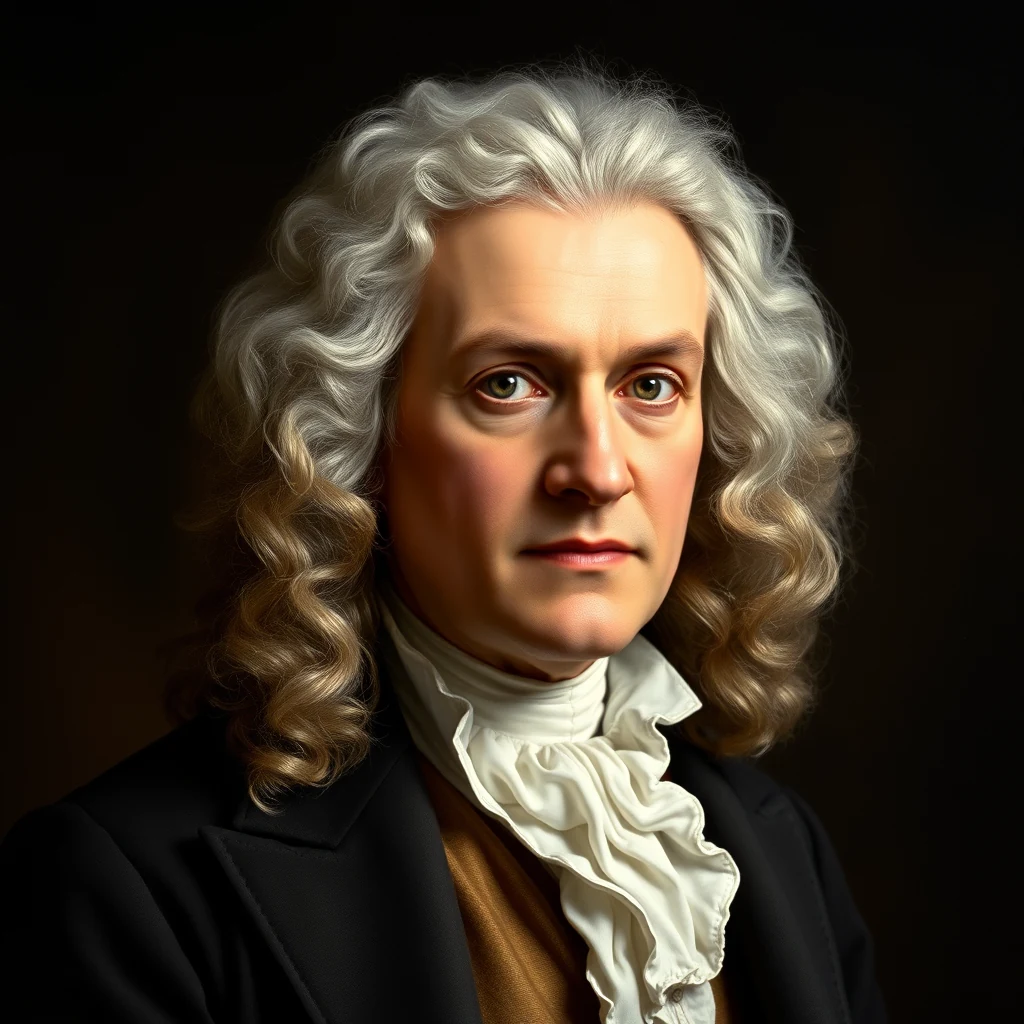
English natural philosopher (1642–1727), Master of the Mint and President of the Royal Society at the time of the Longitude Act. He testified before the parliamentary committee that drafted the Act and listed four possible methods of finding longitude, dismissing a sea-going clock as the least promising of them because no timekeeper could survive the motion and weather of a long voyage.
英国自然哲学家(1642-1727年),在《经度法案》通过时担任皇家造币厂厂长和皇家学会会长。他在起草该法案的议会委员会面前作证,列出了寻找经度的四种可能方法,但认为航海钟是最没有前途的,因为没有钟表能在长期航行的颠簸和恶劣天气中幸存。
Filósofo natural inglés (1642–1727), director de la Casa de la Moneda y presidente de la Royal Society. Testificó ante el comité parlamentario que redactó la Ley de Longitud, enumerando cuatro métodos para hallarla y descartando el reloj marino como el menos prometedor debido a que el movimiento marino alteraría la precisión.
فيلسوف طبيعي إنجليزي (1642-1727)، شغل منصب مدير دار السك ورئيس الجمعية الملكية في وقت قانون خطوط الطول. أدلى بشهادته أمام اللجنة البرلمانية التي صاغت القانون وأدرج أربع طرق ممكنة للعثور على خطوط الطول، رافضاً فكرة ساعة السفر البحري باعتبارها الأقل وعداً نظراً لعدم قدرة الساعات على تحمل حركة السفن.
Filósofo natural inglês (1642-1727), diretor da Casa da Moeda e presidente da Royal Society na época da Lei da Longitude. Testemunhou perante o comité parlamentar que elaborou a lei, listando quatro métodos para encontrar a longitude e descartando o relógio de mar por considerar que nenhum cronómetro resistiria ao mar.
अंग्रेजी प्राकृतिक दार्शनिक (१६४२-१७२७), देशांतर अधिनियम के समय टकसाल के मास्टर और रॉयल सोसाइटी के अध्यक्ष। उन्होंने अधिनियम का मसौदा तैयार करने वाली संसदीय समिति के समक्ष गवाही दी और देशांतर खोजने के चार संभावित तरीकों को सूचीबद्ध किया, जिसमें एक समुद्री घड़ी को सबसे कम आशाजनक बताया क्योंकि कोई भी समयपालक लंबी यात्रा की हलचल और मौसम से बच नहीं सकता था।
Filsuf alam Inggris (1642–1727), Master of the Mint dan Presiden Royal Society pada saat Undang-Undang Bujur disahkan. Ia memberikan kesaksian di depan komite parlemen yang merancang UU tersebut dan mencantumkan empat metode untuk menemukan bujur, menolak jam laut karena menganggap tidak ada pencatat waktu yang tahan guncangan laut.
Philosophe de la nature anglais (1642–1727), directeur de la Monnaie et président de la Royal Society lors de l'adoption du Longitude Act. Témoignant devant le comité parlementaire, il lista quatre méthodes de calcul et écarta l'idée d'un chronomètre de marine, jugeant qu'aucune horloge ne résisterait aux mouvements d'un navire.
解度法制定時に王立造幣局長および王立協会会長を務めた英国の自然哲学家(1642–1727)。同法の草案を作成した議会委員会で証言し、経度測定の4つの候補方法を挙げたが、长期航海の揺れや気候に耐えられる時計はないとして、海上用時計を最も見込みがない方法として退けた。
Английский физик и математик (1642–1727), смотритель Монетного двора и президент Королевского общества во время принятия Закона о долготе. Он выступил в парламенте, перечислив четыре метода поиска долготы и назвав морские часы наименее перспективными, так как ни один механизм не выдержит качки и погоды в плавании.
Englischer Naturphilosoph (1642–1727), Münzmeister und Präsident der Royal Society zur Zeit des Längengradgesetzes. Er sagte vor dem Parlamentsausschuss aus und nannte vier Methoden zur Längengradbestimmung, wies eine Schiffsuhr jedoch als am wenigsten vielversprechend zurück, da kein Zeitmesser die Bewegung und das Wetter einer langen Reise überstehen könne.
영국의 자연철학자(1642~1727)로, 경도법 제정 당시 조폐국장과 왕립학회 회장을 맡고 있었다. 그는 법안을 기안한 의회 위원회에 출석해 경도를 측정하는 네 가지 후보안을 제시했으나, 바다 위의 혹독한 기후와 배의 흔들림을 견뎌낼 수 있는 정밀 시계는 존재하지 않는다고 단언하며 해상 시계 이용안을 가장 실현 가능성이 낮은 방법으로 깎아내렸다.
Mentioned in 8 articles
- Engineering John Harrison - Solved the Longitude Problem In 1714, the British Parliament offered a fortune to anyone who could fix the worst problem in navigation: knowing where you were at sea. A Yorkshire carpenter, working alone in a village workshop, took it apart with a clock.
- Physics Double-Slit Experiment Fire electrons one at a time at a barrier with two slits, and they build up an interference pattern like waves. Watch which slit they go through, and the pattern collapses. A century later, nobody can say why.
- Physics The 300-Year-Old Law That Saves Your Life A car hits a wall at sixty kilometres per hour. The bumper crumples in eighty milliseconds. Inside, in the same fraction of a second, the driver's body continues at sixty kilometres per hour, because nothing has told it to stop. Newton described the problem in 1687.
- Physics Structural Color Peacocks and morpho butterflies have no blue pigment at all. Their brilliant, shifting hues are not the product of chemistry, but of architecture: light interacting with nanometre-scale shapes to build colour out of pure geometry.
- Chemistry Cavendish Weighed the Earth in a Shed A reclusive millionaire in a draughty shed on the edge of London managed to calculate the mass of the planet using two lead balls and a thread so delicate a breath would ruin it. Henry Cavendish didn't just measure a force; he weighed the world.
- History Rømer Timed Light With Jupiter's Moons In 1676, a Danish astronomer named Ole Rømer noticed that Jupiter's moon Io was eclipsed 'late'. By tracking the delays, he became the first to prove light has a measurable, finite speed — a figure within 25% of the true value.
- Physics The Schiehallion Experiment In the summer of 1774, the Astronomer Royal spent four months on a rain-swept Scottish ridge, waiting for the stars to align. He wasn't mapping the heavens, but weighing the world using nothing more than a lead weight, a telescope, and a mountain.
- Engineering John Harrison's Chronometers A self-taught carpenter from Yorkshire spent forty years trying to solve the greatest scientific challenge of the eighteenth century. While the greatest minds in Europe looked to the stars to navigate the oceans, John Harrison looked to a set of ticking bronze gears.