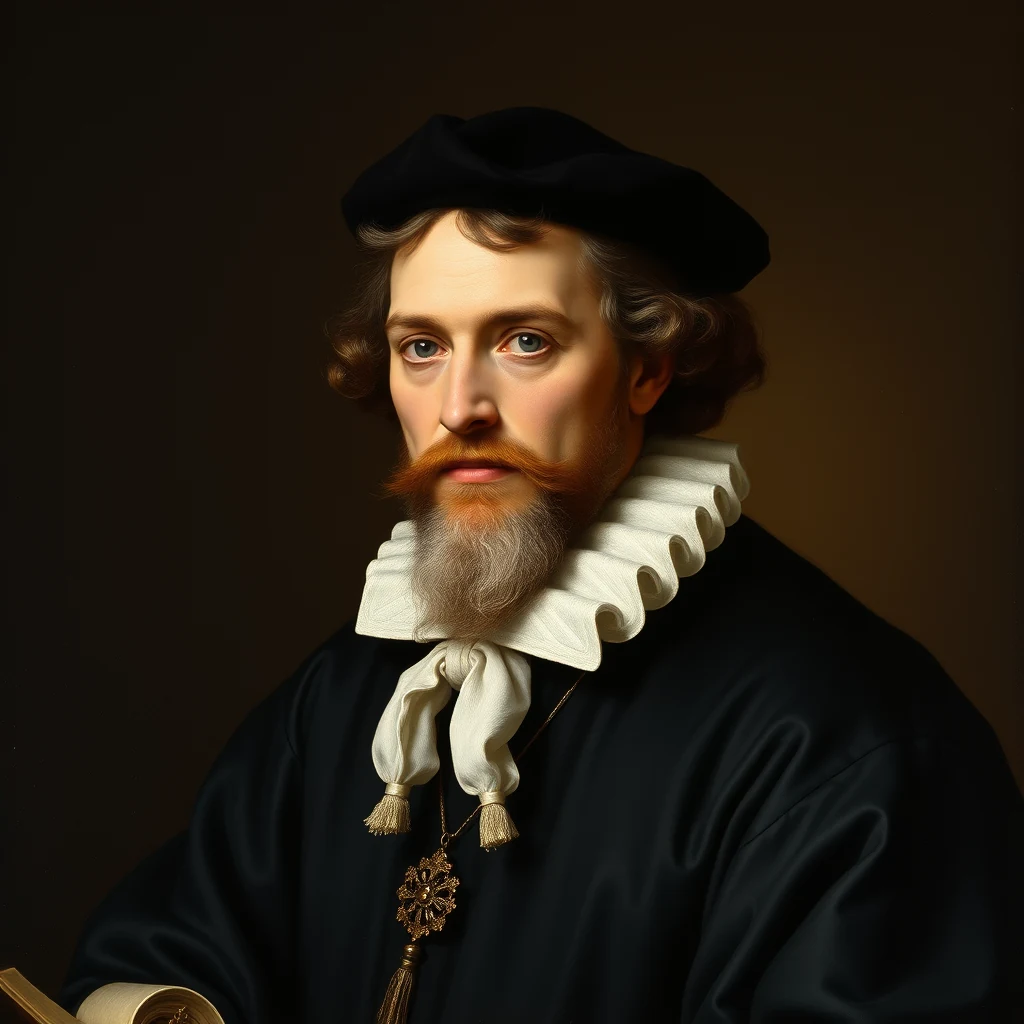
In 1641, a young Italian mathematician rotated a simple curve around an axis and produced a shape that broke the logic of his century. It was a horn of infinite length and area, yet it could hold only a finite amount of wine.
Evangelista TorricelliPersonEvangelista TorricelliItalian mathematician and physicist (1608–1647) best known for inventing the mercury barometer and for explaining atmospheric pressure. He served as Galileo's secretary in the last months of the older man's life and succeeded him as mathematician to the Grand Duke of Tuscany. He worked at the frontier of pre-Newtonian calculus, and died of typhoid in Florence at thirty-nine.埃万杰利斯塔·托里拆利是意大利数学家和物理学家(1608—1647年),最著名的成就是发明了水银气压计并解释了大气压强。他在伽利略生命的最后几个月中担任其秘书,并继任其成为托斯卡纳大公的数学家。他工作在牛顿前微积分时代的最前沿,39岁时因伤寒在佛罗伦萨去世。Matemático y físico italiano (1608–1647), famoso por inventar el barómetro de mercurio y explicar la presión atmosférica. Fue secretario de Galileo en los últimos meses de vida de este y le sucedió como matemático del Gran Duque de Toscana. Trabajó en las fronteras del cálculo prenewtoniano y murió de tifus en Florencia a los 39 años.إيفانجيليستا تورشيللي هو عالم رياضيات وفيزياء إيطالي (1608-1647)، اشتهر باختراع بارومتر الزئبق وتفسير الضغط الجوي. عمل سكرتيراً لغاليليو في الأشهر الأخيرة من حياة غاليليو، وخلفه كعالم رياضيات لدى غراند دوق توسكانا. عمل في طليعة حساب التفاضل والتكامل قبل نيوتن، وتوفي بالتيفوئيد في فلورنسا عن 39 عاماً.Matemático e físico italiano (1608–1647), mais conhecido por inventar o barômetro de mercúrio e por explicar a pressão atmosférica. Serviu como secretário de Galileu nos últimos meses de vida do astrônomo e o sucedeu como matemático do Grão-Duque da Toscana. Trabalhou na fronteira do cálculo pré-newtoniano e morreu de tifo em Florença aos 39 anos.इतालवी गणितज्ञ और भौतिक विज्ञानी (1608-1647), जो पारा बैरोमीटर का आविष्कार करने और वायुमंडलीय दबाव की व्याख्या करने के लिए जाने जाते हैं, जिन्हें इवेंजेलिस्टा टॉरीसेली (Evangelista Torricelli) कहा जाता है। उन्होंने गैलीलियो के जीवन के अंतिम महीनों में उनके सचिव के रूप में कार्य किया। 39 वर्ष की आयु में उनका फ्लोरेंस में निधन हो गया।Evangelista Torricelli (1608–1647) adalah matematikawan dan fisikawan Italia, paling dikenal karena menemukan barometer merkuri dan menjelaskan tekanan atmosfer. Ia menjadi sekretaris Galileo di bulan-bulan terakhir kehidupan fisikawan tersebut dan menggantikannya sebagai matematikawan Adipati Agung Toskana. Ia wafat akibat tifus di Firenze pada usia 39 tahun.Mathématicien et physicien italien (1608–1647), célèbre pour avoir inventé le baromètre à mercure et expliqué la pression atmosphérique. Il fut le secrétaire de Galilée durant les derniers mois de sa vie et lui succéda comme mathématicien du Grand-duc de Toscane. Pionnier du calcul pré-newtonien, il mourut du typhus à Florence à 39 ans.エヴァンジェリスタ・トリチェリ(1608〜1647年)はイタリアの数学者・物理学者。水銀気圧計の発明や、大気圧の原理を説明したことで最もよく知られる。ガリレオ・ガリレイの晩年の数ヶ月間、秘書を務め、彼の死後はトスカーナ大公の数学官の後継者となった。ニュートン以前の最初期の微積分研究の最前線で活躍したが、チフスによりフィレンツェにて39歳で病没した。Итальянский математик и физик (1608–1647), наиболее известный изобретением ртутного барометра и объяснением давления. В последние месяцы жизни Галилея он служил его секретарем и сменил его на посту математика великого герцога Тосканского. Он работал на стыке математики и физики и умер от тифа во Флоренции в 39 лет.Italienischer Mathematiker und Physiker (1608–1647), bekannt für die Erfindung des Quecksilberbarometers und die Erklärung des Luftdrucks. Er war in Galileis letzten Lebensmonaten dessen Sekretär und folgte ihm als Hofmathematiker des Großherzogs der Toskana. Er forschte im Bereich der Analysis vor Newton und starb mit 39 Jahren an Typhus.이탈리아의 수학자이자 물리학자(Evangelista Torricelli, 1608~1647)로 수은 기압계를 발명하고 대기압의 원리를 규명한 것으로 가장 유명하다. 갈릴레오 갈릴레이의 생애 마지막 몇 달간 비서로 일했으며, 갈릴레오 사후 그의 뒤를 이어 토스카나 대공의 수석 수학자가 되었다. 위상수학과 물리학의 최전선에서 연구했으나, 39세의 나이에 피렌체에서 장티푸스로 요절했다. was a protégé of Galileo GalileiPersonGalileo GalileiTuscan astronomer and physicist (1564–1642) whose telescopic observations of Jupiter's moons and Venus's phases dismantled the Ptolemaic universe. Tried by the Roman Inquisition in 1633 for advocating heliocentrism and sentenced to house arrest in Arcetri, where he spent his final years writing and corresponding. Torricelli joined him there as an assistant in the autumn of 1641, three months before his death.伽利略·伽利莱是托斯卡纳天文学家和物理学家(1564—1642年),他用望远镜对木星卫星和金星位相的观测瓦解了托勒密体系的宇宙观。1633年,他因倡导日心说而被罗马裁判所审判,并被判处在阿切特里软禁,在那里他度过了撰写论著和保持通信的晚年时光。1641年秋,托里拆利作为助手加入,当时距伽利略去世仅三个月。Astrónomo y físico toscano (1564–1642) cuyas observaciones telescópicas de las lunas de Júpiter y las fases de Venus desmantelaron el universo ptolemaico. Juzgado por la Inquisición romana en 1633 por defender el heliocentrismo, fue condenado a arresto domiciliario en Arcetri. Torricelli se unió a él como asistente en el otoño de 1641, tres meses antes de su muerte.هو عالم فلك وفيزياء توسكاني (1564-1642)، فككت ملاحظاته بالتلسكوب لأقمار المشتري وأطوار الزهرة الكون البطلمي. حاكمته محاكم التفتيش الرومانية عام 1633 لدفاعه عن مركزية الشمس وحكمت عليه بالإقامة الجبرية في أرسيتري، حيث قضى سنواته الأخيرة يكتب ويراسل. انضم إليه تورشيللي كمساعد في خريف عام 1641، قبل ثلاثة أشهر من وفاته.Astrônomo e físico toscano (1564–1642) cujas observações telescópicas das luas de Júpiter e das fases de Vênus desmantelaram o universo ptolemaico. Julgado pela Inquisição Romana em 1633 por defender o heliocentrismo e condenado à prisão domiciliar em Arcetri, onde passou os anos finais escrevendo. Torricelli juntou-se a ele como assistente no outono de 1641.टस्कन खगोलशास्त्री और भौतिक विज्ञानी (1564-1642) जिनके बृहस्पति के चंद्रमाओं और शुक्र के चरणों के दूरबीन अवलोकनों ने टॉलेमी ब्रह्मांड को नष्ट कर दिया, जिन्हें गैलीलियो गैलीली (Galileo Galilei) कहा जाता है। हेलियोसेंट्रिज़्म की वकालत करने के लिए 1633 में रोमन इनक्विजिशन द्वारा उन पर मुकदमा चलाया गया था। टॉरीसेली शरद ऋतु 1641 में एक सहायक के रूप में शामिल हुए।Galileo Galilei (1564–1642) adalah astronom dan fisikawan Toskana yang pengamatan teleskopiknya terhadap bulan-bulan Jupiter serta fase Venus meruntuhkan alam semesta Ptolemaeus. Diadili oleh Inkuisisi Romawi pada 1633 karena membela heliosentrisme, ia dihukum tahanan rumah di Arcetri. Torricelli bergabung dengannya sebagai asisten pada musim gugur 1641.Astronome et physicien toscan (1564–1642) dont les observations au télescope des lunes de Jupiter et des phases de Vénus ont démantelé l'univers ptolémaïque. Jugé par l'Inquisition en 1633 pour son héliocentrisme, il fut assigné à résidence à Arcetri, où il passa ses dernières années à écrire. Torricelli l'y rejoignit comme assistant en automne 1641.ガリレオ・ガリレイ(1564〜1642年)はトスカーナの天文学者・物理学者。望遠鏡による木星の衛星や金星の満ち欠けの観測によって、天動説(プトレマイオス宇宙)を覆した。地動説を支持したため1633年にローマ異端審問所によって裁判にかけられ、アルチェトリでの自宅軟禁に処された。トリチェリは1641年秋に助手としてそこに加わり、その3ヶ月後にガリレオは没した。Тосканский астроном и физик (1564–1642), чьи наблюдения спутников Юпитера и фаз Венеры разрушили птолемеевскую картину Вселенной. Осужденный Римской инквизицией в 1633 году за защиту гелиоцентризма, он провел последние годы под домашним арестом в Арчетри. Торричелли присоединился к нему в качестве ассистента осенью 1641 года, за три месяца до его кончины.Toskanischer Astronom und Physiker (1564–1642), dessen Teleskopbeobachtungen der Jupitermonde und Venusphasen das ptolemäische Weltbild stürzten. 1633 von der römischen Inquisitions wegen Verfechtung des Heliozentrismus verurteilt, verbrachte er seine letzten Jahre unter Hausarrest in Arcetri. Torricelli stieß im Herbst 1641 als Assistent zu ihm, drei Monate vor Galileis Tod.토스카나 지방 출신의 천문학자이자 물리학자(Galileo Galilei, 1564~1642)로, 망원경을 통한 목성의 위성 관측 및 금성의 위상 변화 관측을 통해 프톨레마이오스의 천동설 우주관을 해체했다. 1633년 지동설을 옹호했다는 이유로 로마 종교재판소의 심문을 받아 아르체트리 자택에 종신 연금되었고 그곳에서 생애 마지막 시기를 저술로 보냈다. 토리첼리가 1641년 가을 그의 조수로 합류한 지 세 달 후 사망했다., working in the humid heat of Florence during the final months of the master's life. In 1641, he took a standard hyperbola—the curve defined by y = 1/x—and imagined it spinning around the horizontal axis from the point x = 1 into the infinite distance. The resulting shape, which he called the *hyperbolicum acutum*, resembled a long, tapering trumpet. Its bell was wide, but its neck stretched forever, narrowing toward a point it would never reach.
Using the method of indivisiblesConceptMethod of indivisiblesA pre-calculus technique, formalised by Cavalieri in the 1630s, for computing the area of a region or the volume of a solid by treating it as an infinite collection of parallel slices of vanishing thickness. The method gave correct answers in cases where classical Greek geometry had no tools, but its handling of "the infinitely small" provoked decades of philosophical objection. Newton and Leibniz would later replace it with the differential calculus.不可分量方法是一种牛顿前微积分时期的几何技术,由卡瓦列里在17世纪30年代形式化,通过将区域或几何体视为厚度无限趋近于零的平行切片的无穷集合,来计算面积或体积。该方法在古典希腊几何无能为力的情况下得出了正确答案,但它对“无限小”的处理引发了数十年的哲学争议。牛顿和莱布尼茨后来用微积分取代了它。Técnica precálculo formalizada por Cavalieri en la década de 1630 para calcular el área de una región o el volumen de un sólido tratándolo como una colección infinita de rebanadas paralelas de grosor infinitesimal. Daba respuestas correctas donde la geometría griega clásica carecía de herramientas, pero su uso de lo infinitesimal provocó objeciones filosóficas durante décadas.طريقة غير القابلة للتجزئة هي تقنية ما قبل حساب التفاضل والتكامل، صاغها كافاليري في ثلاثينيات القرن السابع عشر، لحساب مساحة منطقة أو حجم جسم صلب من خلال معالجته كمجموعة لا نهائية من الشرائح المتوازية ذات السمك المتناهي في الصغر. قدمت الطريقة إجابات صحيحة في حالات لم تكن فيها الهندسة اليونانية الكلاسيكية تمتلك أدوات.Uma técnica de pré-cálculo, formalizada por Cavalieri na década de 1630, para calcular a área de uma região ou o volume de um sólido tratando-o como uma coleção infinita de fatias paralelas de espessura infinitesimal. O método dava respostas corretas onde a geometria grega clássica falhava, mas seu manuseio do 'infinitamente pequeno' provocou objeções filosóficas.एक पूर्व-कैलकुलस तकनीक, जिसे 1630 के दशक में कैवलियरी द्वारा औपचारिक रूप दिया गया था, जिसे अविभाज्यताओं की विधि (method of indivisibles) कहा जाता है। यह किसी क्षेत्र के क्षेत्रफल या ठोस के आयतन की गणना करने के लिए है। इस पद्धति ने उन मामलों में सही उत्तर दिए जहां शास्त्रीय ग्रीक ज्यामिति के पास कोई उपकरण नहीं था। न्यूटन और लीबनिज ने बाद में इसे बदल दिया।Metode indivisibel adalah teknik pra-kalkulus yang diformalisasikan oleh Cavalieri pada tahun 1630-an untuk menghitung luas wilayah atau volume benda padat dengan memperlakukannya sebagai kumpulan tak terhingga irisan paralel dengan tebal mendekati nol. Metode ini menghasilkan jawaban benar ketika geometri Yunani kuno buntu, namun memicu perdebatan filosofis yang panjang.La méthode des indivisibles est une technique de calcul géométrique formalisée par Cavalieri dans les années 1630. Elle permet de calculer l'aire d'une surface ou le volume d'un solide en le considérant comme une collection infinie de tranches parallèles d'épaisseur évanescente. Elle donnait des résultats là où la géométrie grecque classique échouait, mais souleva de vives objections.不可分量法は、1630年代にカヴァリエーリによって定式化された、微積分成立以前の解析手法である。面や体を、厚さが無限に薄い平行な切片の無限の集まりとして扱うことで、面積や体積を計算する。古代ギリシャの古典幾何学では扱えなかった問題に対して正しい解を導いたが、「無限小」の扱いをめぐって数十年に及ぶ哲学的な反発を招いた。のちにニュートンやライプニッツの微積分学に取って代わられた。Метод неделимых — геодезический метод вычисления площади фигуры или объема тела, разработанный Кавальери в 1630-х годах. Фигура рассматривалась как бесконечное множество параллельных срезов бесконечно малой толщины. Метод давал верные ответы там, где греческая геометрия была бессильна, но оперирование «бесконечно малым» вызывало философские споры. Позже Ньютон и Лейбниц заменили его анализом.Eine Vorform der Infinitesimalrechnung, die Cavalieri in den 1630er Jahren formalisierte, um Flächen oder Volumina zu berechnen, indem er sie als unendliche Sammlung paralleler Schnitte von verschwindender Dicke behandelte. Die Methode lieferte korrekte Antworten, wo die klassische griechische Geometrie versagte, rief jedoch jahrzehntelang philosophische Einwände gegen das „unendlich Kleine“ hervor.미적분학 확립 이전 시대에 카발리에리가 1630년대 공식화한 계산법(method of indivisibles)으로, 면이나 고체를 두께가 무한히 0에 수렴하는 평행한 단면 조각들의 무한한 집합으로 취급하여 면적과 부피를 산출했다. 고대 그리스의 고전 기하학 도구로는 해결할 수 없던 난제들에 대한 올바른 답을 도출했으나, '무한소'의 수학적 취급을 둘러싸고 수십 년간 철학적 논쟁을 일으켰다. 이후 뉴턴과 라이프니츠의 미적분학으로 대체되었다. pioneered by his contemporary Bonaventura CavalieriPersonBonaventura CavalieriItalian Jesuat priest and mathematician (1598–1647), professor at Bologna, who developed the method of indivisibles — a technique for computing areas and volumes by treating them as sums of lower-dimensional slices. The method was a direct precursor to integral calculus and was attacked at length by Jesuit mathematicians who considered it metaphysically incoherent. Cavalieri was Torricelli's teacher and lifelong correspondent.博纳文图拉·卡瓦列里是意大利耶稣会神父和数学家(1598—1647年),博洛尼亚大学教授,他发展了不可分量方法——这是一种通过将面积和体积视为低维切片之和来进行计算的几何技术。该方法是积分学的前身,因而长期受到耶稣会数学家们的攻击,他们认为这在形而上学上是不连贯的。卡瓦列里是托里拆利的老师,也是他终生的通信友人。Sacerdote jesuato y matemático italiano (1598–1647), profesor en Bolonia, que desarrolló el método de los indivisibles, técnica para calcular áreas y volúmenes tratándolos como sumas de rebanadas de menor dimensión. Precursor de la integración, fue atacado por matemáticos jesuitas que lo creían incoherente. Cavalieri fue maestro y corresponsal de Torricelli.بونافينتورا كافاليري هو كاهن يسوعي وعالم رياضيات إيطالي (1598-1647)، وكان أستاذاً في بولونيا، وطور طريقة غير القابلة للتجزئة - وهي تقنية لحساب المساحات والأحجام عن طريق معالجتها كمجموع لشرائح ذات أبعاد أقل. كانت الطريقة سلفاً مباشراً لحساب التكامل وتعرضت لهجوم من علماء الرياضيات اليسوعيين الذين اعتبروها غير متسقة ميتافيزيقياً.Sacerdote jesuíta e matemático italiano (1598–1647), professor em Bolonha, que desenvolveu o método dos indivisíveis — uma técnica para calcular áreas e volumes tratando-os como somas de fatias de dimensão inferior. O método foi um precursor direto do cálculo integral e foi atacado por matemáticos jesuítas que o consideravam metafisicamente incoerente. Cavalieri foi professor de Torricelli.इतालवी जेसुअट पुजारी और गणितज्ञ (1598-1647), बोलोग्ना में प्रोफेसर, जिन्होंने अविभाज्यताओं की विधि (method of indivisibles) विकसित की थी, जिन्हें बोनावेंटुरा कैवलियरी (Bonaventura Cavalieri) कहा जाता है। यह कम-आयामी स्लाइस के योग के रूप में व्यवहार करके क्षेत्रों और आयतनों की गणना करने की एक तकनीक है। कैवलियरी टॉरीसेली के शिक्षक थे।Bonaventura Cavalieri (1598–1647) adalah matematikawan dan pastor Yesuit Italia, profesor di Bologna yang mengembangkan metode indivisibel — teknik menghitung luas dan volume dengan memperlakukannya sebagai jumlah irisan dimensi lebih rendah. Metode ini merupakan cikal bakal kalkulus integral dan sempat ditentang keras oleh matematikawan Yesuit. Ia guru Torricelli.Prêtre et mathématicien italien (1598–1647), professeur à Bologne. Il a développé la méthode des indivisibles, qui consiste à calculer des aires et des volumes en les traitant comme des sommes de tranches de dimension inférieure. Cette technique, précurseur direct du calcul intégral, fut attaquée par les jésuites pour son incohérence métaphysique. Il fut le maître de Torricelli.ボナヴェントゥーラ・カヴァリエーリ(1598〜1647年)はイタリアのイエズアト会修道士・数学者であり、ボローニャ大学教授。面積や体積を低次元の切片の総和として扱うことで計算する「不可分量法」を開発した。この手法は積分法の直接の前身となったが、形而上学的に不整合であるとしてイエズス会の数学者たちから激しく非難された。トリチェリの師であり生涯の文通相手であった。Итальянский священник и математик (1598–1647), профессор в Болонье, разработавший метод неделимых — метод вычисления площадей и объемов путем представления их в виде сумм плоских или линейных срезов. Метод был предшественником интегрального исчисления и критиковался иезуитами как метафизически противоречивый. Кавальери был учителем Торричелли.Italienischer Ordenspriester und Mathematiker (1598–1647), Professor in Bologna, der die Methode der Indivisibilien entwickelte — eine Technik zur Berechnung von Flächen und Volumina, indem sie als Summen niederdimensionaler Schnitte behandelt werden. Die Methode war ein Vorläufer der Integralrechnung und wurde von Jesuiten heftig kritisiert. Cavalieri war Torricellis Lehrer.이탈리아의 수도사이자 수학자(Bonaventura Cavalieri, 1598~1647)로 볼로냐 대학교 교수를 지내며 면적과 부피를 자신보다 차원이 하나 낮은 조각들의 합으로 취급하여 계산하는 '불가분량법(method of indivisibles)'을 정립했다. 이 계산법은 적분학의 직접적인 전조가 되었으나 형이상학적으로 일관성이 없다고 본 예수회 수학자들로부터 격렬한 비판을 받았다. 토리첼리의 스승이자 평생의 학문적 동반자였다., Torricelli calculated the volume of this infinite object. To his astonishment, the number was finite. Specifically, the volume of the entire horn, despite its eternal length, was exactly π. It was as if a vessel of infinite extent had been tamed by the laws of geometry. If you were to pour wine into this horn, you would need only three and a bit litres to fill it to the brim.
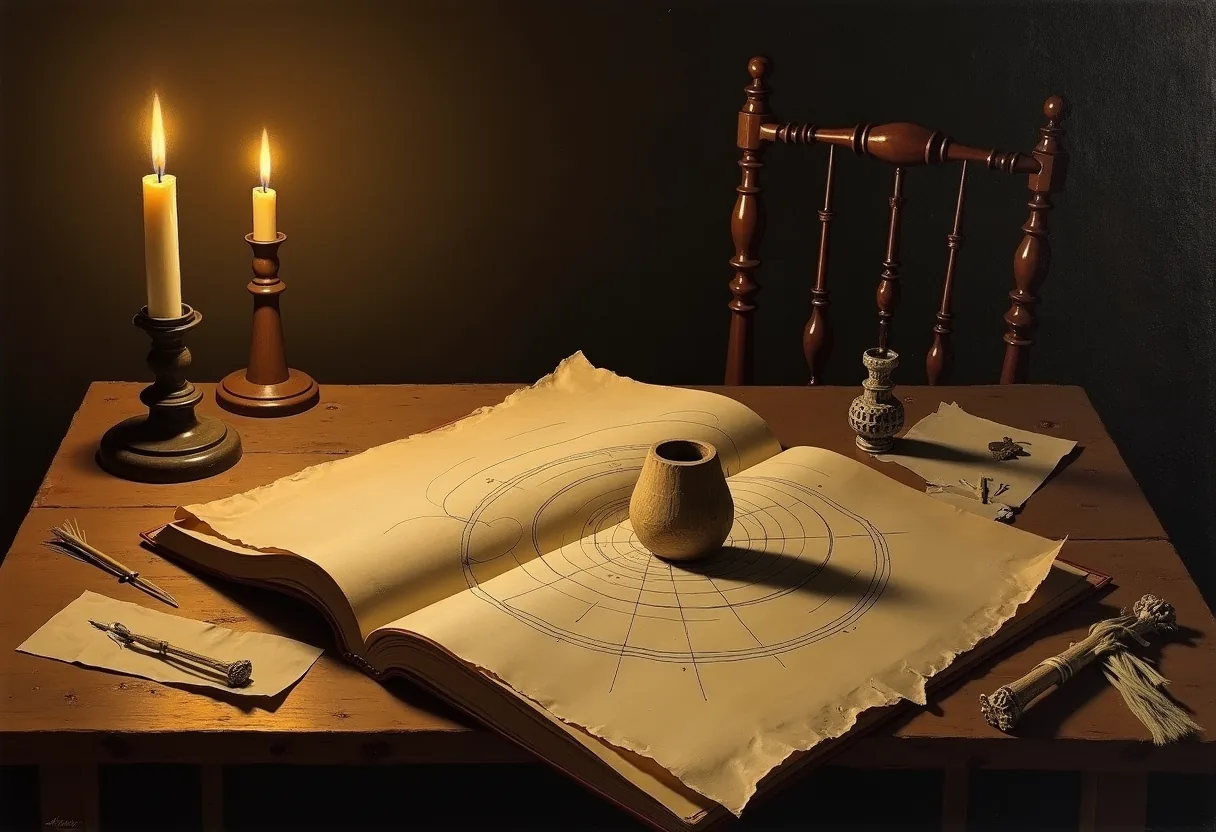
A seventeenth-century Florentine study glows by candlelightIllustration · AI-generated (FLUX.1-dev)
The paradox emerged when he turned his attention to the surface area. Unlike the volume, which converged to a neat, finite sum, the area of the horn’s skin diverged. It was infinite. This was the Painter’s Paradox: a container that can be filled with a finite amount of paint, yet possesses a surface so vast that no amount of paint could ever cover its exterior. To the thinkers of the 17th century, this was not merely a mathematical curiosity; it was a theological and philosophical crisis.
The Battle for the Infinite
The discovery of [[Gabriel's Horn|solid-of-revolution]] shattered the [[Aristotle|aristotle]]an consensus that there was no proportion between the finite and the infinite. For two thousand years, Western thought had held that anything infinite must be infinitely large in every respect. Torricelli had proven that an object could be infinite in reach and area while remaining finite in its occupancy of space.
The English philosopher Thomas HobbesPersonThomas HobbesEnglish political philosopher (1588–1679), author of Leviathan, who fancied himself a geometer and conducted a long, public feud with the Oxford mathematician John Wallis over the foundations of mathematics. He rejected the new calculus and its infinitesimals as a logical scandal, attacking Torricelli's hyperbolic solid in print in 1656. The mathematical community treated his objections as a sideshow; historians of mathematics still find them clarifying.托马斯·霍布斯是英国政治哲学家(1588—1679年),《利维坦》的作者,他自诩为几何学家,并与牛津大学数学家约翰·沃利斯就数学基础展开了长期公开的论战。他拒绝接受新的微积分及其无穷小量,认为这是一种逻辑上的丑闻,并于1656年撰文抨击托里拆利研究的双曲几何体。数学界虽然视他的反对为插曲,但数学史学家至今仍认为它们具有澄清意义。Filósofo político inglés (1588–1679), autor de Leviatán, que se creía geómetra y mantuvo una larga disputa pública con el matemático de Oxford John Wallis sobre los fundamentos matemáticos. Rechazó el nuevo cálculo y sus infinitesimales considerándolos un escándalo lógico, y atacó el sólido hiperbólico de Torricelli. La comunidad matemática ignoró sus críticas, pero los historiadores las consideran interesantes.توماس هوبز هو فيلسوف سياسي إنجليزي (1588-1679)، مؤلف كتاب (Leviathan)، الذي تخيل نفسه عالم هندسة وأدار نزاعاً عاماً طويلاً مع عالم الرياضيات في أكسفورد جون واليس حول أسس الرياضيات. ورفض حساب التفاضل والتكامل الجديد والكميات متناهية الصغر باعتبارها فضيحة منطقية، مهاجماً مجسم تورشيللي الزائدي في عام 1656.Filósofo político inglês (1588–1679), autor do Leviatã, que se considerava um geômetra e manteve uma longa disputa pública com o matemático de Oxford John Wallis sobre os fundamentos da matemática. Rejeitou o novo cálculo e seus infinitesimais como um escândalo lógico, atacando o sólido hiperbólico de Torricelli em 1656. A comunidade matemática ignorou suas objeções.अंग्रेजी राजनीतिक दार्शनिक (1588-1679), लेविआथन के लेखक, जो खुद को एक ज्यामितीय मानते थे और गणित की नींव को लेकर ऑक्सफोर्ड के गणितज्ञ जॉन वालिस के साथ एक लंबा, सार्वजनिक विवाद किया था, जिन्हें थॉमस हॉब्स (Thomas Hobbes) कहा जाता है। उन्होंने नए कैलकुलस को खारिज कर दिया और 1656 में टॉरीसेली के अतिशयोक्तिपूर्ण ठोस पर हमला किया।Thomas Hobbes (1588–1679) adalah filsuf politik Inggris, penulis Leviathan, yang menganggap dirinya geometriwan dan terlibat perseteruan publik yang panjang dengan matematikawan Oxford John Wallis tentang fondasi matematika. Ia menolak kalkulus baru dan konsep infinitesimal sebagai skandal logika, menyerang bangun hiperbolik Torricelli pada 1656.Philosophe politique anglais (1588–1679), auteur du Léviathan. Se piquant de géométrie, il mena une longue querelle publique avec le mathématicien d'Oxford John Wallis sur les fondements des mathématiques. Il rejeta le nouveau calcul et ses infinitésimaux, criant au scandale logique, et attaqua par écrit le solide hyperbolique de Torricelli en 1656. Ses objections restent intéressantes pour les historiens.トマス・ホッブズ(1588〜1679年)はイギリスの政治哲学者であり、『リヴァイアサン』の著者。自らを幾何学者と任じ、数学の基礎をめぐってオックスフォード大学の数学者ジョン・ウォリスと长年にわたり公の場で論争を繰り広げた。彼は新しい微积分学とその無限小の概念を「論理的スキャンダル」として拒絶し、1656年にトリチェリの双曲線立体を批判した。当時の数学界からは相手にされなかったが、数学史家からは今なお評価されている。Английский политический философ (1588–1679), автор «Левиафана», считавший себя геометром и ведший многолетний спор с оксфордским математиком Джоном Валлисом об основаниях математики. Он отвергал новое исчисление и бесконечно малые величины как логический скандал, раскритиковав гиперболическое тело Торричелли в 1656 году. Математики проигнорировали его нападки.Englischer Staatsphilosoph (1588–1679) und Autor des Leviathan, der sich selbst für einen Geometer hielt und eine lange, öffentliche Fehde mit dem Oxforder Mathematiker John Wallis führte. Er lehnte die neue Analysis und ihre Infinitesimalien als logischen Skandal ab und griff 1656 Torricellis hyperbolischen Körper schriftlich an. Die Mathematiker ignorierten seine Einwände.영국의 정치철학자(Thomas Hobbes, 1588~1679)이자 《리바이어던》의 저자이다. 스스로를 뛰어난 기하학자라 칭하며 옥스퍼드 대학교의 수학자 존 월리스와 수학의 기초 정립을 두고 평생 공개 논쟁을 벌였다. 새로운 미적분학 및 무한소 기법을 논리적 붕괴로 규정해 배격했으며, 1656년 토리첼리가 정의한 나팔 모양 입체 도형을 서면으로 맹공격했다. 당시 수학계는 이를 무시했으나 수학사학자들은 그의 지적에 의의를 둔다. was particularly incensed. To Hobbes, geometry was a reflection of the physical world; an infinite length with a finite volume was a madness that threatened the foundations of reason. He engaged in a decades-long dispute with the mathematician John WallisPersonJohn WallisAn English mathematician and Savilian Professor of Geometry at Oxford, Wallis was a pioneer of infinitesimal calculus. He introduced the symbol for infinity and championed the use of arithmetic methods over purely geometric proofs. His defense of Torricelli’s work was a turning point in the mathematical acceptance of the infinite.沃利斯是一位英国数学家,牛津大学萨维尔几何学教授,是微积分的先驱。他引入了无限符号,并倡导使用算术方法,而非纯粹的几何证明。他对托里切利工作的捍卫是数学界接受无限概念的重要转折点。John Wallis fue un matemático inglés y profesor Saviliano de Geometría en Oxford. Fue pionero del cálculo infinitesimal. Introdujo el símbolo para el infinito y defendió el uso de métodos aritméticos en lugar de demostraciones puramente geométricas. Su defensa del trabajo de Torricelli fue un punto de inflexión en la aceptación matemática del infinito.كان واليس عالم رياضيات إنجليزيًا وبروفيسورًا سافيليًا لعلم الهندسة في أكسفورد، وكان من الرواد في حساب التفاضل والتكامل اللانهائي. قدّم رمز اللانهاية ودافع عن استخدام الأساليب الحسابية بدلًا من البراهين الهندسية البحتة. وقد كان دفاعه عن أعمال توريكيلي نقطة تحول في قبول الرياضيات المفهوم اللانهائي.Um matemático inglês e professor Saviliano de Geometria em Oxford, Wallis foi pioneiro no cálculo infinitesimal. Introduziu o símbolo para o infinito e defendeu o uso de métodos aritméticos em detrimento de provas puramente geométricas. Sua defesa do trabalho de Torricelli foi um ponto de virada na aceitação matemática do infinito.वॉलिस एक अंग्रेजी गणितज्ञ तथा ऑक्सफोर्ड में सेविलियन ज्यामिति के प्रोफेसर थे। वे अनंतकलन गणित के प्रारंभिक आविष्कारकों में से एक थे। उन्होंने अनंत के लिए प्रतीक का प्रयोग शुरू किया तथा शुद्ध ज्यामितीय प्रमाणों के बजाय अंकगणितीय विधियों के उपयोग का समर्थन किया। टोरिचेली के कार्य के प्रति उनका रक्षा करना अनंत के गणितीय स्वीकृति के लिए एक महत्वपूर्ण बिंदु था।John Wallis, seorang matematikawan Inggris dan Profesor Geometri Savilian di Oxford, merupakan pelopor kalkulus infinitesimal. Ia memperkenalkan simbol untuk tak hingga dan mempromosikan penggunaan metode aritmetika daripada bukti geometris murni. Pertahanannya terhadap karya Torricelli menjadi titik balik dalam penerimaan matematis terhadap konsep tak hingga.John Wallis, mathématicien anglais et professeur savilien de géométrie à Oxford, fut un pionnier du calcul infinitésimal. Il introduisit le symbole de l'infini et défendit l'usage des méthodes arithmétiques par rapport aux démonstrations purement géométriques. Sa défense des travaux de Torricelli marqua un tournant dans l'acceptation mathématique de l'infini.オックスフォード大学の幾何学セヴィリアン教授であり、数学者であったウォリスは、無限小解析の先駆者である。彼は無限大の記号を導入し、幾何学的証明に代わって算術的方法の利用を主張した。彼がトリチェリの業績を擁護したことは、無限大に関する数学的受容の転換点となった。Английский математик и Савильтонов профессор геометрии в Оксфорде, Валлис был пионером дифференциального исчисления. Он ввёл символ бесконечности и выступал за использование арифметических методов вместо чисто геометрических доказательств. Его защита работ Торричелли стала поворотным моментом в математическом признании бесконечности.John Wallis, englischer Mathematiker und Savilianischer Geometrieprofessor in Oxford, war ein Pionier der Infinitesimalrechnung. Er führte das Symbol für Unendlichkeit ein und setzte sich für die Verwendung arithmetischer Methoden anstelle reiner geometrischer Beweise ein. Seine Verteidigung der Arbeit Torricellis markierte einen Wendepunkt in der mathematischen Akzeptanz des Unendlichen.옥스퍼드 대학의 수학자이자 세비リア너 기하학 교수였던 월리스는 미적분학의 선구자였다. 그는 무한의 기호를 도입했으며, 순수 기하학적 증명보다 산술적 방법을 사용하는 것을 옹호했다. 그가 토리첼리의 연구를 방어한 것은 수학에서 무한의 수용에 있어 전환점이 되었다., who embraced Torricelli’s results. Wallis saw in the horn a glimpse of a new kind of mathematics—one that would eventually become calculusConceptCalculusThe branch of mathematics concerned with the study of continuous change, developed independently by Isaac Newton and Gottfried Wilhelm Leibniz. It provides the rigorous language of limits required to resolve the paradoxes of Gabriel’s Horn, formalising how a shape can have an infinite boundary but a finite volume.微积分是数学的一个分支,致力于研究连续变化,由艾萨克·牛顿和戈特弗里德·威廉·莱布尼茨各自独立发展出来。它提供了严谨的极限语言,用以解决圣彼埃圆锥面的悖论,形式化地说明一个图形如何可以拥有无限边界却具有有限体积。La rama de las matemáticas encargada del estudio del cambio continuo, desarrollada de forma independiente por Isaac Newton y Gottfried Wilhelm Leibniz. Proporciona el lenguaje riguroso de límites necesario para resolver las paradojas de la trompeta de Gabriel, formalizando cómo una figura puede tener un límite infinito pero un volumen finito.الفرع الذي تهتم به الرياضيات بدراسة التغير المستمر، وطوره بشكل مستقل إسحاق نيوتن وغوتفرد فيلهلم ليبنز. كما يقدم لهجة صارمة لدراسة النهايات المطلوبة لحل لغزات قرن جابرييل، ويُشكل كيفية أن يكون للشكل حدود لا نهائية لكن حجمه محدود.A área da matemática que se ocupa do estudo do cambio contínuo, desenvolvida independentemente por Isaac Newton e Gottfried Wilhelm Leibniz. Fornece a linguagem rigorosa de limites necessária para resolver os paradoxos da Trombeta de Gabriel, formalizando como uma forma pode ter um limite infinito mas um volume finito.गणित की वह शाखा जो निरंतर परिवर्तन के अध्ययन से संबंधित है, जिसे आइजैक न्यूटन और गॉटफ्रीड विल्हेम लीब्निज द्वारा स्वतंत्र रूप से विकसित किया गया था। यह गैब्रिएल के हॉर्न के पैराडॉक्स को सुलझाने के लिए आवश्यक सीमा की निर्देशित भाषा प्रदान करती है, औपचारिक रूप से यह बताती है कि एक आकृति में अपनी अपरिमित सीमा हो सकती है लेकिन एक परिमित आयतन हो सकता है।Cabang matematika yang mempelajari perubahan kontinu, dikembangkan secara independen oleh Isaac Newton dan Gottfried Wilhelm Leibniz. Kalkulus menyediakan bahasa yang ketat tentang limit yang diperlukan untuk menyelesaikan paradoks Traktor Gabriel, memformalkan bagaimana suatu bentuk dapat memiliki batas tak terhingga tetapi memiliki volume yang terbatas.La branche des mathématiques consacrée à l'étude du changement continu, développée indépendamment par Isaac Newton et Gottfried Wilhelm Leibniz. Elle fournit le langage rigoureux des limites nécessaire pour résoudre les paradoxes de la trompette de Gabriel, formalisant la manière dont une forme peut avoir une frontière infinie mais un volume fini.微分積分学は、連続的な変化を研究する数学の分野であり、アイザック・ニュートンとゴットフリート・ヴィルヘルム・ライプニッツによってそれぞれ独立して発展した。この理論は、ガブリエルのラッパのパラドックスを解決するために必要な極限の厳密な言語を提供し、無限の境界を持つ形状が有限の体積を持つことができる仕組みを形式化している。Ветвь математики, изучающая непрерывные изменения, независимо разработанная Исааком Ньютоном и Готфридом Вильгельмом Лейбницем. Она обеспечивает строгий язык пределов, необходимый для разрешения парадоксов Рога Габриэля, формализующих способ, как форма может иметь бесконечную границу, но конечный объем.Die mathematische Disziplin, die sich mit der Untersuchung kontinuierlicher Veränderung beschäftigt, wurde unabhängig voneinander von Isaac Newton und Gottfried Wilhelm Leibniz entwickelt. Sie liefert die präzise Sprache der Grenzwerte, die erforderlich ist, um die Paradoxien des Hörnern Gabriels zu lösen, und formalisiert, wie eine Form eine unendliche Grenze haben kann, aber ein endliches Volumen.수학에서 연속적인 변화를 연구하는 분야로, 이са아 뉴턴과 고트프리트 빌헬름 라이프니츠에 의해 독립적으로 개발되었다. 이는 가브리엘의 뿔의 역설을 해결하기 위해 무한한 경계를 가진 형상이 유한한 부피를 가질 수 있다는 것을 엄밀하게 정의하는 극한의 언어를 제공한다.—where the infinite could be manipulated with the same precision as a handful of pebbles.
A long polished bronze horn stretches across a dark workshop floorIllustration · AI-generated (FLUX.1-dev)
The controversy reached into the heart of the Royal Society. Isaac BarrowPersonIsaac BarrowA distinguished English theologian and mathematician, Barrow served as the first Lucasian Professor at Cambridge and was a teacher to Isaac Newton. He sought to reconcile traditional geometry with the new methods of indivisibles, providing a critical philosophical bridge that allowed for the acceptance of infinite geometric paradoxes.一位杰出的英国神学家和数学家,巴罗曾担任剑桥大学首任卢卡逊教授,并曾教授艾萨克·牛顿。他试图调和传统几何学与新出现的不可分量方法,提供了关键的哲学桥梁,使得无限几何悖论得以被接受。Un distinguido teólogo y matemático inglés, Barrow fue el primer profesor Lucasiano en Cambridge y maestro de Isaac Newton. Buscó conciliar la geometría tradicional con los nuevos métodos de los indivisibles, proporcionando un puente filosófico crucial que permitió la aceptación de las paradojas geométricas infinitas.عالم اللاهوت والرياضيات الإنجليزي البارز، شغل بارو منصب أول أستاذ لوكاسي في جامعة كامبريدج وكان معلّمًا لنيوتن. سعى إلى توحيد الهندسة التقليدية مع الأساليب الجديدة للاستحالة، مما أدى إلى بناء جسر فلسفي حيوي سمح بقبول التناقضات الهندسية اللانهائية.Um distinto teólogo e matemático inglês, Barrow foi o primeiro professor Lucasiano em Cambridge e foi professor de Isaac Newton. Buscava conciliar a geometria tradicional com os novos métodos dos indivisíveis, fornecendo uma ponte filosófica crucial que permitiu a aceitação dos paradoxos geométricos infinitos.एक प्रतिष्ठित अंग्रेजी धर्मशास्त्री और गणितज्ञ, बैरो ने कैम्ब्रिज में पहले ल्यूकासियन प्रोफेसर के रूप में कार्यभार संभाला और आइजैक न्यूटन के शिक्षक के रूप में भी कार्य किया। उन्होंने पारंपरिक ज्यामिति को अपनाविभाज्यों की नई विधियों के साथ समन्वित करने का प्रयास किया, जो अनंत ज्यामितीय विरोधाभासों के स्वीकृति की ओर एक महत्वपूर्ण दार्शनिक पुल प्रदान करता है।Seorang teolog dan matematikawan Inggris yang terkemuka, Barrow pernah menjabat sebagai profesor Lucasian pertama di Cambridge dan menjadi guru bagi Isaac Newton. Ia berusaha memadukan geometri tradisional dengan metode baru tentang tak terbagi, memberikan jembatan filosofis yang penting sehingga memungkinkan penerimaan paradoks geometri tak terhingga.Un théologien et mathématicien anglais distingué, Barrow fut le premier professeur Lucasien à Cambridge et enseigna à Isaac Newton. Il chercha à concilier la géométrie traditionnelle avec les nouvelles méthodes des indivisibles, offrant ainsi un pont philosophique essentiel qui permit l'acceptation des paradoxes géométriques infinis.イギリスの著名な神学者で数学者であったバーーは、ケンブリッジ大学で初代ルーカシアーン教授を務め、アイザック・ニュートンの教師でもあった。彼は伝統的な幾何学と新しく登場した不可分法を調和させようとした。その結果、無限の幾何学的パラドックスを受け入れるための重要な哲学的橋渡しを提供した。Выдающийся английский теолог и математик, Барроу был первым Люкасовским профессором Кембриджского университета и преподавателем Исаака Ньютона. Он стремился примирить традиционную геометрию с новыми методами неделимых, создав важный философский мост, позволивший принять геометрические парадоксы бесконечности.Ein herausragender englischer Theologe und Mathematiker, Barrow war der erste Lucasian-Professor an der Cambridge-Universität und Lehrer von Isaac Newton. Er suchte nach einer Versöhnung der traditionellen Geometrie mit den neuen Methoden der Unendlichkeitsrechnung, wodurch er eine entscheidende philosophische Verbindung schuf, die den akzeptablen Umgang mit geometrischen Unendlichkeitsparadoxien ermöglichte.영국의 저명한 신학자이자 수학자인 바로는 케임브리지 대학의 최초 루카시안 교수로 재직했으며 아이작 뉴턴의 스승이기도 했다. 그는 전통 기하학과 새로운 불가분법을 결합하려 했으며, 무한 기하학적 역설을 수용할 수 있도록 하는 중요한 철학적 다리 역할을 했다., Newton’s predecessor at Cambridge, attempted to bridge the gap by arguing that Aristotle’s dictum only applied when comparing like with like—volume with volume, or area with area. But the horn compared the two, proving that a finite volume could be wrapped in an infinite skin. It was a monstrous shape that forced a divorce between mathematical abstraction and physical intuition.
A glass vessel of red wine pours into a smooth metal horn resting on trestlesIllustration · AI-generated (FLUX.1-dev)
Molecules and Measurement
In the modern era, the paradox is often resolved by pointing to the limits of the physical world. While the mathematical horn narrows infinitely, real paint is composed of molecules—long chains of polymers with a fixed, finite width. As the horn’s neck tapers, it eventually becomes narrower than a single molecule of pigment. At that point, the painting becomes impossible; the paint simply cannot enter the narrowing throat.
However, the mathematical truth remains untouched by these physical constraints. Even if we use mathematical paint of zero thickness, the paradox is merely a matter of scaling. As the surface area to be covered increases toward infinity, the thickness of the paint required to cover it from a finite reservoir must decrease toward zero at a faster rate. The volume remains π because the skin of paint becomes so thin it essentially vanishes, yet it remains mathematically present on the surface.
A seventeenth-century philosopher studies a bronze horn model with a compass in handIllustration · AI-generated (FLUX.1-dev)
This convergence is the same logic that allows the harmonic seriesConceptHarmonic seriesThe infinite sum 1 + 1/2 + 1/3 + 1/4 + …, whose terms shrink toward zero but whose partial sums grow without bound. Nicole Oresme proved its divergence in the fourteenth century by grouping terms in expanding blocks, each summing to at least one half. The growth is logarithmic: the sum of the first n terms is approximately ln(n) + 0.577. Reaching a partial sum of 100 takes more than 10⁴³ terms.调和级数是指无穷和 1 + 1/2 + 1/3 + 1/4 + …,其各项无限趋近于零,但其部分和却无限增长。尼科尔·奥雷姆在14世纪通过将项分组为越来越大的块(每组的和至少为二分之一)证明了其发散性。该级数的增长是呈对数级的:前n项的和大约为 ln(n) + 0.577。要达到部分和为100,需要超过10的43次方项。La serie armónica es la suma infinita 1 + 1/2 + 1/3 + 1/4 + ..., cuyos términos tienden a cero pero cuyas sumas parciales crecen sin límite. Nicole Oresme demostró su divergencia en el siglo XIV agrupando términos en bloques que sumaban al menos un medio. El crecimiento es logarítmico: la suma de los primeros n términos es aprox. ln(n) + 0,577. Llegar a 100 requiere más de 10⁴³ términos.المتسلسلة التوافقية هي المجموع اللانهائي (1 + 1/2 + 1/3 + 1/4 + ...)، حيث تتقلص حدودها نحو الصفر ولكن مجاميعها الجزئية تنمو دون حدود. أثبت نيكول أورسم تباعدها في القرن الرابع عشر عن طريق تجميع الحدود في كتل متوسعة، مجموع كل منها لا يقل عن النصف. النمو لوغاريتمي: مجموع أول (n) حدود هو تقريباً (ln(n) + 0.577). الوصول إلى مجموع جزئي قدره 100 يتطلب أكثر من 10⁴³ حداً.A série harmônica é a soma infinita 1 + 1/2 + 1/3 + 1/4 + …, cujos termos encolhem em direção a zero, mas cujas somas parciais crescem sem limite. Nicole Oresme provou sua divergência no século XIV ao agrupar termos em blocos, cada um somando pelo menos um meio. O crescimento é logarítmico: a soma dos primeiros n termos é aproximadamente ln(n) + 0,577. Alcançar uma soma de 100 requer mais de 10⁴³ termos.अनंत योग 1 + 1/2 + 1/3 + 1/4 + …, जिसके पद शून्य की ओर सिकुड़ते हैं लेकिन जिसके आंशिक योग बिना किसी सीमा के बढ़ते हैं, जिसे हार्मोनिक श्रृंखला (harmonic series) कहा जाता है। निकोल ओरेस्मे ने चौदहवीं शताब्दी में प्रत्येक समूह का योग कम से कम आधा करके इसके विचलन को साबित किया। आंशिक योग 100 तक पहुँचने में 10⁴³ से अधिक पद लगते हैं।Deret harmonik adalah jumlah tak terhingga 1 + 1/2 + 1/3 + 1/4 + ..., dengan nilainya menyusut mendekati nol tetapi jumlah parsialnya tumbuh tanpa batas. Nicole Oresme membuktikan divergensi deret ini pada abad ke-14 dengan mengelompokkan suku-suku menjadi blok yang tumbuh, masing-masing berjumlah minimal setengah. Pertumbuhannya logaritmik: jumlah n suku pertama mendekati ln(n) + 0,577.La série harmonique est la somme infinie 1 + 1/2 + 1/3 + 1/4 + …, dont les termes tendent vers zéro mais dont les sommes partielles croissent vers l'infini. Nicole Oresme a prouvé sa divergence au XIVe siècle en regroupant ses termes par blocs valant au moins un demi. La croissance est logarithmique : la somme des n premiers termes vaut environ ln(n) + 0,577. Dépasser la somme 100 requiert plus de 10⁴³ termes.調和級数とは、無限和 1 + 1/2 + 1/3 + 1/4 + … のことである。その各項はゼロに向かって減少するが、部分和は上限なく発散する。14世紀にニコル・オレームは、項をグループ分けして各グループの和が少なくとも1/2以上になるようにすることで、この級数の発散を証明した。その増加は対数的であり、最初のn项の和はおよそ ln(n) + 0.577 である。部分和が100に達するには10の43乗を超える項が必要となる。Гармонический ряд — бесконечная сумма 1 + 1/2 + 1/3 + 1/4 + ..., члены которой стремятся к нулю, но частичные суммы растут безгранично. Николай Орезм доказал его расходимость в XIV веке, сгруппировав члены в расширяющиеся блоки, каждый из которых давал в сумме не менее 1/2. Рост логарифмический: сумма первых n членов составляет примерно ln(n) + 0,577. Чтобы сумма достигла 100, требуется более 10⁴³ членов.Die harmonische Reihe ist die unendliche Summe 1 + 1/2 + 1/3 + 1/4 + …, deren Glieder gegen Null streben, deren Partialsummen jedoch unbeschränkt wachsen. Nicole Oresme bewies ihre Divergenz im 14. Jahrhundert, indem er Glieder in Blöcken zusammenfasste, die jeweils mindestens ein Halb ergaben. Das Wachstum ist logarithmisch: Die Summe der ersten n Glieder beträgt etwa ln(n) + 0,577.조화급수(harmonic series)는 각 항이 0에 수렴하지만 부분합은 무한히 발산하는 무한급수 1 + 1/2 + 1/3 + 1/4 + … 이다. 14세기에 니콜 오렘은 각 항들을 점차 커지는 블록으로 묶어 각 블록의 합이 최소 1/2 이상이 되도록 유도함으로써 이 급수의 발산성을 최초 증명했다. 부분합의 증가율은 로그형(logarithmic)으로, 첫 n개 항의 합은 대략 ln(n) + 0.577이다. 부분합이 100에 도달하려면 10의 43승 개 이상의 항이 필요하다. to diverge while the sum of reciprocal squares stays finite. It is a reminder that the infinite is not a single, monolithic category. There are infinities that grow slowly, and there are finite spaces that contain infinite complexity.
A macro view peers into the throat of a polished horn form as it narrows beyond practical Illustration · AI-generated (FLUX.1-dev)
What we still don't know
We do not know if Torricelli was truly the first to encounter this shape. Some historians point to the 14th-century work of [[Nicole Oresme|nicole-oresme]], who studied infinite series and may have glimpsed the possibility of infinite shapes with finite properties, though his work remained largely forgotten until the 19th century.
We do not know the full implications of such shapes in higher-dimensional topology. While Gabriel's Horn is a three-dimensional object, similar paradoxes exist in n-dimensional spaces, where volume and hyper-volume behave in even more counter-intuitive ways as dimensions increase.
A modern public sculpture of Gabriel's Horn stands in a stone plazaIllustration · AI-generated (FLUX.1-dev)
And we do not fully understand the role of such non-intuitive geometry in the early development of calculus. Torricelli’s proof relied on indivisibles—slices of zero thickness—a concept that was logically shaky at the time and nearly led to the suppression of his work by the Church. The horn was a catalyst for the rigorous definitions of limits that would take another two centuries to formalise.
The Horn of Gabriel remains a bridge between two worlds: the finite world of our senses and the infinite world of our logic. It stands as proof that the mind can go where the body can never follow.
En 1641, un joven matemático italiano rotó una curva simple alrededor de un eje y produjo una forma que rompió la lógica de su siglo. Era una trompeta de longitud e área infinitos, pero solo podía contener una cantidad finita de vino.
Evangelista TorricelliPersonEvangelista TorricelliItalian mathematician and physicist (1608–1647) best known for inventing the mercury barometer and for explaining atmospheric pressure. He served as Galileo's secretary in the last months of the older man's life and succeeded him as mathematician to the Grand Duke of Tuscany. He worked at the frontier of pre-Newtonian calculus, and died of typhoid in Florence at thirty-nine.埃万杰利斯塔·托里拆利是意大利数学家和物理学家(1608—1647年),最著名的成就是发明了水银气压计并解释了大气压强。他在伽利略生命的最后几个月中担任其秘书,并继任其成为托斯卡纳大公的数学家。他工作在牛顿前微积分时代的最前沿,39岁时因伤寒在佛罗伦萨去世。Matemático y físico italiano (1608–1647), famoso por inventar el barómetro de mercurio y explicar la presión atmosférica. Fue secretario de Galileo en los últimos meses de vida de este y le sucedió como matemático del Gran Duque de Toscana. Trabajó en las fronteras del cálculo prenewtoniano y murió de tifus en Florencia a los 39 años.إيفانجيليستا تورشيللي هو عالم رياضيات وفيزياء إيطالي (1608-1647)، اشتهر باختراع بارومتر الزئبق وتفسير الضغط الجوي. عمل سكرتيراً لغاليليو في الأشهر الأخيرة من حياة غاليليو، وخلفه كعالم رياضيات لدى غراند دوق توسكانا. عمل في طليعة حساب التفاضل والتكامل قبل نيوتن، وتوفي بالتيفوئيد في فلورنسا عن 39 عاماً.Matemático e físico italiano (1608–1647), mais conhecido por inventar o barômetro de mercúrio e por explicar a pressão atmosférica. Serviu como secretário de Galileu nos últimos meses de vida do astrônomo e o sucedeu como matemático do Grão-Duque da Toscana. Trabalhou na fronteira do cálculo pré-newtoniano e morreu de tifo em Florença aos 39 anos.इतालवी गणितज्ञ और भौतिक विज्ञानी (1608-1647), जो पारा बैरोमीटर का आविष्कार करने और वायुमंडलीय दबाव की व्याख्या करने के लिए जाने जाते हैं, जिन्हें इवेंजेलिस्टा टॉरीसेली (Evangelista Torricelli) कहा जाता है। उन्होंने गैलीलियो के जीवन के अंतिम महीनों में उनके सचिव के रूप में कार्य किया। 39 वर्ष की आयु में उनका फ्लोरेंस में निधन हो गया।Evangelista Torricelli (1608–1647) adalah matematikawan dan fisikawan Italia, paling dikenal karena menemukan barometer merkuri dan menjelaskan tekanan atmosfer. Ia menjadi sekretaris Galileo di bulan-bulan terakhir kehidupan fisikawan tersebut dan menggantikannya sebagai matematikawan Adipati Agung Toskana. Ia wafat akibat tifus di Firenze pada usia 39 tahun.Mathématicien et physicien italien (1608–1647), célèbre pour avoir inventé le baromètre à mercure et expliqué la pression atmosphérique. Il fut le secrétaire de Galilée durant les derniers mois de sa vie et lui succéda comme mathématicien du Grand-duc de Toscane. Pionnier du calcul pré-newtonien, il mourut du typhus à Florence à 39 ans.エヴァンジェリスタ・トリチェリ(1608〜1647年)はイタリアの数学者・物理学者。水銀気圧計の発明や、大気圧の原理を説明したことで最もよく知られる。ガリレオ・ガリレイの晩年の数ヶ月間、秘書を務め、彼の死後はトスカーナ大公の数学官の後継者となった。ニュートン以前の最初期の微積分研究の最前線で活躍したが、チフスによりフィレンツェにて39歳で病没した。Итальянский математик и физик (1608–1647), наиболее известный изобретением ртутного барометра и объяснением давления. В последние месяцы жизни Галилея он служил его секретарем и сменил его на посту математика великого герцога Тосканского. Он работал на стыке математики и физики и умер от тифа во Флоренции в 39 лет.Italienischer Mathematiker und Physiker (1608–1647), bekannt für die Erfindung des Quecksilberbarometers und die Erklärung des Luftdrucks. Er war in Galileis letzten Lebensmonaten dessen Sekretär und folgte ihm als Hofmathematiker des Großherzogs der Toskana. Er forschte im Bereich der Analysis vor Newton und starb mit 39 Jahren an Typhus.이탈리아의 수학자이자 물리학자(Evangelista Torricelli, 1608~1647)로 수은 기압계를 발명하고 대기압의 원리를 규명한 것으로 가장 유명하다. 갈릴레오 갈릴레이의 생애 마지막 몇 달간 비서로 일했으며, 갈릴레오 사후 그의 뒤를 이어 토스카나 대공의 수석 수학자가 되었다. 위상수학과 물리학의 최전선에서 연구했으나, 39세의 나이에 피렌체에서 장티푸스로 요절했다. fue un discípulo de Galileo GalileiPersonGalileo GalileiTuscan astronomer and physicist (1564–1642) whose telescopic observations of Jupiter's moons and Venus's phases dismantled the Ptolemaic universe. Tried by the Roman Inquisition in 1633 for advocating heliocentrism and sentenced to house arrest in Arcetri, where he spent his final years writing and corresponding. Torricelli joined him there as an assistant in the autumn of 1641, three months before his death.伽利略·伽利莱是托斯卡纳天文学家和物理学家(1564—1642年),他用望远镜对木星卫星和金星位相的观测瓦解了托勒密体系的宇宙观。1633年,他因倡导日心说而被罗马裁判所审判,并被判处在阿切特里软禁,在那里他度过了撰写论著和保持通信的晚年时光。1641年秋,托里拆利作为助手加入,当时距伽利略去世仅三个月。Astrónomo y físico toscano (1564–1642) cuyas observaciones telescópicas de las lunas de Júpiter y las fases de Venus desmantelaron el universo ptolemaico. Juzgado por la Inquisición romana en 1633 por defender el heliocentrismo, fue condenado a arresto domiciliario en Arcetri. Torricelli se unió a él como asistente en el otoño de 1641, tres meses antes de su muerte.هو عالم فلك وفيزياء توسكاني (1564-1642)، فككت ملاحظاته بالتلسكوب لأقمار المشتري وأطوار الزهرة الكون البطلمي. حاكمته محاكم التفتيش الرومانية عام 1633 لدفاعه عن مركزية الشمس وحكمت عليه بالإقامة الجبرية في أرسيتري، حيث قضى سنواته الأخيرة يكتب ويراسل. انضم إليه تورشيللي كمساعد في خريف عام 1641، قبل ثلاثة أشهر من وفاته.Astrônomo e físico toscano (1564–1642) cujas observações telescópicas das luas de Júpiter e das fases de Vênus desmantelaram o universo ptolemaico. Julgado pela Inquisição Romana em 1633 por defender o heliocentrismo e condenado à prisão domiciliar em Arcetri, onde passou os anos finais escrevendo. Torricelli juntou-se a ele como assistente no outono de 1641.टस्कन खगोलशास्त्री और भौतिक विज्ञानी (1564-1642) जिनके बृहस्पति के चंद्रमाओं और शुक्र के चरणों के दूरबीन अवलोकनों ने टॉलेमी ब्रह्मांड को नष्ट कर दिया, जिन्हें गैलीलियो गैलीली (Galileo Galilei) कहा जाता है। हेलियोसेंट्रिज़्म की वकालत करने के लिए 1633 में रोमन इनक्विजिशन द्वारा उन पर मुकदमा चलाया गया था। टॉरीसेली शरद ऋतु 1641 में एक सहायक के रूप में शामिल हुए।Galileo Galilei (1564–1642) adalah astronom dan fisikawan Toskana yang pengamatan teleskopiknya terhadap bulan-bulan Jupiter serta fase Venus meruntuhkan alam semesta Ptolemaeus. Diadili oleh Inkuisisi Romawi pada 1633 karena membela heliosentrisme, ia dihukum tahanan rumah di Arcetri. Torricelli bergabung dengannya sebagai asisten pada musim gugur 1641.Astronome et physicien toscan (1564–1642) dont les observations au télescope des lunes de Jupiter et des phases de Vénus ont démantelé l'univers ptolémaïque. Jugé par l'Inquisition en 1633 pour son héliocentrisme, il fut assigné à résidence à Arcetri, où il passa ses dernières années à écrire. Torricelli l'y rejoignit comme assistant en automne 1641.ガリレオ・ガリレイ(1564〜1642年)はトスカーナの天文学者・物理学者。望遠鏡による木星の衛星や金星の満ち欠けの観測によって、天動説(プトレマイオス宇宙)を覆した。地動説を支持したため1633年にローマ異端審問所によって裁判にかけられ、アルチェトリでの自宅軟禁に処された。トリチェリは1641年秋に助手としてそこに加わり、その3ヶ月後にガリレオは没した。Тосканский астроном и физик (1564–1642), чьи наблюдения спутников Юпитера и фаз Венеры разрушили птолемеевскую картину Вселенной. Осужденный Римской инквизицией в 1633 году за защиту гелиоцентризма, он провел последние годы под домашним арестом в Арчетри. Торричелли присоединился к нему в качестве ассистента осенью 1641 года, за три месяца до его кончины.Toskanischer Astronom und Physiker (1564–1642), dessen Teleskopbeobachtungen der Jupitermonde und Venusphasen das ptolemäische Weltbild stürzten. 1633 von der römischen Inquisitions wegen Verfechtung des Heliozentrismus verurteilt, verbrachte er seine letzten Jahre unter Hausarrest in Arcetri. Torricelli stieß im Herbst 1641 als Assistent zu ihm, drei Monate vor Galileis Tod.토스카나 지방 출신의 천문학자이자 물리학자(Galileo Galilei, 1564~1642)로, 망원경을 통한 목성의 위성 관측 및 금성의 위상 변화 관측을 통해 프톨레마이오스의 천동설 우주관을 해체했다. 1633년 지동설을 옹호했다는 이유로 로마 종교재판소의 심문을 받아 아르체트리 자택에 종신 연금되었고 그곳에서 생애 마지막 시기를 저술로 보냈다. 토리첼리가 1641년 가을 그의 조수로 합류한 지 세 달 후 사망했다., trabajando en el calor húmedo de Florencia durante los meses finales de la vida del maestro. En 1641, tomó una hipérbola estándar—la curva definida por y = 1/x—e imaginó que giraba alrededor del eje horizontal desde el punto x = 1 hasta la distancia infinita. La forma resultante, a la que llamó *hyperbolicum acutum*, se asemejaba a un largo y estrecho trompeta. Su boquilla era ancha, pero su cuello se extendía para siempre, estrechándose hacia un punto que nunca alcanzaría.
Usando el method of indivisiblesConceptMethod of indivisiblesA pre-calculus technique, formalised by Cavalieri in the 1630s, for computing the area of a region or the volume of a solid by treating it as an infinite collection of parallel slices of vanishing thickness. The method gave correct answers in cases where classical Greek geometry had no tools, but its handling of "the infinitely small" provoked decades of philosophical objection. Newton and Leibniz would later replace it with the differential calculus.不可分量方法是一种牛顿前微积分时期的几何技术,由卡瓦列里在17世纪30年代形式化,通过将区域或几何体视为厚度无限趋近于零的平行切片的无穷集合,来计算面积或体积。该方法在古典希腊几何无能为力的情况下得出了正确答案,但它对“无限小”的处理引发了数十年的哲学争议。牛顿和莱布尼茨后来用微积分取代了它。Técnica precálculo formalizada por Cavalieri en la década de 1630 para calcular el área de una región o el volumen de un sólido tratándolo como una colección infinita de rebanadas paralelas de grosor infinitesimal. Daba respuestas correctas donde la geometría griega clásica carecía de herramientas, pero su uso de lo infinitesimal provocó objeciones filosóficas durante décadas.طريقة غير القابلة للتجزئة هي تقنية ما قبل حساب التفاضل والتكامل، صاغها كافاليري في ثلاثينيات القرن السابع عشر، لحساب مساحة منطقة أو حجم جسم صلب من خلال معالجته كمجموعة لا نهائية من الشرائح المتوازية ذات السمك المتناهي في الصغر. قدمت الطريقة إجابات صحيحة في حالات لم تكن فيها الهندسة اليونانية الكلاسيكية تمتلك أدوات.Uma técnica de pré-cálculo, formalizada por Cavalieri na década de 1630, para calcular a área de uma região ou o volume de um sólido tratando-o como uma coleção infinita de fatias paralelas de espessura infinitesimal. O método dava respostas corretas onde a geometria grega clássica falhava, mas seu manuseio do 'infinitamente pequeno' provocou objeções filosóficas.एक पूर्व-कैलकुलस तकनीक, जिसे 1630 के दशक में कैवलियरी द्वारा औपचारिक रूप दिया गया था, जिसे अविभाज्यताओं की विधि (method of indivisibles) कहा जाता है। यह किसी क्षेत्र के क्षेत्रफल या ठोस के आयतन की गणना करने के लिए है। इस पद्धति ने उन मामलों में सही उत्तर दिए जहां शास्त्रीय ग्रीक ज्यामिति के पास कोई उपकरण नहीं था। न्यूटन और लीबनिज ने बाद में इसे बदल दिया।Metode indivisibel adalah teknik pra-kalkulus yang diformalisasikan oleh Cavalieri pada tahun 1630-an untuk menghitung luas wilayah atau volume benda padat dengan memperlakukannya sebagai kumpulan tak terhingga irisan paralel dengan tebal mendekati nol. Metode ini menghasilkan jawaban benar ketika geometri Yunani kuno buntu, namun memicu perdebatan filosofis yang panjang.La méthode des indivisibles est une technique de calcul géométrique formalisée par Cavalieri dans les années 1630. Elle permet de calculer l'aire d'une surface ou le volume d'un solide en le considérant comme une collection infinie de tranches parallèles d'épaisseur évanescente. Elle donnait des résultats là où la géométrie grecque classique échouait, mais souleva de vives objections.不可分量法は、1630年代にカヴァリエーリによって定式化された、微積分成立以前の解析手法である。面や体を、厚さが無限に薄い平行な切片の無限の集まりとして扱うことで、面積や体積を計算する。古代ギリシャの古典幾何学では扱えなかった問題に対して正しい解を導いたが、「無限小」の扱いをめぐって数十年に及ぶ哲学的な反発を招いた。のちにニュートンやライプニッツの微積分学に取って代わられた。Метод неделимых — геодезический метод вычисления площади фигуры или объема тела, разработанный Кавальери в 1630-х годах. Фигура рассматривалась как бесконечное множество параллельных срезов бесконечно малой толщины. Метод давал верные ответы там, где греческая геометрия была бессильна, но оперирование «бесконечно малым» вызывало философские споры. Позже Ньютон и Лейбниц заменили его анализом.Eine Vorform der Infinitesimalrechnung, die Cavalieri in den 1630er Jahren formalisierte, um Flächen oder Volumina zu berechnen, indem er sie als unendliche Sammlung paralleler Schnitte von verschwindender Dicke behandelte. Die Methode lieferte korrekte Antworten, wo die klassische griechische Geometrie versagte, rief jedoch jahrzehntelang philosophische Einwände gegen das „unendlich Kleine“ hervor.미적분학 확립 이전 시대에 카발리에리가 1630년대 공식화한 계산법(method of indivisibles)으로, 면이나 고체를 두께가 무한히 0에 수렴하는 평행한 단면 조각들의 무한한 집합으로 취급하여 면적과 부피를 산출했다. 고대 그리스의 고전 기하학 도구로는 해결할 수 없던 난제들에 대한 올바른 답을 도출했으나, '무한소'의 수학적 취급을 둘러싸고 수십 년간 철학적 논쟁을 일으켰다. 이후 뉴턴과 라이프니츠의 미적분학으로 대체되었다. desarrollado por su contemporáneo Bonaventura CavalieriPersonBonaventura CavalieriItalian Jesuat priest and mathematician (1598–1647), professor at Bologna, who developed the method of indivisibles — a technique for computing areas and volumes by treating them as sums of lower-dimensional slices. The method was a direct precursor to integral calculus and was attacked at length by Jesuit mathematicians who considered it metaphysically incoherent. Cavalieri was Torricelli's teacher and lifelong correspondent.博纳文图拉·卡瓦列里是意大利耶稣会神父和数学家(1598—1647年),博洛尼亚大学教授,他发展了不可分量方法——这是一种通过将面积和体积视为低维切片之和来进行计算的几何技术。该方法是积分学的前身,因而长期受到耶稣会数学家们的攻击,他们认为这在形而上学上是不连贯的。卡瓦列里是托里拆利的老师,也是他终生的通信友人。Sacerdote jesuato y matemático italiano (1598–1647), profesor en Bolonia, que desarrolló el método de los indivisibles, técnica para calcular áreas y volúmenes tratándolos como sumas de rebanadas de menor dimensión. Precursor de la integración, fue atacado por matemáticos jesuitas que lo creían incoherente. Cavalieri fue maestro y corresponsal de Torricelli.بونافينتورا كافاليري هو كاهن يسوعي وعالم رياضيات إيطالي (1598-1647)، وكان أستاذاً في بولونيا، وطور طريقة غير القابلة للتجزئة - وهي تقنية لحساب المساحات والأحجام عن طريق معالجتها كمجموع لشرائح ذات أبعاد أقل. كانت الطريقة سلفاً مباشراً لحساب التكامل وتعرضت لهجوم من علماء الرياضيات اليسوعيين الذين اعتبروها غير متسقة ميتافيزيقياً.Sacerdote jesuíta e matemático italiano (1598–1647), professor em Bolonha, que desenvolveu o método dos indivisíveis — uma técnica para calcular áreas e volumes tratando-os como somas de fatias de dimensão inferior. O método foi um precursor direto do cálculo integral e foi atacado por matemáticos jesuítas que o consideravam metafisicamente incoerente. Cavalieri foi professor de Torricelli.इतालवी जेसुअट पुजारी और गणितज्ञ (1598-1647), बोलोग्ना में प्रोफेसर, जिन्होंने अविभाज्यताओं की विधि (method of indivisibles) विकसित की थी, जिन्हें बोनावेंटुरा कैवलियरी (Bonaventura Cavalieri) कहा जाता है। यह कम-आयामी स्लाइस के योग के रूप में व्यवहार करके क्षेत्रों और आयतनों की गणना करने की एक तकनीक है। कैवलियरी टॉरीसेली के शिक्षक थे।Bonaventura Cavalieri (1598–1647) adalah matematikawan dan pastor Yesuit Italia, profesor di Bologna yang mengembangkan metode indivisibel — teknik menghitung luas dan volume dengan memperlakukannya sebagai jumlah irisan dimensi lebih rendah. Metode ini merupakan cikal bakal kalkulus integral dan sempat ditentang keras oleh matematikawan Yesuit. Ia guru Torricelli.Prêtre et mathématicien italien (1598–1647), professeur à Bologne. Il a développé la méthode des indivisibles, qui consiste à calculer des aires et des volumes en les traitant comme des sommes de tranches de dimension inférieure. Cette technique, précurseur direct du calcul intégral, fut attaquée par les jésuites pour son incohérence métaphysique. Il fut le maître de Torricelli.ボナヴェントゥーラ・カヴァリエーリ(1598〜1647年)はイタリアのイエズアト会修道士・数学者であり、ボローニャ大学教授。面積や体積を低次元の切片の総和として扱うことで計算する「不可分量法」を開発した。この手法は積分法の直接の前身となったが、形而上学的に不整合であるとしてイエズス会の数学者たちから激しく非難された。トリチェリの師であり生涯の文通相手であった。Итальянский священник и математик (1598–1647), профессор в Болонье, разработавший метод неделимых — метод вычисления площадей и объемов путем представления их в виде сумм плоских или линейных срезов. Метод был предшественником интегрального исчисления и критиковался иезуитами как метафизически противоречивый. Кавальери был учителем Торричелли.Italienischer Ordenspriester und Mathematiker (1598–1647), Professor in Bologna, der die Methode der Indivisibilien entwickelte — eine Technik zur Berechnung von Flächen und Volumina, indem sie als Summen niederdimensionaler Schnitte behandelt werden. Die Methode war ein Vorläufer der Integralrechnung und wurde von Jesuiten heftig kritisiert. Cavalieri war Torricellis Lehrer.이탈리아의 수도사이자 수학자(Bonaventura Cavalieri, 1598~1647)로 볼로냐 대학교 교수를 지내며 면적과 부피를 자신보다 차원이 하나 낮은 조각들의 합으로 취급하여 계산하는 '불가분량법(method of indivisibles)'을 정립했다. 이 계산법은 적분학의 직접적인 전조가 되었으나 형이상학적으로 일관성이 없다고 본 예수회 수학자들로부터 격렬한 비판을 받았다. 토리첼리의 스승이자 평생의 학문적 동반자였다., Torricelli calculó el volumen de este objeto infinito. Para su asombro, el número era finito. Específicamente, el volumen de toda la trompeta, a pesar de su longitud eterna, era exactamente π. Era como si un recipiente de extensión infinita hubiera sido domado por las leyes de la geometría. Si vertieras vino en esta trompeta, necesitarías solo tres litros y un poco más para llenarla hasta el borde.
A seventeenth-century Florentine study glows by candlelightIllustration · AI-generated (FLUX.1-dev)
La paradoja emergió cuando dirigió su atención al área de la superficie. A diferencia del volumen, que convergía a una suma finita y ordenada, el área de la piel de la trompeta divergía. Era infinita. Esta era la Paradoja del Pintor: un recipiente que puede ser llenado con una cantidad finita de pintura, pero que posee una superficie tan vasta que ninguna cantidad de pintura podría cubrir su exterior. Para los pensadores del siglo XVII, esto no era solo una curiosidad matemática; era una crisis teológica y filosófica.
La batalla por lo infinito
El descubrimiento de [[Gabriel's Horn|solid-of-revolution]] destruyó el consenso [[Aristotle|aristotle]]ano de que no existía proporción entre lo finito y lo infinito. Durante dos mil años, el pensamiento occidental había sostenido que cualquier cosa infinita debía ser infinitamente grande en todos los aspectos. Torricelli había demostrado que un objeto podía ser infinito en alcance y área, pero permanecer finito en su ocupación del espacio.
El filósofo inglés Thomas HobbesPersonThomas HobbesEnglish political philosopher (1588–1679), author of Leviathan, who fancied himself a geometer and conducted a long, public feud with the Oxford mathematician John Wallis over the foundations of mathematics. He rejected the new calculus and its infinitesimals as a logical scandal, attacking Torricelli's hyperbolic solid in print in 1656. The mathematical community treated his objections as a sideshow; historians of mathematics still find them clarifying.托马斯·霍布斯是英国政治哲学家(1588—1679年),《利维坦》的作者,他自诩为几何学家,并与牛津大学数学家约翰·沃利斯就数学基础展开了长期公开的论战。他拒绝接受新的微积分及其无穷小量,认为这是一种逻辑上的丑闻,并于1656年撰文抨击托里拆利研究的双曲几何体。数学界虽然视他的反对为插曲,但数学史学家至今仍认为它们具有澄清意义。Filósofo político inglés (1588–1679), autor de Leviatán, que se creía geómetra y mantuvo una larga disputa pública con el matemático de Oxford John Wallis sobre los fundamentos matemáticos. Rechazó el nuevo cálculo y sus infinitesimales considerándolos un escándalo lógico, y atacó el sólido hiperbólico de Torricelli. La comunidad matemática ignoró sus críticas, pero los historiadores las consideran interesantes.توماس هوبز هو فيلسوف سياسي إنجليزي (1588-1679)، مؤلف كتاب (Leviathan)، الذي تخيل نفسه عالم هندسة وأدار نزاعاً عاماً طويلاً مع عالم الرياضيات في أكسفورد جون واليس حول أسس الرياضيات. ورفض حساب التفاضل والتكامل الجديد والكميات متناهية الصغر باعتبارها فضيحة منطقية، مهاجماً مجسم تورشيللي الزائدي في عام 1656.Filósofo político inglês (1588–1679), autor do Leviatã, que se considerava um geômetra e manteve uma longa disputa pública com o matemático de Oxford John Wallis sobre os fundamentos da matemática. Rejeitou o novo cálculo e seus infinitesimais como um escândalo lógico, atacando o sólido hiperbólico de Torricelli em 1656. A comunidade matemática ignorou suas objeções.अंग्रेजी राजनीतिक दार्शनिक (1588-1679), लेविआथन के लेखक, जो खुद को एक ज्यामितीय मानते थे और गणित की नींव को लेकर ऑक्सफोर्ड के गणितज्ञ जॉन वालिस के साथ एक लंबा, सार्वजनिक विवाद किया था, जिन्हें थॉमस हॉब्स (Thomas Hobbes) कहा जाता है। उन्होंने नए कैलकुलस को खारिज कर दिया और 1656 में टॉरीसेली के अतिशयोक्तिपूर्ण ठोस पर हमला किया।Thomas Hobbes (1588–1679) adalah filsuf politik Inggris, penulis Leviathan, yang menganggap dirinya geometriwan dan terlibat perseteruan publik yang panjang dengan matematikawan Oxford John Wallis tentang fondasi matematika. Ia menolak kalkulus baru dan konsep infinitesimal sebagai skandal logika, menyerang bangun hiperbolik Torricelli pada 1656.Philosophe politique anglais (1588–1679), auteur du Léviathan. Se piquant de géométrie, il mena une longue querelle publique avec le mathématicien d'Oxford John Wallis sur les fondements des mathématiques. Il rejeta le nouveau calcul et ses infinitésimaux, criant au scandale logique, et attaqua par écrit le solide hyperbolique de Torricelli en 1656. Ses objections restent intéressantes pour les historiens.トマス・ホッブズ(1588〜1679年)はイギリスの政治哲学者であり、『リヴァイアサン』の著者。自らを幾何学者と任じ、数学の基礎をめぐってオックスフォード大学の数学者ジョン・ウォリスと长年にわたり公の場で論争を繰り広げた。彼は新しい微积分学とその無限小の概念を「論理的スキャンダル」として拒絶し、1656年にトリチェリの双曲線立体を批判した。当時の数学界からは相手にされなかったが、数学史家からは今なお評価されている。Английский политический философ (1588–1679), автор «Левиафана», считавший себя геометром и ведший многолетний спор с оксфордским математиком Джоном Валлисом об основаниях математики. Он отвергал новое исчисление и бесконечно малые величины как логический скандал, раскритиковав гиперболическое тело Торричелли в 1656 году. Математики проигнорировали его нападки.Englischer Staatsphilosoph (1588–1679) und Autor des Leviathan, der sich selbst für einen Geometer hielt und eine lange, öffentliche Fehde mit dem Oxforder Mathematiker John Wallis führte. Er lehnte die neue Analysis und ihre Infinitesimalien als logischen Skandal ab und griff 1656 Torricellis hyperbolischen Körper schriftlich an. Die Mathematiker ignorierten seine Einwände.영국의 정치철학자(Thomas Hobbes, 1588~1679)이자 《리바이어던》의 저자이다. 스스로를 뛰어난 기하학자라 칭하며 옥스퍼드 대학교의 수학자 존 월리스와 수학의 기초 정립을 두고 평생 공개 논쟁을 벌였다. 새로운 미적분학 및 무한소 기법을 논리적 붕괴로 규정해 배격했으며, 1656년 토리첼리가 정의한 나팔 모양 입체 도형을 서면으로 맹공격했다. 당시 수학계는 이를 무시했으나 수학사학자들은 그의 지적에 의의를 둔다. estaba particularmente indignado. Para Hobbes, la geometría era una reflexión del mundo físico; una longitud infinita con un volumen finito era una locura que ponía en peligro los cimientos de la razón. Se enzarzó en una disputa de décadas con el matemático John WallisPersonJohn WallisAn English mathematician and Savilian Professor of Geometry at Oxford, Wallis was a pioneer of infinitesimal calculus. He introduced the symbol for infinity and championed the use of arithmetic methods over purely geometric proofs. His defense of Torricelli’s work was a turning point in the mathematical acceptance of the infinite.沃利斯是一位英国数学家,牛津大学萨维尔几何学教授,是微积分的先驱。他引入了无限符号,并倡导使用算术方法,而非纯粹的几何证明。他对托里切利工作的捍卫是数学界接受无限概念的重要转折点。John Wallis fue un matemático inglés y profesor Saviliano de Geometría en Oxford. Fue pionero del cálculo infinitesimal. Introdujo el símbolo para el infinito y defendió el uso de métodos aritméticos en lugar de demostraciones puramente geométricas. Su defensa del trabajo de Torricelli fue un punto de inflexión en la aceptación matemática del infinito.كان واليس عالم رياضيات إنجليزيًا وبروفيسورًا سافيليًا لعلم الهندسة في أكسفورد، وكان من الرواد في حساب التفاضل والتكامل اللانهائي. قدّم رمز اللانهاية ودافع عن استخدام الأساليب الحسابية بدلًا من البراهين الهندسية البحتة. وقد كان دفاعه عن أعمال توريكيلي نقطة تحول في قبول الرياضيات المفهوم اللانهائي.Um matemático inglês e professor Saviliano de Geometria em Oxford, Wallis foi pioneiro no cálculo infinitesimal. Introduziu o símbolo para o infinito e defendeu o uso de métodos aritméticos em detrimento de provas puramente geométricas. Sua defesa do trabalho de Torricelli foi um ponto de virada na aceitação matemática do infinito.वॉलिस एक अंग्रेजी गणितज्ञ तथा ऑक्सफोर्ड में सेविलियन ज्यामिति के प्रोफेसर थे। वे अनंतकलन गणित के प्रारंभिक आविष्कारकों में से एक थे। उन्होंने अनंत के लिए प्रतीक का प्रयोग शुरू किया तथा शुद्ध ज्यामितीय प्रमाणों के बजाय अंकगणितीय विधियों के उपयोग का समर्थन किया। टोरिचेली के कार्य के प्रति उनका रक्षा करना अनंत के गणितीय स्वीकृति के लिए एक महत्वपूर्ण बिंदु था।John Wallis, seorang matematikawan Inggris dan Profesor Geometri Savilian di Oxford, merupakan pelopor kalkulus infinitesimal. Ia memperkenalkan simbol untuk tak hingga dan mempromosikan penggunaan metode aritmetika daripada bukti geometris murni. Pertahanannya terhadap karya Torricelli menjadi titik balik dalam penerimaan matematis terhadap konsep tak hingga.John Wallis, mathématicien anglais et professeur savilien de géométrie à Oxford, fut un pionnier du calcul infinitésimal. Il introduisit le symbole de l'infini et défendit l'usage des méthodes arithmétiques par rapport aux démonstrations purement géométriques. Sa défense des travaux de Torricelli marqua un tournant dans l'acceptation mathématique de l'infini.オックスフォード大学の幾何学セヴィリアン教授であり、数学者であったウォリスは、無限小解析の先駆者である。彼は無限大の記号を導入し、幾何学的証明に代わって算術的方法の利用を主張した。彼がトリチェリの業績を擁護したことは、無限大に関する数学的受容の転換点となった。Английский математик и Савильтонов профессор геометрии в Оксфорде, Валлис был пионером дифференциального исчисления. Он ввёл символ бесконечности и выступал за использование арифметических методов вместо чисто геометрических доказательств. Его защита работ Торричелли стала поворотным моментом в математическом признании бесконечности.John Wallis, englischer Mathematiker und Savilianischer Geometrieprofessor in Oxford, war ein Pionier der Infinitesimalrechnung. Er führte das Symbol für Unendlichkeit ein und setzte sich für die Verwendung arithmetischer Methoden anstelle reiner geometrischer Beweise ein. Seine Verteidigung der Arbeit Torricellis markierte einen Wendepunkt in der mathematischen Akzeptanz des Unendlichen.옥스퍼드 대학의 수학자이자 세비リア너 기하학 교수였던 월리스는 미적분학의 선구자였다. 그는 무한의 기호를 도입했으며, 순수 기하학적 증명보다 산술적 방법을 사용하는 것을 옹호했다. 그가 토리첼리의 연구를 방어한 것은 수학에서 무한의 수용에 있어 전환점이 되었다., quien aceptó los resultados de Torricelli. Wallis veía en la trompeta un vislumbre de una nueva clase de matemáticas—la que eventualmente se convertiría en calculusConceptCalculusThe branch of mathematics concerned with the study of continuous change, developed independently by Isaac Newton and Gottfried Wilhelm Leibniz. It provides the rigorous language of limits required to resolve the paradoxes of Gabriel’s Horn, formalising how a shape can have an infinite boundary but a finite volume.微积分是数学的一个分支,致力于研究连续变化,由艾萨克·牛顿和戈特弗里德·威廉·莱布尼茨各自独立发展出来。它提供了严谨的极限语言,用以解决圣彼埃圆锥面的悖论,形式化地说明一个图形如何可以拥有无限边界却具有有限体积。La rama de las matemáticas encargada del estudio del cambio continuo, desarrollada de forma independiente por Isaac Newton y Gottfried Wilhelm Leibniz. Proporciona el lenguaje riguroso de límites necesario para resolver las paradojas de la trompeta de Gabriel, formalizando cómo una figura puede tener un límite infinito pero un volumen finito.الفرع الذي تهتم به الرياضيات بدراسة التغير المستمر، وطوره بشكل مستقل إسحاق نيوتن وغوتفرد فيلهلم ليبنز. كما يقدم لهجة صارمة لدراسة النهايات المطلوبة لحل لغزات قرن جابرييل، ويُشكل كيفية أن يكون للشكل حدود لا نهائية لكن حجمه محدود.A área da matemática que se ocupa do estudo do cambio contínuo, desenvolvida independentemente por Isaac Newton e Gottfried Wilhelm Leibniz. Fornece a linguagem rigorosa de limites necessária para resolver os paradoxos da Trombeta de Gabriel, formalizando como uma forma pode ter um limite infinito mas um volume finito.गणित की वह शाखा जो निरंतर परिवर्तन के अध्ययन से संबंधित है, जिसे आइजैक न्यूटन और गॉटफ्रीड विल्हेम लीब्निज द्वारा स्वतंत्र रूप से विकसित किया गया था। यह गैब्रिएल के हॉर्न के पैराडॉक्स को सुलझाने के लिए आवश्यक सीमा की निर्देशित भाषा प्रदान करती है, औपचारिक रूप से यह बताती है कि एक आकृति में अपनी अपरिमित सीमा हो सकती है लेकिन एक परिमित आयतन हो सकता है।Cabang matematika yang mempelajari perubahan kontinu, dikembangkan secara independen oleh Isaac Newton dan Gottfried Wilhelm Leibniz. Kalkulus menyediakan bahasa yang ketat tentang limit yang diperlukan untuk menyelesaikan paradoks Traktor Gabriel, memformalkan bagaimana suatu bentuk dapat memiliki batas tak terhingga tetapi memiliki volume yang terbatas.La branche des mathématiques consacrée à l'étude du changement continu, développée indépendamment par Isaac Newton et Gottfried Wilhelm Leibniz. Elle fournit le langage rigoureux des limites nécessaire pour résoudre les paradoxes de la trompette de Gabriel, formalisant la manière dont une forme peut avoir une frontière infinie mais un volume fini.微分積分学は、連続的な変化を研究する数学の分野であり、アイザック・ニュートンとゴットフリート・ヴィルヘルム・ライプニッツによってそれぞれ独立して発展した。この理論は、ガブリエルのラッパのパラドックスを解決するために必要な極限の厳密な言語を提供し、無限の境界を持つ形状が有限の体積を持つことができる仕組みを形式化している。Ветвь математики, изучающая непрерывные изменения, независимо разработанная Исааком Ньютоном и Готфридом Вильгельмом Лейбницем. Она обеспечивает строгий язык пределов, необходимый для разрешения парадоксов Рога Габриэля, формализующих способ, как форма может иметь бесконечную границу, но конечный объем.Die mathematische Disziplin, die sich mit der Untersuchung kontinuierlicher Veränderung beschäftigt, wurde unabhängig voneinander von Isaac Newton und Gottfried Wilhelm Leibniz entwickelt. Sie liefert die präzise Sprache der Grenzwerte, die erforderlich ist, um die Paradoxien des Hörnern Gabriels zu lösen, und formalisiert, wie eine Form eine unendliche Grenze haben kann, aber ein endliches Volumen.수학에서 연속적인 변화를 연구하는 분야로, 이са아 뉴턴과 고트프리트 빌헬름 라이프니츠에 의해 독립적으로 개발되었다. 이는 가브리엘의 뿔의 역설을 해결하기 위해 무한한 경계를 가진 형상이 유한한 부피를 가질 수 있다는 것을 엄밀하게 정의하는 극한의 언어를 제공한다.—donde lo infinito podía manipularse con la misma precisión que un puñado de piedras.
A long polished bronze horn stretches across a dark workshop floorIllustration · AI-generated (FLUX.1-dev)
La controversia llegó al corazón de la Royal Society. Isaac BarrowPersonIsaac BarrowA distinguished English theologian and mathematician, Barrow served as the first Lucasian Professor at Cambridge and was a teacher to Isaac Newton. He sought to reconcile traditional geometry with the new methods of indivisibles, providing a critical philosophical bridge that allowed for the acceptance of infinite geometric paradoxes.一位杰出的英国神学家和数学家,巴罗曾担任剑桥大学首任卢卡逊教授,并曾教授艾萨克·牛顿。他试图调和传统几何学与新出现的不可分量方法,提供了关键的哲学桥梁,使得无限几何悖论得以被接受。Un distinguido teólogo y matemático inglés, Barrow fue el primer profesor Lucasiano en Cambridge y maestro de Isaac Newton. Buscó conciliar la geometría tradicional con los nuevos métodos de los indivisibles, proporcionando un puente filosófico crucial que permitió la aceptación de las paradojas geométricas infinitas.عالم اللاهوت والرياضيات الإنجليزي البارز، شغل بارو منصب أول أستاذ لوكاسي في جامعة كامبريدج وكان معلّمًا لنيوتن. سعى إلى توحيد الهندسة التقليدية مع الأساليب الجديدة للاستحالة، مما أدى إلى بناء جسر فلسفي حيوي سمح بقبول التناقضات الهندسية اللانهائية.Um distinto teólogo e matemático inglês, Barrow foi o primeiro professor Lucasiano em Cambridge e foi professor de Isaac Newton. Buscava conciliar a geometria tradicional com os novos métodos dos indivisíveis, fornecendo uma ponte filosófica crucial que permitiu a aceitação dos paradoxos geométricos infinitos.एक प्रतिष्ठित अंग्रेजी धर्मशास्त्री और गणितज्ञ, बैरो ने कैम्ब्रिज में पहले ल्यूकासियन प्रोफेसर के रूप में कार्यभार संभाला और आइजैक न्यूटन के शिक्षक के रूप में भी कार्य किया। उन्होंने पारंपरिक ज्यामिति को अपनाविभाज्यों की नई विधियों के साथ समन्वित करने का प्रयास किया, जो अनंत ज्यामितीय विरोधाभासों के स्वीकृति की ओर एक महत्वपूर्ण दार्शनिक पुल प्रदान करता है।Seorang teolog dan matematikawan Inggris yang terkemuka, Barrow pernah menjabat sebagai profesor Lucasian pertama di Cambridge dan menjadi guru bagi Isaac Newton. Ia berusaha memadukan geometri tradisional dengan metode baru tentang tak terbagi, memberikan jembatan filosofis yang penting sehingga memungkinkan penerimaan paradoks geometri tak terhingga.Un théologien et mathématicien anglais distingué, Barrow fut le premier professeur Lucasien à Cambridge et enseigna à Isaac Newton. Il chercha à concilier la géométrie traditionnelle avec les nouvelles méthodes des indivisibles, offrant ainsi un pont philosophique essentiel qui permit l'acceptation des paradoxes géométriques infinis.イギリスの著名な神学者で数学者であったバーーは、ケンブリッジ大学で初代ルーカシアーン教授を務め、アイザック・ニュートンの教師でもあった。彼は伝統的な幾何学と新しく登場した不可分法を調和させようとした。その結果、無限の幾何学的パラドックスを受け入れるための重要な哲学的橋渡しを提供した。Выдающийся английский теолог и математик, Барроу был первым Люкасовским профессором Кембриджского университета и преподавателем Исаака Ньютона. Он стремился примирить традиционную геометрию с новыми методами неделимых, создав важный философский мост, позволивший принять геометрические парадоксы бесконечности.Ein herausragender englischer Theologe und Mathematiker, Barrow war der erste Lucasian-Professor an der Cambridge-Universität und Lehrer von Isaac Newton. Er suchte nach einer Versöhnung der traditionellen Geometrie mit den neuen Methoden der Unendlichkeitsrechnung, wodurch er eine entscheidende philosophische Verbindung schuf, die den akzeptablen Umgang mit geometrischen Unendlichkeitsparadoxien ermöglichte.영국의 저명한 신학자이자 수학자인 바로는 케임브리지 대학의 최초 루카시안 교수로 재직했으며 아이작 뉴턴의 스승이기도 했다. 그는 전통 기하학과 새로운 불가분법을 결합하려 했으며, 무한 기하학적 역설을 수용할 수 있도록 하는 중요한 철학적 다리 역할을 했다., el predecesor de Newton en Cambridge, intentó resolver el conflicto argumentando que el dictum de Aristóteles solo se aplicaba al comparar lo semejante con lo semejante—volumen con volumen, o área con área. Pero la trompeta comparaba ambos, demostrando que un volumen finito podía envolverse en una piel infinita. Era una forma monstruosa que forzaba la separación entre la abstracción matemática y la intuición física.
A glass vessel of red wine pours into a smooth metal horn resting on trestlesIllustration · AI-generated (FLUX.1-dev)
Moléculas y medición
En la era moderna, la paradoja suele resolverse apuntando a los límites del mundo físico. Mientras que la trompeta matemática se estrecha infinitamente, la pintura real está compuesta de moléculas—largas cadenas de polímeros con un ancho fijo y finito. A medida que el cuello de la trompeta se estrecha, eventualmente se vuelve más estrecho que una sola molécula de pigmento. En ese punto, pintar se vuelve imposible; la pintura simplemente no puede entrar por el cuello cada vez más estrecho.
Sin embargo, la verdad matemática permanece indemne ante estas restricciones físicas. Incluso si usamos pintura matemática de espesor cero, la paradoja es solo un asunto de escala. A medida que el área de superficie a cubrir aumenta hacia el infinito, el espesor de la pintura necesaria para cubrirla desde un depósito finito debe disminuir hacia cero a un ritmo más rápido. El volumen permanece π porque la piel de pintura se vuelve tan delgada que esencialmente desaparece, pero permanece matemáticamente presente en la superficie.
A seventeenth-century philosopher studies a bronze horn model with a compass in handIllustration · AI-generated (FLUX.1-dev)
Esta convergencia es la misma lógica que permite que la harmonic seriesConceptHarmonic seriesThe infinite sum 1 + 1/2 + 1/3 + 1/4 + …, whose terms shrink toward zero but whose partial sums grow without bound. Nicole Oresme proved its divergence in the fourteenth century by grouping terms in expanding blocks, each summing to at least one half. The growth is logarithmic: the sum of the first n terms is approximately ln(n) + 0.577. Reaching a partial sum of 100 takes more than 10⁴³ terms.调和级数是指无穷和 1 + 1/2 + 1/3 + 1/4 + …,其各项无限趋近于零,但其部分和却无限增长。尼科尔·奥雷姆在14世纪通过将项分组为越来越大的块(每组的和至少为二分之一)证明了其发散性。该级数的增长是呈对数级的:前n项的和大约为 ln(n) + 0.577。要达到部分和为100,需要超过10的43次方项。La serie armónica es la suma infinita 1 + 1/2 + 1/3 + 1/4 + ..., cuyos términos tienden a cero pero cuyas sumas parciales crecen sin límite. Nicole Oresme demostró su divergencia en el siglo XIV agrupando términos en bloques que sumaban al menos un medio. El crecimiento es logarítmico: la suma de los primeros n términos es aprox. ln(n) + 0,577. Llegar a 100 requiere más de 10⁴³ términos.المتسلسلة التوافقية هي المجموع اللانهائي (1 + 1/2 + 1/3 + 1/4 + ...)، حيث تتقلص حدودها نحو الصفر ولكن مجاميعها الجزئية تنمو دون حدود. أثبت نيكول أورسم تباعدها في القرن الرابع عشر عن طريق تجميع الحدود في كتل متوسعة، مجموع كل منها لا يقل عن النصف. النمو لوغاريتمي: مجموع أول (n) حدود هو تقريباً (ln(n) + 0.577). الوصول إلى مجموع جزئي قدره 100 يتطلب أكثر من 10⁴³ حداً.A série harmônica é a soma infinita 1 + 1/2 + 1/3 + 1/4 + …, cujos termos encolhem em direção a zero, mas cujas somas parciais crescem sem limite. Nicole Oresme provou sua divergência no século XIV ao agrupar termos em blocos, cada um somando pelo menos um meio. O crescimento é logarítmico: a soma dos primeiros n termos é aproximadamente ln(n) + 0,577. Alcançar uma soma de 100 requer mais de 10⁴³ termos.अनंत योग 1 + 1/2 + 1/3 + 1/4 + …, जिसके पद शून्य की ओर सिकुड़ते हैं लेकिन जिसके आंशिक योग बिना किसी सीमा के बढ़ते हैं, जिसे हार्मोनिक श्रृंखला (harmonic series) कहा जाता है। निकोल ओरेस्मे ने चौदहवीं शताब्दी में प्रत्येक समूह का योग कम से कम आधा करके इसके विचलन को साबित किया। आंशिक योग 100 तक पहुँचने में 10⁴³ से अधिक पद लगते हैं।Deret harmonik adalah jumlah tak terhingga 1 + 1/2 + 1/3 + 1/4 + ..., dengan nilainya menyusut mendekati nol tetapi jumlah parsialnya tumbuh tanpa batas. Nicole Oresme membuktikan divergensi deret ini pada abad ke-14 dengan mengelompokkan suku-suku menjadi blok yang tumbuh, masing-masing berjumlah minimal setengah. Pertumbuhannya logaritmik: jumlah n suku pertama mendekati ln(n) + 0,577.La série harmonique est la somme infinie 1 + 1/2 + 1/3 + 1/4 + …, dont les termes tendent vers zéro mais dont les sommes partielles croissent vers l'infini. Nicole Oresme a prouvé sa divergence au XIVe siècle en regroupant ses termes par blocs valant au moins un demi. La croissance est logarithmique : la somme des n premiers termes vaut environ ln(n) + 0,577. Dépasser la somme 100 requiert plus de 10⁴³ termes.調和級数とは、無限和 1 + 1/2 + 1/3 + 1/4 + … のことである。その各項はゼロに向かって減少するが、部分和は上限なく発散する。14世紀にニコル・オレームは、項をグループ分けして各グループの和が少なくとも1/2以上になるようにすることで、この級数の発散を証明した。その増加は対数的であり、最初のn项の和はおよそ ln(n) + 0.577 である。部分和が100に達するには10の43乗を超える項が必要となる。Гармонический ряд — бесконечная сумма 1 + 1/2 + 1/3 + 1/4 + ..., члены которой стремятся к нулю, но частичные суммы растут безгранично. Николай Орезм доказал его расходимость в XIV веке, сгруппировав члены в расширяющиеся блоки, каждый из которых давал в сумме не менее 1/2. Рост логарифмический: сумма первых n членов составляет примерно ln(n) + 0,577. Чтобы сумма достигла 100, требуется более 10⁴³ членов.Die harmonische Reihe ist die unendliche Summe 1 + 1/2 + 1/3 + 1/4 + …, deren Glieder gegen Null streben, deren Partialsummen jedoch unbeschränkt wachsen. Nicole Oresme bewies ihre Divergenz im 14. Jahrhundert, indem er Glieder in Blöcken zusammenfasste, die jeweils mindestens ein Halb ergaben. Das Wachstum ist logarithmisch: Die Summe der ersten n Glieder beträgt etwa ln(n) + 0,577.조화급수(harmonic series)는 각 항이 0에 수렴하지만 부분합은 무한히 발산하는 무한급수 1 + 1/2 + 1/3 + 1/4 + … 이다. 14세기에 니콜 오렘은 각 항들을 점차 커지는 블록으로 묶어 각 블록의 합이 최소 1/2 이상이 되도록 유도함으로써 이 급수의 발산성을 최초 증명했다. 부분합의 증가율은 로그형(logarithmic)으로, 첫 n개 항의 합은 대략 ln(n) + 0.577이다. 부분합이 100에 도달하려면 10의 43승 개 이상의 항이 필요하다. diverja mientras que la suma de recíprocos cuadrados permanece finita. Es un recordatorio de que lo infinito no es una categoría única y monolítica. Hay infinitos que crecen lentamente, y hay espacios finitos que contienen una complejidad infinita.
A macro view peers into the throat of a polished horn form as it narrows beyond practical Illustration · AI-generated (FLUX.1-dev)
Lo que aún no sabemos
No sabemos si Torricelli fue realmente el primero en encontrar esta forma. Algunos historiadores señalan al trabajo del siglo XIV de [[Nicole Oresme|nicole-oresme]], quien estudió series infinitas y quizás vislumbró la posibilidad de formas infinitas con propiedades finitas, aunque su trabajo permaneció en gran parte olvidado hasta el siglo XIX.
No sabemos las implicaciones completas de tales formas en la topología de dimensiones superiores. Mientras que la trompeta de Gabriel es un objeto tridimensional, paradojas similares existen en espacios n-dimensionales, donde el volumen y el hiper-volumen se comportan de maneras aún más contrarias a la intuición a medida que aumentan las dimensiones.
A modern public sculpture of Gabriel's Horn stands in a stone plazaIllustration · AI-generated (FLUX.1-dev)
Y no comprendemos del todo el papel de esta geometría contraria a la intuición en el desarrollo inicial del cálculo. La prueba de Torricelli dependía de indivisibles—rebanadas de espesor cero—un concepto que era lógicamente inestable en aquella época y casi llevó a la supresión de su trabajo por parte de la Iglesia. La trompeta fue un catalizador para las definiciones rigurosas de límites que tardarían otros dos siglos en formalizarse.
La trompeta de Gabriel sigue siendo un puente entre dos mundos: el mundo finito de nuestros sentidos y el mundo infinito de nuestra lógica. Es prueba de que la mente puede ir donde el cuerpo nunca podría seguir.
Em 1641, um jovem matemático italiano girou uma curva simples em torno de um eixo e produziu uma forma que quebrou a lógica do seu século. Era um chifre de comprimento e área infinitos, ainda que pudesse conter apenas uma quantidade finita de vinho.
Evangelista TorricelliPersonEvangelista TorricelliItalian mathematician and physicist (1608–1647) best known for inventing the mercury barometer and for explaining atmospheric pressure. He served as Galileo's secretary in the last months of the older man's life and succeeded him as mathematician to the Grand Duke of Tuscany. He worked at the frontier of pre-Newtonian calculus, and died of typhoid in Florence at thirty-nine.埃万杰利斯塔·托里拆利是意大利数学家和物理学家(1608—1647年),最著名的成就是发明了水银气压计并解释了大气压强。他在伽利略生命的最后几个月中担任其秘书,并继任其成为托斯卡纳大公的数学家。他工作在牛顿前微积分时代的最前沿,39岁时因伤寒在佛罗伦萨去世。Matemático y físico italiano (1608–1647), famoso por inventar el barómetro de mercurio y explicar la presión atmosférica. Fue secretario de Galileo en los últimos meses de vida de este y le sucedió como matemático del Gran Duque de Toscana. Trabajó en las fronteras del cálculo prenewtoniano y murió de tifus en Florencia a los 39 años.إيفانجيليستا تورشيللي هو عالم رياضيات وفيزياء إيطالي (1608-1647)، اشتهر باختراع بارومتر الزئبق وتفسير الضغط الجوي. عمل سكرتيراً لغاليليو في الأشهر الأخيرة من حياة غاليليو، وخلفه كعالم رياضيات لدى غراند دوق توسكانا. عمل في طليعة حساب التفاضل والتكامل قبل نيوتن، وتوفي بالتيفوئيد في فلورنسا عن 39 عاماً.Matemático e físico italiano (1608–1647), mais conhecido por inventar o barômetro de mercúrio e por explicar a pressão atmosférica. Serviu como secretário de Galileu nos últimos meses de vida do astrônomo e o sucedeu como matemático do Grão-Duque da Toscana. Trabalhou na fronteira do cálculo pré-newtoniano e morreu de tifo em Florença aos 39 anos.इतालवी गणितज्ञ और भौतिक विज्ञानी (1608-1647), जो पारा बैरोमीटर का आविष्कार करने और वायुमंडलीय दबाव की व्याख्या करने के लिए जाने जाते हैं, जिन्हें इवेंजेलिस्टा टॉरीसेली (Evangelista Torricelli) कहा जाता है। उन्होंने गैलीलियो के जीवन के अंतिम महीनों में उनके सचिव के रूप में कार्य किया। 39 वर्ष की आयु में उनका फ्लोरेंस में निधन हो गया।Evangelista Torricelli (1608–1647) adalah matematikawan dan fisikawan Italia, paling dikenal karena menemukan barometer merkuri dan menjelaskan tekanan atmosfer. Ia menjadi sekretaris Galileo di bulan-bulan terakhir kehidupan fisikawan tersebut dan menggantikannya sebagai matematikawan Adipati Agung Toskana. Ia wafat akibat tifus di Firenze pada usia 39 tahun.Mathématicien et physicien italien (1608–1647), célèbre pour avoir inventé le baromètre à mercure et expliqué la pression atmosphérique. Il fut le secrétaire de Galilée durant les derniers mois de sa vie et lui succéda comme mathématicien du Grand-duc de Toscane. Pionnier du calcul pré-newtonien, il mourut du typhus à Florence à 39 ans.エヴァンジェリスタ・トリチェリ(1608〜1647年)はイタリアの数学者・物理学者。水銀気圧計の発明や、大気圧の原理を説明したことで最もよく知られる。ガリレオ・ガリレイの晩年の数ヶ月間、秘書を務め、彼の死後はトスカーナ大公の数学官の後継者となった。ニュートン以前の最初期の微積分研究の最前線で活躍したが、チフスによりフィレンツェにて39歳で病没した。Итальянский математик и физик (1608–1647), наиболее известный изобретением ртутного барометра и объяснением давления. В последние месяцы жизни Галилея он служил его секретарем и сменил его на посту математика великого герцога Тосканского. Он работал на стыке математики и физики и умер от тифа во Флоренции в 39 лет.Italienischer Mathematiker und Physiker (1608–1647), bekannt für die Erfindung des Quecksilberbarometers und die Erklärung des Luftdrucks. Er war in Galileis letzten Lebensmonaten dessen Sekretär und folgte ihm als Hofmathematiker des Großherzogs der Toskana. Er forschte im Bereich der Analysis vor Newton und starb mit 39 Jahren an Typhus.이탈리아의 수학자이자 물리학자(Evangelista Torricelli, 1608~1647)로 수은 기압계를 발명하고 대기압의 원리를 규명한 것으로 가장 유명하다. 갈릴레오 갈릴레이의 생애 마지막 몇 달간 비서로 일했으며, 갈릴레오 사후 그의 뒤를 이어 토스카나 대공의 수석 수학자가 되었다. 위상수학과 물리학의 최전선에서 연구했으나, 39세의 나이에 피렌체에서 장티푸스로 요절했다. foi um discípulo de Galileo GalileiPersonGalileo GalileiTuscan astronomer and physicist (1564–1642) whose telescopic observations of Jupiter's moons and Venus's phases dismantled the Ptolemaic universe. Tried by the Roman Inquisition in 1633 for advocating heliocentrism and sentenced to house arrest in Arcetri, where he spent his final years writing and corresponding. Torricelli joined him there as an assistant in the autumn of 1641, three months before his death.伽利略·伽利莱是托斯卡纳天文学家和物理学家(1564—1642年),他用望远镜对木星卫星和金星位相的观测瓦解了托勒密体系的宇宙观。1633年,他因倡导日心说而被罗马裁判所审判,并被判处在阿切特里软禁,在那里他度过了撰写论著和保持通信的晚年时光。1641年秋,托里拆利作为助手加入,当时距伽利略去世仅三个月。Astrónomo y físico toscano (1564–1642) cuyas observaciones telescópicas de las lunas de Júpiter y las fases de Venus desmantelaron el universo ptolemaico. Juzgado por la Inquisición romana en 1633 por defender el heliocentrismo, fue condenado a arresto domiciliario en Arcetri. Torricelli se unió a él como asistente en el otoño de 1641, tres meses antes de su muerte.هو عالم فلك وفيزياء توسكاني (1564-1642)، فككت ملاحظاته بالتلسكوب لأقمار المشتري وأطوار الزهرة الكون البطلمي. حاكمته محاكم التفتيش الرومانية عام 1633 لدفاعه عن مركزية الشمس وحكمت عليه بالإقامة الجبرية في أرسيتري، حيث قضى سنواته الأخيرة يكتب ويراسل. انضم إليه تورشيللي كمساعد في خريف عام 1641، قبل ثلاثة أشهر من وفاته.Astrônomo e físico toscano (1564–1642) cujas observações telescópicas das luas de Júpiter e das fases de Vênus desmantelaram o universo ptolemaico. Julgado pela Inquisição Romana em 1633 por defender o heliocentrismo e condenado à prisão domiciliar em Arcetri, onde passou os anos finais escrevendo. Torricelli juntou-se a ele como assistente no outono de 1641.टस्कन खगोलशास्त्री और भौतिक विज्ञानी (1564-1642) जिनके बृहस्पति के चंद्रमाओं और शुक्र के चरणों के दूरबीन अवलोकनों ने टॉलेमी ब्रह्मांड को नष्ट कर दिया, जिन्हें गैलीलियो गैलीली (Galileo Galilei) कहा जाता है। हेलियोसेंट्रिज़्म की वकालत करने के लिए 1633 में रोमन इनक्विजिशन द्वारा उन पर मुकदमा चलाया गया था। टॉरीसेली शरद ऋतु 1641 में एक सहायक के रूप में शामिल हुए।Galileo Galilei (1564–1642) adalah astronom dan fisikawan Toskana yang pengamatan teleskopiknya terhadap bulan-bulan Jupiter serta fase Venus meruntuhkan alam semesta Ptolemaeus. Diadili oleh Inkuisisi Romawi pada 1633 karena membela heliosentrisme, ia dihukum tahanan rumah di Arcetri. Torricelli bergabung dengannya sebagai asisten pada musim gugur 1641.Astronome et physicien toscan (1564–1642) dont les observations au télescope des lunes de Jupiter et des phases de Vénus ont démantelé l'univers ptolémaïque. Jugé par l'Inquisition en 1633 pour son héliocentrisme, il fut assigné à résidence à Arcetri, où il passa ses dernières années à écrire. Torricelli l'y rejoignit comme assistant en automne 1641.ガリレオ・ガリレイ(1564〜1642年)はトスカーナの天文学者・物理学者。望遠鏡による木星の衛星や金星の満ち欠けの観測によって、天動説(プトレマイオス宇宙)を覆した。地動説を支持したため1633年にローマ異端審問所によって裁判にかけられ、アルチェトリでの自宅軟禁に処された。トリチェリは1641年秋に助手としてそこに加わり、その3ヶ月後にガリレオは没した。Тосканский астроном и физик (1564–1642), чьи наблюдения спутников Юпитера и фаз Венеры разрушили птолемеевскую картину Вселенной. Осужденный Римской инквизицией в 1633 году за защиту гелиоцентризма, он провел последние годы под домашним арестом в Арчетри. Торричелли присоединился к нему в качестве ассистента осенью 1641 года, за три месяца до его кончины.Toskanischer Astronom und Physiker (1564–1642), dessen Teleskopbeobachtungen der Jupitermonde und Venusphasen das ptolemäische Weltbild stürzten. 1633 von der römischen Inquisitions wegen Verfechtung des Heliozentrismus verurteilt, verbrachte er seine letzten Jahre unter Hausarrest in Arcetri. Torricelli stieß im Herbst 1641 als Assistent zu ihm, drei Monate vor Galileis Tod.토스카나 지방 출신의 천문학자이자 물리학자(Galileo Galilei, 1564~1642)로, 망원경을 통한 목성의 위성 관측 및 금성의 위상 변화 관측을 통해 프톨레마이오스의 천동설 우주관을 해체했다. 1633년 지동설을 옹호했다는 이유로 로마 종교재판소의 심문을 받아 아르체트리 자택에 종신 연금되었고 그곳에서 생애 마지막 시기를 저술로 보냈다. 토리첼리가 1641년 가을 그의 조수로 합류한 지 세 달 후 사망했다., trabalhando no calor úmido de Florença durante os meses finais da vida do mestre. Em 1641, ele tomou uma hipérbole padrão— a curva definida por y = 1/x — e imaginou-a girando em torno do eixo horizontal a partir do ponto x = 1 até a distância infinita. A forma resultante, a qual chamou de *hyperbolicum acutum*, assemelhava-se a um longo trompete afunilado. Seu bocal era largo, mas seu pescoço estendia-se para sempre, estreitando-se em direção a um ponto que nunca alcançaria.
Usando a method of indivisiblesConceptMethod of indivisiblesA pre-calculus technique, formalised by Cavalieri in the 1630s, for computing the area of a region or the volume of a solid by treating it as an infinite collection of parallel slices of vanishing thickness. The method gave correct answers in cases where classical Greek geometry had no tools, but its handling of "the infinitely small" provoked decades of philosophical objection. Newton and Leibniz would later replace it with the differential calculus.不可分量方法是一种牛顿前微积分时期的几何技术,由卡瓦列里在17世纪30年代形式化,通过将区域或几何体视为厚度无限趋近于零的平行切片的无穷集合,来计算面积或体积。该方法在古典希腊几何无能为力的情况下得出了正确答案,但它对“无限小”的处理引发了数十年的哲学争议。牛顿和莱布尼茨后来用微积分取代了它。Técnica precálculo formalizada por Cavalieri en la década de 1630 para calcular el área de una región o el volumen de un sólido tratándolo como una colección infinita de rebanadas paralelas de grosor infinitesimal. Daba respuestas correctas donde la geometría griega clásica carecía de herramientas, pero su uso de lo infinitesimal provocó objeciones filosóficas durante décadas.طريقة غير القابلة للتجزئة هي تقنية ما قبل حساب التفاضل والتكامل، صاغها كافاليري في ثلاثينيات القرن السابع عشر، لحساب مساحة منطقة أو حجم جسم صلب من خلال معالجته كمجموعة لا نهائية من الشرائح المتوازية ذات السمك المتناهي في الصغر. قدمت الطريقة إجابات صحيحة في حالات لم تكن فيها الهندسة اليونانية الكلاسيكية تمتلك أدوات.Uma técnica de pré-cálculo, formalizada por Cavalieri na década de 1630, para calcular a área de uma região ou o volume de um sólido tratando-o como uma coleção infinita de fatias paralelas de espessura infinitesimal. O método dava respostas corretas onde a geometria grega clássica falhava, mas seu manuseio do 'infinitamente pequeno' provocou objeções filosóficas.एक पूर्व-कैलकुलस तकनीक, जिसे 1630 के दशक में कैवलियरी द्वारा औपचारिक रूप दिया गया था, जिसे अविभाज्यताओं की विधि (method of indivisibles) कहा जाता है। यह किसी क्षेत्र के क्षेत्रफल या ठोस के आयतन की गणना करने के लिए है। इस पद्धति ने उन मामलों में सही उत्तर दिए जहां शास्त्रीय ग्रीक ज्यामिति के पास कोई उपकरण नहीं था। न्यूटन और लीबनिज ने बाद में इसे बदल दिया।Metode indivisibel adalah teknik pra-kalkulus yang diformalisasikan oleh Cavalieri pada tahun 1630-an untuk menghitung luas wilayah atau volume benda padat dengan memperlakukannya sebagai kumpulan tak terhingga irisan paralel dengan tebal mendekati nol. Metode ini menghasilkan jawaban benar ketika geometri Yunani kuno buntu, namun memicu perdebatan filosofis yang panjang.La méthode des indivisibles est une technique de calcul géométrique formalisée par Cavalieri dans les années 1630. Elle permet de calculer l'aire d'une surface ou le volume d'un solide en le considérant comme une collection infinie de tranches parallèles d'épaisseur évanescente. Elle donnait des résultats là où la géométrie grecque classique échouait, mais souleva de vives objections.不可分量法は、1630年代にカヴァリエーリによって定式化された、微積分成立以前の解析手法である。面や体を、厚さが無限に薄い平行な切片の無限の集まりとして扱うことで、面積や体積を計算する。古代ギリシャの古典幾何学では扱えなかった問題に対して正しい解を導いたが、「無限小」の扱いをめぐって数十年に及ぶ哲学的な反発を招いた。のちにニュートンやライプニッツの微積分学に取って代わられた。Метод неделимых — геодезический метод вычисления площади фигуры или объема тела, разработанный Кавальери в 1630-х годах. Фигура рассматривалась как бесконечное множество параллельных срезов бесконечно малой толщины. Метод давал верные ответы там, где греческая геометрия была бессильна, но оперирование «бесконечно малым» вызывало философские споры. Позже Ньютон и Лейбниц заменили его анализом.Eine Vorform der Infinitesimalrechnung, die Cavalieri in den 1630er Jahren formalisierte, um Flächen oder Volumina zu berechnen, indem er sie als unendliche Sammlung paralleler Schnitte von verschwindender Dicke behandelte. Die Methode lieferte korrekte Antworten, wo die klassische griechische Geometrie versagte, rief jedoch jahrzehntelang philosophische Einwände gegen das „unendlich Kleine“ hervor.미적분학 확립 이전 시대에 카발리에리가 1630년대 공식화한 계산법(method of indivisibles)으로, 면이나 고체를 두께가 무한히 0에 수렴하는 평행한 단면 조각들의 무한한 집합으로 취급하여 면적과 부피를 산출했다. 고대 그리스의 고전 기하학 도구로는 해결할 수 없던 난제들에 대한 올바른 답을 도출했으나, '무한소'의 수학적 취급을 둘러싸고 수십 년간 철학적 논쟁을 일으켰다. 이후 뉴턴과 라이프니츠의 미적분학으로 대체되었다. pioneira de seu contemporâneo Bonaventura CavalieriPersonBonaventura CavalieriItalian Jesuat priest and mathematician (1598–1647), professor at Bologna, who developed the method of indivisibles — a technique for computing areas and volumes by treating them as sums of lower-dimensional slices. The method was a direct precursor to integral calculus and was attacked at length by Jesuit mathematicians who considered it metaphysically incoherent. Cavalieri was Torricelli's teacher and lifelong correspondent.博纳文图拉·卡瓦列里是意大利耶稣会神父和数学家(1598—1647年),博洛尼亚大学教授,他发展了不可分量方法——这是一种通过将面积和体积视为低维切片之和来进行计算的几何技术。该方法是积分学的前身,因而长期受到耶稣会数学家们的攻击,他们认为这在形而上学上是不连贯的。卡瓦列里是托里拆利的老师,也是他终生的通信友人。Sacerdote jesuato y matemático italiano (1598–1647), profesor en Bolonia, que desarrolló el método de los indivisibles, técnica para calcular áreas y volúmenes tratándolos como sumas de rebanadas de menor dimensión. Precursor de la integración, fue atacado por matemáticos jesuitas que lo creían incoherente. Cavalieri fue maestro y corresponsal de Torricelli.بونافينتورا كافاليري هو كاهن يسوعي وعالم رياضيات إيطالي (1598-1647)، وكان أستاذاً في بولونيا، وطور طريقة غير القابلة للتجزئة - وهي تقنية لحساب المساحات والأحجام عن طريق معالجتها كمجموع لشرائح ذات أبعاد أقل. كانت الطريقة سلفاً مباشراً لحساب التكامل وتعرضت لهجوم من علماء الرياضيات اليسوعيين الذين اعتبروها غير متسقة ميتافيزيقياً.Sacerdote jesuíta e matemático italiano (1598–1647), professor em Bolonha, que desenvolveu o método dos indivisíveis — uma técnica para calcular áreas e volumes tratando-os como somas de fatias de dimensão inferior. O método foi um precursor direto do cálculo integral e foi atacado por matemáticos jesuítas que o consideravam metafisicamente incoerente. Cavalieri foi professor de Torricelli.इतालवी जेसुअट पुजारी और गणितज्ञ (1598-1647), बोलोग्ना में प्रोफेसर, जिन्होंने अविभाज्यताओं की विधि (method of indivisibles) विकसित की थी, जिन्हें बोनावेंटुरा कैवलियरी (Bonaventura Cavalieri) कहा जाता है। यह कम-आयामी स्लाइस के योग के रूप में व्यवहार करके क्षेत्रों और आयतनों की गणना करने की एक तकनीक है। कैवलियरी टॉरीसेली के शिक्षक थे।Bonaventura Cavalieri (1598–1647) adalah matematikawan dan pastor Yesuit Italia, profesor di Bologna yang mengembangkan metode indivisibel — teknik menghitung luas dan volume dengan memperlakukannya sebagai jumlah irisan dimensi lebih rendah. Metode ini merupakan cikal bakal kalkulus integral dan sempat ditentang keras oleh matematikawan Yesuit. Ia guru Torricelli.Prêtre et mathématicien italien (1598–1647), professeur à Bologne. Il a développé la méthode des indivisibles, qui consiste à calculer des aires et des volumes en les traitant comme des sommes de tranches de dimension inférieure. Cette technique, précurseur direct du calcul intégral, fut attaquée par les jésuites pour son incohérence métaphysique. Il fut le maître de Torricelli.ボナヴェントゥーラ・カヴァリエーリ(1598〜1647年)はイタリアのイエズアト会修道士・数学者であり、ボローニャ大学教授。面積や体積を低次元の切片の総和として扱うことで計算する「不可分量法」を開発した。この手法は積分法の直接の前身となったが、形而上学的に不整合であるとしてイエズス会の数学者たちから激しく非難された。トリチェリの師であり生涯の文通相手であった。Итальянский священник и математик (1598–1647), профессор в Болонье, разработавший метод неделимых — метод вычисления площадей и объемов путем представления их в виде сумм плоских или линейных срезов. Метод был предшественником интегрального исчисления и критиковался иезуитами как метафизически противоречивый. Кавальери был учителем Торричелли.Italienischer Ordenspriester und Mathematiker (1598–1647), Professor in Bologna, der die Methode der Indivisibilien entwickelte — eine Technik zur Berechnung von Flächen und Volumina, indem sie als Summen niederdimensionaler Schnitte behandelt werden. Die Methode war ein Vorläufer der Integralrechnung und wurde von Jesuiten heftig kritisiert. Cavalieri war Torricellis Lehrer.이탈리아의 수도사이자 수학자(Bonaventura Cavalieri, 1598~1647)로 볼로냐 대학교 교수를 지내며 면적과 부피를 자신보다 차원이 하나 낮은 조각들의 합으로 취급하여 계산하는 '불가분량법(method of indivisibles)'을 정립했다. 이 계산법은 적분학의 직접적인 전조가 되었으나 형이상학적으로 일관성이 없다고 본 예수회 수학자들로부터 격렬한 비판을 받았다. 토리첼리의 스승이자 평생의 학문적 동반자였다., Torricelli calculou o volume deste objeto infinito. Para sua surpresa, o número era finito. Especificamente, o volume de toda a trombeta, apesar de seu comprimento eterno, era exatamente π. Era como se um recipiente de extensão infinita tivesse sido domado pelas leis da geometria. Se você derramasse vinho nessa trombeta, precisaria de apenas três litros e um pouco mais para enchê-la até a borda.
A seventeenth-century Florentine study glows by candlelightIllustration · AI-generated (FLUX.1-dev)
O paradoxo emergiu quando ele voltou sua atenção para a área da superfície. Ao contrário do volume, que convergia para uma soma limpa e finita, a área da pele da trombeta divergia. Era infinita. Este foi o Paradoxo do Pintor: um recipiente que pode ser preenchido com uma quantidade finita de tinta, mas que possui uma superfície tão vasta que nenhuma quantidade de tinta poderia cobrir seu exterior. Para os pensadores do século XVII, isso não era apenas uma curiosidade matemática; era uma crise teológica e filosófica.
A Batalha pelo Infinito
A descoberta de [[Gabriel's Horn|solid-of-revolution]] quebrou o consenso [[Aristotle|aristotle]]ano de que não havia proporção entre o finito e o infinito. Durante dois mil anos, o pensamento ocidental manteve que qualquer coisa infinita deveria ser infinitamente grande em todos os aspectos. Torricelli provou que um objeto podia ser infinito em alcance e área enquanto permanecia finito em sua ocupação do espaço.
O filósofo inglês Thomas HobbesPersonThomas HobbesEnglish political philosopher (1588–1679), author of Leviathan, who fancied himself a geometer and conducted a long, public feud with the Oxford mathematician John Wallis over the foundations of mathematics. He rejected the new calculus and its infinitesimals as a logical scandal, attacking Torricelli's hyperbolic solid in print in 1656. The mathematical community treated his objections as a sideshow; historians of mathematics still find them clarifying.托马斯·霍布斯是英国政治哲学家(1588—1679年),《利维坦》的作者,他自诩为几何学家,并与牛津大学数学家约翰·沃利斯就数学基础展开了长期公开的论战。他拒绝接受新的微积分及其无穷小量,认为这是一种逻辑上的丑闻,并于1656年撰文抨击托里拆利研究的双曲几何体。数学界虽然视他的反对为插曲,但数学史学家至今仍认为它们具有澄清意义。Filósofo político inglés (1588–1679), autor de Leviatán, que se creía geómetra y mantuvo una larga disputa pública con el matemático de Oxford John Wallis sobre los fundamentos matemáticos. Rechazó el nuevo cálculo y sus infinitesimales considerándolos un escándalo lógico, y atacó el sólido hiperbólico de Torricelli. La comunidad matemática ignoró sus críticas, pero los historiadores las consideran interesantes.توماس هوبز هو فيلسوف سياسي إنجليزي (1588-1679)، مؤلف كتاب (Leviathan)، الذي تخيل نفسه عالم هندسة وأدار نزاعاً عاماً طويلاً مع عالم الرياضيات في أكسفورد جون واليس حول أسس الرياضيات. ورفض حساب التفاضل والتكامل الجديد والكميات متناهية الصغر باعتبارها فضيحة منطقية، مهاجماً مجسم تورشيللي الزائدي في عام 1656.Filósofo político inglês (1588–1679), autor do Leviatã, que se considerava um geômetra e manteve uma longa disputa pública com o matemático de Oxford John Wallis sobre os fundamentos da matemática. Rejeitou o novo cálculo e seus infinitesimais como um escândalo lógico, atacando o sólido hiperbólico de Torricelli em 1656. A comunidade matemática ignorou suas objeções.अंग्रेजी राजनीतिक दार्शनिक (1588-1679), लेविआथन के लेखक, जो खुद को एक ज्यामितीय मानते थे और गणित की नींव को लेकर ऑक्सफोर्ड के गणितज्ञ जॉन वालिस के साथ एक लंबा, सार्वजनिक विवाद किया था, जिन्हें थॉमस हॉब्स (Thomas Hobbes) कहा जाता है। उन्होंने नए कैलकुलस को खारिज कर दिया और 1656 में टॉरीसेली के अतिशयोक्तिपूर्ण ठोस पर हमला किया।Thomas Hobbes (1588–1679) adalah filsuf politik Inggris, penulis Leviathan, yang menganggap dirinya geometriwan dan terlibat perseteruan publik yang panjang dengan matematikawan Oxford John Wallis tentang fondasi matematika. Ia menolak kalkulus baru dan konsep infinitesimal sebagai skandal logika, menyerang bangun hiperbolik Torricelli pada 1656.Philosophe politique anglais (1588–1679), auteur du Léviathan. Se piquant de géométrie, il mena une longue querelle publique avec le mathématicien d'Oxford John Wallis sur les fondements des mathématiques. Il rejeta le nouveau calcul et ses infinitésimaux, criant au scandale logique, et attaqua par écrit le solide hyperbolique de Torricelli en 1656. Ses objections restent intéressantes pour les historiens.トマス・ホッブズ(1588〜1679年)はイギリスの政治哲学者であり、『リヴァイアサン』の著者。自らを幾何学者と任じ、数学の基礎をめぐってオックスフォード大学の数学者ジョン・ウォリスと长年にわたり公の場で論争を繰り広げた。彼は新しい微积分学とその無限小の概念を「論理的スキャンダル」として拒絶し、1656年にトリチェリの双曲線立体を批判した。当時の数学界からは相手にされなかったが、数学史家からは今なお評価されている。Английский политический философ (1588–1679), автор «Левиафана», считавший себя геометром и ведший многолетний спор с оксфордским математиком Джоном Валлисом об основаниях математики. Он отвергал новое исчисление и бесконечно малые величины как логический скандал, раскритиковав гиперболическое тело Торричелли в 1656 году. Математики проигнорировали его нападки.Englischer Staatsphilosoph (1588–1679) und Autor des Leviathan, der sich selbst für einen Geometer hielt und eine lange, öffentliche Fehde mit dem Oxforder Mathematiker John Wallis führte. Er lehnte die neue Analysis und ihre Infinitesimalien als logischen Skandal ab und griff 1656 Torricellis hyperbolischen Körper schriftlich an. Die Mathematiker ignorierten seine Einwände.영국의 정치철학자(Thomas Hobbes, 1588~1679)이자 《리바이어던》의 저자이다. 스스로를 뛰어난 기하학자라 칭하며 옥스퍼드 대학교의 수학자 존 월리스와 수학의 기초 정립을 두고 평생 공개 논쟁을 벌였다. 새로운 미적분학 및 무한소 기법을 논리적 붕괴로 규정해 배격했으며, 1656년 토리첼리가 정의한 나팔 모양 입체 도형을 서면으로 맹공격했다. 당시 수학계는 이를 무시했으나 수학사학자들은 그의 지적에 의의를 둔다. estava particularmente indignado. Para Hobbes, a geometria era uma reflexão do mundo físico; um comprimento infinito com um volume finito era uma loucura que ameaçava os fundamentos da razão. Ele engajou-se em uma disputa de décadas com o matemático John WallisPersonJohn WallisAn English mathematician and Savilian Professor of Geometry at Oxford, Wallis was a pioneer of infinitesimal calculus. He introduced the symbol for infinity and championed the use of arithmetic methods over purely geometric proofs. His defense of Torricelli’s work was a turning point in the mathematical acceptance of the infinite.沃利斯是一位英国数学家,牛津大学萨维尔几何学教授,是微积分的先驱。他引入了无限符号,并倡导使用算术方法,而非纯粹的几何证明。他对托里切利工作的捍卫是数学界接受无限概念的重要转折点。John Wallis fue un matemático inglés y profesor Saviliano de Geometría en Oxford. Fue pionero del cálculo infinitesimal. Introdujo el símbolo para el infinito y defendió el uso de métodos aritméticos en lugar de demostraciones puramente geométricas. Su defensa del trabajo de Torricelli fue un punto de inflexión en la aceptación matemática del infinito.كان واليس عالم رياضيات إنجليزيًا وبروفيسورًا سافيليًا لعلم الهندسة في أكسفورد، وكان من الرواد في حساب التفاضل والتكامل اللانهائي. قدّم رمز اللانهاية ودافع عن استخدام الأساليب الحسابية بدلًا من البراهين الهندسية البحتة. وقد كان دفاعه عن أعمال توريكيلي نقطة تحول في قبول الرياضيات المفهوم اللانهائي.Um matemático inglês e professor Saviliano de Geometria em Oxford, Wallis foi pioneiro no cálculo infinitesimal. Introduziu o símbolo para o infinito e defendeu o uso de métodos aritméticos em detrimento de provas puramente geométricas. Sua defesa do trabalho de Torricelli foi um ponto de virada na aceitação matemática do infinito.वॉलिस एक अंग्रेजी गणितज्ञ तथा ऑक्सफोर्ड में सेविलियन ज्यामिति के प्रोफेसर थे। वे अनंतकलन गणित के प्रारंभिक आविष्कारकों में से एक थे। उन्होंने अनंत के लिए प्रतीक का प्रयोग शुरू किया तथा शुद्ध ज्यामितीय प्रमाणों के बजाय अंकगणितीय विधियों के उपयोग का समर्थन किया। टोरिचेली के कार्य के प्रति उनका रक्षा करना अनंत के गणितीय स्वीकृति के लिए एक महत्वपूर्ण बिंदु था।John Wallis, seorang matematikawan Inggris dan Profesor Geometri Savilian di Oxford, merupakan pelopor kalkulus infinitesimal. Ia memperkenalkan simbol untuk tak hingga dan mempromosikan penggunaan metode aritmetika daripada bukti geometris murni. Pertahanannya terhadap karya Torricelli menjadi titik balik dalam penerimaan matematis terhadap konsep tak hingga.John Wallis, mathématicien anglais et professeur savilien de géométrie à Oxford, fut un pionnier du calcul infinitésimal. Il introduisit le symbole de l'infini et défendit l'usage des méthodes arithmétiques par rapport aux démonstrations purement géométriques. Sa défense des travaux de Torricelli marqua un tournant dans l'acceptation mathématique de l'infini.オックスフォード大学の幾何学セヴィリアン教授であり、数学者であったウォリスは、無限小解析の先駆者である。彼は無限大の記号を導入し、幾何学的証明に代わって算術的方法の利用を主張した。彼がトリチェリの業績を擁護したことは、無限大に関する数学的受容の転換点となった。Английский математик и Савильтонов профессор геометрии в Оксфорде, Валлис был пионером дифференциального исчисления. Он ввёл символ бесконечности и выступал за использование арифметических методов вместо чисто геометрических доказательств. Его защита работ Торричелли стала поворотным моментом в математическом признании бесконечности.John Wallis, englischer Mathematiker und Savilianischer Geometrieprofessor in Oxford, war ein Pionier der Infinitesimalrechnung. Er führte das Symbol für Unendlichkeit ein und setzte sich für die Verwendung arithmetischer Methoden anstelle reiner geometrischer Beweise ein. Seine Verteidigung der Arbeit Torricellis markierte einen Wendepunkt in der mathematischen Akzeptanz des Unendlichen.옥스퍼드 대학의 수학자이자 세비リア너 기하학 교수였던 월리스는 미적분학의 선구자였다. 그는 무한의 기호를 도입했으며, 순수 기하학적 증명보다 산술적 방법을 사용하는 것을 옹호했다. 그가 토리첼리의 연구를 방어한 것은 수학에서 무한의 수용에 있어 전환점이 되었다., que abraçou os resultados de Torricelli. Wallis via na trombeta uma visão de um novo tipo de matemática — uma que eventualmente se tornaria calculusConceptCalculusThe branch of mathematics concerned with the study of continuous change, developed independently by Isaac Newton and Gottfried Wilhelm Leibniz. It provides the rigorous language of limits required to resolve the paradoxes of Gabriel’s Horn, formalising how a shape can have an infinite boundary but a finite volume.微积分是数学的一个分支,致力于研究连续变化,由艾萨克·牛顿和戈特弗里德·威廉·莱布尼茨各自独立发展出来。它提供了严谨的极限语言,用以解决圣彼埃圆锥面的悖论,形式化地说明一个图形如何可以拥有无限边界却具有有限体积。La rama de las matemáticas encargada del estudio del cambio continuo, desarrollada de forma independiente por Isaac Newton y Gottfried Wilhelm Leibniz. Proporciona el lenguaje riguroso de límites necesario para resolver las paradojas de la trompeta de Gabriel, formalizando cómo una figura puede tener un límite infinito pero un volumen finito.الفرع الذي تهتم به الرياضيات بدراسة التغير المستمر، وطوره بشكل مستقل إسحاق نيوتن وغوتفرد فيلهلم ليبنز. كما يقدم لهجة صارمة لدراسة النهايات المطلوبة لحل لغزات قرن جابرييل، ويُشكل كيفية أن يكون للشكل حدود لا نهائية لكن حجمه محدود.A área da matemática que se ocupa do estudo do cambio contínuo, desenvolvida independentemente por Isaac Newton e Gottfried Wilhelm Leibniz. Fornece a linguagem rigorosa de limites necessária para resolver os paradoxos da Trombeta de Gabriel, formalizando como uma forma pode ter um limite infinito mas um volume finito.गणित की वह शाखा जो निरंतर परिवर्तन के अध्ययन से संबंधित है, जिसे आइजैक न्यूटन और गॉटफ्रीड विल्हेम लीब्निज द्वारा स्वतंत्र रूप से विकसित किया गया था। यह गैब्रिएल के हॉर्न के पैराडॉक्स को सुलझाने के लिए आवश्यक सीमा की निर्देशित भाषा प्रदान करती है, औपचारिक रूप से यह बताती है कि एक आकृति में अपनी अपरिमित सीमा हो सकती है लेकिन एक परिमित आयतन हो सकता है।Cabang matematika yang mempelajari perubahan kontinu, dikembangkan secara independen oleh Isaac Newton dan Gottfried Wilhelm Leibniz. Kalkulus menyediakan bahasa yang ketat tentang limit yang diperlukan untuk menyelesaikan paradoks Traktor Gabriel, memformalkan bagaimana suatu bentuk dapat memiliki batas tak terhingga tetapi memiliki volume yang terbatas.La branche des mathématiques consacrée à l'étude du changement continu, développée indépendamment par Isaac Newton et Gottfried Wilhelm Leibniz. Elle fournit le langage rigoureux des limites nécessaire pour résoudre les paradoxes de la trompette de Gabriel, formalisant la manière dont une forme peut avoir une frontière infinie mais un volume fini.微分積分学は、連続的な変化を研究する数学の分野であり、アイザック・ニュートンとゴットフリート・ヴィルヘルム・ライプニッツによってそれぞれ独立して発展した。この理論は、ガブリエルのラッパのパラドックスを解決するために必要な極限の厳密な言語を提供し、無限の境界を持つ形状が有限の体積を持つことができる仕組みを形式化している。Ветвь математики, изучающая непрерывные изменения, независимо разработанная Исааком Ньютоном и Готфридом Вильгельмом Лейбницем. Она обеспечивает строгий язык пределов, необходимый для разрешения парадоксов Рога Габриэля, формализующих способ, как форма может иметь бесконечную границу, но конечный объем.Die mathematische Disziplin, die sich mit der Untersuchung kontinuierlicher Veränderung beschäftigt, wurde unabhängig voneinander von Isaac Newton und Gottfried Wilhelm Leibniz entwickelt. Sie liefert die präzise Sprache der Grenzwerte, die erforderlich ist, um die Paradoxien des Hörnern Gabriels zu lösen, und formalisiert, wie eine Form eine unendliche Grenze haben kann, aber ein endliches Volumen.수학에서 연속적인 변화를 연구하는 분야로, 이са아 뉴턴과 고트프리트 빌헬름 라이프니츠에 의해 독립적으로 개발되었다. 이는 가브리엘의 뿔의 역설을 해결하기 위해 무한한 경계를 가진 형상이 유한한 부피를 가질 수 있다는 것을 엄밀하게 정의하는 극한의 언어를 제공한다. — onde o infinito poderia ser manipulado com a mesma precisão que um punhado de pedras.
A long polished bronze horn stretches across a dark workshop floorIllustration · AI-generated (FLUX.1-dev)
A controvérsia chegou ao coração da Sociedade Real. Isaac BarrowPersonIsaac BarrowA distinguished English theologian and mathematician, Barrow served as the first Lucasian Professor at Cambridge and was a teacher to Isaac Newton. He sought to reconcile traditional geometry with the new methods of indivisibles, providing a critical philosophical bridge that allowed for the acceptance of infinite geometric paradoxes.一位杰出的英国神学家和数学家,巴罗曾担任剑桥大学首任卢卡逊教授,并曾教授艾萨克·牛顿。他试图调和传统几何学与新出现的不可分量方法,提供了关键的哲学桥梁,使得无限几何悖论得以被接受。Un distinguido teólogo y matemático inglés, Barrow fue el primer profesor Lucasiano en Cambridge y maestro de Isaac Newton. Buscó conciliar la geometría tradicional con los nuevos métodos de los indivisibles, proporcionando un puente filosófico crucial que permitió la aceptación de las paradojas geométricas infinitas.عالم اللاهوت والرياضيات الإنجليزي البارز، شغل بارو منصب أول أستاذ لوكاسي في جامعة كامبريدج وكان معلّمًا لنيوتن. سعى إلى توحيد الهندسة التقليدية مع الأساليب الجديدة للاستحالة، مما أدى إلى بناء جسر فلسفي حيوي سمح بقبول التناقضات الهندسية اللانهائية.Um distinto teólogo e matemático inglês, Barrow foi o primeiro professor Lucasiano em Cambridge e foi professor de Isaac Newton. Buscava conciliar a geometria tradicional com os novos métodos dos indivisíveis, fornecendo uma ponte filosófica crucial que permitiu a aceitação dos paradoxos geométricos infinitos.एक प्रतिष्ठित अंग्रेजी धर्मशास्त्री और गणितज्ञ, बैरो ने कैम्ब्रिज में पहले ल्यूकासियन प्रोफेसर के रूप में कार्यभार संभाला और आइजैक न्यूटन के शिक्षक के रूप में भी कार्य किया। उन्होंने पारंपरिक ज्यामिति को अपनाविभाज्यों की नई विधियों के साथ समन्वित करने का प्रयास किया, जो अनंत ज्यामितीय विरोधाभासों के स्वीकृति की ओर एक महत्वपूर्ण दार्शनिक पुल प्रदान करता है।Seorang teolog dan matematikawan Inggris yang terkemuka, Barrow pernah menjabat sebagai profesor Lucasian pertama di Cambridge dan menjadi guru bagi Isaac Newton. Ia berusaha memadukan geometri tradisional dengan metode baru tentang tak terbagi, memberikan jembatan filosofis yang penting sehingga memungkinkan penerimaan paradoks geometri tak terhingga.Un théologien et mathématicien anglais distingué, Barrow fut le premier professeur Lucasien à Cambridge et enseigna à Isaac Newton. Il chercha à concilier la géométrie traditionnelle avec les nouvelles méthodes des indivisibles, offrant ainsi un pont philosophique essentiel qui permit l'acceptation des paradoxes géométriques infinis.イギリスの著名な神学者で数学者であったバーーは、ケンブリッジ大学で初代ルーカシアーン教授を務め、アイザック・ニュートンの教師でもあった。彼は伝統的な幾何学と新しく登場した不可分法を調和させようとした。その結果、無限の幾何学的パラドックスを受け入れるための重要な哲学的橋渡しを提供した。Выдающийся английский теолог и математик, Барроу был первым Люкасовским профессором Кембриджского университета и преподавателем Исаака Ньютона. Он стремился примирить традиционную геометрию с новыми методами неделимых, создав важный философский мост, позволивший принять геометрические парадоксы бесконечности.Ein herausragender englischer Theologe und Mathematiker, Barrow war der erste Lucasian-Professor an der Cambridge-Universität und Lehrer von Isaac Newton. Er suchte nach einer Versöhnung der traditionellen Geometrie mit den neuen Methoden der Unendlichkeitsrechnung, wodurch er eine entscheidende philosophische Verbindung schuf, die den akzeptablen Umgang mit geometrischen Unendlichkeitsparadoxien ermöglichte.영국의 저명한 신학자이자 수학자인 바로는 케임브리지 대학의 최초 루카시안 교수로 재직했으며 아이작 뉴턴의 스승이기도 했다. 그는 전통 기하학과 새로운 불가분법을 결합하려 했으며, 무한 기하학적 역설을 수용할 수 있도록 하는 중요한 철학적 다리 역할을 했다., o predecessor de Newton em Cambridge, tentou mediar o debate argumentando que o ditado de Aristóteles só se aplicava ao comparar coisas semelhantes — volume com volume, ou área com área. Mas a trombeta comparava as duas, provando que um volume finito podia ser envolto por uma pele infinita. Era uma forma monstruosa que forçava uma separação entre a abstração matemática e a intuição física.
A glass vessel of red wine pours into a smooth metal horn resting on trestlesIllustration · AI-generated (FLUX.1-dev)
Moléculas e Medida
Na era moderna, o paradoxo é frequentemente resolvido apontando para os limites do mundo físico. Embora a trombeta matemática se estreite infinitamente, a tinta real é composta de moléculas — longas cadeias de polímeros com uma largura fixa e finita. À medida que o pescoço da trombeta se estreita, ele eventualmente se torna mais estreito do que uma única molécula de pigmento. Nesse ponto, pintar torna-se impossível; a tinta simplesmente não consegue entrar no gargalo estreitado.
No entanto, a verdade matemática permanece intocada por essas restrições físicas. Mesmo que usemos tinta matemática de espessura zero, o paradoxo é apenas uma questão de escala. À medida que a área da superfície a ser coberta aumenta em direção ao infinito, a espessura da tinta necessária para cobri-la a partir de um reservatório finito deve diminuir em direção a zero em uma taxa mais rápida. O volume permanece π porque a pele da tinta se torna tão fina que essencialmente desaparece, mas permanece matematicamente presente na superfície.
A seventeenth-century philosopher studies a bronze horn model with a compass in handIllustration · AI-generated (FLUX.1-dev)
Essa convergência é a mesma lógica que permite que a harmonic seriesConceptHarmonic seriesThe infinite sum 1 + 1/2 + 1/3 + 1/4 + …, whose terms shrink toward zero but whose partial sums grow without bound. Nicole Oresme proved its divergence in the fourteenth century by grouping terms in expanding blocks, each summing to at least one half. The growth is logarithmic: the sum of the first n terms is approximately ln(n) + 0.577. Reaching a partial sum of 100 takes more than 10⁴³ terms.调和级数是指无穷和 1 + 1/2 + 1/3 + 1/4 + …,其各项无限趋近于零,但其部分和却无限增长。尼科尔·奥雷姆在14世纪通过将项分组为越来越大的块(每组的和至少为二分之一)证明了其发散性。该级数的增长是呈对数级的:前n项的和大约为 ln(n) + 0.577。要达到部分和为100,需要超过10的43次方项。La serie armónica es la suma infinita 1 + 1/2 + 1/3 + 1/4 + ..., cuyos términos tienden a cero pero cuyas sumas parciales crecen sin límite. Nicole Oresme demostró su divergencia en el siglo XIV agrupando términos en bloques que sumaban al menos un medio. El crecimiento es logarítmico: la suma de los primeros n términos es aprox. ln(n) + 0,577. Llegar a 100 requiere más de 10⁴³ términos.المتسلسلة التوافقية هي المجموع اللانهائي (1 + 1/2 + 1/3 + 1/4 + ...)، حيث تتقلص حدودها نحو الصفر ولكن مجاميعها الجزئية تنمو دون حدود. أثبت نيكول أورسم تباعدها في القرن الرابع عشر عن طريق تجميع الحدود في كتل متوسعة، مجموع كل منها لا يقل عن النصف. النمو لوغاريتمي: مجموع أول (n) حدود هو تقريباً (ln(n) + 0.577). الوصول إلى مجموع جزئي قدره 100 يتطلب أكثر من 10⁴³ حداً.A série harmônica é a soma infinita 1 + 1/2 + 1/3 + 1/4 + …, cujos termos encolhem em direção a zero, mas cujas somas parciais crescem sem limite. Nicole Oresme provou sua divergência no século XIV ao agrupar termos em blocos, cada um somando pelo menos um meio. O crescimento é logarítmico: a soma dos primeiros n termos é aproximadamente ln(n) + 0,577. Alcançar uma soma de 100 requer mais de 10⁴³ termos.अनंत योग 1 + 1/2 + 1/3 + 1/4 + …, जिसके पद शून्य की ओर सिकुड़ते हैं लेकिन जिसके आंशिक योग बिना किसी सीमा के बढ़ते हैं, जिसे हार्मोनिक श्रृंखला (harmonic series) कहा जाता है। निकोल ओरेस्मे ने चौदहवीं शताब्दी में प्रत्येक समूह का योग कम से कम आधा करके इसके विचलन को साबित किया। आंशिक योग 100 तक पहुँचने में 10⁴³ से अधिक पद लगते हैं।Deret harmonik adalah jumlah tak terhingga 1 + 1/2 + 1/3 + 1/4 + ..., dengan nilainya menyusut mendekati nol tetapi jumlah parsialnya tumbuh tanpa batas. Nicole Oresme membuktikan divergensi deret ini pada abad ke-14 dengan mengelompokkan suku-suku menjadi blok yang tumbuh, masing-masing berjumlah minimal setengah. Pertumbuhannya logaritmik: jumlah n suku pertama mendekati ln(n) + 0,577.La série harmonique est la somme infinie 1 + 1/2 + 1/3 + 1/4 + …, dont les termes tendent vers zéro mais dont les sommes partielles croissent vers l'infini. Nicole Oresme a prouvé sa divergence au XIVe siècle en regroupant ses termes par blocs valant au moins un demi. La croissance est logarithmique : la somme des n premiers termes vaut environ ln(n) + 0,577. Dépasser la somme 100 requiert plus de 10⁴³ termes.調和級数とは、無限和 1 + 1/2 + 1/3 + 1/4 + … のことである。その各項はゼロに向かって減少するが、部分和は上限なく発散する。14世紀にニコル・オレームは、項をグループ分けして各グループの和が少なくとも1/2以上になるようにすることで、この級数の発散を証明した。その増加は対数的であり、最初のn项の和はおよそ ln(n) + 0.577 である。部分和が100に達するには10の43乗を超える項が必要となる。Гармонический ряд — бесконечная сумма 1 + 1/2 + 1/3 + 1/4 + ..., члены которой стремятся к нулю, но частичные суммы растут безгранично. Николай Орезм доказал его расходимость в XIV веке, сгруппировав члены в расширяющиеся блоки, каждый из которых давал в сумме не менее 1/2. Рост логарифмический: сумма первых n членов составляет примерно ln(n) + 0,577. Чтобы сумма достигла 100, требуется более 10⁴³ членов.Die harmonische Reihe ist die unendliche Summe 1 + 1/2 + 1/3 + 1/4 + …, deren Glieder gegen Null streben, deren Partialsummen jedoch unbeschränkt wachsen. Nicole Oresme bewies ihre Divergenz im 14. Jahrhundert, indem er Glieder in Blöcken zusammenfasste, die jeweils mindestens ein Halb ergaben. Das Wachstum ist logarithmisch: Die Summe der ersten n Glieder beträgt etwa ln(n) + 0,577.조화급수(harmonic series)는 각 항이 0에 수렴하지만 부분합은 무한히 발산하는 무한급수 1 + 1/2 + 1/3 + 1/4 + … 이다. 14세기에 니콜 오렘은 각 항들을 점차 커지는 블록으로 묶어 각 블록의 합이 최소 1/2 이상이 되도록 유도함으로써 이 급수의 발산성을 최초 증명했다. 부분합의 증가율은 로그형(logarithmic)으로, 첫 n개 항의 합은 대략 ln(n) + 0.577이다. 부분합이 100에 도달하려면 10의 43승 개 이상의 항이 필요하다. diverja enquanto a soma dos inversos dos quadrados permanece finita. É um lembrete de que o infinito não é uma categoria única e monolítica. Existem infinitos que crescem lentamente, e existem espaços finitos que contêm infinita complexidade.
A macro view peers into the throat of a polished horn form as it narrows beyond practical Illustration · AI-generated (FLUX.1-dev)
O que ainda não sabemos
Não sabemos se Torricelli foi realmente o primeiro a encontrar essa forma. Alguns historiadores apontam para o trabalho do século XIV de [[Nicole Oresme|nicole-oresme]], que estudou séries infinitas e pode ter vislumbrado a possibilidade de formas infinitas com propriedades finitas, embora seu trabalho permanecesse amplamente esquecido até o século XIX.
Não sabemos as implicações completas dessas formas na topologia de dimensões superiores. Embora a Trombeta de Gabriel seja um objeto tridimensional, paradoxos semelhantes existem em espaços de n dimensões, onde volume e hiper-volume se comportam de maneiras ainda mais contraintuitivas à medida que as dimensões aumentam.
A modern public sculpture of Gabriel's Horn stands in a stone plazaIllustration · AI-generated (FLUX.1-dev)
E não compreendemos plenamente o papel dessa geometria não intuitiva no desenvolvimento inicial do cálculo. A prova de Torricelli dependia de indivisíveis — fatias de espessura zero — um conceito logicamente instável na época e que quase levou à supressão de seu trabalho pela Igreja. A trombeta foi um catalisador para as definições rigorosas de limites que levariam outros dois séculos para serem formalizadas.
A Trombeta de Gabriel permanece uma ponte entre dois mundos: o mundo finito dos nossos sentidos e o mundo infinito da nossa lógica. É uma prova de que a mente pode ir aonde o corpo nunca poderá seguir.
En 1641, un jeune mathématicien italien fit tourner une courbe simple autour d'un axe et produisit une forme qui défiait la logique de son siècle. C'était un cornu de longueur et d'aire infinies, pourtant il ne pouvait contenir qu'une quantité finie de vin.
Evangelista TorricelliPersonEvangelista TorricelliItalian mathematician and physicist (1608–1647) best known for inventing the mercury barometer and for explaining atmospheric pressure. He served as Galileo's secretary in the last months of the older man's life and succeeded him as mathematician to the Grand Duke of Tuscany. He worked at the frontier of pre-Newtonian calculus, and died of typhoid in Florence at thirty-nine.埃万杰利斯塔·托里拆利是意大利数学家和物理学家(1608—1647年),最著名的成就是发明了水银气压计并解释了大气压强。他在伽利略生命的最后几个月中担任其秘书,并继任其成为托斯卡纳大公的数学家。他工作在牛顿前微积分时代的最前沿,39岁时因伤寒在佛罗伦萨去世。Matemático y físico italiano (1608–1647), famoso por inventar el barómetro de mercurio y explicar la presión atmosférica. Fue secretario de Galileo en los últimos meses de vida de este y le sucedió como matemático del Gran Duque de Toscana. Trabajó en las fronteras del cálculo prenewtoniano y murió de tifus en Florencia a los 39 años.إيفانجيليستا تورشيللي هو عالم رياضيات وفيزياء إيطالي (1608-1647)، اشتهر باختراع بارومتر الزئبق وتفسير الضغط الجوي. عمل سكرتيراً لغاليليو في الأشهر الأخيرة من حياة غاليليو، وخلفه كعالم رياضيات لدى غراند دوق توسكانا. عمل في طليعة حساب التفاضل والتكامل قبل نيوتن، وتوفي بالتيفوئيد في فلورنسا عن 39 عاماً.Matemático e físico italiano (1608–1647), mais conhecido por inventar o barômetro de mercúrio e por explicar a pressão atmosférica. Serviu como secretário de Galileu nos últimos meses de vida do astrônomo e o sucedeu como matemático do Grão-Duque da Toscana. Trabalhou na fronteira do cálculo pré-newtoniano e morreu de tifo em Florença aos 39 anos.इतालवी गणितज्ञ और भौतिक विज्ञानी (1608-1647), जो पारा बैरोमीटर का आविष्कार करने और वायुमंडलीय दबाव की व्याख्या करने के लिए जाने जाते हैं, जिन्हें इवेंजेलिस्टा टॉरीसेली (Evangelista Torricelli) कहा जाता है। उन्होंने गैलीलियो के जीवन के अंतिम महीनों में उनके सचिव के रूप में कार्य किया। 39 वर्ष की आयु में उनका फ्लोरेंस में निधन हो गया।Evangelista Torricelli (1608–1647) adalah matematikawan dan fisikawan Italia, paling dikenal karena menemukan barometer merkuri dan menjelaskan tekanan atmosfer. Ia menjadi sekretaris Galileo di bulan-bulan terakhir kehidupan fisikawan tersebut dan menggantikannya sebagai matematikawan Adipati Agung Toskana. Ia wafat akibat tifus di Firenze pada usia 39 tahun.Mathématicien et physicien italien (1608–1647), célèbre pour avoir inventé le baromètre à mercure et expliqué la pression atmosphérique. Il fut le secrétaire de Galilée durant les derniers mois de sa vie et lui succéda comme mathématicien du Grand-duc de Toscane. Pionnier du calcul pré-newtonien, il mourut du typhus à Florence à 39 ans.エヴァンジェリスタ・トリチェリ(1608〜1647年)はイタリアの数学者・物理学者。水銀気圧計の発明や、大気圧の原理を説明したことで最もよく知られる。ガリレオ・ガリレイの晩年の数ヶ月間、秘書を務め、彼の死後はトスカーナ大公の数学官の後継者となった。ニュートン以前の最初期の微積分研究の最前線で活躍したが、チフスによりフィレンツェにて39歳で病没した。Итальянский математик и физик (1608–1647), наиболее известный изобретением ртутного барометра и объяснением давления. В последние месяцы жизни Галилея он служил его секретарем и сменил его на посту математика великого герцога Тосканского. Он работал на стыке математики и физики и умер от тифа во Флоренции в 39 лет.Italienischer Mathematiker und Physiker (1608–1647), bekannt für die Erfindung des Quecksilberbarometers und die Erklärung des Luftdrucks. Er war in Galileis letzten Lebensmonaten dessen Sekretär und folgte ihm als Hofmathematiker des Großherzogs der Toskana. Er forschte im Bereich der Analysis vor Newton und starb mit 39 Jahren an Typhus.이탈리아의 수학자이자 물리학자(Evangelista Torricelli, 1608~1647)로 수은 기압계를 발명하고 대기압의 원리를 규명한 것으로 가장 유명하다. 갈릴레오 갈릴레이의 생애 마지막 몇 달간 비서로 일했으며, 갈릴레오 사후 그의 뒤를 이어 토스카나 대공의 수석 수학자가 되었다. 위상수학과 물리학의 최전선에서 연구했으나, 39세의 나이에 피렌체에서 장티푸스로 요절했다. fut l'élève d'Galileo GalileiPersonGalileo GalileiTuscan astronomer and physicist (1564–1642) whose telescopic observations of Jupiter's moons and Venus's phases dismantled the Ptolemaic universe. Tried by the Roman Inquisition in 1633 for advocating heliocentrism and sentenced to house arrest in Arcetri, where he spent his final years writing and corresponding. Torricelli joined him there as an assistant in the autumn of 1641, three months before his death.伽利略·伽利莱是托斯卡纳天文学家和物理学家(1564—1642年),他用望远镜对木星卫星和金星位相的观测瓦解了托勒密体系的宇宙观。1633年,他因倡导日心说而被罗马裁判所审判,并被判处在阿切特里软禁,在那里他度过了撰写论著和保持通信的晚年时光。1641年秋,托里拆利作为助手加入,当时距伽利略去世仅三个月。Astrónomo y físico toscano (1564–1642) cuyas observaciones telescópicas de las lunas de Júpiter y las fases de Venus desmantelaron el universo ptolemaico. Juzgado por la Inquisición romana en 1633 por defender el heliocentrismo, fue condenado a arresto domiciliario en Arcetri. Torricelli se unió a él como asistente en el otoño de 1641, tres meses antes de su muerte.هو عالم فلك وفيزياء توسكاني (1564-1642)، فككت ملاحظاته بالتلسكوب لأقمار المشتري وأطوار الزهرة الكون البطلمي. حاكمته محاكم التفتيش الرومانية عام 1633 لدفاعه عن مركزية الشمس وحكمت عليه بالإقامة الجبرية في أرسيتري، حيث قضى سنواته الأخيرة يكتب ويراسل. انضم إليه تورشيللي كمساعد في خريف عام 1641، قبل ثلاثة أشهر من وفاته.Astrônomo e físico toscano (1564–1642) cujas observações telescópicas das luas de Júpiter e das fases de Vênus desmantelaram o universo ptolemaico. Julgado pela Inquisição Romana em 1633 por defender o heliocentrismo e condenado à prisão domiciliar em Arcetri, onde passou os anos finais escrevendo. Torricelli juntou-se a ele como assistente no outono de 1641.टस्कन खगोलशास्त्री और भौतिक विज्ञानी (1564-1642) जिनके बृहस्पति के चंद्रमाओं और शुक्र के चरणों के दूरबीन अवलोकनों ने टॉलेमी ब्रह्मांड को नष्ट कर दिया, जिन्हें गैलीलियो गैलीली (Galileo Galilei) कहा जाता है। हेलियोसेंट्रिज़्म की वकालत करने के लिए 1633 में रोमन इनक्विजिशन द्वारा उन पर मुकदमा चलाया गया था। टॉरीसेली शरद ऋतु 1641 में एक सहायक के रूप में शामिल हुए।Galileo Galilei (1564–1642) adalah astronom dan fisikawan Toskana yang pengamatan teleskopiknya terhadap bulan-bulan Jupiter serta fase Venus meruntuhkan alam semesta Ptolemaeus. Diadili oleh Inkuisisi Romawi pada 1633 karena membela heliosentrisme, ia dihukum tahanan rumah di Arcetri. Torricelli bergabung dengannya sebagai asisten pada musim gugur 1641.Astronome et physicien toscan (1564–1642) dont les observations au télescope des lunes de Jupiter et des phases de Vénus ont démantelé l'univers ptolémaïque. Jugé par l'Inquisition en 1633 pour son héliocentrisme, il fut assigné à résidence à Arcetri, où il passa ses dernières années à écrire. Torricelli l'y rejoignit comme assistant en automne 1641.ガリレオ・ガリレイ(1564〜1642年)はトスカーナの天文学者・物理学者。望遠鏡による木星の衛星や金星の満ち欠けの観測によって、天動説(プトレマイオス宇宙)を覆した。地動説を支持したため1633年にローマ異端審問所によって裁判にかけられ、アルチェトリでの自宅軟禁に処された。トリチェリは1641年秋に助手としてそこに加わり、その3ヶ月後にガリレオは没した。Тосканский астроном и физик (1564–1642), чьи наблюдения спутников Юпитера и фаз Венеры разрушили птолемеевскую картину Вселенной. Осужденный Римской инквизицией в 1633 году за защиту гелиоцентризма, он провел последние годы под домашним арестом в Арчетри. Торричелли присоединился к нему в качестве ассистента осенью 1641 года, за три месяца до его кончины.Toskanischer Astronom und Physiker (1564–1642), dessen Teleskopbeobachtungen der Jupitermonde und Venusphasen das ptolemäische Weltbild stürzten. 1633 von der römischen Inquisitions wegen Verfechtung des Heliozentrismus verurteilt, verbrachte er seine letzten Jahre unter Hausarrest in Arcetri. Torricelli stieß im Herbst 1641 als Assistent zu ihm, drei Monate vor Galileis Tod.토스카나 지방 출신의 천문학자이자 물리학자(Galileo Galilei, 1564~1642)로, 망원경을 통한 목성의 위성 관측 및 금성의 위상 변화 관측을 통해 프톨레마이오스의 천동설 우주관을 해체했다. 1633년 지동설을 옹호했다는 이유로 로마 종교재판소의 심문을 받아 아르체트리 자택에 종신 연금되었고 그곳에서 생애 마지막 시기를 저술로 보냈다. 토리첼리가 1641년 가을 그의 조수로 합류한 지 세 달 후 사망했다., travaillant dans la chaleur humide de Florence pendant les mois fatidiques de la vie du maître. En 1641, il prit une hyperbole standard — la courbe définie par y = 1/x — et imagina qu'elle tournait autour de l'axe horizontal à partir du point x = 1 jusqu'à l'infini. La forme obtenue, qu'il appela le *hyperbolicum acutum*, ressemblait à un long trompette étranglée. Son embouchure était large, mais son col s'étirait éternellement, se rétrécissant vers un point qu'il n'atteindrait jamais.
En utilisant la method of indivisiblesConceptMethod of indivisiblesA pre-calculus technique, formalised by Cavalieri in the 1630s, for computing the area of a region or the volume of a solid by treating it as an infinite collection of parallel slices of vanishing thickness. The method gave correct answers in cases where classical Greek geometry had no tools, but its handling of "the infinitely small" provoked decades of philosophical objection. Newton and Leibniz would later replace it with the differential calculus.不可分量方法是一种牛顿前微积分时期的几何技术,由卡瓦列里在17世纪30年代形式化,通过将区域或几何体视为厚度无限趋近于零的平行切片的无穷集合,来计算面积或体积。该方法在古典希腊几何无能为力的情况下得出了正确答案,但它对“无限小”的处理引发了数十年的哲学争议。牛顿和莱布尼茨后来用微积分取代了它。Técnica precálculo formalizada por Cavalieri en la década de 1630 para calcular el área de una región o el volumen de un sólido tratándolo como una colección infinita de rebanadas paralelas de grosor infinitesimal. Daba respuestas correctas donde la geometría griega clásica carecía de herramientas, pero su uso de lo infinitesimal provocó objeciones filosóficas durante décadas.طريقة غير القابلة للتجزئة هي تقنية ما قبل حساب التفاضل والتكامل، صاغها كافاليري في ثلاثينيات القرن السابع عشر، لحساب مساحة منطقة أو حجم جسم صلب من خلال معالجته كمجموعة لا نهائية من الشرائح المتوازية ذات السمك المتناهي في الصغر. قدمت الطريقة إجابات صحيحة في حالات لم تكن فيها الهندسة اليونانية الكلاسيكية تمتلك أدوات.Uma técnica de pré-cálculo, formalizada por Cavalieri na década de 1630, para calcular a área de uma região ou o volume de um sólido tratando-o como uma coleção infinita de fatias paralelas de espessura infinitesimal. O método dava respostas corretas onde a geometria grega clássica falhava, mas seu manuseio do 'infinitamente pequeno' provocou objeções filosóficas.एक पूर्व-कैलकुलस तकनीक, जिसे 1630 के दशक में कैवलियरी द्वारा औपचारिक रूप दिया गया था, जिसे अविभाज्यताओं की विधि (method of indivisibles) कहा जाता है। यह किसी क्षेत्र के क्षेत्रफल या ठोस के आयतन की गणना करने के लिए है। इस पद्धति ने उन मामलों में सही उत्तर दिए जहां शास्त्रीय ग्रीक ज्यामिति के पास कोई उपकरण नहीं था। न्यूटन और लीबनिज ने बाद में इसे बदल दिया।Metode indivisibel adalah teknik pra-kalkulus yang diformalisasikan oleh Cavalieri pada tahun 1630-an untuk menghitung luas wilayah atau volume benda padat dengan memperlakukannya sebagai kumpulan tak terhingga irisan paralel dengan tebal mendekati nol. Metode ini menghasilkan jawaban benar ketika geometri Yunani kuno buntu, namun memicu perdebatan filosofis yang panjang.La méthode des indivisibles est une technique de calcul géométrique formalisée par Cavalieri dans les années 1630. Elle permet de calculer l'aire d'une surface ou le volume d'un solide en le considérant comme une collection infinie de tranches parallèles d'épaisseur évanescente. Elle donnait des résultats là où la géométrie grecque classique échouait, mais souleva de vives objections.不可分量法は、1630年代にカヴァリエーリによって定式化された、微積分成立以前の解析手法である。面や体を、厚さが無限に薄い平行な切片の無限の集まりとして扱うことで、面積や体積を計算する。古代ギリシャの古典幾何学では扱えなかった問題に対して正しい解を導いたが、「無限小」の扱いをめぐって数十年に及ぶ哲学的な反発を招いた。のちにニュートンやライプニッツの微積分学に取って代わられた。Метод неделимых — геодезический метод вычисления площади фигуры или объема тела, разработанный Кавальери в 1630-х годах. Фигура рассматривалась как бесконечное множество параллельных срезов бесконечно малой толщины. Метод давал верные ответы там, где греческая геометрия была бессильна, но оперирование «бесконечно малым» вызывало философские споры. Позже Ньютон и Лейбниц заменили его анализом.Eine Vorform der Infinitesimalrechnung, die Cavalieri in den 1630er Jahren formalisierte, um Flächen oder Volumina zu berechnen, indem er sie als unendliche Sammlung paralleler Schnitte von verschwindender Dicke behandelte. Die Methode lieferte korrekte Antworten, wo die klassische griechische Geometrie versagte, rief jedoch jahrzehntelang philosophische Einwände gegen das „unendlich Kleine“ hervor.미적분학 확립 이전 시대에 카발리에리가 1630년대 공식화한 계산법(method of indivisibles)으로, 면이나 고체를 두께가 무한히 0에 수렴하는 평행한 단면 조각들의 무한한 집합으로 취급하여 면적과 부피를 산출했다. 고대 그리스의 고전 기하학 도구로는 해결할 수 없던 난제들에 대한 올바른 답을 도출했으나, '무한소'의 수학적 취급을 둘러싸고 수십 년간 철학적 논쟁을 일으켰다. 이후 뉴턴과 라이프니츠의 미적분학으로 대체되었다. développée par son contemporain Bonaventura CavalieriPersonBonaventura CavalieriItalian Jesuat priest and mathematician (1598–1647), professor at Bologna, who developed the method of indivisibles — a technique for computing areas and volumes by treating them as sums of lower-dimensional slices. The method was a direct precursor to integral calculus and was attacked at length by Jesuit mathematicians who considered it metaphysically incoherent. Cavalieri was Torricelli's teacher and lifelong correspondent.博纳文图拉·卡瓦列里是意大利耶稣会神父和数学家(1598—1647年),博洛尼亚大学教授,他发展了不可分量方法——这是一种通过将面积和体积视为低维切片之和来进行计算的几何技术。该方法是积分学的前身,因而长期受到耶稣会数学家们的攻击,他们认为这在形而上学上是不连贯的。卡瓦列里是托里拆利的老师,也是他终生的通信友人。Sacerdote jesuato y matemático italiano (1598–1647), profesor en Bolonia, que desarrolló el método de los indivisibles, técnica para calcular áreas y volúmenes tratándolos como sumas de rebanadas de menor dimensión. Precursor de la integración, fue atacado por matemáticos jesuitas que lo creían incoherente. Cavalieri fue maestro y corresponsal de Torricelli.بونافينتورا كافاليري هو كاهن يسوعي وعالم رياضيات إيطالي (1598-1647)، وكان أستاذاً في بولونيا، وطور طريقة غير القابلة للتجزئة - وهي تقنية لحساب المساحات والأحجام عن طريق معالجتها كمجموع لشرائح ذات أبعاد أقل. كانت الطريقة سلفاً مباشراً لحساب التكامل وتعرضت لهجوم من علماء الرياضيات اليسوعيين الذين اعتبروها غير متسقة ميتافيزيقياً.Sacerdote jesuíta e matemático italiano (1598–1647), professor em Bolonha, que desenvolveu o método dos indivisíveis — uma técnica para calcular áreas e volumes tratando-os como somas de fatias de dimensão inferior. O método foi um precursor direto do cálculo integral e foi atacado por matemáticos jesuítas que o consideravam metafisicamente incoerente. Cavalieri foi professor de Torricelli.इतालवी जेसुअट पुजारी और गणितज्ञ (1598-1647), बोलोग्ना में प्रोफेसर, जिन्होंने अविभाज्यताओं की विधि (method of indivisibles) विकसित की थी, जिन्हें बोनावेंटुरा कैवलियरी (Bonaventura Cavalieri) कहा जाता है। यह कम-आयामी स्लाइस के योग के रूप में व्यवहार करके क्षेत्रों और आयतनों की गणना करने की एक तकनीक है। कैवलियरी टॉरीसेली के शिक्षक थे।Bonaventura Cavalieri (1598–1647) adalah matematikawan dan pastor Yesuit Italia, profesor di Bologna yang mengembangkan metode indivisibel — teknik menghitung luas dan volume dengan memperlakukannya sebagai jumlah irisan dimensi lebih rendah. Metode ini merupakan cikal bakal kalkulus integral dan sempat ditentang keras oleh matematikawan Yesuit. Ia guru Torricelli.Prêtre et mathématicien italien (1598–1647), professeur à Bologne. Il a développé la méthode des indivisibles, qui consiste à calculer des aires et des volumes en les traitant comme des sommes de tranches de dimension inférieure. Cette technique, précurseur direct du calcul intégral, fut attaquée par les jésuites pour son incohérence métaphysique. Il fut le maître de Torricelli.ボナヴェントゥーラ・カヴァリエーリ(1598〜1647年)はイタリアのイエズアト会修道士・数学者であり、ボローニャ大学教授。面積や体積を低次元の切片の総和として扱うことで計算する「不可分量法」を開発した。この手法は積分法の直接の前身となったが、形而上学的に不整合であるとしてイエズス会の数学者たちから激しく非難された。トリチェリの師であり生涯の文通相手であった。Итальянский священник и математик (1598–1647), профессор в Болонье, разработавший метод неделимых — метод вычисления площадей и объемов путем представления их в виде сумм плоских или линейных срезов. Метод был предшественником интегрального исчисления и критиковался иезуитами как метафизически противоречивый. Кавальери был учителем Торричелли.Italienischer Ordenspriester und Mathematiker (1598–1647), Professor in Bologna, der die Methode der Indivisibilien entwickelte — eine Technik zur Berechnung von Flächen und Volumina, indem sie als Summen niederdimensionaler Schnitte behandelt werden. Die Methode war ein Vorläufer der Integralrechnung und wurde von Jesuiten heftig kritisiert. Cavalieri war Torricellis Lehrer.이탈리아의 수도사이자 수학자(Bonaventura Cavalieri, 1598~1647)로 볼로냐 대학교 교수를 지내며 면적과 부피를 자신보다 차원이 하나 낮은 조각들의 합으로 취급하여 계산하는 '불가분량법(method of indivisibles)'을 정립했다. 이 계산법은 적분학의 직접적인 전조가 되었으나 형이상학적으로 일관성이 없다고 본 예수회 수학자들로부터 격렬한 비판을 받았다. 토리첼리의 스승이자 평생의 학문적 동반자였다., Torricelli calcula le volume de cet objet infini. À son étonnement, le nombre était fini. Précisément, le volume de toute la trompette, malgré sa longueur éternelle, était exactement π. C'était comme si un récipient d'étendue infinie avait été dompté par les lois de la géométrie. Si vous versiez du vin dans cette trompette, il vous suffirait d'un peu plus de trois litres pour le remplir jusqu'au bord.
A seventeenth-century Florentine study glows by candlelightIllustration · AI-generated (FLUX.1-dev)
La contradiction émergea lorsqu'il se tourna vers la surface. Contrairement au volume, qui convergeait vers une somme élégante et finie, la surface de la peau de la trompette divergeait. Elle était infinie. C'était le paradoxe du Peintre : un contenant pouvant être rempli avec une quantité finie de peinture, mais possédant une surface si vaste qu'aucune quantité de peinture ne pourrait jamais recouvrir son extérieur. Pour les penseurs du XVIIe siècle, ce n'était pas seulement une curiosité mathématique ; c'était une crise théologique et philosophique.
La Bataille pour l'Infini
La découverte de [[Gabriel's Horn|solid-of-revolution]] brisa le consensus [[Aristotle|aristotle]]ien selon lequel il n'existait pas de proportion entre le fini et l'infini. Pendant deux mille ans, la pensée occidentale avait affirmé qu'une chose infinie devait nécessairement être infiniment grande dans tous les sens. Torricelli avait prouvé qu'un objet pouvait être infini dans son étendue et sa surface tout en restant fini dans son occupation de l'espace.
Le philosophe anglais Thomas HobbesPersonThomas HobbesEnglish political philosopher (1588–1679), author of Leviathan, who fancied himself a geometer and conducted a long, public feud with the Oxford mathematician John Wallis over the foundations of mathematics. He rejected the new calculus and its infinitesimals as a logical scandal, attacking Torricelli's hyperbolic solid in print in 1656. The mathematical community treated his objections as a sideshow; historians of mathematics still find them clarifying.托马斯·霍布斯是英国政治哲学家(1588—1679年),《利维坦》的作者,他自诩为几何学家,并与牛津大学数学家约翰·沃利斯就数学基础展开了长期公开的论战。他拒绝接受新的微积分及其无穷小量,认为这是一种逻辑上的丑闻,并于1656年撰文抨击托里拆利研究的双曲几何体。数学界虽然视他的反对为插曲,但数学史学家至今仍认为它们具有澄清意义。Filósofo político inglés (1588–1679), autor de Leviatán, que se creía geómetra y mantuvo una larga disputa pública con el matemático de Oxford John Wallis sobre los fundamentos matemáticos. Rechazó el nuevo cálculo y sus infinitesimales considerándolos un escándalo lógico, y atacó el sólido hiperbólico de Torricelli. La comunidad matemática ignoró sus críticas, pero los historiadores las consideran interesantes.توماس هوبز هو فيلسوف سياسي إنجليزي (1588-1679)، مؤلف كتاب (Leviathan)، الذي تخيل نفسه عالم هندسة وأدار نزاعاً عاماً طويلاً مع عالم الرياضيات في أكسفورد جون واليس حول أسس الرياضيات. ورفض حساب التفاضل والتكامل الجديد والكميات متناهية الصغر باعتبارها فضيحة منطقية، مهاجماً مجسم تورشيللي الزائدي في عام 1656.Filósofo político inglês (1588–1679), autor do Leviatã, que se considerava um geômetra e manteve uma longa disputa pública com o matemático de Oxford John Wallis sobre os fundamentos da matemática. Rejeitou o novo cálculo e seus infinitesimais como um escândalo lógico, atacando o sólido hiperbólico de Torricelli em 1656. A comunidade matemática ignorou suas objeções.अंग्रेजी राजनीतिक दार्शनिक (1588-1679), लेविआथन के लेखक, जो खुद को एक ज्यामितीय मानते थे और गणित की नींव को लेकर ऑक्सफोर्ड के गणितज्ञ जॉन वालिस के साथ एक लंबा, सार्वजनिक विवाद किया था, जिन्हें थॉमस हॉब्स (Thomas Hobbes) कहा जाता है। उन्होंने नए कैलकुलस को खारिज कर दिया और 1656 में टॉरीसेली के अतिशयोक्तिपूर्ण ठोस पर हमला किया।Thomas Hobbes (1588–1679) adalah filsuf politik Inggris, penulis Leviathan, yang menganggap dirinya geometriwan dan terlibat perseteruan publik yang panjang dengan matematikawan Oxford John Wallis tentang fondasi matematika. Ia menolak kalkulus baru dan konsep infinitesimal sebagai skandal logika, menyerang bangun hiperbolik Torricelli pada 1656.Philosophe politique anglais (1588–1679), auteur du Léviathan. Se piquant de géométrie, il mena une longue querelle publique avec le mathématicien d'Oxford John Wallis sur les fondements des mathématiques. Il rejeta le nouveau calcul et ses infinitésimaux, criant au scandale logique, et attaqua par écrit le solide hyperbolique de Torricelli en 1656. Ses objections restent intéressantes pour les historiens.トマス・ホッブズ(1588〜1679年)はイギリスの政治哲学者であり、『リヴァイアサン』の著者。自らを幾何学者と任じ、数学の基礎をめぐってオックスフォード大学の数学者ジョン・ウォリスと长年にわたり公の場で論争を繰り広げた。彼は新しい微积分学とその無限小の概念を「論理的スキャンダル」として拒絶し、1656年にトリチェリの双曲線立体を批判した。当時の数学界からは相手にされなかったが、数学史家からは今なお評価されている。Английский политический философ (1588–1679), автор «Левиафана», считавший себя геометром и ведший многолетний спор с оксфордским математиком Джоном Валлисом об основаниях математики. Он отвергал новое исчисление и бесконечно малые величины как логический скандал, раскритиковав гиперболическое тело Торричелли в 1656 году. Математики проигнорировали его нападки.Englischer Staatsphilosoph (1588–1679) und Autor des Leviathan, der sich selbst für einen Geometer hielt und eine lange, öffentliche Fehde mit dem Oxforder Mathematiker John Wallis führte. Er lehnte die neue Analysis und ihre Infinitesimalien als logischen Skandal ab und griff 1656 Torricellis hyperbolischen Körper schriftlich an. Die Mathematiker ignorierten seine Einwände.영국의 정치철학자(Thomas Hobbes, 1588~1679)이자 《리바이어던》의 저자이다. 스스로를 뛰어난 기하학자라 칭하며 옥스퍼드 대학교의 수학자 존 월리스와 수학의 기초 정립을 두고 평생 공개 논쟁을 벌였다. 새로운 미적분학 및 무한소 기법을 논리적 붕괴로 규정해 배격했으며, 1656년 토리첼리가 정의한 나팔 모양 입체 도형을 서면으로 맹공격했다. 당시 수학계는 이를 무시했으나 수학사학자들은 그의 지적에 의의를 둔다. fut particulièrement irrité. Pour Hobbes, la géométrie était une réflexion du monde physique ; une longueur infinie avec un volume fini était une folie menaçant les fondements de la raison. Il s'engagea dans une querelle de plusieurs décennies avec le mathématicien John WallisPersonJohn WallisAn English mathematician and Savilian Professor of Geometry at Oxford, Wallis was a pioneer of infinitesimal calculus. He introduced the symbol for infinity and championed the use of arithmetic methods over purely geometric proofs. His defense of Torricelli’s work was a turning point in the mathematical acceptance of the infinite.沃利斯是一位英国数学家,牛津大学萨维尔几何学教授,是微积分的先驱。他引入了无限符号,并倡导使用算术方法,而非纯粹的几何证明。他对托里切利工作的捍卫是数学界接受无限概念的重要转折点。John Wallis fue un matemático inglés y profesor Saviliano de Geometría en Oxford. Fue pionero del cálculo infinitesimal. Introdujo el símbolo para el infinito y defendió el uso de métodos aritméticos en lugar de demostraciones puramente geométricas. Su defensa del trabajo de Torricelli fue un punto de inflexión en la aceptación matemática del infinito.كان واليس عالم رياضيات إنجليزيًا وبروفيسورًا سافيليًا لعلم الهندسة في أكسفورد، وكان من الرواد في حساب التفاضل والتكامل اللانهائي. قدّم رمز اللانهاية ودافع عن استخدام الأساليب الحسابية بدلًا من البراهين الهندسية البحتة. وقد كان دفاعه عن أعمال توريكيلي نقطة تحول في قبول الرياضيات المفهوم اللانهائي.Um matemático inglês e professor Saviliano de Geometria em Oxford, Wallis foi pioneiro no cálculo infinitesimal. Introduziu o símbolo para o infinito e defendeu o uso de métodos aritméticos em detrimento de provas puramente geométricas. Sua defesa do trabalho de Torricelli foi um ponto de virada na aceitação matemática do infinito.वॉलिस एक अंग्रेजी गणितज्ञ तथा ऑक्सफोर्ड में सेविलियन ज्यामिति के प्रोफेसर थे। वे अनंतकलन गणित के प्रारंभिक आविष्कारकों में से एक थे। उन्होंने अनंत के लिए प्रतीक का प्रयोग शुरू किया तथा शुद्ध ज्यामितीय प्रमाणों के बजाय अंकगणितीय विधियों के उपयोग का समर्थन किया। टोरिचेली के कार्य के प्रति उनका रक्षा करना अनंत के गणितीय स्वीकृति के लिए एक महत्वपूर्ण बिंदु था।John Wallis, seorang matematikawan Inggris dan Profesor Geometri Savilian di Oxford, merupakan pelopor kalkulus infinitesimal. Ia memperkenalkan simbol untuk tak hingga dan mempromosikan penggunaan metode aritmetika daripada bukti geometris murni. Pertahanannya terhadap karya Torricelli menjadi titik balik dalam penerimaan matematis terhadap konsep tak hingga.John Wallis, mathématicien anglais et professeur savilien de géométrie à Oxford, fut un pionnier du calcul infinitésimal. Il introduisit le symbole de l'infini et défendit l'usage des méthodes arithmétiques par rapport aux démonstrations purement géométriques. Sa défense des travaux de Torricelli marqua un tournant dans l'acceptation mathématique de l'infini.オックスフォード大学の幾何学セヴィリアン教授であり、数学者であったウォリスは、無限小解析の先駆者である。彼は無限大の記号を導入し、幾何学的証明に代わって算術的方法の利用を主張した。彼がトリチェリの業績を擁護したことは、無限大に関する数学的受容の転換点となった。Английский математик и Савильтонов профессор геометрии в Оксфорде, Валлис был пионером дифференциального исчисления. Он ввёл символ бесконечности и выступал за использование арифметических методов вместо чисто геометрических доказательств. Его защита работ Торричелли стала поворотным моментом в математическом признании бесконечности.John Wallis, englischer Mathematiker und Savilianischer Geometrieprofessor in Oxford, war ein Pionier der Infinitesimalrechnung. Er führte das Symbol für Unendlichkeit ein und setzte sich für die Verwendung arithmetischer Methoden anstelle reiner geometrischer Beweise ein. Seine Verteidigung der Arbeit Torricellis markierte einen Wendepunkt in der mathematischen Akzeptanz des Unendlichen.옥스퍼드 대학의 수학자이자 세비リア너 기하학 교수였던 월리스는 미적분학의 선구자였다. 그는 무한의 기호를 도입했으며, 순수 기하학적 증명보다 산술적 방법을 사용하는 것을 옹호했다. 그가 토리첼리의 연구를 방어한 것은 수학에서 무한의 수용에 있어 전환점이 되었다., qui adopta les résultats de Torricelli. Wallis voyait dans la trompette un aperçu d'une nouvelle forme de mathématiques — celle qui deviendrait finalement calculusConceptCalculusThe branch of mathematics concerned with the study of continuous change, developed independently by Isaac Newton and Gottfried Wilhelm Leibniz. It provides the rigorous language of limits required to resolve the paradoxes of Gabriel’s Horn, formalising how a shape can have an infinite boundary but a finite volume.微积分是数学的一个分支,致力于研究连续变化,由艾萨克·牛顿和戈特弗里德·威廉·莱布尼茨各自独立发展出来。它提供了严谨的极限语言,用以解决圣彼埃圆锥面的悖论,形式化地说明一个图形如何可以拥有无限边界却具有有限体积。La rama de las matemáticas encargada del estudio del cambio continuo, desarrollada de forma independiente por Isaac Newton y Gottfried Wilhelm Leibniz. Proporciona el lenguaje riguroso de límites necesario para resolver las paradojas de la trompeta de Gabriel, formalizando cómo una figura puede tener un límite infinito pero un volumen finito.الفرع الذي تهتم به الرياضيات بدراسة التغير المستمر، وطوره بشكل مستقل إسحاق نيوتن وغوتفرد فيلهلم ليبنز. كما يقدم لهجة صارمة لدراسة النهايات المطلوبة لحل لغزات قرن جابرييل، ويُشكل كيفية أن يكون للشكل حدود لا نهائية لكن حجمه محدود.A área da matemática que se ocupa do estudo do cambio contínuo, desenvolvida independentemente por Isaac Newton e Gottfried Wilhelm Leibniz. Fornece a linguagem rigorosa de limites necessária para resolver os paradoxos da Trombeta de Gabriel, formalizando como uma forma pode ter um limite infinito mas um volume finito.गणित की वह शाखा जो निरंतर परिवर्तन के अध्ययन से संबंधित है, जिसे आइजैक न्यूटन और गॉटफ्रीड विल्हेम लीब्निज द्वारा स्वतंत्र रूप से विकसित किया गया था। यह गैब्रिएल के हॉर्न के पैराडॉक्स को सुलझाने के लिए आवश्यक सीमा की निर्देशित भाषा प्रदान करती है, औपचारिक रूप से यह बताती है कि एक आकृति में अपनी अपरिमित सीमा हो सकती है लेकिन एक परिमित आयतन हो सकता है।Cabang matematika yang mempelajari perubahan kontinu, dikembangkan secara independen oleh Isaac Newton dan Gottfried Wilhelm Leibniz. Kalkulus menyediakan bahasa yang ketat tentang limit yang diperlukan untuk menyelesaikan paradoks Traktor Gabriel, memformalkan bagaimana suatu bentuk dapat memiliki batas tak terhingga tetapi memiliki volume yang terbatas.La branche des mathématiques consacrée à l'étude du changement continu, développée indépendamment par Isaac Newton et Gottfried Wilhelm Leibniz. Elle fournit le langage rigoureux des limites nécessaire pour résoudre les paradoxes de la trompette de Gabriel, formalisant la manière dont une forme peut avoir une frontière infinie mais un volume fini.微分積分学は、連続的な変化を研究する数学の分野であり、アイザック・ニュートンとゴットフリート・ヴィルヘルム・ライプニッツによってそれぞれ独立して発展した。この理論は、ガブリエルのラッパのパラドックスを解決するために必要な極限の厳密な言語を提供し、無限の境界を持つ形状が有限の体積を持つことができる仕組みを形式化している。Ветвь математики, изучающая непрерывные изменения, независимо разработанная Исааком Ньютоном и Готфридом Вильгельмом Лейбницем. Она обеспечивает строгий язык пределов, необходимый для разрешения парадоксов Рога Габриэля, формализующих способ, как форма может иметь бесконечную границу, но конечный объем.Die mathematische Disziplin, die sich mit der Untersuchung kontinuierlicher Veränderung beschäftigt, wurde unabhängig voneinander von Isaac Newton und Gottfried Wilhelm Leibniz entwickelt. Sie liefert die präzise Sprache der Grenzwerte, die erforderlich ist, um die Paradoxien des Hörnern Gabriels zu lösen, und formalisiert, wie eine Form eine unendliche Grenze haben kann, aber ein endliches Volumen.수학에서 연속적인 변화를 연구하는 분야로, 이са아 뉴턴과 고트프리트 빌헬름 라이프니츠에 의해 독립적으로 개발되었다. 이는 가브리엘의 뿔의 역설을 해결하기 위해 무한한 경계를 가진 형상이 유한한 부피를 가질 수 있다는 것을 엄밀하게 정의하는 극한의 언어를 제공한다. — où l'infini pouvait être manipulé avec la même précision qu'un tas de cailloux.
A long polished bronze horn stretches across a dark workshop floorIllustration · AI-generated (FLUX.1-dev)
La controverse atteignit le cœur de la Royal Society. Isaac BarrowPersonIsaac BarrowA distinguished English theologian and mathematician, Barrow served as the first Lucasian Professor at Cambridge and was a teacher to Isaac Newton. He sought to reconcile traditional geometry with the new methods of indivisibles, providing a critical philosophical bridge that allowed for the acceptance of infinite geometric paradoxes.一位杰出的英国神学家和数学家,巴罗曾担任剑桥大学首任卢卡逊教授,并曾教授艾萨克·牛顿。他试图调和传统几何学与新出现的不可分量方法,提供了关键的哲学桥梁,使得无限几何悖论得以被接受。Un distinguido teólogo y matemático inglés, Barrow fue el primer profesor Lucasiano en Cambridge y maestro de Isaac Newton. Buscó conciliar la geometría tradicional con los nuevos métodos de los indivisibles, proporcionando un puente filosófico crucial que permitió la aceptación de las paradojas geométricas infinitas.عالم اللاهوت والرياضيات الإنجليزي البارز، شغل بارو منصب أول أستاذ لوكاسي في جامعة كامبريدج وكان معلّمًا لنيوتن. سعى إلى توحيد الهندسة التقليدية مع الأساليب الجديدة للاستحالة، مما أدى إلى بناء جسر فلسفي حيوي سمح بقبول التناقضات الهندسية اللانهائية.Um distinto teólogo e matemático inglês, Barrow foi o primeiro professor Lucasiano em Cambridge e foi professor de Isaac Newton. Buscava conciliar a geometria tradicional com os novos métodos dos indivisíveis, fornecendo uma ponte filosófica crucial que permitiu a aceitação dos paradoxos geométricos infinitos.एक प्रतिष्ठित अंग्रेजी धर्मशास्त्री और गणितज्ञ, बैरो ने कैम्ब्रिज में पहले ल्यूकासियन प्रोफेसर के रूप में कार्यभार संभाला और आइजैक न्यूटन के शिक्षक के रूप में भी कार्य किया। उन्होंने पारंपरिक ज्यामिति को अपनाविभाज्यों की नई विधियों के साथ समन्वित करने का प्रयास किया, जो अनंत ज्यामितीय विरोधाभासों के स्वीकृति की ओर एक महत्वपूर्ण दार्शनिक पुल प्रदान करता है।Seorang teolog dan matematikawan Inggris yang terkemuka, Barrow pernah menjabat sebagai profesor Lucasian pertama di Cambridge dan menjadi guru bagi Isaac Newton. Ia berusaha memadukan geometri tradisional dengan metode baru tentang tak terbagi, memberikan jembatan filosofis yang penting sehingga memungkinkan penerimaan paradoks geometri tak terhingga.Un théologien et mathématicien anglais distingué, Barrow fut le premier professeur Lucasien à Cambridge et enseigna à Isaac Newton. Il chercha à concilier la géométrie traditionnelle avec les nouvelles méthodes des indivisibles, offrant ainsi un pont philosophique essentiel qui permit l'acceptation des paradoxes géométriques infinis.イギリスの著名な神学者で数学者であったバーーは、ケンブリッジ大学で初代ルーカシアーン教授を務め、アイザック・ニュートンの教師でもあった。彼は伝統的な幾何学と新しく登場した不可分法を調和させようとした。その結果、無限の幾何学的パラドックスを受け入れるための重要な哲学的橋渡しを提供した。Выдающийся английский теолог и математик, Барроу был первым Люкасовским профессором Кембриджского университета и преподавателем Исаака Ньютона. Он стремился примирить традиционную геометрию с новыми методами неделимых, создав важный философский мост, позволивший принять геометрические парадоксы бесконечности.Ein herausragender englischer Theologe und Mathematiker, Barrow war der erste Lucasian-Professor an der Cambridge-Universität und Lehrer von Isaac Newton. Er suchte nach einer Versöhnung der traditionellen Geometrie mit den neuen Methoden der Unendlichkeitsrechnung, wodurch er eine entscheidende philosophische Verbindung schuf, die den akzeptablen Umgang mit geometrischen Unendlichkeitsparadoxien ermöglichte.영국의 저명한 신학자이자 수학자인 바로는 케임브리지 대학의 최초 루카시안 교수로 재직했으며 아이작 뉴턴의 스승이기도 했다. 그는 전통 기하학과 새로운 불가분법을 결합하려 했으며, 무한 기하학적 역설을 수용할 수 있도록 하는 중요한 철학적 다리 역할을 했다., prédécesseur de Newton à Cambridge, tenta de combler le fossé en arguant que le dicton d'Aristote n'était valable que lorsqu'on comparait des choses semblables — volume avec volume, ou surface avec surface. Mais la trompette comparait les deux, démontrant qu'un volume fini pouvait être enveloppé par une surface infinie. C'était une forme monstrueuse qui forçait à séparer l'abstraction mathématique de l'intuition physique.
A glass vessel of red wine pours into a smooth metal horn resting on trestlesIllustration · AI-generated (FLUX.1-dev)
Molécules et Mesure
À l'ère moderne, le paradoxe est souvent résolu en pointant les limites du monde physique. Bien que la trompette mathématique se rétrécisse à l'infini, la peinture réelle est composée de molécules — longues chaînes de polymères d'une largeur fixe et finie. À mesure que le col de la trompette s'affine, il devient finalement plus étroit qu'une seule molécule de pigment. À ce moment, le peintre devient impossible ; la peinture ne peut tout simplement pas entrer dans le couloir se rétrécissant.
Cependant, la vérité mathématique reste intacte malgré ces contraintes physiques. Même si l'on utilise une peinture mathématique d'épaisseur nulle, le paradoxe n'est qu'une question d'échelle. Alors que la surface à couvrir croît vers l'infini, l'épaisseur nécessaire de la peinture pour la recouvrir à partir d'un réservoir fini doit décroître vers zéro à un rythme plus rapide. Le volume reste π, car la peinture devient si fine qu'elle disparaît pratiquement, tout en restant mathématiquement présente sur la surface.
A seventeenth-century philosopher studies a bronze horn model with a compass in handIllustration · AI-generated (FLUX.1-dev)
Cette convergence suit la même logique qui permet à la harmonic seriesConceptHarmonic seriesThe infinite sum 1 + 1/2 + 1/3 + 1/4 + …, whose terms shrink toward zero but whose partial sums grow without bound. Nicole Oresme proved its divergence in the fourteenth century by grouping terms in expanding blocks, each summing to at least one half. The growth is logarithmic: the sum of the first n terms is approximately ln(n) + 0.577. Reaching a partial sum of 100 takes more than 10⁴³ terms.调和级数是指无穷和 1 + 1/2 + 1/3 + 1/4 + …,其各项无限趋近于零,但其部分和却无限增长。尼科尔·奥雷姆在14世纪通过将项分组为越来越大的块(每组的和至少为二分之一)证明了其发散性。该级数的增长是呈对数级的:前n项的和大约为 ln(n) + 0.577。要达到部分和为100,需要超过10的43次方项。La serie armónica es la suma infinita 1 + 1/2 + 1/3 + 1/4 + ..., cuyos términos tienden a cero pero cuyas sumas parciales crecen sin límite. Nicole Oresme demostró su divergencia en el siglo XIV agrupando términos en bloques que sumaban al menos un medio. El crecimiento es logarítmico: la suma de los primeros n términos es aprox. ln(n) + 0,577. Llegar a 100 requiere más de 10⁴³ términos.المتسلسلة التوافقية هي المجموع اللانهائي (1 + 1/2 + 1/3 + 1/4 + ...)، حيث تتقلص حدودها نحو الصفر ولكن مجاميعها الجزئية تنمو دون حدود. أثبت نيكول أورسم تباعدها في القرن الرابع عشر عن طريق تجميع الحدود في كتل متوسعة، مجموع كل منها لا يقل عن النصف. النمو لوغاريتمي: مجموع أول (n) حدود هو تقريباً (ln(n) + 0.577). الوصول إلى مجموع جزئي قدره 100 يتطلب أكثر من 10⁴³ حداً.A série harmônica é a soma infinita 1 + 1/2 + 1/3 + 1/4 + …, cujos termos encolhem em direção a zero, mas cujas somas parciais crescem sem limite. Nicole Oresme provou sua divergência no século XIV ao agrupar termos em blocos, cada um somando pelo menos um meio. O crescimento é logarítmico: a soma dos primeiros n termos é aproximadamente ln(n) + 0,577. Alcançar uma soma de 100 requer mais de 10⁴³ termos.अनंत योग 1 + 1/2 + 1/3 + 1/4 + …, जिसके पद शून्य की ओर सिकुड़ते हैं लेकिन जिसके आंशिक योग बिना किसी सीमा के बढ़ते हैं, जिसे हार्मोनिक श्रृंखला (harmonic series) कहा जाता है। निकोल ओरेस्मे ने चौदहवीं शताब्दी में प्रत्येक समूह का योग कम से कम आधा करके इसके विचलन को साबित किया। आंशिक योग 100 तक पहुँचने में 10⁴³ से अधिक पद लगते हैं।Deret harmonik adalah jumlah tak terhingga 1 + 1/2 + 1/3 + 1/4 + ..., dengan nilainya menyusut mendekati nol tetapi jumlah parsialnya tumbuh tanpa batas. Nicole Oresme membuktikan divergensi deret ini pada abad ke-14 dengan mengelompokkan suku-suku menjadi blok yang tumbuh, masing-masing berjumlah minimal setengah. Pertumbuhannya logaritmik: jumlah n suku pertama mendekati ln(n) + 0,577.La série harmonique est la somme infinie 1 + 1/2 + 1/3 + 1/4 + …, dont les termes tendent vers zéro mais dont les sommes partielles croissent vers l'infini. Nicole Oresme a prouvé sa divergence au XIVe siècle en regroupant ses termes par blocs valant au moins un demi. La croissance est logarithmique : la somme des n premiers termes vaut environ ln(n) + 0,577. Dépasser la somme 100 requiert plus de 10⁴³ termes.調和級数とは、無限和 1 + 1/2 + 1/3 + 1/4 + … のことである。その各項はゼロに向かって減少するが、部分和は上限なく発散する。14世紀にニコル・オレームは、項をグループ分けして各グループの和が少なくとも1/2以上になるようにすることで、この級数の発散を証明した。その増加は対数的であり、最初のn项の和はおよそ ln(n) + 0.577 である。部分和が100に達するには10の43乗を超える項が必要となる。Гармонический ряд — бесконечная сумма 1 + 1/2 + 1/3 + 1/4 + ..., члены которой стремятся к нулю, но частичные суммы растут безгранично. Николай Орезм доказал его расходимость в XIV веке, сгруппировав члены в расширяющиеся блоки, каждый из которых давал в сумме не менее 1/2. Рост логарифмический: сумма первых n членов составляет примерно ln(n) + 0,577. Чтобы сумма достигла 100, требуется более 10⁴³ членов.Die harmonische Reihe ist die unendliche Summe 1 + 1/2 + 1/3 + 1/4 + …, deren Glieder gegen Null streben, deren Partialsummen jedoch unbeschränkt wachsen. Nicole Oresme bewies ihre Divergenz im 14. Jahrhundert, indem er Glieder in Blöcken zusammenfasste, die jeweils mindestens ein Halb ergaben. Das Wachstum ist logarithmisch: Die Summe der ersten n Glieder beträgt etwa ln(n) + 0,577.조화급수(harmonic series)는 각 항이 0에 수렴하지만 부분합은 무한히 발산하는 무한급수 1 + 1/2 + 1/3 + 1/4 + … 이다. 14세기에 니콜 오렘은 각 항들을 점차 커지는 블록으로 묶어 각 블록의 합이 최소 1/2 이상이 되도록 유도함으로써 이 급수의 발산성을 최초 증명했다. 부분합의 증가율은 로그형(logarithmic)으로, 첫 n개 항의 합은 대략 ln(n) + 0.577이다. 부분합이 100에 도달하려면 10의 43승 개 이상의 항이 필요하다. de diverger alors que la somme des inverses des carrés reste finie. C'est un rappel que l'infini n'est pas une catégorie monolithique. Il existe des infinis qui croissent lentement, et des espaces finis qui contiennent une infinité de complexité.
A macro view peers into the throat of a polished horn form as it narrows beyond practical Illustration · AI-generated (FLUX.1-dev)
Ce que nous ne savons toujours pas
Nous ne savons pas si Torricelli fut vraiment le premier à rencontrer cette forme. Certains historiens font référence au travail du XIVe siècle de [[Nicole Oresme|nicole-oresme]], qui étudiait les séries infinies et aurait peut-être entrevu la possibilité d'objets infinis possédant des propriétés finies, bien que son œuvre ait resté largement oubliée jusqu'au XIXe siècle.
Nous ne savons pas les implications pleines de tels objets en topologie de dimensions supérieures. Bien que la trompette de Gabriel soit un objet tridimensionnel, des paradoxes similaires existent dans les espaces à n dimensions, où volume et hyper-volume se comportent de manière encore plus contre-intuitive à mesure que les dimensions augmentent.
A modern public sculpture of Gabriel's Horn stands in a stone plazaIllustration · AI-generated (FLUX.1-dev)
Et nous ne comprenons pas pleinement le rôle de cette géométrie contre-intuitive dans le développement initial du calcul différentiel. La preuve de Torricelli reposait sur les indivisibles — des tranches d'épaisseur nulle —, une notion logiquement fragile à l'époque et qui faillit même entraîner la suppression de son œuvre par l'Église. La trompette fut un catalyseur pour les définitions rigoureuses des limites, qui ne furent formalisées qu'après deux autres siècles.
La Trompette de Gabriel reste un pont entre deux mondes : le monde fini de nos sens et le monde infini de notre logique. Elle est la preuve que l'esprit peut aller là où le corps ne pourra jamais suivre.
Pada tahun 1641, seorang matematikawan muda Italia memutar sebuah kurva sederhana mengelilingi sebuah poros dan menghasilkan bentuk yang memecahkan logika abadnya. Itu adalah sebuah tanduk dengan panjang dan luas tak terbatas, namun hanya mampu menampung jumlah anggur yang terbatas.
Evangelista TorricelliPersonEvangelista TorricelliItalian mathematician and physicist (1608–1647) best known for inventing the mercury barometer and for explaining atmospheric pressure. He served as Galileo's secretary in the last months of the older man's life and succeeded him as mathematician to the Grand Duke of Tuscany. He worked at the frontier of pre-Newtonian calculus, and died of typhoid in Florence at thirty-nine.埃万杰利斯塔·托里拆利是意大利数学家和物理学家(1608—1647年),最著名的成就是发明了水银气压计并解释了大气压强。他在伽利略生命的最后几个月中担任其秘书,并继任其成为托斯卡纳大公的数学家。他工作在牛顿前微积分时代的最前沿,39岁时因伤寒在佛罗伦萨去世。Matemático y físico italiano (1608–1647), famoso por inventar el barómetro de mercurio y explicar la presión atmosférica. Fue secretario de Galileo en los últimos meses de vida de este y le sucedió como matemático del Gran Duque de Toscana. Trabajó en las fronteras del cálculo prenewtoniano y murió de tifus en Florencia a los 39 años.إيفانجيليستا تورشيللي هو عالم رياضيات وفيزياء إيطالي (1608-1647)، اشتهر باختراع بارومتر الزئبق وتفسير الضغط الجوي. عمل سكرتيراً لغاليليو في الأشهر الأخيرة من حياة غاليليو، وخلفه كعالم رياضيات لدى غراند دوق توسكانا. عمل في طليعة حساب التفاضل والتكامل قبل نيوتن، وتوفي بالتيفوئيد في فلورنسا عن 39 عاماً.Matemático e físico italiano (1608–1647), mais conhecido por inventar o barômetro de mercúrio e por explicar a pressão atmosférica. Serviu como secretário de Galileu nos últimos meses de vida do astrônomo e o sucedeu como matemático do Grão-Duque da Toscana. Trabalhou na fronteira do cálculo pré-newtoniano e morreu de tifo em Florença aos 39 anos.इतालवी गणितज्ञ और भौतिक विज्ञानी (1608-1647), जो पारा बैरोमीटर का आविष्कार करने और वायुमंडलीय दबाव की व्याख्या करने के लिए जाने जाते हैं, जिन्हें इवेंजेलिस्टा टॉरीसेली (Evangelista Torricelli) कहा जाता है। उन्होंने गैलीलियो के जीवन के अंतिम महीनों में उनके सचिव के रूप में कार्य किया। 39 वर्ष की आयु में उनका फ्लोरेंस में निधन हो गया।Evangelista Torricelli (1608–1647) adalah matematikawan dan fisikawan Italia, paling dikenal karena menemukan barometer merkuri dan menjelaskan tekanan atmosfer. Ia menjadi sekretaris Galileo di bulan-bulan terakhir kehidupan fisikawan tersebut dan menggantikannya sebagai matematikawan Adipati Agung Toskana. Ia wafat akibat tifus di Firenze pada usia 39 tahun.Mathématicien et physicien italien (1608–1647), célèbre pour avoir inventé le baromètre à mercure et expliqué la pression atmosphérique. Il fut le secrétaire de Galilée durant les derniers mois de sa vie et lui succéda comme mathématicien du Grand-duc de Toscane. Pionnier du calcul pré-newtonien, il mourut du typhus à Florence à 39 ans.エヴァンジェリスタ・トリチェリ(1608〜1647年)はイタリアの数学者・物理学者。水銀気圧計の発明や、大気圧の原理を説明したことで最もよく知られる。ガリレオ・ガリレイの晩年の数ヶ月間、秘書を務め、彼の死後はトスカーナ大公の数学官の後継者となった。ニュートン以前の最初期の微積分研究の最前線で活躍したが、チフスによりフィレンツェにて39歳で病没した。Итальянский математик и физик (1608–1647), наиболее известный изобретением ртутного барометра и объяснением давления. В последние месяцы жизни Галилея он служил его секретарем и сменил его на посту математика великого герцога Тосканского. Он работал на стыке математики и физики и умер от тифа во Флоренции в 39 лет.Italienischer Mathematiker und Physiker (1608–1647), bekannt für die Erfindung des Quecksilberbarometers und die Erklärung des Luftdrucks. Er war in Galileis letzten Lebensmonaten dessen Sekretär und folgte ihm als Hofmathematiker des Großherzogs der Toskana. Er forschte im Bereich der Analysis vor Newton und starb mit 39 Jahren an Typhus.이탈리아의 수학자이자 물리학자(Evangelista Torricelli, 1608~1647)로 수은 기압계를 발명하고 대기압의 원리를 규명한 것으로 가장 유명하다. 갈릴레오 갈릴레이의 생애 마지막 몇 달간 비서로 일했으며, 갈릴레오 사후 그의 뒤를 이어 토스카나 대공의 수석 수학자가 되었다. 위상수학과 물리학의 최전선에서 연구했으나, 39세의 나이에 피렌체에서 장티푸스로 요절했다. adalah seorang murid dari Galileo GalileiPersonGalileo GalileiTuscan astronomer and physicist (1564–1642) whose telescopic observations of Jupiter's moons and Venus's phases dismantled the Ptolemaic universe. Tried by the Roman Inquisition in 1633 for advocating heliocentrism and sentenced to house arrest in Arcetri, where he spent his final years writing and corresponding. Torricelli joined him there as an assistant in the autumn of 1641, three months before his death.伽利略·伽利莱是托斯卡纳天文学家和物理学家(1564—1642年),他用望远镜对木星卫星和金星位相的观测瓦解了托勒密体系的宇宙观。1633年,他因倡导日心说而被罗马裁判所审判,并被判处在阿切特里软禁,在那里他度过了撰写论著和保持通信的晚年时光。1641年秋,托里拆利作为助手加入,当时距伽利略去世仅三个月。Astrónomo y físico toscano (1564–1642) cuyas observaciones telescópicas de las lunas de Júpiter y las fases de Venus desmantelaron el universo ptolemaico. Juzgado por la Inquisición romana en 1633 por defender el heliocentrismo, fue condenado a arresto domiciliario en Arcetri. Torricelli se unió a él como asistente en el otoño de 1641, tres meses antes de su muerte.هو عالم فلك وفيزياء توسكاني (1564-1642)، فككت ملاحظاته بالتلسكوب لأقمار المشتري وأطوار الزهرة الكون البطلمي. حاكمته محاكم التفتيش الرومانية عام 1633 لدفاعه عن مركزية الشمس وحكمت عليه بالإقامة الجبرية في أرسيتري، حيث قضى سنواته الأخيرة يكتب ويراسل. انضم إليه تورشيللي كمساعد في خريف عام 1641، قبل ثلاثة أشهر من وفاته.Astrônomo e físico toscano (1564–1642) cujas observações telescópicas das luas de Júpiter e das fases de Vênus desmantelaram o universo ptolemaico. Julgado pela Inquisição Romana em 1633 por defender o heliocentrismo e condenado à prisão domiciliar em Arcetri, onde passou os anos finais escrevendo. Torricelli juntou-se a ele como assistente no outono de 1641.टस्कन खगोलशास्त्री और भौतिक विज्ञानी (1564-1642) जिनके बृहस्पति के चंद्रमाओं और शुक्र के चरणों के दूरबीन अवलोकनों ने टॉलेमी ब्रह्मांड को नष्ट कर दिया, जिन्हें गैलीलियो गैलीली (Galileo Galilei) कहा जाता है। हेलियोसेंट्रिज़्म की वकालत करने के लिए 1633 में रोमन इनक्विजिशन द्वारा उन पर मुकदमा चलाया गया था। टॉरीसेली शरद ऋतु 1641 में एक सहायक के रूप में शामिल हुए।Galileo Galilei (1564–1642) adalah astronom dan fisikawan Toskana yang pengamatan teleskopiknya terhadap bulan-bulan Jupiter serta fase Venus meruntuhkan alam semesta Ptolemaeus. Diadili oleh Inkuisisi Romawi pada 1633 karena membela heliosentrisme, ia dihukum tahanan rumah di Arcetri. Torricelli bergabung dengannya sebagai asisten pada musim gugur 1641.Astronome et physicien toscan (1564–1642) dont les observations au télescope des lunes de Jupiter et des phases de Vénus ont démantelé l'univers ptolémaïque. Jugé par l'Inquisition en 1633 pour son héliocentrisme, il fut assigné à résidence à Arcetri, où il passa ses dernières années à écrire. Torricelli l'y rejoignit comme assistant en automne 1641.ガリレオ・ガリレイ(1564〜1642年)はトスカーナの天文学者・物理学者。望遠鏡による木星の衛星や金星の満ち欠けの観測によって、天動説(プトレマイオス宇宙)を覆した。地動説を支持したため1633年にローマ異端審問所によって裁判にかけられ、アルチェトリでの自宅軟禁に処された。トリチェリは1641年秋に助手としてそこに加わり、その3ヶ月後にガリレオは没した。Тосканский астроном и физик (1564–1642), чьи наблюдения спутников Юпитера и фаз Венеры разрушили птолемеевскую картину Вселенной. Осужденный Римской инквизицией в 1633 году за защиту гелиоцентризма, он провел последние годы под домашним арестом в Арчетри. Торричелли присоединился к нему в качестве ассистента осенью 1641 года, за три месяца до его кончины.Toskanischer Astronom und Physiker (1564–1642), dessen Teleskopbeobachtungen der Jupitermonde und Venusphasen das ptolemäische Weltbild stürzten. 1633 von der römischen Inquisitions wegen Verfechtung des Heliozentrismus verurteilt, verbrachte er seine letzten Jahre unter Hausarrest in Arcetri. Torricelli stieß im Herbst 1641 als Assistent zu ihm, drei Monate vor Galileis Tod.토스카나 지방 출신의 천문학자이자 물리학자(Galileo Galilei, 1564~1642)로, 망원경을 통한 목성의 위성 관측 및 금성의 위상 변화 관측을 통해 프톨레마이오스의 천동설 우주관을 해체했다. 1633년 지동설을 옹호했다는 이유로 로마 종교재판소의 심문을 받아 아르체트리 자택에 종신 연금되었고 그곳에서 생애 마지막 시기를 저술로 보냈다. 토리첼리가 1641년 가을 그의 조수로 합류한 지 세 달 후 사망했다., bekerja di udara yang lembap dan panas Florence selama bulan-bulan terakhir hidup sang guru. Pada tahun 1641, ia mengambil sebuah hiperbola standar—kurva yang didefinisikan oleh y = 1/x—dan membayangkan kurva tersebut berputar mengelilingi sumbu horizontal dari titik x = 1 hingga jarak tak terhingga. Bentuk yang dihasilkan, yang ia sebut *hyperbolicum acutum*, menyerupai trompet panjang yang meruncing. Tutupnya lebar, tetapi lehernya terus-menerus memanjang, menyempit menuju suatu titik yang tidak pernah tercapai.
Menggunakan method of indivisiblesConceptMethod of indivisiblesA pre-calculus technique, formalised by Cavalieri in the 1630s, for computing the area of a region or the volume of a solid by treating it as an infinite collection of parallel slices of vanishing thickness. The method gave correct answers in cases where classical Greek geometry had no tools, but its handling of "the infinitely small" provoked decades of philosophical objection. Newton and Leibniz would later replace it with the differential calculus.不可分量方法是一种牛顿前微积分时期的几何技术,由卡瓦列里在17世纪30年代形式化,通过将区域或几何体视为厚度无限趋近于零的平行切片的无穷集合,来计算面积或体积。该方法在古典希腊几何无能为力的情况下得出了正确答案,但它对“无限小”的处理引发了数十年的哲学争议。牛顿和莱布尼茨后来用微积分取代了它。Técnica precálculo formalizada por Cavalieri en la década de 1630 para calcular el área de una región o el volumen de un sólido tratándolo como una colección infinita de rebanadas paralelas de grosor infinitesimal. Daba respuestas correctas donde la geometría griega clásica carecía de herramientas, pero su uso de lo infinitesimal provocó objeciones filosóficas durante décadas.طريقة غير القابلة للتجزئة هي تقنية ما قبل حساب التفاضل والتكامل، صاغها كافاليري في ثلاثينيات القرن السابع عشر، لحساب مساحة منطقة أو حجم جسم صلب من خلال معالجته كمجموعة لا نهائية من الشرائح المتوازية ذات السمك المتناهي في الصغر. قدمت الطريقة إجابات صحيحة في حالات لم تكن فيها الهندسة اليونانية الكلاسيكية تمتلك أدوات.Uma técnica de pré-cálculo, formalizada por Cavalieri na década de 1630, para calcular a área de uma região ou o volume de um sólido tratando-o como uma coleção infinita de fatias paralelas de espessura infinitesimal. O método dava respostas corretas onde a geometria grega clássica falhava, mas seu manuseio do 'infinitamente pequeno' provocou objeções filosóficas.एक पूर्व-कैलकुलस तकनीक, जिसे 1630 के दशक में कैवलियरी द्वारा औपचारिक रूप दिया गया था, जिसे अविभाज्यताओं की विधि (method of indivisibles) कहा जाता है। यह किसी क्षेत्र के क्षेत्रफल या ठोस के आयतन की गणना करने के लिए है। इस पद्धति ने उन मामलों में सही उत्तर दिए जहां शास्त्रीय ग्रीक ज्यामिति के पास कोई उपकरण नहीं था। न्यूटन और लीबनिज ने बाद में इसे बदल दिया।Metode indivisibel adalah teknik pra-kalkulus yang diformalisasikan oleh Cavalieri pada tahun 1630-an untuk menghitung luas wilayah atau volume benda padat dengan memperlakukannya sebagai kumpulan tak terhingga irisan paralel dengan tebal mendekati nol. Metode ini menghasilkan jawaban benar ketika geometri Yunani kuno buntu, namun memicu perdebatan filosofis yang panjang.La méthode des indivisibles est une technique de calcul géométrique formalisée par Cavalieri dans les années 1630. Elle permet de calculer l'aire d'une surface ou le volume d'un solide en le considérant comme une collection infinie de tranches parallèles d'épaisseur évanescente. Elle donnait des résultats là où la géométrie grecque classique échouait, mais souleva de vives objections.不可分量法は、1630年代にカヴァリエーリによって定式化された、微積分成立以前の解析手法である。面や体を、厚さが無限に薄い平行な切片の無限の集まりとして扱うことで、面積や体積を計算する。古代ギリシャの古典幾何学では扱えなかった問題に対して正しい解を導いたが、「無限小」の扱いをめぐって数十年に及ぶ哲学的な反発を招いた。のちにニュートンやライプニッツの微積分学に取って代わられた。Метод неделимых — геодезический метод вычисления площади фигуры или объема тела, разработанный Кавальери в 1630-х годах. Фигура рассматривалась как бесконечное множество параллельных срезов бесконечно малой толщины. Метод давал верные ответы там, где греческая геометрия была бессильна, но оперирование «бесконечно малым» вызывало философские споры. Позже Ньютон и Лейбниц заменили его анализом.Eine Vorform der Infinitesimalrechnung, die Cavalieri in den 1630er Jahren formalisierte, um Flächen oder Volumina zu berechnen, indem er sie als unendliche Sammlung paralleler Schnitte von verschwindender Dicke behandelte. Die Methode lieferte korrekte Antworten, wo die klassische griechische Geometrie versagte, rief jedoch jahrzehntelang philosophische Einwände gegen das „unendlich Kleine“ hervor.미적분학 확립 이전 시대에 카발리에리가 1630년대 공식화한 계산법(method of indivisibles)으로, 면이나 고체를 두께가 무한히 0에 수렴하는 평행한 단면 조각들의 무한한 집합으로 취급하여 면적과 부피를 산출했다. 고대 그리스의 고전 기하학 도구로는 해결할 수 없던 난제들에 대한 올바른 답을 도출했으나, '무한소'의 수학적 취급을 둘러싸고 수십 년간 철학적 논쟁을 일으켰다. 이후 뉴턴과 라이프니츠의 미적분학으로 대체되었다. yang dipopulerkan oleh rekan sekaligus temannya, Bonaventura CavalieriPersonBonaventura CavalieriItalian Jesuat priest and mathematician (1598–1647), professor at Bologna, who developed the method of indivisibles — a technique for computing areas and volumes by treating them as sums of lower-dimensional slices. The method was a direct precursor to integral calculus and was attacked at length by Jesuit mathematicians who considered it metaphysically incoherent. Cavalieri was Torricelli's teacher and lifelong correspondent.博纳文图拉·卡瓦列里是意大利耶稣会神父和数学家(1598—1647年),博洛尼亚大学教授,他发展了不可分量方法——这是一种通过将面积和体积视为低维切片之和来进行计算的几何技术。该方法是积分学的前身,因而长期受到耶稣会数学家们的攻击,他们认为这在形而上学上是不连贯的。卡瓦列里是托里拆利的老师,也是他终生的通信友人。Sacerdote jesuato y matemático italiano (1598–1647), profesor en Bolonia, que desarrolló el método de los indivisibles, técnica para calcular áreas y volúmenes tratándolos como sumas de rebanadas de menor dimensión. Precursor de la integración, fue atacado por matemáticos jesuitas que lo creían incoherente. Cavalieri fue maestro y corresponsal de Torricelli.بونافينتورا كافاليري هو كاهن يسوعي وعالم رياضيات إيطالي (1598-1647)، وكان أستاذاً في بولونيا، وطور طريقة غير القابلة للتجزئة - وهي تقنية لحساب المساحات والأحجام عن طريق معالجتها كمجموع لشرائح ذات أبعاد أقل. كانت الطريقة سلفاً مباشراً لحساب التكامل وتعرضت لهجوم من علماء الرياضيات اليسوعيين الذين اعتبروها غير متسقة ميتافيزيقياً.Sacerdote jesuíta e matemático italiano (1598–1647), professor em Bolonha, que desenvolveu o método dos indivisíveis — uma técnica para calcular áreas e volumes tratando-os como somas de fatias de dimensão inferior. O método foi um precursor direto do cálculo integral e foi atacado por matemáticos jesuítas que o consideravam metafisicamente incoerente. Cavalieri foi professor de Torricelli.इतालवी जेसुअट पुजारी और गणितज्ञ (1598-1647), बोलोग्ना में प्रोफेसर, जिन्होंने अविभाज्यताओं की विधि (method of indivisibles) विकसित की थी, जिन्हें बोनावेंटुरा कैवलियरी (Bonaventura Cavalieri) कहा जाता है। यह कम-आयामी स्लाइस के योग के रूप में व्यवहार करके क्षेत्रों और आयतनों की गणना करने की एक तकनीक है। कैवलियरी टॉरीसेली के शिक्षक थे।Bonaventura Cavalieri (1598–1647) adalah matematikawan dan pastor Yesuit Italia, profesor di Bologna yang mengembangkan metode indivisibel — teknik menghitung luas dan volume dengan memperlakukannya sebagai jumlah irisan dimensi lebih rendah. Metode ini merupakan cikal bakal kalkulus integral dan sempat ditentang keras oleh matematikawan Yesuit. Ia guru Torricelli.Prêtre et mathématicien italien (1598–1647), professeur à Bologne. Il a développé la méthode des indivisibles, qui consiste à calculer des aires et des volumes en les traitant comme des sommes de tranches de dimension inférieure. Cette technique, précurseur direct du calcul intégral, fut attaquée par les jésuites pour son incohérence métaphysique. Il fut le maître de Torricelli.ボナヴェントゥーラ・カヴァリエーリ(1598〜1647年)はイタリアのイエズアト会修道士・数学者であり、ボローニャ大学教授。面積や体積を低次元の切片の総和として扱うことで計算する「不可分量法」を開発した。この手法は積分法の直接の前身となったが、形而上学的に不整合であるとしてイエズス会の数学者たちから激しく非難された。トリチェリの師であり生涯の文通相手であった。Итальянский священник и математик (1598–1647), профессор в Болонье, разработавший метод неделимых — метод вычисления площадей и объемов путем представления их в виде сумм плоских или линейных срезов. Метод был предшественником интегрального исчисления и критиковался иезуитами как метафизически противоречивый. Кавальери был учителем Торричелли.Italienischer Ordenspriester und Mathematiker (1598–1647), Professor in Bologna, der die Methode der Indivisibilien entwickelte — eine Technik zur Berechnung von Flächen und Volumina, indem sie als Summen niederdimensionaler Schnitte behandelt werden. Die Methode war ein Vorläufer der Integralrechnung und wurde von Jesuiten heftig kritisiert. Cavalieri war Torricellis Lehrer.이탈리아의 수도사이자 수학자(Bonaventura Cavalieri, 1598~1647)로 볼로냐 대학교 교수를 지내며 면적과 부피를 자신보다 차원이 하나 낮은 조각들의 합으로 취급하여 계산하는 '불가분량법(method of indivisibles)'을 정립했다. 이 계산법은 적분학의 직접적인 전조가 되었으나 형이상학적으로 일관성이 없다고 본 예수회 수학자들로부터 격렬한 비판을 받았다. 토리첼리의 스승이자 평생의 학문적 동반자였다., Torricelli menghitung volume benda tak terhingga ini. Keheranannya, angka yang diperolehnya adalah terbatas. Secara khusus, volume seluruh terompet, meskipun panjangnya abadi, tepatnya adalah π. Ini seolah-olah wadah dengan ruang tak terbatas telah dikuasai oleh hukum-hukum geometri. Jika Anda menuangkan anggur ke dalam terompet ini, Anda hanya membutuhkan tiga liter lebih sedikit untuk mengisi hingga penuh.
A seventeenth-century Florentine study glows by candlelightIllustration · AI-generated (FLUX.1-dev)
Paradoks muncul ketika ia beralih perhatiannya ke luas permukaan. Berbeda dengan volume, yang konvergen ke jumlah terbatas, luas permukaan kulit terompet ini divergen. Ia tak terbatas. Ini adalah Paradoks Sang Pelukis: wadah yang dapat diisi dengan jumlah cat terbatas, namun memiliki permukaan begitu luasnya sehingga tidak ada jumlah cat yang bisa pernah menutupi sisi luarnya. Bagi para pemikir abad ke-17, ini bukan hanya sebuah keanehan matematis; ini adalah krisis teologis dan filosofis.
Perang atas Tak Terbatas
Penemuan [[Gabriel's Horn|solid-of-revolution]] menghancurkan konsensus [[Aristotle|aristotle]]an bahwa tidak ada proporsi antara yang terbatas dan yang tak terbatas. Selama dua ribu tahun, pemikiran Barat mempertahankan keyakinan bahwa segala sesuatu yang tak terbatas harus tak terbatas dalam segala aspek. Torricelli telah membuktikan bahwa suatu benda dapat tak terbatas dalam jangkauan dan luasnya, namun tetap terbatas dalam penghunian ruangnya.
Filosof Inggris Thomas HobbesPersonThomas HobbesEnglish political philosopher (1588–1679), author of Leviathan, who fancied himself a geometer and conducted a long, public feud with the Oxford mathematician John Wallis over the foundations of mathematics. He rejected the new calculus and its infinitesimals as a logical scandal, attacking Torricelli's hyperbolic solid in print in 1656. The mathematical community treated his objections as a sideshow; historians of mathematics still find them clarifying.托马斯·霍布斯是英国政治哲学家(1588—1679年),《利维坦》的作者,他自诩为几何学家,并与牛津大学数学家约翰·沃利斯就数学基础展开了长期公开的论战。他拒绝接受新的微积分及其无穷小量,认为这是一种逻辑上的丑闻,并于1656年撰文抨击托里拆利研究的双曲几何体。数学界虽然视他的反对为插曲,但数学史学家至今仍认为它们具有澄清意义。Filósofo político inglés (1588–1679), autor de Leviatán, que se creía geómetra y mantuvo una larga disputa pública con el matemático de Oxford John Wallis sobre los fundamentos matemáticos. Rechazó el nuevo cálculo y sus infinitesimales considerándolos un escándalo lógico, y atacó el sólido hiperbólico de Torricelli. La comunidad matemática ignoró sus críticas, pero los historiadores las consideran interesantes.توماس هوبز هو فيلسوف سياسي إنجليزي (1588-1679)، مؤلف كتاب (Leviathan)، الذي تخيل نفسه عالم هندسة وأدار نزاعاً عاماً طويلاً مع عالم الرياضيات في أكسفورد جون واليس حول أسس الرياضيات. ورفض حساب التفاضل والتكامل الجديد والكميات متناهية الصغر باعتبارها فضيحة منطقية، مهاجماً مجسم تورشيللي الزائدي في عام 1656.Filósofo político inglês (1588–1679), autor do Leviatã, que se considerava um geômetra e manteve uma longa disputa pública com o matemático de Oxford John Wallis sobre os fundamentos da matemática. Rejeitou o novo cálculo e seus infinitesimais como um escândalo lógico, atacando o sólido hiperbólico de Torricelli em 1656. A comunidade matemática ignorou suas objeções.अंग्रेजी राजनीतिक दार्शनिक (1588-1679), लेविआथन के लेखक, जो खुद को एक ज्यामितीय मानते थे और गणित की नींव को लेकर ऑक्सफोर्ड के गणितज्ञ जॉन वालिस के साथ एक लंबा, सार्वजनिक विवाद किया था, जिन्हें थॉमस हॉब्स (Thomas Hobbes) कहा जाता है। उन्होंने नए कैलकुलस को खारिज कर दिया और 1656 में टॉरीसेली के अतिशयोक्तिपूर्ण ठोस पर हमला किया।Thomas Hobbes (1588–1679) adalah filsuf politik Inggris, penulis Leviathan, yang menganggap dirinya geometriwan dan terlibat perseteruan publik yang panjang dengan matematikawan Oxford John Wallis tentang fondasi matematika. Ia menolak kalkulus baru dan konsep infinitesimal sebagai skandal logika, menyerang bangun hiperbolik Torricelli pada 1656.Philosophe politique anglais (1588–1679), auteur du Léviathan. Se piquant de géométrie, il mena une longue querelle publique avec le mathématicien d'Oxford John Wallis sur les fondements des mathématiques. Il rejeta le nouveau calcul et ses infinitésimaux, criant au scandale logique, et attaqua par écrit le solide hyperbolique de Torricelli en 1656. Ses objections restent intéressantes pour les historiens.トマス・ホッブズ(1588〜1679年)はイギリスの政治哲学者であり、『リヴァイアサン』の著者。自らを幾何学者と任じ、数学の基礎をめぐってオックスフォード大学の数学者ジョン・ウォリスと长年にわたり公の場で論争を繰り広げた。彼は新しい微积分学とその無限小の概念を「論理的スキャンダル」として拒絶し、1656年にトリチェリの双曲線立体を批判した。当時の数学界からは相手にされなかったが、数学史家からは今なお評価されている。Английский политический философ (1588–1679), автор «Левиафана», считавший себя геометром и ведший многолетний спор с оксфордским математиком Джоном Валлисом об основаниях математики. Он отвергал новое исчисление и бесконечно малые величины как логический скандал, раскритиковав гиперболическое тело Торричелли в 1656 году. Математики проигнорировали его нападки.Englischer Staatsphilosoph (1588–1679) und Autor des Leviathan, der sich selbst für einen Geometer hielt und eine lange, öffentliche Fehde mit dem Oxforder Mathematiker John Wallis führte. Er lehnte die neue Analysis und ihre Infinitesimalien als logischen Skandal ab und griff 1656 Torricellis hyperbolischen Körper schriftlich an. Die Mathematiker ignorierten seine Einwände.영국의 정치철학자(Thomas Hobbes, 1588~1679)이자 《리바이어던》의 저자이다. 스스로를 뛰어난 기하학자라 칭하며 옥스퍼드 대학교의 수학자 존 월리스와 수학의 기초 정립을 두고 평생 공개 논쟁을 벌였다. 새로운 미적분학 및 무한소 기법을 논리적 붕괴로 규정해 배격했으며, 1656년 토리첼리가 정의한 나팔 모양 입체 도형을 서면으로 맹공격했다. 당시 수학계는 이를 무시했으나 수학사학자들은 그의 지적에 의의를 둔다. sangat marah. Bagi Hobbes, geometri adalah cermin dari dunia fisik; panjang tak terbatas dengan volume terbatas adalah kegilaan yang mengancam fondasi akal sehat. Ia terlibat dalam perselisihan panjang selama puluhan tahun dengan matematikawan John WallisPersonJohn WallisAn English mathematician and Savilian Professor of Geometry at Oxford, Wallis was a pioneer of infinitesimal calculus. He introduced the symbol for infinity and championed the use of arithmetic methods over purely geometric proofs. His defense of Torricelli’s work was a turning point in the mathematical acceptance of the infinite.沃利斯是一位英国数学家,牛津大学萨维尔几何学教授,是微积分的先驱。他引入了无限符号,并倡导使用算术方法,而非纯粹的几何证明。他对托里切利工作的捍卫是数学界接受无限概念的重要转折点。John Wallis fue un matemático inglés y profesor Saviliano de Geometría en Oxford. Fue pionero del cálculo infinitesimal. Introdujo el símbolo para el infinito y defendió el uso de métodos aritméticos en lugar de demostraciones puramente geométricas. Su defensa del trabajo de Torricelli fue un punto de inflexión en la aceptación matemática del infinito.كان واليس عالم رياضيات إنجليزيًا وبروفيسورًا سافيليًا لعلم الهندسة في أكسفورد، وكان من الرواد في حساب التفاضل والتكامل اللانهائي. قدّم رمز اللانهاية ودافع عن استخدام الأساليب الحسابية بدلًا من البراهين الهندسية البحتة. وقد كان دفاعه عن أعمال توريكيلي نقطة تحول في قبول الرياضيات المفهوم اللانهائي.Um matemático inglês e professor Saviliano de Geometria em Oxford, Wallis foi pioneiro no cálculo infinitesimal. Introduziu o símbolo para o infinito e defendeu o uso de métodos aritméticos em detrimento de provas puramente geométricas. Sua defesa do trabalho de Torricelli foi um ponto de virada na aceitação matemática do infinito.वॉलिस एक अंग्रेजी गणितज्ञ तथा ऑक्सफोर्ड में सेविलियन ज्यामिति के प्रोफेसर थे। वे अनंतकलन गणित के प्रारंभिक आविष्कारकों में से एक थे। उन्होंने अनंत के लिए प्रतीक का प्रयोग शुरू किया तथा शुद्ध ज्यामितीय प्रमाणों के बजाय अंकगणितीय विधियों के उपयोग का समर्थन किया। टोरिचेली के कार्य के प्रति उनका रक्षा करना अनंत के गणितीय स्वीकृति के लिए एक महत्वपूर्ण बिंदु था।John Wallis, seorang matematikawan Inggris dan Profesor Geometri Savilian di Oxford, merupakan pelopor kalkulus infinitesimal. Ia memperkenalkan simbol untuk tak hingga dan mempromosikan penggunaan metode aritmetika daripada bukti geometris murni. Pertahanannya terhadap karya Torricelli menjadi titik balik dalam penerimaan matematis terhadap konsep tak hingga.John Wallis, mathématicien anglais et professeur savilien de géométrie à Oxford, fut un pionnier du calcul infinitésimal. Il introduisit le symbole de l'infini et défendit l'usage des méthodes arithmétiques par rapport aux démonstrations purement géométriques. Sa défense des travaux de Torricelli marqua un tournant dans l'acceptation mathématique de l'infini.オックスフォード大学の幾何学セヴィリアン教授であり、数学者であったウォリスは、無限小解析の先駆者である。彼は無限大の記号を導入し、幾何学的証明に代わって算術的方法の利用を主張した。彼がトリチェリの業績を擁護したことは、無限大に関する数学的受容の転換点となった。Английский математик и Савильтонов профессор геометрии в Оксфорде, Валлис был пионером дифференциального исчисления. Он ввёл символ бесконечности и выступал за использование арифметических методов вместо чисто геометрических доказательств. Его защита работ Торричелли стала поворотным моментом в математическом признании бесконечности.John Wallis, englischer Mathematiker und Savilianischer Geometrieprofessor in Oxford, war ein Pionier der Infinitesimalrechnung. Er führte das Symbol für Unendlichkeit ein und setzte sich für die Verwendung arithmetischer Methoden anstelle reiner geometrischer Beweise ein. Seine Verteidigung der Arbeit Torricellis markierte einen Wendepunkt in der mathematischen Akzeptanz des Unendlichen.옥스퍼드 대학의 수학자이자 세비リア너 기하학 교수였던 월리스는 미적분학의 선구자였다. 그는 무한의 기호를 도입했으며, 순수 기하학적 증명보다 산술적 방법을 사용하는 것을 옹호했다. 그가 토리첼리의 연구를 방어한 것은 수학에서 무한의 수용에 있어 전환점이 되었다., yang menerima hasil Torricelli. Wallis melihat dalam terompet ini sekilas gambaran jenis matematika baru—yang akan akhirnya menjadi calculusConceptCalculusThe branch of mathematics concerned with the study of continuous change, developed independently by Isaac Newton and Gottfried Wilhelm Leibniz. It provides the rigorous language of limits required to resolve the paradoxes of Gabriel’s Horn, formalising how a shape can have an infinite boundary but a finite volume.微积分是数学的一个分支,致力于研究连续变化,由艾萨克·牛顿和戈特弗里德·威廉·莱布尼茨各自独立发展出来。它提供了严谨的极限语言,用以解决圣彼埃圆锥面的悖论,形式化地说明一个图形如何可以拥有无限边界却具有有限体积。La rama de las matemáticas encargada del estudio del cambio continuo, desarrollada de forma independiente por Isaac Newton y Gottfried Wilhelm Leibniz. Proporciona el lenguaje riguroso de límites necesario para resolver las paradojas de la trompeta de Gabriel, formalizando cómo una figura puede tener un límite infinito pero un volumen finito.الفرع الذي تهتم به الرياضيات بدراسة التغير المستمر، وطوره بشكل مستقل إسحاق نيوتن وغوتفرد فيلهلم ليبنز. كما يقدم لهجة صارمة لدراسة النهايات المطلوبة لحل لغزات قرن جابرييل، ويُشكل كيفية أن يكون للشكل حدود لا نهائية لكن حجمه محدود.A área da matemática que se ocupa do estudo do cambio contínuo, desenvolvida independentemente por Isaac Newton e Gottfried Wilhelm Leibniz. Fornece a linguagem rigorosa de limites necessária para resolver os paradoxos da Trombeta de Gabriel, formalizando como uma forma pode ter um limite infinito mas um volume finito.गणित की वह शाखा जो निरंतर परिवर्तन के अध्ययन से संबंधित है, जिसे आइजैक न्यूटन और गॉटफ्रीड विल्हेम लीब्निज द्वारा स्वतंत्र रूप से विकसित किया गया था। यह गैब्रिएल के हॉर्न के पैराडॉक्स को सुलझाने के लिए आवश्यक सीमा की निर्देशित भाषा प्रदान करती है, औपचारिक रूप से यह बताती है कि एक आकृति में अपनी अपरिमित सीमा हो सकती है लेकिन एक परिमित आयतन हो सकता है।Cabang matematika yang mempelajari perubahan kontinu, dikembangkan secara independen oleh Isaac Newton dan Gottfried Wilhelm Leibniz. Kalkulus menyediakan bahasa yang ketat tentang limit yang diperlukan untuk menyelesaikan paradoks Traktor Gabriel, memformalkan bagaimana suatu bentuk dapat memiliki batas tak terhingga tetapi memiliki volume yang terbatas.La branche des mathématiques consacrée à l'étude du changement continu, développée indépendamment par Isaac Newton et Gottfried Wilhelm Leibniz. Elle fournit le langage rigoureux des limites nécessaire pour résoudre les paradoxes de la trompette de Gabriel, formalisant la manière dont une forme peut avoir une frontière infinie mais un volume fini.微分積分学は、連続的な変化を研究する数学の分野であり、アイザック・ニュートンとゴットフリート・ヴィルヘルム・ライプニッツによってそれぞれ独立して発展した。この理論は、ガブリエルのラッパのパラドックスを解決するために必要な極限の厳密な言語を提供し、無限の境界を持つ形状が有限の体積を持つことができる仕組みを形式化している。Ветвь математики, изучающая непрерывные изменения, независимо разработанная Исааком Ньютоном и Готфридом Вильгельмом Лейбницем. Она обеспечивает строгий язык пределов, необходимый для разрешения парадоксов Рога Габриэля, формализующих способ, как форма может иметь бесконечную границу, но конечный объем.Die mathematische Disziplin, die sich mit der Untersuchung kontinuierlicher Veränderung beschäftigt, wurde unabhängig voneinander von Isaac Newton und Gottfried Wilhelm Leibniz entwickelt. Sie liefert die präzise Sprache der Grenzwerte, die erforderlich ist, um die Paradoxien des Hörnern Gabriels zu lösen, und formalisiert, wie eine Form eine unendliche Grenze haben kann, aber ein endliches Volumen.수학에서 연속적인 변화를 연구하는 분야로, 이са아 뉴턴과 고트프리트 빌헬름 라이프니츠에 의해 독립적으로 개발되었다. 이는 가브리엘의 뿔의 역설을 해결하기 위해 무한한 경계를 가진 형상이 유한한 부피를 가질 수 있다는 것을 엄밀하게 정의하는 극한의 언어를 제공한다.—di mana yang tak terbatas dapat dimanipulasi dengan presisi yang sama seperti sekeranjang kerikil.
A long polished bronze horn stretches across a dark workshop floorIllustration · AI-generated (FLUX.1-dev)
Perdebatan ini mencapai inti Royal Society. Isaac BarrowPersonIsaac BarrowA distinguished English theologian and mathematician, Barrow served as the first Lucasian Professor at Cambridge and was a teacher to Isaac Newton. He sought to reconcile traditional geometry with the new methods of indivisibles, providing a critical philosophical bridge that allowed for the acceptance of infinite geometric paradoxes.一位杰出的英国神学家和数学家,巴罗曾担任剑桥大学首任卢卡逊教授,并曾教授艾萨克·牛顿。他试图调和传统几何学与新出现的不可分量方法,提供了关键的哲学桥梁,使得无限几何悖论得以被接受。Un distinguido teólogo y matemático inglés, Barrow fue el primer profesor Lucasiano en Cambridge y maestro de Isaac Newton. Buscó conciliar la geometría tradicional con los nuevos métodos de los indivisibles, proporcionando un puente filosófico crucial que permitió la aceptación de las paradojas geométricas infinitas.عالم اللاهوت والرياضيات الإنجليزي البارز، شغل بارو منصب أول أستاذ لوكاسي في جامعة كامبريدج وكان معلّمًا لنيوتن. سعى إلى توحيد الهندسة التقليدية مع الأساليب الجديدة للاستحالة، مما أدى إلى بناء جسر فلسفي حيوي سمح بقبول التناقضات الهندسية اللانهائية.Um distinto teólogo e matemático inglês, Barrow foi o primeiro professor Lucasiano em Cambridge e foi professor de Isaac Newton. Buscava conciliar a geometria tradicional com os novos métodos dos indivisíveis, fornecendo uma ponte filosófica crucial que permitiu a aceitação dos paradoxos geométricos infinitos.एक प्रतिष्ठित अंग्रेजी धर्मशास्त्री और गणितज्ञ, बैरो ने कैम्ब्रिज में पहले ल्यूकासियन प्रोफेसर के रूप में कार्यभार संभाला और आइजैक न्यूटन के शिक्षक के रूप में भी कार्य किया। उन्होंने पारंपरिक ज्यामिति को अपनाविभाज्यों की नई विधियों के साथ समन्वित करने का प्रयास किया, जो अनंत ज्यामितीय विरोधाभासों के स्वीकृति की ओर एक महत्वपूर्ण दार्शनिक पुल प्रदान करता है।Seorang teolog dan matematikawan Inggris yang terkemuka, Barrow pernah menjabat sebagai profesor Lucasian pertama di Cambridge dan menjadi guru bagi Isaac Newton. Ia berusaha memadukan geometri tradisional dengan metode baru tentang tak terbagi, memberikan jembatan filosofis yang penting sehingga memungkinkan penerimaan paradoks geometri tak terhingga.Un théologien et mathématicien anglais distingué, Barrow fut le premier professeur Lucasien à Cambridge et enseigna à Isaac Newton. Il chercha à concilier la géométrie traditionnelle avec les nouvelles méthodes des indivisibles, offrant ainsi un pont philosophique essentiel qui permit l'acceptation des paradoxes géométriques infinis.イギリスの著名な神学者で数学者であったバーーは、ケンブリッジ大学で初代ルーカシアーン教授を務め、アイザック・ニュートンの教師でもあった。彼は伝統的な幾何学と新しく登場した不可分法を調和させようとした。その結果、無限の幾何学的パラドックスを受け入れるための重要な哲学的橋渡しを提供した。Выдающийся английский теолог и математик, Барроу был первым Люкасовским профессором Кембриджского университета и преподавателем Исаака Ньютона. Он стремился примирить традиционную геометрию с новыми методами неделимых, создав важный философский мост, позволивший принять геометрические парадоксы бесконечности.Ein herausragender englischer Theologe und Mathematiker, Barrow war der erste Lucasian-Professor an der Cambridge-Universität und Lehrer von Isaac Newton. Er suchte nach einer Versöhnung der traditionellen Geometrie mit den neuen Methoden der Unendlichkeitsrechnung, wodurch er eine entscheidende philosophische Verbindung schuf, die den akzeptablen Umgang mit geometrischen Unendlichkeitsparadoxien ermöglichte.영국의 저명한 신학자이자 수학자인 바로는 케임브리지 대학의 최초 루카시안 교수로 재직했으며 아이작 뉴턴의 스승이기도 했다. 그는 전통 기하학과 새로운 불가분법을 결합하려 했으며, 무한 기하학적 역설을 수용할 수 있도록 하는 중요한 철학적 다리 역할을 했다., pendahulu Newton di Cambridge, berusaha membangun jembatan dengan berargumen bahwa ajaran Aristoteles hanya berlaku ketika membandingkan hal yang sejenis—volume dengan volume, atau luas dengan luas. Namun terompet ini membandingkan keduanya, membuktikan bahwa volume terbatas bisa dibungkus dalam kulit tak terbatas. Ini adalah bentuk monstros yang memaksa terjadinya pemisahan antara abstraksi matematis dan intuisi fisik.
A glass vessel of red wine pours into a smooth metal horn resting on trestlesIllustration · AI-generated (FLUX.1-dev)
Molekul dan Pengukuran
Di era modern, paradoks ini sering diatasi dengan mengacu pada batas-batas dunia fisik. Meskipun terompet matematis ini menyempit secara tak terbatas, cat sebenarnya terdiri dari molekul—rantai panjang polimer dengan lebar tetap dan terbatas. Seiring leher terompet menyempit, akhirnya menjadi lebih sempit dari satu molekul pigmen. Pada titik ini, pengecatan menjadi mustahil; cat sederhana tidak bisa masuk ke leher yang semakin menyempit.
Namun, kebenaran matematis tetap tidak tergoyahkan oleh batasan-batasan fisik ini. Bahkan jika kita menggunakan cat matematis dengan ketebalan nol, paradoks ini hanyalah masalah skala. Seiring luas permukaan yang perlu ditutupi meningkat menuju tak terbatas, ketebalan cat yang dibutuhkan untuk menutupinya dari cadangan terbatas harus berkurang menuju nol dengan kecepatan yang lebih tinggi. Volume tetap π karena kulit cat menjadi begitu tipis hingga pada dasarnya menghilang, namun tetap secara matematis hadir di permukaan.
A seventeenth-century philosopher studies a bronze horn model with a compass in handIllustration · AI-generated (FLUX.1-dev)
Kekonvergenan ini adalah logika yang sama yang memungkinkan harmonic seriesConceptHarmonic seriesThe infinite sum 1 + 1/2 + 1/3 + 1/4 + …, whose terms shrink toward zero but whose partial sums grow without bound. Nicole Oresme proved its divergence in the fourteenth century by grouping terms in expanding blocks, each summing to at least one half. The growth is logarithmic: the sum of the first n terms is approximately ln(n) + 0.577. Reaching a partial sum of 100 takes more than 10⁴³ terms.调和级数是指无穷和 1 + 1/2 + 1/3 + 1/4 + …,其各项无限趋近于零,但其部分和却无限增长。尼科尔·奥雷姆在14世纪通过将项分组为越来越大的块(每组的和至少为二分之一)证明了其发散性。该级数的增长是呈对数级的:前n项的和大约为 ln(n) + 0.577。要达到部分和为100,需要超过10的43次方项。La serie armónica es la suma infinita 1 + 1/2 + 1/3 + 1/4 + ..., cuyos términos tienden a cero pero cuyas sumas parciales crecen sin límite. Nicole Oresme demostró su divergencia en el siglo XIV agrupando términos en bloques que sumaban al menos un medio. El crecimiento es logarítmico: la suma de los primeros n términos es aprox. ln(n) + 0,577. Llegar a 100 requiere más de 10⁴³ términos.المتسلسلة التوافقية هي المجموع اللانهائي (1 + 1/2 + 1/3 + 1/4 + ...)، حيث تتقلص حدودها نحو الصفر ولكن مجاميعها الجزئية تنمو دون حدود. أثبت نيكول أورسم تباعدها في القرن الرابع عشر عن طريق تجميع الحدود في كتل متوسعة، مجموع كل منها لا يقل عن النصف. النمو لوغاريتمي: مجموع أول (n) حدود هو تقريباً (ln(n) + 0.577). الوصول إلى مجموع جزئي قدره 100 يتطلب أكثر من 10⁴³ حداً.A série harmônica é a soma infinita 1 + 1/2 + 1/3 + 1/4 + …, cujos termos encolhem em direção a zero, mas cujas somas parciais crescem sem limite. Nicole Oresme provou sua divergência no século XIV ao agrupar termos em blocos, cada um somando pelo menos um meio. O crescimento é logarítmico: a soma dos primeiros n termos é aproximadamente ln(n) + 0,577. Alcançar uma soma de 100 requer mais de 10⁴³ termos.अनंत योग 1 + 1/2 + 1/3 + 1/4 + …, जिसके पद शून्य की ओर सिकुड़ते हैं लेकिन जिसके आंशिक योग बिना किसी सीमा के बढ़ते हैं, जिसे हार्मोनिक श्रृंखला (harmonic series) कहा जाता है। निकोल ओरेस्मे ने चौदहवीं शताब्दी में प्रत्येक समूह का योग कम से कम आधा करके इसके विचलन को साबित किया। आंशिक योग 100 तक पहुँचने में 10⁴³ से अधिक पद लगते हैं।Deret harmonik adalah jumlah tak terhingga 1 + 1/2 + 1/3 + 1/4 + ..., dengan nilainya menyusut mendekati nol tetapi jumlah parsialnya tumbuh tanpa batas. Nicole Oresme membuktikan divergensi deret ini pada abad ke-14 dengan mengelompokkan suku-suku menjadi blok yang tumbuh, masing-masing berjumlah minimal setengah. Pertumbuhannya logaritmik: jumlah n suku pertama mendekati ln(n) + 0,577.La série harmonique est la somme infinie 1 + 1/2 + 1/3 + 1/4 + …, dont les termes tendent vers zéro mais dont les sommes partielles croissent vers l'infini. Nicole Oresme a prouvé sa divergence au XIVe siècle en regroupant ses termes par blocs valant au moins un demi. La croissance est logarithmique : la somme des n premiers termes vaut environ ln(n) + 0,577. Dépasser la somme 100 requiert plus de 10⁴³ termes.調和級数とは、無限和 1 + 1/2 + 1/3 + 1/4 + … のことである。その各項はゼロに向かって減少するが、部分和は上限なく発散する。14世紀にニコル・オレームは、項をグループ分けして各グループの和が少なくとも1/2以上になるようにすることで、この級数の発散を証明した。その増加は対数的であり、最初のn项の和はおよそ ln(n) + 0.577 である。部分和が100に達するには10の43乗を超える項が必要となる。Гармонический ряд — бесконечная сумма 1 + 1/2 + 1/3 + 1/4 + ..., члены которой стремятся к нулю, но частичные суммы растут безгранично. Николай Орезм доказал его расходимость в XIV веке, сгруппировав члены в расширяющиеся блоки, каждый из которых давал в сумме не менее 1/2. Рост логарифмический: сумма первых n членов составляет примерно ln(n) + 0,577. Чтобы сумма достигла 100, требуется более 10⁴³ членов.Die harmonische Reihe ist die unendliche Summe 1 + 1/2 + 1/3 + 1/4 + …, deren Glieder gegen Null streben, deren Partialsummen jedoch unbeschränkt wachsen. Nicole Oresme bewies ihre Divergenz im 14. Jahrhundert, indem er Glieder in Blöcken zusammenfasste, die jeweils mindestens ein Halb ergaben. Das Wachstum ist logarithmisch: Die Summe der ersten n Glieder beträgt etwa ln(n) + 0,577.조화급수(harmonic series)는 각 항이 0에 수렴하지만 부분합은 무한히 발산하는 무한급수 1 + 1/2 + 1/3 + 1/4 + … 이다. 14세기에 니콜 오렘은 각 항들을 점차 커지는 블록으로 묶어 각 블록의 합이 최소 1/2 이상이 되도록 유도함으로써 이 급수의 발산성을 최초 증명했다. 부분합의 증가율은 로그형(logarithmic)으로, 첫 n개 항의 합은 대략 ln(n) + 0.577이다. 부분합이 100에 도달하려면 10의 43승 개 이상의 항이 필요하다. untuk divergen sementara jumlah kebalikan kuadrat tetap terbatas. Ini adalah pengingat bahwa tak terbatas bukanlah kategori tunggal yang monolitik. Ada tak terbatas yang tumbuh perlahan, dan ada ruang terbatas yang mengandung kompleksitas tak terbatas.
A macro view peers into the throat of a polished horn form as it narrows beyond practical Illustration · AI-generated (FLUX.1-dev)
Apa yang Masih Kita Tidak Tahu
Kita tidak tahu apakah Torricelli benar-benar orang pertama yang mengalami bentuk ini. Sebagian sejarawan menunjuk karya abad ke-14 [[Nicole Oresme|nicole-oresme]], yang mempelajari deret tak terbatas dan mungkin telah melihat kemungkinan bentuk tak terbatas dengan sifat terbatas, meskipun karyanya hampir sepenuhnya dilupakan hingga abad ke-19.
Kita tidak tahu implikasi penuh bentuk-bentuk ini dalam topologi dimensi lebih tinggi. Meskipun Terompet Gabriel adalah benda tiga dimensi, paradoks serupa ada di ruang n-dimensi, di mana volume dan hiper-volume berperilaku bahkan lebih kontra-intuitif seiring dimensi meningkat.
A modern public sculpture of Gabriel's Horn stands in a stone plazaIllustration · AI-generated (FLUX.1-dev)
Dan kita tidak sepenuhnya memahami peran geometri yang tidak intuitif ini dalam perkembangan awal kalkulus. Bukti Torricelli bergantung pada indivisibles—potongan dengan ketebalan nol—sebuah konsep yang secara logis tidak stabil pada masa itu dan hampir menyebabkan karyanya dihentikan oleh Gereja. Terompet ini menjadi katalis untuk definisi ketat tentang limit yang akan memakan waktu dua abad lagi untuk diformalisasi.
Terompet Gabriel tetap menjadi jembatan antara dua dunia: dunia terbatas dari pancaindra kita dan dunia tak terbatas dari logika kita. Ia berdiri sebagai bukti bahwa pikiran dapat pergi ke tempat yang tubuh tidak pernah bisa mengikuti.
В 1641 году молодой итальянский математик вращал простую кривую вокруг оси и создал форму, которая нарушила логику своего века. Это был рог бесконечной длины и площади, но он мог вместить лишь конечное количество вина.
Evangelista TorricelliPersonEvangelista TorricelliItalian mathematician and physicist (1608–1647) best known for inventing the mercury barometer and for explaining atmospheric pressure. He served as Galileo's secretary in the last months of the older man's life and succeeded him as mathematician to the Grand Duke of Tuscany. He worked at the frontier of pre-Newtonian calculus, and died of typhoid in Florence at thirty-nine.埃万杰利斯塔·托里拆利是意大利数学家和物理学家(1608—1647年),最著名的成就是发明了水银气压计并解释了大气压强。他在伽利略生命的最后几个月中担任其秘书,并继任其成为托斯卡纳大公的数学家。他工作在牛顿前微积分时代的最前沿,39岁时因伤寒在佛罗伦萨去世。Matemático y físico italiano (1608–1647), famoso por inventar el barómetro de mercurio y explicar la presión atmosférica. Fue secretario de Galileo en los últimos meses de vida de este y le sucedió como matemático del Gran Duque de Toscana. Trabajó en las fronteras del cálculo prenewtoniano y murió de tifus en Florencia a los 39 años.إيفانجيليستا تورشيللي هو عالم رياضيات وفيزياء إيطالي (1608-1647)، اشتهر باختراع بارومتر الزئبق وتفسير الضغط الجوي. عمل سكرتيراً لغاليليو في الأشهر الأخيرة من حياة غاليليو، وخلفه كعالم رياضيات لدى غراند دوق توسكانا. عمل في طليعة حساب التفاضل والتكامل قبل نيوتن، وتوفي بالتيفوئيد في فلورنسا عن 39 عاماً.Matemático e físico italiano (1608–1647), mais conhecido por inventar o barômetro de mercúrio e por explicar a pressão atmosférica. Serviu como secretário de Galileu nos últimos meses de vida do astrônomo e o sucedeu como matemático do Grão-Duque da Toscana. Trabalhou na fronteira do cálculo pré-newtoniano e morreu de tifo em Florença aos 39 anos.इतालवी गणितज्ञ और भौतिक विज्ञानी (1608-1647), जो पारा बैरोमीटर का आविष्कार करने और वायुमंडलीय दबाव की व्याख्या करने के लिए जाने जाते हैं, जिन्हें इवेंजेलिस्टा टॉरीसेली (Evangelista Torricelli) कहा जाता है। उन्होंने गैलीलियो के जीवन के अंतिम महीनों में उनके सचिव के रूप में कार्य किया। 39 वर्ष की आयु में उनका फ्लोरेंस में निधन हो गया।Evangelista Torricelli (1608–1647) adalah matematikawan dan fisikawan Italia, paling dikenal karena menemukan barometer merkuri dan menjelaskan tekanan atmosfer. Ia menjadi sekretaris Galileo di bulan-bulan terakhir kehidupan fisikawan tersebut dan menggantikannya sebagai matematikawan Adipati Agung Toskana. Ia wafat akibat tifus di Firenze pada usia 39 tahun.Mathématicien et physicien italien (1608–1647), célèbre pour avoir inventé le baromètre à mercure et expliqué la pression atmosphérique. Il fut le secrétaire de Galilée durant les derniers mois de sa vie et lui succéda comme mathématicien du Grand-duc de Toscane. Pionnier du calcul pré-newtonien, il mourut du typhus à Florence à 39 ans.エヴァンジェリスタ・トリチェリ(1608〜1647年)はイタリアの数学者・物理学者。水銀気圧計の発明や、大気圧の原理を説明したことで最もよく知られる。ガリレオ・ガリレイの晩年の数ヶ月間、秘書を務め、彼の死後はトスカーナ大公の数学官の後継者となった。ニュートン以前の最初期の微積分研究の最前線で活躍したが、チフスによりフィレンツェにて39歳で病没した。Итальянский математик и физик (1608–1647), наиболее известный изобретением ртутного барометра и объяснением давления. В последние месяцы жизни Галилея он служил его секретарем и сменил его на посту математика великого герцога Тосканского. Он работал на стыке математики и физики и умер от тифа во Флоренции в 39 лет.Italienischer Mathematiker und Physiker (1608–1647), bekannt für die Erfindung des Quecksilberbarometers und die Erklärung des Luftdrucks. Er war in Galileis letzten Lebensmonaten dessen Sekretär und folgte ihm als Hofmathematiker des Großherzogs der Toskana. Er forschte im Bereich der Analysis vor Newton und starb mit 39 Jahren an Typhus.이탈리아의 수학자이자 물리학자(Evangelista Torricelli, 1608~1647)로 수은 기압계를 발명하고 대기압의 원리를 규명한 것으로 가장 유명하다. 갈릴레오 갈릴레이의 생애 마지막 몇 달간 비서로 일했으며, 갈릴레오 사후 그의 뒤를 이어 토스카나 대공의 수석 수학자가 되었다. 위상수학과 물리학의 최전선에서 연구했으나, 39세의 나이에 피렌체에서 장티푸스로 요절했다. был учеником Galileo GalileiPersonGalileo GalileiTuscan astronomer and physicist (1564–1642) whose telescopic observations of Jupiter's moons and Venus's phases dismantled the Ptolemaic universe. Tried by the Roman Inquisition in 1633 for advocating heliocentrism and sentenced to house arrest in Arcetri, where he spent his final years writing and corresponding. Torricelli joined him there as an assistant in the autumn of 1641, three months before his death.伽利略·伽利莱是托斯卡纳天文学家和物理学家(1564—1642年),他用望远镜对木星卫星和金星位相的观测瓦解了托勒密体系的宇宙观。1633年,他因倡导日心说而被罗马裁判所审判,并被判处在阿切特里软禁,在那里他度过了撰写论著和保持通信的晚年时光。1641年秋,托里拆利作为助手加入,当时距伽利略去世仅三个月。Astrónomo y físico toscano (1564–1642) cuyas observaciones telescópicas de las lunas de Júpiter y las fases de Venus desmantelaron el universo ptolemaico. Juzgado por la Inquisición romana en 1633 por defender el heliocentrismo, fue condenado a arresto domiciliario en Arcetri. Torricelli se unió a él como asistente en el otoño de 1641, tres meses antes de su muerte.هو عالم فلك وفيزياء توسكاني (1564-1642)، فككت ملاحظاته بالتلسكوب لأقمار المشتري وأطوار الزهرة الكون البطلمي. حاكمته محاكم التفتيش الرومانية عام 1633 لدفاعه عن مركزية الشمس وحكمت عليه بالإقامة الجبرية في أرسيتري، حيث قضى سنواته الأخيرة يكتب ويراسل. انضم إليه تورشيللي كمساعد في خريف عام 1641، قبل ثلاثة أشهر من وفاته.Astrônomo e físico toscano (1564–1642) cujas observações telescópicas das luas de Júpiter e das fases de Vênus desmantelaram o universo ptolemaico. Julgado pela Inquisição Romana em 1633 por defender o heliocentrismo e condenado à prisão domiciliar em Arcetri, onde passou os anos finais escrevendo. Torricelli juntou-se a ele como assistente no outono de 1641.टस्कन खगोलशास्त्री और भौतिक विज्ञानी (1564-1642) जिनके बृहस्पति के चंद्रमाओं और शुक्र के चरणों के दूरबीन अवलोकनों ने टॉलेमी ब्रह्मांड को नष्ट कर दिया, जिन्हें गैलीलियो गैलीली (Galileo Galilei) कहा जाता है। हेलियोसेंट्रिज़्म की वकालत करने के लिए 1633 में रोमन इनक्विजिशन द्वारा उन पर मुकदमा चलाया गया था। टॉरीसेली शरद ऋतु 1641 में एक सहायक के रूप में शामिल हुए।Galileo Galilei (1564–1642) adalah astronom dan fisikawan Toskana yang pengamatan teleskopiknya terhadap bulan-bulan Jupiter serta fase Venus meruntuhkan alam semesta Ptolemaeus. Diadili oleh Inkuisisi Romawi pada 1633 karena membela heliosentrisme, ia dihukum tahanan rumah di Arcetri. Torricelli bergabung dengannya sebagai asisten pada musim gugur 1641.Astronome et physicien toscan (1564–1642) dont les observations au télescope des lunes de Jupiter et des phases de Vénus ont démantelé l'univers ptolémaïque. Jugé par l'Inquisition en 1633 pour son héliocentrisme, il fut assigné à résidence à Arcetri, où il passa ses dernières années à écrire. Torricelli l'y rejoignit comme assistant en automne 1641.ガリレオ・ガリレイ(1564〜1642年)はトスカーナの天文学者・物理学者。望遠鏡による木星の衛星や金星の満ち欠けの観測によって、天動説(プトレマイオス宇宙)を覆した。地動説を支持したため1633年にローマ異端審問所によって裁判にかけられ、アルチェトリでの自宅軟禁に処された。トリチェリは1641年秋に助手としてそこに加わり、その3ヶ月後にガリレオは没した。Тосканский астроном и физик (1564–1642), чьи наблюдения спутников Юпитера и фаз Венеры разрушили птолемеевскую картину Вселенной. Осужденный Римской инквизицией в 1633 году за защиту гелиоцентризма, он провел последние годы под домашним арестом в Арчетри. Торричелли присоединился к нему в качестве ассистента осенью 1641 года, за три месяца до его кончины.Toskanischer Astronom und Physiker (1564–1642), dessen Teleskopbeobachtungen der Jupitermonde und Venusphasen das ptolemäische Weltbild stürzten. 1633 von der römischen Inquisitions wegen Verfechtung des Heliozentrismus verurteilt, verbrachte er seine letzten Jahre unter Hausarrest in Arcetri. Torricelli stieß im Herbst 1641 als Assistent zu ihm, drei Monate vor Galileis Tod.토스카나 지방 출신의 천문학자이자 물리학자(Galileo Galilei, 1564~1642)로, 망원경을 통한 목성의 위성 관측 및 금성의 위상 변화 관측을 통해 프톨레마이오스의 천동설 우주관을 해체했다. 1633년 지동설을 옹호했다는 이유로 로마 종교재판소의 심문을 받아 아르체트리 자택에 종신 연금되었고 그곳에서 생애 마지막 시기를 저술로 보냈다. 토리첼리가 1641년 가을 그의 조수로 합류한 지 세 달 후 사망했다., работавшим в влажном жарком Флоренции в последние месяцы жизни своего учителя. В 1641 году он взял стандартную гиперболу — кривую, заданную уравнением y = 1/x, — и представил, что она вращается вокруг горизонтальной оси от точки x = 1 до бесконечности. Полученная фигура, которую он назвал *hyperbolicum acutum*, напоминала длинную, сужающуюся трубу. Её диффузор был широким, но горло тянулось вечно, сужаясь к точке, которую никогда не достигало.
Используя method of indivisiblesConceptMethod of indivisiblesA pre-calculus technique, formalised by Cavalieri in the 1630s, for computing the area of a region or the volume of a solid by treating it as an infinite collection of parallel slices of vanishing thickness. The method gave correct answers in cases where classical Greek geometry had no tools, but its handling of "the infinitely small" provoked decades of philosophical objection. Newton and Leibniz would later replace it with the differential calculus.不可分量方法是一种牛顿前微积分时期的几何技术,由卡瓦列里在17世纪30年代形式化,通过将区域或几何体视为厚度无限趋近于零的平行切片的无穷集合,来计算面积或体积。该方法在古典希腊几何无能为力的情况下得出了正确答案,但它对“无限小”的处理引发了数十年的哲学争议。牛顿和莱布尼茨后来用微积分取代了它。Técnica precálculo formalizada por Cavalieri en la década de 1630 para calcular el área de una región o el volumen de un sólido tratándolo como una colección infinita de rebanadas paralelas de grosor infinitesimal. Daba respuestas correctas donde la geometría griega clásica carecía de herramientas, pero su uso de lo infinitesimal provocó objeciones filosóficas durante décadas.طريقة غير القابلة للتجزئة هي تقنية ما قبل حساب التفاضل والتكامل، صاغها كافاليري في ثلاثينيات القرن السابع عشر، لحساب مساحة منطقة أو حجم جسم صلب من خلال معالجته كمجموعة لا نهائية من الشرائح المتوازية ذات السمك المتناهي في الصغر. قدمت الطريقة إجابات صحيحة في حالات لم تكن فيها الهندسة اليونانية الكلاسيكية تمتلك أدوات.Uma técnica de pré-cálculo, formalizada por Cavalieri na década de 1630, para calcular a área de uma região ou o volume de um sólido tratando-o como uma coleção infinita de fatias paralelas de espessura infinitesimal. O método dava respostas corretas onde a geometria grega clássica falhava, mas seu manuseio do 'infinitamente pequeno' provocou objeções filosóficas.एक पूर्व-कैलकुलस तकनीक, जिसे 1630 के दशक में कैवलियरी द्वारा औपचारिक रूप दिया गया था, जिसे अविभाज्यताओं की विधि (method of indivisibles) कहा जाता है। यह किसी क्षेत्र के क्षेत्रफल या ठोस के आयतन की गणना करने के लिए है। इस पद्धति ने उन मामलों में सही उत्तर दिए जहां शास्त्रीय ग्रीक ज्यामिति के पास कोई उपकरण नहीं था। न्यूटन और लीबनिज ने बाद में इसे बदल दिया।Metode indivisibel adalah teknik pra-kalkulus yang diformalisasikan oleh Cavalieri pada tahun 1630-an untuk menghitung luas wilayah atau volume benda padat dengan memperlakukannya sebagai kumpulan tak terhingga irisan paralel dengan tebal mendekati nol. Metode ini menghasilkan jawaban benar ketika geometri Yunani kuno buntu, namun memicu perdebatan filosofis yang panjang.La méthode des indivisibles est une technique de calcul géométrique formalisée par Cavalieri dans les années 1630. Elle permet de calculer l'aire d'une surface ou le volume d'un solide en le considérant comme une collection infinie de tranches parallèles d'épaisseur évanescente. Elle donnait des résultats là où la géométrie grecque classique échouait, mais souleva de vives objections.不可分量法は、1630年代にカヴァリエーリによって定式化された、微積分成立以前の解析手法である。面や体を、厚さが無限に薄い平行な切片の無限の集まりとして扱うことで、面積や体積を計算する。古代ギリシャの古典幾何学では扱えなかった問題に対して正しい解を導いたが、「無限小」の扱いをめぐって数十年に及ぶ哲学的な反発を招いた。のちにニュートンやライプニッツの微積分学に取って代わられた。Метод неделимых — геодезический метод вычисления площади фигуры или объема тела, разработанный Кавальери в 1630-х годах. Фигура рассматривалась как бесконечное множество параллельных срезов бесконечно малой толщины. Метод давал верные ответы там, где греческая геометрия была бессильна, но оперирование «бесконечно малым» вызывало философские споры. Позже Ньютон и Лейбниц заменили его анализом.Eine Vorform der Infinitesimalrechnung, die Cavalieri in den 1630er Jahren formalisierte, um Flächen oder Volumina zu berechnen, indem er sie als unendliche Sammlung paralleler Schnitte von verschwindender Dicke behandelte. Die Methode lieferte korrekte Antworten, wo die klassische griechische Geometrie versagte, rief jedoch jahrzehntelang philosophische Einwände gegen das „unendlich Kleine“ hervor.미적분학 확립 이전 시대에 카발리에리가 1630년대 공식화한 계산법(method of indivisibles)으로, 면이나 고체를 두께가 무한히 0에 수렴하는 평행한 단면 조각들의 무한한 집합으로 취급하여 면적과 부피를 산출했다. 고대 그리스의 고전 기하학 도구로는 해결할 수 없던 난제들에 대한 올바른 답을 도출했으나, '무한소'의 수학적 취급을 둘러싸고 수십 년간 철학적 논쟁을 일으켰다. 이후 뉴턴과 라이프니츠의 미적분학으로 대체되었다., разработанные его современником Bonaventura CavalieriPersonBonaventura CavalieriItalian Jesuat priest and mathematician (1598–1647), professor at Bologna, who developed the method of indivisibles — a technique for computing areas and volumes by treating them as sums of lower-dimensional slices. The method was a direct precursor to integral calculus and was attacked at length by Jesuit mathematicians who considered it metaphysically incoherent. Cavalieri was Torricelli's teacher and lifelong correspondent.博纳文图拉·卡瓦列里是意大利耶稣会神父和数学家(1598—1647年),博洛尼亚大学教授,他发展了不可分量方法——这是一种通过将面积和体积视为低维切片之和来进行计算的几何技术。该方法是积分学的前身,因而长期受到耶稣会数学家们的攻击,他们认为这在形而上学上是不连贯的。卡瓦列里是托里拆利的老师,也是他终生的通信友人。Sacerdote jesuato y matemático italiano (1598–1647), profesor en Bolonia, que desarrolló el método de los indivisibles, técnica para calcular áreas y volúmenes tratándolos como sumas de rebanadas de menor dimensión. Precursor de la integración, fue atacado por matemáticos jesuitas que lo creían incoherente. Cavalieri fue maestro y corresponsal de Torricelli.بونافينتورا كافاليري هو كاهن يسوعي وعالم رياضيات إيطالي (1598-1647)، وكان أستاذاً في بولونيا، وطور طريقة غير القابلة للتجزئة - وهي تقنية لحساب المساحات والأحجام عن طريق معالجتها كمجموع لشرائح ذات أبعاد أقل. كانت الطريقة سلفاً مباشراً لحساب التكامل وتعرضت لهجوم من علماء الرياضيات اليسوعيين الذين اعتبروها غير متسقة ميتافيزيقياً.Sacerdote jesuíta e matemático italiano (1598–1647), professor em Bolonha, que desenvolveu o método dos indivisíveis — uma técnica para calcular áreas e volumes tratando-os como somas de fatias de dimensão inferior. O método foi um precursor direto do cálculo integral e foi atacado por matemáticos jesuítas que o consideravam metafisicamente incoerente. Cavalieri foi professor de Torricelli.इतालवी जेसुअट पुजारी और गणितज्ञ (1598-1647), बोलोग्ना में प्रोफेसर, जिन्होंने अविभाज्यताओं की विधि (method of indivisibles) विकसित की थी, जिन्हें बोनावेंटुरा कैवलियरी (Bonaventura Cavalieri) कहा जाता है। यह कम-आयामी स्लाइस के योग के रूप में व्यवहार करके क्षेत्रों और आयतनों की गणना करने की एक तकनीक है। कैवलियरी टॉरीसेली के शिक्षक थे।Bonaventura Cavalieri (1598–1647) adalah matematikawan dan pastor Yesuit Italia, profesor di Bologna yang mengembangkan metode indivisibel — teknik menghitung luas dan volume dengan memperlakukannya sebagai jumlah irisan dimensi lebih rendah. Metode ini merupakan cikal bakal kalkulus integral dan sempat ditentang keras oleh matematikawan Yesuit. Ia guru Torricelli.Prêtre et mathématicien italien (1598–1647), professeur à Bologne. Il a développé la méthode des indivisibles, qui consiste à calculer des aires et des volumes en les traitant comme des sommes de tranches de dimension inférieure. Cette technique, précurseur direct du calcul intégral, fut attaquée par les jésuites pour son incohérence métaphysique. Il fut le maître de Torricelli.ボナヴェントゥーラ・カヴァリエーリ(1598〜1647年)はイタリアのイエズアト会修道士・数学者であり、ボローニャ大学教授。面積や体積を低次元の切片の総和として扱うことで計算する「不可分量法」を開発した。この手法は積分法の直接の前身となったが、形而上学的に不整合であるとしてイエズス会の数学者たちから激しく非難された。トリチェリの師であり生涯の文通相手であった。Итальянский священник и математик (1598–1647), профессор в Болонье, разработавший метод неделимых — метод вычисления площадей и объемов путем представления их в виде сумм плоских или линейных срезов. Метод был предшественником интегрального исчисления и критиковался иезуитами как метафизически противоречивый. Кавальери был учителем Торричелли.Italienischer Ordenspriester und Mathematiker (1598–1647), Professor in Bologna, der die Methode der Indivisibilien entwickelte — eine Technik zur Berechnung von Flächen und Volumina, indem sie als Summen niederdimensionaler Schnitte behandelt werden. Die Methode war ein Vorläufer der Integralrechnung und wurde von Jesuiten heftig kritisiert. Cavalieri war Torricellis Lehrer.이탈리아의 수도사이자 수학자(Bonaventura Cavalieri, 1598~1647)로 볼로냐 대학교 교수를 지내며 면적과 부피를 자신보다 차원이 하나 낮은 조각들의 합으로 취급하여 계산하는 '불가분량법(method of indivisibles)'을 정립했다. 이 계산법은 적분학의 직접적인 전조가 되었으나 형이상학적으로 일관성이 없다고 본 예수회 수학자들로부터 격렬한 비판을 받았다. 토리첼리의 스승이자 평생의 학문적 동반자였다., Торричелли рассчитал объём этой бесконечной фигуры. К его изумлению, число оказалось конечным. Конкретно, объём всей трубки, несмотря на её вечную длину, составлял в точности π. Это было как будто сосуд бесконечного размера был приручен законами геометрии. Если бы вы налили виноградное вино в эту трубку, вам потребовалось бы всего три литра и немного, чтобы заполнить её до краёв.
A seventeenth-century Florentine study glows by candlelightIllustration · AI-generated (FLUX.1-dev)
Парадокс возник, когда он обратил внимание на площадь поверхности. В отличие от объёма, который сходился к аккуратной конечной сумме, площадь кожи трубки расходилась. Она была бесконечной. Это был Парадокс Живописца: сосуд, который можно заполнить конечным количеством краски, но при этом обладающий такой огромной поверхностью, что никакое количество краски не сможет покрыть её внешнюю сторону. Для мыслителей XVII века это было не просто математической любопытственностью; это был теологический и философский кризис.
Битва за бесконечное
Открытие [[Gabriel's Horn|solid-of-revolution]] разрушило [[Aristotle|aristotle]]анское согласие о том, что между конечным и бесконечным нет пропорции. В течение двух тысяч лет западная мысль утверждала, что всё бесконечное должно быть бесконечно большим во всех отношениях. Торричелли доказал, что объект может быть бесконечным в протяжении и площади, оставаясь конечным в занимаемом им пространстве.
Английский философ Thomas HobbesPersonThomas HobbesEnglish political philosopher (1588–1679), author of Leviathan, who fancied himself a geometer and conducted a long, public feud with the Oxford mathematician John Wallis over the foundations of mathematics. He rejected the new calculus and its infinitesimals as a logical scandal, attacking Torricelli's hyperbolic solid in print in 1656. The mathematical community treated his objections as a sideshow; historians of mathematics still find them clarifying.托马斯·霍布斯是英国政治哲学家(1588—1679年),《利维坦》的作者,他自诩为几何学家,并与牛津大学数学家约翰·沃利斯就数学基础展开了长期公开的论战。他拒绝接受新的微积分及其无穷小量,认为这是一种逻辑上的丑闻,并于1656年撰文抨击托里拆利研究的双曲几何体。数学界虽然视他的反对为插曲,但数学史学家至今仍认为它们具有澄清意义。Filósofo político inglés (1588–1679), autor de Leviatán, que se creía geómetra y mantuvo una larga disputa pública con el matemático de Oxford John Wallis sobre los fundamentos matemáticos. Rechazó el nuevo cálculo y sus infinitesimales considerándolos un escándalo lógico, y atacó el sólido hiperbólico de Torricelli. La comunidad matemática ignoró sus críticas, pero los historiadores las consideran interesantes.توماس هوبز هو فيلسوف سياسي إنجليزي (1588-1679)، مؤلف كتاب (Leviathan)، الذي تخيل نفسه عالم هندسة وأدار نزاعاً عاماً طويلاً مع عالم الرياضيات في أكسفورد جون واليس حول أسس الرياضيات. ورفض حساب التفاضل والتكامل الجديد والكميات متناهية الصغر باعتبارها فضيحة منطقية، مهاجماً مجسم تورشيللي الزائدي في عام 1656.Filósofo político inglês (1588–1679), autor do Leviatã, que se considerava um geômetra e manteve uma longa disputa pública com o matemático de Oxford John Wallis sobre os fundamentos da matemática. Rejeitou o novo cálculo e seus infinitesimais como um escândalo lógico, atacando o sólido hiperbólico de Torricelli em 1656. A comunidade matemática ignorou suas objeções.अंग्रेजी राजनीतिक दार्शनिक (1588-1679), लेविआथन के लेखक, जो खुद को एक ज्यामितीय मानते थे और गणित की नींव को लेकर ऑक्सफोर्ड के गणितज्ञ जॉन वालिस के साथ एक लंबा, सार्वजनिक विवाद किया था, जिन्हें थॉमस हॉब्स (Thomas Hobbes) कहा जाता है। उन्होंने नए कैलकुलस को खारिज कर दिया और 1656 में टॉरीसेली के अतिशयोक्तिपूर्ण ठोस पर हमला किया।Thomas Hobbes (1588–1679) adalah filsuf politik Inggris, penulis Leviathan, yang menganggap dirinya geometriwan dan terlibat perseteruan publik yang panjang dengan matematikawan Oxford John Wallis tentang fondasi matematika. Ia menolak kalkulus baru dan konsep infinitesimal sebagai skandal logika, menyerang bangun hiperbolik Torricelli pada 1656.Philosophe politique anglais (1588–1679), auteur du Léviathan. Se piquant de géométrie, il mena une longue querelle publique avec le mathématicien d'Oxford John Wallis sur les fondements des mathématiques. Il rejeta le nouveau calcul et ses infinitésimaux, criant au scandale logique, et attaqua par écrit le solide hyperbolique de Torricelli en 1656. Ses objections restent intéressantes pour les historiens.トマス・ホッブズ(1588〜1679年)はイギリスの政治哲学者であり、『リヴァイアサン』の著者。自らを幾何学者と任じ、数学の基礎をめぐってオックスフォード大学の数学者ジョン・ウォリスと长年にわたり公の場で論争を繰り広げた。彼は新しい微积分学とその無限小の概念を「論理的スキャンダル」として拒絶し、1656年にトリチェリの双曲線立体を批判した。当時の数学界からは相手にされなかったが、数学史家からは今なお評価されている。Английский политический философ (1588–1679), автор «Левиафана», считавший себя геометром и ведший многолетний спор с оксфордским математиком Джоном Валлисом об основаниях математики. Он отвергал новое исчисление и бесконечно малые величины как логический скандал, раскритиковав гиперболическое тело Торричелли в 1656 году. Математики проигнорировали его нападки.Englischer Staatsphilosoph (1588–1679) und Autor des Leviathan, der sich selbst für einen Geometer hielt und eine lange, öffentliche Fehde mit dem Oxforder Mathematiker John Wallis führte. Er lehnte die neue Analysis und ihre Infinitesimalien als logischen Skandal ab und griff 1656 Torricellis hyperbolischen Körper schriftlich an. Die Mathematiker ignorierten seine Einwände.영국의 정치철학자(Thomas Hobbes, 1588~1679)이자 《리바이어던》의 저자이다. 스스로를 뛰어난 기하학자라 칭하며 옥스퍼드 대학교의 수학자 존 월리스와 수학의 기초 정립을 두고 평생 공개 논쟁을 벌였다. 새로운 미적분학 및 무한소 기법을 논리적 붕괴로 규정해 배격했으며, 1656년 토리첼리가 정의한 나팔 모양 입체 도형을 서면으로 맹공격했다. 당시 수학계는 이를 무시했으나 수학사학자들은 그의 지적에 의의를 둔다. был особенно возмущён. Для Гоббса геометрия отражала физический мир; бесконечная длина с конечным объёмом была безумием, угрожающим основам разума. Он вёл десятилетнюю дискуссию с математиком John WallisPersonJohn WallisAn English mathematician and Savilian Professor of Geometry at Oxford, Wallis was a pioneer of infinitesimal calculus. He introduced the symbol for infinity and championed the use of arithmetic methods over purely geometric proofs. His defense of Torricelli’s work was a turning point in the mathematical acceptance of the infinite.沃利斯是一位英国数学家,牛津大学萨维尔几何学教授,是微积分的先驱。他引入了无限符号,并倡导使用算术方法,而非纯粹的几何证明。他对托里切利工作的捍卫是数学界接受无限概念的重要转折点。John Wallis fue un matemático inglés y profesor Saviliano de Geometría en Oxford. Fue pionero del cálculo infinitesimal. Introdujo el símbolo para el infinito y defendió el uso de métodos aritméticos en lugar de demostraciones puramente geométricas. Su defensa del trabajo de Torricelli fue un punto de inflexión en la aceptación matemática del infinito.كان واليس عالم رياضيات إنجليزيًا وبروفيسورًا سافيليًا لعلم الهندسة في أكسفورد، وكان من الرواد في حساب التفاضل والتكامل اللانهائي. قدّم رمز اللانهاية ودافع عن استخدام الأساليب الحسابية بدلًا من البراهين الهندسية البحتة. وقد كان دفاعه عن أعمال توريكيلي نقطة تحول في قبول الرياضيات المفهوم اللانهائي.Um matemático inglês e professor Saviliano de Geometria em Oxford, Wallis foi pioneiro no cálculo infinitesimal. Introduziu o símbolo para o infinito e defendeu o uso de métodos aritméticos em detrimento de provas puramente geométricas. Sua defesa do trabalho de Torricelli foi um ponto de virada na aceitação matemática do infinito.वॉलिस एक अंग्रेजी गणितज्ञ तथा ऑक्सफोर्ड में सेविलियन ज्यामिति के प्रोफेसर थे। वे अनंतकलन गणित के प्रारंभिक आविष्कारकों में से एक थे। उन्होंने अनंत के लिए प्रतीक का प्रयोग शुरू किया तथा शुद्ध ज्यामितीय प्रमाणों के बजाय अंकगणितीय विधियों के उपयोग का समर्थन किया। टोरिचेली के कार्य के प्रति उनका रक्षा करना अनंत के गणितीय स्वीकृति के लिए एक महत्वपूर्ण बिंदु था।John Wallis, seorang matematikawan Inggris dan Profesor Geometri Savilian di Oxford, merupakan pelopor kalkulus infinitesimal. Ia memperkenalkan simbol untuk tak hingga dan mempromosikan penggunaan metode aritmetika daripada bukti geometris murni. Pertahanannya terhadap karya Torricelli menjadi titik balik dalam penerimaan matematis terhadap konsep tak hingga.John Wallis, mathématicien anglais et professeur savilien de géométrie à Oxford, fut un pionnier du calcul infinitésimal. Il introduisit le symbole de l'infini et défendit l'usage des méthodes arithmétiques par rapport aux démonstrations purement géométriques. Sa défense des travaux de Torricelli marqua un tournant dans l'acceptation mathématique de l'infini.オックスフォード大学の幾何学セヴィリアン教授であり、数学者であったウォリスは、無限小解析の先駆者である。彼は無限大の記号を導入し、幾何学的証明に代わって算術的方法の利用を主張した。彼がトリチェリの業績を擁護したことは、無限大に関する数学的受容の転換点となった。Английский математик и Савильтонов профессор геометрии в Оксфорде, Валлис был пионером дифференциального исчисления. Он ввёл символ бесконечности и выступал за использование арифметических методов вместо чисто геометрических доказательств. Его защита работ Торричелли стала поворотным моментом в математическом признании бесконечности.John Wallis, englischer Mathematiker und Savilianischer Geometrieprofessor in Oxford, war ein Pionier der Infinitesimalrechnung. Er führte das Symbol für Unendlichkeit ein und setzte sich für die Verwendung arithmetischer Methoden anstelle reiner geometrischer Beweise ein. Seine Verteidigung der Arbeit Torricellis markierte einen Wendepunkt in der mathematischen Akzeptanz des Unendlichen.옥스퍼드 대학의 수학자이자 세비リア너 기하학 교수였던 월리스는 미적분학의 선구자였다. 그는 무한의 기호를 도입했으며, 순수 기하학적 증명보다 산술적 방법을 사용하는 것을 옹호했다. 그가 토리첼리의 연구를 방어한 것은 수학에서 무한의 수용에 있어 전환점이 되었다., который принял результаты Торричелли. Уоллес видел в трубке предвосхищение нового вида математики — той, которая в конечном итоге стала calculusConceptCalculusThe branch of mathematics concerned with the study of continuous change, developed independently by Isaac Newton and Gottfried Wilhelm Leibniz. It provides the rigorous language of limits required to resolve the paradoxes of Gabriel’s Horn, formalising how a shape can have an infinite boundary but a finite volume.微积分是数学的一个分支,致力于研究连续变化,由艾萨克·牛顿和戈特弗里德·威廉·莱布尼茨各自独立发展出来。它提供了严谨的极限语言,用以解决圣彼埃圆锥面的悖论,形式化地说明一个图形如何可以拥有无限边界却具有有限体积。La rama de las matemáticas encargada del estudio del cambio continuo, desarrollada de forma independiente por Isaac Newton y Gottfried Wilhelm Leibniz. Proporciona el lenguaje riguroso de límites necesario para resolver las paradojas de la trompeta de Gabriel, formalizando cómo una figura puede tener un límite infinito pero un volumen finito.الفرع الذي تهتم به الرياضيات بدراسة التغير المستمر، وطوره بشكل مستقل إسحاق نيوتن وغوتفرد فيلهلم ليبنز. كما يقدم لهجة صارمة لدراسة النهايات المطلوبة لحل لغزات قرن جابرييل، ويُشكل كيفية أن يكون للشكل حدود لا نهائية لكن حجمه محدود.A área da matemática que se ocupa do estudo do cambio contínuo, desenvolvida independentemente por Isaac Newton e Gottfried Wilhelm Leibniz. Fornece a linguagem rigorosa de limites necessária para resolver os paradoxos da Trombeta de Gabriel, formalizando como uma forma pode ter um limite infinito mas um volume finito.गणित की वह शाखा जो निरंतर परिवर्तन के अध्ययन से संबंधित है, जिसे आइजैक न्यूटन और गॉटफ्रीड विल्हेम लीब्निज द्वारा स्वतंत्र रूप से विकसित किया गया था। यह गैब्रिएल के हॉर्न के पैराडॉक्स को सुलझाने के लिए आवश्यक सीमा की निर्देशित भाषा प्रदान करती है, औपचारिक रूप से यह बताती है कि एक आकृति में अपनी अपरिमित सीमा हो सकती है लेकिन एक परिमित आयतन हो सकता है।Cabang matematika yang mempelajari perubahan kontinu, dikembangkan secara independen oleh Isaac Newton dan Gottfried Wilhelm Leibniz. Kalkulus menyediakan bahasa yang ketat tentang limit yang diperlukan untuk menyelesaikan paradoks Traktor Gabriel, memformalkan bagaimana suatu bentuk dapat memiliki batas tak terhingga tetapi memiliki volume yang terbatas.La branche des mathématiques consacrée à l'étude du changement continu, développée indépendamment par Isaac Newton et Gottfried Wilhelm Leibniz. Elle fournit le langage rigoureux des limites nécessaire pour résoudre les paradoxes de la trompette de Gabriel, formalisant la manière dont une forme peut avoir une frontière infinie mais un volume fini.微分積分学は、連続的な変化を研究する数学の分野であり、アイザック・ニュートンとゴットフリート・ヴィルヘルム・ライプニッツによってそれぞれ独立して発展した。この理論は、ガブリエルのラッパのパラドックスを解決するために必要な極限の厳密な言語を提供し、無限の境界を持つ形状が有限の体積を持つことができる仕組みを形式化している。Ветвь математики, изучающая непрерывные изменения, независимо разработанная Исааком Ньютоном и Готфридом Вильгельмом Лейбницем. Она обеспечивает строгий язык пределов, необходимый для разрешения парадоксов Рога Габриэля, формализующих способ, как форма может иметь бесконечную границу, но конечный объем.Die mathematische Disziplin, die sich mit der Untersuchung kontinuierlicher Veränderung beschäftigt, wurde unabhängig voneinander von Isaac Newton und Gottfried Wilhelm Leibniz entwickelt. Sie liefert die präzise Sprache der Grenzwerte, die erforderlich ist, um die Paradoxien des Hörnern Gabriels zu lösen, und formalisiert, wie eine Form eine unendliche Grenze haben kann, aber ein endliches Volumen.수학에서 연속적인 변화를 연구하는 분야로, 이са아 뉴턴과 고트프리트 빌헬름 라이프니츠에 의해 독립적으로 개발되었다. 이는 가브리엘의 뿔의 역설을 해결하기 위해 무한한 경계를 가진 형상이 유한한 부피를 가질 수 있다는 것을 엄밀하게 정의하는 극한의 언어를 제공한다. — где бесконечное можно было манипулировать с той же точностью, что и горстка камешков.
A long polished bronze horn stretches across a dark workshop floorIllustration · AI-generated (FLUX.1-dev)
Споры достигли сердца Королевского общества. Isaac BarrowPersonIsaac BarrowA distinguished English theologian and mathematician, Barrow served as the first Lucasian Professor at Cambridge and was a teacher to Isaac Newton. He sought to reconcile traditional geometry with the new methods of indivisibles, providing a critical philosophical bridge that allowed for the acceptance of infinite geometric paradoxes.一位杰出的英国神学家和数学家,巴罗曾担任剑桥大学首任卢卡逊教授,并曾教授艾萨克·牛顿。他试图调和传统几何学与新出现的不可分量方法,提供了关键的哲学桥梁,使得无限几何悖论得以被接受。Un distinguido teólogo y matemático inglés, Barrow fue el primer profesor Lucasiano en Cambridge y maestro de Isaac Newton. Buscó conciliar la geometría tradicional con los nuevos métodos de los indivisibles, proporcionando un puente filosófico crucial que permitió la aceptación de las paradojas geométricas infinitas.عالم اللاهوت والرياضيات الإنجليزي البارز، شغل بارو منصب أول أستاذ لوكاسي في جامعة كامبريدج وكان معلّمًا لنيوتن. سعى إلى توحيد الهندسة التقليدية مع الأساليب الجديدة للاستحالة، مما أدى إلى بناء جسر فلسفي حيوي سمح بقبول التناقضات الهندسية اللانهائية.Um distinto teólogo e matemático inglês, Barrow foi o primeiro professor Lucasiano em Cambridge e foi professor de Isaac Newton. Buscava conciliar a geometria tradicional com os novos métodos dos indivisíveis, fornecendo uma ponte filosófica crucial que permitiu a aceitação dos paradoxos geométricos infinitos.एक प्रतिष्ठित अंग्रेजी धर्मशास्त्री और गणितज्ञ, बैरो ने कैम्ब्रिज में पहले ल्यूकासियन प्रोफेसर के रूप में कार्यभार संभाला और आइजैक न्यूटन के शिक्षक के रूप में भी कार्य किया। उन्होंने पारंपरिक ज्यामिति को अपनाविभाज्यों की नई विधियों के साथ समन्वित करने का प्रयास किया, जो अनंत ज्यामितीय विरोधाभासों के स्वीकृति की ओर एक महत्वपूर्ण दार्शनिक पुल प्रदान करता है।Seorang teolog dan matematikawan Inggris yang terkemuka, Barrow pernah menjabat sebagai profesor Lucasian pertama di Cambridge dan menjadi guru bagi Isaac Newton. Ia berusaha memadukan geometri tradisional dengan metode baru tentang tak terbagi, memberikan jembatan filosofis yang penting sehingga memungkinkan penerimaan paradoks geometri tak terhingga.Un théologien et mathématicien anglais distingué, Barrow fut le premier professeur Lucasien à Cambridge et enseigna à Isaac Newton. Il chercha à concilier la géométrie traditionnelle avec les nouvelles méthodes des indivisibles, offrant ainsi un pont philosophique essentiel qui permit l'acceptation des paradoxes géométriques infinis.イギリスの著名な神学者で数学者であったバーーは、ケンブリッジ大学で初代ルーカシアーン教授を務め、アイザック・ニュートンの教師でもあった。彼は伝統的な幾何学と新しく登場した不可分法を調和させようとした。その結果、無限の幾何学的パラドックスを受け入れるための重要な哲学的橋渡しを提供した。Выдающийся английский теолог и математик, Барроу был первым Люкасовским профессором Кембриджского университета и преподавателем Исаака Ньютона. Он стремился примирить традиционную геометрию с новыми методами неделимых, создав важный философский мост, позволивший принять геометрические парадоксы бесконечности.Ein herausragender englischer Theologe und Mathematiker, Barrow war der erste Lucasian-Professor an der Cambridge-Universität und Lehrer von Isaac Newton. Er suchte nach einer Versöhnung der traditionellen Geometrie mit den neuen Methoden der Unendlichkeitsrechnung, wodurch er eine entscheidende philosophische Verbindung schuf, die den akzeptablen Umgang mit geometrischen Unendlichkeitsparadoxien ermöglichte.영국의 저명한 신학자이자 수학자인 바로는 케임브리지 대학의 최초 루카시안 교수로 재직했으며 아이작 뉴턴의 스승이기도 했다. 그는 전통 기하학과 새로운 불가분법을 결합하려 했으며, 무한 기하학적 역설을 수용할 수 있도록 하는 중요한 철학적 다리 역할을 했다., преемник Ньютона в Кембридже, пытался сократить разрыв, утверждая, что изречение Аристотеля применялось только при сравнении подобного с подобным — объём с объёмом или площадь с площадью. Но трубка сравнивала их, доказывая, что конечный объём может быть обёрнут бесконечной кожей. Это была монструозная форма, вынудившая разрыв между математической абстракцией и физической интуицией.
A glass vessel of red wine pours into a smooth metal horn resting on trestlesIllustration · AI-generated (FLUX.1-dev)
Молекулы и измерения
В современную эпоху парадокс часто разрешают, указывая на пределы физического мира. Хотя математическая трубка сужается бесконечно, настоящая краска состоит из молекул — длинных цепочек полимеров с фиксированной, конечной шириной. По мере сужения трубки её горло в конечном итоге становится уже одной молекулы краски. В этот момент покраска становится невозможной; краска просто не может проникнуть в сужающееся горло.
Однако математическая истина остаётся неповреждённой этими физическими ограничениями. Даже если мы используем математическую краску нулевой толщины, парадокс остаётся просто вопросом масштаба. По мере увеличения площади поверхности, которую нужно покрыть, толщина краски, необходимой для покрытия её из конечного резервуара, должна уменьшаться до нуля с большей скоростью. Объём остаётся π, потому что кожа краски становится настолько тонкой, что практически исчезает, но остаётся математически присутствующей на поверхности.
A seventeenth-century philosopher studies a bronze horn model with a compass in handIllustration · AI-generated (FLUX.1-dev)
Эта сходимость — та же логика, которая позволяет harmonic seriesConceptHarmonic seriesThe infinite sum 1 + 1/2 + 1/3 + 1/4 + …, whose terms shrink toward zero but whose partial sums grow without bound. Nicole Oresme proved its divergence in the fourteenth century by grouping terms in expanding blocks, each summing to at least one half. The growth is logarithmic: the sum of the first n terms is approximately ln(n) + 0.577. Reaching a partial sum of 100 takes more than 10⁴³ terms.调和级数是指无穷和 1 + 1/2 + 1/3 + 1/4 + …,其各项无限趋近于零,但其部分和却无限增长。尼科尔·奥雷姆在14世纪通过将项分组为越来越大的块(每组的和至少为二分之一)证明了其发散性。该级数的增长是呈对数级的:前n项的和大约为 ln(n) + 0.577。要达到部分和为100,需要超过10的43次方项。La serie armónica es la suma infinita 1 + 1/2 + 1/3 + 1/4 + ..., cuyos términos tienden a cero pero cuyas sumas parciales crecen sin límite. Nicole Oresme demostró su divergencia en el siglo XIV agrupando términos en bloques que sumaban al menos un medio. El crecimiento es logarítmico: la suma de los primeros n términos es aprox. ln(n) + 0,577. Llegar a 100 requiere más de 10⁴³ términos.المتسلسلة التوافقية هي المجموع اللانهائي (1 + 1/2 + 1/3 + 1/4 + ...)، حيث تتقلص حدودها نحو الصفر ولكن مجاميعها الجزئية تنمو دون حدود. أثبت نيكول أورسم تباعدها في القرن الرابع عشر عن طريق تجميع الحدود في كتل متوسعة، مجموع كل منها لا يقل عن النصف. النمو لوغاريتمي: مجموع أول (n) حدود هو تقريباً (ln(n) + 0.577). الوصول إلى مجموع جزئي قدره 100 يتطلب أكثر من 10⁴³ حداً.A série harmônica é a soma infinita 1 + 1/2 + 1/3 + 1/4 + …, cujos termos encolhem em direção a zero, mas cujas somas parciais crescem sem limite. Nicole Oresme provou sua divergência no século XIV ao agrupar termos em blocos, cada um somando pelo menos um meio. O crescimento é logarítmico: a soma dos primeiros n termos é aproximadamente ln(n) + 0,577. Alcançar uma soma de 100 requer mais de 10⁴³ termos.अनंत योग 1 + 1/2 + 1/3 + 1/4 + …, जिसके पद शून्य की ओर सिकुड़ते हैं लेकिन जिसके आंशिक योग बिना किसी सीमा के बढ़ते हैं, जिसे हार्मोनिक श्रृंखला (harmonic series) कहा जाता है। निकोल ओरेस्मे ने चौदहवीं शताब्दी में प्रत्येक समूह का योग कम से कम आधा करके इसके विचलन को साबित किया। आंशिक योग 100 तक पहुँचने में 10⁴³ से अधिक पद लगते हैं।Deret harmonik adalah jumlah tak terhingga 1 + 1/2 + 1/3 + 1/4 + ..., dengan nilainya menyusut mendekati nol tetapi jumlah parsialnya tumbuh tanpa batas. Nicole Oresme membuktikan divergensi deret ini pada abad ke-14 dengan mengelompokkan suku-suku menjadi blok yang tumbuh, masing-masing berjumlah minimal setengah. Pertumbuhannya logaritmik: jumlah n suku pertama mendekati ln(n) + 0,577.La série harmonique est la somme infinie 1 + 1/2 + 1/3 + 1/4 + …, dont les termes tendent vers zéro mais dont les sommes partielles croissent vers l'infini. Nicole Oresme a prouvé sa divergence au XIVe siècle en regroupant ses termes par blocs valant au moins un demi. La croissance est logarithmique : la somme des n premiers termes vaut environ ln(n) + 0,577. Dépasser la somme 100 requiert plus de 10⁴³ termes.調和級数とは、無限和 1 + 1/2 + 1/3 + 1/4 + … のことである。その各項はゼロに向かって減少するが、部分和は上限なく発散する。14世紀にニコル・オレームは、項をグループ分けして各グループの和が少なくとも1/2以上になるようにすることで、この級数の発散を証明した。その増加は対数的であり、最初のn项の和はおよそ ln(n) + 0.577 である。部分和が100に達するには10の43乗を超える項が必要となる。Гармонический ряд — бесконечная сумма 1 + 1/2 + 1/3 + 1/4 + ..., члены которой стремятся к нулю, но частичные суммы растут безгранично. Николай Орезм доказал его расходимость в XIV веке, сгруппировав члены в расширяющиеся блоки, каждый из которых давал в сумме не менее 1/2. Рост логарифмический: сумма первых n членов составляет примерно ln(n) + 0,577. Чтобы сумма достигла 100, требуется более 10⁴³ членов.Die harmonische Reihe ist die unendliche Summe 1 + 1/2 + 1/3 + 1/4 + …, deren Glieder gegen Null streben, deren Partialsummen jedoch unbeschränkt wachsen. Nicole Oresme bewies ihre Divergenz im 14. Jahrhundert, indem er Glieder in Blöcken zusammenfasste, die jeweils mindestens ein Halb ergaben. Das Wachstum ist logarithmisch: Die Summe der ersten n Glieder beträgt etwa ln(n) + 0,577.조화급수(harmonic series)는 각 항이 0에 수렴하지만 부분합은 무한히 발산하는 무한급수 1 + 1/2 + 1/3 + 1/4 + … 이다. 14세기에 니콜 오렘은 각 항들을 점차 커지는 블록으로 묶어 각 블록의 합이 최소 1/2 이상이 되도록 유도함으로써 이 급수의 발산성을 최초 증명했다. 부분합의 증가율은 로그형(logarithmic)으로, 첫 n개 항의 합은 대략 ln(n) + 0.577이다. 부분합이 100에 도달하려면 10의 43승 개 이상의 항이 필요하다. расходиться, в то время как сумма обратных квадратов остаётся конечной. Это напоминание о том, что бесконечное — не единая монолитная категория. Есть бесконечности, которые растут медленно, и есть конечные пространства, в которых содержится бесконечная сложность.
A macro view peers into the throat of a polished horn form as it narrows beyond practical Illustration · AI-generated (FLUX.1-dev)
То, чего мы до сих пор не знаем
Мы не знаем, был ли Торричелли действительно первым, кто столкнулся с этой формой. Некоторые историки указывают на работу XIV века [[Nicole Oresme|nicole-oresme]], изучавшего бесконечные ряды и, возможно, увидевшего возможность бесконечных форм с конечными свойствами, хотя его работы в основном забыты были до XIX века.
Мы не знаем полных последствий таких форм в высшей размерности топологии. Хотя Рог Габриэля — это трёхмерный объект, подобные парадоксы существуют в n-мерных пространствах, где объём и гипер-объём ведут себя ещё более контринтуитивным образом, когда размерности увеличиваются.
A modern public sculpture of Gabriel's Horn stands in a stone plazaIllustration · AI-generated (FLUX.1-dev)
И мы не полностью понимаем роль такой неинтуитивной геометрии в раннем развитии исчисления. Доказательство Торричелли опиралось на неделимые — сечения нулевой толщины — понятие, которое было логически неустойчивым в то время и почти привело к запрету его работы Церковью. Рог был катализатором строгих определений пределов, которые потребовали ещё двух веков, чтобы быть формализованными.
Рог Габриэля остаётся мостом между двумя мирами: конечным миром наших чувств и бесконечным миром нашей логики. Он служит доказательством того, что разум может идти туда, куда тело никогда не последует.
1641 में, एक युवा इतालवी गणितज्ञ ने एक सरल वक्र को एक अक्ष के चारों ओर घुमाया और एक आकृति उत्पन्न हुई जिसने अपनी शताब्दी के तर्क को तोड़ दिया। यह एक अनंत लंबाई और क्षेत्रफल वाला एक शंख था, फिर भी यह केवल एक सीमित मात्रा में अंगूर का सुरा रख सकता था।
Evangelista TorricelliPersonEvangelista TorricelliItalian mathematician and physicist (1608–1647) best known for inventing the mercury barometer and for explaining atmospheric pressure. He served as Galileo's secretary in the last months of the older man's life and succeeded him as mathematician to the Grand Duke of Tuscany. He worked at the frontier of pre-Newtonian calculus, and died of typhoid in Florence at thirty-nine.埃万杰利斯塔·托里拆利是意大利数学家和物理学家(1608—1647年),最著名的成就是发明了水银气压计并解释了大气压强。他在伽利略生命的最后几个月中担任其秘书,并继任其成为托斯卡纳大公的数学家。他工作在牛顿前微积分时代的最前沿,39岁时因伤寒在佛罗伦萨去世。Matemático y físico italiano (1608–1647), famoso por inventar el barómetro de mercurio y explicar la presión atmosférica. Fue secretario de Galileo en los últimos meses de vida de este y le sucedió como matemático del Gran Duque de Toscana. Trabajó en las fronteras del cálculo prenewtoniano y murió de tifus en Florencia a los 39 años.إيفانجيليستا تورشيللي هو عالم رياضيات وفيزياء إيطالي (1608-1647)، اشتهر باختراع بارومتر الزئبق وتفسير الضغط الجوي. عمل سكرتيراً لغاليليو في الأشهر الأخيرة من حياة غاليليو، وخلفه كعالم رياضيات لدى غراند دوق توسكانا. عمل في طليعة حساب التفاضل والتكامل قبل نيوتن، وتوفي بالتيفوئيد في فلورنسا عن 39 عاماً.Matemático e físico italiano (1608–1647), mais conhecido por inventar o barômetro de mercúrio e por explicar a pressão atmosférica. Serviu como secretário de Galileu nos últimos meses de vida do astrônomo e o sucedeu como matemático do Grão-Duque da Toscana. Trabalhou na fronteira do cálculo pré-newtoniano e morreu de tifo em Florença aos 39 anos.इतालवी गणितज्ञ और भौतिक विज्ञानी (1608-1647), जो पारा बैरोमीटर का आविष्कार करने और वायुमंडलीय दबाव की व्याख्या करने के लिए जाने जाते हैं, जिन्हें इवेंजेलिस्टा टॉरीसेली (Evangelista Torricelli) कहा जाता है। उन्होंने गैलीलियो के जीवन के अंतिम महीनों में उनके सचिव के रूप में कार्य किया। 39 वर्ष की आयु में उनका फ्लोरेंस में निधन हो गया।Evangelista Torricelli (1608–1647) adalah matematikawan dan fisikawan Italia, paling dikenal karena menemukan barometer merkuri dan menjelaskan tekanan atmosfer. Ia menjadi sekretaris Galileo di bulan-bulan terakhir kehidupan fisikawan tersebut dan menggantikannya sebagai matematikawan Adipati Agung Toskana. Ia wafat akibat tifus di Firenze pada usia 39 tahun.Mathématicien et physicien italien (1608–1647), célèbre pour avoir inventé le baromètre à mercure et expliqué la pression atmosphérique. Il fut le secrétaire de Galilée durant les derniers mois de sa vie et lui succéda comme mathématicien du Grand-duc de Toscane. Pionnier du calcul pré-newtonien, il mourut du typhus à Florence à 39 ans.エヴァンジェリスタ・トリチェリ(1608〜1647年)はイタリアの数学者・物理学者。水銀気圧計の発明や、大気圧の原理を説明したことで最もよく知られる。ガリレオ・ガリレイの晩年の数ヶ月間、秘書を務め、彼の死後はトスカーナ大公の数学官の後継者となった。ニュートン以前の最初期の微積分研究の最前線で活躍したが、チフスによりフィレンツェにて39歳で病没した。Итальянский математик и физик (1608–1647), наиболее известный изобретением ртутного барометра и объяснением давления. В последние месяцы жизни Галилея он служил его секретарем и сменил его на посту математика великого герцога Тосканского. Он работал на стыке математики и физики и умер от тифа во Флоренции в 39 лет.Italienischer Mathematiker und Physiker (1608–1647), bekannt für die Erfindung des Quecksilberbarometers und die Erklärung des Luftdrucks. Er war in Galileis letzten Lebensmonaten dessen Sekretär und folgte ihm als Hofmathematiker des Großherzogs der Toskana. Er forschte im Bereich der Analysis vor Newton und starb mit 39 Jahren an Typhus.이탈리아의 수학자이자 물리학자(Evangelista Torricelli, 1608~1647)로 수은 기압계를 발명하고 대기압의 원리를 규명한 것으로 가장 유명하다. 갈릴레오 갈릴레이의 생애 마지막 몇 달간 비서로 일했으며, 갈릴레오 사후 그의 뒤를 이어 토스카나 대공의 수석 수학자가 되었다. 위상수학과 물리학의 최전선에서 연구했으나, 39세의 나이에 피렌체에서 장티푸스로 요절했다.Galileo GalileiPersonGalileo GalileiTuscan astronomer and physicist (1564–1642) whose telescopic observations of Jupiter's moons and Venus's phases dismantled the Ptolemaic universe. Tried by the Roman Inquisition in 1633 for advocating heliocentrism and sentenced to house arrest in Arcetri, where he spent his final years writing and corresponding. Torricelli joined him there as an assistant in the autumn of 1641, three months before his death.伽利略·伽利莱是托斯卡纳天文学家和物理学家(1564—1642年),他用望远镜对木星卫星和金星位相的观测瓦解了托勒密体系的宇宙观。1633年,他因倡导日心说而被罗马裁判所审判,并被判处在阿切特里软禁,在那里他度过了撰写论著和保持通信的晚年时光。1641年秋,托里拆利作为助手加入,当时距伽利略去世仅三个月。Astrónomo y físico toscano (1564–1642) cuyas observaciones telescópicas de las lunas de Júpiter y las fases de Venus desmantelaron el universo ptolemaico. Juzgado por la Inquisición romana en 1633 por defender el heliocentrismo, fue condenado a arresto domiciliario en Arcetri. Torricelli se unió a él como asistente en el otoño de 1641, tres meses antes de su muerte.هو عالم فلك وفيزياء توسكاني (1564-1642)، فككت ملاحظاته بالتلسكوب لأقمار المشتري وأطوار الزهرة الكون البطلمي. حاكمته محاكم التفتيش الرومانية عام 1633 لدفاعه عن مركزية الشمس وحكمت عليه بالإقامة الجبرية في أرسيتري، حيث قضى سنواته الأخيرة يكتب ويراسل. انضم إليه تورشيللي كمساعد في خريف عام 1641، قبل ثلاثة أشهر من وفاته.Astrônomo e físico toscano (1564–1642) cujas observações telescópicas das luas de Júpiter e das fases de Vênus desmantelaram o universo ptolemaico. Julgado pela Inquisição Romana em 1633 por defender o heliocentrismo e condenado à prisão domiciliar em Arcetri, onde passou os anos finais escrevendo. Torricelli juntou-se a ele como assistente no outono de 1641.टस्कन खगोलशास्त्री और भौतिक विज्ञानी (1564-1642) जिनके बृहस्पति के चंद्रमाओं और शुक्र के चरणों के दूरबीन अवलोकनों ने टॉलेमी ब्रह्मांड को नष्ट कर दिया, जिन्हें गैलीलियो गैलीली (Galileo Galilei) कहा जाता है। हेलियोसेंट्रिज़्म की वकालत करने के लिए 1633 में रोमन इनक्विजिशन द्वारा उन पर मुकदमा चलाया गया था। टॉरीसेली शरद ऋतु 1641 में एक सहायक के रूप में शामिल हुए।Galileo Galilei (1564–1642) adalah astronom dan fisikawan Toskana yang pengamatan teleskopiknya terhadap bulan-bulan Jupiter serta fase Venus meruntuhkan alam semesta Ptolemaeus. Diadili oleh Inkuisisi Romawi pada 1633 karena membela heliosentrisme, ia dihukum tahanan rumah di Arcetri. Torricelli bergabung dengannya sebagai asisten pada musim gugur 1641.Astronome et physicien toscan (1564–1642) dont les observations au télescope des lunes de Jupiter et des phases de Vénus ont démantelé l'univers ptolémaïque. Jugé par l'Inquisition en 1633 pour son héliocentrisme, il fut assigné à résidence à Arcetri, où il passa ses dernières années à écrire. Torricelli l'y rejoignit comme assistant en automne 1641.ガリレオ・ガリレイ(1564〜1642年)はトスカーナの天文学者・物理学者。望遠鏡による木星の衛星や金星の満ち欠けの観測によって、天動説(プトレマイオス宇宙)を覆した。地動説を支持したため1633年にローマ異端審問所によって裁判にかけられ、アルチェトリでの自宅軟禁に処された。トリチェリは1641年秋に助手としてそこに加わり、その3ヶ月後にガリレオは没した。Тосканский астроном и физик (1564–1642), чьи наблюдения спутников Юпитера и фаз Венеры разрушили птолемеевскую картину Вселенной. Осужденный Римской инквизицией в 1633 году за защиту гелиоцентризма, он провел последние годы под домашним арестом в Арчетри. Торричелли присоединился к нему в качестве ассистента осенью 1641 года, за три месяца до его кончины.Toskanischer Astronom und Physiker (1564–1642), dessen Teleskopbeobachtungen der Jupitermonde und Venusphasen das ptolemäische Weltbild stürzten. 1633 von der römischen Inquisitions wegen Verfechtung des Heliozentrismus verurteilt, verbrachte er seine letzten Jahre unter Hausarrest in Arcetri. Torricelli stieß im Herbst 1641 als Assistent zu ihm, drei Monate vor Galileis Tod.토스카나 지방 출신의 천문학자이자 물리학자(Galileo Galilei, 1564~1642)로, 망원경을 통한 목성의 위성 관측 및 금성의 위상 변화 관측을 통해 프톨레마이오스의 천동설 우주관을 해체했다. 1633년 지동설을 옹호했다는 이유로 로마 종교재판소의 심문을 받아 아르체트리 자택에 종신 연금되었고 그곳에서 생애 마지막 시기를 저술로 보냈다. 토리첼리가 1641년 가을 그의 조수로 합류한 지 세 달 후 사망했다. के शिष्य थे, जब उनके गुरु के जीवन के अंतिम महीने फ्लोरेंस की गर्मी और नमी में बीत रहे थे। 1641 में, उन्होंने एक मानक हाइपरबोला—वक्र y = 1/x द्वारा परिभाषित—को लिया और इसे x = 1 से अनंत तक क्षैतिज अक्ष के चारों ओर घूमते हुए कल्पना किया। परिणामी आकृति, जिसे उन्होंने *हाइपरबोलिकम अक्यूटम* कहा, एक लंबे, संकरे बैगला की तरह दिखाई देती थी। इसका बेल चौड़ा था, लेकिन इसका गला हमेशा तक फैला रहता था, एक बिंदु की ओर संकरा होता जाता था जिसे वह कभी नहीं पहुंच सकता था।
अपने समकालीन Bonaventura CavalieriPersonBonaventura CavalieriItalian Jesuat priest and mathematician (1598–1647), professor at Bologna, who developed the method of indivisibles — a technique for computing areas and volumes by treating them as sums of lower-dimensional slices. The method was a direct precursor to integral calculus and was attacked at length by Jesuit mathematicians who considered it metaphysically incoherent. Cavalieri was Torricelli's teacher and lifelong correspondent.博纳文图拉·卡瓦列里是意大利耶稣会神父和数学家(1598—1647年),博洛尼亚大学教授,他发展了不可分量方法——这是一种通过将面积和体积视为低维切片之和来进行计算的几何技术。该方法是积分学的前身,因而长期受到耶稣会数学家们的攻击,他们认为这在形而上学上是不连贯的。卡瓦列里是托里拆利的老师,也是他终生的通信友人。Sacerdote jesuato y matemático italiano (1598–1647), profesor en Bolonia, que desarrolló el método de los indivisibles, técnica para calcular áreas y volúmenes tratándolos como sumas de rebanadas de menor dimensión. Precursor de la integración, fue atacado por matemáticos jesuitas que lo creían incoherente. Cavalieri fue maestro y corresponsal de Torricelli.بونافينتورا كافاليري هو كاهن يسوعي وعالم رياضيات إيطالي (1598-1647)، وكان أستاذاً في بولونيا، وطور طريقة غير القابلة للتجزئة - وهي تقنية لحساب المساحات والأحجام عن طريق معالجتها كمجموع لشرائح ذات أبعاد أقل. كانت الطريقة سلفاً مباشراً لحساب التكامل وتعرضت لهجوم من علماء الرياضيات اليسوعيين الذين اعتبروها غير متسقة ميتافيزيقياً.Sacerdote jesuíta e matemático italiano (1598–1647), professor em Bolonha, que desenvolveu o método dos indivisíveis — uma técnica para calcular áreas e volumes tratando-os como somas de fatias de dimensão inferior. O método foi um precursor direto do cálculo integral e foi atacado por matemáticos jesuítas que o consideravam metafisicamente incoerente. Cavalieri foi professor de Torricelli.इतालवी जेसुअट पुजारी और गणितज्ञ (1598-1647), बोलोग्ना में प्रोफेसर, जिन्होंने अविभाज्यताओं की विधि (method of indivisibles) विकसित की थी, जिन्हें बोनावेंटुरा कैवलियरी (Bonaventura Cavalieri) कहा जाता है। यह कम-आयामी स्लाइस के योग के रूप में व्यवहार करके क्षेत्रों और आयतनों की गणना करने की एक तकनीक है। कैवलियरी टॉरीसेली के शिक्षक थे।Bonaventura Cavalieri (1598–1647) adalah matematikawan dan pastor Yesuit Italia, profesor di Bologna yang mengembangkan metode indivisibel — teknik menghitung luas dan volume dengan memperlakukannya sebagai jumlah irisan dimensi lebih rendah. Metode ini merupakan cikal bakal kalkulus integral dan sempat ditentang keras oleh matematikawan Yesuit. Ia guru Torricelli.Prêtre et mathématicien italien (1598–1647), professeur à Bologne. Il a développé la méthode des indivisibles, qui consiste à calculer des aires et des volumes en les traitant comme des sommes de tranches de dimension inférieure. Cette technique, précurseur direct du calcul intégral, fut attaquée par les jésuites pour son incohérence métaphysique. Il fut le maître de Torricelli.ボナヴェントゥーラ・カヴァリエーリ(1598〜1647年)はイタリアのイエズアト会修道士・数学者であり、ボローニャ大学教授。面積や体積を低次元の切片の総和として扱うことで計算する「不可分量法」を開発した。この手法は積分法の直接の前身となったが、形而上学的に不整合であるとしてイエズス会の数学者たちから激しく非難された。トリチェリの師であり生涯の文通相手であった。Итальянский священник и математик (1598–1647), профессор в Болонье, разработавший метод неделимых — метод вычисления площадей и объемов путем представления их в виде сумм плоских или линейных срезов. Метод был предшественником интегрального исчисления и критиковался иезуитами как метафизически противоречивый. Кавальери был учителем Торричелли.Italienischer Ordenspriester und Mathematiker (1598–1647), Professor in Bologna, der die Methode der Indivisibilien entwickelte — eine Technik zur Berechnung von Flächen und Volumina, indem sie als Summen niederdimensionaler Schnitte behandelt werden. Die Methode war ein Vorläufer der Integralrechnung und wurde von Jesuiten heftig kritisiert. Cavalieri war Torricellis Lehrer.이탈리아의 수도사이자 수학자(Bonaventura Cavalieri, 1598~1647)로 볼로냐 대학교 교수를 지내며 면적과 부피를 자신보다 차원이 하나 낮은 조각들의 합으로 취급하여 계산하는 '불가분량법(method of indivisibles)'을 정립했다. 이 계산법은 적분학의 직접적인 전조가 되었으나 형이상학적으로 일관성이 없다고 본 예수회 수학자들로부터 격렬한 비판을 받았다. 토리첼리의 스승이자 평생의 학문적 동반자였다. द्वारा प्रचलित method of indivisiblesConceptMethod of indivisiblesA pre-calculus technique, formalised by Cavalieri in the 1630s, for computing the area of a region or the volume of a solid by treating it as an infinite collection of parallel slices of vanishing thickness. The method gave correct answers in cases where classical Greek geometry had no tools, but its handling of "the infinitely small" provoked decades of philosophical objection. Newton and Leibniz would later replace it with the differential calculus.不可分量方法是一种牛顿前微积分时期的几何技术,由卡瓦列里在17世纪30年代形式化,通过将区域或几何体视为厚度无限趋近于零的平行切片的无穷集合,来计算面积或体积。该方法在古典希腊几何无能为力的情况下得出了正确答案,但它对“无限小”的处理引发了数十年的哲学争议。牛顿和莱布尼茨后来用微积分取代了它。Técnica precálculo formalizada por Cavalieri en la década de 1630 para calcular el área de una región o el volumen de un sólido tratándolo como una colección infinita de rebanadas paralelas de grosor infinitesimal. Daba respuestas correctas donde la geometría griega clásica carecía de herramientas, pero su uso de lo infinitesimal provocó objeciones filosóficas durante décadas.طريقة غير القابلة للتجزئة هي تقنية ما قبل حساب التفاضل والتكامل، صاغها كافاليري في ثلاثينيات القرن السابع عشر، لحساب مساحة منطقة أو حجم جسم صلب من خلال معالجته كمجموعة لا نهائية من الشرائح المتوازية ذات السمك المتناهي في الصغر. قدمت الطريقة إجابات صحيحة في حالات لم تكن فيها الهندسة اليونانية الكلاسيكية تمتلك أدوات.Uma técnica de pré-cálculo, formalizada por Cavalieri na década de 1630, para calcular a área de uma região ou o volume de um sólido tratando-o como uma coleção infinita de fatias paralelas de espessura infinitesimal. O método dava respostas corretas onde a geometria grega clássica falhava, mas seu manuseio do 'infinitamente pequeno' provocou objeções filosóficas.एक पूर्व-कैलकुलस तकनीक, जिसे 1630 के दशक में कैवलियरी द्वारा औपचारिक रूप दिया गया था, जिसे अविभाज्यताओं की विधि (method of indivisibles) कहा जाता है। यह किसी क्षेत्र के क्षेत्रफल या ठोस के आयतन की गणना करने के लिए है। इस पद्धति ने उन मामलों में सही उत्तर दिए जहां शास्त्रीय ग्रीक ज्यामिति के पास कोई उपकरण नहीं था। न्यूटन और लीबनिज ने बाद में इसे बदल दिया।Metode indivisibel adalah teknik pra-kalkulus yang diformalisasikan oleh Cavalieri pada tahun 1630-an untuk menghitung luas wilayah atau volume benda padat dengan memperlakukannya sebagai kumpulan tak terhingga irisan paralel dengan tebal mendekati nol. Metode ini menghasilkan jawaban benar ketika geometri Yunani kuno buntu, namun memicu perdebatan filosofis yang panjang.La méthode des indivisibles est une technique de calcul géométrique formalisée par Cavalieri dans les années 1630. Elle permet de calculer l'aire d'une surface ou le volume d'un solide en le considérant comme une collection infinie de tranches parallèles d'épaisseur évanescente. Elle donnait des résultats là où la géométrie grecque classique échouait, mais souleva de vives objections.不可分量法は、1630年代にカヴァリエーリによって定式化された、微積分成立以前の解析手法である。面や体を、厚さが無限に薄い平行な切片の無限の集まりとして扱うことで、面積や体積を計算する。古代ギリシャの古典幾何学では扱えなかった問題に対して正しい解を導いたが、「無限小」の扱いをめぐって数十年に及ぶ哲学的な反発を招いた。のちにニュートンやライプニッツの微積分学に取って代わられた。Метод неделимых — геодезический метод вычисления площади фигуры или объема тела, разработанный Кавальери в 1630-х годах. Фигура рассматривалась как бесконечное множество параллельных срезов бесконечно малой толщины. Метод давал верные ответы там, где греческая геометрия была бессильна, но оперирование «бесконечно малым» вызывало философские споры. Позже Ньютон и Лейбниц заменили его анализом.Eine Vorform der Infinitesimalrechnung, die Cavalieri in den 1630er Jahren formalisierte, um Flächen oder Volumina zu berechnen, indem er sie als unendliche Sammlung paralleler Schnitte von verschwindender Dicke behandelte. Die Methode lieferte korrekte Antworten, wo die klassische griechische Geometrie versagte, rief jedoch jahrzehntelang philosophische Einwände gegen das „unendlich Kleine“ hervor.미적분학 확립 이전 시대에 카발리에리가 1630년대 공식화한 계산법(method of indivisibles)으로, 면이나 고체를 두께가 무한히 0에 수렴하는 평행한 단면 조각들의 무한한 집합으로 취급하여 면적과 부피를 산출했다. 고대 그리스의 고전 기하학 도구로는 해결할 수 없던 난제들에 대한 올바른 답을 도출했으나, '무한소'의 수학적 취급을 둘러싸고 수십 년간 철학적 논쟁을 일으켰다. 이후 뉴턴과 라이프니츠의 미적분학으로 대체되었다. का उपयोग करके, टॉरिकेली ने इस अनंत वस्तु के आयतन की गणना की। उनके आश्चर्य के विपरीत, यह संख्या अंतिम थी। विशेष रूप से, इस अनंत तख्ताकार वस्तु का आयतन, इसकी चिरकालीन लंबाई के बावजूद, ठीक π था। यह जैसे कि एक अनंत विस्तार वाला बर्तन ज्यामिति के नियमों द्वारा नियंत्रित हो गया हो। यदि आप इस तख्ताकार वस्तु में शराब डालें, तो आपको इसे भरने के लिए केवल तीन लीटर और थोड़ा अधिक की आवश्यकता होगी।
A seventeenth-century Florentine study glows by candlelightIllustration · AI-generated (FLUX.1-dev)
परिप्रेक्ष्य तब उभरा जब उन्होंने इसके सतह क्षेत्र पर ध्यान दिया। आयतन के विपरीत, जो एक सुंदर, अंतिम योग पर अभिसरित हो गया, हॉर्न की त्वचा का क्षेत्र अभिसरित नहीं हुआ। यह अनंत था। यह चित्रकार का परिप्रेक्ष्य था: एक बर्तन जिसे एक सीमित मात्रा में रंग के साथ भरा जा सकता है, लेकिन जिसकी सतह इतनी विशाल है कि कोई भी रंग के मात्रा इसके बाहरी भाग को कभी ढक नहीं सकती। 17वीं शताब्दी के विचारकों के लिए यह केवल एक गणितीय रोचकता नहीं थी; यह एक धार्मिक और दार्शनिक संकट था।
अनंत के लिए युद्ध
[[Gabriel's Horn|solid-of-revolution]] की खोज ने [[Aristotle|aristotle]]वादी समझौता तहस-नहस कर दिया कि अंतिम और अनंत के बीच कोई अनुपात नहीं है। दो हजार सालों तक पश्चिमी विचार इस बात पर रहा कि कोई भी अनंत चीज हर तरह से अनंत रूप से बड़ी होती है। टॉरिकेली ने साबित किया कि एक वस्तु अपने ताबूत और क्षेत्र में अनंत हो सकती है, जबकि अंतरिक्ष के अधिग्रहण में अंतिम रह सकती है।
अंग्रेज दार्शनिक Thomas HobbesPersonThomas HobbesEnglish political philosopher (1588–1679), author of Leviathan, who fancied himself a geometer and conducted a long, public feud with the Oxford mathematician John Wallis over the foundations of mathematics. He rejected the new calculus and its infinitesimals as a logical scandal, attacking Torricelli's hyperbolic solid in print in 1656. The mathematical community treated his objections as a sideshow; historians of mathematics still find them clarifying.托马斯·霍布斯是英国政治哲学家(1588—1679年),《利维坦》的作者,他自诩为几何学家,并与牛津大学数学家约翰·沃利斯就数学基础展开了长期公开的论战。他拒绝接受新的微积分及其无穷小量,认为这是一种逻辑上的丑闻,并于1656年撰文抨击托里拆利研究的双曲几何体。数学界虽然视他的反对为插曲,但数学史学家至今仍认为它们具有澄清意义。Filósofo político inglés (1588–1679), autor de Leviatán, que se creía geómetra y mantuvo una larga disputa pública con el matemático de Oxford John Wallis sobre los fundamentos matemáticos. Rechazó el nuevo cálculo y sus infinitesimales considerándolos un escándalo lógico, y atacó el sólido hiperbólico de Torricelli. La comunidad matemática ignoró sus críticas, pero los historiadores las consideran interesantes.توماس هوبز هو فيلسوف سياسي إنجليزي (1588-1679)، مؤلف كتاب (Leviathan)، الذي تخيل نفسه عالم هندسة وأدار نزاعاً عاماً طويلاً مع عالم الرياضيات في أكسفورد جون واليس حول أسس الرياضيات. ورفض حساب التفاضل والتكامل الجديد والكميات متناهية الصغر باعتبارها فضيحة منطقية، مهاجماً مجسم تورشيللي الزائدي في عام 1656.Filósofo político inglês (1588–1679), autor do Leviatã, que se considerava um geômetra e manteve uma longa disputa pública com o matemático de Oxford John Wallis sobre os fundamentos da matemática. Rejeitou o novo cálculo e seus infinitesimais como um escândalo lógico, atacando o sólido hiperbólico de Torricelli em 1656. A comunidade matemática ignorou suas objeções.अंग्रेजी राजनीतिक दार्शनिक (1588-1679), लेविआथन के लेखक, जो खुद को एक ज्यामितीय मानते थे और गणित की नींव को लेकर ऑक्सफोर्ड के गणितज्ञ जॉन वालिस के साथ एक लंबा, सार्वजनिक विवाद किया था, जिन्हें थॉमस हॉब्स (Thomas Hobbes) कहा जाता है। उन्होंने नए कैलकुलस को खारिज कर दिया और 1656 में टॉरीसेली के अतिशयोक्तिपूर्ण ठोस पर हमला किया।Thomas Hobbes (1588–1679) adalah filsuf politik Inggris, penulis Leviathan, yang menganggap dirinya geometriwan dan terlibat perseteruan publik yang panjang dengan matematikawan Oxford John Wallis tentang fondasi matematika. Ia menolak kalkulus baru dan konsep infinitesimal sebagai skandal logika, menyerang bangun hiperbolik Torricelli pada 1656.Philosophe politique anglais (1588–1679), auteur du Léviathan. Se piquant de géométrie, il mena une longue querelle publique avec le mathématicien d'Oxford John Wallis sur les fondements des mathématiques. Il rejeta le nouveau calcul et ses infinitésimaux, criant au scandale logique, et attaqua par écrit le solide hyperbolique de Torricelli en 1656. Ses objections restent intéressantes pour les historiens.トマス・ホッブズ(1588〜1679年)はイギリスの政治哲学者であり、『リヴァイアサン』の著者。自らを幾何学者と任じ、数学の基礎をめぐってオックスフォード大学の数学者ジョン・ウォリスと长年にわたり公の場で論争を繰り広げた。彼は新しい微积分学とその無限小の概念を「論理的スキャンダル」として拒絶し、1656年にトリチェリの双曲線立体を批判した。当時の数学界からは相手にされなかったが、数学史家からは今なお評価されている。Английский политический философ (1588–1679), автор «Левиафана», считавший себя геометром и ведший многолетний спор с оксфордским математиком Джоном Валлисом об основаниях математики. Он отвергал новое исчисление и бесконечно малые величины как логический скандал, раскритиковав гиперболическое тело Торричелли в 1656 году. Математики проигнорировали его нападки.Englischer Staatsphilosoph (1588–1679) und Autor des Leviathan, der sich selbst für einen Geometer hielt und eine lange, öffentliche Fehde mit dem Oxforder Mathematiker John Wallis führte. Er lehnte die neue Analysis und ihre Infinitesimalien als logischen Skandal ab und griff 1656 Torricellis hyperbolischen Körper schriftlich an. Die Mathematiker ignorierten seine Einwände.영국의 정치철학자(Thomas Hobbes, 1588~1679)이자 《리바이어던》의 저자이다. 스스로를 뛰어난 기하학자라 칭하며 옥스퍼드 대학교의 수학자 존 월리스와 수학의 기초 정립을 두고 평생 공개 논쟁을 벌였다. 새로운 미적분학 및 무한소 기법을 논리적 붕괴로 규정해 배격했으며, 1656년 토리첼리가 정의한 나팔 모양 입체 도형을 서면으로 맹공격했다. 당시 수학계는 이를 무시했으나 수학사학자들은 그의 지적에 의의를 둔다. विशेष रूप से क्रोधित थे। हॉब्स के लिए, ज्यामिति भौतिक दुनिया का एक प्रतिबिंब था; एक अनंत लंबाई जिसका एक अंतिम आयतन हो, एक विवेक की नींव के खिलाफ एक पागलपन था। उन्होंने गणितज्ञ John WallisPersonJohn WallisAn English mathematician and Savilian Professor of Geometry at Oxford, Wallis was a pioneer of infinitesimal calculus. He introduced the symbol for infinity and championed the use of arithmetic methods over purely geometric proofs. His defense of Torricelli’s work was a turning point in the mathematical acceptance of the infinite.沃利斯是一位英国数学家,牛津大学萨维尔几何学教授,是微积分的先驱。他引入了无限符号,并倡导使用算术方法,而非纯粹的几何证明。他对托里切利工作的捍卫是数学界接受无限概念的重要转折点。John Wallis fue un matemático inglés y profesor Saviliano de Geometría en Oxford. Fue pionero del cálculo infinitesimal. Introdujo el símbolo para el infinito y defendió el uso de métodos aritméticos en lugar de demostraciones puramente geométricas. Su defensa del trabajo de Torricelli fue un punto de inflexión en la aceptación matemática del infinito.كان واليس عالم رياضيات إنجليزيًا وبروفيسورًا سافيليًا لعلم الهندسة في أكسفورد، وكان من الرواد في حساب التفاضل والتكامل اللانهائي. قدّم رمز اللانهاية ودافع عن استخدام الأساليب الحسابية بدلًا من البراهين الهندسية البحتة. وقد كان دفاعه عن أعمال توريكيلي نقطة تحول في قبول الرياضيات المفهوم اللانهائي.Um matemático inglês e professor Saviliano de Geometria em Oxford, Wallis foi pioneiro no cálculo infinitesimal. Introduziu o símbolo para o infinito e defendeu o uso de métodos aritméticos em detrimento de provas puramente geométricas. Sua defesa do trabalho de Torricelli foi um ponto de virada na aceitação matemática do infinito.वॉलिस एक अंग्रेजी गणितज्ञ तथा ऑक्सफोर्ड में सेविलियन ज्यामिति के प्रोफेसर थे। वे अनंतकलन गणित के प्रारंभिक आविष्कारकों में से एक थे। उन्होंने अनंत के लिए प्रतीक का प्रयोग शुरू किया तथा शुद्ध ज्यामितीय प्रमाणों के बजाय अंकगणितीय विधियों के उपयोग का समर्थन किया। टोरिचेली के कार्य के प्रति उनका रक्षा करना अनंत के गणितीय स्वीकृति के लिए एक महत्वपूर्ण बिंदु था।John Wallis, seorang matematikawan Inggris dan Profesor Geometri Savilian di Oxford, merupakan pelopor kalkulus infinitesimal. Ia memperkenalkan simbol untuk tak hingga dan mempromosikan penggunaan metode aritmetika daripada bukti geometris murni. Pertahanannya terhadap karya Torricelli menjadi titik balik dalam penerimaan matematis terhadap konsep tak hingga.John Wallis, mathématicien anglais et professeur savilien de géométrie à Oxford, fut un pionnier du calcul infinitésimal. Il introduisit le symbole de l'infini et défendit l'usage des méthodes arithmétiques par rapport aux démonstrations purement géométriques. Sa défense des travaux de Torricelli marqua un tournant dans l'acceptation mathématique de l'infini.オックスフォード大学の幾何学セヴィリアン教授であり、数学者であったウォリスは、無限小解析の先駆者である。彼は無限大の記号を導入し、幾何学的証明に代わって算術的方法の利用を主張した。彼がトリチェリの業績を擁護したことは、無限大に関する数学的受容の転換点となった。Английский математик и Савильтонов профессор геометрии в Оксфорде, Валлис был пионером дифференциального исчисления. Он ввёл символ бесконечности и выступал за использование арифметических методов вместо чисто геометрических доказательств. Его защита работ Торричелли стала поворотным моментом в математическом признании бесконечности.John Wallis, englischer Mathematiker und Savilianischer Geometrieprofessor in Oxford, war ein Pionier der Infinitesimalrechnung. Er führte das Symbol für Unendlichkeit ein und setzte sich für die Verwendung arithmetischer Methoden anstelle reiner geometrischer Beweise ein. Seine Verteidigung der Arbeit Torricellis markierte einen Wendepunkt in der mathematischen Akzeptanz des Unendlichen.옥스퍼드 대학의 수학자이자 세비リア너 기하학 교수였던 월리스는 미적분학의 선구자였다. 그는 무한의 기호를 도입했으며, 순수 기하학적 증명보다 산술적 방법을 사용하는 것을 옹호했다. 그가 토리첼리의 연구를 방어한 것은 수학에서 무한의 수용에 있어 전환점이 되었다. के साथ दशकों तक एक विवाद में शामिल हुए, जिन्होंने टॉरिकेली के परिणामों को स्वीकार किया। वॉलिस को हॉर्न में एक नई तरह के गणित की ओर एक झलक दिखाई, जो अंततः calculusConceptCalculusThe branch of mathematics concerned with the study of continuous change, developed independently by Isaac Newton and Gottfried Wilhelm Leibniz. It provides the rigorous language of limits required to resolve the paradoxes of Gabriel’s Horn, formalising how a shape can have an infinite boundary but a finite volume.微积分是数学的一个分支,致力于研究连续变化,由艾萨克·牛顿和戈特弗里德·威廉·莱布尼茨各自独立发展出来。它提供了严谨的极限语言,用以解决圣彼埃圆锥面的悖论,形式化地说明一个图形如何可以拥有无限边界却具有有限体积。La rama de las matemáticas encargada del estudio del cambio continuo, desarrollada de forma independiente por Isaac Newton y Gottfried Wilhelm Leibniz. Proporciona el lenguaje riguroso de límites necesario para resolver las paradojas de la trompeta de Gabriel, formalizando cómo una figura puede tener un límite infinito pero un volumen finito.الفرع الذي تهتم به الرياضيات بدراسة التغير المستمر، وطوره بشكل مستقل إسحاق نيوتن وغوتفرد فيلهلم ليبنز. كما يقدم لهجة صارمة لدراسة النهايات المطلوبة لحل لغزات قرن جابرييل، ويُشكل كيفية أن يكون للشكل حدود لا نهائية لكن حجمه محدود.A área da matemática que se ocupa do estudo do cambio contínuo, desenvolvida independentemente por Isaac Newton e Gottfried Wilhelm Leibniz. Fornece a linguagem rigorosa de limites necessária para resolver os paradoxos da Trombeta de Gabriel, formalizando como uma forma pode ter um limite infinito mas um volume finito.गणित की वह शाखा जो निरंतर परिवर्तन के अध्ययन से संबंधित है, जिसे आइजैक न्यूटन और गॉटफ्रीड विल्हेम लीब्निज द्वारा स्वतंत्र रूप से विकसित किया गया था। यह गैब्रिएल के हॉर्न के पैराडॉक्स को सुलझाने के लिए आवश्यक सीमा की निर्देशित भाषा प्रदान करती है, औपचारिक रूप से यह बताती है कि एक आकृति में अपनी अपरिमित सीमा हो सकती है लेकिन एक परिमित आयतन हो सकता है।Cabang matematika yang mempelajari perubahan kontinu, dikembangkan secara independen oleh Isaac Newton dan Gottfried Wilhelm Leibniz. Kalkulus menyediakan bahasa yang ketat tentang limit yang diperlukan untuk menyelesaikan paradoks Traktor Gabriel, memformalkan bagaimana suatu bentuk dapat memiliki batas tak terhingga tetapi memiliki volume yang terbatas.La branche des mathématiques consacrée à l'étude du changement continu, développée indépendamment par Isaac Newton et Gottfried Wilhelm Leibniz. Elle fournit le langage rigoureux des limites nécessaire pour résoudre les paradoxes de la trompette de Gabriel, formalisant la manière dont une forme peut avoir une frontière infinie mais un volume fini.微分積分学は、連続的な変化を研究する数学の分野であり、アイザック・ニュートンとゴットフリート・ヴィルヘルム・ライプニッツによってそれぞれ独立して発展した。この理論は、ガブリエルのラッパのパラドックスを解決するために必要な極限の厳密な言語を提供し、無限の境界を持つ形状が有限の体積を持つことができる仕組みを形式化している。Ветвь математики, изучающая непрерывные изменения, независимо разработанная Исааком Ньютоном и Готфридом Вильгельмом Лейбницем. Она обеспечивает строгий язык пределов, необходимый для разрешения парадоксов Рога Габриэля, формализующих способ, как форма может иметь бесконечную границу, но конечный объем.Die mathematische Disziplin, die sich mit der Untersuchung kontinuierlicher Veränderung beschäftigt, wurde unabhängig voneinander von Isaac Newton und Gottfried Wilhelm Leibniz entwickelt. Sie liefert die präzise Sprache der Grenzwerte, die erforderlich ist, um die Paradoxien des Hörnern Gabriels zu lösen, und formalisiert, wie eine Form eine unendliche Grenze haben kann, aber ein endliches Volumen.수학에서 연속적인 변화를 연구하는 분야로, 이са아 뉴턴과 고트프리트 빌헬름 라이프니츠에 의해 독립적으로 개발되었다. 이는 가브리엘의 뿔의 역설을 해결하기 위해 무한한 경계를 가진 형상이 유한한 부피를 가질 수 있다는 것을 엄밀하게 정의하는 극한의 언어를 제공한다. बन जाएगा, जहां अनंत को थोड़े पत्थरों के समान सटीकता के साथ नियंत्रित किया जा सकता है।
A long polished bronze horn stretches across a dark workshop floorIllustration · AI-generated (FLUX.1-dev)
विवाद रॉयल सोसाइटी के हृदय तक पहुंच गया। Isaac BarrowPersonIsaac BarrowA distinguished English theologian and mathematician, Barrow served as the first Lucasian Professor at Cambridge and was a teacher to Isaac Newton. He sought to reconcile traditional geometry with the new methods of indivisibles, providing a critical philosophical bridge that allowed for the acceptance of infinite geometric paradoxes.一位杰出的英国神学家和数学家,巴罗曾担任剑桥大学首任卢卡逊教授,并曾教授艾萨克·牛顿。他试图调和传统几何学与新出现的不可分量方法,提供了关键的哲学桥梁,使得无限几何悖论得以被接受。Un distinguido teólogo y matemático inglés, Barrow fue el primer profesor Lucasiano en Cambridge y maestro de Isaac Newton. Buscó conciliar la geometría tradicional con los nuevos métodos de los indivisibles, proporcionando un puente filosófico crucial que permitió la aceptación de las paradojas geométricas infinitas.عالم اللاهوت والرياضيات الإنجليزي البارز، شغل بارو منصب أول أستاذ لوكاسي في جامعة كامبريدج وكان معلّمًا لنيوتن. سعى إلى توحيد الهندسة التقليدية مع الأساليب الجديدة للاستحالة، مما أدى إلى بناء جسر فلسفي حيوي سمح بقبول التناقضات الهندسية اللانهائية.Um distinto teólogo e matemático inglês, Barrow foi o primeiro professor Lucasiano em Cambridge e foi professor de Isaac Newton. Buscava conciliar a geometria tradicional com os novos métodos dos indivisíveis, fornecendo uma ponte filosófica crucial que permitiu a aceitação dos paradoxos geométricos infinitos.एक प्रतिष्ठित अंग्रेजी धर्मशास्त्री और गणितज्ञ, बैरो ने कैम्ब्रिज में पहले ल्यूकासियन प्रोफेसर के रूप में कार्यभार संभाला और आइजैक न्यूटन के शिक्षक के रूप में भी कार्य किया। उन्होंने पारंपरिक ज्यामिति को अपनाविभाज्यों की नई विधियों के साथ समन्वित करने का प्रयास किया, जो अनंत ज्यामितीय विरोधाभासों के स्वीकृति की ओर एक महत्वपूर्ण दार्शनिक पुल प्रदान करता है।Seorang teolog dan matematikawan Inggris yang terkemuka, Barrow pernah menjabat sebagai profesor Lucasian pertama di Cambridge dan menjadi guru bagi Isaac Newton. Ia berusaha memadukan geometri tradisional dengan metode baru tentang tak terbagi, memberikan jembatan filosofis yang penting sehingga memungkinkan penerimaan paradoks geometri tak terhingga.Un théologien et mathématicien anglais distingué, Barrow fut le premier professeur Lucasien à Cambridge et enseigna à Isaac Newton. Il chercha à concilier la géométrie traditionnelle avec les nouvelles méthodes des indivisibles, offrant ainsi un pont philosophique essentiel qui permit l'acceptation des paradoxes géométriques infinis.イギリスの著名な神学者で数学者であったバーーは、ケンブリッジ大学で初代ルーカシアーン教授を務め、アイザック・ニュートンの教師でもあった。彼は伝統的な幾何学と新しく登場した不可分法を調和させようとした。その結果、無限の幾何学的パラドックスを受け入れるための重要な哲学的橋渡しを提供した。Выдающийся английский теолог и математик, Барроу был первым Люкасовским профессором Кембриджского университета и преподавателем Исаака Ньютона. Он стремился примирить традиционную геометрию с новыми методами неделимых, создав важный философский мост, позволивший принять геометрические парадоксы бесконечности.Ein herausragender englischer Theologe und Mathematiker, Barrow war der erste Lucasian-Professor an der Cambridge-Universität und Lehrer von Isaac Newton. Er suchte nach einer Versöhnung der traditionellen Geometrie mit den neuen Methoden der Unendlichkeitsrechnung, wodurch er eine entscheidende philosophische Verbindung schuf, die den akzeptablen Umgang mit geometrischen Unendlichkeitsparadoxien ermöglichte.영국의 저명한 신학자이자 수학자인 바로는 케임브리지 대학의 최초 루카시안 교수로 재직했으며 아이작 뉴턴의 스승이기도 했다. 그는 전통 기하학과 새로운 불가분법을 결합하려 했으며, 무한 기하학적 역설을 수용할 수 있도록 하는 중요한 철학적 다리 역할을 했다., न्यूटन के कैम्ब्रिज में पूर्ववर्ती, ने एक अंतर करने की कोशिश की कि अरस्तू के नियम केवल तभी लागू होते हैं जब अनुरूप चीजों की तुलना की जाती है—आयतन के आयतन के साथ, या क्षेत्र के क्षेत्र के साथ। लेकिन हॉर्न ने दोनों की तुलना की, साबित कर दिया कि एक अंतिम आयतन एक अनंत त्वचा में लपेटा जा सकता है। यह एक भयानक आकृति थी जिसने गणितीय अमूर्तता और भौतिक अंतर्ज्ञान के बीच एक अलगाव ला दिया।
A glass vessel of red wine pours into a smooth metal horn resting on trestlesIllustration · AI-generated (FLUX.1-dev)
अणु और मापन
आधुनिक युग में, परिप्रेक्ष्य को अक्सर भौतिक दुनिया की सीमाओं की ओर इशारा करके हल किया जाता है। जबकि गणितीय हॉर्न अनंत रूप से संकरा होता है, वास्तविक रंग अणुओं से बना होता है—पॉलिमर के लंबे श्रृंखला जिनकी एक निश्चित, अंतिम चौड़ाई होती है। जैसे-जैसे हॉर्न का गला संकरा होता जाता है, यह अंततः एक एकल रंग के अणु से भी संकरा हो जाता है। उस बिंदु पर, रंग के चित्रित होना असंभव हो जाता है; रंग सिर्फ घूमते हुए गले में प्रवेश नहीं कर सकता।
हालांकि, गणितीय सत्य इन भौतिक प्रतिबंधों से अछूता रहता है। यहां तक कि हम शून्य मोटाई वाले गणितीय रंग का उपयोग करते हैं, परिप्रेक्ष्य केवल पैमाने के बारे में एक विषय है। जैसे-जैसे ढंके जाने वाले सतह क्षेत्र अनंत की ओर बढ़ता है, एक अंतिम भंडार से इसे ढकने के लिए आवश्यक रंग की मोटाई शून्य की ओर तेजी से कम होती जाती है। आयतन π बना रहता है क्योंकि रंग की त्वचा इतनी पतली हो जाती है कि यह लगभग गायब हो जाती है, लेकिन यह गणितीय रूप से सतह पर उपस्थित रहती है।
A seventeenth-century philosopher studies a bronze horn model with a compass in handIllustration · AI-generated (FLUX.1-dev)
यह अभिसरण harmonic seriesConceptHarmonic seriesThe infinite sum 1 + 1/2 + 1/3 + 1/4 + …, whose terms shrink toward zero but whose partial sums grow without bound. Nicole Oresme proved its divergence in the fourteenth century by grouping terms in expanding blocks, each summing to at least one half. The growth is logarithmic: the sum of the first n terms is approximately ln(n) + 0.577. Reaching a partial sum of 100 takes more than 10⁴³ terms.调和级数是指无穷和 1 + 1/2 + 1/3 + 1/4 + …,其各项无限趋近于零,但其部分和却无限增长。尼科尔·奥雷姆在14世纪通过将项分组为越来越大的块(每组的和至少为二分之一)证明了其发散性。该级数的增长是呈对数级的:前n项的和大约为 ln(n) + 0.577。要达到部分和为100,需要超过10的43次方项。La serie armónica es la suma infinita 1 + 1/2 + 1/3 + 1/4 + ..., cuyos términos tienden a cero pero cuyas sumas parciales crecen sin límite. Nicole Oresme demostró su divergencia en el siglo XIV agrupando términos en bloques que sumaban al menos un medio. El crecimiento es logarítmico: la suma de los primeros n términos es aprox. ln(n) + 0,577. Llegar a 100 requiere más de 10⁴³ términos.المتسلسلة التوافقية هي المجموع اللانهائي (1 + 1/2 + 1/3 + 1/4 + ...)، حيث تتقلص حدودها نحو الصفر ولكن مجاميعها الجزئية تنمو دون حدود. أثبت نيكول أورسم تباعدها في القرن الرابع عشر عن طريق تجميع الحدود في كتل متوسعة، مجموع كل منها لا يقل عن النصف. النمو لوغاريتمي: مجموع أول (n) حدود هو تقريباً (ln(n) + 0.577). الوصول إلى مجموع جزئي قدره 100 يتطلب أكثر من 10⁴³ حداً.A série harmônica é a soma infinita 1 + 1/2 + 1/3 + 1/4 + …, cujos termos encolhem em direção a zero, mas cujas somas parciais crescem sem limite. Nicole Oresme provou sua divergência no século XIV ao agrupar termos em blocos, cada um somando pelo menos um meio. O crescimento é logarítmico: a soma dos primeiros n termos é aproximadamente ln(n) + 0,577. Alcançar uma soma de 100 requer mais de 10⁴³ termos.अनंत योग 1 + 1/2 + 1/3 + 1/4 + …, जिसके पद शून्य की ओर सिकुड़ते हैं लेकिन जिसके आंशिक योग बिना किसी सीमा के बढ़ते हैं, जिसे हार्मोनिक श्रृंखला (harmonic series) कहा जाता है। निकोल ओरेस्मे ने चौदहवीं शताब्दी में प्रत्येक समूह का योग कम से कम आधा करके इसके विचलन को साबित किया। आंशिक योग 100 तक पहुँचने में 10⁴³ से अधिक पद लगते हैं।Deret harmonik adalah jumlah tak terhingga 1 + 1/2 + 1/3 + 1/4 + ..., dengan nilainya menyusut mendekati nol tetapi jumlah parsialnya tumbuh tanpa batas. Nicole Oresme membuktikan divergensi deret ini pada abad ke-14 dengan mengelompokkan suku-suku menjadi blok yang tumbuh, masing-masing berjumlah minimal setengah. Pertumbuhannya logaritmik: jumlah n suku pertama mendekati ln(n) + 0,577.La série harmonique est la somme infinie 1 + 1/2 + 1/3 + 1/4 + …, dont les termes tendent vers zéro mais dont les sommes partielles croissent vers l'infini. Nicole Oresme a prouvé sa divergence au XIVe siècle en regroupant ses termes par blocs valant au moins un demi. La croissance est logarithmique : la somme des n premiers termes vaut environ ln(n) + 0,577. Dépasser la somme 100 requiert plus de 10⁴³ termes.調和級数とは、無限和 1 + 1/2 + 1/3 + 1/4 + … のことである。その各項はゼロに向かって減少するが、部分和は上限なく発散する。14世紀にニコル・オレームは、項をグループ分けして各グループの和が少なくとも1/2以上になるようにすることで、この級数の発散を証明した。その増加は対数的であり、最初のn项の和はおよそ ln(n) + 0.577 である。部分和が100に達するには10の43乗を超える項が必要となる。Гармонический ряд — бесконечная сумма 1 + 1/2 + 1/3 + 1/4 + ..., члены которой стремятся к нулю, но частичные суммы растут безгранично. Николай Орезм доказал его расходимость в XIV веке, сгруппировав члены в расширяющиеся блоки, каждый из которых давал в сумме не менее 1/2. Рост логарифмический: сумма первых n членов составляет примерно ln(n) + 0,577. Чтобы сумма достигла 100, требуется более 10⁴³ членов.Die harmonische Reihe ist die unendliche Summe 1 + 1/2 + 1/3 + 1/4 + …, deren Glieder gegen Null streben, deren Partialsummen jedoch unbeschränkt wachsen. Nicole Oresme bewies ihre Divergenz im 14. Jahrhundert, indem er Glieder in Blöcken zusammenfasste, die jeweils mindestens ein Halb ergaben. Das Wachstum ist logarithmisch: Die Summe der ersten n Glieder beträgt etwa ln(n) + 0,577.조화급수(harmonic series)는 각 항이 0에 수렴하지만 부분합은 무한히 발산하는 무한급수 1 + 1/2 + 1/3 + 1/4 + … 이다. 14세기에 니콜 오렘은 각 항들을 점차 커지는 블록으로 묶어 각 블록의 합이 최소 1/2 이상이 되도록 유도함으로써 이 급수의 발산성을 최초 증명했다. 부분합의 증가율은 로그형(logarithmic)으로, 첫 n개 항의 합은 대략 ln(n) + 0.577이다. 부분합이 100에 도달하려면 10의 43승 개 이상의 항이 필요하다. के अभिसरण के समान तर्क है जबकि व्युत्क्रम वर्गों का योग अंतिम रहता है। यह याद दिलाता है कि अनंत एक एकल, एकल श्रेणी नहीं है। धीरे-धीरे बढ़ने वाले अनंत होते हैं, और अंतिम स्थान होते हैं जिनमें अनंत जटिलता शामिल होती है।
A macro view peers into the throat of a polished horn form as it narrows beyond practical Illustration · AI-generated (FLUX.1-dev)
जो हम अभी भी नहीं जानते
हम नहीं जानते कि क्या टॉरिकेली वास्तव में इस आकृति के अनुभव के पहले थे। कुछ इतिहासकार [[Nicole Oresme|nicole-oresme]] के 14वीं शताब्दी के कार्य को इंगित करते हैं, जिन्होंने अनंत श्रृंखलाओं का अध्ययन किया और अनंत आकृतियों के साथ अंतिम गुणों के संभावित संयोजन के बारे में एक झलक प्राप्त की, हालांकि उनका कार्य लगभग भूल गया था जब तक कि 19वीं शताब्दी तक नहीं।
हम उच्च-आयामी टोपोलॉजी में इस तरह के आकृतियों के पूर्ण प्रभाव के बारे में नहीं जानते। जबकि गैब्रिएल का हॉर्न एक तीन-आयामी वस्तु है, इसी तरह के परिप्रेक्ष्य n-आयामी स्थानों में मौजूद हैं, जहां आयतन और हाइपर-आयतन आयाम बढ़ने के साथ अधिक अंतर्ज्ञानविरोधी तरीके से व्यवहार करते हैं।
A modern public sculpture of Gabriel's Horn stands in a stone plazaIllustration · AI-generated (FLUX.1-dev)
और हम गणितीय रूप से अंतर्ज्ञानविरोधी ज्यामिति के कलन विकास के शुरुआती दिनों में इसकी भूमिका को पूरी तरह से समझ नहीं पाते हैं। टॉरिकेली का प्रमाण अपरिभाषितों पर निर्भर करता था—शून्य मोटाई के स्लाइस—एक अवधारणा जो उस समय तार्किक रूप से कमजोर थी और जिसके कारण चर्च द्वारा उनके कार्य को दबाने की कोशिश की गई थी। हॉर्न ने सीमाओं की निर्दिष्ट परिभाषाओं के लिए एक उत्तेजक के रूप में कार्य किया, जिसे अगले दो शताब्दियों तक औपचारिक रूप देने की आवश्यकता थी।
गैब्रिएल का हॉर्न अभी भी दो दुनियाओं के बीच एक पुल के रूप में बना हुआ है: हमारे संवेदनों के अंतिम दुनिया और हमारे तर्क के अनंत दुनिया के बीच। यह एक साक्ष्य के रूप में खड़ा है कि मन वहां जा सकता है जहां शरीर कभी भी अनुसरण नहीं कर सकता।
Im Jahr 1641 drehte ein junger italienischer Mathematiker eine einfache Kurve um eine Achse und erzeugte eine Form, die die Logik seines Jahrhunderts zerstörte. Es war ein Horn von unendlicher Länge und Fläche, doch es konnte nur eine endliche Menge Wein fassen.
Evangelista TorricelliPersonEvangelista TorricelliItalian mathematician and physicist (1608–1647) best known for inventing the mercury barometer and for explaining atmospheric pressure. He served as Galileo's secretary in the last months of the older man's life and succeeded him as mathematician to the Grand Duke of Tuscany. He worked at the frontier of pre-Newtonian calculus, and died of typhoid in Florence at thirty-nine.埃万杰利斯塔·托里拆利是意大利数学家和物理学家(1608—1647年),最著名的成就是发明了水银气压计并解释了大气压强。他在伽利略生命的最后几个月中担任其秘书,并继任其成为托斯卡纳大公的数学家。他工作在牛顿前微积分时代的最前沿,39岁时因伤寒在佛罗伦萨去世。Matemático y físico italiano (1608–1647), famoso por inventar el barómetro de mercurio y explicar la presión atmosférica. Fue secretario de Galileo en los últimos meses de vida de este y le sucedió como matemático del Gran Duque de Toscana. Trabajó en las fronteras del cálculo prenewtoniano y murió de tifus en Florencia a los 39 años.إيفانجيليستا تورشيللي هو عالم رياضيات وفيزياء إيطالي (1608-1647)، اشتهر باختراع بارومتر الزئبق وتفسير الضغط الجوي. عمل سكرتيراً لغاليليو في الأشهر الأخيرة من حياة غاليليو، وخلفه كعالم رياضيات لدى غراند دوق توسكانا. عمل في طليعة حساب التفاضل والتكامل قبل نيوتن، وتوفي بالتيفوئيد في فلورنسا عن 39 عاماً.Matemático e físico italiano (1608–1647), mais conhecido por inventar o barômetro de mercúrio e por explicar a pressão atmosférica. Serviu como secretário de Galileu nos últimos meses de vida do astrônomo e o sucedeu como matemático do Grão-Duque da Toscana. Trabalhou na fronteira do cálculo pré-newtoniano e morreu de tifo em Florença aos 39 anos.इतालवी गणितज्ञ और भौतिक विज्ञानी (1608-1647), जो पारा बैरोमीटर का आविष्कार करने और वायुमंडलीय दबाव की व्याख्या करने के लिए जाने जाते हैं, जिन्हें इवेंजेलिस्टा टॉरीसेली (Evangelista Torricelli) कहा जाता है। उन्होंने गैलीलियो के जीवन के अंतिम महीनों में उनके सचिव के रूप में कार्य किया। 39 वर्ष की आयु में उनका फ्लोरेंस में निधन हो गया।Evangelista Torricelli (1608–1647) adalah matematikawan dan fisikawan Italia, paling dikenal karena menemukan barometer merkuri dan menjelaskan tekanan atmosfer. Ia menjadi sekretaris Galileo di bulan-bulan terakhir kehidupan fisikawan tersebut dan menggantikannya sebagai matematikawan Adipati Agung Toskana. Ia wafat akibat tifus di Firenze pada usia 39 tahun.Mathématicien et physicien italien (1608–1647), célèbre pour avoir inventé le baromètre à mercure et expliqué la pression atmosphérique. Il fut le secrétaire de Galilée durant les derniers mois de sa vie et lui succéda comme mathématicien du Grand-duc de Toscane. Pionnier du calcul pré-newtonien, il mourut du typhus à Florence à 39 ans.エヴァンジェリスタ・トリチェリ(1608〜1647年)はイタリアの数学者・物理学者。水銀気圧計の発明や、大気圧の原理を説明したことで最もよく知られる。ガリレオ・ガリレイの晩年の数ヶ月間、秘書を務め、彼の死後はトスカーナ大公の数学官の後継者となった。ニュートン以前の最初期の微積分研究の最前線で活躍したが、チフスによりフィレンツェにて39歳で病没した。Итальянский математик и физик (1608–1647), наиболее известный изобретением ртутного барометра и объяснением давления. В последние месяцы жизни Галилея он служил его секретарем и сменил его на посту математика великого герцога Тосканского. Он работал на стыке математики и физики и умер от тифа во Флоренции в 39 лет.Italienischer Mathematiker und Physiker (1608–1647), bekannt für die Erfindung des Quecksilberbarometers und die Erklärung des Luftdrucks. Er war in Galileis letzten Lebensmonaten dessen Sekretär und folgte ihm als Hofmathematiker des Großherzogs der Toskana. Er forschte im Bereich der Analysis vor Newton und starb mit 39 Jahren an Typhus.이탈리아의 수학자이자 물리학자(Evangelista Torricelli, 1608~1647)로 수은 기압계를 발명하고 대기압의 원리를 규명한 것으로 가장 유명하다. 갈릴레오 갈릴레이의 생애 마지막 몇 달간 비서로 일했으며, 갈릴레오 사후 그의 뒤를 이어 토스카나 대공의 수석 수학자가 되었다. 위상수학과 물리학의 최전선에서 연구했으나, 39세의 나이에 피렌체에서 장티푸스로 요절했다. war ein Protegé von Galileo GalileiPersonGalileo GalileiTuscan astronomer and physicist (1564–1642) whose telescopic observations of Jupiter's moons and Venus's phases dismantled the Ptolemaic universe. Tried by the Roman Inquisition in 1633 for advocating heliocentrism and sentenced to house arrest in Arcetri, where he spent his final years writing and corresponding. Torricelli joined him there as an assistant in the autumn of 1641, three months before his death.伽利略·伽利莱是托斯卡纳天文学家和物理学家(1564—1642年),他用望远镜对木星卫星和金星位相的观测瓦解了托勒密体系的宇宙观。1633年,他因倡导日心说而被罗马裁判所审判,并被判处在阿切特里软禁,在那里他度过了撰写论著和保持通信的晚年时光。1641年秋,托里拆利作为助手加入,当时距伽利略去世仅三个月。Astrónomo y físico toscano (1564–1642) cuyas observaciones telescópicas de las lunas de Júpiter y las fases de Venus desmantelaron el universo ptolemaico. Juzgado por la Inquisición romana en 1633 por defender el heliocentrismo, fue condenado a arresto domiciliario en Arcetri. Torricelli se unió a él como asistente en el otoño de 1641, tres meses antes de su muerte.هو عالم فلك وفيزياء توسكاني (1564-1642)، فككت ملاحظاته بالتلسكوب لأقمار المشتري وأطوار الزهرة الكون البطلمي. حاكمته محاكم التفتيش الرومانية عام 1633 لدفاعه عن مركزية الشمس وحكمت عليه بالإقامة الجبرية في أرسيتري، حيث قضى سنواته الأخيرة يكتب ويراسل. انضم إليه تورشيللي كمساعد في خريف عام 1641، قبل ثلاثة أشهر من وفاته.Astrônomo e físico toscano (1564–1642) cujas observações telescópicas das luas de Júpiter e das fases de Vênus desmantelaram o universo ptolemaico. Julgado pela Inquisição Romana em 1633 por defender o heliocentrismo e condenado à prisão domiciliar em Arcetri, onde passou os anos finais escrevendo. Torricelli juntou-se a ele como assistente no outono de 1641.टस्कन खगोलशास्त्री और भौतिक विज्ञानी (1564-1642) जिनके बृहस्पति के चंद्रमाओं और शुक्र के चरणों के दूरबीन अवलोकनों ने टॉलेमी ब्रह्मांड को नष्ट कर दिया, जिन्हें गैलीलियो गैलीली (Galileo Galilei) कहा जाता है। हेलियोसेंट्रिज़्म की वकालत करने के लिए 1633 में रोमन इनक्विजिशन द्वारा उन पर मुकदमा चलाया गया था। टॉरीसेली शरद ऋतु 1641 में एक सहायक के रूप में शामिल हुए।Galileo Galilei (1564–1642) adalah astronom dan fisikawan Toskana yang pengamatan teleskopiknya terhadap bulan-bulan Jupiter serta fase Venus meruntuhkan alam semesta Ptolemaeus. Diadili oleh Inkuisisi Romawi pada 1633 karena membela heliosentrisme, ia dihukum tahanan rumah di Arcetri. Torricelli bergabung dengannya sebagai asisten pada musim gugur 1641.Astronome et physicien toscan (1564–1642) dont les observations au télescope des lunes de Jupiter et des phases de Vénus ont démantelé l'univers ptolémaïque. Jugé par l'Inquisition en 1633 pour son héliocentrisme, il fut assigné à résidence à Arcetri, où il passa ses dernières années à écrire. Torricelli l'y rejoignit comme assistant en automne 1641.ガリレオ・ガリレイ(1564〜1642年)はトスカーナの天文学者・物理学者。望遠鏡による木星の衛星や金星の満ち欠けの観測によって、天動説(プトレマイオス宇宙)を覆した。地動説を支持したため1633年にローマ異端審問所によって裁判にかけられ、アルチェトリでの自宅軟禁に処された。トリチェリは1641年秋に助手としてそこに加わり、その3ヶ月後にガリレオは没した。Тосканский астроном и физик (1564–1642), чьи наблюдения спутников Юпитера и фаз Венеры разрушили птолемеевскую картину Вселенной. Осужденный Римской инквизицией в 1633 году за защиту гелиоцентризма, он провел последние годы под домашним арестом в Арчетри. Торричелли присоединился к нему в качестве ассистента осенью 1641 года, за три месяца до его кончины.Toskanischer Astronom und Physiker (1564–1642), dessen Teleskopbeobachtungen der Jupitermonde und Venusphasen das ptolemäische Weltbild stürzten. 1633 von der römischen Inquisitions wegen Verfechtung des Heliozentrismus verurteilt, verbrachte er seine letzten Jahre unter Hausarrest in Arcetri. Torricelli stieß im Herbst 1641 als Assistent zu ihm, drei Monate vor Galileis Tod.토스카나 지방 출신의 천문학자이자 물리학자(Galileo Galilei, 1564~1642)로, 망원경을 통한 목성의 위성 관측 및 금성의 위상 변화 관측을 통해 프톨레마이오스의 천동설 우주관을 해체했다. 1633년 지동설을 옹호했다는 이유로 로마 종교재판소의 심문을 받아 아르체트리 자택에 종신 연금되었고 그곳에서 생애 마지막 시기를 저술로 보냈다. 토리첼리가 1641년 가을 그의 조수로 합류한 지 세 달 후 사망했다., der in der feuchtheißen Luft von Florenz in den letzten Monaten des Lebens seines Meisters arbeitete. Im Jahr 1641 nahm er eine Standardhyperbel – die Kurve, definiert durch y = 1/x – und stellte sich vor, sie würde sich um die horizontale Achse vom Punkt x = 1 bis ins Unendliche drehen. Die entstehende Form, die er das *hyperbolicum acutum* nannte, ähnelte einem langen, sich verengenden Trompetenrohr. Ihre Mundblume war weit, doch ihr Hals dehnte sich ewig, verengte sich immer weiter und näherte sich einem Punkt, den er nie erreichen würde.
Mit dem method of indivisiblesConceptMethod of indivisiblesA pre-calculus technique, formalised by Cavalieri in the 1630s, for computing the area of a region or the volume of a solid by treating it as an infinite collection of parallel slices of vanishing thickness. The method gave correct answers in cases where classical Greek geometry had no tools, but its handling of "the infinitely small" provoked decades of philosophical objection. Newton and Leibniz would later replace it with the differential calculus.不可分量方法是一种牛顿前微积分时期的几何技术,由卡瓦列里在17世纪30年代形式化,通过将区域或几何体视为厚度无限趋近于零的平行切片的无穷集合,来计算面积或体积。该方法在古典希腊几何无能为力的情况下得出了正确答案,但它对“无限小”的处理引发了数十年的哲学争议。牛顿和莱布尼茨后来用微积分取代了它。Técnica precálculo formalizada por Cavalieri en la década de 1630 para calcular el área de una región o el volumen de un sólido tratándolo como una colección infinita de rebanadas paralelas de grosor infinitesimal. Daba respuestas correctas donde la geometría griega clásica carecía de herramientas, pero su uso de lo infinitesimal provocó objeciones filosóficas durante décadas.طريقة غير القابلة للتجزئة هي تقنية ما قبل حساب التفاضل والتكامل، صاغها كافاليري في ثلاثينيات القرن السابع عشر، لحساب مساحة منطقة أو حجم جسم صلب من خلال معالجته كمجموعة لا نهائية من الشرائح المتوازية ذات السمك المتناهي في الصغر. قدمت الطريقة إجابات صحيحة في حالات لم تكن فيها الهندسة اليونانية الكلاسيكية تمتلك أدوات.Uma técnica de pré-cálculo, formalizada por Cavalieri na década de 1630, para calcular a área de uma região ou o volume de um sólido tratando-o como uma coleção infinita de fatias paralelas de espessura infinitesimal. O método dava respostas corretas onde a geometria grega clássica falhava, mas seu manuseio do 'infinitamente pequeno' provocou objeções filosóficas.एक पूर्व-कैलकुलस तकनीक, जिसे 1630 के दशक में कैवलियरी द्वारा औपचारिक रूप दिया गया था, जिसे अविभाज्यताओं की विधि (method of indivisibles) कहा जाता है। यह किसी क्षेत्र के क्षेत्रफल या ठोस के आयतन की गणना करने के लिए है। इस पद्धति ने उन मामलों में सही उत्तर दिए जहां शास्त्रीय ग्रीक ज्यामिति के पास कोई उपकरण नहीं था। न्यूटन और लीबनिज ने बाद में इसे बदल दिया।Metode indivisibel adalah teknik pra-kalkulus yang diformalisasikan oleh Cavalieri pada tahun 1630-an untuk menghitung luas wilayah atau volume benda padat dengan memperlakukannya sebagai kumpulan tak terhingga irisan paralel dengan tebal mendekati nol. Metode ini menghasilkan jawaban benar ketika geometri Yunani kuno buntu, namun memicu perdebatan filosofis yang panjang.La méthode des indivisibles est une technique de calcul géométrique formalisée par Cavalieri dans les années 1630. Elle permet de calculer l'aire d'une surface ou le volume d'un solide en le considérant comme une collection infinie de tranches parallèles d'épaisseur évanescente. Elle donnait des résultats là où la géométrie grecque classique échouait, mais souleva de vives objections.不可分量法は、1630年代にカヴァリエーリによって定式化された、微積分成立以前の解析手法である。面や体を、厚さが無限に薄い平行な切片の無限の集まりとして扱うことで、面積や体積を計算する。古代ギリシャの古典幾何学では扱えなかった問題に対して正しい解を導いたが、「無限小」の扱いをめぐって数十年に及ぶ哲学的な反発を招いた。のちにニュートンやライプニッツの微積分学に取って代わられた。Метод неделимых — геодезический метод вычисления площади фигуры или объема тела, разработанный Кавальери в 1630-х годах. Фигура рассматривалась как бесконечное множество параллельных срезов бесконечно малой толщины. Метод давал верные ответы там, где греческая геометрия была бессильна, но оперирование «бесконечно малым» вызывало философские споры. Позже Ньютон и Лейбниц заменили его анализом.Eine Vorform der Infinitesimalrechnung, die Cavalieri in den 1630er Jahren formalisierte, um Flächen oder Volumina zu berechnen, indem er sie als unendliche Sammlung paralleler Schnitte von verschwindender Dicke behandelte. Die Methode lieferte korrekte Antworten, wo die klassische griechische Geometrie versagte, rief jedoch jahrzehntelang philosophische Einwände gegen das „unendlich Kleine“ hervor.미적분학 확립 이전 시대에 카발리에리가 1630년대 공식화한 계산법(method of indivisibles)으로, 면이나 고체를 두께가 무한히 0에 수렴하는 평행한 단면 조각들의 무한한 집합으로 취급하여 면적과 부피를 산출했다. 고대 그리스의 고전 기하학 도구로는 해결할 수 없던 난제들에 대한 올바른 답을 도출했으나, '무한소'의 수학적 취급을 둘러싸고 수십 년간 철학적 논쟁을 일으켰다. 이후 뉴턴과 라이프니츠의 미적분학으로 대체되었다., das von seinem Zeitgenossen Bonaventura CavalieriPersonBonaventura CavalieriItalian Jesuat priest and mathematician (1598–1647), professor at Bologna, who developed the method of indivisibles — a technique for computing areas and volumes by treating them as sums of lower-dimensional slices. The method was a direct precursor to integral calculus and was attacked at length by Jesuit mathematicians who considered it metaphysically incoherent. Cavalieri was Torricelli's teacher and lifelong correspondent.博纳文图拉·卡瓦列里是意大利耶稣会神父和数学家(1598—1647年),博洛尼亚大学教授,他发展了不可分量方法——这是一种通过将面积和体积视为低维切片之和来进行计算的几何技术。该方法是积分学的前身,因而长期受到耶稣会数学家们的攻击,他们认为这在形而上学上是不连贯的。卡瓦列里是托里拆利的老师,也是他终生的通信友人。Sacerdote jesuato y matemático italiano (1598–1647), profesor en Bolonia, que desarrolló el método de los indivisibles, técnica para calcular áreas y volúmenes tratándolos como sumas de rebanadas de menor dimensión. Precursor de la integración, fue atacado por matemáticos jesuitas que lo creían incoherente. Cavalieri fue maestro y corresponsal de Torricelli.بونافينتورا كافاليري هو كاهن يسوعي وعالم رياضيات إيطالي (1598-1647)، وكان أستاذاً في بولونيا، وطور طريقة غير القابلة للتجزئة - وهي تقنية لحساب المساحات والأحجام عن طريق معالجتها كمجموع لشرائح ذات أبعاد أقل. كانت الطريقة سلفاً مباشراً لحساب التكامل وتعرضت لهجوم من علماء الرياضيات اليسوعيين الذين اعتبروها غير متسقة ميتافيزيقياً.Sacerdote jesuíta e matemático italiano (1598–1647), professor em Bolonha, que desenvolveu o método dos indivisíveis — uma técnica para calcular áreas e volumes tratando-os como somas de fatias de dimensão inferior. O método foi um precursor direto do cálculo integral e foi atacado por matemáticos jesuítas que o consideravam metafisicamente incoerente. Cavalieri foi professor de Torricelli.इतालवी जेसुअट पुजारी और गणितज्ञ (1598-1647), बोलोग्ना में प्रोफेसर, जिन्होंने अविभाज्यताओं की विधि (method of indivisibles) विकसित की थी, जिन्हें बोनावेंटुरा कैवलियरी (Bonaventura Cavalieri) कहा जाता है। यह कम-आयामी स्लाइस के योग के रूप में व्यवहार करके क्षेत्रों और आयतनों की गणना करने की एक तकनीक है। कैवलियरी टॉरीसेली के शिक्षक थे।Bonaventura Cavalieri (1598–1647) adalah matematikawan dan pastor Yesuit Italia, profesor di Bologna yang mengembangkan metode indivisibel — teknik menghitung luas dan volume dengan memperlakukannya sebagai jumlah irisan dimensi lebih rendah. Metode ini merupakan cikal bakal kalkulus integral dan sempat ditentang keras oleh matematikawan Yesuit. Ia guru Torricelli.Prêtre et mathématicien italien (1598–1647), professeur à Bologne. Il a développé la méthode des indivisibles, qui consiste à calculer des aires et des volumes en les traitant comme des sommes de tranches de dimension inférieure. Cette technique, précurseur direct du calcul intégral, fut attaquée par les jésuites pour son incohérence métaphysique. Il fut le maître de Torricelli.ボナヴェントゥーラ・カヴァリエーリ(1598〜1647年)はイタリアのイエズアト会修道士・数学者であり、ボローニャ大学教授。面積や体積を低次元の切片の総和として扱うことで計算する「不可分量法」を開発した。この手法は積分法の直接の前身となったが、形而上学的に不整合であるとしてイエズス会の数学者たちから激しく非難された。トリチェリの師であり生涯の文通相手であった。Итальянский священник и математик (1598–1647), профессор в Болонье, разработавший метод неделимых — метод вычисления площадей и объемов путем представления их в виде сумм плоских или линейных срезов. Метод был предшественником интегрального исчисления и критиковался иезуитами как метафизически противоречивый. Кавальери был учителем Торричелли.Italienischer Ordenspriester und Mathematiker (1598–1647), Professor in Bologna, der die Methode der Indivisibilien entwickelte — eine Technik zur Berechnung von Flächen und Volumina, indem sie als Summen niederdimensionaler Schnitte behandelt werden. Die Methode war ein Vorläufer der Integralrechnung und wurde von Jesuiten heftig kritisiert. Cavalieri war Torricellis Lehrer.이탈리아의 수도사이자 수학자(Bonaventura Cavalieri, 1598~1647)로 볼로냐 대학교 교수를 지내며 면적과 부피를 자신보다 차원이 하나 낮은 조각들의 합으로 취급하여 계산하는 '불가분량법(method of indivisibles)'을 정립했다. 이 계산법은 적분학의 직접적인 전조가 되었으나 형이상학적으로 일관성이 없다고 본 예수회 수학자들로부터 격렬한 비판을 받았다. 토리첼리의 스승이자 평생의 학문적 동반자였다. eingesetzt worden war, berechnete Torricelli das Volumen dieses unendlichen Objekts. Zu seiner Verwunderung war die Zahl endlich. Genauer gesagt war das Volumen der gesamten Trompete, trotz ihrer ewigen Länge, genau π. Es war, als hätte ein Gefäß von unendlicher Ausdehnung durch die Gesetze der Geometrie gezähmt werden können. Wenn man Wein in dieses Rohr gießen würde, bräuchte man lediglich etwas mehr als drei Liter, um es bis zum Rand zu füllen.
A seventeenth-century Florentine study glows by candlelightIllustration · AI-generated (FLUX.1-dev)
Der Paradoxon trat hervor, als er sich der Oberfläche zuwandte. Anders als das Volumen, das sich zu einer ordentlichen, endlichen Summe zusammenzog, divergierte die Fläche der Trompetenhaut. Sie war unendlich. Dies war der Malerparadoxon: ein Behälter, der mit einer endlichen Menge Farbe gefüllt werden kann, doch eine so riesige Oberfläche besitzt, dass keine Menge an Farbe sie je vollständig bedecken könnte. Für die Denker des 17. Jahrhunderts war dies nicht bloß eine mathematische Kuriosität; es war eine theologische und philosophische Krise.
Der Kampf um das Unendliche
Die Entdeckung von [[Gabriel's Horn|solid-of-revolution]] zerstörte die [[Aristotle|aristotle]]-ische Einigkeit, dass es kein Verhältnis zwischen dem Endlichen und dem Unendlichen gäbe. Für zweitausend Jahre hatte die westliche Gedankenwelt geglaubt, dass alles Unendliche in jedem Aspekt unendlich groß sein müsse. Torricelli hatte bewiesen, dass ein Objekt unendlich weit reichen und unendlich groß sein konnte, während es im Raum endlich blieb.
Der englische Philosoph Thomas HobbesPersonThomas HobbesEnglish political philosopher (1588–1679), author of Leviathan, who fancied himself a geometer and conducted a long, public feud with the Oxford mathematician John Wallis over the foundations of mathematics. He rejected the new calculus and its infinitesimals as a logical scandal, attacking Torricelli's hyperbolic solid in print in 1656. The mathematical community treated his objections as a sideshow; historians of mathematics still find them clarifying.托马斯·霍布斯是英国政治哲学家(1588—1679年),《利维坦》的作者,他自诩为几何学家,并与牛津大学数学家约翰·沃利斯就数学基础展开了长期公开的论战。他拒绝接受新的微积分及其无穷小量,认为这是一种逻辑上的丑闻,并于1656年撰文抨击托里拆利研究的双曲几何体。数学界虽然视他的反对为插曲,但数学史学家至今仍认为它们具有澄清意义。Filósofo político inglés (1588–1679), autor de Leviatán, que se creía geómetra y mantuvo una larga disputa pública con el matemático de Oxford John Wallis sobre los fundamentos matemáticos. Rechazó el nuevo cálculo y sus infinitesimales considerándolos un escándalo lógico, y atacó el sólido hiperbólico de Torricelli. La comunidad matemática ignoró sus críticas, pero los historiadores las consideran interesantes.توماس هوبز هو فيلسوف سياسي إنجليزي (1588-1679)، مؤلف كتاب (Leviathan)، الذي تخيل نفسه عالم هندسة وأدار نزاعاً عاماً طويلاً مع عالم الرياضيات في أكسفورد جون واليس حول أسس الرياضيات. ورفض حساب التفاضل والتكامل الجديد والكميات متناهية الصغر باعتبارها فضيحة منطقية، مهاجماً مجسم تورشيللي الزائدي في عام 1656.Filósofo político inglês (1588–1679), autor do Leviatã, que se considerava um geômetra e manteve uma longa disputa pública com o matemático de Oxford John Wallis sobre os fundamentos da matemática. Rejeitou o novo cálculo e seus infinitesimais como um escândalo lógico, atacando o sólido hiperbólico de Torricelli em 1656. A comunidade matemática ignorou suas objeções.अंग्रेजी राजनीतिक दार्शनिक (1588-1679), लेविआथन के लेखक, जो खुद को एक ज्यामितीय मानते थे और गणित की नींव को लेकर ऑक्सफोर्ड के गणितज्ञ जॉन वालिस के साथ एक लंबा, सार्वजनिक विवाद किया था, जिन्हें थॉमस हॉब्स (Thomas Hobbes) कहा जाता है। उन्होंने नए कैलकुलस को खारिज कर दिया और 1656 में टॉरीसेली के अतिशयोक्तिपूर्ण ठोस पर हमला किया।Thomas Hobbes (1588–1679) adalah filsuf politik Inggris, penulis Leviathan, yang menganggap dirinya geometriwan dan terlibat perseteruan publik yang panjang dengan matematikawan Oxford John Wallis tentang fondasi matematika. Ia menolak kalkulus baru dan konsep infinitesimal sebagai skandal logika, menyerang bangun hiperbolik Torricelli pada 1656.Philosophe politique anglais (1588–1679), auteur du Léviathan. Se piquant de géométrie, il mena une longue querelle publique avec le mathématicien d'Oxford John Wallis sur les fondements des mathématiques. Il rejeta le nouveau calcul et ses infinitésimaux, criant au scandale logique, et attaqua par écrit le solide hyperbolique de Torricelli en 1656. Ses objections restent intéressantes pour les historiens.トマス・ホッブズ(1588〜1679年)はイギリスの政治哲学者であり、『リヴァイアサン』の著者。自らを幾何学者と任じ、数学の基礎をめぐってオックスフォード大学の数学者ジョン・ウォリスと长年にわたり公の場で論争を繰り広げた。彼は新しい微积分学とその無限小の概念を「論理的スキャンダル」として拒絶し、1656年にトリチェリの双曲線立体を批判した。当時の数学界からは相手にされなかったが、数学史家からは今なお評価されている。Английский политический философ (1588–1679), автор «Левиафана», считавший себя геометром и ведший многолетний спор с оксфордским математиком Джоном Валлисом об основаниях математики. Он отвергал новое исчисление и бесконечно малые величины как логический скандал, раскритиковав гиперболическое тело Торричелли в 1656 году. Математики проигнорировали его нападки.Englischer Staatsphilosoph (1588–1679) und Autor des Leviathan, der sich selbst für einen Geometer hielt und eine lange, öffentliche Fehde mit dem Oxforder Mathematiker John Wallis führte. Er lehnte die neue Analysis und ihre Infinitesimalien als logischen Skandal ab und griff 1656 Torricellis hyperbolischen Körper schriftlich an. Die Mathematiker ignorierten seine Einwände.영국의 정치철학자(Thomas Hobbes, 1588~1679)이자 《리바이어던》의 저자이다. 스스로를 뛰어난 기하학자라 칭하며 옥스퍼드 대학교의 수학자 존 월리스와 수학의 기초 정립을 두고 평생 공개 논쟁을 벌였다. 새로운 미적분학 및 무한소 기법을 논리적 붕괴로 규정해 배격했으며, 1656년 토리첼리가 정의한 나팔 모양 입체 도형을 서면으로 맹공격했다. 당시 수학계는 이를 무시했으나 수학사학자들은 그의 지적에 의의를 둔다. war besonders erzürnt. Für Hobbes war Geometrie ein Abbild der physischen Welt; eine unendliche Länge mit einem endlichen Volumen war eine Wahnsinnigkeit, die die Grundlagen der Vernunft bedrohte. Er geriet in einen jahrzehntelangen Streit mit dem Mathematiker John WallisPersonJohn WallisAn English mathematician and Savilian Professor of Geometry at Oxford, Wallis was a pioneer of infinitesimal calculus. He introduced the symbol for infinity and championed the use of arithmetic methods over purely geometric proofs. His defense of Torricelli’s work was a turning point in the mathematical acceptance of the infinite.沃利斯是一位英国数学家,牛津大学萨维尔几何学教授,是微积分的先驱。他引入了无限符号,并倡导使用算术方法,而非纯粹的几何证明。他对托里切利工作的捍卫是数学界接受无限概念的重要转折点。John Wallis fue un matemático inglés y profesor Saviliano de Geometría en Oxford. Fue pionero del cálculo infinitesimal. Introdujo el símbolo para el infinito y defendió el uso de métodos aritméticos en lugar de demostraciones puramente geométricas. Su defensa del trabajo de Torricelli fue un punto de inflexión en la aceptación matemática del infinito.كان واليس عالم رياضيات إنجليزيًا وبروفيسورًا سافيليًا لعلم الهندسة في أكسفورد، وكان من الرواد في حساب التفاضل والتكامل اللانهائي. قدّم رمز اللانهاية ودافع عن استخدام الأساليب الحسابية بدلًا من البراهين الهندسية البحتة. وقد كان دفاعه عن أعمال توريكيلي نقطة تحول في قبول الرياضيات المفهوم اللانهائي.Um matemático inglês e professor Saviliano de Geometria em Oxford, Wallis foi pioneiro no cálculo infinitesimal. Introduziu o símbolo para o infinito e defendeu o uso de métodos aritméticos em detrimento de provas puramente geométricas. Sua defesa do trabalho de Torricelli foi um ponto de virada na aceitação matemática do infinito.वॉलिस एक अंग्रेजी गणितज्ञ तथा ऑक्सफोर्ड में सेविलियन ज्यामिति के प्रोफेसर थे। वे अनंतकलन गणित के प्रारंभिक आविष्कारकों में से एक थे। उन्होंने अनंत के लिए प्रतीक का प्रयोग शुरू किया तथा शुद्ध ज्यामितीय प्रमाणों के बजाय अंकगणितीय विधियों के उपयोग का समर्थन किया। टोरिचेली के कार्य के प्रति उनका रक्षा करना अनंत के गणितीय स्वीकृति के लिए एक महत्वपूर्ण बिंदु था।John Wallis, seorang matematikawan Inggris dan Profesor Geometri Savilian di Oxford, merupakan pelopor kalkulus infinitesimal. Ia memperkenalkan simbol untuk tak hingga dan mempromosikan penggunaan metode aritmetika daripada bukti geometris murni. Pertahanannya terhadap karya Torricelli menjadi titik balik dalam penerimaan matematis terhadap konsep tak hingga.John Wallis, mathématicien anglais et professeur savilien de géométrie à Oxford, fut un pionnier du calcul infinitésimal. Il introduisit le symbole de l'infini et défendit l'usage des méthodes arithmétiques par rapport aux démonstrations purement géométriques. Sa défense des travaux de Torricelli marqua un tournant dans l'acceptation mathématique de l'infini.オックスフォード大学の幾何学セヴィリアン教授であり、数学者であったウォリスは、無限小解析の先駆者である。彼は無限大の記号を導入し、幾何学的証明に代わって算術的方法の利用を主張した。彼がトリチェリの業績を擁護したことは、無限大に関する数学的受容の転換点となった。Английский математик и Савильтонов профессор геометрии в Оксфорде, Валлис был пионером дифференциального исчисления. Он ввёл символ бесконечности и выступал за использование арифметических методов вместо чисто геометрических доказательств. Его защита работ Торричелли стала поворотным моментом в математическом признании бесконечности.John Wallis, englischer Mathematiker und Savilianischer Geometrieprofessor in Oxford, war ein Pionier der Infinitesimalrechnung. Er führte das Symbol für Unendlichkeit ein und setzte sich für die Verwendung arithmetischer Methoden anstelle reiner geometrischer Beweise ein. Seine Verteidigung der Arbeit Torricellis markierte einen Wendepunkt in der mathematischen Akzeptanz des Unendlichen.옥스퍼드 대학의 수학자이자 세비リア너 기하학 교수였던 월리스는 미적분학의 선구자였다. 그는 무한의 기호를 도입했으며, 순수 기하학적 증명보다 산술적 방법을 사용하는 것을 옹호했다. 그가 토리첼리의 연구를 방어한 것은 수학에서 무한의 수용에 있어 전환점이 되었다., der Torricellis Ergebnisse annahm. Wallis sah in der Trompete einen Blick auf eine neue Art der Mathematik – eine, die schließlich zur calculusConceptCalculusThe branch of mathematics concerned with the study of continuous change, developed independently by Isaac Newton and Gottfried Wilhelm Leibniz. It provides the rigorous language of limits required to resolve the paradoxes of Gabriel’s Horn, formalising how a shape can have an infinite boundary but a finite volume.微积分是数学的一个分支,致力于研究连续变化,由艾萨克·牛顿和戈特弗里德·威廉·莱布尼茨各自独立发展出来。它提供了严谨的极限语言,用以解决圣彼埃圆锥面的悖论,形式化地说明一个图形如何可以拥有无限边界却具有有限体积。La rama de las matemáticas encargada del estudio del cambio continuo, desarrollada de forma independiente por Isaac Newton y Gottfried Wilhelm Leibniz. Proporciona el lenguaje riguroso de límites necesario para resolver las paradojas de la trompeta de Gabriel, formalizando cómo una figura puede tener un límite infinito pero un volumen finito.الفرع الذي تهتم به الرياضيات بدراسة التغير المستمر، وطوره بشكل مستقل إسحاق نيوتن وغوتفرد فيلهلم ليبنز. كما يقدم لهجة صارمة لدراسة النهايات المطلوبة لحل لغزات قرن جابرييل، ويُشكل كيفية أن يكون للشكل حدود لا نهائية لكن حجمه محدود.A área da matemática que se ocupa do estudo do cambio contínuo, desenvolvida independentemente por Isaac Newton e Gottfried Wilhelm Leibniz. Fornece a linguagem rigorosa de limites necessária para resolver os paradoxos da Trombeta de Gabriel, formalizando como uma forma pode ter um limite infinito mas um volume finito.गणित की वह शाखा जो निरंतर परिवर्तन के अध्ययन से संबंधित है, जिसे आइजैक न्यूटन और गॉटफ्रीड विल्हेम लीब्निज द्वारा स्वतंत्र रूप से विकसित किया गया था। यह गैब्रिएल के हॉर्न के पैराडॉक्स को सुलझाने के लिए आवश्यक सीमा की निर्देशित भाषा प्रदान करती है, औपचारिक रूप से यह बताती है कि एक आकृति में अपनी अपरिमित सीमा हो सकती है लेकिन एक परिमित आयतन हो सकता है।Cabang matematika yang mempelajari perubahan kontinu, dikembangkan secara independen oleh Isaac Newton dan Gottfried Wilhelm Leibniz. Kalkulus menyediakan bahasa yang ketat tentang limit yang diperlukan untuk menyelesaikan paradoks Traktor Gabriel, memformalkan bagaimana suatu bentuk dapat memiliki batas tak terhingga tetapi memiliki volume yang terbatas.La branche des mathématiques consacrée à l'étude du changement continu, développée indépendamment par Isaac Newton et Gottfried Wilhelm Leibniz. Elle fournit le langage rigoureux des limites nécessaire pour résoudre les paradoxes de la trompette de Gabriel, formalisant la manière dont une forme peut avoir une frontière infinie mais un volume fini.微分積分学は、連続的な変化を研究する数学の分野であり、アイザック・ニュートンとゴットフリート・ヴィルヘルム・ライプニッツによってそれぞれ独立して発展した。この理論は、ガブリエルのラッパのパラドックスを解決するために必要な極限の厳密な言語を提供し、無限の境界を持つ形状が有限の体積を持つことができる仕組みを形式化している。Ветвь математики, изучающая непрерывные изменения, независимо разработанная Исааком Ньютоном и Готфридом Вильгельмом Лейбницем. Она обеспечивает строгий язык пределов, необходимый для разрешения парадоксов Рога Габриэля, формализующих способ, как форма может иметь бесконечную границу, но конечный объем.Die mathematische Disziplin, die sich mit der Untersuchung kontinuierlicher Veränderung beschäftigt, wurde unabhängig voneinander von Isaac Newton und Gottfried Wilhelm Leibniz entwickelt. Sie liefert die präzise Sprache der Grenzwerte, die erforderlich ist, um die Paradoxien des Hörnern Gabriels zu lösen, und formalisiert, wie eine Form eine unendliche Grenze haben kann, aber ein endliches Volumen.수학에서 연속적인 변화를 연구하는 분야로, 이са아 뉴턴과 고트프리트 빌헬름 라이프니츠에 의해 독립적으로 개발되었다. 이는 가브리엘의 뿔의 역설을 해결하기 위해 무한한 경계를 가진 형상이 유한한 부피를 가질 수 있다는 것을 엄밀하게 정의하는 극한의 언어를 제공한다. werden würde –, in der das Unendliche mit derselben Präzision manipuliert werden konnte wie ein Haufen Steine.
A long polished bronze horn stretches across a dark workshop floorIllustration · AI-generated (FLUX.1-dev)
Die Kontroverse erreichte das Herz der Royal Society. Isaac BarrowPersonIsaac BarrowA distinguished English theologian and mathematician, Barrow served as the first Lucasian Professor at Cambridge and was a teacher to Isaac Newton. He sought to reconcile traditional geometry with the new methods of indivisibles, providing a critical philosophical bridge that allowed for the acceptance of infinite geometric paradoxes.一位杰出的英国神学家和数学家,巴罗曾担任剑桥大学首任卢卡逊教授,并曾教授艾萨克·牛顿。他试图调和传统几何学与新出现的不可分量方法,提供了关键的哲学桥梁,使得无限几何悖论得以被接受。Un distinguido teólogo y matemático inglés, Barrow fue el primer profesor Lucasiano en Cambridge y maestro de Isaac Newton. Buscó conciliar la geometría tradicional con los nuevos métodos de los indivisibles, proporcionando un puente filosófico crucial que permitió la aceptación de las paradojas geométricas infinitas.عالم اللاهوت والرياضيات الإنجليزي البارز، شغل بارو منصب أول أستاذ لوكاسي في جامعة كامبريدج وكان معلّمًا لنيوتن. سعى إلى توحيد الهندسة التقليدية مع الأساليب الجديدة للاستحالة، مما أدى إلى بناء جسر فلسفي حيوي سمح بقبول التناقضات الهندسية اللانهائية.Um distinto teólogo e matemático inglês, Barrow foi o primeiro professor Lucasiano em Cambridge e foi professor de Isaac Newton. Buscava conciliar a geometria tradicional com os novos métodos dos indivisíveis, fornecendo uma ponte filosófica crucial que permitiu a aceitação dos paradoxos geométricos infinitos.एक प्रतिष्ठित अंग्रेजी धर्मशास्त्री और गणितज्ञ, बैरो ने कैम्ब्रिज में पहले ल्यूकासियन प्रोफेसर के रूप में कार्यभार संभाला और आइजैक न्यूटन के शिक्षक के रूप में भी कार्य किया। उन्होंने पारंपरिक ज्यामिति को अपनाविभाज्यों की नई विधियों के साथ समन्वित करने का प्रयास किया, जो अनंत ज्यामितीय विरोधाभासों के स्वीकृति की ओर एक महत्वपूर्ण दार्शनिक पुल प्रदान करता है।Seorang teolog dan matematikawan Inggris yang terkemuka, Barrow pernah menjabat sebagai profesor Lucasian pertama di Cambridge dan menjadi guru bagi Isaac Newton. Ia berusaha memadukan geometri tradisional dengan metode baru tentang tak terbagi, memberikan jembatan filosofis yang penting sehingga memungkinkan penerimaan paradoks geometri tak terhingga.Un théologien et mathématicien anglais distingué, Barrow fut le premier professeur Lucasien à Cambridge et enseigna à Isaac Newton. Il chercha à concilier la géométrie traditionnelle avec les nouvelles méthodes des indivisibles, offrant ainsi un pont philosophique essentiel qui permit l'acceptation des paradoxes géométriques infinis.イギリスの著名な神学者で数学者であったバーーは、ケンブリッジ大学で初代ルーカシアーン教授を務め、アイザック・ニュートンの教師でもあった。彼は伝統的な幾何学と新しく登場した不可分法を調和させようとした。その結果、無限の幾何学的パラドックスを受け入れるための重要な哲学的橋渡しを提供した。Выдающийся английский теолог и математик, Барроу был первым Люкасовским профессором Кембриджского университета и преподавателем Исаака Ньютона. Он стремился примирить традиционную геометрию с новыми методами неделимых, создав важный философский мост, позволивший принять геометрические парадоксы бесконечности.Ein herausragender englischer Theologe und Mathematiker, Barrow war der erste Lucasian-Professor an der Cambridge-Universität und Lehrer von Isaac Newton. Er suchte nach einer Versöhnung der traditionellen Geometrie mit den neuen Methoden der Unendlichkeitsrechnung, wodurch er eine entscheidende philosophische Verbindung schuf, die den akzeptablen Umgang mit geometrischen Unendlichkeitsparadoxien ermöglichte.영국의 저명한 신학자이자 수학자인 바로는 케임브리지 대학의 최초 루카시안 교수로 재직했으며 아이작 뉴턴의 스승이기도 했다. 그는 전통 기하학과 새로운 불가분법을 결합하려 했으며, 무한 기하학적 역설을 수용할 수 있도록 하는 중요한 철학적 다리 역할을 했다., Newtons Vorgänger in Cambridge, versuchte die Kluft zu überbrücken, indem er argumentierte, dass Aristotels Diktum nur zutreffe, wenn man Ähnliches mit Ähnlichem vergleiche – Volumen mit Volumen oder Fläche mit Fläche. Doch die Trompete verglich die beiden, bewies, dass ein endliches Volumen in eine unendliche Haut eingehüllt sein konnte. Es war eine monströse Form, die eine Trennung zwischen mathematischer Abstraktion und physischer Intuition erzwang.
A glass vessel of red wine pours into a smooth metal horn resting on trestlesIllustration · AI-generated (FLUX.1-dev)
Moleküle und Messung
In der modernen Zeit wird der Paradoxon oft dadurch gelöst, dass man auf die Grenzen der physischen Welt verweist. Während die mathematische Trompete sich unendlich verengt, besteht echte Farbe aus Molekülen – langen Polymerketten mit einer festen, endlichen Breite. Während sich der Hals der Trompete verengt, wird er schließlich schmaler als ein einzelnes Farbmolekül. An diesem Punkt wird das Malen unmöglich; die Farbe kann einfach nicht in den sich verengenden Hals eindringen.
Doch die mathematische Wahrheit bleibt unberührt von diesen physischen Einschränkungen. Selbst wenn wir mathematische Farbe mit einer Dicke von Null verwenden, bleibt der Paradoxon lediglich eine Frage der Skalierung. Während die Fläche, die bedeckt werden muss, sich der Unendlichkeit nähert, muss die Dicke der Farbe, um sie aus einer endlichen Quelle zu bedecken, schneller als alles andere gegen Null abnehmen. Das Volumen bleibt π, weil die Farbschicht so dünn wird, dass sie im Wesentlichen verschwindet, doch sie bleibt mathematisch auf der Oberfläche anwesend.
A seventeenth-century philosopher studies a bronze horn model with a compass in handIllustration · AI-generated (FLUX.1-dev)
Diese Konvergenz ist dieselbe Logik, die es der harmonic seriesConceptHarmonic seriesThe infinite sum 1 + 1/2 + 1/3 + 1/4 + …, whose terms shrink toward zero but whose partial sums grow without bound. Nicole Oresme proved its divergence in the fourteenth century by grouping terms in expanding blocks, each summing to at least one half. The growth is logarithmic: the sum of the first n terms is approximately ln(n) + 0.577. Reaching a partial sum of 100 takes more than 10⁴³ terms.调和级数是指无穷和 1 + 1/2 + 1/3 + 1/4 + …,其各项无限趋近于零,但其部分和却无限增长。尼科尔·奥雷姆在14世纪通过将项分组为越来越大的块(每组的和至少为二分之一)证明了其发散性。该级数的增长是呈对数级的:前n项的和大约为 ln(n) + 0.577。要达到部分和为100,需要超过10的43次方项。La serie armónica es la suma infinita 1 + 1/2 + 1/3 + 1/4 + ..., cuyos términos tienden a cero pero cuyas sumas parciales crecen sin límite. Nicole Oresme demostró su divergencia en el siglo XIV agrupando términos en bloques que sumaban al menos un medio. El crecimiento es logarítmico: la suma de los primeros n términos es aprox. ln(n) + 0,577. Llegar a 100 requiere más de 10⁴³ términos.المتسلسلة التوافقية هي المجموع اللانهائي (1 + 1/2 + 1/3 + 1/4 + ...)، حيث تتقلص حدودها نحو الصفر ولكن مجاميعها الجزئية تنمو دون حدود. أثبت نيكول أورسم تباعدها في القرن الرابع عشر عن طريق تجميع الحدود في كتل متوسعة، مجموع كل منها لا يقل عن النصف. النمو لوغاريتمي: مجموع أول (n) حدود هو تقريباً (ln(n) + 0.577). الوصول إلى مجموع جزئي قدره 100 يتطلب أكثر من 10⁴³ حداً.A série harmônica é a soma infinita 1 + 1/2 + 1/3 + 1/4 + …, cujos termos encolhem em direção a zero, mas cujas somas parciais crescem sem limite. Nicole Oresme provou sua divergência no século XIV ao agrupar termos em blocos, cada um somando pelo menos um meio. O crescimento é logarítmico: a soma dos primeiros n termos é aproximadamente ln(n) + 0,577. Alcançar uma soma de 100 requer mais de 10⁴³ termos.अनंत योग 1 + 1/2 + 1/3 + 1/4 + …, जिसके पद शून्य की ओर सिकुड़ते हैं लेकिन जिसके आंशिक योग बिना किसी सीमा के बढ़ते हैं, जिसे हार्मोनिक श्रृंखला (harmonic series) कहा जाता है। निकोल ओरेस्मे ने चौदहवीं शताब्दी में प्रत्येक समूह का योग कम से कम आधा करके इसके विचलन को साबित किया। आंशिक योग 100 तक पहुँचने में 10⁴³ से अधिक पद लगते हैं।Deret harmonik adalah jumlah tak terhingga 1 + 1/2 + 1/3 + 1/4 + ..., dengan nilainya menyusut mendekati nol tetapi jumlah parsialnya tumbuh tanpa batas. Nicole Oresme membuktikan divergensi deret ini pada abad ke-14 dengan mengelompokkan suku-suku menjadi blok yang tumbuh, masing-masing berjumlah minimal setengah. Pertumbuhannya logaritmik: jumlah n suku pertama mendekati ln(n) + 0,577.La série harmonique est la somme infinie 1 + 1/2 + 1/3 + 1/4 + …, dont les termes tendent vers zéro mais dont les sommes partielles croissent vers l'infini. Nicole Oresme a prouvé sa divergence au XIVe siècle en regroupant ses termes par blocs valant au moins un demi. La croissance est logarithmique : la somme des n premiers termes vaut environ ln(n) + 0,577. Dépasser la somme 100 requiert plus de 10⁴³ termes.調和級数とは、無限和 1 + 1/2 + 1/3 + 1/4 + … のことである。その各項はゼロに向かって減少するが、部分和は上限なく発散する。14世紀にニコル・オレームは、項をグループ分けして各グループの和が少なくとも1/2以上になるようにすることで、この級数の発散を証明した。その増加は対数的であり、最初のn项の和はおよそ ln(n) + 0.577 である。部分和が100に達するには10の43乗を超える項が必要となる。Гармонический ряд — бесконечная сумма 1 + 1/2 + 1/3 + 1/4 + ..., члены которой стремятся к нулю, но частичные суммы растут безгранично. Николай Орезм доказал его расходимость в XIV веке, сгруппировав члены в расширяющиеся блоки, каждый из которых давал в сумме не менее 1/2. Рост логарифмический: сумма первых n членов составляет примерно ln(n) + 0,577. Чтобы сумма достигла 100, требуется более 10⁴³ членов.Die harmonische Reihe ist die unendliche Summe 1 + 1/2 + 1/3 + 1/4 + …, deren Glieder gegen Null streben, deren Partialsummen jedoch unbeschränkt wachsen. Nicole Oresme bewies ihre Divergenz im 14. Jahrhundert, indem er Glieder in Blöcken zusammenfasste, die jeweils mindestens ein Halb ergaben. Das Wachstum ist logarithmisch: Die Summe der ersten n Glieder beträgt etwa ln(n) + 0,577.조화급수(harmonic series)는 각 항이 0에 수렴하지만 부분합은 무한히 발산하는 무한급수 1 + 1/2 + 1/3 + 1/4 + … 이다. 14세기에 니콜 오렘은 각 항들을 점차 커지는 블록으로 묶어 각 블록의 합이 최소 1/2 이상이 되도록 유도함으로써 이 급수의 발산성을 최초 증명했다. 부분합의 증가율은 로그형(logarithmic)으로, 첫 n개 항의 합은 대략 ln(n) + 0.577이다. 부분합이 100에 도달하려면 10의 43승 개 이상의 항이 필요하다. erlaubt, zu divergieren, während die Summe der reziproken Quadrate endlich bleibt. Es ist eine Erinnerung daran, dass das Unendliche keine einzige, monolithische Kategorie ist. Es gibt Unendlichkeiten, die sich langsam entwickeln, und es gibt endliche Räume, die unendliche Komplexität enthalten.
A macro view peers into the throat of a polished horn form as it narrows beyond practical Illustration · AI-generated (FLUX.1-dev)
Was wir noch immer nicht wissen
Wir wissen nicht, ob Torricelli tatsächlich der Erste war, der diese Form entdeckte. Einige Historiker verweisen auf das 14. Jahrhundert und die Arbeit von [[Nicole Oresme|nicole-oresme]], der unendliche Reihen untersuchte und möglicherweise den Gedanken an unendliche Formen mit endlichen Eigenschaften erhaschte, obwohl seine Arbeit bis ins 19. Jahrhundert hauptsächlich vergessen blieb.
Wir wissen nicht die vollen Implikationen solcher Formen in der höherdimensionalen Topologie. Während Gabriels Horn ein dreidimensionales Objekt ist, existieren ähnliche Paradoxien in n-dimensionalen Räumen, in denen Volumen und Hyper-Volumen bei zunehmender Dimension noch verwirrender handeln.
A modern public sculpture of Gabriel's Horn stands in a stone plazaIllustration · AI-generated (FLUX.1-dev)
Und wir verstehen nicht vollständig die Rolle solcher nicht-intuitiver Geometrie in der frühen Entwicklung der Analysis. Torricellis Beweis beruhte auf Indivisiblen – Schichten von Nulldicke –, ein Konzept, das damals logisch fragwürdig war und fast zur Unterdrückung seiner Arbeit durch die Kirche führte. Das Horn war ein Katalysator für die strengen Definitionen von Grenzwerten, die noch zwei Jahrhunderte brauchten, um formalisiert zu werden.
Die Trompete Gabriels bleibt eine Brücke zwischen zwei Welten: der endlichen Welt unserer Sinne und der unendlichen Welt unserer Logik. Sie steht als Beweis dafür, dass der Geist dorthin gehen kann, wohin der Körper niemals folgen kann.
Evangelista TorricelliPersonEvangelista TorricelliItalian mathematician and physicist (1608–1647) best known for inventing the mercury barometer and for explaining atmospheric pressure. He served as Galileo's secretary in the last months of the older man's life and succeeded him as mathematician to the Grand Duke of Tuscany. He worked at the frontier of pre-Newtonian calculus, and died of typhoid in Florence at thirty-nine.埃万杰利斯塔·托里拆利是意大利数学家和物理学家(1608—1647年),最著名的成就是发明了水银气压计并解释了大气压强。他在伽利略生命的最后几个月中担任其秘书,并继任其成为托斯卡纳大公的数学家。他工作在牛顿前微积分时代的最前沿,39岁时因伤寒在佛罗伦萨去世。Matemático y físico italiano (1608–1647), famoso por inventar el barómetro de mercurio y explicar la presión atmosférica. Fue secretario de Galileo en los últimos meses de vida de este y le sucedió como matemático del Gran Duque de Toscana. Trabajó en las fronteras del cálculo prenewtoniano y murió de tifus en Florencia a los 39 años.إيفانجيليستا تورشيللي هو عالم رياضيات وفيزياء إيطالي (1608-1647)، اشتهر باختراع بارومتر الزئبق وتفسير الضغط الجوي. عمل سكرتيراً لغاليليو في الأشهر الأخيرة من حياة غاليليو، وخلفه كعالم رياضيات لدى غراند دوق توسكانا. عمل في طليعة حساب التفاضل والتكامل قبل نيوتن، وتوفي بالتيفوئيد في فلورنسا عن 39 عاماً.Matemático e físico italiano (1608–1647), mais conhecido por inventar o barômetro de mercúrio e por explicar a pressão atmosférica. Serviu como secretário de Galileu nos últimos meses de vida do astrônomo e o sucedeu como matemático do Grão-Duque da Toscana. Trabalhou na fronteira do cálculo pré-newtoniano e morreu de tifo em Florença aos 39 anos.इतालवी गणितज्ञ और भौतिक विज्ञानी (1608-1647), जो पारा बैरोमीटर का आविष्कार करने और वायुमंडलीय दबाव की व्याख्या करने के लिए जाने जाते हैं, जिन्हें इवेंजेलिस्टा टॉरीसेली (Evangelista Torricelli) कहा जाता है। उन्होंने गैलीलियो के जीवन के अंतिम महीनों में उनके सचिव के रूप में कार्य किया। 39 वर्ष की आयु में उनका फ्लोरेंस में निधन हो गया।Evangelista Torricelli (1608–1647) adalah matematikawan dan fisikawan Italia, paling dikenal karena menemukan barometer merkuri dan menjelaskan tekanan atmosfer. Ia menjadi sekretaris Galileo di bulan-bulan terakhir kehidupan fisikawan tersebut dan menggantikannya sebagai matematikawan Adipati Agung Toskana. Ia wafat akibat tifus di Firenze pada usia 39 tahun.Mathématicien et physicien italien (1608–1647), célèbre pour avoir inventé le baromètre à mercure et expliqué la pression atmosphérique. Il fut le secrétaire de Galilée durant les derniers mois de sa vie et lui succéda comme mathématicien du Grand-duc de Toscane. Pionnier du calcul pré-newtonien, il mourut du typhus à Florence à 39 ans.エヴァンジェリスタ・トリチェリ(1608〜1647年)はイタリアの数学者・物理学者。水銀気圧計の発明や、大気圧の原理を説明したことで最もよく知られる。ガリレオ・ガリレイの晩年の数ヶ月間、秘書を務め、彼の死後はトスカーナ大公の数学官の後継者となった。ニュートン以前の最初期の微積分研究の最前線で活躍したが、チフスによりフィレンツェにて39歳で病没した。Итальянский математик и физик (1608–1647), наиболее известный изобретением ртутного барометра и объяснением давления. В последние месяцы жизни Галилея он служил его секретарем и сменил его на посту математика великого герцога Тосканского. Он работал на стыке математики и физики и умер от тифа во Флоренции в 39 лет.Italienischer Mathematiker und Physiker (1608–1647), bekannt für die Erfindung des Quecksilberbarometers und die Erklärung des Luftdrucks. Er war in Galileis letzten Lebensmonaten dessen Sekretär und folgte ihm als Hofmathematiker des Großherzogs der Toskana. Er forschte im Bereich der Analysis vor Newton und starb mit 39 Jahren an Typhus.이탈리아의 수학자이자 물리학자(Evangelista Torricelli, 1608~1647)로 수은 기압계를 발명하고 대기압의 원리를 규명한 것으로 가장 유명하다. 갈릴레오 갈릴레이의 생애 마지막 몇 달간 비서로 일했으며, 갈릴레오 사후 그의 뒤를 이어 토스카나 대공의 수석 수학자가 되었다. 위상수학과 물리학의 최전선에서 연구했으나, 39세의 나이에 피렌체에서 장티푸스로 요절했다. 是 Galileo GalileiPersonGalileo GalileiTuscan astronomer and physicist (1564–1642) whose telescopic observations of Jupiter's moons and Venus's phases dismantled the Ptolemaic universe. Tried by the Roman Inquisition in 1633 for advocating heliocentrism and sentenced to house arrest in Arcetri, where he spent his final years writing and corresponding. Torricelli joined him there as an assistant in the autumn of 1641, three months before his death.伽利略·伽利莱是托斯卡纳天文学家和物理学家(1564—1642年),他用望远镜对木星卫星和金星位相的观测瓦解了托勒密体系的宇宙观。1633年,他因倡导日心说而被罗马裁判所审判,并被判处在阿切特里软禁,在那里他度过了撰写论著和保持通信的晚年时光。1641年秋,托里拆利作为助手加入,当时距伽利略去世仅三个月。Astrónomo y físico toscano (1564–1642) cuyas observaciones telescópicas de las lunas de Júpiter y las fases de Venus desmantelaron el universo ptolemaico. Juzgado por la Inquisición romana en 1633 por defender el heliocentrismo, fue condenado a arresto domiciliario en Arcetri. Torricelli se unió a él como asistente en el otoño de 1641, tres meses antes de su muerte.هو عالم فلك وفيزياء توسكاني (1564-1642)، فككت ملاحظاته بالتلسكوب لأقمار المشتري وأطوار الزهرة الكون البطلمي. حاكمته محاكم التفتيش الرومانية عام 1633 لدفاعه عن مركزية الشمس وحكمت عليه بالإقامة الجبرية في أرسيتري، حيث قضى سنواته الأخيرة يكتب ويراسل. انضم إليه تورشيللي كمساعد في خريف عام 1641، قبل ثلاثة أشهر من وفاته.Astrônomo e físico toscano (1564–1642) cujas observações telescópicas das luas de Júpiter e das fases de Vênus desmantelaram o universo ptolemaico. Julgado pela Inquisição Romana em 1633 por defender o heliocentrismo e condenado à prisão domiciliar em Arcetri, onde passou os anos finais escrevendo. Torricelli juntou-se a ele como assistente no outono de 1641.टस्कन खगोलशास्त्री और भौतिक विज्ञानी (1564-1642) जिनके बृहस्पति के चंद्रमाओं और शुक्र के चरणों के दूरबीन अवलोकनों ने टॉलेमी ब्रह्मांड को नष्ट कर दिया, जिन्हें गैलीलियो गैलीली (Galileo Galilei) कहा जाता है। हेलियोसेंट्रिज़्म की वकालत करने के लिए 1633 में रोमन इनक्विजिशन द्वारा उन पर मुकदमा चलाया गया था। टॉरीसेली शरद ऋतु 1641 में एक सहायक के रूप में शामिल हुए।Galileo Galilei (1564–1642) adalah astronom dan fisikawan Toskana yang pengamatan teleskopiknya terhadap bulan-bulan Jupiter serta fase Venus meruntuhkan alam semesta Ptolemaeus. Diadili oleh Inkuisisi Romawi pada 1633 karena membela heliosentrisme, ia dihukum tahanan rumah di Arcetri. Torricelli bergabung dengannya sebagai asisten pada musim gugur 1641.Astronome et physicien toscan (1564–1642) dont les observations au télescope des lunes de Jupiter et des phases de Vénus ont démantelé l'univers ptolémaïque. Jugé par l'Inquisition en 1633 pour son héliocentrisme, il fut assigné à résidence à Arcetri, où il passa ses dernières années à écrire. Torricelli l'y rejoignit comme assistant en automne 1641.ガリレオ・ガリレイ(1564〜1642年)はトスカーナの天文学者・物理学者。望遠鏡による木星の衛星や金星の満ち欠けの観測によって、天動説(プトレマイオス宇宙)を覆した。地動説を支持したため1633年にローマ異端審問所によって裁判にかけられ、アルチェトリでの自宅軟禁に処された。トリチェリは1641年秋に助手としてそこに加わり、その3ヶ月後にガリレオは没した。Тосканский астроном и физик (1564–1642), чьи наблюдения спутников Юпитера и фаз Венеры разрушили птолемеевскую картину Вселенной. Осужденный Римской инквизицией в 1633 году за защиту гелиоцентризма, он провел последние годы под домашним арестом в Арчетри. Торричелли присоединился к нему в качестве ассистента осенью 1641 года, за три месяца до его кончины.Toskanischer Astronom und Physiker (1564–1642), dessen Teleskopbeobachtungen der Jupitermonde und Venusphasen das ptolemäische Weltbild stürzten. 1633 von der römischen Inquisitions wegen Verfechtung des Heliozentrismus verurteilt, verbrachte er seine letzten Jahre unter Hausarrest in Arcetri. Torricelli stieß im Herbst 1641 als Assistent zu ihm, drei Monate vor Galileis Tod.토스카나 지방 출신의 천문학자이자 물리학자(Galileo Galilei, 1564~1642)로, 망원경을 통한 목성의 위성 관측 및 금성의 위상 변화 관측을 통해 프톨레마이오스의 천동설 우주관을 해체했다. 1633년 지동설을 옹호했다는 이유로 로마 종교재판소의 심문을 받아 아르체트리 자택에 종신 연금되었고 그곳에서 생애 마지막 시기를 저술로 보냈다. 토리첼리가 1641년 가을 그의 조수로 합류한 지 세 달 후 사망했다. 的弟子,曾在佛罗伦萨的湿热环境中工作,陪伴大师走过了生命的最后几个月。1641年,他设想将一个标准的双曲线——即由 y = 1/x 定义的曲线——绕着水平轴从 x = 1 的点旋转到无限远处。他称这个形状为 *hyperbolicum acutum*,它像一个细长的喇叭。喇叭口很宽,但它的颈部却无限延伸,逐渐变细,却永远无法到达那个点。
托里切利使用他的同时代人 Bonaventura CavalieriPersonBonaventura CavalieriItalian Jesuat priest and mathematician (1598–1647), professor at Bologna, who developed the method of indivisibles — a technique for computing areas and volumes by treating them as sums of lower-dimensional slices. The method was a direct precursor to integral calculus and was attacked at length by Jesuit mathematicians who considered it metaphysically incoherent. Cavalieri was Torricelli's teacher and lifelong correspondent.博纳文图拉·卡瓦列里是意大利耶稣会神父和数学家(1598—1647年),博洛尼亚大学教授,他发展了不可分量方法——这是一种通过将面积和体积视为低维切片之和来进行计算的几何技术。该方法是积分学的前身,因而长期受到耶稣会数学家们的攻击,他们认为这在形而上学上是不连贯的。卡瓦列里是托里拆利的老师,也是他终生的通信友人。Sacerdote jesuato y matemático italiano (1598–1647), profesor en Bolonia, que desarrolló el método de los indivisibles, técnica para calcular áreas y volúmenes tratándolos como sumas de rebanadas de menor dimensión. Precursor de la integración, fue atacado por matemáticos jesuitas que lo creían incoherente. Cavalieri fue maestro y corresponsal de Torricelli.بونافينتورا كافاليري هو كاهن يسوعي وعالم رياضيات إيطالي (1598-1647)، وكان أستاذاً في بولونيا، وطور طريقة غير القابلة للتجزئة - وهي تقنية لحساب المساحات والأحجام عن طريق معالجتها كمجموع لشرائح ذات أبعاد أقل. كانت الطريقة سلفاً مباشراً لحساب التكامل وتعرضت لهجوم من علماء الرياضيات اليسوعيين الذين اعتبروها غير متسقة ميتافيزيقياً.Sacerdote jesuíta e matemático italiano (1598–1647), professor em Bolonha, que desenvolveu o método dos indivisíveis — uma técnica para calcular áreas e volumes tratando-os como somas de fatias de dimensão inferior. O método foi um precursor direto do cálculo integral e foi atacado por matemáticos jesuítas que o consideravam metafisicamente incoerente. Cavalieri foi professor de Torricelli.इतालवी जेसुअट पुजारी और गणितज्ञ (1598-1647), बोलोग्ना में प्रोफेसर, जिन्होंने अविभाज्यताओं की विधि (method of indivisibles) विकसित की थी, जिन्हें बोनावेंटुरा कैवलियरी (Bonaventura Cavalieri) कहा जाता है। यह कम-आयामी स्लाइस के योग के रूप में व्यवहार करके क्षेत्रों और आयतनों की गणना करने की एक तकनीक है। कैवलियरी टॉरीसेली के शिक्षक थे।Bonaventura Cavalieri (1598–1647) adalah matematikawan dan pastor Yesuit Italia, profesor di Bologna yang mengembangkan metode indivisibel — teknik menghitung luas dan volume dengan memperlakukannya sebagai jumlah irisan dimensi lebih rendah. Metode ini merupakan cikal bakal kalkulus integral dan sempat ditentang keras oleh matematikawan Yesuit. Ia guru Torricelli.Prêtre et mathématicien italien (1598–1647), professeur à Bologne. Il a développé la méthode des indivisibles, qui consiste à calculer des aires et des volumes en les traitant comme des sommes de tranches de dimension inférieure. Cette technique, précurseur direct du calcul intégral, fut attaquée par les jésuites pour son incohérence métaphysique. Il fut le maître de Torricelli.ボナヴェントゥーラ・カヴァリエーリ(1598〜1647年)はイタリアのイエズアト会修道士・数学者であり、ボローニャ大学教授。面積や体積を低次元の切片の総和として扱うことで計算する「不可分量法」を開発した。この手法は積分法の直接の前身となったが、形而上学的に不整合であるとしてイエズス会の数学者たちから激しく非難された。トリチェリの師であり生涯の文通相手であった。Итальянский священник и математик (1598–1647), профессор в Болонье, разработавший метод неделимых — метод вычисления площадей и объемов путем представления их в виде сумм плоских или линейных срезов. Метод был предшественником интегрального исчисления и критиковался иезуитами как метафизически противоречивый. Кавальери был учителем Торричелли.Italienischer Ordenspriester und Mathematiker (1598–1647), Professor in Bologna, der die Methode der Indivisibilien entwickelte — eine Technik zur Berechnung von Flächen und Volumina, indem sie als Summen niederdimensionaler Schnitte behandelt werden. Die Methode war ein Vorläufer der Integralrechnung und wurde von Jesuiten heftig kritisiert. Cavalieri war Torricellis Lehrer.이탈리아의 수도사이자 수학자(Bonaventura Cavalieri, 1598~1647)로 볼로냐 대학교 교수를 지내며 면적과 부피를 자신보다 차원이 하나 낮은 조각들의 합으로 취급하여 계산하는 '불가분량법(method of indivisibles)'을 정립했다. 이 계산법은 적분학의 직접적인 전조가 되었으나 형이상학적으로 일관성이 없다고 본 예수회 수학자들로부터 격렬한 비판을 받았다. 토리첼리의 스승이자 평생의 학문적 동반자였다. 所开创的 method of indivisiblesConceptMethod of indivisiblesA pre-calculus technique, formalised by Cavalieri in the 1630s, for computing the area of a region or the volume of a solid by treating it as an infinite collection of parallel slices of vanishing thickness. The method gave correct answers in cases where classical Greek geometry had no tools, but its handling of "the infinitely small" provoked decades of philosophical objection. Newton and Leibniz would later replace it with the differential calculus.不可分量方法是一种牛顿前微积分时期的几何技术,由卡瓦列里在17世纪30年代形式化,通过将区域或几何体视为厚度无限趋近于零的平行切片的无穷集合,来计算面积或体积。该方法在古典希腊几何无能为力的情况下得出了正确答案,但它对“无限小”的处理引发了数十年的哲学争议。牛顿和莱布尼茨后来用微积分取代了它。Técnica precálculo formalizada por Cavalieri en la década de 1630 para calcular el área de una región o el volumen de un sólido tratándolo como una colección infinita de rebanadas paralelas de grosor infinitesimal. Daba respuestas correctas donde la geometría griega clásica carecía de herramientas, pero su uso de lo infinitesimal provocó objeciones filosóficas durante décadas.طريقة غير القابلة للتجزئة هي تقنية ما قبل حساب التفاضل والتكامل، صاغها كافاليري في ثلاثينيات القرن السابع عشر، لحساب مساحة منطقة أو حجم جسم صلب من خلال معالجته كمجموعة لا نهائية من الشرائح المتوازية ذات السمك المتناهي في الصغر. قدمت الطريقة إجابات صحيحة في حالات لم تكن فيها الهندسة اليونانية الكلاسيكية تمتلك أدوات.Uma técnica de pré-cálculo, formalizada por Cavalieri na década de 1630, para calcular a área de uma região ou o volume de um sólido tratando-o como uma coleção infinita de fatias paralelas de espessura infinitesimal. O método dava respostas corretas onde a geometria grega clássica falhava, mas seu manuseio do 'infinitamente pequeno' provocou objeções filosóficas.एक पूर्व-कैलकुलस तकनीक, जिसे 1630 के दशक में कैवलियरी द्वारा औपचारिक रूप दिया गया था, जिसे अविभाज्यताओं की विधि (method of indivisibles) कहा जाता है। यह किसी क्षेत्र के क्षेत्रफल या ठोस के आयतन की गणना करने के लिए है। इस पद्धति ने उन मामलों में सही उत्तर दिए जहां शास्त्रीय ग्रीक ज्यामिति के पास कोई उपकरण नहीं था। न्यूटन और लीबनिज ने बाद में इसे बदल दिया।Metode indivisibel adalah teknik pra-kalkulus yang diformalisasikan oleh Cavalieri pada tahun 1630-an untuk menghitung luas wilayah atau volume benda padat dengan memperlakukannya sebagai kumpulan tak terhingga irisan paralel dengan tebal mendekati nol. Metode ini menghasilkan jawaban benar ketika geometri Yunani kuno buntu, namun memicu perdebatan filosofis yang panjang.La méthode des indivisibles est une technique de calcul géométrique formalisée par Cavalieri dans les années 1630. Elle permet de calculer l'aire d'une surface ou le volume d'un solide en le considérant comme une collection infinie de tranches parallèles d'épaisseur évanescente. Elle donnait des résultats là où la géométrie grecque classique échouait, mais souleva de vives objections.不可分量法は、1630年代にカヴァリエーリによって定式化された、微積分成立以前の解析手法である。面や体を、厚さが無限に薄い平行な切片の無限の集まりとして扱うことで、面積や体積を計算する。古代ギリシャの古典幾何学では扱えなかった問題に対して正しい解を導いたが、「無限小」の扱いをめぐって数十年に及ぶ哲学的な反発を招いた。のちにニュートンやライプニッツの微積分学に取って代わられた。Метод неделимых — геодезический метод вычисления площади фигуры или объема тела, разработанный Кавальери в 1630-х годах. Фигура рассматривалась как бесконечное множество параллельных срезов бесконечно малой толщины. Метод давал верные ответы там, где греческая геометрия была бессильна, но оперирование «бесконечно малым» вызывало философские споры. Позже Ньютон и Лейбниц заменили его анализом.Eine Vorform der Infinitesimalrechnung, die Cavalieri in den 1630er Jahren formalisierte, um Flächen oder Volumina zu berechnen, indem er sie als unendliche Sammlung paralleler Schnitte von verschwindender Dicke behandelte. Die Methode lieferte korrekte Antworten, wo die klassische griechische Geometrie versagte, rief jedoch jahrzehntelang philosophische Einwände gegen das „unendlich Kleine“ hervor.미적분학 확립 이전 시대에 카발리에리가 1630년대 공식화한 계산법(method of indivisibles)으로, 면이나 고체를 두께가 무한히 0에 수렴하는 평행한 단면 조각들의 무한한 집합으로 취급하여 면적과 부피를 산출했다. 고대 그리스의 고전 기하학 도구로는 해결할 수 없던 난제들에 대한 올바른 답을 도출했으나, '무한소'의 수학적 취급을 둘러싸고 수십 년간 철학적 논쟁을 일으켰다. 이후 뉴턴과 라이프니츠의 미적분학으로 대체되었다.,计算了这个无限物体的体积。令他惊讶的是,这个数字是有限的。具体来说,尽管这个号角有着永恒的长度,其整个体积却恰好是 π。这就像一个无限延伸的容器被几何学的法则驯服了一般。如果你往这个号角里倒葡萄酒,你只需要三升多一点的酒就能把它填满。
A seventeenth-century Florentine study glows by candlelightIllustration · AI-generated (FLUX.1-dev)
英国哲学家 Thomas HobbesPersonThomas HobbesEnglish political philosopher (1588–1679), author of Leviathan, who fancied himself a geometer and conducted a long, public feud with the Oxford mathematician John Wallis over the foundations of mathematics. He rejected the new calculus and its infinitesimals as a logical scandal, attacking Torricelli's hyperbolic solid in print in 1656. The mathematical community treated his objections as a sideshow; historians of mathematics still find them clarifying.托马斯·霍布斯是英国政治哲学家(1588—1679年),《利维坦》的作者,他自诩为几何学家,并与牛津大学数学家约翰·沃利斯就数学基础展开了长期公开的论战。他拒绝接受新的微积分及其无穷小量,认为这是一种逻辑上的丑闻,并于1656年撰文抨击托里拆利研究的双曲几何体。数学界虽然视他的反对为插曲,但数学史学家至今仍认为它们具有澄清意义。Filósofo político inglés (1588–1679), autor de Leviatán, que se creía geómetra y mantuvo una larga disputa pública con el matemático de Oxford John Wallis sobre los fundamentos matemáticos. Rechazó el nuevo cálculo y sus infinitesimales considerándolos un escándalo lógico, y atacó el sólido hiperbólico de Torricelli. La comunidad matemática ignoró sus críticas, pero los historiadores las consideran interesantes.توماس هوبز هو فيلسوف سياسي إنجليزي (1588-1679)، مؤلف كتاب (Leviathan)، الذي تخيل نفسه عالم هندسة وأدار نزاعاً عاماً طويلاً مع عالم الرياضيات في أكسفورد جون واليس حول أسس الرياضيات. ورفض حساب التفاضل والتكامل الجديد والكميات متناهية الصغر باعتبارها فضيحة منطقية، مهاجماً مجسم تورشيللي الزائدي في عام 1656.Filósofo político inglês (1588–1679), autor do Leviatã, que se considerava um geômetra e manteve uma longa disputa pública com o matemático de Oxford John Wallis sobre os fundamentos da matemática. Rejeitou o novo cálculo e seus infinitesimais como um escândalo lógico, atacando o sólido hiperbólico de Torricelli em 1656. A comunidade matemática ignorou suas objeções.अंग्रेजी राजनीतिक दार्शनिक (1588-1679), लेविआथन के लेखक, जो खुद को एक ज्यामितीय मानते थे और गणित की नींव को लेकर ऑक्सफोर्ड के गणितज्ञ जॉन वालिस के साथ एक लंबा, सार्वजनिक विवाद किया था, जिन्हें थॉमस हॉब्स (Thomas Hobbes) कहा जाता है। उन्होंने नए कैलकुलस को खारिज कर दिया और 1656 में टॉरीसेली के अतिशयोक्तिपूर्ण ठोस पर हमला किया।Thomas Hobbes (1588–1679) adalah filsuf politik Inggris, penulis Leviathan, yang menganggap dirinya geometriwan dan terlibat perseteruan publik yang panjang dengan matematikawan Oxford John Wallis tentang fondasi matematika. Ia menolak kalkulus baru dan konsep infinitesimal sebagai skandal logika, menyerang bangun hiperbolik Torricelli pada 1656.Philosophe politique anglais (1588–1679), auteur du Léviathan. Se piquant de géométrie, il mena une longue querelle publique avec le mathématicien d'Oxford John Wallis sur les fondements des mathématiques. Il rejeta le nouveau calcul et ses infinitésimaux, criant au scandale logique, et attaqua par écrit le solide hyperbolique de Torricelli en 1656. Ses objections restent intéressantes pour les historiens.トマス・ホッブズ(1588〜1679年)はイギリスの政治哲学者であり、『リヴァイアサン』の著者。自らを幾何学者と任じ、数学の基礎をめぐってオックスフォード大学の数学者ジョン・ウォリスと长年にわたり公の場で論争を繰り広げた。彼は新しい微积分学とその無限小の概念を「論理的スキャンダル」として拒絶し、1656年にトリチェリの双曲線立体を批判した。当時の数学界からは相手にされなかったが、数学史家からは今なお評価されている。Английский политический философ (1588–1679), автор «Левиафана», считавший себя геометром и ведший многолетний спор с оксфордским математиком Джоном Валлисом об основаниях математики. Он отвергал новое исчисление и бесконечно малые величины как логический скандал, раскритиковав гиперболическое тело Торричелли в 1656 году. Математики проигнорировали его нападки.Englischer Staatsphilosoph (1588–1679) und Autor des Leviathan, der sich selbst für einen Geometer hielt und eine lange, öffentliche Fehde mit dem Oxforder Mathematiker John Wallis führte. Er lehnte die neue Analysis und ihre Infinitesimalien als logischen Skandal ab und griff 1656 Torricellis hyperbolischen Körper schriftlich an. Die Mathematiker ignorierten seine Einwände.영국의 정치철학자(Thomas Hobbes, 1588~1679)이자 《리바이어던》의 저자이다. 스스로를 뛰어난 기하학자라 칭하며 옥스퍼드 대학교의 수학자 존 월리스와 수학의 기초 정립을 두고 평생 공개 논쟁을 벌였다. 새로운 미적분학 및 무한소 기법을 논리적 붕괴로 규정해 배격했으며, 1656년 토리첼리가 정의한 나팔 모양 입체 도형을 서면으로 맹공격했다. 당시 수학계는 이를 무시했으나 수학사학자들은 그의 지적에 의의를 둔다. 特别愤怒。对霍布斯来说,几何学是物理世界的反映;一个无限长却有限体积的物体是一种威胁理性的疯狂。他与数学家 John WallisPersonJohn WallisAn English mathematician and Savilian Professor of Geometry at Oxford, Wallis was a pioneer of infinitesimal calculus. He introduced the symbol for infinity and championed the use of arithmetic methods over purely geometric proofs. His defense of Torricelli’s work was a turning point in the mathematical acceptance of the infinite.沃利斯是一位英国数学家,牛津大学萨维尔几何学教授,是微积分的先驱。他引入了无限符号,并倡导使用算术方法,而非纯粹的几何证明。他对托里切利工作的捍卫是数学界接受无限概念的重要转折点。John Wallis fue un matemático inglés y profesor Saviliano de Geometría en Oxford. Fue pionero del cálculo infinitesimal. Introdujo el símbolo para el infinito y defendió el uso de métodos aritméticos en lugar de demostraciones puramente geométricas. Su defensa del trabajo de Torricelli fue un punto de inflexión en la aceptación matemática del infinito.كان واليس عالم رياضيات إنجليزيًا وبروفيسورًا سافيليًا لعلم الهندسة في أكسفورد، وكان من الرواد في حساب التفاضل والتكامل اللانهائي. قدّم رمز اللانهاية ودافع عن استخدام الأساليب الحسابية بدلًا من البراهين الهندسية البحتة. وقد كان دفاعه عن أعمال توريكيلي نقطة تحول في قبول الرياضيات المفهوم اللانهائي.Um matemático inglês e professor Saviliano de Geometria em Oxford, Wallis foi pioneiro no cálculo infinitesimal. Introduziu o símbolo para o infinito e defendeu o uso de métodos aritméticos em detrimento de provas puramente geométricas. Sua defesa do trabalho de Torricelli foi um ponto de virada na aceitação matemática do infinito.वॉलिस एक अंग्रेजी गणितज्ञ तथा ऑक्सफोर्ड में सेविलियन ज्यामिति के प्रोफेसर थे। वे अनंतकलन गणित के प्रारंभिक आविष्कारकों में से एक थे। उन्होंने अनंत के लिए प्रतीक का प्रयोग शुरू किया तथा शुद्ध ज्यामितीय प्रमाणों के बजाय अंकगणितीय विधियों के उपयोग का समर्थन किया। टोरिचेली के कार्य के प्रति उनका रक्षा करना अनंत के गणितीय स्वीकृति के लिए एक महत्वपूर्ण बिंदु था।John Wallis, seorang matematikawan Inggris dan Profesor Geometri Savilian di Oxford, merupakan pelopor kalkulus infinitesimal. Ia memperkenalkan simbol untuk tak hingga dan mempromosikan penggunaan metode aritmetika daripada bukti geometris murni. Pertahanannya terhadap karya Torricelli menjadi titik balik dalam penerimaan matematis terhadap konsep tak hingga.John Wallis, mathématicien anglais et professeur savilien de géométrie à Oxford, fut un pionnier du calcul infinitésimal. Il introduisit le symbole de l'infini et défendit l'usage des méthodes arithmétiques par rapport aux démonstrations purement géométriques. Sa défense des travaux de Torricelli marqua un tournant dans l'acceptation mathématique de l'infini.オックスフォード大学の幾何学セヴィリアン教授であり、数学者であったウォリスは、無限小解析の先駆者である。彼は無限大の記号を導入し、幾何学的証明に代わって算術的方法の利用を主張した。彼がトリチェリの業績を擁護したことは、無限大に関する数学的受容の転換点となった。Английский математик и Савильтонов профессор геометрии в Оксфорде, Валлис был пионером дифференциального исчисления. Он ввёл символ бесконечности и выступал за использование арифметических методов вместо чисто геометрических доказательств. Его защита работ Торричелли стала поворотным моментом в математическом признании бесконечности.John Wallis, englischer Mathematiker und Savilianischer Geometrieprofessor in Oxford, war ein Pionier der Infinitesimalrechnung. Er führte das Symbol für Unendlichkeit ein und setzte sich für die Verwendung arithmetischer Methoden anstelle reiner geometrischer Beweise ein. Seine Verteidigung der Arbeit Torricellis markierte einen Wendepunkt in der mathematischen Akzeptanz des Unendlichen.옥스퍼드 대학의 수학자이자 세비リア너 기하학 교수였던 월리스는 미적분학의 선구자였다. 그는 무한의 기호를 도입했으며, 순수 기하학적 증명보다 산술적 방법을 사용하는 것을 옹호했다. 그가 토리첼리의 연구를 방어한 것은 수학에서 무한의 수용에 있어 전환점이 되었다. 进行了长达数十年的争论,后者接受了托里切利的结论。华里士在号角中看到了一种新数学的曙光——这种数学最终将发展为 calculusConceptCalculusThe branch of mathematics concerned with the study of continuous change, developed independently by Isaac Newton and Gottfried Wilhelm Leibniz. It provides the rigorous language of limits required to resolve the paradoxes of Gabriel’s Horn, formalising how a shape can have an infinite boundary but a finite volume.微积分是数学的一个分支,致力于研究连续变化,由艾萨克·牛顿和戈特弗里德·威廉·莱布尼茨各自独立发展出来。它提供了严谨的极限语言,用以解决圣彼埃圆锥面的悖论,形式化地说明一个图形如何可以拥有无限边界却具有有限体积。La rama de las matemáticas encargada del estudio del cambio continuo, desarrollada de forma independiente por Isaac Newton y Gottfried Wilhelm Leibniz. Proporciona el lenguaje riguroso de límites necesario para resolver las paradojas de la trompeta de Gabriel, formalizando cómo una figura puede tener un límite infinito pero un volumen finito.الفرع الذي تهتم به الرياضيات بدراسة التغير المستمر، وطوره بشكل مستقل إسحاق نيوتن وغوتفرد فيلهلم ليبنز. كما يقدم لهجة صارمة لدراسة النهايات المطلوبة لحل لغزات قرن جابرييل، ويُشكل كيفية أن يكون للشكل حدود لا نهائية لكن حجمه محدود.A área da matemática que se ocupa do estudo do cambio contínuo, desenvolvida independentemente por Isaac Newton e Gottfried Wilhelm Leibniz. Fornece a linguagem rigorosa de limites necessária para resolver os paradoxos da Trombeta de Gabriel, formalizando como uma forma pode ter um limite infinito mas um volume finito.गणित की वह शाखा जो निरंतर परिवर्तन के अध्ययन से संबंधित है, जिसे आइजैक न्यूटन और गॉटफ्रीड विल्हेम लीब्निज द्वारा स्वतंत्र रूप से विकसित किया गया था। यह गैब्रिएल के हॉर्न के पैराडॉक्स को सुलझाने के लिए आवश्यक सीमा की निर्देशित भाषा प्रदान करती है, औपचारिक रूप से यह बताती है कि एक आकृति में अपनी अपरिमित सीमा हो सकती है लेकिन एक परिमित आयतन हो सकता है।Cabang matematika yang mempelajari perubahan kontinu, dikembangkan secara independen oleh Isaac Newton dan Gottfried Wilhelm Leibniz. Kalkulus menyediakan bahasa yang ketat tentang limit yang diperlukan untuk menyelesaikan paradoks Traktor Gabriel, memformalkan bagaimana suatu bentuk dapat memiliki batas tak terhingga tetapi memiliki volume yang terbatas.La branche des mathématiques consacrée à l'étude du changement continu, développée indépendamment par Isaac Newton et Gottfried Wilhelm Leibniz. Elle fournit le langage rigoureux des limites nécessaire pour résoudre les paradoxes de la trompette de Gabriel, formalisant la manière dont une forme peut avoir une frontière infinie mais un volume fini.微分積分学は、連続的な変化を研究する数学の分野であり、アイザック・ニュートンとゴットフリート・ヴィルヘルム・ライプニッツによってそれぞれ独立して発展した。この理論は、ガブリエルのラッパのパラドックスを解決するために必要な極限の厳密な言語を提供し、無限の境界を持つ形状が有限の体積を持つことができる仕組みを形式化している。Ветвь математики, изучающая непрерывные изменения, независимо разработанная Исааком Ньютоном и Готфридом Вильгельмом Лейбницем. Она обеспечивает строгий язык пределов, необходимый для разрешения парадоксов Рога Габриэля, формализующих способ, как форма может иметь бесконечную границу, но конечный объем.Die mathematische Disziplin, die sich mit der Untersuchung kontinuierlicher Veränderung beschäftigt, wurde unabhängig voneinander von Isaac Newton und Gottfried Wilhelm Leibniz entwickelt. Sie liefert die präzise Sprache der Grenzwerte, die erforderlich ist, um die Paradoxien des Hörnern Gabriels zu lösen, und formalisiert, wie eine Form eine unendliche Grenze haben kann, aber ein endliches Volumen.수학에서 연속적인 변화를 연구하는 분야로, 이са아 뉴턴과 고트프리트 빌헬름 라이프니츠에 의해 독립적으로 개발되었다. 이는 가브리엘의 뿔의 역설을 해결하기 위해 무한한 경계를 가진 형상이 유한한 부피를 가질 수 있다는 것을 엄밀하게 정의하는 극한의 언어를 제공한다.,在那里,无限可以像几颗鹅卵石一样被精确操控。
A long polished bronze horn stretches across a dark workshop floorIllustration · AI-generated (FLUX.1-dev)
这场争论进入了皇家学会的核心。Isaac BarrowPersonIsaac BarrowA distinguished English theologian and mathematician, Barrow served as the first Lucasian Professor at Cambridge and was a teacher to Isaac Newton. He sought to reconcile traditional geometry with the new methods of indivisibles, providing a critical philosophical bridge that allowed for the acceptance of infinite geometric paradoxes.一位杰出的英国神学家和数学家,巴罗曾担任剑桥大学首任卢卡逊教授,并曾教授艾萨克·牛顿。他试图调和传统几何学与新出现的不可分量方法,提供了关键的哲学桥梁,使得无限几何悖论得以被接受。Un distinguido teólogo y matemático inglés, Barrow fue el primer profesor Lucasiano en Cambridge y maestro de Isaac Newton. Buscó conciliar la geometría tradicional con los nuevos métodos de los indivisibles, proporcionando un puente filosófico crucial que permitió la aceptación de las paradojas geométricas infinitas.عالم اللاهوت والرياضيات الإنجليزي البارز، شغل بارو منصب أول أستاذ لوكاسي في جامعة كامبريدج وكان معلّمًا لنيوتن. سعى إلى توحيد الهندسة التقليدية مع الأساليب الجديدة للاستحالة، مما أدى إلى بناء جسر فلسفي حيوي سمح بقبول التناقضات الهندسية اللانهائية.Um distinto teólogo e matemático inglês, Barrow foi o primeiro professor Lucasiano em Cambridge e foi professor de Isaac Newton. Buscava conciliar a geometria tradicional com os novos métodos dos indivisíveis, fornecendo uma ponte filosófica crucial que permitiu a aceitação dos paradoxos geométricos infinitos.एक प्रतिष्ठित अंग्रेजी धर्मशास्त्री और गणितज्ञ, बैरो ने कैम्ब्रिज में पहले ल्यूकासियन प्रोफेसर के रूप में कार्यभार संभाला और आइजैक न्यूटन के शिक्षक के रूप में भी कार्य किया। उन्होंने पारंपरिक ज्यामिति को अपनाविभाज्यों की नई विधियों के साथ समन्वित करने का प्रयास किया, जो अनंत ज्यामितीय विरोधाभासों के स्वीकृति की ओर एक महत्वपूर्ण दार्शनिक पुल प्रदान करता है।Seorang teolog dan matematikawan Inggris yang terkemuka, Barrow pernah menjabat sebagai profesor Lucasian pertama di Cambridge dan menjadi guru bagi Isaac Newton. Ia berusaha memadukan geometri tradisional dengan metode baru tentang tak terbagi, memberikan jembatan filosofis yang penting sehingga memungkinkan penerimaan paradoks geometri tak terhingga.Un théologien et mathématicien anglais distingué, Barrow fut le premier professeur Lucasien à Cambridge et enseigna à Isaac Newton. Il chercha à concilier la géométrie traditionnelle avec les nouvelles méthodes des indivisibles, offrant ainsi un pont philosophique essentiel qui permit l'acceptation des paradoxes géométriques infinis.イギリスの著名な神学者で数学者であったバーーは、ケンブリッジ大学で初代ルーカシアーン教授を務め、アイザック・ニュートンの教師でもあった。彼は伝統的な幾何学と新しく登場した不可分法を調和させようとした。その結果、無限の幾何学的パラドックスを受け入れるための重要な哲学的橋渡しを提供した。Выдающийся английский теолог и математик, Барроу был первым Люкасовским профессором Кембриджского университета и преподавателем Исаака Ньютона. Он стремился примирить традиционную геометрию с новыми методами неделимых, создав важный философский мост, позволивший принять геометрические парадоксы бесконечности.Ein herausragender englischer Theologe und Mathematiker, Barrow war der erste Lucasian-Professor an der Cambridge-Universität und Lehrer von Isaac Newton. Er suchte nach einer Versöhnung der traditionellen Geometrie mit den neuen Methoden der Unendlichkeitsrechnung, wodurch er eine entscheidende philosophische Verbindung schuf, die den akzeptablen Umgang mit geometrischen Unendlichkeitsparadoxien ermöglichte.영국의 저명한 신학자이자 수학자인 바로는 케임브리지 대학의 최초 루카시안 교수로 재직했으며 아이작 뉴턴의 스승이기도 했다. 그는 전통 기하학과 새로운 불가분법을 결합하려 했으며, 무한 기하학적 역설을 수용할 수 있도록 하는 중요한 철학적 다리 역할을 했다.,牛顿在剑桥的前任,试图通过主张亚里士多德的格言只适用于同类比较——体积与体积、面积与面积——来弥合分歧。但号角却比较了这两者,证明了一个有限体积可以包裹在一个无限的表面积中。这是一个迫使数学抽象与物理直觉分离的怪异形状。
A glass vessel of red wine pours into a smooth metal horn resting on trestlesIllustration · AI-generated (FLUX.1-dev)
A seventeenth-century philosopher studies a bronze horn model with a compass in handIllustration · AI-generated (FLUX.1-dev)
这种收敛与 harmonic seriesConceptHarmonic seriesThe infinite sum 1 + 1/2 + 1/3 + 1/4 + …, whose terms shrink toward zero but whose partial sums grow without bound. Nicole Oresme proved its divergence in the fourteenth century by grouping terms in expanding blocks, each summing to at least one half. The growth is logarithmic: the sum of the first n terms is approximately ln(n) + 0.577. Reaching a partial sum of 100 takes more than 10⁴³ terms.调和级数是指无穷和 1 + 1/2 + 1/3 + 1/4 + …,其各项无限趋近于零,但其部分和却无限增长。尼科尔·奥雷姆在14世纪通过将项分组为越来越大的块(每组的和至少为二分之一)证明了其发散性。该级数的增长是呈对数级的:前n项的和大约为 ln(n) + 0.577。要达到部分和为100,需要超过10的43次方项。La serie armónica es la suma infinita 1 + 1/2 + 1/3 + 1/4 + ..., cuyos términos tienden a cero pero cuyas sumas parciales crecen sin límite. Nicole Oresme demostró su divergencia en el siglo XIV agrupando términos en bloques que sumaban al menos un medio. El crecimiento es logarítmico: la suma de los primeros n términos es aprox. ln(n) + 0,577. Llegar a 100 requiere más de 10⁴³ términos.المتسلسلة التوافقية هي المجموع اللانهائي (1 + 1/2 + 1/3 + 1/4 + ...)، حيث تتقلص حدودها نحو الصفر ولكن مجاميعها الجزئية تنمو دون حدود. أثبت نيكول أورسم تباعدها في القرن الرابع عشر عن طريق تجميع الحدود في كتل متوسعة، مجموع كل منها لا يقل عن النصف. النمو لوغاريتمي: مجموع أول (n) حدود هو تقريباً (ln(n) + 0.577). الوصول إلى مجموع جزئي قدره 100 يتطلب أكثر من 10⁴³ حداً.A série harmônica é a soma infinita 1 + 1/2 + 1/3 + 1/4 + …, cujos termos encolhem em direção a zero, mas cujas somas parciais crescem sem limite. Nicole Oresme provou sua divergência no século XIV ao agrupar termos em blocos, cada um somando pelo menos um meio. O crescimento é logarítmico: a soma dos primeiros n termos é aproximadamente ln(n) + 0,577. Alcançar uma soma de 100 requer mais de 10⁴³ termos.अनंत योग 1 + 1/2 + 1/3 + 1/4 + …, जिसके पद शून्य की ओर सिकुड़ते हैं लेकिन जिसके आंशिक योग बिना किसी सीमा के बढ़ते हैं, जिसे हार्मोनिक श्रृंखला (harmonic series) कहा जाता है। निकोल ओरेस्मे ने चौदहवीं शताब्दी में प्रत्येक समूह का योग कम से कम आधा करके इसके विचलन को साबित किया। आंशिक योग 100 तक पहुँचने में 10⁴³ से अधिक पद लगते हैं।Deret harmonik adalah jumlah tak terhingga 1 + 1/2 + 1/3 + 1/4 + ..., dengan nilainya menyusut mendekati nol tetapi jumlah parsialnya tumbuh tanpa batas. Nicole Oresme membuktikan divergensi deret ini pada abad ke-14 dengan mengelompokkan suku-suku menjadi blok yang tumbuh, masing-masing berjumlah minimal setengah. Pertumbuhannya logaritmik: jumlah n suku pertama mendekati ln(n) + 0,577.La série harmonique est la somme infinie 1 + 1/2 + 1/3 + 1/4 + …, dont les termes tendent vers zéro mais dont les sommes partielles croissent vers l'infini. Nicole Oresme a prouvé sa divergence au XIVe siècle en regroupant ses termes par blocs valant au moins un demi. La croissance est logarithmique : la somme des n premiers termes vaut environ ln(n) + 0,577. Dépasser la somme 100 requiert plus de 10⁴³ termes.調和級数とは、無限和 1 + 1/2 + 1/3 + 1/4 + … のことである。その各項はゼロに向かって減少するが、部分和は上限なく発散する。14世紀にニコル・オレームは、項をグループ分けして各グループの和が少なくとも1/2以上になるようにすることで、この級数の発散を証明した。その増加は対数的であり、最初のn项の和はおよそ ln(n) + 0.577 である。部分和が100に達するには10の43乗を超える項が必要となる。Гармонический ряд — бесконечная сумма 1 + 1/2 + 1/3 + 1/4 + ..., члены которой стремятся к нулю, но частичные суммы растут безгранично. Николай Орезм доказал его расходимость в XIV веке, сгруппировав члены в расширяющиеся блоки, каждый из которых давал в сумме не менее 1/2. Рост логарифмический: сумма первых n членов составляет примерно ln(n) + 0,577. Чтобы сумма достигла 100, требуется более 10⁴³ членов.Die harmonische Reihe ist die unendliche Summe 1 + 1/2 + 1/3 + 1/4 + …, deren Glieder gegen Null streben, deren Partialsummen jedoch unbeschränkt wachsen. Nicole Oresme bewies ihre Divergenz im 14. Jahrhundert, indem er Glieder in Blöcken zusammenfasste, die jeweils mindestens ein Halb ergaben. Das Wachstum ist logarithmisch: Die Summe der ersten n Glieder beträgt etwa ln(n) + 0,577.조화급수(harmonic series)는 각 항이 0에 수렴하지만 부분합은 무한히 발산하는 무한급수 1 + 1/2 + 1/3 + 1/4 + … 이다. 14세기에 니콜 오렘은 각 항들을 점차 커지는 블록으로 묶어 각 블록의 합이 최소 1/2 이상이 되도록 유도함으로써 이 급수의 발산성을 최초 증명했다. 부분합의 증가율은 로그형(logarithmic)으로, 첫 n개 항의 합은 대략 ln(n) + 0.577이다. 부분합이 100에 도달하려면 10의 43승 개 이상의 항이 필요하다. 发散而倒数平方和保持有限的逻辑是一样的。它提醒我们,无限并不是一个单一、统一的类别。有些无限增长缓慢,而有些有限的空间却包含无限的复杂性。
A macro view peers into the throat of a polished horn form as it narrows beyond practical Illustration · AI-generated (FLUX.1-dev)
في سنة 1641، قام عالم رياضيات إيطالي شاب بتدوير منحنى بسيط حول محور، مما أدى إلى إنتاج شكل كسر منطق قرنهم. فقد كان ذلك الشكل على شكل قرني مسافة وأبعاد لا نهائية، لكنه كان يحتوي فقط على كمية محدودة من النبيذ.
كان Evangelista TorricelliPersonEvangelista TorricelliItalian mathematician and physicist (1608–1647) best known for inventing the mercury barometer and for explaining atmospheric pressure. He served as Galileo's secretary in the last months of the older man's life and succeeded him as mathematician to the Grand Duke of Tuscany. He worked at the frontier of pre-Newtonian calculus, and died of typhoid in Florence at thirty-nine.埃万杰利斯塔·托里拆利是意大利数学家和物理学家(1608—1647年),最著名的成就是发明了水银气压计并解释了大气压强。他在伽利略生命的最后几个月中担任其秘书,并继任其成为托斯卡纳大公的数学家。他工作在牛顿前微积分时代的最前沿,39岁时因伤寒在佛罗伦萨去世。Matemático y físico italiano (1608–1647), famoso por inventar el barómetro de mercurio y explicar la presión atmosférica. Fue secretario de Galileo en los últimos meses de vida de este y le sucedió como matemático del Gran Duque de Toscana. Trabajó en las fronteras del cálculo prenewtoniano y murió de tifus en Florencia a los 39 años.إيفانجيليستا تورشيللي هو عالم رياضيات وفيزياء إيطالي (1608-1647)، اشتهر باختراع بارومتر الزئبق وتفسير الضغط الجوي. عمل سكرتيراً لغاليليو في الأشهر الأخيرة من حياة غاليليو، وخلفه كعالم رياضيات لدى غراند دوق توسكانا. عمل في طليعة حساب التفاضل والتكامل قبل نيوتن، وتوفي بالتيفوئيد في فلورنسا عن 39 عاماً.Matemático e físico italiano (1608–1647), mais conhecido por inventar o barômetro de mercúrio e por explicar a pressão atmosférica. Serviu como secretário de Galileu nos últimos meses de vida do astrônomo e o sucedeu como matemático do Grão-Duque da Toscana. Trabalhou na fronteira do cálculo pré-newtoniano e morreu de tifo em Florença aos 39 anos.इतालवी गणितज्ञ और भौतिक विज्ञानी (1608-1647), जो पारा बैरोमीटर का आविष्कार करने और वायुमंडलीय दबाव की व्याख्या करने के लिए जाने जाते हैं, जिन्हें इवेंजेलिस्टा टॉरीसेली (Evangelista Torricelli) कहा जाता है। उन्होंने गैलीलियो के जीवन के अंतिम महीनों में उनके सचिव के रूप में कार्य किया। 39 वर्ष की आयु में उनका फ्लोरेंस में निधन हो गया।Evangelista Torricelli (1608–1647) adalah matematikawan dan fisikawan Italia, paling dikenal karena menemukan barometer merkuri dan menjelaskan tekanan atmosfer. Ia menjadi sekretaris Galileo di bulan-bulan terakhir kehidupan fisikawan tersebut dan menggantikannya sebagai matematikawan Adipati Agung Toskana. Ia wafat akibat tifus di Firenze pada usia 39 tahun.Mathématicien et physicien italien (1608–1647), célèbre pour avoir inventé le baromètre à mercure et expliqué la pression atmosphérique. Il fut le secrétaire de Galilée durant les derniers mois de sa vie et lui succéda comme mathématicien du Grand-duc de Toscane. Pionnier du calcul pré-newtonien, il mourut du typhus à Florence à 39 ans.エヴァンジェリスタ・トリチェリ(1608〜1647年)はイタリアの数学者・物理学者。水銀気圧計の発明や、大気圧の原理を説明したことで最もよく知られる。ガリレオ・ガリレイの晩年の数ヶ月間、秘書を務め、彼の死後はトスカーナ大公の数学官の後継者となった。ニュートン以前の最初期の微積分研究の最前線で活躍したが、チフスによりフィレンツェにて39歳で病没した。Итальянский математик и физик (1608–1647), наиболее известный изобретением ртутного барометра и объяснением давления. В последние месяцы жизни Галилея он служил его секретарем и сменил его на посту математика великого герцога Тосканского. Он работал на стыке математики и физики и умер от тифа во Флоренции в 39 лет.Italienischer Mathematiker und Physiker (1608–1647), bekannt für die Erfindung des Quecksilberbarometers und die Erklärung des Luftdrucks. Er war in Galileis letzten Lebensmonaten dessen Sekretär und folgte ihm als Hofmathematiker des Großherzogs der Toskana. Er forschte im Bereich der Analysis vor Newton und starb mit 39 Jahren an Typhus.이탈리아의 수학자이자 물리학자(Evangelista Torricelli, 1608~1647)로 수은 기압계를 발명하고 대기압의 원리를 규명한 것으로 가장 유명하다. 갈릴레오 갈릴레이의 생애 마지막 몇 달간 비서로 일했으며, 갈릴레오 사후 그의 뒤를 이어 토스카나 대공의 수석 수학자가 되었다. 위상수학과 물리학의 최전선에서 연구했으나, 39세의 나이에 피렌체에서 장티푸스로 요절했다. تلميذًا لـ Galileo GalileiPersonGalileo GalileiTuscan astronomer and physicist (1564–1642) whose telescopic observations of Jupiter's moons and Venus's phases dismantled the Ptolemaic universe. Tried by the Roman Inquisition in 1633 for advocating heliocentrism and sentenced to house arrest in Arcetri, where he spent his final years writing and corresponding. Torricelli joined him there as an assistant in the autumn of 1641, three months before his death.伽利略·伽利莱是托斯卡纳天文学家和物理学家(1564—1642年),他用望远镜对木星卫星和金星位相的观测瓦解了托勒密体系的宇宙观。1633年,他因倡导日心说而被罗马裁判所审判,并被判处在阿切特里软禁,在那里他度过了撰写论著和保持通信的晚年时光。1641年秋,托里拆利作为助手加入,当时距伽利略去世仅三个月。Astrónomo y físico toscano (1564–1642) cuyas observaciones telescópicas de las lunas de Júpiter y las fases de Venus desmantelaron el universo ptolemaico. Juzgado por la Inquisición romana en 1633 por defender el heliocentrismo, fue condenado a arresto domiciliario en Arcetri. Torricelli se unió a él como asistente en el otoño de 1641, tres meses antes de su muerte.هو عالم فلك وفيزياء توسكاني (1564-1642)، فككت ملاحظاته بالتلسكوب لأقمار المشتري وأطوار الزهرة الكون البطلمي. حاكمته محاكم التفتيش الرومانية عام 1633 لدفاعه عن مركزية الشمس وحكمت عليه بالإقامة الجبرية في أرسيتري، حيث قضى سنواته الأخيرة يكتب ويراسل. انضم إليه تورشيللي كمساعد في خريف عام 1641، قبل ثلاثة أشهر من وفاته.Astrônomo e físico toscano (1564–1642) cujas observações telescópicas das luas de Júpiter e das fases de Vênus desmantelaram o universo ptolemaico. Julgado pela Inquisição Romana em 1633 por defender o heliocentrismo e condenado à prisão domiciliar em Arcetri, onde passou os anos finais escrevendo. Torricelli juntou-se a ele como assistente no outono de 1641.टस्कन खगोलशास्त्री और भौतिक विज्ञानी (1564-1642) जिनके बृहस्पति के चंद्रमाओं और शुक्र के चरणों के दूरबीन अवलोकनों ने टॉलेमी ब्रह्मांड को नष्ट कर दिया, जिन्हें गैलीलियो गैलीली (Galileo Galilei) कहा जाता है। हेलियोसेंट्रिज़्म की वकालत करने के लिए 1633 में रोमन इनक्विजिशन द्वारा उन पर मुकदमा चलाया गया था। टॉरीसेली शरद ऋतु 1641 में एक सहायक के रूप में शामिल हुए।Galileo Galilei (1564–1642) adalah astronom dan fisikawan Toskana yang pengamatan teleskopiknya terhadap bulan-bulan Jupiter serta fase Venus meruntuhkan alam semesta Ptolemaeus. Diadili oleh Inkuisisi Romawi pada 1633 karena membela heliosentrisme, ia dihukum tahanan rumah di Arcetri. Torricelli bergabung dengannya sebagai asisten pada musim gugur 1641.Astronome et physicien toscan (1564–1642) dont les observations au télescope des lunes de Jupiter et des phases de Vénus ont démantelé l'univers ptolémaïque. Jugé par l'Inquisition en 1633 pour son héliocentrisme, il fut assigné à résidence à Arcetri, où il passa ses dernières années à écrire. Torricelli l'y rejoignit comme assistant en automne 1641.ガリレオ・ガリレイ(1564〜1642年)はトスカーナの天文学者・物理学者。望遠鏡による木星の衛星や金星の満ち欠けの観測によって、天動説(プトレマイオス宇宙)を覆した。地動説を支持したため1633年にローマ異端審問所によって裁判にかけられ、アルチェトリでの自宅軟禁に処された。トリチェリは1641年秋に助手としてそこに加わり、その3ヶ月後にガリレオは没した。Тосканский астроном и физик (1564–1642), чьи наблюдения спутников Юпитера и фаз Венеры разрушили птолемеевскую картину Вселенной. Осужденный Римской инквизицией в 1633 году за защиту гелиоцентризма, он провел последние годы под домашним арестом в Арчетри. Торричелли присоединился к нему в качестве ассистента осенью 1641 года, за три месяца до его кончины.Toskanischer Astronom und Physiker (1564–1642), dessen Teleskopbeobachtungen der Jupitermonde und Venusphasen das ptolemäische Weltbild stürzten. 1633 von der römischen Inquisitions wegen Verfechtung des Heliozentrismus verurteilt, verbrachte er seine letzten Jahre unter Hausarrest in Arcetri. Torricelli stieß im Herbst 1641 als Assistent zu ihm, drei Monate vor Galileis Tod.토스카나 지방 출신의 천문학자이자 물리학자(Galileo Galilei, 1564~1642)로, 망원경을 통한 목성의 위성 관측 및 금성의 위상 변화 관측을 통해 프톨레마이오스의 천동설 우주관을 해체했다. 1633년 지동설을 옹호했다는 이유로 로마 종교재판소의 심문을 받아 아르체트리 자택에 종신 연금되었고 그곳에서 생애 마지막 시기를 저술로 보냈다. 토리첼리가 1641년 가을 그의 조수로 합류한 지 세 달 후 사망했다.، حيث عمل في حرارة الرطب في فلورنسا خلال الأشهر الأخيرة من حياة المعلم. في عام 1641، أخذ تيبيرابولا القياسية — المنحنى المعرف بـ y = 1/x — وتخيل دورانها حول المحور الأفقي من النقطة x = 1 إلى المسافة اللانهائية. الشكل الناتج، والذي أطلق عليه اسم *hyperbolicum acutum*، كان يشبه طبلًا طويلًا متقلصًا. كان فمه واسعًا، لكن عنقه كان يمتد إلى الأبد، يتقلص نحو نقطة لن يبلغها أبدًا.
استخدم method of indivisiblesConceptMethod of indivisiblesA pre-calculus technique, formalised by Cavalieri in the 1630s, for computing the area of a region or the volume of a solid by treating it as an infinite collection of parallel slices of vanishing thickness. The method gave correct answers in cases where classical Greek geometry had no tools, but its handling of "the infinitely small" provoked decades of philosophical objection. Newton and Leibniz would later replace it with the differential calculus.不可分量方法是一种牛顿前微积分时期的几何技术,由卡瓦列里在17世纪30年代形式化,通过将区域或几何体视为厚度无限趋近于零的平行切片的无穷集合,来计算面积或体积。该方法在古典希腊几何无能为力的情况下得出了正确答案,但它对“无限小”的处理引发了数十年的哲学争议。牛顿和莱布尼茨后来用微积分取代了它。Técnica precálculo formalizada por Cavalieri en la década de 1630 para calcular el área de una región o el volumen de un sólido tratándolo como una colección infinita de rebanadas paralelas de grosor infinitesimal. Daba respuestas correctas donde la geometría griega clásica carecía de herramientas, pero su uso de lo infinitesimal provocó objeciones filosóficas durante décadas.طريقة غير القابلة للتجزئة هي تقنية ما قبل حساب التفاضل والتكامل، صاغها كافاليري في ثلاثينيات القرن السابع عشر، لحساب مساحة منطقة أو حجم جسم صلب من خلال معالجته كمجموعة لا نهائية من الشرائح المتوازية ذات السمك المتناهي في الصغر. قدمت الطريقة إجابات صحيحة في حالات لم تكن فيها الهندسة اليونانية الكلاسيكية تمتلك أدوات.Uma técnica de pré-cálculo, formalizada por Cavalieri na década de 1630, para calcular a área de uma região ou o volume de um sólido tratando-o como uma coleção infinita de fatias paralelas de espessura infinitesimal. O método dava respostas corretas onde a geometria grega clássica falhava, mas seu manuseio do 'infinitamente pequeno' provocou objeções filosóficas.एक पूर्व-कैलकुलस तकनीक, जिसे 1630 के दशक में कैवलियरी द्वारा औपचारिक रूप दिया गया था, जिसे अविभाज्यताओं की विधि (method of indivisibles) कहा जाता है। यह किसी क्षेत्र के क्षेत्रफल या ठोस के आयतन की गणना करने के लिए है। इस पद्धति ने उन मामलों में सही उत्तर दिए जहां शास्त्रीय ग्रीक ज्यामिति के पास कोई उपकरण नहीं था। न्यूटन और लीबनिज ने बाद में इसे बदल दिया।Metode indivisibel adalah teknik pra-kalkulus yang diformalisasikan oleh Cavalieri pada tahun 1630-an untuk menghitung luas wilayah atau volume benda padat dengan memperlakukannya sebagai kumpulan tak terhingga irisan paralel dengan tebal mendekati nol. Metode ini menghasilkan jawaban benar ketika geometri Yunani kuno buntu, namun memicu perdebatan filosofis yang panjang.La méthode des indivisibles est une technique de calcul géométrique formalisée par Cavalieri dans les années 1630. Elle permet de calculer l'aire d'une surface ou le volume d'un solide en le considérant comme une collection infinie de tranches parallèles d'épaisseur évanescente. Elle donnait des résultats là où la géométrie grecque classique échouait, mais souleva de vives objections.不可分量法は、1630年代にカヴァリエーリによって定式化された、微積分成立以前の解析手法である。面や体を、厚さが無限に薄い平行な切片の無限の集まりとして扱うことで、面積や体積を計算する。古代ギリシャの古典幾何学では扱えなかった問題に対して正しい解を導いたが、「無限小」の扱いをめぐって数十年に及ぶ哲学的な反発を招いた。のちにニュートンやライプニッツの微積分学に取って代わられた。Метод неделимых — геодезический метод вычисления площади фигуры или объема тела, разработанный Кавальери в 1630-х годах. Фигура рассматривалась как бесконечное множество параллельных срезов бесконечно малой толщины. Метод давал верные ответы там, где греческая геометрия была бессильна, но оперирование «бесконечно малым» вызывало философские споры. Позже Ньютон и Лейбниц заменили его анализом.Eine Vorform der Infinitesimalrechnung, die Cavalieri in den 1630er Jahren formalisierte, um Flächen oder Volumina zu berechnen, indem er sie als unendliche Sammlung paralleler Schnitte von verschwindender Dicke behandelte. Die Methode lieferte korrekte Antworten, wo die klassische griechische Geometrie versagte, rief jedoch jahrzehntelang philosophische Einwände gegen das „unendlich Kleine“ hervor.미적분학 확립 이전 시대에 카발리에리가 1630년대 공식화한 계산법(method of indivisibles)으로, 면이나 고체를 두께가 무한히 0에 수렴하는 평행한 단면 조각들의 무한한 집합으로 취급하여 면적과 부피를 산출했다. 고대 그리스의 고전 기하학 도구로는 해결할 수 없던 난제들에 대한 올바른 답을 도출했으나, '무한소'의 수학적 취급을 둘러싸고 수십 년간 철학적 논쟁을 일으켰다. 이후 뉴턴과 라이프니츠의 미적분학으로 대체되었다. التي طورها زميله Bonaventura CavalieriPersonBonaventura CavalieriItalian Jesuat priest and mathematician (1598–1647), professor at Bologna, who developed the method of indivisibles — a technique for computing areas and volumes by treating them as sums of lower-dimensional slices. The method was a direct precursor to integral calculus and was attacked at length by Jesuit mathematicians who considered it metaphysically incoherent. Cavalieri was Torricelli's teacher and lifelong correspondent.博纳文图拉·卡瓦列里是意大利耶稣会神父和数学家(1598—1647年),博洛尼亚大学教授,他发展了不可分量方法——这是一种通过将面积和体积视为低维切片之和来进行计算的几何技术。该方法是积分学的前身,因而长期受到耶稣会数学家们的攻击,他们认为这在形而上学上是不连贯的。卡瓦列里是托里拆利的老师,也是他终生的通信友人。Sacerdote jesuato y matemático italiano (1598–1647), profesor en Bolonia, que desarrolló el método de los indivisibles, técnica para calcular áreas y volúmenes tratándolos como sumas de rebanadas de menor dimensión. Precursor de la integración, fue atacado por matemáticos jesuitas que lo creían incoherente. Cavalieri fue maestro y corresponsal de Torricelli.بونافينتورا كافاليري هو كاهن يسوعي وعالم رياضيات إيطالي (1598-1647)، وكان أستاذاً في بولونيا، وطور طريقة غير القابلة للتجزئة - وهي تقنية لحساب المساحات والأحجام عن طريق معالجتها كمجموع لشرائح ذات أبعاد أقل. كانت الطريقة سلفاً مباشراً لحساب التكامل وتعرضت لهجوم من علماء الرياضيات اليسوعيين الذين اعتبروها غير متسقة ميتافيزيقياً.Sacerdote jesuíta e matemático italiano (1598–1647), professor em Bolonha, que desenvolveu o método dos indivisíveis — uma técnica para calcular áreas e volumes tratando-os como somas de fatias de dimensão inferior. O método foi um precursor direto do cálculo integral e foi atacado por matemáticos jesuítas que o consideravam metafisicamente incoerente. Cavalieri foi professor de Torricelli.इतालवी जेसुअट पुजारी और गणितज्ञ (1598-1647), बोलोग्ना में प्रोफेसर, जिन्होंने अविभाज्यताओं की विधि (method of indivisibles) विकसित की थी, जिन्हें बोनावेंटुरा कैवलियरी (Bonaventura Cavalieri) कहा जाता है। यह कम-आयामी स्लाइस के योग के रूप में व्यवहार करके क्षेत्रों और आयतनों की गणना करने की एक तकनीक है। कैवलियरी टॉरीसेली के शिक्षक थे।Bonaventura Cavalieri (1598–1647) adalah matematikawan dan pastor Yesuit Italia, profesor di Bologna yang mengembangkan metode indivisibel — teknik menghitung luas dan volume dengan memperlakukannya sebagai jumlah irisan dimensi lebih rendah. Metode ini merupakan cikal bakal kalkulus integral dan sempat ditentang keras oleh matematikawan Yesuit. Ia guru Torricelli.Prêtre et mathématicien italien (1598–1647), professeur à Bologne. Il a développé la méthode des indivisibles, qui consiste à calculer des aires et des volumes en les traitant comme des sommes de tranches de dimension inférieure. Cette technique, précurseur direct du calcul intégral, fut attaquée par les jésuites pour son incohérence métaphysique. Il fut le maître de Torricelli.ボナヴェントゥーラ・カヴァリエーリ(1598〜1647年)はイタリアのイエズアト会修道士・数学者であり、ボローニャ大学教授。面積や体積を低次元の切片の総和として扱うことで計算する「不可分量法」を開発した。この手法は積分法の直接の前身となったが、形而上学的に不整合であるとしてイエズス会の数学者たちから激しく非難された。トリチェリの師であり生涯の文通相手であった。Итальянский священник и математик (1598–1647), профессор в Болонье, разработавший метод неделимых — метод вычисления площадей и объемов путем представления их в виде сумм плоских или линейных срезов. Метод был предшественником интегрального исчисления и критиковался иезуитами как метафизически противоречивый. Кавальери был учителем Торричелли.Italienischer Ordenspriester und Mathematiker (1598–1647), Professor in Bologna, der die Methode der Indivisibilien entwickelte — eine Technik zur Berechnung von Flächen und Volumina, indem sie als Summen niederdimensionaler Schnitte behandelt werden. Die Methode war ein Vorläufer der Integralrechnung und wurde von Jesuiten heftig kritisiert. Cavalieri war Torricellis Lehrer.이탈리아의 수도사이자 수학자(Bonaventura Cavalieri, 1598~1647)로 볼로냐 대학교 교수를 지내며 면적과 부피를 자신보다 차원이 하나 낮은 조각들의 합으로 취급하여 계산하는 '불가분량법(method of indivisibles)'을 정립했다. 이 계산법은 적분학의 직접적인 전조가 되었으나 형이상학적으로 일관성이 없다고 본 예수회 수학자들로부터 격렬한 비판을 받았다. 토리첼리의 스승이자 평생의 학문적 동반자였다.، حسب توريكيلي الحجم لهذا الشكل اللانهائي. إلى انبهاره، كان العدد محدودًا. تحديدًا، كان حجم القرن بأكمله، رغم طوله الأزلي، هو بالضبط π. كان ذلك كأن وعاءً بامتداد لانهائي قد تم ترويضه بواسطة قوانين الهندسة. لو سكبت خمرًا داخل هذا القرن، فلن تحتاج سوى لترين ونصف لتغطيته تمامًا.
A seventeenth-century Florentine study glows by candlelightIllustration · AI-generated (FLUX.1-dev)
ظهرت المفارقة عندما أدار انتباهه إلى مساحة السطح. على عكس الحجم، الذي تقارب إلى مجموع نظيف ومحدود، ابتعدت مساحة جلد القرن. كانت لانهائية. هذه كانت مفارقة الرسام: وعاء يمكن ملؤه بكمية محدودة من الطلاء، لكنه يمتلك سطحًا هائلًا لا يمكن أن يغطيه أي كمية من الطلاء. بالنسبة للفلاسفة في القرن السابع عشر، لم تكن هذه مجرد مفارقة رياضية؛ بل كانت أزمة فلسفية ودينية.
المعركة من أجل اللانهائي
اكتشاف [[Gabriel's Horn|solid-of-revolution]] هز اتفاق [[Aristotle|aristotle]] القائل بعدم وجود نسبة بين المحدود واللامحدود. لفترة سبعة آلاف عام، اعتقد الفكر الغربي أن أي شيء لانهائي يجب أن يكون هائلًا في كل الجوانب. أثبت توريكيلي أن كائنًا يمكن أن يكون لانهائيًا في امتداده ومساحته، في حين يظل محدودًا في احتلاله للمساحة.
كان الفيلسوف الإنجليزي Thomas HobbesPersonThomas HobbesEnglish political philosopher (1588–1679), author of Leviathan, who fancied himself a geometer and conducted a long, public feud with the Oxford mathematician John Wallis over the foundations of mathematics. He rejected the new calculus and its infinitesimals as a logical scandal, attacking Torricelli's hyperbolic solid in print in 1656. The mathematical community treated his objections as a sideshow; historians of mathematics still find them clarifying.托马斯·霍布斯是英国政治哲学家(1588—1679年),《利维坦》的作者,他自诩为几何学家,并与牛津大学数学家约翰·沃利斯就数学基础展开了长期公开的论战。他拒绝接受新的微积分及其无穷小量,认为这是一种逻辑上的丑闻,并于1656年撰文抨击托里拆利研究的双曲几何体。数学界虽然视他的反对为插曲,但数学史学家至今仍认为它们具有澄清意义。Filósofo político inglés (1588–1679), autor de Leviatán, que se creía geómetra y mantuvo una larga disputa pública con el matemático de Oxford John Wallis sobre los fundamentos matemáticos. Rechazó el nuevo cálculo y sus infinitesimales considerándolos un escándalo lógico, y atacó el sólido hiperbólico de Torricelli. La comunidad matemática ignoró sus críticas, pero los historiadores las consideran interesantes.توماس هوبز هو فيلسوف سياسي إنجليزي (1588-1679)، مؤلف كتاب (Leviathan)، الذي تخيل نفسه عالم هندسة وأدار نزاعاً عاماً طويلاً مع عالم الرياضيات في أكسفورد جون واليس حول أسس الرياضيات. ورفض حساب التفاضل والتكامل الجديد والكميات متناهية الصغر باعتبارها فضيحة منطقية، مهاجماً مجسم تورشيللي الزائدي في عام 1656.Filósofo político inglês (1588–1679), autor do Leviatã, que se considerava um geômetra e manteve uma longa disputa pública com o matemático de Oxford John Wallis sobre os fundamentos da matemática. Rejeitou o novo cálculo e seus infinitesimais como um escândalo lógico, atacando o sólido hiperbólico de Torricelli em 1656. A comunidade matemática ignorou suas objeções.अंग्रेजी राजनीतिक दार्शनिक (1588-1679), लेविआथन के लेखक, जो खुद को एक ज्यामितीय मानते थे और गणित की नींव को लेकर ऑक्सफोर्ड के गणितज्ञ जॉन वालिस के साथ एक लंबा, सार्वजनिक विवाद किया था, जिन्हें थॉमस हॉब्स (Thomas Hobbes) कहा जाता है। उन्होंने नए कैलकुलस को खारिज कर दिया और 1656 में टॉरीसेली के अतिशयोक्तिपूर्ण ठोस पर हमला किया।Thomas Hobbes (1588–1679) adalah filsuf politik Inggris, penulis Leviathan, yang menganggap dirinya geometriwan dan terlibat perseteruan publik yang panjang dengan matematikawan Oxford John Wallis tentang fondasi matematika. Ia menolak kalkulus baru dan konsep infinitesimal sebagai skandal logika, menyerang bangun hiperbolik Torricelli pada 1656.Philosophe politique anglais (1588–1679), auteur du Léviathan. Se piquant de géométrie, il mena une longue querelle publique avec le mathématicien d'Oxford John Wallis sur les fondements des mathématiques. Il rejeta le nouveau calcul et ses infinitésimaux, criant au scandale logique, et attaqua par écrit le solide hyperbolique de Torricelli en 1656. Ses objections restent intéressantes pour les historiens.トマス・ホッブズ(1588〜1679年)はイギリスの政治哲学者であり、『リヴァイアサン』の著者。自らを幾何学者と任じ、数学の基礎をめぐってオックスフォード大学の数学者ジョン・ウォリスと长年にわたり公の場で論争を繰り広げた。彼は新しい微积分学とその無限小の概念を「論理的スキャンダル」として拒絶し、1656年にトリチェリの双曲線立体を批判した。当時の数学界からは相手にされなかったが、数学史家からは今なお評価されている。Английский политический философ (1588–1679), автор «Левиафана», считавший себя геометром и ведший многолетний спор с оксфордским математиком Джоном Валлисом об основаниях математики. Он отвергал новое исчисление и бесконечно малые величины как логический скандал, раскритиковав гиперболическое тело Торричелли в 1656 году. Математики проигнорировали его нападки.Englischer Staatsphilosoph (1588–1679) und Autor des Leviathan, der sich selbst für einen Geometer hielt und eine lange, öffentliche Fehde mit dem Oxforder Mathematiker John Wallis führte. Er lehnte die neue Analysis und ihre Infinitesimalien als logischen Skandal ab und griff 1656 Torricellis hyperbolischen Körper schriftlich an. Die Mathematiker ignorierten seine Einwände.영국의 정치철학자(Thomas Hobbes, 1588~1679)이자 《리바이어던》의 저자이다. 스스로를 뛰어난 기하학자라 칭하며 옥스퍼드 대학교의 수학자 존 월리스와 수학의 기초 정립을 두고 평생 공개 논쟁을 벌였다. 새로운 미적분학 및 무한소 기법을 논리적 붕괴로 규정해 배격했으며, 1656년 토리첼리가 정의한 나팔 모양 입체 도형을 서면으로 맹공격했다. 당시 수학계는 이를 무시했으나 수학사학자들은 그의 지적에 의의를 둔다. غاضبًا بشكل خاص. بالنسبة لهوبس، كانت الهندسة انعكاسًا للعالم المادي؛ أن يكون طولًا لانهائيًا مع حجم محدود كان جنونًا يهدد أسس العقل. شارك في مناقشة استمرت عقودًا مع الرياضي John WallisPersonJohn WallisAn English mathematician and Savilian Professor of Geometry at Oxford, Wallis was a pioneer of infinitesimal calculus. He introduced the symbol for infinity and championed the use of arithmetic methods over purely geometric proofs. His defense of Torricelli’s work was a turning point in the mathematical acceptance of the infinite.沃利斯是一位英国数学家,牛津大学萨维尔几何学教授,是微积分的先驱。他引入了无限符号,并倡导使用算术方法,而非纯粹的几何证明。他对托里切利工作的捍卫是数学界接受无限概念的重要转折点。John Wallis fue un matemático inglés y profesor Saviliano de Geometría en Oxford. Fue pionero del cálculo infinitesimal. Introdujo el símbolo para el infinito y defendió el uso de métodos aritméticos en lugar de demostraciones puramente geométricas. Su defensa del trabajo de Torricelli fue un punto de inflexión en la aceptación matemática del infinito.كان واليس عالم رياضيات إنجليزيًا وبروفيسورًا سافيليًا لعلم الهندسة في أكسفورد، وكان من الرواد في حساب التفاضل والتكامل اللانهائي. قدّم رمز اللانهاية ودافع عن استخدام الأساليب الحسابية بدلًا من البراهين الهندسية البحتة. وقد كان دفاعه عن أعمال توريكيلي نقطة تحول في قبول الرياضيات المفهوم اللانهائي.Um matemático inglês e professor Saviliano de Geometria em Oxford, Wallis foi pioneiro no cálculo infinitesimal. Introduziu o símbolo para o infinito e defendeu o uso de métodos aritméticos em detrimento de provas puramente geométricas. Sua defesa do trabalho de Torricelli foi um ponto de virada na aceitação matemática do infinito.वॉलिस एक अंग्रेजी गणितज्ञ तथा ऑक्सफोर्ड में सेविलियन ज्यामिति के प्रोफेसर थे। वे अनंतकलन गणित के प्रारंभिक आविष्कारकों में से एक थे। उन्होंने अनंत के लिए प्रतीक का प्रयोग शुरू किया तथा शुद्ध ज्यामितीय प्रमाणों के बजाय अंकगणितीय विधियों के उपयोग का समर्थन किया। टोरिचेली के कार्य के प्रति उनका रक्षा करना अनंत के गणितीय स्वीकृति के लिए एक महत्वपूर्ण बिंदु था।John Wallis, seorang matematikawan Inggris dan Profesor Geometri Savilian di Oxford, merupakan pelopor kalkulus infinitesimal. Ia memperkenalkan simbol untuk tak hingga dan mempromosikan penggunaan metode aritmetika daripada bukti geometris murni. Pertahanannya terhadap karya Torricelli menjadi titik balik dalam penerimaan matematis terhadap konsep tak hingga.John Wallis, mathématicien anglais et professeur savilien de géométrie à Oxford, fut un pionnier du calcul infinitésimal. Il introduisit le symbole de l'infini et défendit l'usage des méthodes arithmétiques par rapport aux démonstrations purement géométriques. Sa défense des travaux de Torricelli marqua un tournant dans l'acceptation mathématique de l'infini.オックスフォード大学の幾何学セヴィリアン教授であり、数学者であったウォリスは、無限小解析の先駆者である。彼は無限大の記号を導入し、幾何学的証明に代わって算術的方法の利用を主張した。彼がトリチェリの業績を擁護したことは、無限大に関する数学的受容の転換点となった。Английский математик и Савильтонов профессор геометрии в Оксфорде, Валлис был пионером дифференциального исчисления. Он ввёл символ бесконечности и выступал за использование арифметических методов вместо чисто геометрических доказательств. Его защита работ Торричелли стала поворотным моментом в математическом признании бесконечности.John Wallis, englischer Mathematiker und Savilianischer Geometrieprofessor in Oxford, war ein Pionier der Infinitesimalrechnung. Er führte das Symbol für Unendlichkeit ein und setzte sich für die Verwendung arithmetischer Methoden anstelle reiner geometrischer Beweise ein. Seine Verteidigung der Arbeit Torricellis markierte einen Wendepunkt in der mathematischen Akzeptanz des Unendlichen.옥스퍼드 대학의 수학자이자 세비リア너 기하학 교수였던 월리스는 미적분학의 선구자였다. 그는 무한의 기호를 도입했으며, 순수 기하학적 증명보다 산술적 방법을 사용하는 것을 옹호했다. 그가 토리첼리의 연구를 방어한 것은 수학에서 무한의 수용에 있어 전환점이 되었다.، الذي وافق على نتائج توريكيلي. رأى واليس في القرن نظرة ل نوع جديد من الرياضيات — التي أصبحت لاحقًا calculusConceptCalculusThe branch of mathematics concerned with the study of continuous change, developed independently by Isaac Newton and Gottfried Wilhelm Leibniz. It provides the rigorous language of limits required to resolve the paradoxes of Gabriel’s Horn, formalising how a shape can have an infinite boundary but a finite volume.微积分是数学的一个分支,致力于研究连续变化,由艾萨克·牛顿和戈特弗里德·威廉·莱布尼茨各自独立发展出来。它提供了严谨的极限语言,用以解决圣彼埃圆锥面的悖论,形式化地说明一个图形如何可以拥有无限边界却具有有限体积。La rama de las matemáticas encargada del estudio del cambio continuo, desarrollada de forma independiente por Isaac Newton y Gottfried Wilhelm Leibniz. Proporciona el lenguaje riguroso de límites necesario para resolver las paradojas de la trompeta de Gabriel, formalizando cómo una figura puede tener un límite infinito pero un volumen finito.الفرع الذي تهتم به الرياضيات بدراسة التغير المستمر، وطوره بشكل مستقل إسحاق نيوتن وغوتفرد فيلهلم ليبنز. كما يقدم لهجة صارمة لدراسة النهايات المطلوبة لحل لغزات قرن جابرييل، ويُشكل كيفية أن يكون للشكل حدود لا نهائية لكن حجمه محدود.A área da matemática que se ocupa do estudo do cambio contínuo, desenvolvida independentemente por Isaac Newton e Gottfried Wilhelm Leibniz. Fornece a linguagem rigorosa de limites necessária para resolver os paradoxos da Trombeta de Gabriel, formalizando como uma forma pode ter um limite infinito mas um volume finito.गणित की वह शाखा जो निरंतर परिवर्तन के अध्ययन से संबंधित है, जिसे आइजैक न्यूटन और गॉटफ्रीड विल्हेम लीब्निज द्वारा स्वतंत्र रूप से विकसित किया गया था। यह गैब्रिएल के हॉर्न के पैराडॉक्स को सुलझाने के लिए आवश्यक सीमा की निर्देशित भाषा प्रदान करती है, औपचारिक रूप से यह बताती है कि एक आकृति में अपनी अपरिमित सीमा हो सकती है लेकिन एक परिमित आयतन हो सकता है।Cabang matematika yang mempelajari perubahan kontinu, dikembangkan secara independen oleh Isaac Newton dan Gottfried Wilhelm Leibniz. Kalkulus menyediakan bahasa yang ketat tentang limit yang diperlukan untuk menyelesaikan paradoks Traktor Gabriel, memformalkan bagaimana suatu bentuk dapat memiliki batas tak terhingga tetapi memiliki volume yang terbatas.La branche des mathématiques consacrée à l'étude du changement continu, développée indépendamment par Isaac Newton et Gottfried Wilhelm Leibniz. Elle fournit le langage rigoureux des limites nécessaire pour résoudre les paradoxes de la trompette de Gabriel, formalisant la manière dont une forme peut avoir une frontière infinie mais un volume fini.微分積分学は、連続的な変化を研究する数学の分野であり、アイザック・ニュートンとゴットフリート・ヴィルヘルム・ライプニッツによってそれぞれ独立して発展した。この理論は、ガブリエルのラッパのパラドックスを解決するために必要な極限の厳密な言語を提供し、無限の境界を持つ形状が有限の体積を持つことができる仕組みを形式化している。Ветвь математики, изучающая непрерывные изменения, независимо разработанная Исааком Ньютоном и Готфридом Вильгельмом Лейбницем. Она обеспечивает строгий язык пределов, необходимый для разрешения парадоксов Рога Габриэля, формализующих способ, как форма может иметь бесконечную границу, но конечный объем.Die mathematische Disziplin, die sich mit der Untersuchung kontinuierlicher Veränderung beschäftigt, wurde unabhängig voneinander von Isaac Newton und Gottfried Wilhelm Leibniz entwickelt. Sie liefert die präzise Sprache der Grenzwerte, die erforderlich ist, um die Paradoxien des Hörnern Gabriels zu lösen, und formalisiert, wie eine Form eine unendliche Grenze haben kann, aber ein endliches Volumen.수학에서 연속적인 변화를 연구하는 분야로, 이са아 뉴턴과 고트프리트 빌헬름 라이프니츠에 의해 독립적으로 개발되었다. 이는 가브리엘의 뿔의 역설을 해결하기 위해 무한한 경계를 가진 형상이 유한한 부피를 가질 수 있다는 것을 엄밀하게 정의하는 극한의 언어를 제공한다. — حيث يمكن التعامل مع اللانهائي بنفس الدقة التي يمكن بها التعامل مع حفنة من الحصى.
A long polished bronze horn stretches across a dark workshop floorIllustration · AI-generated (FLUX.1-dev)
وصل الجدل إلى قلب الجمعية الملكية. Isaac BarrowPersonIsaac BarrowA distinguished English theologian and mathematician, Barrow served as the first Lucasian Professor at Cambridge and was a teacher to Isaac Newton. He sought to reconcile traditional geometry with the new methods of indivisibles, providing a critical philosophical bridge that allowed for the acceptance of infinite geometric paradoxes.一位杰出的英国神学家和数学家,巴罗曾担任剑桥大学首任卢卡逊教授,并曾教授艾萨克·牛顿。他试图调和传统几何学与新出现的不可分量方法,提供了关键的哲学桥梁,使得无限几何悖论得以被接受。Un distinguido teólogo y matemático inglés, Barrow fue el primer profesor Lucasiano en Cambridge y maestro de Isaac Newton. Buscó conciliar la geometría tradicional con los nuevos métodos de los indivisibles, proporcionando un puente filosófico crucial que permitió la aceptación de las paradojas geométricas infinitas.عالم اللاهوت والرياضيات الإنجليزي البارز، شغل بارو منصب أول أستاذ لوكاسي في جامعة كامبريدج وكان معلّمًا لنيوتن. سعى إلى توحيد الهندسة التقليدية مع الأساليب الجديدة للاستحالة، مما أدى إلى بناء جسر فلسفي حيوي سمح بقبول التناقضات الهندسية اللانهائية.Um distinto teólogo e matemático inglês, Barrow foi o primeiro professor Lucasiano em Cambridge e foi professor de Isaac Newton. Buscava conciliar a geometria tradicional com os novos métodos dos indivisíveis, fornecendo uma ponte filosófica crucial que permitiu a aceitação dos paradoxos geométricos infinitos.एक प्रतिष्ठित अंग्रेजी धर्मशास्त्री और गणितज्ञ, बैरो ने कैम्ब्रिज में पहले ल्यूकासियन प्रोफेसर के रूप में कार्यभार संभाला और आइजैक न्यूटन के शिक्षक के रूप में भी कार्य किया। उन्होंने पारंपरिक ज्यामिति को अपनाविभाज्यों की नई विधियों के साथ समन्वित करने का प्रयास किया, जो अनंत ज्यामितीय विरोधाभासों के स्वीकृति की ओर एक महत्वपूर्ण दार्शनिक पुल प्रदान करता है।Seorang teolog dan matematikawan Inggris yang terkemuka, Barrow pernah menjabat sebagai profesor Lucasian pertama di Cambridge dan menjadi guru bagi Isaac Newton. Ia berusaha memadukan geometri tradisional dengan metode baru tentang tak terbagi, memberikan jembatan filosofis yang penting sehingga memungkinkan penerimaan paradoks geometri tak terhingga.Un théologien et mathématicien anglais distingué, Barrow fut le premier professeur Lucasien à Cambridge et enseigna à Isaac Newton. Il chercha à concilier la géométrie traditionnelle avec les nouvelles méthodes des indivisibles, offrant ainsi un pont philosophique essentiel qui permit l'acceptation des paradoxes géométriques infinis.イギリスの著名な神学者で数学者であったバーーは、ケンブリッジ大学で初代ルーカシアーン教授を務め、アイザック・ニュートンの教師でもあった。彼は伝統的な幾何学と新しく登場した不可分法を調和させようとした。その結果、無限の幾何学的パラドックスを受け入れるための重要な哲学的橋渡しを提供した。Выдающийся английский теолог и математик, Барроу был первым Люкасовским профессором Кембриджского университета и преподавателем Исаака Ньютона. Он стремился примирить традиционную геометрию с новыми методами неделимых, создав важный философский мост, позволивший принять геометрические парадоксы бесконечности.Ein herausragender englischer Theologe und Mathematiker, Barrow war der erste Lucasian-Professor an der Cambridge-Universität und Lehrer von Isaac Newton. Er suchte nach einer Versöhnung der traditionellen Geometrie mit den neuen Methoden der Unendlichkeitsrechnung, wodurch er eine entscheidende philosophische Verbindung schuf, die den akzeptablen Umgang mit geometrischen Unendlichkeitsparadoxien ermöglichte.영국의 저명한 신학자이자 수학자인 바로는 케임브리지 대학의 최초 루카시안 교수로 재직했으며 아이작 뉴턴의 스승이기도 했다. 그는 전통 기하학과 새로운 불가분법을 결합하려 했으며, 무한 기하학적 역설을 수용할 수 있도록 하는 중요한 철학적 다리 역할을 했다.، سابقة نيوتن في كامبريدج، حاول تخفيف الفجوة من خلال القول بأن حكم أرسطو ينطبق فقط عند مقارنة الشيء نفسه مع نفسه — الحجم مع الحجم أو المساحة مع المساحة. لكن القرن قارن بين الاثنين، مثبتًا أن حجمًا محدودًا يمكن أن يُلف بجلد لانهائي. كان شكلًا مخيفًا أجبر على فصل التجريد الرياضي عن الإحساس الجسدي.
A glass vessel of red wine pours into a smooth metal horn resting on trestlesIllustration · AI-generated (FLUX.1-dev)
الجزيئات والقياس
في العصر الحديث، تُحل المفارقة غالبًا بربطها بالحدود في العالم المادي. بينما يضيق القرن الرياضي إلى اللانهاية، فإن الطلاء الحقيقي يتكون من جزيئات — سلاسل طويلة من البوليمرات ذات عرض ثابت ومحدود. بينما يضيق عنق القرن، فإنه في النهاية يصبح أضيق من جزيء واحد من الصبغة. في تلك النقطة، يصبح الطلاء مستحيلًا؛ فالطلاء ببساطة لا يمكن أن يدخل في الحنجرة المتقلصة.
ومع ذلك، تظل الحقيقة الرياضية غير متأثرة بهذه القيود المادية. حتى لو استخدمنا طلاءً رياضيًا بسمك صفر، فإن المفارقة لا تزال مجرد مسألة توسعة. بينما تزداد مساحة السطح التي يجب تغطيتها نحو اللانهاية، يجب أن يتناقص سمك الطلاء المطلوب لتغطيتها من خزان محدود بسرعة أكبر. يظل الحجم π لأن جلد الطلاء يصبح رقيقًا لدرجة أنه يختفي تقريبًا، لكنه يظل موجودًا رياضيًا على السطح.
A seventeenth-century philosopher studies a bronze horn model with a compass in handIllustration · AI-generated (FLUX.1-dev)
هذا التقارب هو نفسه المنطق الذي يسمح بتباعد harmonic seriesConceptHarmonic seriesThe infinite sum 1 + 1/2 + 1/3 + 1/4 + …, whose terms shrink toward zero but whose partial sums grow without bound. Nicole Oresme proved its divergence in the fourteenth century by grouping terms in expanding blocks, each summing to at least one half. The growth is logarithmic: the sum of the first n terms is approximately ln(n) + 0.577. Reaching a partial sum of 100 takes more than 10⁴³ terms.调和级数是指无穷和 1 + 1/2 + 1/3 + 1/4 + …,其各项无限趋近于零,但其部分和却无限增长。尼科尔·奥雷姆在14世纪通过将项分组为越来越大的块(每组的和至少为二分之一)证明了其发散性。该级数的增长是呈对数级的:前n项的和大约为 ln(n) + 0.577。要达到部分和为100,需要超过10的43次方项。La serie armónica es la suma infinita 1 + 1/2 + 1/3 + 1/4 + ..., cuyos términos tienden a cero pero cuyas sumas parciales crecen sin límite. Nicole Oresme demostró su divergencia en el siglo XIV agrupando términos en bloques que sumaban al menos un medio. El crecimiento es logarítmico: la suma de los primeros n términos es aprox. ln(n) + 0,577. Llegar a 100 requiere más de 10⁴³ términos.المتسلسلة التوافقية هي المجموع اللانهائي (1 + 1/2 + 1/3 + 1/4 + ...)، حيث تتقلص حدودها نحو الصفر ولكن مجاميعها الجزئية تنمو دون حدود. أثبت نيكول أورسم تباعدها في القرن الرابع عشر عن طريق تجميع الحدود في كتل متوسعة، مجموع كل منها لا يقل عن النصف. النمو لوغاريتمي: مجموع أول (n) حدود هو تقريباً (ln(n) + 0.577). الوصول إلى مجموع جزئي قدره 100 يتطلب أكثر من 10⁴³ حداً.A série harmônica é a soma infinita 1 + 1/2 + 1/3 + 1/4 + …, cujos termos encolhem em direção a zero, mas cujas somas parciais crescem sem limite. Nicole Oresme provou sua divergência no século XIV ao agrupar termos em blocos, cada um somando pelo menos um meio. O crescimento é logarítmico: a soma dos primeiros n termos é aproximadamente ln(n) + 0,577. Alcançar uma soma de 100 requer mais de 10⁴³ termos.अनंत योग 1 + 1/2 + 1/3 + 1/4 + …, जिसके पद शून्य की ओर सिकुड़ते हैं लेकिन जिसके आंशिक योग बिना किसी सीमा के बढ़ते हैं, जिसे हार्मोनिक श्रृंखला (harmonic series) कहा जाता है। निकोल ओरेस्मे ने चौदहवीं शताब्दी में प्रत्येक समूह का योग कम से कम आधा करके इसके विचलन को साबित किया। आंशिक योग 100 तक पहुँचने में 10⁴³ से अधिक पद लगते हैं।Deret harmonik adalah jumlah tak terhingga 1 + 1/2 + 1/3 + 1/4 + ..., dengan nilainya menyusut mendekati nol tetapi jumlah parsialnya tumbuh tanpa batas. Nicole Oresme membuktikan divergensi deret ini pada abad ke-14 dengan mengelompokkan suku-suku menjadi blok yang tumbuh, masing-masing berjumlah minimal setengah. Pertumbuhannya logaritmik: jumlah n suku pertama mendekati ln(n) + 0,577.La série harmonique est la somme infinie 1 + 1/2 + 1/3 + 1/4 + …, dont les termes tendent vers zéro mais dont les sommes partielles croissent vers l'infini. Nicole Oresme a prouvé sa divergence au XIVe siècle en regroupant ses termes par blocs valant au moins un demi. La croissance est logarithmique : la somme des n premiers termes vaut environ ln(n) + 0,577. Dépasser la somme 100 requiert plus de 10⁴³ termes.調和級数とは、無限和 1 + 1/2 + 1/3 + 1/4 + … のことである。その各項はゼロに向かって減少するが、部分和は上限なく発散する。14世紀にニコル・オレームは、項をグループ分けして各グループの和が少なくとも1/2以上になるようにすることで、この級数の発散を証明した。その増加は対数的であり、最初のn项の和はおよそ ln(n) + 0.577 である。部分和が100に達するには10の43乗を超える項が必要となる。Гармонический ряд — бесконечная сумма 1 + 1/2 + 1/3 + 1/4 + ..., члены которой стремятся к нулю, но частичные суммы растут безгранично. Николай Орезм доказал его расходимость в XIV веке, сгруппировав члены в расширяющиеся блоки, каждый из которых давал в сумме не менее 1/2. Рост логарифмический: сумма первых n членов составляет примерно ln(n) + 0,577. Чтобы сумма достигла 100, требуется более 10⁴³ членов.Die harmonische Reihe ist die unendliche Summe 1 + 1/2 + 1/3 + 1/4 + …, deren Glieder gegen Null streben, deren Partialsummen jedoch unbeschränkt wachsen. Nicole Oresme bewies ihre Divergenz im 14. Jahrhundert, indem er Glieder in Blöcken zusammenfasste, die jeweils mindestens ein Halb ergaben. Das Wachstum ist logarithmisch: Die Summe der ersten n Glieder beträgt etwa ln(n) + 0,577.조화급수(harmonic series)는 각 항이 0에 수렴하지만 부분합은 무한히 발산하는 무한급수 1 + 1/2 + 1/3 + 1/4 + … 이다. 14세기에 니콜 오렘은 각 항들을 점차 커지는 블록으로 묶어 각 블록의 합이 최소 1/2 이상이 되도록 유도함으로써 이 급수의 발산성을 최초 증명했다. 부분합의 증가율은 로그형(logarithmic)으로, 첫 n개 항의 합은 대략 ln(n) + 0.577이다. 부분합이 100에 도달하려면 10의 43승 개 이상의 항이 필요하다. بينما يظل مجموع المربعات المتناسقة محدودًا. إنه تذكير بأن اللانهائي ليس فئة واحدة موحدة. هناك لانهاء تنمو ببطء، وهناك مساحات محدودة تحتوي على تعقيد لانهائي.
A macro view peers into the throat of a polished horn form as it narrows beyond practical Illustration · AI-generated (FLUX.1-dev)
ما لا نزال لا نعرفه
لا نعرف إن كان توريكيلي هو حقًا أول من اكتشف هذا الشكل. يشير بعض المؤرخين إلى العمل في القرن الرابع عشر من قِبل [[Nicole Oresme|nicole-oresme]]، الذي درس السلاسل اللانهائية وقد يلمس إمكانية وجود أشكال لانهائية ذات خصائص محدودة، رغم أن عمله بقي في الغالب مُنسى حتى القرن التاسع عشر.
لا نعرف العواقب الكاملة لوجود هذه الأشكال في الطوبولوجيا متعددة الأبعاد. بينما هو رنة جابرييل هي كائن ثلاثي الأبعاد، فإن مفارقات مشابهة موجودة في الفضاءات ذات الأبعاد n، حيث تصرف الحجم والحجم الفائق بشكل أكثر عبثية مع زيادة الأبعاد.
A modern public sculpture of Gabriel's Horn stands in a stone plazaIllustration · AI-generated (FLUX.1-dev)
ومن ثم، لا نفهم تمامًا دور هذه الهندسة غير المعقولة في تطور حساب التفاضل والتكامل المبكر. اعتمد إثبات توريكيلي على غير القابلة للتقسيم — شرائح بسمك صفر — وهي مفهوم كان ضعيفًا من الناحية المنطقية في ذلك الوقت، وربما أدى إلى حظر عمله من قبل الكنيسة. كانت رنة جابرييل محفزًا لتعريفات صارمة للحدود، والتي سيستغرق الأمر قرنين آخرين لتعزيزها.
تظل رنة جابرييل جسرًا بين عالمين: عالم المحدود الذي ندركه بحواسنا، وعالم اللانهائي الذي ندركه بمنطقنا. إنها دليل على أن العقل يمكنه الذهاب إلى حيث لا يمكن للجسم أن يتبعه.
1641년, 어린 이탈리아 수학자가 간단한 곡선을 축을 중심으로 회전시켜 그 시대의 논리에 도전하는 모양을 만들어냈다. 그것은 무한한 길이와 면적을 지닌 뿔이었지만, 유한한 양의 와인만 담을 수 있었다.
Evangelista TorricelliPersonEvangelista TorricelliItalian mathematician and physicist (1608–1647) best known for inventing the mercury barometer and for explaining atmospheric pressure. He served as Galileo's secretary in the last months of the older man's life and succeeded him as mathematician to the Grand Duke of Tuscany. He worked at the frontier of pre-Newtonian calculus, and died of typhoid in Florence at thirty-nine.埃万杰利斯塔·托里拆利是意大利数学家和物理学家(1608—1647年),最著名的成就是发明了水银气压计并解释了大气压强。他在伽利略生命的最后几个月中担任其秘书,并继任其成为托斯卡纳大公的数学家。他工作在牛顿前微积分时代的最前沿,39岁时因伤寒在佛罗伦萨去世。Matemático y físico italiano (1608–1647), famoso por inventar el barómetro de mercurio y explicar la presión atmosférica. Fue secretario de Galileo en los últimos meses de vida de este y le sucedió como matemático del Gran Duque de Toscana. Trabajó en las fronteras del cálculo prenewtoniano y murió de tifus en Florencia a los 39 años.إيفانجيليستا تورشيللي هو عالم رياضيات وفيزياء إيطالي (1608-1647)، اشتهر باختراع بارومتر الزئبق وتفسير الضغط الجوي. عمل سكرتيراً لغاليليو في الأشهر الأخيرة من حياة غاليليو، وخلفه كعالم رياضيات لدى غراند دوق توسكانا. عمل في طليعة حساب التفاضل والتكامل قبل نيوتن، وتوفي بالتيفوئيد في فلورنسا عن 39 عاماً.Matemático e físico italiano (1608–1647), mais conhecido por inventar o barômetro de mercúrio e por explicar a pressão atmosférica. Serviu como secretário de Galileu nos últimos meses de vida do astrônomo e o sucedeu como matemático do Grão-Duque da Toscana. Trabalhou na fronteira do cálculo pré-newtoniano e morreu de tifo em Florença aos 39 anos.इतालवी गणितज्ञ और भौतिक विज्ञानी (1608-1647), जो पारा बैरोमीटर का आविष्कार करने और वायुमंडलीय दबाव की व्याख्या करने के लिए जाने जाते हैं, जिन्हें इवेंजेलिस्टा टॉरीसेली (Evangelista Torricelli) कहा जाता है। उन्होंने गैलीलियो के जीवन के अंतिम महीनों में उनके सचिव के रूप में कार्य किया। 39 वर्ष की आयु में उनका फ्लोरेंस में निधन हो गया।Evangelista Torricelli (1608–1647) adalah matematikawan dan fisikawan Italia, paling dikenal karena menemukan barometer merkuri dan menjelaskan tekanan atmosfer. Ia menjadi sekretaris Galileo di bulan-bulan terakhir kehidupan fisikawan tersebut dan menggantikannya sebagai matematikawan Adipati Agung Toskana. Ia wafat akibat tifus di Firenze pada usia 39 tahun.Mathématicien et physicien italien (1608–1647), célèbre pour avoir inventé le baromètre à mercure et expliqué la pression atmosphérique. Il fut le secrétaire de Galilée durant les derniers mois de sa vie et lui succéda comme mathématicien du Grand-duc de Toscane. Pionnier du calcul pré-newtonien, il mourut du typhus à Florence à 39 ans.エヴァンジェリスタ・トリチェリ(1608〜1647年)はイタリアの数学者・物理学者。水銀気圧計の発明や、大気圧の原理を説明したことで最もよく知られる。ガリレオ・ガリレイの晩年の数ヶ月間、秘書を務め、彼の死後はトスカーナ大公の数学官の後継者となった。ニュートン以前の最初期の微積分研究の最前線で活躍したが、チフスによりフィレンツェにて39歳で病没した。Итальянский математик и физик (1608–1647), наиболее известный изобретением ртутного барометра и объяснением давления. В последние месяцы жизни Галилея он служил его секретарем и сменил его на посту математика великого герцога Тосканского. Он работал на стыке математики и физики и умер от тифа во Флоренции в 39 лет.Italienischer Mathematiker und Physiker (1608–1647), bekannt für die Erfindung des Quecksilberbarometers und die Erklärung des Luftdrucks. Er war in Galileis letzten Lebensmonaten dessen Sekretär und folgte ihm als Hofmathematiker des Großherzogs der Toskana. Er forschte im Bereich der Analysis vor Newton und starb mit 39 Jahren an Typhus.이탈리아의 수학자이자 물리학자(Evangelista Torricelli, 1608~1647)로 수은 기압계를 발명하고 대기압의 원리를 규명한 것으로 가장 유명하다. 갈릴레오 갈릴레이의 생애 마지막 몇 달간 비서로 일했으며, 갈릴레오 사후 그의 뒤를 이어 토스카나 대공의 수석 수학자가 되었다. 위상수학과 물리학의 최전선에서 연구했으나, 39세의 나이에 피렌체에서 장티푸스로 요절했다.은 Galileo GalileiPersonGalileo GalileiTuscan astronomer and physicist (1564–1642) whose telescopic observations of Jupiter's moons and Venus's phases dismantled the Ptolemaic universe. Tried by the Roman Inquisition in 1633 for advocating heliocentrism and sentenced to house arrest in Arcetri, where he spent his final years writing and corresponding. Torricelli joined him there as an assistant in the autumn of 1641, three months before his death.伽利略·伽利莱是托斯卡纳天文学家和物理学家(1564—1642年),他用望远镜对木星卫星和金星位相的观测瓦解了托勒密体系的宇宙观。1633年,他因倡导日心说而被罗马裁判所审判,并被判处在阿切特里软禁,在那里他度过了撰写论著和保持通信的晚年时光。1641年秋,托里拆利作为助手加入,当时距伽利略去世仅三个月。Astrónomo y físico toscano (1564–1642) cuyas observaciones telescópicas de las lunas de Júpiter y las fases de Venus desmantelaron el universo ptolemaico. Juzgado por la Inquisición romana en 1633 por defender el heliocentrismo, fue condenado a arresto domiciliario en Arcetri. Torricelli se unió a él como asistente en el otoño de 1641, tres meses antes de su muerte.هو عالم فلك وفيزياء توسكاني (1564-1642)، فككت ملاحظاته بالتلسكوب لأقمار المشتري وأطوار الزهرة الكون البطلمي. حاكمته محاكم التفتيش الرومانية عام 1633 لدفاعه عن مركزية الشمس وحكمت عليه بالإقامة الجبرية في أرسيتري، حيث قضى سنواته الأخيرة يكتب ويراسل. انضم إليه تورشيللي كمساعد في خريف عام 1641، قبل ثلاثة أشهر من وفاته.Astrônomo e físico toscano (1564–1642) cujas observações telescópicas das luas de Júpiter e das fases de Vênus desmantelaram o universo ptolemaico. Julgado pela Inquisição Romana em 1633 por defender o heliocentrismo e condenado à prisão domiciliar em Arcetri, onde passou os anos finais escrevendo. Torricelli juntou-se a ele como assistente no outono de 1641.टस्कन खगोलशास्त्री और भौतिक विज्ञानी (1564-1642) जिनके बृहस्पति के चंद्रमाओं और शुक्र के चरणों के दूरबीन अवलोकनों ने टॉलेमी ब्रह्मांड को नष्ट कर दिया, जिन्हें गैलीलियो गैलीली (Galileo Galilei) कहा जाता है। हेलियोसेंट्रिज़्म की वकालत करने के लिए 1633 में रोमन इनक्विजिशन द्वारा उन पर मुकदमा चलाया गया था। टॉरीसेली शरद ऋतु 1641 में एक सहायक के रूप में शामिल हुए।Galileo Galilei (1564–1642) adalah astronom dan fisikawan Toskana yang pengamatan teleskopiknya terhadap bulan-bulan Jupiter serta fase Venus meruntuhkan alam semesta Ptolemaeus. Diadili oleh Inkuisisi Romawi pada 1633 karena membela heliosentrisme, ia dihukum tahanan rumah di Arcetri. Torricelli bergabung dengannya sebagai asisten pada musim gugur 1641.Astronome et physicien toscan (1564–1642) dont les observations au télescope des lunes de Jupiter et des phases de Vénus ont démantelé l'univers ptolémaïque. Jugé par l'Inquisition en 1633 pour son héliocentrisme, il fut assigné à résidence à Arcetri, où il passa ses dernières années à écrire. Torricelli l'y rejoignit comme assistant en automne 1641.ガリレオ・ガリレイ(1564〜1642年)はトスカーナの天文学者・物理学者。望遠鏡による木星の衛星や金星の満ち欠けの観測によって、天動説(プトレマイオス宇宙)を覆した。地動説を支持したため1633年にローマ異端審問所によって裁判にかけられ、アルチェトリでの自宅軟禁に処された。トリチェリは1641年秋に助手としてそこに加わり、その3ヶ月後にガリレオは没した。Тосканский астроном и физик (1564–1642), чьи наблюдения спутников Юпитера и фаз Венеры разрушили птолемеевскую картину Вселенной. Осужденный Римской инквизицией в 1633 году за защиту гелиоцентризма, он провел последние годы под домашним арестом в Арчетри. Торричелли присоединился к нему в качестве ассистента осенью 1641 года, за три месяца до его кончины.Toskanischer Astronom und Physiker (1564–1642), dessen Teleskopbeobachtungen der Jupitermonde und Venusphasen das ptolemäische Weltbild stürzten. 1633 von der römischen Inquisitions wegen Verfechtung des Heliozentrismus verurteilt, verbrachte er seine letzten Jahre unter Hausarrest in Arcetri. Torricelli stieß im Herbst 1641 als Assistent zu ihm, drei Monate vor Galileis Tod.토스카나 지방 출신의 천문학자이자 물리학자(Galileo Galilei, 1564~1642)로, 망원경을 통한 목성의 위성 관측 및 금성의 위상 변화 관측을 통해 프톨레마이오스의 천동설 우주관을 해체했다. 1633년 지동설을 옹호했다는 이유로 로마 종교재판소의 심문을 받아 아르체트리 자택에 종신 연금되었고 그곳에서 생애 마지막 시기를 저술로 보냈다. 토리첼리가 1641년 가을 그의 조수로 합류한 지 세 달 후 사망했다.의 제자로, 스승의 생애 마지막 달인 1641년, 습하고 더운 피렌체에서 일했다. 그는 표준적인 쌍곡선—y = 1/x로 정의되는 곡선—을 x = 1에서 무한대로 이어지는 수평축을 중심으로 회전시켜 상상해 보았다. 그렇게 만들어진 모양은 그가 *하이퍼볼리쿰 아쿠툼*이라고 명명했으며, 길고 점점 가는 금喇叭처럼 보였다. 그 입구는 넓었지만, 목은 영원히 뻗어나가며 점점 좁아져 도달할 수 없는 한 점에 다가갔다.
method of indivisiblesConceptMethod of indivisiblesA pre-calculus technique, formalised by Cavalieri in the 1630s, for computing the area of a region or the volume of a solid by treating it as an infinite collection of parallel slices of vanishing thickness. The method gave correct answers in cases where classical Greek geometry had no tools, but its handling of "the infinitely small" provoked decades of philosophical objection. Newton and Leibniz would later replace it with the differential calculus.不可分量方法是一种牛顿前微积分时期的几何技术,由卡瓦列里在17世纪30年代形式化,通过将区域或几何体视为厚度无限趋近于零的平行切片的无穷集合,来计算面积或体积。该方法在古典希腊几何无能为力的情况下得出了正确答案,但它对“无限小”的处理引发了数十年的哲学争议。牛顿和莱布尼茨后来用微积分取代了它。Técnica precálculo formalizada por Cavalieri en la década de 1630 para calcular el área de una región o el volumen de un sólido tratándolo como una colección infinita de rebanadas paralelas de grosor infinitesimal. Daba respuestas correctas donde la geometría griega clásica carecía de herramientas, pero su uso de lo infinitesimal provocó objeciones filosóficas durante décadas.طريقة غير القابلة للتجزئة هي تقنية ما قبل حساب التفاضل والتكامل، صاغها كافاليري في ثلاثينيات القرن السابع عشر، لحساب مساحة منطقة أو حجم جسم صلب من خلال معالجته كمجموعة لا نهائية من الشرائح المتوازية ذات السمك المتناهي في الصغر. قدمت الطريقة إجابات صحيحة في حالات لم تكن فيها الهندسة اليونانية الكلاسيكية تمتلك أدوات.Uma técnica de pré-cálculo, formalizada por Cavalieri na década de 1630, para calcular a área de uma região ou o volume de um sólido tratando-o como uma coleção infinita de fatias paralelas de espessura infinitesimal. O método dava respostas corretas onde a geometria grega clássica falhava, mas seu manuseio do 'infinitamente pequeno' provocou objeções filosóficas.एक पूर्व-कैलकुलस तकनीक, जिसे 1630 के दशक में कैवलियरी द्वारा औपचारिक रूप दिया गया था, जिसे अविभाज्यताओं की विधि (method of indivisibles) कहा जाता है। यह किसी क्षेत्र के क्षेत्रफल या ठोस के आयतन की गणना करने के लिए है। इस पद्धति ने उन मामलों में सही उत्तर दिए जहां शास्त्रीय ग्रीक ज्यामिति के पास कोई उपकरण नहीं था। न्यूटन और लीबनिज ने बाद में इसे बदल दिया।Metode indivisibel adalah teknik pra-kalkulus yang diformalisasikan oleh Cavalieri pada tahun 1630-an untuk menghitung luas wilayah atau volume benda padat dengan memperlakukannya sebagai kumpulan tak terhingga irisan paralel dengan tebal mendekati nol. Metode ini menghasilkan jawaban benar ketika geometri Yunani kuno buntu, namun memicu perdebatan filosofis yang panjang.La méthode des indivisibles est une technique de calcul géométrique formalisée par Cavalieri dans les années 1630. Elle permet de calculer l'aire d'une surface ou le volume d'un solide en le considérant comme une collection infinie de tranches parallèles d'épaisseur évanescente. Elle donnait des résultats là où la géométrie grecque classique échouait, mais souleva de vives objections.不可分量法は、1630年代にカヴァリエーリによって定式化された、微積分成立以前の解析手法である。面や体を、厚さが無限に薄い平行な切片の無限の集まりとして扱うことで、面積や体積を計算する。古代ギリシャの古典幾何学では扱えなかった問題に対して正しい解を導いたが、「無限小」の扱いをめぐって数十年に及ぶ哲学的な反発を招いた。のちにニュートンやライプニッツの微積分学に取って代わられた。Метод неделимых — геодезический метод вычисления площади фигуры или объема тела, разработанный Кавальери в 1630-х годах. Фигура рассматривалась как бесконечное множество параллельных срезов бесконечно малой толщины. Метод давал верные ответы там, где греческая геометрия была бессильна, но оперирование «бесконечно малым» вызывало философские споры. Позже Ньютон и Лейбниц заменили его анализом.Eine Vorform der Infinitesimalrechnung, die Cavalieri in den 1630er Jahren formalisierte, um Flächen oder Volumina zu berechnen, indem er sie als unendliche Sammlung paralleler Schnitte von verschwindender Dicke behandelte. Die Methode lieferte korrekte Antworten, wo die klassische griechische Geometrie versagte, rief jedoch jahrzehntelang philosophische Einwände gegen das „unendlich Kleine“ hervor.미적분학 확립 이전 시대에 카발리에리가 1630년대 공식화한 계산법(method of indivisibles)으로, 면이나 고체를 두께가 무한히 0에 수렴하는 평행한 단면 조각들의 무한한 집합으로 취급하여 면적과 부피를 산출했다. 고대 그리스의 고전 기하학 도구로는 해결할 수 없던 난제들에 대한 올바른 답을 도출했으나, '무한소'의 수학적 취급을 둘러싸고 수십 년간 철학적 논쟁을 일으켰다. 이후 뉴턴과 라이프니츠의 미적분학으로 대체되었다.를 자신의 시대의 동료인 Bonaventura CavalieriPersonBonaventura CavalieriItalian Jesuat priest and mathematician (1598–1647), professor at Bologna, who developed the method of indivisibles — a technique for computing areas and volumes by treating them as sums of lower-dimensional slices. The method was a direct precursor to integral calculus and was attacked at length by Jesuit mathematicians who considered it metaphysically incoherent. Cavalieri was Torricelli's teacher and lifelong correspondent.博纳文图拉·卡瓦列里是意大利耶稣会神父和数学家(1598—1647年),博洛尼亚大学教授,他发展了不可分量方法——这是一种通过将面积和体积视为低维切片之和来进行计算的几何技术。该方法是积分学的前身,因而长期受到耶稣会数学家们的攻击,他们认为这在形而上学上是不连贯的。卡瓦列里是托里拆利的老师,也是他终生的通信友人。Sacerdote jesuato y matemático italiano (1598–1647), profesor en Bolonia, que desarrolló el método de los indivisibles, técnica para calcular áreas y volúmenes tratándolos como sumas de rebanadas de menor dimensión. Precursor de la integración, fue atacado por matemáticos jesuitas que lo creían incoherente. Cavalieri fue maestro y corresponsal de Torricelli.بونافينتورا كافاليري هو كاهن يسوعي وعالم رياضيات إيطالي (1598-1647)، وكان أستاذاً في بولونيا، وطور طريقة غير القابلة للتجزئة - وهي تقنية لحساب المساحات والأحجام عن طريق معالجتها كمجموع لشرائح ذات أبعاد أقل. كانت الطريقة سلفاً مباشراً لحساب التكامل وتعرضت لهجوم من علماء الرياضيات اليسوعيين الذين اعتبروها غير متسقة ميتافيزيقياً.Sacerdote jesuíta e matemático italiano (1598–1647), professor em Bolonha, que desenvolveu o método dos indivisíveis — uma técnica para calcular áreas e volumes tratando-os como somas de fatias de dimensão inferior. O método foi um precursor direto do cálculo integral e foi atacado por matemáticos jesuítas que o consideravam metafisicamente incoerente. Cavalieri foi professor de Torricelli.इतालवी जेसुअट पुजारी और गणितज्ञ (1598-1647), बोलोग्ना में प्रोफेसर, जिन्होंने अविभाज्यताओं की विधि (method of indivisibles) विकसित की थी, जिन्हें बोनावेंटुरा कैवलियरी (Bonaventura Cavalieri) कहा जाता है। यह कम-आयामी स्लाइस के योग के रूप में व्यवहार करके क्षेत्रों और आयतनों की गणना करने की एक तकनीक है। कैवलियरी टॉरीसेली के शिक्षक थे।Bonaventura Cavalieri (1598–1647) adalah matematikawan dan pastor Yesuit Italia, profesor di Bologna yang mengembangkan metode indivisibel — teknik menghitung luas dan volume dengan memperlakukannya sebagai jumlah irisan dimensi lebih rendah. Metode ini merupakan cikal bakal kalkulus integral dan sempat ditentang keras oleh matematikawan Yesuit. Ia guru Torricelli.Prêtre et mathématicien italien (1598–1647), professeur à Bologne. Il a développé la méthode des indivisibles, qui consiste à calculer des aires et des volumes en les traitant comme des sommes de tranches de dimension inférieure. Cette technique, précurseur direct du calcul intégral, fut attaquée par les jésuites pour son incohérence métaphysique. Il fut le maître de Torricelli.ボナヴェントゥーラ・カヴァリエーリ(1598〜1647年)はイタリアのイエズアト会修道士・数学者であり、ボローニャ大学教授。面積や体積を低次元の切片の総和として扱うことで計算する「不可分量法」を開発した。この手法は積分法の直接の前身となったが、形而上学的に不整合であるとしてイエズス会の数学者たちから激しく非難された。トリチェリの師であり生涯の文通相手であった。Итальянский священник и математик (1598–1647), профессор в Болонье, разработавший метод неделимых — метод вычисления площадей и объемов путем представления их в виде сумм плоских или линейных срезов. Метод был предшественником интегрального исчисления и критиковался иезуитами как метафизически противоречивый. Кавальери был учителем Торричелли.Italienischer Ordenspriester und Mathematiker (1598–1647), Professor in Bologna, der die Methode der Indivisibilien entwickelte — eine Technik zur Berechnung von Flächen und Volumina, indem sie als Summen niederdimensionaler Schnitte behandelt werden. Die Methode war ein Vorläufer der Integralrechnung und wurde von Jesuiten heftig kritisiert. Cavalieri war Torricellis Lehrer.이탈리아의 수도사이자 수학자(Bonaventura Cavalieri, 1598~1647)로 볼로냐 대학교 교수를 지내며 면적과 부피를 자신보다 차원이 하나 낮은 조각들의 합으로 취급하여 계산하는 '불가분량법(method of indivisibles)'을 정립했다. 이 계산법은 적분학의 직접적인 전조가 되었으나 형이상학적으로 일관성이 없다고 본 예수회 수학자들로부터 격렬한 비판을 받았다. 토리첼리의 스승이자 평생의 학문적 동반자였다.이 개척한 방법을 사용하여, 토리첼리는 이 무한한 물체의 부피를 계산했다. 놀랍게도, 그 수치는 유한했다. 구체적으로 말해, 이 끝없이 길어진 뿔 전체의 부피는 정확히 π였다. 마치 무한한 크기를 지닌 용기가 기하학의 법칙에 의해 억제된 듯했다. 이 뿔에 포도주를 따르면, 끝까지 채우기 위해서는 3리터 조금 넘는 양만 있으면 충분했다.
A seventeenth-century Florentine study glows by candlelightIllustration · AI-generated (FLUX.1-dev)
이 역설은 그가 표면적에 주목할 때 드러났다. 부피와 달리, 뿔의 표면적은 수렴하지 않았다. 그것은 무한했다. 이것이 바로 '페인터스 패러독스'였다. 유한한 양의 페인트로 채울 수 있는 용기이면서도, 그 표면은 페인트로 덮을 수 없을 만큼 넓은 것이었다. 17세기의 사색가들에게 이는 단순한 수학적 흥미거리가 아니었다. 이는 신학적이고 철학적인 위기였다.
무한을 둘러싼 전투
[[Gabriel's Horn|solid-of-revolution]]의 발견은 [[Aristotle|aristotle]]학파의 유한과 무한 사이에 비례가 존재하지 않는다는 공감대를 깨뜨렸다. 서양 사상은 2천 년 동안 무한은 모든 면에서 무한히 크다고 믿어왔다. 토리첼리는 무한한 길이와 면적을 지닌 물체가 공간의 점유 면에서는 유한할 수 있음을 증명했다.
영국 철학자 Thomas HobbesPersonThomas HobbesEnglish political philosopher (1588–1679), author of Leviathan, who fancied himself a geometer and conducted a long, public feud with the Oxford mathematician John Wallis over the foundations of mathematics. He rejected the new calculus and its infinitesimals as a logical scandal, attacking Torricelli's hyperbolic solid in print in 1656. The mathematical community treated his objections as a sideshow; historians of mathematics still find them clarifying.托马斯·霍布斯是英国政治哲学家(1588—1679年),《利维坦》的作者,他自诩为几何学家,并与牛津大学数学家约翰·沃利斯就数学基础展开了长期公开的论战。他拒绝接受新的微积分及其无穷小量,认为这是一种逻辑上的丑闻,并于1656年撰文抨击托里拆利研究的双曲几何体。数学界虽然视他的反对为插曲,但数学史学家至今仍认为它们具有澄清意义。Filósofo político inglés (1588–1679), autor de Leviatán, que se creía geómetra y mantuvo una larga disputa pública con el matemático de Oxford John Wallis sobre los fundamentos matemáticos. Rechazó el nuevo cálculo y sus infinitesimales considerándolos un escándalo lógico, y atacó el sólido hiperbólico de Torricelli. La comunidad matemática ignoró sus críticas, pero los historiadores las consideran interesantes.توماس هوبز هو فيلسوف سياسي إنجليزي (1588-1679)، مؤلف كتاب (Leviathan)، الذي تخيل نفسه عالم هندسة وأدار نزاعاً عاماً طويلاً مع عالم الرياضيات في أكسفورد جون واليس حول أسس الرياضيات. ورفض حساب التفاضل والتكامل الجديد والكميات متناهية الصغر باعتبارها فضيحة منطقية، مهاجماً مجسم تورشيللي الزائدي في عام 1656.Filósofo político inglês (1588–1679), autor do Leviatã, que se considerava um geômetra e manteve uma longa disputa pública com o matemático de Oxford John Wallis sobre os fundamentos da matemática. Rejeitou o novo cálculo e seus infinitesimais como um escândalo lógico, atacando o sólido hiperbólico de Torricelli em 1656. A comunidade matemática ignorou suas objeções.अंग्रेजी राजनीतिक दार्शनिक (1588-1679), लेविआथन के लेखक, जो खुद को एक ज्यामितीय मानते थे और गणित की नींव को लेकर ऑक्सफोर्ड के गणितज्ञ जॉन वालिस के साथ एक लंबा, सार्वजनिक विवाद किया था, जिन्हें थॉमस हॉब्स (Thomas Hobbes) कहा जाता है। उन्होंने नए कैलकुलस को खारिज कर दिया और 1656 में टॉरीसेली के अतिशयोक्तिपूर्ण ठोस पर हमला किया।Thomas Hobbes (1588–1679) adalah filsuf politik Inggris, penulis Leviathan, yang menganggap dirinya geometriwan dan terlibat perseteruan publik yang panjang dengan matematikawan Oxford John Wallis tentang fondasi matematika. Ia menolak kalkulus baru dan konsep infinitesimal sebagai skandal logika, menyerang bangun hiperbolik Torricelli pada 1656.Philosophe politique anglais (1588–1679), auteur du Léviathan. Se piquant de géométrie, il mena une longue querelle publique avec le mathématicien d'Oxford John Wallis sur les fondements des mathématiques. Il rejeta le nouveau calcul et ses infinitésimaux, criant au scandale logique, et attaqua par écrit le solide hyperbolique de Torricelli en 1656. Ses objections restent intéressantes pour les historiens.トマス・ホッブズ(1588〜1679年)はイギリスの政治哲学者であり、『リヴァイアサン』の著者。自らを幾何学者と任じ、数学の基礎をめぐってオックスフォード大学の数学者ジョン・ウォリスと长年にわたり公の場で論争を繰り広げた。彼は新しい微积分学とその無限小の概念を「論理的スキャンダル」として拒絶し、1656年にトリチェリの双曲線立体を批判した。当時の数学界からは相手にされなかったが、数学史家からは今なお評価されている。Английский политический философ (1588–1679), автор «Левиафана», считавший себя геометром и ведший многолетний спор с оксфордским математиком Джоном Валлисом об основаниях математики. Он отвергал новое исчисление и бесконечно малые величины как логический скандал, раскритиковав гиперболическое тело Торричелли в 1656 году. Математики проигнорировали его нападки.Englischer Staatsphilosoph (1588–1679) und Autor des Leviathan, der sich selbst für einen Geometer hielt und eine lange, öffentliche Fehde mit dem Oxforder Mathematiker John Wallis führte. Er lehnte die neue Analysis und ihre Infinitesimalien als logischen Skandal ab und griff 1656 Torricellis hyperbolischen Körper schriftlich an. Die Mathematiker ignorierten seine Einwände.영국의 정치철학자(Thomas Hobbes, 1588~1679)이자 《리바이어던》의 저자이다. 스스로를 뛰어난 기하학자라 칭하며 옥스퍼드 대학교의 수학자 존 월리스와 수학의 기초 정립을 두고 평생 공개 논쟁을 벌였다. 새로운 미적분학 및 무한소 기법을 논리적 붕괴로 규정해 배격했으며, 1656년 토리첼리가 정의한 나팔 모양 입체 도형을 서면으로 맹공격했다. 당시 수학계는 이를 무시했으나 수학사학자들은 그의 지적에 의의를 둔다.는 특히 분노했다. 하وب스에게 기하학은 물리 세계의 반영이었다. 무한한 길이에 유한한 부피를 가진 것은 이성의 기초를 위태롭게 하는 미친 생각이었다. 그는 수학자 John WallisPersonJohn WallisAn English mathematician and Savilian Professor of Geometry at Oxford, Wallis was a pioneer of infinitesimal calculus. He introduced the symbol for infinity and championed the use of arithmetic methods over purely geometric proofs. His defense of Torricelli’s work was a turning point in the mathematical acceptance of the infinite.沃利斯是一位英国数学家,牛津大学萨维尔几何学教授,是微积分的先驱。他引入了无限符号,并倡导使用算术方法,而非纯粹的几何证明。他对托里切利工作的捍卫是数学界接受无限概念的重要转折点。John Wallis fue un matemático inglés y profesor Saviliano de Geometría en Oxford. Fue pionero del cálculo infinitesimal. Introdujo el símbolo para el infinito y defendió el uso de métodos aritméticos en lugar de demostraciones puramente geométricas. Su defensa del trabajo de Torricelli fue un punto de inflexión en la aceptación matemática del infinito.كان واليس عالم رياضيات إنجليزيًا وبروفيسورًا سافيليًا لعلم الهندسة في أكسفورد، وكان من الرواد في حساب التفاضل والتكامل اللانهائي. قدّم رمز اللانهاية ودافع عن استخدام الأساليب الحسابية بدلًا من البراهين الهندسية البحتة. وقد كان دفاعه عن أعمال توريكيلي نقطة تحول في قبول الرياضيات المفهوم اللانهائي.Um matemático inglês e professor Saviliano de Geometria em Oxford, Wallis foi pioneiro no cálculo infinitesimal. Introduziu o símbolo para o infinito e defendeu o uso de métodos aritméticos em detrimento de provas puramente geométricas. Sua defesa do trabalho de Torricelli foi um ponto de virada na aceitação matemática do infinito.वॉलिस एक अंग्रेजी गणितज्ञ तथा ऑक्सफोर्ड में सेविलियन ज्यामिति के प्रोफेसर थे। वे अनंतकलन गणित के प्रारंभिक आविष्कारकों में से एक थे। उन्होंने अनंत के लिए प्रतीक का प्रयोग शुरू किया तथा शुद्ध ज्यामितीय प्रमाणों के बजाय अंकगणितीय विधियों के उपयोग का समर्थन किया। टोरिचेली के कार्य के प्रति उनका रक्षा करना अनंत के गणितीय स्वीकृति के लिए एक महत्वपूर्ण बिंदु था।John Wallis, seorang matematikawan Inggris dan Profesor Geometri Savilian di Oxford, merupakan pelopor kalkulus infinitesimal. Ia memperkenalkan simbol untuk tak hingga dan mempromosikan penggunaan metode aritmetika daripada bukti geometris murni. Pertahanannya terhadap karya Torricelli menjadi titik balik dalam penerimaan matematis terhadap konsep tak hingga.John Wallis, mathématicien anglais et professeur savilien de géométrie à Oxford, fut un pionnier du calcul infinitésimal. Il introduisit le symbole de l'infini et défendit l'usage des méthodes arithmétiques par rapport aux démonstrations purement géométriques. Sa défense des travaux de Torricelli marqua un tournant dans l'acceptation mathématique de l'infini.オックスフォード大学の幾何学セヴィリアン教授であり、数学者であったウォリスは、無限小解析の先駆者である。彼は無限大の記号を導入し、幾何学的証明に代わって算術的方法の利用を主張した。彼がトリチェリの業績を擁護したことは、無限大に関する数学的受容の転換点となった。Английский математик и Савильтонов профессор геометрии в Оксфорде, Валлис был пионером дифференциального исчисления. Он ввёл символ бесконечности и выступал за использование арифметических методов вместо чисто геометрических доказательств. Его защита работ Торричелли стала поворотным моментом в математическом признании бесконечности.John Wallis, englischer Mathematiker und Savilianischer Geometrieprofessor in Oxford, war ein Pionier der Infinitesimalrechnung. Er führte das Symbol für Unendlichkeit ein und setzte sich für die Verwendung arithmetischer Methoden anstelle reiner geometrischer Beweise ein. Seine Verteidigung der Arbeit Torricellis markierte einen Wendepunkt in der mathematischen Akzeptanz des Unendlichen.옥스퍼드 대학의 수학자이자 세비リア너 기하학 교수였던 월리스는 미적분학의 선구자였다. 그는 무한의 기호를 도입했으며, 순수 기하학적 증명보다 산술적 방법을 사용하는 것을 옹호했다. 그가 토리첼리의 연구를 방어한 것은 수학에서 무한의 수용에 있어 전환점이 되었다.과 수십 년간 논쟁을 벌이며 토리첼리의 결과를 받아들였다. 월리스는 이 뿔에서 새로운 수학의 조짐을 보았다. 이는 결국 calculusConceptCalculusThe branch of mathematics concerned with the study of continuous change, developed independently by Isaac Newton and Gottfried Wilhelm Leibniz. It provides the rigorous language of limits required to resolve the paradoxes of Gabriel’s Horn, formalising how a shape can have an infinite boundary but a finite volume.微积分是数学的一个分支,致力于研究连续变化,由艾萨克·牛顿和戈特弗里德·威廉·莱布尼茨各自独立发展出来。它提供了严谨的极限语言,用以解决圣彼埃圆锥面的悖论,形式化地说明一个图形如何可以拥有无限边界却具有有限体积。La rama de las matemáticas encargada del estudio del cambio continuo, desarrollada de forma independiente por Isaac Newton y Gottfried Wilhelm Leibniz. Proporciona el lenguaje riguroso de límites necesario para resolver las paradojas de la trompeta de Gabriel, formalizando cómo una figura puede tener un límite infinito pero un volumen finito.الفرع الذي تهتم به الرياضيات بدراسة التغير المستمر، وطوره بشكل مستقل إسحاق نيوتن وغوتفرد فيلهلم ليبنز. كما يقدم لهجة صارمة لدراسة النهايات المطلوبة لحل لغزات قرن جابرييل، ويُشكل كيفية أن يكون للشكل حدود لا نهائية لكن حجمه محدود.A área da matemática que se ocupa do estudo do cambio contínuo, desenvolvida independentemente por Isaac Newton e Gottfried Wilhelm Leibniz. Fornece a linguagem rigorosa de limites necessária para resolver os paradoxos da Trombeta de Gabriel, formalizando como uma forma pode ter um limite infinito mas um volume finito.गणित की वह शाखा जो निरंतर परिवर्तन के अध्ययन से संबंधित है, जिसे आइजैक न्यूटन और गॉटफ्रीड विल्हेम लीब्निज द्वारा स्वतंत्र रूप से विकसित किया गया था। यह गैब्रिएल के हॉर्न के पैराडॉक्स को सुलझाने के लिए आवश्यक सीमा की निर्देशित भाषा प्रदान करती है, औपचारिक रूप से यह बताती है कि एक आकृति में अपनी अपरिमित सीमा हो सकती है लेकिन एक परिमित आयतन हो सकता है।Cabang matematika yang mempelajari perubahan kontinu, dikembangkan secara independen oleh Isaac Newton dan Gottfried Wilhelm Leibniz. Kalkulus menyediakan bahasa yang ketat tentang limit yang diperlukan untuk menyelesaikan paradoks Traktor Gabriel, memformalkan bagaimana suatu bentuk dapat memiliki batas tak terhingga tetapi memiliki volume yang terbatas.La branche des mathématiques consacrée à l'étude du changement continu, développée indépendamment par Isaac Newton et Gottfried Wilhelm Leibniz. Elle fournit le langage rigoureux des limites nécessaire pour résoudre les paradoxes de la trompette de Gabriel, formalisant la manière dont une forme peut avoir une frontière infinie mais un volume fini.微分積分学は、連続的な変化を研究する数学の分野であり、アイザック・ニュートンとゴットフリート・ヴィルヘルム・ライプニッツによってそれぞれ独立して発展した。この理論は、ガブリエルのラッパのパラドックスを解決するために必要な極限の厳密な言語を提供し、無限の境界を持つ形状が有限の体積を持つことができる仕組みを形式化している。Ветвь математики, изучающая непрерывные изменения, независимо разработанная Исааком Ньютоном и Готфридом Вильгельмом Лейбницем. Она обеспечивает строгий язык пределов, необходимый для разрешения парадоксов Рога Габриэля, формализующих способ, как форма может иметь бесконечную границу, но конечный объем.Die mathematische Disziplin, die sich mit der Untersuchung kontinuierlicher Veränderung beschäftigt, wurde unabhängig voneinander von Isaac Newton und Gottfried Wilhelm Leibniz entwickelt. Sie liefert die präzise Sprache der Grenzwerte, die erforderlich ist, um die Paradoxien des Hörnern Gabriels zu lösen, und formalisiert, wie eine Form eine unendliche Grenze haben kann, aber ein endliches Volumen.수학에서 연속적인 변화를 연구하는 분야로, 이са아 뉴턴과 고트프리트 빌헬름 라이프니츠에 의해 독립적으로 개발되었다. 이는 가브리엘의 뿔의 역설을 해결하기 위해 무한한 경계를 가진 형상이 유한한 부피를 가질 수 있다는 것을 엄밀하게 정의하는 극한의 언어를 제공한다.으로 발전할 수학이었다. 무한을 돌멩이 몇 개처럼 정밀하게 다룰 수 있는 수학이었다.
A long polished bronze horn stretches across a dark workshop floorIllustration · AI-generated (FLUX.1-dev)
이 논란은 왕립학회 중심으로까지 번졌다. Isaac BarrowPersonIsaac BarrowA distinguished English theologian and mathematician, Barrow served as the first Lucasian Professor at Cambridge and was a teacher to Isaac Newton. He sought to reconcile traditional geometry with the new methods of indivisibles, providing a critical philosophical bridge that allowed for the acceptance of infinite geometric paradoxes.一位杰出的英国神学家和数学家,巴罗曾担任剑桥大学首任卢卡逊教授,并曾教授艾萨克·牛顿。他试图调和传统几何学与新出现的不可分量方法,提供了关键的哲学桥梁,使得无限几何悖论得以被接受。Un distinguido teólogo y matemático inglés, Barrow fue el primer profesor Lucasiano en Cambridge y maestro de Isaac Newton. Buscó conciliar la geometría tradicional con los nuevos métodos de los indivisibles, proporcionando un puente filosófico crucial que permitió la aceptación de las paradojas geométricas infinitas.عالم اللاهوت والرياضيات الإنجليزي البارز، شغل بارو منصب أول أستاذ لوكاسي في جامعة كامبريدج وكان معلّمًا لنيوتن. سعى إلى توحيد الهندسة التقليدية مع الأساليب الجديدة للاستحالة، مما أدى إلى بناء جسر فلسفي حيوي سمح بقبول التناقضات الهندسية اللانهائية.Um distinto teólogo e matemático inglês, Barrow foi o primeiro professor Lucasiano em Cambridge e foi professor de Isaac Newton. Buscava conciliar a geometria tradicional com os novos métodos dos indivisíveis, fornecendo uma ponte filosófica crucial que permitiu a aceitação dos paradoxos geométricos infinitos.एक प्रतिष्ठित अंग्रेजी धर्मशास्त्री और गणितज्ञ, बैरो ने कैम्ब्रिज में पहले ल्यूकासियन प्रोफेसर के रूप में कार्यभार संभाला और आइजैक न्यूटन के शिक्षक के रूप में भी कार्य किया। उन्होंने पारंपरिक ज्यामिति को अपनाविभाज्यों की नई विधियों के साथ समन्वित करने का प्रयास किया, जो अनंत ज्यामितीय विरोधाभासों के स्वीकृति की ओर एक महत्वपूर्ण दार्शनिक पुल प्रदान करता है।Seorang teolog dan matematikawan Inggris yang terkemuka, Barrow pernah menjabat sebagai profesor Lucasian pertama di Cambridge dan menjadi guru bagi Isaac Newton. Ia berusaha memadukan geometri tradisional dengan metode baru tentang tak terbagi, memberikan jembatan filosofis yang penting sehingga memungkinkan penerimaan paradoks geometri tak terhingga.Un théologien et mathématicien anglais distingué, Barrow fut le premier professeur Lucasien à Cambridge et enseigna à Isaac Newton. Il chercha à concilier la géométrie traditionnelle avec les nouvelles méthodes des indivisibles, offrant ainsi un pont philosophique essentiel qui permit l'acceptation des paradoxes géométriques infinis.イギリスの著名な神学者で数学者であったバーーは、ケンブリッジ大学で初代ルーカシアーン教授を務め、アイザック・ニュートンの教師でもあった。彼は伝統的な幾何学と新しく登場した不可分法を調和させようとした。その結果、無限の幾何学的パラドックスを受け入れるための重要な哲学的橋渡しを提供した。Выдающийся английский теолог и математик, Барроу был первым Люкасовским профессором Кембриджского университета и преподавателем Исаака Ньютона. Он стремился примирить традиционную геометрию с новыми методами неделимых, создав важный философский мост, позволивший принять геометрические парадоксы бесконечности.Ein herausragender englischer Theologe und Mathematiker, Barrow war der erste Lucasian-Professor an der Cambridge-Universität und Lehrer von Isaac Newton. Er suchte nach einer Versöhnung der traditionellen Geometrie mit den neuen Methoden der Unendlichkeitsrechnung, wodurch er eine entscheidende philosophische Verbindung schuf, die den akzeptablen Umgang mit geometrischen Unendlichkeitsparadoxien ermöglichte.영국의 저명한 신학자이자 수학자인 바로는 케임브리지 대학의 최초 루카시안 교수로 재직했으며 아이작 뉴턴의 스승이기도 했다. 그는 전통 기하학과 새로운 불가분법을 결합하려 했으며, 무한 기하학적 역설을 수용할 수 있도록 하는 중요한 철학적 다리 역할을 했다.는 뉴턴의 케임브리지 시절 선배로, 아리스토텔레스의 견해가 '비슷한 것끼리' 비교할 때만 적용된다고 주장하며 갈등을 줄이려 했다. 부피는 부피와, 면적은 면적과 비교해야 한다는 것이었다. 그러나 뿔은 이 둘을 비교함으로써 유한한 부피가 무한한 표면에 둘러싸일 수 있음을 증명했다. 이는 수학적 추상과 물리적 직관 사이의 균열을 강요하는 괴이한 형상이었다.
A glass vessel of red wine pours into a smooth metal horn resting on trestlesIllustration · AI-generated (FLUX.1-dev)
분자와 측정
현대에는 이 역설을 해결하기 위해 물리 세계의 한계를 지적한다. 수학적 뿔은 무한히 좁아지지만, 실제 페인트는 분자로 구성되어 있다. 고분자로 이루어진 긴 사슬은 고정된 유한한 너비를 지닌다. 뿔의 목이 점점 가늘어질수록 결국 단일 분자보다 작아지게 된다. 그 순간부터 페인트를 칠하는 것은 불가능해진다. 페인트는 좁아지는 목구멍에 들어갈 수 없기 때문이다.
그러나 이러한 물리적 제약은 수학적 진리에 영향을 주지 않는다. 수학적 페인트가 0의 두께를 지닌다고 하더라도, 역설은 단지 스케일의 문제일 뿐이다. 덮어야 할 표면적이 무한으로 증가할수록 유한한 저장소에서 페인트 두께는 그 증가 속도보다 더 빠르게 0으로 수렴해야 한다. 부피는 여전히 π로 남는다. 페인트의 표면은 수학적으로 존재하지만, 그 두께는 거의 사라져 버린다.
A seventeenth-century philosopher studies a bronze horn model with a compass in handIllustration · AI-generated (FLUX.1-dev)
이 수렴은 harmonic seriesConceptHarmonic seriesThe infinite sum 1 + 1/2 + 1/3 + 1/4 + …, whose terms shrink toward zero but whose partial sums grow without bound. Nicole Oresme proved its divergence in the fourteenth century by grouping terms in expanding blocks, each summing to at least one half. The growth is logarithmic: the sum of the first n terms is approximately ln(n) + 0.577. Reaching a partial sum of 100 takes more than 10⁴³ terms.调和级数是指无穷和 1 + 1/2 + 1/3 + 1/4 + …,其各项无限趋近于零,但其部分和却无限增长。尼科尔·奥雷姆在14世纪通过将项分组为越来越大的块(每组的和至少为二分之一)证明了其发散性。该级数的增长是呈对数级的:前n项的和大约为 ln(n) + 0.577。要达到部分和为100,需要超过10的43次方项。La serie armónica es la suma infinita 1 + 1/2 + 1/3 + 1/4 + ..., cuyos términos tienden a cero pero cuyas sumas parciales crecen sin límite. Nicole Oresme demostró su divergencia en el siglo XIV agrupando términos en bloques que sumaban al menos un medio. El crecimiento es logarítmico: la suma de los primeros n términos es aprox. ln(n) + 0,577. Llegar a 100 requiere más de 10⁴³ términos.المتسلسلة التوافقية هي المجموع اللانهائي (1 + 1/2 + 1/3 + 1/4 + ...)، حيث تتقلص حدودها نحو الصفر ولكن مجاميعها الجزئية تنمو دون حدود. أثبت نيكول أورسم تباعدها في القرن الرابع عشر عن طريق تجميع الحدود في كتل متوسعة، مجموع كل منها لا يقل عن النصف. النمو لوغاريتمي: مجموع أول (n) حدود هو تقريباً (ln(n) + 0.577). الوصول إلى مجموع جزئي قدره 100 يتطلب أكثر من 10⁴³ حداً.A série harmônica é a soma infinita 1 + 1/2 + 1/3 + 1/4 + …, cujos termos encolhem em direção a zero, mas cujas somas parciais crescem sem limite. Nicole Oresme provou sua divergência no século XIV ao agrupar termos em blocos, cada um somando pelo menos um meio. O crescimento é logarítmico: a soma dos primeiros n termos é aproximadamente ln(n) + 0,577. Alcançar uma soma de 100 requer mais de 10⁴³ termos.अनंत योग 1 + 1/2 + 1/3 + 1/4 + …, जिसके पद शून्य की ओर सिकुड़ते हैं लेकिन जिसके आंशिक योग बिना किसी सीमा के बढ़ते हैं, जिसे हार्मोनिक श्रृंखला (harmonic series) कहा जाता है। निकोल ओरेस्मे ने चौदहवीं शताब्दी में प्रत्येक समूह का योग कम से कम आधा करके इसके विचलन को साबित किया। आंशिक योग 100 तक पहुँचने में 10⁴³ से अधिक पद लगते हैं।Deret harmonik adalah jumlah tak terhingga 1 + 1/2 + 1/3 + 1/4 + ..., dengan nilainya menyusut mendekati nol tetapi jumlah parsialnya tumbuh tanpa batas. Nicole Oresme membuktikan divergensi deret ini pada abad ke-14 dengan mengelompokkan suku-suku menjadi blok yang tumbuh, masing-masing berjumlah minimal setengah. Pertumbuhannya logaritmik: jumlah n suku pertama mendekati ln(n) + 0,577.La série harmonique est la somme infinie 1 + 1/2 + 1/3 + 1/4 + …, dont les termes tendent vers zéro mais dont les sommes partielles croissent vers l'infini. Nicole Oresme a prouvé sa divergence au XIVe siècle en regroupant ses termes par blocs valant au moins un demi. La croissance est logarithmique : la somme des n premiers termes vaut environ ln(n) + 0,577. Dépasser la somme 100 requiert plus de 10⁴³ termes.調和級数とは、無限和 1 + 1/2 + 1/3 + 1/4 + … のことである。その各項はゼロに向かって減少するが、部分和は上限なく発散する。14世紀にニコル・オレームは、項をグループ分けして各グループの和が少なくとも1/2以上になるようにすることで、この級数の発散を証明した。その増加は対数的であり、最初のn项の和はおよそ ln(n) + 0.577 である。部分和が100に達するには10の43乗を超える項が必要となる。Гармонический ряд — бесконечная сумма 1 + 1/2 + 1/3 + 1/4 + ..., члены которой стремятся к нулю, но частичные суммы растут безгранично. Николай Орезм доказал его расходимость в XIV веке, сгруппировав члены в расширяющиеся блоки, каждый из которых давал в сумме не менее 1/2. Рост логарифмический: сумма первых n членов составляет примерно ln(n) + 0,577. Чтобы сумма достигла 100, требуется более 10⁴³ членов.Die harmonische Reihe ist die unendliche Summe 1 + 1/2 + 1/3 + 1/4 + …, deren Glieder gegen Null streben, deren Partialsummen jedoch unbeschränkt wachsen. Nicole Oresme bewies ihre Divergenz im 14. Jahrhundert, indem er Glieder in Blöcken zusammenfasste, die jeweils mindestens ein Halb ergaben. Das Wachstum ist logarithmisch: Die Summe der ersten n Glieder beträgt etwa ln(n) + 0,577.조화급수(harmonic series)는 각 항이 0에 수렴하지만 부분합은 무한히 발산하는 무한급수 1 + 1/2 + 1/3 + 1/4 + … 이다. 14세기에 니콜 오렘은 각 항들을 점차 커지는 블록으로 묶어 각 블록의 합이 최소 1/2 이상이 되도록 유도함으로써 이 급수의 발산성을 최초 증명했다. 부분합의 증가율은 로그형(logarithmic)으로, 첫 n개 항의 합은 대략 ln(n) + 0.577이다. 부분합이 100에 도달하려면 10의 43승 개 이상의 항이 필요하다.이 발산하면서도 역수 제곱의 합이 유한하게 유지되는 것과 같은 논리다. 이는 무한이 단일하고 단단한 범주가 아니라는 것을 상기시켜 준다. 천천히 증가하는 무한도 있고, 유한한 공간에 무한한 복잡성을 담고 있는 것도 있다.
A macro view peers into the throat of a polished horn form as it narrows beyond practical Illustration · AI-generated (FLUX.1-dev)
여전히 알지 못하는 것들
우리는 토리첼리가 이 형상과 처음 마주쳤던 것이 정말 처음인지 확신할 수 없다. 일부 역사학자들은 14세기에 활동한 [[Nicole Oresme|nicole-oresme]]의 연구를 지적한다. 그는 무한 급수를 연구하며, 유한한 성질을 지닌 무한한 형상의 가능성을 엿볼 수 있었을지도 모른다. 하지만 그의 연구는 19세기까지 거의 잊혀졌다.
우리는 고차원 위상에서 이러한 형상이 어떤 의미를 지닐지 완전히 알지 못한다. 가브리엘의 뿔은 3차원 물체이지만, 유사한 역설은 n차원 공간에서도 존재한다. 차원이 증가할수록 부피와 초부피는 더욱 직관에 어긋나는 방식으로 행동한다.
A modern public sculpture of Gabriel's Horn stands in a stone plazaIllustration · AI-generated (FLUX.1-dev)
또 우리는 이러한 비직관적인 기하학이 미적분학의 초기 발전에서 어떤 역할을 했는지도 완전히 이해하지 못한다. 토리첼리의 증명은 '불가분량'에 기반했다. 즉, 0의 두께를 지닌 단면을 말한다. 당시 이 개념은 논리적으로 불안정했으며, 교회는 그의 연구를 억압하려는 시도를 거의 했다. 뿔은 극한의 엄밀한 정의가 두 세기 뒤에야 완성되기에 이르렀다.
가브리엘의 뿔은 여전히 두 세계 사이의 다리로 남아 있다. 우리의 감각이 느낄 수 있는 유한한 세계와, 우리의 논리가 도달할 수 있는 무한한 세계 사이의 다리 말이다. 이는 우리의 몸이 따라갈 수 없는 곳으로 우리의 마음이 갈 수 있음을 증명해 주는 것이다.
Evangelista TorricelliPersonEvangelista TorricelliItalian mathematician and physicist (1608–1647) best known for inventing the mercury barometer and for explaining atmospheric pressure. He served as Galileo's secretary in the last months of the older man's life and succeeded him as mathematician to the Grand Duke of Tuscany. He worked at the frontier of pre-Newtonian calculus, and died of typhoid in Florence at thirty-nine.埃万杰利斯塔·托里拆利是意大利数学家和物理学家(1608—1647年),最著名的成就是发明了水银气压计并解释了大气压强。他在伽利略生命的最后几个月中担任其秘书,并继任其成为托斯卡纳大公的数学家。他工作在牛顿前微积分时代的最前沿,39岁时因伤寒在佛罗伦萨去世。Matemático y físico italiano (1608–1647), famoso por inventar el barómetro de mercurio y explicar la presión atmosférica. Fue secretario de Galileo en los últimos meses de vida de este y le sucedió como matemático del Gran Duque de Toscana. Trabajó en las fronteras del cálculo prenewtoniano y murió de tifus en Florencia a los 39 años.إيفانجيليستا تورشيللي هو عالم رياضيات وفيزياء إيطالي (1608-1647)، اشتهر باختراع بارومتر الزئبق وتفسير الضغط الجوي. عمل سكرتيراً لغاليليو في الأشهر الأخيرة من حياة غاليليو، وخلفه كعالم رياضيات لدى غراند دوق توسكانا. عمل في طليعة حساب التفاضل والتكامل قبل نيوتن، وتوفي بالتيفوئيد في فلورنسا عن 39 عاماً.Matemático e físico italiano (1608–1647), mais conhecido por inventar o barômetro de mercúrio e por explicar a pressão atmosférica. Serviu como secretário de Galileu nos últimos meses de vida do astrônomo e o sucedeu como matemático do Grão-Duque da Toscana. Trabalhou na fronteira do cálculo pré-newtoniano e morreu de tifo em Florença aos 39 anos.इतालवी गणितज्ञ और भौतिक विज्ञानी (1608-1647), जो पारा बैरोमीटर का आविष्कार करने और वायुमंडलीय दबाव की व्याख्या करने के लिए जाने जाते हैं, जिन्हें इवेंजेलिस्टा टॉरीसेली (Evangelista Torricelli) कहा जाता है। उन्होंने गैलीलियो के जीवन के अंतिम महीनों में उनके सचिव के रूप में कार्य किया। 39 वर्ष की आयु में उनका फ्लोरेंस में निधन हो गया।Evangelista Torricelli (1608–1647) adalah matematikawan dan fisikawan Italia, paling dikenal karena menemukan barometer merkuri dan menjelaskan tekanan atmosfer. Ia menjadi sekretaris Galileo di bulan-bulan terakhir kehidupan fisikawan tersebut dan menggantikannya sebagai matematikawan Adipati Agung Toskana. Ia wafat akibat tifus di Firenze pada usia 39 tahun.Mathématicien et physicien italien (1608–1647), célèbre pour avoir inventé le baromètre à mercure et expliqué la pression atmosphérique. Il fut le secrétaire de Galilée durant les derniers mois de sa vie et lui succéda comme mathématicien du Grand-duc de Toscane. Pionnier du calcul pré-newtonien, il mourut du typhus à Florence à 39 ans.エヴァンジェリスタ・トリチェリ(1608〜1647年)はイタリアの数学者・物理学者。水銀気圧計の発明や、大気圧の原理を説明したことで最もよく知られる。ガリレオ・ガリレイの晩年の数ヶ月間、秘書を務め、彼の死後はトスカーナ大公の数学官の後継者となった。ニュートン以前の最初期の微積分研究の最前線で活躍したが、チフスによりフィレンツェにて39歳で病没した。Итальянский математик и физик (1608–1647), наиболее известный изобретением ртутного барометра и объяснением давления. В последние месяцы жизни Галилея он служил его секретарем и сменил его на посту математика великого герцога Тосканского. Он работал на стыке математики и физики и умер от тифа во Флоренции в 39 лет.Italienischer Mathematiker und Physiker (1608–1647), bekannt für die Erfindung des Quecksilberbarometers und die Erklärung des Luftdrucks. Er war in Galileis letzten Lebensmonaten dessen Sekretär und folgte ihm als Hofmathematiker des Großherzogs der Toskana. Er forschte im Bereich der Analysis vor Newton und starb mit 39 Jahren an Typhus.이탈리아의 수학자이자 물리학자(Evangelista Torricelli, 1608~1647)로 수은 기압계를 발명하고 대기압의 원리를 규명한 것으로 가장 유명하다. 갈릴레오 갈릴레이의 생애 마지막 몇 달간 비서로 일했으며, 갈릴레오 사후 그의 뒤를 이어 토스카나 대공의 수석 수학자가 되었다. 위상수학과 물리학의 최전선에서 연구했으나, 39세의 나이에 피렌체에서 장티푸스로 요절했다.はGalileo GalileiPersonGalileo GalileiTuscan astronomer and physicist (1564–1642) whose telescopic observations of Jupiter's moons and Venus's phases dismantled the Ptolemaic universe. Tried by the Roman Inquisition in 1633 for advocating heliocentrism and sentenced to house arrest in Arcetri, where he spent his final years writing and corresponding. Torricelli joined him there as an assistant in the autumn of 1641, three months before his death.伽利略·伽利莱是托斯卡纳天文学家和物理学家(1564—1642年),他用望远镜对木星卫星和金星位相的观测瓦解了托勒密体系的宇宙观。1633年,他因倡导日心说而被罗马裁判所审判,并被判处在阿切特里软禁,在那里他度过了撰写论著和保持通信的晚年时光。1641年秋,托里拆利作为助手加入,当时距伽利略去世仅三个月。Astrónomo y físico toscano (1564–1642) cuyas observaciones telescópicas de las lunas de Júpiter y las fases de Venus desmantelaron el universo ptolemaico. Juzgado por la Inquisición romana en 1633 por defender el heliocentrismo, fue condenado a arresto domiciliario en Arcetri. Torricelli se unió a él como asistente en el otoño de 1641, tres meses antes de su muerte.هو عالم فلك وفيزياء توسكاني (1564-1642)، فككت ملاحظاته بالتلسكوب لأقمار المشتري وأطوار الزهرة الكون البطلمي. حاكمته محاكم التفتيش الرومانية عام 1633 لدفاعه عن مركزية الشمس وحكمت عليه بالإقامة الجبرية في أرسيتري، حيث قضى سنواته الأخيرة يكتب ويراسل. انضم إليه تورشيللي كمساعد في خريف عام 1641، قبل ثلاثة أشهر من وفاته.Astrônomo e físico toscano (1564–1642) cujas observações telescópicas das luas de Júpiter e das fases de Vênus desmantelaram o universo ptolemaico. Julgado pela Inquisição Romana em 1633 por defender o heliocentrismo e condenado à prisão domiciliar em Arcetri, onde passou os anos finais escrevendo. Torricelli juntou-se a ele como assistente no outono de 1641.टस्कन खगोलशास्त्री और भौतिक विज्ञानी (1564-1642) जिनके बृहस्पति के चंद्रमाओं और शुक्र के चरणों के दूरबीन अवलोकनों ने टॉलेमी ब्रह्मांड को नष्ट कर दिया, जिन्हें गैलीलियो गैलीली (Galileo Galilei) कहा जाता है। हेलियोसेंट्रिज़्म की वकालत करने के लिए 1633 में रोमन इनक्विजिशन द्वारा उन पर मुकदमा चलाया गया था। टॉरीसेली शरद ऋतु 1641 में एक सहायक के रूप में शामिल हुए।Galileo Galilei (1564–1642) adalah astronom dan fisikawan Toskana yang pengamatan teleskopiknya terhadap bulan-bulan Jupiter serta fase Venus meruntuhkan alam semesta Ptolemaeus. Diadili oleh Inkuisisi Romawi pada 1633 karena membela heliosentrisme, ia dihukum tahanan rumah di Arcetri. Torricelli bergabung dengannya sebagai asisten pada musim gugur 1641.Astronome et physicien toscan (1564–1642) dont les observations au télescope des lunes de Jupiter et des phases de Vénus ont démantelé l'univers ptolémaïque. Jugé par l'Inquisition en 1633 pour son héliocentrisme, il fut assigné à résidence à Arcetri, où il passa ses dernières années à écrire. Torricelli l'y rejoignit comme assistant en automne 1641.ガリレオ・ガリレイ(1564〜1642年)はトスカーナの天文学者・物理学者。望遠鏡による木星の衛星や金星の満ち欠けの観測によって、天動説(プトレマイオス宇宙)を覆した。地動説を支持したため1633年にローマ異端審問所によって裁判にかけられ、アルチェトリでの自宅軟禁に処された。トリチェリは1641年秋に助手としてそこに加わり、その3ヶ月後にガリレオは没した。Тосканский астроном и физик (1564–1642), чьи наблюдения спутников Юпитера и фаз Венеры разрушили птолемеевскую картину Вселенной. Осужденный Римской инквизицией в 1633 году за защиту гелиоцентризма, он провел последние годы под домашним арестом в Арчетри. Торричелли присоединился к нему в качестве ассистента осенью 1641 года, за три месяца до его кончины.Toskanischer Astronom und Physiker (1564–1642), dessen Teleskopbeobachtungen der Jupitermonde und Venusphasen das ptolemäische Weltbild stürzten. 1633 von der römischen Inquisitions wegen Verfechtung des Heliozentrismus verurteilt, verbrachte er seine letzten Jahre unter Hausarrest in Arcetri. Torricelli stieß im Herbst 1641 als Assistent zu ihm, drei Monate vor Galileis Tod.토스카나 지방 출신의 천문학자이자 물리학자(Galileo Galilei, 1564~1642)로, 망원경을 통한 목성의 위성 관측 및 금성의 위상 변화 관측을 통해 프톨레마이오스의 천동설 우주관을 해체했다. 1633년 지동설을 옹호했다는 이유로 로마 종교재판소의 심문을 받아 아르체트리 자택에 종신 연금되었고 그곳에서 생애 마지막 시기를 저술로 보냈다. 토리첼리가 1641년 가을 그의 조수로 합류한 지 세 달 후 사망했다.の弟子であり、師の人生の最後の数カ月、フィレンツェの湿気の多い暑さの中で働いた。1641年、彼は標準的な双曲線——y = 1/xで定義される曲線——を取り上げ、x = 1から無限遠まで水平軸の周りを回転させることを想像した。その結果として得られた形は、彼が*hyperbolicum acutum*と名付けたが、長く細く広がるトランペットに似ていた。そのベルは広かったが、その首は永遠に伸び、決して到達しない一点に向かって細まっていった。
method of indivisiblesConceptMethod of indivisiblesA pre-calculus technique, formalised by Cavalieri in the 1630s, for computing the area of a region or the volume of a solid by treating it as an infinite collection of parallel slices of vanishing thickness. The method gave correct answers in cases where classical Greek geometry had no tools, but its handling of "the infinitely small" provoked decades of philosophical objection. Newton and Leibniz would later replace it with the differential calculus.不可分量方法是一种牛顿前微积分时期的几何技术,由卡瓦列里在17世纪30年代形式化,通过将区域或几何体视为厚度无限趋近于零的平行切片的无穷集合,来计算面积或体积。该方法在古典希腊几何无能为力的情况下得出了正确答案,但它对“无限小”的处理引发了数十年的哲学争议。牛顿和莱布尼茨后来用微积分取代了它。Técnica precálculo formalizada por Cavalieri en la década de 1630 para calcular el área de una región o el volumen de un sólido tratándolo como una colección infinita de rebanadas paralelas de grosor infinitesimal. Daba respuestas correctas donde la geometría griega clásica carecía de herramientas, pero su uso de lo infinitesimal provocó objeciones filosóficas durante décadas.طريقة غير القابلة للتجزئة هي تقنية ما قبل حساب التفاضل والتكامل، صاغها كافاليري في ثلاثينيات القرن السابع عشر، لحساب مساحة منطقة أو حجم جسم صلب من خلال معالجته كمجموعة لا نهائية من الشرائح المتوازية ذات السمك المتناهي في الصغر. قدمت الطريقة إجابات صحيحة في حالات لم تكن فيها الهندسة اليونانية الكلاسيكية تمتلك أدوات.Uma técnica de pré-cálculo, formalizada por Cavalieri na década de 1630, para calcular a área de uma região ou o volume de um sólido tratando-o como uma coleção infinita de fatias paralelas de espessura infinitesimal. O método dava respostas corretas onde a geometria grega clássica falhava, mas seu manuseio do 'infinitamente pequeno' provocou objeções filosóficas.एक पूर्व-कैलकुलस तकनीक, जिसे 1630 के दशक में कैवलियरी द्वारा औपचारिक रूप दिया गया था, जिसे अविभाज्यताओं की विधि (method of indivisibles) कहा जाता है। यह किसी क्षेत्र के क्षेत्रफल या ठोस के आयतन की गणना करने के लिए है। इस पद्धति ने उन मामलों में सही उत्तर दिए जहां शास्त्रीय ग्रीक ज्यामिति के पास कोई उपकरण नहीं था। न्यूटन और लीबनिज ने बाद में इसे बदल दिया।Metode indivisibel adalah teknik pra-kalkulus yang diformalisasikan oleh Cavalieri pada tahun 1630-an untuk menghitung luas wilayah atau volume benda padat dengan memperlakukannya sebagai kumpulan tak terhingga irisan paralel dengan tebal mendekati nol. Metode ini menghasilkan jawaban benar ketika geometri Yunani kuno buntu, namun memicu perdebatan filosofis yang panjang.La méthode des indivisibles est une technique de calcul géométrique formalisée par Cavalieri dans les années 1630. Elle permet de calculer l'aire d'une surface ou le volume d'un solide en le considérant comme une collection infinie de tranches parallèles d'épaisseur évanescente. Elle donnait des résultats là où la géométrie grecque classique échouait, mais souleva de vives objections.不可分量法は、1630年代にカヴァリエーリによって定式化された、微積分成立以前の解析手法である。面や体を、厚さが無限に薄い平行な切片の無限の集まりとして扱うことで、面積や体積を計算する。古代ギリシャの古典幾何学では扱えなかった問題に対して正しい解を導いたが、「無限小」の扱いをめぐって数十年に及ぶ哲学的な反発を招いた。のちにニュートンやライプニッツの微積分学に取って代わられた。Метод неделимых — геодезический метод вычисления площади фигуры или объема тела, разработанный Кавальери в 1630-х годах. Фигура рассматривалась как бесконечное множество параллельных срезов бесконечно малой толщины. Метод давал верные ответы там, где греческая геометрия была бессильна, но оперирование «бесконечно малым» вызывало философские споры. Позже Ньютон и Лейбниц заменили его анализом.Eine Vorform der Infinitesimalrechnung, die Cavalieri in den 1630er Jahren formalisierte, um Flächen oder Volumina zu berechnen, indem er sie als unendliche Sammlung paralleler Schnitte von verschwindender Dicke behandelte. Die Methode lieferte korrekte Antworten, wo die klassische griechische Geometrie versagte, rief jedoch jahrzehntelang philosophische Einwände gegen das „unendlich Kleine“ hervor.미적분학 확립 이전 시대에 카발리에리가 1630년대 공식화한 계산법(method of indivisibles)으로, 면이나 고체를 두께가 무한히 0에 수렴하는 평행한 단면 조각들의 무한한 집합으로 취급하여 면적과 부피를 산출했다. 고대 그리스의 고전 기하학 도구로는 해결할 수 없던 난제들에 대한 올바른 답을 도출했으나, '무한소'의 수학적 취급을 둘러싸고 수십 년간 철학적 논쟁을 일으켰다. 이후 뉴턴과 라이프니츠의 미적분학으로 대체되었다.を同時代のBonaventura CavalieriPersonBonaventura CavalieriItalian Jesuat priest and mathematician (1598–1647), professor at Bologna, who developed the method of indivisibles — a technique for computing areas and volumes by treating them as sums of lower-dimensional slices. The method was a direct precursor to integral calculus and was attacked at length by Jesuit mathematicians who considered it metaphysically incoherent. Cavalieri was Torricelli's teacher and lifelong correspondent.博纳文图拉·卡瓦列里是意大利耶稣会神父和数学家(1598—1647年),博洛尼亚大学教授,他发展了不可分量方法——这是一种通过将面积和体积视为低维切片之和来进行计算的几何技术。该方法是积分学的前身,因而长期受到耶稣会数学家们的攻击,他们认为这在形而上学上是不连贯的。卡瓦列里是托里拆利的老师,也是他终生的通信友人。Sacerdote jesuato y matemático italiano (1598–1647), profesor en Bolonia, que desarrolló el método de los indivisibles, técnica para calcular áreas y volúmenes tratándolos como sumas de rebanadas de menor dimensión. Precursor de la integración, fue atacado por matemáticos jesuitas que lo creían incoherente. Cavalieri fue maestro y corresponsal de Torricelli.بونافينتورا كافاليري هو كاهن يسوعي وعالم رياضيات إيطالي (1598-1647)، وكان أستاذاً في بولونيا، وطور طريقة غير القابلة للتجزئة - وهي تقنية لحساب المساحات والأحجام عن طريق معالجتها كمجموع لشرائح ذات أبعاد أقل. كانت الطريقة سلفاً مباشراً لحساب التكامل وتعرضت لهجوم من علماء الرياضيات اليسوعيين الذين اعتبروها غير متسقة ميتافيزيقياً.Sacerdote jesuíta e matemático italiano (1598–1647), professor em Bolonha, que desenvolveu o método dos indivisíveis — uma técnica para calcular áreas e volumes tratando-os como somas de fatias de dimensão inferior. O método foi um precursor direto do cálculo integral e foi atacado por matemáticos jesuítas que o consideravam metafisicamente incoerente. Cavalieri foi professor de Torricelli.इतालवी जेसुअट पुजारी और गणितज्ञ (1598-1647), बोलोग्ना में प्रोफेसर, जिन्होंने अविभाज्यताओं की विधि (method of indivisibles) विकसित की थी, जिन्हें बोनावेंटुरा कैवलियरी (Bonaventura Cavalieri) कहा जाता है। यह कम-आयामी स्लाइस के योग के रूप में व्यवहार करके क्षेत्रों और आयतनों की गणना करने की एक तकनीक है। कैवलियरी टॉरीसेली के शिक्षक थे।Bonaventura Cavalieri (1598–1647) adalah matematikawan dan pastor Yesuit Italia, profesor di Bologna yang mengembangkan metode indivisibel — teknik menghitung luas dan volume dengan memperlakukannya sebagai jumlah irisan dimensi lebih rendah. Metode ini merupakan cikal bakal kalkulus integral dan sempat ditentang keras oleh matematikawan Yesuit. Ia guru Torricelli.Prêtre et mathématicien italien (1598–1647), professeur à Bologne. Il a développé la méthode des indivisibles, qui consiste à calculer des aires et des volumes en les traitant comme des sommes de tranches de dimension inférieure. Cette technique, précurseur direct du calcul intégral, fut attaquée par les jésuites pour son incohérence métaphysique. Il fut le maître de Torricelli.ボナヴェントゥーラ・カヴァリエーリ(1598〜1647年)はイタリアのイエズアト会修道士・数学者であり、ボローニャ大学教授。面積や体積を低次元の切片の総和として扱うことで計算する「不可分量法」を開発した。この手法は積分法の直接の前身となったが、形而上学的に不整合であるとしてイエズス会の数学者たちから激しく非難された。トリチェリの師であり生涯の文通相手であった。Итальянский священник и математик (1598–1647), профессор в Болонье, разработавший метод неделимых — метод вычисления площадей и объемов путем представления их в виде сумм плоских или линейных срезов. Метод был предшественником интегрального исчисления и критиковался иезуитами как метафизически противоречивый. Кавальери был учителем Торричелли.Italienischer Ordenspriester und Mathematiker (1598–1647), Professor in Bologna, der die Methode der Indivisibilien entwickelte — eine Technik zur Berechnung von Flächen und Volumina, indem sie als Summen niederdimensionaler Schnitte behandelt werden. Die Methode war ein Vorläufer der Integralrechnung und wurde von Jesuiten heftig kritisiert. Cavalieri war Torricellis Lehrer.이탈리아의 수도사이자 수학자(Bonaventura Cavalieri, 1598~1647)로 볼로냐 대학교 교수를 지내며 면적과 부피를 자신보다 차원이 하나 낮은 조각들의 합으로 취급하여 계산하는 '불가분량법(method of indivisibles)'을 정립했다. 이 계산법은 적분학의 직접적인 전조가 되었으나 형이상학적으로 일관성이 없다고 본 예수회 수학자들로부터 격렬한 비판을 받았다. 토리첼리의 스승이자 평생의 학문적 동반자였다.が先駆けとして確立したものを用いて、トリチェリはこの無限の物体の体積を計算した。彼の驚きに、その数値は有限だった。具体的には、この無限の長さを持つ角笛全体の体積は正確にπだった。まるで、無限の広がりを持つ容器が幾何学の法則によって従順にされたかのように思えた。もしあなたがこの角笛にワインを注ぐとしたら、満たすのにわずか3リットルちょっとのワインが必要だった。
A seventeenth-century Florentine study glows by candlelightIllustration · AI-generated (FLUX.1-dev)
イギリスの哲学者Thomas HobbesPersonThomas HobbesEnglish political philosopher (1588–1679), author of Leviathan, who fancied himself a geometer and conducted a long, public feud with the Oxford mathematician John Wallis over the foundations of mathematics. He rejected the new calculus and its infinitesimals as a logical scandal, attacking Torricelli's hyperbolic solid in print in 1656. The mathematical community treated his objections as a sideshow; historians of mathematics still find them clarifying.托马斯·霍布斯是英国政治哲学家(1588—1679年),《利维坦》的作者,他自诩为几何学家,并与牛津大学数学家约翰·沃利斯就数学基础展开了长期公开的论战。他拒绝接受新的微积分及其无穷小量,认为这是一种逻辑上的丑闻,并于1656年撰文抨击托里拆利研究的双曲几何体。数学界虽然视他的反对为插曲,但数学史学家至今仍认为它们具有澄清意义。Filósofo político inglés (1588–1679), autor de Leviatán, que se creía geómetra y mantuvo una larga disputa pública con el matemático de Oxford John Wallis sobre los fundamentos matemáticos. Rechazó el nuevo cálculo y sus infinitesimales considerándolos un escándalo lógico, y atacó el sólido hiperbólico de Torricelli. La comunidad matemática ignoró sus críticas, pero los historiadores las consideran interesantes.توماس هوبز هو فيلسوف سياسي إنجليزي (1588-1679)، مؤلف كتاب (Leviathan)، الذي تخيل نفسه عالم هندسة وأدار نزاعاً عاماً طويلاً مع عالم الرياضيات في أكسفورد جون واليس حول أسس الرياضيات. ورفض حساب التفاضل والتكامل الجديد والكميات متناهية الصغر باعتبارها فضيحة منطقية، مهاجماً مجسم تورشيللي الزائدي في عام 1656.Filósofo político inglês (1588–1679), autor do Leviatã, que se considerava um geômetra e manteve uma longa disputa pública com o matemático de Oxford John Wallis sobre os fundamentos da matemática. Rejeitou o novo cálculo e seus infinitesimais como um escândalo lógico, atacando o sólido hiperbólico de Torricelli em 1656. A comunidade matemática ignorou suas objeções.अंग्रेजी राजनीतिक दार्शनिक (1588-1679), लेविआथन के लेखक, जो खुद को एक ज्यामितीय मानते थे और गणित की नींव को लेकर ऑक्सफोर्ड के गणितज्ञ जॉन वालिस के साथ एक लंबा, सार्वजनिक विवाद किया था, जिन्हें थॉमस हॉब्स (Thomas Hobbes) कहा जाता है। उन्होंने नए कैलकुलस को खारिज कर दिया और 1656 में टॉरीसेली के अतिशयोक्तिपूर्ण ठोस पर हमला किया।Thomas Hobbes (1588–1679) adalah filsuf politik Inggris, penulis Leviathan, yang menganggap dirinya geometriwan dan terlibat perseteruan publik yang panjang dengan matematikawan Oxford John Wallis tentang fondasi matematika. Ia menolak kalkulus baru dan konsep infinitesimal sebagai skandal logika, menyerang bangun hiperbolik Torricelli pada 1656.Philosophe politique anglais (1588–1679), auteur du Léviathan. Se piquant de géométrie, il mena une longue querelle publique avec le mathématicien d'Oxford John Wallis sur les fondements des mathématiques. Il rejeta le nouveau calcul et ses infinitésimaux, criant au scandale logique, et attaqua par écrit le solide hyperbolique de Torricelli en 1656. Ses objections restent intéressantes pour les historiens.トマス・ホッブズ(1588〜1679年)はイギリスの政治哲学者であり、『リヴァイアサン』の著者。自らを幾何学者と任じ、数学の基礎をめぐってオックスフォード大学の数学者ジョン・ウォリスと长年にわたり公の場で論争を繰り広げた。彼は新しい微积分学とその無限小の概念を「論理的スキャンダル」として拒絶し、1656年にトリチェリの双曲線立体を批判した。当時の数学界からは相手にされなかったが、数学史家からは今なお評価されている。Английский политический философ (1588–1679), автор «Левиафана», считавший себя геометром и ведший многолетний спор с оксфордским математиком Джоном Валлисом об основаниях математики. Он отвергал новое исчисление и бесконечно малые величины как логический скандал, раскритиковав гиперболическое тело Торричелли в 1656 году. Математики проигнорировали его нападки.Englischer Staatsphilosoph (1588–1679) und Autor des Leviathan, der sich selbst für einen Geometer hielt und eine lange, öffentliche Fehde mit dem Oxforder Mathematiker John Wallis führte. Er lehnte die neue Analysis und ihre Infinitesimalien als logischen Skandal ab und griff 1656 Torricellis hyperbolischen Körper schriftlich an. Die Mathematiker ignorierten seine Einwände.영국의 정치철학자(Thomas Hobbes, 1588~1679)이자 《리바이어던》의 저자이다. 스스로를 뛰어난 기하학자라 칭하며 옥스퍼드 대학교의 수학자 존 월리스와 수학의 기초 정립을 두고 평생 공개 논쟁을 벌였다. 새로운 미적분학 및 무한소 기법을 논리적 붕괴로 규정해 배격했으며, 1656년 토리첼리가 정의한 나팔 모양 입체 도형을 서면으로 맹공격했다. 당시 수학계는 이를 무시했으나 수학사학자들은 그의 지적에 의의를 둔다.はとりわけ怒りを示した。ホッブズにとって幾何学は物理世界の反映であり、有限の体積を持つ無限の長さは、理性の基礎を脅かす狂気だった。ホッブズは、トリチェリの結果を受け入れた数学者John WallisPersonJohn WallisAn English mathematician and Savilian Professor of Geometry at Oxford, Wallis was a pioneer of infinitesimal calculus. He introduced the symbol for infinity and championed the use of arithmetic methods over purely geometric proofs. His defense of Torricelli’s work was a turning point in the mathematical acceptance of the infinite.沃利斯是一位英国数学家,牛津大学萨维尔几何学教授,是微积分的先驱。他引入了无限符号,并倡导使用算术方法,而非纯粹的几何证明。他对托里切利工作的捍卫是数学界接受无限概念的重要转折点。John Wallis fue un matemático inglés y profesor Saviliano de Geometría en Oxford. Fue pionero del cálculo infinitesimal. Introdujo el símbolo para el infinito y defendió el uso de métodos aritméticos en lugar de demostraciones puramente geométricas. Su defensa del trabajo de Torricelli fue un punto de inflexión en la aceptación matemática del infinito.كان واليس عالم رياضيات إنجليزيًا وبروفيسورًا سافيليًا لعلم الهندسة في أكسفورد، وكان من الرواد في حساب التفاضل والتكامل اللانهائي. قدّم رمز اللانهاية ودافع عن استخدام الأساليب الحسابية بدلًا من البراهين الهندسية البحتة. وقد كان دفاعه عن أعمال توريكيلي نقطة تحول في قبول الرياضيات المفهوم اللانهائي.Um matemático inglês e professor Saviliano de Geometria em Oxford, Wallis foi pioneiro no cálculo infinitesimal. Introduziu o símbolo para o infinito e defendeu o uso de métodos aritméticos em detrimento de provas puramente geométricas. Sua defesa do trabalho de Torricelli foi um ponto de virada na aceitação matemática do infinito.वॉलिस एक अंग्रेजी गणितज्ञ तथा ऑक्सफोर्ड में सेविलियन ज्यामिति के प्रोफेसर थे। वे अनंतकलन गणित के प्रारंभिक आविष्कारकों में से एक थे। उन्होंने अनंत के लिए प्रतीक का प्रयोग शुरू किया तथा शुद्ध ज्यामितीय प्रमाणों के बजाय अंकगणितीय विधियों के उपयोग का समर्थन किया। टोरिचेली के कार्य के प्रति उनका रक्षा करना अनंत के गणितीय स्वीकृति के लिए एक महत्वपूर्ण बिंदु था।John Wallis, seorang matematikawan Inggris dan Profesor Geometri Savilian di Oxford, merupakan pelopor kalkulus infinitesimal. Ia memperkenalkan simbol untuk tak hingga dan mempromosikan penggunaan metode aritmetika daripada bukti geometris murni. Pertahanannya terhadap karya Torricelli menjadi titik balik dalam penerimaan matematis terhadap konsep tak hingga.John Wallis, mathématicien anglais et professeur savilien de géométrie à Oxford, fut un pionnier du calcul infinitésimal. Il introduisit le symbole de l'infini et défendit l'usage des méthodes arithmétiques par rapport aux démonstrations purement géométriques. Sa défense des travaux de Torricelli marqua un tournant dans l'acceptation mathématique de l'infini.オックスフォード大学の幾何学セヴィリアン教授であり、数学者であったウォリスは、無限小解析の先駆者である。彼は無限大の記号を導入し、幾何学的証明に代わって算術的方法の利用を主張した。彼がトリチェリの業績を擁護したことは、無限大に関する数学的受容の転換点となった。Английский математик и Савильтонов профессор геометрии в Оксфорде, Валлис был пионером дифференциального исчисления. Он ввёл символ бесконечности и выступал за использование арифметических методов вместо чисто геометрических доказательств. Его защита работ Торричелли стала поворотным моментом в математическом признании бесконечности.John Wallis, englischer Mathematiker und Savilianischer Geometrieprofessor in Oxford, war ein Pionier der Infinitesimalrechnung. Er führte das Symbol für Unendlichkeit ein und setzte sich für die Verwendung arithmetischer Methoden anstelle reiner geometrischer Beweise ein. Seine Verteidigung der Arbeit Torricellis markierte einen Wendepunkt in der mathematischen Akzeptanz des Unendlichen.옥스퍼드 대학의 수학자이자 세비リア너 기하학 교수였던 월리스는 미적분학의 선구자였다. 그는 무한의 기호를 도입했으며, 순수 기하학적 증명보다 산술적 방법을 사용하는 것을 옹호했다. 그가 토리첼리의 연구를 방어한 것은 수학에서 무한의 수용에 있어 전환점이 되었다.と数十年にわたる論争を展開した。ウォリスはこの角笛から新しい種類の数学——最終的にcalculusConceptCalculusThe branch of mathematics concerned with the study of continuous change, developed independently by Isaac Newton and Gottfried Wilhelm Leibniz. It provides the rigorous language of limits required to resolve the paradoxes of Gabriel’s Horn, formalising how a shape can have an infinite boundary but a finite volume.微积分是数学的一个分支,致力于研究连续变化,由艾萨克·牛顿和戈特弗里德·威廉·莱布尼茨各自独立发展出来。它提供了严谨的极限语言,用以解决圣彼埃圆锥面的悖论,形式化地说明一个图形如何可以拥有无限边界却具有有限体积。La rama de las matemáticas encargada del estudio del cambio continuo, desarrollada de forma independiente por Isaac Newton y Gottfried Wilhelm Leibniz. Proporciona el lenguaje riguroso de límites necesario para resolver las paradojas de la trompeta de Gabriel, formalizando cómo una figura puede tener un límite infinito pero un volumen finito.الفرع الذي تهتم به الرياضيات بدراسة التغير المستمر، وطوره بشكل مستقل إسحاق نيوتن وغوتفرد فيلهلم ليبنز. كما يقدم لهجة صارمة لدراسة النهايات المطلوبة لحل لغزات قرن جابرييل، ويُشكل كيفية أن يكون للشكل حدود لا نهائية لكن حجمه محدود.A área da matemática que se ocupa do estudo do cambio contínuo, desenvolvida independentemente por Isaac Newton e Gottfried Wilhelm Leibniz. Fornece a linguagem rigorosa de limites necessária para resolver os paradoxos da Trombeta de Gabriel, formalizando como uma forma pode ter um limite infinito mas um volume finito.गणित की वह शाखा जो निरंतर परिवर्तन के अध्ययन से संबंधित है, जिसे आइजैक न्यूटन और गॉटफ्रीड विल्हेम लीब्निज द्वारा स्वतंत्र रूप से विकसित किया गया था। यह गैब्रिएल के हॉर्न के पैराडॉक्स को सुलझाने के लिए आवश्यक सीमा की निर्देशित भाषा प्रदान करती है, औपचारिक रूप से यह बताती है कि एक आकृति में अपनी अपरिमित सीमा हो सकती है लेकिन एक परिमित आयतन हो सकता है।Cabang matematika yang mempelajari perubahan kontinu, dikembangkan secara independen oleh Isaac Newton dan Gottfried Wilhelm Leibniz. Kalkulus menyediakan bahasa yang ketat tentang limit yang diperlukan untuk menyelesaikan paradoks Traktor Gabriel, memformalkan bagaimana suatu bentuk dapat memiliki batas tak terhingga tetapi memiliki volume yang terbatas.La branche des mathématiques consacrée à l'étude du changement continu, développée indépendamment par Isaac Newton et Gottfried Wilhelm Leibniz. Elle fournit le langage rigoureux des limites nécessaire pour résoudre les paradoxes de la trompette de Gabriel, formalisant la manière dont une forme peut avoir une frontière infinie mais un volume fini.微分積分学は、連続的な変化を研究する数学の分野であり、アイザック・ニュートンとゴットフリート・ヴィルヘルム・ライプニッツによってそれぞれ独立して発展した。この理論は、ガブリエルのラッパのパラドックスを解決するために必要な極限の厳密な言語を提供し、無限の境界を持つ形状が有限の体積を持つことができる仕組みを形式化している。Ветвь математики, изучающая непрерывные изменения, независимо разработанная Исааком Ньютоном и Готфридом Вильгельмом Лейбницем. Она обеспечивает строгий язык пределов, необходимый для разрешения парадоксов Рога Габриэля, формализующих способ, как форма может иметь бесконечную границу, но конечный объем.Die mathematische Disziplin, die sich mit der Untersuchung kontinuierlicher Veränderung beschäftigt, wurde unabhängig voneinander von Isaac Newton und Gottfried Wilhelm Leibniz entwickelt. Sie liefert die präzise Sprache der Grenzwerte, die erforderlich ist, um die Paradoxien des Hörnern Gabriels zu lösen, und formalisiert, wie eine Form eine unendliche Grenze haben kann, aber ein endliches Volumen.수학에서 연속적인 변화를 연구하는 분야로, 이са아 뉴턴과 고트프리트 빌헬름 라이프니츠에 의해 독립적으로 개발되었다. 이는 가브리엘의 뿔의 역설을 해결하기 위해 무한한 경계를 가진 형상이 유한한 부피를 가질 수 있다는 것을 엄밀하게 정의하는 극한의 언어를 제공한다.となるもの——のほんのわずかな一瞥を得たと見た。この数学では、無限を石の束と同じように正確に操作することができた。
A long polished bronze horn stretches across a dark workshop floorIllustration · AI-generated (FLUX.1-dev)
この論争は王立協会の中心にまで達した。ニュートンのケンブリッジでの前任者であるIsaac BarrowPersonIsaac BarrowA distinguished English theologian and mathematician, Barrow served as the first Lucasian Professor at Cambridge and was a teacher to Isaac Newton. He sought to reconcile traditional geometry with the new methods of indivisibles, providing a critical philosophical bridge that allowed for the acceptance of infinite geometric paradoxes.一位杰出的英国神学家和数学家,巴罗曾担任剑桥大学首任卢卡逊教授,并曾教授艾萨克·牛顿。他试图调和传统几何学与新出现的不可分量方法,提供了关键的哲学桥梁,使得无限几何悖论得以被接受。Un distinguido teólogo y matemático inglés, Barrow fue el primer profesor Lucasiano en Cambridge y maestro de Isaac Newton. Buscó conciliar la geometría tradicional con los nuevos métodos de los indivisibles, proporcionando un puente filosófico crucial que permitió la aceptación de las paradojas geométricas infinitas.عالم اللاهوت والرياضيات الإنجليزي البارز، شغل بارو منصب أول أستاذ لوكاسي في جامعة كامبريدج وكان معلّمًا لنيوتن. سعى إلى توحيد الهندسة التقليدية مع الأساليب الجديدة للاستحالة، مما أدى إلى بناء جسر فلسفي حيوي سمح بقبول التناقضات الهندسية اللانهائية.Um distinto teólogo e matemático inglês, Barrow foi o primeiro professor Lucasiano em Cambridge e foi professor de Isaac Newton. Buscava conciliar a geometria tradicional com os novos métodos dos indivisíveis, fornecendo uma ponte filosófica crucial que permitiu a aceitação dos paradoxos geométricos infinitos.एक प्रतिष्ठित अंग्रेजी धर्मशास्त्री और गणितज्ञ, बैरो ने कैम्ब्रिज में पहले ल्यूकासियन प्रोफेसर के रूप में कार्यभार संभाला और आइजैक न्यूटन के शिक्षक के रूप में भी कार्य किया। उन्होंने पारंपरिक ज्यामिति को अपनाविभाज्यों की नई विधियों के साथ समन्वित करने का प्रयास किया, जो अनंत ज्यामितीय विरोधाभासों के स्वीकृति की ओर एक महत्वपूर्ण दार्शनिक पुल प्रदान करता है।Seorang teolog dan matematikawan Inggris yang terkemuka, Barrow pernah menjabat sebagai profesor Lucasian pertama di Cambridge dan menjadi guru bagi Isaac Newton. Ia berusaha memadukan geometri tradisional dengan metode baru tentang tak terbagi, memberikan jembatan filosofis yang penting sehingga memungkinkan penerimaan paradoks geometri tak terhingga.Un théologien et mathématicien anglais distingué, Barrow fut le premier professeur Lucasien à Cambridge et enseigna à Isaac Newton. Il chercha à concilier la géométrie traditionnelle avec les nouvelles méthodes des indivisibles, offrant ainsi un pont philosophique essentiel qui permit l'acceptation des paradoxes géométriques infinis.イギリスの著名な神学者で数学者であったバーーは、ケンブリッジ大学で初代ルーカシアーン教授を務め、アイザック・ニュートンの教師でもあった。彼は伝統的な幾何学と新しく登場した不可分法を調和させようとした。その結果、無限の幾何学的パラドックスを受け入れるための重要な哲学的橋渡しを提供した。Выдающийся английский теолог и математик, Барроу был первым Люкасовским профессором Кембриджского университета и преподавателем Исаака Ньютона. Он стремился примирить традиционную геометрию с новыми методами неделимых, создав важный философский мост, позволивший принять геометрические парадоксы бесконечности.Ein herausragender englischer Theologe und Mathematiker, Barrow war der erste Lucasian-Professor an der Cambridge-Universität und Lehrer von Isaac Newton. Er suchte nach einer Versöhnung der traditionellen Geometrie mit den neuen Methoden der Unendlichkeitsrechnung, wodurch er eine entscheidende philosophische Verbindung schuf, die den akzeptablen Umgang mit geometrischen Unendlichkeitsparadoxien ermöglichte.영국의 저명한 신학자이자 수학자인 바로는 케임브리지 대학의 최초 루카시안 교수로 재직했으며 아이작 뉴턴의 스승이기도 했다. 그는 전통 기하학과 새로운 불가분법을 결합하려 했으며, 무한 기하학적 역설을 수용할 수 있도록 하는 중요한 철학적 다리 역할을 했다.は、アリストテレスの言説が「同質同士」の比較——体積と体積、あるいは面積と面積——にのみ適用されるものであると主張して、差異を埋めようとした。しかし角笛はそうした比較を証明し、有限の体積が無限の皮膚に包まれることを示した。これは数学的抽象と物理的直感の分離を強制する怪物的な形だった。
A glass vessel of red wine pours into a smooth metal horn resting on trestlesIllustration · AI-generated (FLUX.1-dev)
A seventeenth-century philosopher studies a bronze horn model with a compass in handIllustration · AI-generated (FLUX.1-dev)
この収束は、harmonic seriesConceptHarmonic seriesThe infinite sum 1 + 1/2 + 1/3 + 1/4 + …, whose terms shrink toward zero but whose partial sums grow without bound. Nicole Oresme proved its divergence in the fourteenth century by grouping terms in expanding blocks, each summing to at least one half. The growth is logarithmic: the sum of the first n terms is approximately ln(n) + 0.577. Reaching a partial sum of 100 takes more than 10⁴³ terms.调和级数是指无穷和 1 + 1/2 + 1/3 + 1/4 + …,其各项无限趋近于零,但其部分和却无限增长。尼科尔·奥雷姆在14世纪通过将项分组为越来越大的块(每组的和至少为二分之一)证明了其发散性。该级数的增长是呈对数级的:前n项的和大约为 ln(n) + 0.577。要达到部分和为100,需要超过10的43次方项。La serie armónica es la suma infinita 1 + 1/2 + 1/3 + 1/4 + ..., cuyos términos tienden a cero pero cuyas sumas parciales crecen sin límite. Nicole Oresme demostró su divergencia en el siglo XIV agrupando términos en bloques que sumaban al menos un medio. El crecimiento es logarítmico: la suma de los primeros n términos es aprox. ln(n) + 0,577. Llegar a 100 requiere más de 10⁴³ términos.المتسلسلة التوافقية هي المجموع اللانهائي (1 + 1/2 + 1/3 + 1/4 + ...)، حيث تتقلص حدودها نحو الصفر ولكن مجاميعها الجزئية تنمو دون حدود. أثبت نيكول أورسم تباعدها في القرن الرابع عشر عن طريق تجميع الحدود في كتل متوسعة، مجموع كل منها لا يقل عن النصف. النمو لوغاريتمي: مجموع أول (n) حدود هو تقريباً (ln(n) + 0.577). الوصول إلى مجموع جزئي قدره 100 يتطلب أكثر من 10⁴³ حداً.A série harmônica é a soma infinita 1 + 1/2 + 1/3 + 1/4 + …, cujos termos encolhem em direção a zero, mas cujas somas parciais crescem sem limite. Nicole Oresme provou sua divergência no século XIV ao agrupar termos em blocos, cada um somando pelo menos um meio. O crescimento é logarítmico: a soma dos primeiros n termos é aproximadamente ln(n) + 0,577. Alcançar uma soma de 100 requer mais de 10⁴³ termos.अनंत योग 1 + 1/2 + 1/3 + 1/4 + …, जिसके पद शून्य की ओर सिकुड़ते हैं लेकिन जिसके आंशिक योग बिना किसी सीमा के बढ़ते हैं, जिसे हार्मोनिक श्रृंखला (harmonic series) कहा जाता है। निकोल ओरेस्मे ने चौदहवीं शताब्दी में प्रत्येक समूह का योग कम से कम आधा करके इसके विचलन को साबित किया। आंशिक योग 100 तक पहुँचने में 10⁴³ से अधिक पद लगते हैं।Deret harmonik adalah jumlah tak terhingga 1 + 1/2 + 1/3 + 1/4 + ..., dengan nilainya menyusut mendekati nol tetapi jumlah parsialnya tumbuh tanpa batas. Nicole Oresme membuktikan divergensi deret ini pada abad ke-14 dengan mengelompokkan suku-suku menjadi blok yang tumbuh, masing-masing berjumlah minimal setengah. Pertumbuhannya logaritmik: jumlah n suku pertama mendekati ln(n) + 0,577.La série harmonique est la somme infinie 1 + 1/2 + 1/3 + 1/4 + …, dont les termes tendent vers zéro mais dont les sommes partielles croissent vers l'infini. Nicole Oresme a prouvé sa divergence au XIVe siècle en regroupant ses termes par blocs valant au moins un demi. La croissance est logarithmique : la somme des n premiers termes vaut environ ln(n) + 0,577. Dépasser la somme 100 requiert plus de 10⁴³ termes.調和級数とは、無限和 1 + 1/2 + 1/3 + 1/4 + … のことである。その各項はゼロに向かって減少するが、部分和は上限なく発散する。14世紀にニコル・オレームは、項をグループ分けして各グループの和が少なくとも1/2以上になるようにすることで、この級数の発散を証明した。その増加は対数的であり、最初のn项の和はおよそ ln(n) + 0.577 である。部分和が100に達するには10の43乗を超える項が必要となる。Гармонический ряд — бесконечная сумма 1 + 1/2 + 1/3 + 1/4 + ..., члены которой стремятся к нулю, но частичные суммы растут безгранично. Николай Орезм доказал его расходимость в XIV веке, сгруппировав члены в расширяющиеся блоки, каждый из которых давал в сумме не менее 1/2. Рост логарифмический: сумма первых n членов составляет примерно ln(n) + 0,577. Чтобы сумма достигла 100, требуется более 10⁴³ членов.Die harmonische Reihe ist die unendliche Summe 1 + 1/2 + 1/3 + 1/4 + …, deren Glieder gegen Null streben, deren Partialsummen jedoch unbeschränkt wachsen. Nicole Oresme bewies ihre Divergenz im 14. Jahrhundert, indem er Glieder in Blöcken zusammenfasste, die jeweils mindestens ein Halb ergaben. Das Wachstum ist logarithmisch: Die Summe der ersten n Glieder beträgt etwa ln(n) + 0,577.조화급수(harmonic series)는 각 항이 0에 수렴하지만 부분합은 무한히 발산하는 무한급수 1 + 1/2 + 1/3 + 1/4 + … 이다. 14세기에 니콜 오렘은 각 항들을 점차 커지는 블록으로 묶어 각 블록의 합이 최소 1/2 이상이 되도록 유도함으로써 이 급수의 발산성을 최초 증명했다. 부분합의 증가율은 로그형(logarithmic)으로, 첫 n개 항의 합은 대략 ln(n) + 0.577이다. 부분합이 100에 도달하려면 10의 43승 개 이상의 항이 필요하다.が発散する一方で逆数の二乗の和が有限のままであるのと同じ論理である。無限は単一で単純なカテゴリではなく、ゆっくり成長する無限と、無限の複雑さを内包する有限の空間が存在することを思い出させてくれる。
A macro view peers into the throat of a polished horn form as it narrows beyond practical Illustration · AI-generated (FLUX.1-dev)
Torricelli, E. (1644). Opera Geometrica. Florence.
Mancosu, P. (1996). Philosophy of Mathematics and Mathematical Practice in the Seventeenth Century. Oxford University Press.
Wallis, J. (1656). Arithmetica Infinitorum. Oxford.
Jardine, N. (1991). The Birth of History and Philosophy of Science. Cambridge University Press.
Production storyboard
The 90-second video script behind this article.
EN script
HI script
Ek geometric shape jo infinite surface area hai lekin finite volume, jisme aap usko paint se fill kar sakte hai lekin uski bahar ko kisi bhi tarah se paint nahi kar sakte.
01
A seventeenth-century Florentine study with a brass horn model and wine pouring
02
A large bronze horn sculpture in a dark workshop with scholars
03
Wine pouring into a metal horn in a dim corridor
04
A philosopher examining a horn model with a compass
05
Macro view of a horn throat with a paint droplet
06
A modern bronze sculpture of the horn in a public plaza