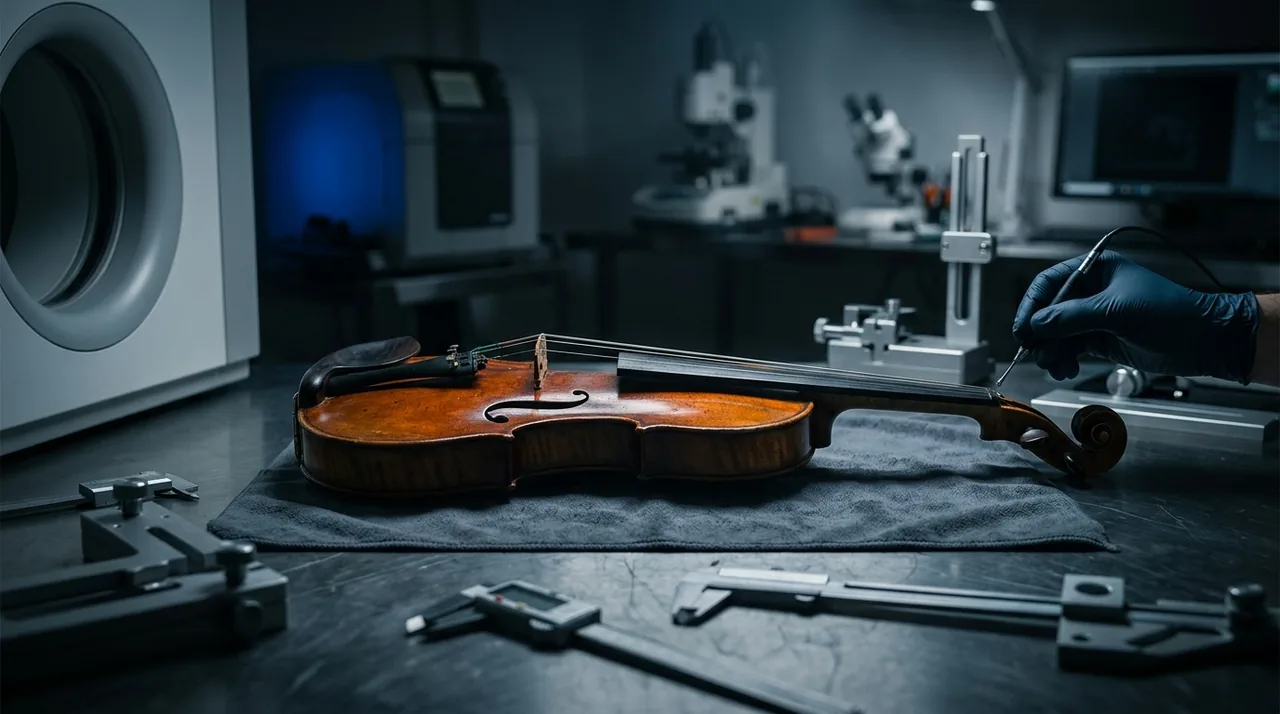
In a workshop on the Piazza San Domenico in Cremona  Place Cremona Lombard town on the Po river, about eighty kilometres south-east of Milan, that produced the three great violin-making dynasties of the seventeenth and eighteenth centuries: the Amati, the Guarneri, and the Stradivari. The trade collapsed within a generation of Stradivari's death and the town remained a backwater until twentieth-century scholarship turned it into a place of pilgrimage for luthiers.克雷莫纳是位于波河畔的伦巴第小镇,位于米兰东北约80公里处。这里诞生了17和18世纪的三个伟大小提琴制作家族:阿马蒂家族、瓜奈里家族和斯特拉迪瓦里家族。在斯特拉迪瓦里去世后的一代人时间里,该行业宣告衰落,小镇也沦为平庸之所,直到20世纪的学术研究使它重新成为现代琴师的朝圣之地。Ciudad de Lombardía a orillas del río Po, a unos ochenta kilómetros al sureste de Milán, donde surgieron las tres grandes dinastías de constructores de violines de los siglos XVII y XVIII: los Amati, los Guarneri y los Stradivari. El oficio colapsó una generación después de la muerte de Stradivari y la ciudad quedó en el olvido hasta que los estudios del siglo XX la convirtieron en lugar de peregrinación para lutiers.كريفونا هي بلدة لومباردية تقع على نهر بو، على بعد حوالي ثمانين كيلومتراً جنوب شرق ميلانو، وأنتجت السلالات الثلاث العظيمة لصناعة الكمان في القرنين السابع عشر والثامن عشر: عائلة أماتي، وعائلة غوارنيري، وعائلة ستراديفاري. انهارت الحرفة خلال جيل واحد من وفاة ستراديفاري وظلت البلدة راكدة حتى حولتها أبحاث القرن العشرين إلى مكان حج لصانعي الآلات الموسيقية.Cidade da Lombardia, às margens do rio Pó, a cerca de oitenta quilômetros a sudeste de Milão, que produziu as três grandes dinastias de fabricantes de violinos dos séculos XVII e XVIII: os Amati, os Guarneri e os Stradivari. O comércio local entrou em declínio uma geração após a morte de Stradivari e a cidade ficou esquecida até que estudos no século XX a transformaram em local de peregrinação para luthiers.पो नदी पर बसा लोम्बार्ड शहर, जो मिलान से लगभग अस्सी किलोमीटर दक्षिण-पूर्व में है, जिसने सत्रहवीं और अठारहवीं शताब्दी के तीन महान वायलिन बनाने वाले घरानों का निर्माण किया: अमाती (Amati), ग्वार्नेरी (Guarneri), और स्ट्राडिवारी (Stradivari), जिसे क्रेमोना (Cremona) कहा जाता है। स्ट्राडिवारी की मृत्यु की एक पीढ़ी के भीतर यह व्यापार ठप हो गया था और 20वीं सदी के शोधों ने इसे लूथियर्स के लिए तीर्थ स्थान बनाने तक यह शहर उपेक्षित रहा था।Kota di Lombardia yang terletak di tepi sungai Po, sekitar delapan puluh kilometer di sebelah tenggara Milan. Kota ini melahirkan tiga dinasti pembuat biola terkemuka pada abad ke-17 dan ke-18: Amati, Guarneri, dan Stradivari. Perdagangan ini runtuh dalam satu generasi setelah kematian Stradivari dan kota tersebut terlupakan hingga penelitian abad ke-20 menjadikannya tempat ziarah bagi para pembuat biola.Ville de Lombardie située sur le Pô, à environ quatre-vingts kilomètres au sud-est de Milan, qui a vu naître les trois grandes dynasties de luthier des XVIIe et XVIIIe siècles : les Amati, les Guarneri et les Stradivari. Le commerce s'est effondré une génération après la mort de Stradivari et la ville est restée endormie jusqu'à ce que les recherches du XXe siècle en fassent un lieu de pèlement (pèlerinage) pour les luthiers.ミランの南东约80キロメートル、ポー川沿いにあるロンバルディア州の町であり、17〜18世紀のバイオリン製作の三大名門(アマティ、ガルネリ、ストラディバリ)を生み出した。ストラディバリの死後1世代でこの産業は崩壊し、20世紀の学術研究によってバイオリン製作者たちの巡礼地となるまで、この町は歴史の表舞台から消え去っていた。Ломбардский город на реке По, примерно в восьмидесяти километрах к юго-востоку от Милана, в котором в XVII и XVIII веках сложились три великие династии скрипичных мастеров: Амати, Гварнери и Страдивари. Ремесло пришло в упадок в течение одного поколения после смерти Страдивари, и город оставался провинцией, пока научные исследования XX века не превратили его в место паломничества мастеров.Eine lombardische Stadt am Fluss Po, etwa achtzig Kilometer südöstlich von Mailand, die die drei großen Geigenbauer-Dynastien des 17. und 18. Jahrhunderts hervorbrachte: Amati, Guarneri und Stradivari. Das Handwerk brach innerhalb einer Generation nach Stradivaris Tod zusammen und die Stadt blieb bedeutungslos, bis wissenschaftliche Forschungen im 20. Jahrhundert sie zu einem Wallfahrtsort für Geigenbauer machte.밀라노에서 남동쪽으로 약 80km 떨어진 포강 유역의 롬바르디아주 도시(Cremona)로, 17~18세기 현악기 제작의 3대 가문인 아마티, 과르네리, 브레게를 배출했다. 이 가업은 브레게 사후 한 세대 만에 몰락하였고 도시 역시 한동안 쇠락해 있었으나, 20세기 학술 연구를 통해 다시 현악기 제작자들의 성지로 조명받기 시작했다. , between 1666 and his death in 1737, a man named Antonio Stradivari cut, planed, glued, and varnished somewhere around eleven hundred stringed instruments. Roughly six hundred and fifty survive. They are insured for sums that would buy a small apartment building. The "Lady Blunt" violin sold at auction in 2011 for $15.9 million. The soloists who borrow them play with the awareness that they are holding an object older than the United States, and that no one alive knows how to make another one.
This last part is the embarrassing one. It is not for lack of trying. Modern luthiers can mill a maple back to a tolerance of five microns. They have CT scans of the "Betts," the "Titian," the "Messiah." They have published gas chromatography of the varnish, neutron-activation analyses of the wood, modal vibration maps of the plates. The dimensions are not secret. The recipe is not secret. The instruments produced by following the recipe are, by any technical measure, excellent. They are not Stradivariuses, and trained players, in double-blind tests, mostly still know it.

What the lab found
The wood came from the high Alps, almost certainly Norway spruce for the tops and flamed maple for the backs and ribs. Dendrochronology of Stradivari  Person Antonio Stradivari Italian luthier, born around 1644 in or near Cremona and died there in 1737. Apprenticed in the workshop of Nicolò Amati and went on to define the modern violin: longer, flatter, with a stronger projection than his teacher's instruments. His mature period, roughly 1700 to 1725, produced the violins now considered unsurpassable. He also made violas, cellos, guitars, and at least one harp.安东尼奥·斯特拉迪瓦里(Antonio Stradivari)是意大利制琴师,约于1644年出生于克雷莫纳或其附近,并于1737年在那里去世。他在尼科洛·阿马蒂的工坊中做学徒,随后定义了现代小提琴的样式:比其老师制作的琴更长、更平扁,且声音共鸣更强。他从1700年到1725年左右的成熟期制作的小提琴,如今被认为无法超越。他也制作中提琴、大提琴、吉他和至少一架竖琴。Lutier italiano, nacido hacia 1644 en Cremona o sus alrededores y fallecido allí en 1737. Aprendiz en el taller de Nicolò Amati, pasó a definir el violín moderno: más largo, plano y con mayor proyección que los instrumentos de su maestro. Su período de madurez, entre 1700 y 1725, produjo los violines que hoy se consideran insuperables. También construyó violas, violonchelos, guitarras y al menos un arpa.أنطونيو ستراديفاري هو صانع آلات وترية إيطالي ولد حوالي عام 1644 في كريفونا أو بالقرب منها وتوفي هناك عام 1737. تدرب ستراديفاري في ورشة عمل نيكولو أماتي وساهم في إعادة تعريف شكل الكمان الحديث، فجعلها أطول وأكثر تسطحاً وذات إسقاط صوتي أقوى من آلات معلمه. أنتجت فترة نضجه (بين عامي 1700 و 1725) كمانات تعتبر اليوم لا تُضاهى. وصنع أيضاً آلات فيولا وتشيلو وغيتار وقيثارة واحدة على الأقل.Luthier italiano, nascido por volta de 1644 em Cremona ou arredores, onde faleceu em 1737. Foi aprendiz na oficina de Nicolò Amati e definiu o violino moderno: mais longo, mais plano e com projeção de som mais forte do que os instrumentos de seu mestre. Seu período de maturidade, aproximadamente de 1700 a 1725, produziu os violinos hoje considerados insuperáveis. Ele também fabricou violas, violoncelos, violões e pelo menos uma harpa.इतालवी लूथियर (तार वाले वाद्ययंत्र बनाने वाले), जिनका जन्म 1644 के आसपास क्रेमोना में या उसके पास हुआ था और 1737 में वहीं मृत्यु हो गई थी, जिन्हें एंटोनियो स्ट्राडिवारी (Antonio Stradivari) कहा जाता है। उन्होंने निकोलो अमाती की कार्यशाला में प्रशिक्षण लिया और आधुनिक वायलिन को परिभाषित किया: जो उनके शिक्षक के वाद्ययंत्रों की तुलना में लंबा, सपाट और अधिक मजबूत ध्वनि प्रक्षेपण वाला था। उनके परिपक्व काल, लगभग 1700 से 1725 में उन वायलिनों का निर्माण हुआ जिन्हें अब बेजोड़ माना जाता है। उन्होंने वायोला, सेलो, गिटार और कम से कम एक हार्प भी बनाया था।Pembuat instrumen musik gesek asal Italia, lahir sekitar tahun 1644 di atau dekat Cremona dan wafat di sana pada tahun 1737. Magang di bengkel Nicolò Amati dan kemudian mendefinisikan biola modern: lebih panjang, lebih pipih, dengan proyeksi suara yang lebih kuat daripada instrumen buatan gurunya. Masa keemasannya, sekitar tahun 1700 hingga 1725, menghasilkan biola-biola yang kini dianggap tiada tandingannya. Ia juga membuat viola, selo, gitar, dan setidaknya satu harpa.Luthier italien, né vers 1644 à ou près de Crémone et mort dans cette ville en 1737. Apprenti dans l'atelier de Nicolò Amati, il a défini le violon moderne : plus long, plus plat, avec une projection sonore plus forte que les instruments de son maître. Sa période de maturité, d'environ 1700 à 1725, a produit les violons considérés aujourd'hui comme inégalables. Il a également fabriqué des altos, des violoncelles, des guitares et au moins une harpe.1644年頃にクレモナ近郊で生まれ、1737年に同地で没したイタリアの弦楽器製作者。ニコロ・アマティの工房で修行し、師の楽器よりも長く、平らで、力強い音の響きを持つ「現代のバイオリン」の仕様を確立した。1700年から1725年頃の黄金期には、今日でも最高峰とされるバイオリン群を製作した。彼はまた、ビオラ、チェロ、ギター、そして少なくとも1台のハープも製作した。Итальянский скрипичный мастер, родился около 1644 года в Кремоне или ее окрестностях и умер там же в 1737 году. Учился в мастерской Николо Амати и впоследствии определил облик современной скрипки: она стала длиннее, более плоской, с более мощным звучанием, чем инструменты его учителя. В период расцвета его творчества (примерно с 1700 по 1725 год) были созданы скрипки, которые сейчас считаются непревзойденными. Он также делал альты, виолончели, гитары и как минимум одну арфу.Ein italienischer Geigenbauer, der um 1644 in oder bei Cremona geboren wurde und dort 1737 starb. Er ging in der Werkstatt von Nicolò Amati in die Lehre und definierte in der Folge die moderne Geige: länger, flacher und mit einem stärkeren Klang als die Instrumente seines Lehrers. In seiner Reifezeit von etwa 1700 bis 1725 schuf er die Geigen, die heute als unübertroffen gelten. Er baute auch Bratschen, Celli, Gitarren und mindestens eine Harfe.1644년경 크레모나 인근에서 태어나 1737년 그곳에서 사망한 이탈리아의 현악기 제작자(Antonio Stradivari)이다. 니콜로 아마티의 공방에서 수습 기간을 거친 후 스승의 악기보다 더 길고 납작하며 소리의 울림이 강한 현대적인 바이올린의 규격을 정립했다. 1700~1725년경의 황금기에 그가 제작한 바이올린들은 오늘날 도저히 모방할 수 없는 명기로 여겨진다. 그는 비올라, 첼로, 기타, 그리고 적어도 하나 이상의 하프를 남겼다. 's soundboards places many of the trees in a band of growth that overlaps the Maunder Minimum
  Concept Maunder Minimum A period of unusually low solar activity from roughly 1645 to 1715, named after the astronomer Edward Maunder, who in the 1890s catalogued the near-absence of sunspots during those decades. It coincides with the coldest stretch of the Little Ice Age in Europe. Whether the link is causal remains debated, but the climatic effect on Alpine tree growth is visible in the rings.蒙德极小期是指大约从1645年到1715年太阳活动异常偏低的一段时期,以天文学家爱德华·蒙德命名,他在19世纪90年代整理编撰了那些十年中几乎没有太阳黑子的记录。它与欧洲小冰期最寒冷的阶段重合。尽管两者的因果联系仍有争议,但气候变化对高山树木生长的影响在树木年轮中清晰可见。Período de actividad solar inusualmente baja entre aproximadamente 1645 y 1715, bautizado en honor del astrónomo Edward Maunder, quien en la década de 1890 catalogó la casi total ausencia de manchas solares durante esas décadas. Coincide con la fase más fría de la Pequeña Edad de Hielo en Europa. Aunque su relación causal se sigue debatiendo, el impacto climático en los árboles alpinos es visible en sus anillos.كمون موندر (Maunder Minimum) هو فترة تميزت بنشاط شمسي منخفض بشكل غير عادي بين عامي 1645 و1715 تقريباً، وسُميت تيمناً بعالم الفلك إدوارد موندر الذي وضع في تسعينيات القرن التاسع عشر فهرساً يوثق شبه انعدام الكلف الشمسي خلال تلك العقود. تتزامن هذه الفترة مع أبرد فترات العصر الجليدي الصغير في أوروبا. ولا يزال الجدل قائماً حول وجود علاقة سببية، لكن الأثر المناخي على نمو الأشجار الألبية يظهر بوضوح في حلقاتها.Um período de atividade solar incomumente baixa, de aproximadamente 1645 a 1715, batizado em homenagem ao astrônomo Edward Maunder, que na década de 1890 catalogou a quase total ausência de manchas solares nessas décadas. O período coincide com a fase mais fria da Pequena Idade do Gelo na Europa. Embora a relação de causa ainda seja debatida, o efeito climático no crescimento das árvores alpinas é visível nos anéis do tronco.लगभग 1645 से 1715 तक असामान्य रूप से कम सौर गतिविधि की अवधि, जिसका नाम खगोलशास्त्री एडवर्ड मोंडर के नाम पर रखा गया है, जिन्होंने 1890 के दशक में उन दशकों के दौरान सनस्पॉट (सौर कलंक) की लगभग अनुपस्थिति को सूचीबद्ध किया था, जिसे मोंडर न्यूनतम (Maunder minimum) कहा जाता है। यह यूरोप में लघु हिमयुग (लघु हिमयुग) के सबसे ठंडे काल से मेल खाता है। क्या यह संबंध कारण-जन्य है, इस पर बहस जारी है, लेकिन अल्पाइन पेड़ों की वृद्धि पर इसका प्रभाव वार्षिक वलयों (रिंग्स) में दिखाई देता है।Minimum Maunder adalah periode aktivitas matahari yang luar biasa rendah dari sekitar tahun 1645 hingga 1715, dinamai berdasarkan astronom Edward Maunder, yang pada tahun 1890-an mengatalogkan ketiadaan bintik matahari selama dekade-dekade tersebut. Periode ini bertepatan dengan masa terdingin dari Zaman Es Kecil di Eropa. Meskipun hubungan sebab-akibatnya masih diperdebatkan, efek iklim terhadap pertumbuhan pohon Alpen terlihat jelas pada lingkaran tahunnya.Une période d'activité solaire exceptionnellement basse d'environ 1645 à 1715, nommée d'après l'astronome Edward Maunder, qui a répertorié dans les années 1890 la quasi-absence de taches solaires au cours de ces décennies. Elle coïncide avec la période la plus froide du petit âge glaciaire en Europe. Bien que le lien de causalité reste débattu, l'effet climatique sur la croissance des arbres alpins est visible dans leurs cernes.1645年頃から1715年頃にかけて見られた、太阳活动が極端に低下した時期であり、1890年代にこの数十年間の太阳黒点数記録がほぼ皆無であったことを調査整理した天文学者エドワード・マウンダーにちなんで名付けられた。这是欧州における小氷期の最も寒冷な時期と一致している。因果関係については議論が続いているが、アルプス山脈の樹木成長への気候的影響は年輪に明確に現れている。Минимум Маундера — период необычайно низкой солнечной активности примерно с 1645 по 1715 год, названный в честь астронома Эдварда Маундера, который в 1890-х годах каталогизировал практически полное отсутствие солнечных пятен в те десятилетия. Он совпадает с самым холодным периодом Малого ледникового периода в Европе. Является ли эта связь причинно-следственной, до сих пор обсуждается, но влияние климата на рост альпийских деревьев отчетливо видно по их кольцам.Das Maunder-Minimum war eine Periode ungewöhnlich geringer Sonnenaktivität von etwa 1645 bis 1715, benannt nach dem Astronomen Edward Maunder, der in den 1890er Jahren das fast vollständige Fehlen von Sonnenflecken in diesen Jahrzehnten katalogisierte. Es fällt mit der kältesten Phase der Kleinen Eiszeit in Europa zusammen. Ob ein kausaler Zusammenhang besteht, ist umstritten, doch der klimatische Effekt auf das Wachstum alpiner Bäume ist in den Jahresringen sichtbar.약 1645~1715년의 이례적으로 태양 활동이 침체되었던 시기(Maunder minimum)로, 1890년대에 당시 태양 흑점이 거의 없었음을 기록으로 규명한 천문학자 에드워드 마운더의 이름을 땄다. 유럽의 소빙하기 중 가장 추웠던 기간과 시기적으로 일치한다. 인과관계 여부는 학계의 논란이 지속되고 있으나, 알프스 지대 나무의 성장 속도가 크게 둔화되었던 기후적 영향은 나이테에 고스란히 남아 있다. , the deepest cold spell of the Little Ice Age
  Event Little Ice Age A cooling that affected the North Atlantic and Europe from roughly the fourteenth to the mid-nineteenth century, with the deepest cold in the late 1600s. Glaciers advanced in the Alps, the Thames froze hard enough for frost fairs, and Alpine timber grew slowly and densely. The temperature anomaly was around half a degree below the twentieth-century mean — small in absolute terms, large in its effects.小冰期是指从大约14世纪到19世纪中叶影响北大西洋和欧洲的降温期,其中17世纪晚期最为寒冷。其间阿尔卑斯山脉的冰川向前推进,泰晤士河彻底结冰以致能举行冰雪集市,阿尔卑斯山区的木材生长缓慢且致密。当时温度较20世纪均值低约半度——绝对数值虽小,影响却很深远。Enfriamiento que afectó al Atlántico Norte y a Europa desde aproximadamente el siglo XIV hasta mediados del siglo XIX, con su fase más gélida a finales del siglo XVII. Los glaciares avanzaron en los Alpes, el Támesis se congeló tanto como para albergar ferias de hielo, y la madera alpina creció despacio y con densidad. La anomalía de temperatura fue de medio grado bajo la media del siglo XX; pequeña en términos absolutos, grande en sus efectos.العصر الجليدي الصغير هو فترة تبريد أثرت على شمال المحيط الأطلسي وأوروبا من القرن الرابع عشر إلى منتصف القرن التاسع عشر تقريباً، وبلغ البرد أشده في أواخر القرن السابع عشر. تقدمت الأنهار الجليدية في جبال الألب، وتجمد نهر التيمز لدرجة سمحت بإقامة مهرجانات الصقيع، ونمت أخشاب جبال الألب ببطء وكثافة. كان الانحراف الحراري حوالي نصف درجة أقل من متوسط القرن العشرين؛ وهو صغير بالقيمة المطلقة، لكنه هائل في تأثيراته.Um resfriamento que afetou o Atlântico Norte e a Europa de meados do século XIV até meados do século XIX, com o frio mais intenso no final dos anos 1600. Geiras de gelo avançaram nos Alpes, o Tâmisa congelou o suficiente para receber feiras no gelo, e a madeira alpina cresceu lenta e densamente. A anomalia de temperatura foi de cerca de meio grau abaixo da média do século XX — pequena em termos absolutos, mas grande em seus efeitos.एक शीतलन अवधि जिसने लगभग चौदहवीं से उन्नीसवीं शताब्दी के मध्य तक उत्तरी अटलांटिक और यूरोप को प्रभावित किया, जिसमें सबसे गहरा शीतकाल 1600 के दशक के उत्तरार्ध में था, जिसे लघु हिमयुग (Little Ice Age) कहा जाता है। आल्प्स में ग्लेशियर आगे बढ़े, टेम्स नदी इतनी जम गई कि उस पर हिम मेले लग सके, और अल्पाइन की लकड़ी धीमी और सघन रूप से बढ़ी। तापमान की विसंगति 20वीं सदी के माध्य से लगभग आधा डिग्री कम थी — जो पूर्ण संदर्भ में छोटी, लेकिन अपने प्रभावों में बहुत बड़ी थी।Zaman Es Kecil adalah penurunan suhu yang memengaruhi Atlantik Utara dan Eropa dari sekitar abad ke-14 hingga pertengahan abad ke-19, dengan suhu paling dingin terjadi pada akhir tahun 1600-an. Gletser maju di Pegunungan Alpen, Sungai Thames membeku sehingga festival es dapat diselenggarakan, serta kayu Alpen tumbuh dengan lambat dan padat. Anomali suhu tercatat sekitar setengah derajat di bawah rata-rata abad ke-20 — angka kecil secara absolut, tetapi berdampak besar.Un refroidissement qui a affecté l'Atlantique Nord et l'Europe environ du XIVe au milieu du XIXe siècle, le froid le plus intense survenant à la fin du XVIIe siècle. Les glaciers ont progressé dans les Alpes, la Tamise a gelé au point de permettre des foires sur glace, et le bois alpin a poussé lentement et densément. L'anomalie de température était d'environ un demi-degré sous la moyenne du XXe siècle — faible dans l'absolu, majeure par ses effets.14世紀から19世紀半ばにかけて北大西洋および欧州を襲った寒冷化現象であり、1600年代後半に最も厳しい寒さを記録した。アルプスの氷河が前進し、テムズ川が氷上フェアを開催できるほど強固に凍りつき、アルプスの木材は成長速度が落ちて高密度化させた。この気温変化は20世紀平均より約0.5度低く、絶対的な数値としては小さいが、もたらした影響は極めて大きかった。Малый ледниковый период — похолодание, затронувшее Северную Атлантику и Европу примерно с XIV по середину XIX века, с пиком холодов в конце XVII века. В Альпах наступали ледники, Темза замерзала достаточно прочно для проведения ледовых ярмарок, а альпийская древесина росла медленно и плотно. Температурная аномалия составила около полуградуса ниже среднего значения XX века — мало в абсолютном выражении, но масштабно по последствиям.Eine Abkühlung, die den Nordatlantik und Europa vom 14. bis zur Mitte des 19. Jahrhunderts betraf, mit der kältesten Phase im späten 17. Jahrhundert. Gletscher stießen in den Alpen vor, die Themse fror so stark zu, dass Frostmärkte abgehalten werden konnten, und alpines Holz wuchs langsam und dicht. Die Temperaturanomalie lag rund ein halbes Grad unter dem Mittelwert des 20. Jahrhunderts – absolut gesehen gering, in ihren Auswirkungen jedoch gravierend.약 14세기부터 19세기 중엽까지 북대서양과 유럽 지역에 영향을 미쳤던 기온 하강기(Little Ice Age)로, 17세기 후반에 추위가 가장 기승을 부렸다. 알프스 빙하가 전진했고 템스강이 두껍게 얼어붙어 빙판 축제가 열렸으며, 알프스 지대 목재는 성장 속도가 둔화되어 밀도가 촘촘해졌다. 기온 강하 폭은 20세기 평균보다 약 0.5도 낮은 수준으로 절대 수치는 작았지만 파급 효과는 막대했다. , roughly 1645 to 1715. Cold summers meant narrow, even rings and unusually dense, stiff wood. Whether this matters acoustically is still contested, but Stradivari was working with a material that, by accident of climate, will not be reliably available again.

The varnish, long assumed to hold some lost secret, turned out to be ordinary. A 2009 study by Jean-Philippe Echard  Person Jean-Philippe Echard French conservation scientist at the Musée de la Musique in Paris, whose group used infrared and Raman microscopy on samples taken from five Stradivari instruments. The 2009 results, published in Angewandte Chemie, dismantled a century of speculation about secret recipes by showing the varnish was an ordinary oil-and-resin system of the kind any contemporary cabinet-maker would have known.让-菲利普·埃沙尔(Jean-Philippe Échard)是巴黎音乐博物馆的法国文物保护科学家,其团队利用红外和拉曼显微技术对取自五件斯特拉迪瓦里乐器的样本进行了分析。发表在《应用化学》上的2009年研究结果表明,琴漆只是普通的油和树脂混合系统,这彻底拆穿了关于神秘配方的百年传言,因为当时任何家具木匠都熟知这种涂料。Científico de conservación francés en el Musée de la Musique de París, cuyo grupo utilizó microscopía infrarroja y Raman en muestras de cinco instrumentos Stradivari. Los resultados de 2009, publicados en *Angewandte Chemie*, desmitificaron un siglo de especulación sobre recetas secretas al demostrar que el barniz era un sistema común de aceite y resina que cualquier ebanista contemporáneo habría conocido.جان فيليب إيشار هو عالم حفظ فرنسي في متحف الموسيقى بباريس، استخدمت مجموعته الفحص المجهري بالأشعة تحت الحمراء ومجهر رامان على عينات مأخوذة من خمس آلات لستراديفاري. فككت نتائج الدراسة المنشورة عام 2009 في مجلة (Angewandte Chemie) قرناً من التكهنات حول وجود وصفات سرية للطلاء، بإثباتها أن الورنيش المستخدم كان نظاماً عادياً من الزيت والراتنج يعرفه أي صانع خزانة معاصر.Cientista de conservação francês do Musée de la Musique em Paris, cuja equipe usou microscopia infravermelha e Raman em amostras retiradas de cinco instrumentos Stradivari. Os resultados de 2009, publicados na *Angewandte Chemie*, desmistificaram um século de especulação sobre receitas secretas ao mostrar que o verniz era um sistema comum de óleo e resina que qualquer marceneiro da época conheceria.पेरिस में म्यूसी डे ला म्यूजिक में फ्रांसीसी संरक्षण वैज्ञानिक जीन-फिलिप एशार्ड (Jean-Philippe Echard) थे, जिनके समूह ने पांच स्ट्राडिवारी वाद्ययंत्रों से लिए गए नमूनों पर इन्फ्रारेड और रमन माइक्रोस्कोपी का उपयोग किया। 'एंगवेन्डे चेमी' में प्रकाशित 2009 के परिणामों ने गुप्त व्यंजनों के बारे में एक सदी की अटकलों को खारिज कर दिया, यह दिखाकर कि वार्निश एक साधारण तेल-और-राल प्रणाली थी जिसे उस समय का कोई भी बढ़ई जानता होगा।Ilmuwan konservasi Prancis di Musée de la Musique di Paris, yang kelompok penelitiannya menggunakan mikroskopi inframerah dan Raman pada sampel dari lima instrumen Stradivari. Hasil tahun 2009 yang diterbitkan dalam Angewandte Chemie mematahkan spekulasi satu abad tentang resep rahasia dengan menunjukkan bahwa pernis tersebut adalah sistem minyak-dan-resin biasa yang lazim dikenal oleh pembuat lemari pada masa itu.Scientifique français en conservation au Musée de la musique à Paris, dont l'équipe a utilisé la microscopie infrarouge et Raman sur des échantillons prélevés sur cinq instruments Stradivari. Les résultats de 2009, publiés dans Angewandte Chemie, ont balayé un siècle de spéculations sur des recettes secrètes en démontrant que le vernis était un mélange ordinaire d'huile et de résine que tout ébéniste de l'époque connaissait.パリの音乐博物馆に勤務するフランスの保存科学者であり、彼の研究グループは5台のストラディバリ製楽器から採取したサンプルに赤外線分光法およびラマン顕微鏡法を適用した。2009年に『アンゲヴァンテ・ケミー』誌で発表された結果は、ニスが当時の家具職人なら誰でも知っていた一般的なオイルと樹脂の混合物であることを示し、秘密の調合法をめぐる1世紀にわたる憶测を打ち砕いた。Французский специалист по реставрации музыкальных инструментов из Музея музыки в Париже, группа которого использовала инфракрасную и рамановскую микроскопию образцов пяти инструментов Страдивари. Результаты 2009 года, опубликованные в Angewandte Chemie, опровергли столетние спекуляции о секретных рецептах лака, показав, что он представлял собой обычную масляно-смоляную систему, известную любому краснодеревщику того времени.Ein französischer Restaurierungswissenschaftler am Musée de la Musique in Paris, dessen Gruppe Infrarot- und Raman-Mikroskopie an Proben von fünf Stradivari-Instrumenten durchführte. Die 2009 in der Angewandten Chemie veröffentlichten Ergebnisse beendeten ein Jahrhundert der Spekulationen über geheime Rezepturen, indem sie zeigten, dass der Lack ein gewöhnliches Öl-Harz-System war, das jedem damaligen Möbelschreiner bekannt war.파리 음악박물관 소속 프랑스 보존과학자(Jean-Philippe Echard)로, 그의 연구팀은 다섯 대의 스트라디바리우스 악기 표면에서 채취한 시료에 적외선 및 라만 현미경 분석을 시행했다. 『Angewandte Chemie』에 게재된 2009년 분석 결과는 그간 명기의 베일에 싸여 있던 비법 바니시가 당시 가구 제작자라면 흔히 쓰던 평범한 오일-레진 조합물임을 밝혀내며 1백 년간의 비법 루머를 일축했다. at the Cité de la Musique in Paris used infrared microscopy on five Stradivari instruments and found a two-layer system: an oil-resin ground over the bare wood, then a coloured top coat of pine resin and drying oil with iron-oxide and cochineal pigments. Nothing exotic. Nothing a competent eighteenth-century painter could not have mixed.

In 2008, Joseph Nagyvary  Person Joseph Nagyvary Biochemist at Texas A&M University and amateur violin maker, who from the 1970s argued that the distinctive sound of Cremonese instruments came from chemical treatment of the wood before carving. His 2006 Nature note and later spectroscopic work identified borate, fluoride and metallic salts in Stradivari and Guarneri soundboards. The interpretation — preservative, accident, or acoustic intent — is still disputed.约瑟夫·纳吉瓦里(Joseph Nagyvary)是德克萨斯农工大学的生物化学家兼业余小提琴制作师。他从20世纪70年代起就坚持认为,克雷莫纳乐器的独特音质源于雕刻前对木材进行的化学处理。他在2006年《自然》杂志上发表的文章及后来的光谱分析研究,在斯特拉迪瓦里和瓜奈里琴的音板中检出了硼酸盐、氟化物和金属盐。关于这属于防腐剂、意外事件还是声学意图,依然存在争议。Bioquímico de la Universidad de Texas A&M y fabricante aficionado de violines, quien desde la década de 1970 defendió que el sonido distintivo de los instrumentos cremonenses provenía del tratamiento químico de la madera antes de tallarla. Su nota en *Nature* de 2006 y trabajos espectroscópicos posteriores identificaron sales de borato, fluoruro y metales en tapas armónicas de Stradivari y Guarneri. La interpretación —preservante, accidente o intención acústica— sigue en disputa.جوزيف ناجيفاري هو عالم كيمياء حيوية في جامعة تكساس إيه آند إم وصانع كمان هاوٍ، جادل منذ سبعينيات القرن العشرين بأن الصوت المميز لآلات كريفونا نتج عن المعالجة الكيميائية للخشب قبل نحته. حددت ورقته العلمية المنشورة في مجلة (Nature) عام 2006 وأعماله الطيفية اللاحقة وجود البورات والفلوريد والأملاح المعدنية في ألواح صوت كمانات ستراديفاري وغوارنيري. ولا يزال التفسير -سواء كمادة حافظة، أو صدفة، أو نية صوتية- محل خلاف.Bioquímico da Texas A&M University e luthier amador, que desde os anos 1970 defendeu que o som característico dos instrumentos cremoneses vinha de um tratamento químico da madeira antes de ser esculpida. Sua publicação de 2006 na *Nature* e trabalhos espectroscópicos posteriores identificaram borato, fluoreto e sais metálicos em tampos de Stradivari e Guarneri. A interpretação — preservativo, acidente ou intenção acústica — ainda é disputada.टेक्सास एएंडएम विश्वविद्यालय के बायोकेमिस्ट और शौकिया वायलिन निर्माता जोसेफ नागीवरी (Joseph Nagyvary) थे, जिन्होंने 1970 के दशक से यह तर्क दिया था कि क्रेमोनीस वाद्ययंत्रों की विशिष्ट ध्वनि तराशने से पहले लकड़ी के रासायनिक उपचार से आती थी। उनके 2006 के नेचर नोट और बाद के स्पेक्ट्रोस्कोपिक कार्य ने स्ट्राडिवारी और ग्वार्नेरी साउंडबोर्ड में बोरेट, फ्लोराइड और धातु लवणों की पहचान की। व्याख्या — परिरक्षक, दुर्घटना, या ध्वनिक उद्देश्य — अभी भी विवादित है।Ahli biokimia di Texas A&M University sekaligus pembuat biola amatir, yang sejak 1970-an berpendapat bahwa suara khas instrumen Cremona berasal dari perlakuan kimiawi pada kayu sebelum dipahat. Catatan Nature tahun 2006 miliknya dan analisis spektroskopi setelahnya mendeteksi adanya borat, fluorida, dan garam logam pada papan suara Stradivari dan Guarneri. Interpretasi atas temuan tersebut — pengawet, ketidaksengajaan, atau tujuan akustik — masih diperdebatkan.Biochimiste à l'université Texas A&M et luthier amateur, qui a soutenu dès les années 1970 que le son distinctif des instruments de Crémone provenait d'un traitement chimique du bois avant la sculpture. Sa note dans Nature en 2006 et des travaux spectroscopiques ultérieurs ont mis en évidence du borate, du fluorure et des sels métalliques dans les tables d'harmonie de Stradivari et de Guarneri. L'interprétation — traitement de conservation, accident ou intention acoustique — reste discutée.テキサスA&M大学の生化学者であり、アマチュアのバイオリン製作者。1970年代から、クレモナ製楽器の独特な響きは木材を削る前の化学的処理に由来すると主張した。2006年の『ネイチャー』誌の短報およびその後の分光分析研究により、ストラディバリとガルネリの表板からホウ酸塩、フッ化物、および金属塩を検出した。これが防腐処理、偶然、あるいは音響的意図によるものかという解釈は未だ議論が分かれている。Биохимик из Техасского университета A&M и мастер-любитель, который с 1970-х годов утверждал, что уникальный звук кремонских инструментов был результатом химической обработки дерева перед резьбой. Его публикация в Nature 2006 года и последующие спектроскопические исследования выявили наличие боратов, фторидов и металлических солей в деках скрипок Страдивари и Гварнери. Объяснение этого — консервация, случайность или акустический расчет — до сих пор оспаривается.Ein Biochemiker an der Texas A&M University und Amateurgeigenbauer, der seit den 1970er Jahren argumentierte, dass der unverwechselbare Klang cremonesischer Instrumente von einer chemischen Behandlung des Holzes vor dem Schnitzen herrührt. Seine Veröffentlichung in Nature 2006 und spätere spektroskopische Arbeiten wiesen Borate, Fluoride und Metallsalze in den Resonanzböden von Stradivari und Guarneri nach. Die Interpretation – Konservierungsmittel, Zufall oder akustische Absicht – ist nach wie vor umstritten.텍사스 A&M 대학교의 생화학자이자 아마추어 바이올린 제작자(Joseph Nagyvary)로, 1970년대부터 크레모나 악기들의 독특한 음색이 조각 전 목재에 가해진 화학적 처리에서 기인한다고 주장했다. 그의 2006년 『Nature』 기고 및 이후의 분광학적 분석을 통해 스트라디바리와 과르네리의 사운드보드에서 붕산염, 불화물, 금속염이 검출되었다. 이 성분들이 방부제였는지, 우연의 산물인지, 아니면 음향적 목적의 처리였는지는 여전히 학계의 쟁점이다. at Texas A&M reported that the wood itself had been chemically treated, soaked in or fumigated with mineral salts — borax, fluorides, chromium and iron compounds — possibly as a preservative against woodworm. He argued this changed the wood's damping in a way no modern maker reproduces because no modern maker thinks to poison their spruce. Others have replicated the finding and disagree about whether it matters.

The blindfold problem
In 2012, the violinist Claudia Fritz  Person Claudia Fritz French acoustician at the Sorbonne whose double-blind studies have done more than anything else to embarrass the Stradivari mystique. Working with the American luthier Joseph Curtin, she set up controlled comparisons in 2010, 2012, and 2017 in which professional soloists could not reliably distinguish old Italian instruments from new ones, and on average preferred the new.克劳迪娅·弗里茨(Claudia Fritz)是索邦大学的法国声学家,她的双盲研究比任何事情都更能揭穿斯特拉迪瓦里的神秘面纱。在与美国制琴师约瑟夫·柯廷合作的过程中,她在2010年、2012年和2017年设立了受控对比实验。在实验中,专业的独奏家无法可靠地从新提琴中区分出古老的意大利提琴,并且在平均得分上更青睐新琴。Acústica francesa de la Sorbona cuyas investigaciones de doble ciego han hecho más que nada por desmitificar el aura de Stradivari. En colaboración con el lutier estadounidense Joseph Curtin, organizó comparaciones controladas en 2010, 2012 y 2017 en las que solistas profesionales no pudieron distinguir con fiabilidad los antiguos instrumentos italianos de los nuevos y, de media, prefirieron los nuevos.كلوديا فريتز هي عالمة صوتيات فرنسية في جامعة السوربون، وقد ساهمت دراساتها مزدوجة التعمية أكثر من أي شيء آخر في إزالة الغموض المحيط بآلات ستراديفاري. بالتعاون مع صانع الآلات الموسيقية الأمريكي جوزيف كيرتن، أجرت فريتز مقارنات خاضعة للمراقبة في أعوام 2010 و 2012 و 2017، لم يتمكن فيها عازفون منفردون محترفون من التمييز بشكل موثوق بين الآلات الإيطالية القديمة والجديدة، بل وفضلوا الآلات الجديدة في المتوسط.Acústica francesa da Sorbonne cujos estudos duplo-cegos fizeram mais do que qualquer outra coisa para desmistificar a aura do Stradivari. Trabalhando com o luthier americano Joseph Curtin, ela realizou testes controlados em 2010, 2012 e 2017, nos quais solistas profissionais não conseguiram diferenciar com segurança os antigos instrumentos italianos dos novos e, na média, preferiram os novos.सोरबोन में फ्रांसीसी ध्वनिकीविद् (एकौस्टिशियन) क्लाउडिया फ्रिट्ज (Claudia Fritz) थीं, जिनके डबल-ब्लाइंड अध्ययनों ने स्ट्राडिवारी के रहस्य को उजागर करने के लिए सबसे अधिक काम किया। अमेरिकी लूथियर जोसेफ कर्टिन के साथ काम करते हुए, उन्होंने 2010, 2012 और 2017 में नियंत्रित तुलनात्मक परीक्षण स्थापित किए जिसमें पेशेवर एकल वादक (सोलोइस्ट) पुराने इतालवी वाद्ययंत्रों और नए वाद्ययंत्रों के बीच स्पष्ट रूप से अंतर नहीं कर सके, और औसतन उन्होंने नए वाद्ययंत्रों को प्राथमिकता दी।Ahli akustik Prancis di Sorbonne yang studi acak tersamarnya (double-blind studies) sangat berperan dalam mematahkan mitos keunggulan mutlak Stradivari. Bekerja sama dengan pembuat biola asal Amerika Joseph Curtin, ia melakukan uji perbandingan terkontrol pada tahun 2010, 2012, dan 2017. Hasilnya menunjukkan bahwa para solois profesional tidak dapat secara meyakinkan membedakan instrumen Italia kuno dari instrumen baru, dan secara rata-rata mereka justru lebih menyukai biola baru.Acousticienne française à la Sorbonne dont les études en double aveugle ont grandement contribué à démystifier le mythe Stradivari. En collaboration avec le luthier américain Joseph Curtin, elle a organisé des comparaisons contrôlées en 2010, 2012 et 2017 au cours desquelles des solistes professionnels n'ont pas pu distinguer de manière fiable les anciens instruments italiens des nouveaux, préférant même en moyenne ces derniers.ソルボンヌ大学のフランス人音響学者であり、彼女の実施した二重盲検法による研究は、ストラディバリの神秘的な崇拝を退ける上で決定的な役割を果たした。米国の弦楽器製作者ジョセフ・カーティンと共同で、2010年、2012年、2017年に管理された比較実験を設定し、プロのソリストらが古いイタリア製楽器と新しい楽器を正しく区別できず、平均して新しい楽器を好むという結果を示した。Французский акустик из Сорбонны, чьи слепые исследования сделали больше, чем что-либо еще, для развенчания мифа о Страдивари. Вместе с американским скрипичным мастером Джозефом Кертином она провела в 2010, 2012 и 2017 годах контролируемые сравнения, в которых профессиональные солисты не могли надежно отличить старинные итальянские инструменты от современных, причем в среднем отдавали предпочтение новым.Eine französische Akustikerin an der Sorbonne, deren Doppelblindstudien maßgeblich zur Entzauberung des Stradivari-Mythos beigetragen haben. In Zusammenarbeit mit dem amerikanischen Geigenbauer Joseph Curtin führte sie 2010, 2012 und 2017 kontrollierte Vergleichstests durch, bei denen professionelle Solisten alte italienische Instrumente nicht verlässlich von neuen unterscheiden konnten und im Durchschnitt die neuen bevorzugten.소르본 대학교 소속 프랑스 음향학자(Claudia Fritz)로, 그녀가 설계한 이중맹검 실험들은 스트라디바리우스에 씐 신비를 벗겨내는 데 결정적으로 기여했다. 미국의 현악기 제작자 조셉 커틴과 함께 2010년, 2012년, 2017년에 통제 비교 실험을 진행했고, 노련한 전문 솔로 연주자들은 이탈리아 명기와 신형 바이올린을 제대로 구분하지 못했으며 평균적으로는 신형 바이올린의 음색을 더 선호한다는 결과를 확인했다. and the maker Joseph Curtin ran an experiment in a Paris hotel room. Twenty-one professional soloists played six violins in the dark, behind welder's goggles: three new instruments by living makers, three old Italians including two Stradivariuses. They were asked which they preferred and which they thought was old. The soloists, on average, preferred the new violins. They could not reliably tell which were old. A follow-up in 2017, in a concert hall with an audience, found the same thing: listeners preferred the new instruments and projected them as louder.

This should have ended the argument. It has not. The counter-argument from the trade is that the experiment used six violins, not the right six; that "preference in a hotel room" is not the same as a thirty-year career relationship between a soloist and the specific instrument they have learned; that what a Stradivarius does over four hours of Mahler at the back of a two-thousand-seat hall is not what any single A-B test can capture. There is no clean way to settle this.

What we still don't know
We do not know whether the "Stradivari sound" is in the instrument or in the listener. Two centuries of myth-making, beginning with the dealer Luigi Tarisio  Person Luigi Tarisio Italian dealer, born around 1790, who walked across northern Italy buying up forgotten Cremonese instruments from churches and country attics and selling them on to Paris. He died in 1854 in a Milanese garret with the "Messiah" Stradivarius wrapped in newspaper beside the bed. More than any luthier, Tarisio invented the modern cult of the old Italian violin as a commercial proposition.路易吉·塔里西奥(Luigi Tarisio)是意大利古董商,约于1790年出生。他步行穿过意大利北部,从教堂和乡村阁楼中低价收购被遗忘的克雷莫纳乐器,然后再转卖给巴黎。1854年,他死于米兰的一间阁楼,床头放着用报纸包裹着的“弥赛亚”斯特拉迪瓦里琴。相比于任何制琴师,塔里西奥更多地发明了现代将古老意大利小提琴作为商品包装运作的崇拜机制。Distribuidor italiano, nacido hacia 1790, que recorrió a pie el norte de Italia comprando instrumentos cremonenses olvidados en iglesias y desvanes rurales para revenderlos en París. Murió en 1854 en un altillo de Milán con el violín Stradivarius «Mesías» envuelto en periódicos junto a la cama. Más que cualquier lutier, Tarisio ideó el culto moderno al violín antiguo italiano como propuesta comercial.لويجي تاريسيو هو تاجر إيطالي ولد حوالي عام 1790، سار على قدميه عبر شمال إيطاليا يشتري آلات كريفونا المنسية من الكنائس وأقبية المنازل الريفية ليعيد بيعها في باريس. توفي عام 1854 في علية بميلانو وعثر بجانبه على كمان ستراديفاريوس "المسيا" ملفوفاً بجريدة بجانب السرير. ساهم تاريسيو، أكثر من أي صانع آلات، في ترسيخ الفكرة الحديثة لتقديس الكمان الإيطالي القديم كقيمة تجارية.Comerciante italiano, nascido por volta de 1790, que percorreu o norte da Itália a pé comprando instrumentos cremoneses esquecidos em igrejas e sótãos rurais e revendendo-os em Paris. Ele faleceu em 1854 em um sótão em Milão com o Stradivarius "Messias" embrulhado em jornal ao lado da cama. Mais do que qualquer luthier, Tarisio criou o culto moderno ao violino italiano antigo como modelo comercial.इतालवी डीलर, जिनका जन्म 1790 के आसपास हुआ था, जो चर्चों और देहाती अटारियों से भूले-बिसरे क्रेमोनीस वाद्ययंत्रों को खरीदने और उन्हें पेरिस में बेचने के लिए पूरे उत्तरी इटली में घूमे, जिन्हें लुइगी तारिसियो (Luigi Tarisio) कहा जाता है। 1854 में मिलान के एक अटारी में उनका निधन हो गया, जहाँ बिस्तर के पास अखबार में लिपटा 'मसीहा' (Messiah) स्ट्राडिवारी वायलिन रखा था। किसी भी लूथियर से अधिक, तारिसियो ने पुराने इतालवी वायलिन को व्यावसायिक प्रस्ताव के रूप में बढ़ावा दिया।Pedagang asal Italia, lahir sekitar tahun 1790, yang berjalan melintasi Italia utara untuk membeli instrumen Cremona yang terlupakan dari gereja dan loteng pedesaan, lalu menjualnya ke Paris. Ia meninggal pada tahun 1854 di sebuah loteng di Milan dengan biola Stradivarius "Messiah" yang dibungkus koran di samping tempat tidurnya. Dibandingkan para pembuat biola, Tarisio lebih berperan dalam menciptakan pemujaan modern terhadap biola Italia kuno sebagai komoditas bisnis.Marchand italien, né vers 1790, qui a parcouru le nord de l'Italie à pied pour acheter des instruments de Crémone oubliés dans des églises et des greniers de campagne, afin de les revendre à Paris. Il est mort en 1854 dans une mansarde milanaise, avec le Stradivarius « Messie » enveloppé dans un journal à côté de son lit. Plus que tout luthier, Tarisio a inventé le culte moderne du vieux violon italien comme produit commercial.1790年頃に生まれたイタリアのディーラーであり、イタリア北部を歩き回って教会や田舎の屋根裏部屋から忘れ去られたクレモナ製楽器を買い集め、それをパリで売却した。1854年、ミラノの屋根裏部屋で没した際、ベッドの脇に新聞紙に包まれたストラディバリウス「メサイア」が置かれていた。どの製作者よりも、タリシオは古いイタリア製バイオリンを商業的な価値対象として崇拝する現代の風潮を作り出した。Итальянский торговец, родился около 1790 года, который пешком исходил всю Северную Италию, скупая забытые кремонские инструменты в церквях и на деревенских чердаках для последующей продажи в Париже. Умер в 1854 году в миланской мансарде, где рядом с кроватью лежал завернутый в газету Страдивари «Мессия». Больше, чем кто-либо из мастеров, Таризио создал современный культ старинных итальянских скрипок как коммерческого товара.Ein italienischer Händler, der um 1790 geboren wurde. Er reiste zu Fuß durch Norditalien, kaufte in Kirchen und ländlichen Dachböden vergessene cremonesische Instrumente auf und verkaufte sie in Paris weiter. Er starb 1854 in einer Mailänder Dachkammer mit der in Zeitungspapier eingewickelten „Messias“-Stradivari neben dem Bett. Mehr als jeder Geigenbauer erfand Tarisio den modernen Kult um die alte italienische Geige als Handelsware.1790년경 태어난 이탈리아의 악기 상인으로, 이탈리아 북부 전역을 걸어 다니며 교회와 시골 다락방에 방치된 크레모나 명기들을 헐값에 매입하여 파리에 내다 팔았다. 1854년 밀라노의 한 다락방에서 사망한 채 발견되었을 때 그의 침대 곁에는 신문지에 싸인 스트라디바리우스 '메시아'가 놓여 있었다. 현악기 제작자들보다도 타리시오야말로 고대 이탈리아 바이올린을 상업적 가치로서 숭배하게 만든 현대적 숭배 비즈니스의 창시자라 할 수 있다. in the 1820s and amplified by every concert programme since, have made it nearly impossible to hear one of these violins without the name pre-loaded.

We do not know what Stradivari actually did with his hands. He left no treatise. His sons Francesco and Omobono carried on the workshop and the quality fell off within a generation. Whatever the tacit knowledge was, it did not survive its transmission inside his own family.

We do not know whether the surviving instruments are even representative. Most have been opened, re-graduated, re-necked, re-bass-barred to handle modern string tension and modern pitch. The 1715 violin a soloist plays in 2026 is, in a strict sense, a heavily modified eighteenth-century object that has been worked on by two hundred years of subsequent luthiers. Some of what we call "the Strad sound" may be the Vuillaume  Person Jean-Baptiste Vuillaume Nineteenth-century Parisian luthier (1798–1875) who bought, restored, copied, and in many cases re-graduated the great Cremonese instruments as they passed through his workshop. Most surviving Stradivariuses were modernised in the 1800s — longer necks, higher bridges, steel strings, heavier bass-bars — to meet the demands of larger concert halls. Vuillaume's hand is on more of them than is comfortable to admit.让-巴蒂斯特·维约姆(Jean-Baptiste Vuillaume,1798-1875)是19世纪的巴黎制琴师。他在克雷莫纳伟大的乐器流经其工坊时,对其进行了收购、修复、复制,并且在许多情况下重新调整了厚度。大多数存世的斯特拉迪瓦里琴在1800年代都经历了现代化改造——更长的琴颈、更高的琴桥、钢弦和更重的低音梁——以适应更大音乐厅的需求。维约姆参与修改的琴多得令人汗颜。Lutier parisino del siglo XIX (1798–1875) que compró, restauró, copió y en muchos casos recalibró los grandes instrumentos cremonenses a su paso por su taller. La mayoría de los Stradivarius que se conservan se modernizaron en el siglo XIX (mástiles más largos, puentes más altos, cuerdas de acero, barras armónicas más pesadas) para adaptarse a salas de conciertos más grandes. La mano de Vuillaume está en más de ellos de lo que conviene admitir.كان باتيست فويوم هو صانع آلات موسيقية باريسي من القرن التاسع عشر (1798-1875)، قام بشراء وترميم وتكرار، وفي كثير من الحالات، إعادة تقييم سماكة آلات كريفونا العظيمة التي مرت عبر ورشته. تم تحديث معظم كمانات ستراديفاريوس المتبقية في القرن التاسع عشر (عن طريق إطالة الأعناق، ورفع الجسور، واستخدام أوتار فولاذية، وعوارض صوت أثقل) لتلبية متطلبات قاعات الحفلات الموسيقية الأكبر. بصمة فويوم موجودة على عدد منها أكبر مما نود الاعتراف به.Luthier parisiense do século XIX (1798–1875) que comprou, restaurou, copiou e, em muitos casos, recalibrou os grandes instrumentos cremoneses que passaram por sua oficina. A maioria dos Stradivarius sobreviventes foi modernizada nos anos 1800 — braços mais longos, cavaletes mais altos, cordas de aço, barras de baixo mais pesadas — para atender à demanda de salas de concerto maiores. A mão de Vuillaume está em mais deles do que se gostaria de admitir.उन्नीसवीं सदी के पेरिस के लूथियर जीन-बैप्टिस्ट वुइल्यूम (Jean-Baptiste Vuillaume) (1798-1875) थे, जिन्होंने क्रेमोना के महान वाद्ययंत्रों को अपनी कार्यशाला से गुजरने पर खरीदा, मरम्मत की, उनकी नकल की और कई मामलों में उनकी मोटाई व ट्यूनिंग को बदला। अधिकांश जीवित बचे स्ट्राडिवारी वायलिनों को 1800 के दशक में आधुनिक बनाया गया था — लंबे नेक, ऊंचे ब्रिज, स्टील के तार, भारी बास-बार — ताकि बड़े कॉन्सर्ट हॉल की मांगों को पूरा किया जा सके। स्वीकार करने में संकोच हो सकता है, लेकिन वुइल्यूम का हाथ इनमें से बहुत सी घड़ियों व वायलिनों पर था।Pembuat biola asal Paris pada abad ke-19 (1798–1875) yang membeli, merestorasi, meniru, dan dalam banyak kasus merancang ulang ketebalan kayu instrumen Cremona saat melewati bengkelnya. Sebagian besar biola Stradivarius yang masih bertahan dimodernisasi pada tahun 1800-an — leher lebih panjang, penopang senar lebih tinggi, senar baja, bass-bar lebih berat — demi memenuhi kebutuhan gedung konser yang lebih besar. Sentuhan tangan Vuillaume ada pada biola-biola tersebut lebih banyak daripada yang mau diakui.Luthier parisien du XIXe siècle (1798-1875) qui a acheté, restauré, copié et, dans bien des cas, modifié l'épaisseur des grands instruments de Crémone passant par son atelier. La plupart des Stradivarius survivants ont été modernisés dans les années 1800 — manches plus longs, chevalets plus hauts, cordes en acier, barres d'harmonie plus lourdes — pour répondre aux exigences des grandes salles de concert. La main de Vuillaume s'est posée sur plus d'instruments qu'on ne veut bien l'admettre.19世紀パリの弦楽器製作者(1798–1875)。工房を通過するクレモナの名器を買い取り、修復、模倣し、多くの場合で表板の厚みを調整した。現存するストラディバリウスの大部分は、より広いコンサートホールの要求に応えるため、1800年代に近代化改造(ネックの延長、駒の嵩上げ、スチール弦化、バスバーの重量化)を施された。認めがたいことだが、多くの名器にヴィヨームの手が入っている。Парижский скрипичный мастер XIX века (1798–1875), который скупал, реставрировал, копировал и во многих случаях заново настраивал великие кремонские инструменты, проходившие через его мастерскую. Большинство сохранившихся скрипок Страдивари были модернизированы в XIX веке (удлиненные грифы, более высокие подставки, стальные струны, утяжеленные пружины) под требования больших концертных залов. Рука Вильома прикоснулась к большему их числу, чем принято признавать.Ein Pariser Geigenbauer des 19. Jahrhunderts (1798–1875), der die großen cremonesischen Instrumente auf ihrem Weg durch seine Werkstatt kaufte, restaurierte, kopierte und in vielen Fällen die Deckenstärke veränderte. Die meisten erhaltenen Stradivaris wurden im 19. Jahrhundert modernisiert – längere Hälse, höhere Stege, Stahlsaiten, schwerere Bassbalken –, um den Anforderungen größerer Konzertsäle gerecht zu werden. Vuillaumes Handschrift tragen mehr von ihnen, als man gerne zugibt.유로 19세기 파리의 현악기 제작자(Jean-Baptiste Vuillaume, 1798~1875)로, 그의 공방을 거쳐 간 크레모나 명기들을 매입, 복원, 복제했으며 많은 경우 사운드보드 두께를 재조정했다. 오늘날 남아 있는 대다수 스트라디바리우스는 대형 콘서트홀의 음량 요구에 맞춰 1800년대에 현대화 개조(넥 연장, 브릿지 높이기, 스틸 현 교체, 베이스바 보강 등)를 거쳤다. 불편한 진실이지만 현존 명기 상당수에 뷔욤의 손길이 닿아 있다. sound, or the modern setup sound, layered on top.
The instruments will go on outliving the people who play them. Spruce stiffens slowly as its hemicelluloses decay; a violin made tomorrow will not sound like a Stradivarius for three hundred years, by which point no one will care whether they match.